
Showing 4 items matching "rolled serpentine"
-
 Flagstaff Hill Maritime Museum and Village
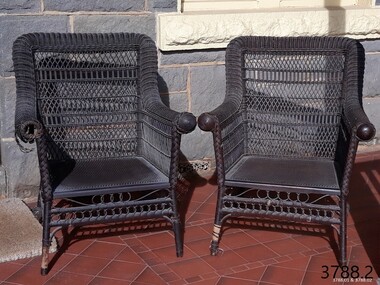
Furniture - Armchair, 1897-1921
... ...rolled serpentine...A reinforcing pattern of wicker work covers the top edges of the armrests and backrest in one piece and folds around to the underside, referred to as rolled serpentine arms and back. The hollow ends of the armrests are filled with a circular knob of wicker work. ...A reinforcing pattern of wicker work covers the top edges of the armrests and backrest in one piece and folds around to the underside, referred to as rolled serpentine arms and back. The hollow ends of the armrests are filled with a circular knob of wicker work. ...These cane chairs are one of many 19th-century items of furniture, linen and crockery donated to Flagstaff Hill Maritime Village by Vera and Aurelin Giles. The items are associated with Warrnambool and the Giles Family history. Items donated by the family have come to be known as the Giles Collection. Many items in the Lighthouse Keeper’s Cottage were donated by Vera and Aurelin Giles and mostly came from the home of Vera’s parents-in-law, Henry Giles and his wife Mary Jane (nee Freckleton), who married in 1880 and whose photos are on display in the parlour. Henry was born at Tower Hill in 1858 and was a labourer on the construction of the Warrnambool Breakwater before leaving in 1895 for around seven years to build bridges in NSW. Mary Jane was born in 1860 at Cooramook, and she attended Mailor’s Flat State School and where she eventually became a student teacher. After which she became a governess at “Injemiara”, where her grandfather, Francis Freckleton, had once owned land. Henry and Mary’s family consisted of six; some of the children were born at Mailor’s Flat, and later, some children were born at Wangoom. They lived with their parents at Wangoom and Purnim west, and this is where Henry died in 1933 and Mary Jane in 1940. Heywood & Wakefield Furniture Co: - The Heywood-Wakefield Company is an American furniture manufacturer established in 1897. It went on to become a major presence in the US. Its older products are considered collectibles and have been featured on television antique programs. The Heywood brothers established themselves in 1826 as furniture makers, and the Wakefield Company began in 1855 as a separate company. Both firms produced wicker and rattan furniture, and as these products became increasingly popular towards the end of the century, they became serious rivals. In 1897, the companies merged as Heywood Brothers & Wakefield Company (this name was changed to Heywood-Wakefield Company in 1921), purchasing Washburn-Heywood Chair Company in 1916, Oregon Chair Company in 1920, and Lloyd Manufacturing Company in 1921. While its wooden furniture plant in Gardner, Massachusetts, closed in 1979, a branch in Menominee, Michigan, continued to manufacture metal outdoor seats, auditorium seats, and school furniture. The Heywood-Wakefield Company Complex in Gardner was added to the National Historic Register in 1983. The South Beach Furniture Company acquired the rights to the name in 1994 and reproduces its wooden furniture. Both founding companies produced wicker and rattan furniture in the late 19th century. The wicker styles drew on the Aesthetic Movement and Japanese influences simpler designs arose in the wake of the Arts and Crafts Movement. The merged entity stayed abreast of wicker furniture trends by hiring designers such as Paul Frankl and Donald Deskey during the 1920s. Its furniture was exhibited at the 1933 Century of Progress exhibition and the 1964 New York World's Fair. During the 1930s and 1940s, Heywood-Wakefield began producing furniture using sleek designs based on French Art Deco.The Giles family collection has social significance at a local level because it illustrates the level of material support the Warrnambool community gave to Flagstaff Hill when the village and museum were established. The wicker furniture is a fine example of late 19th and early 20th century lightweight domestic furniture that is today a very collectible item and quite rare and valuable.Armchair: pair of wicker armchairs, painted dark brown. The open wicker weave pattern of a traditional Asian design extends from the seat up to the armrests and completely over the backrest, plus across the front of the chair below the seat. The seat is very firmly woven and fitted into a timber frame. A reinforcing pattern of wicker work covers the top edges of the armrests and backrest in one piece and folds around to the underside, referred to as rolled serpentine arms and back. The hollow ends of the armrests are filled with a circular knob of wicker work. The back legs are also completed with decorative wicker knobs. The frames are constructed from bamboo. One chair base (3788.1) has been strengthened with metal bracing. The other chair (3788.2) has the remnants of an orange manufacturer’s tag fixed to the base. The chairs were made from 1897 to 1921 by Heywood Brothers & Wakefield Company, USA. These chairs are part of the Giles Collection.Tag, orange with black print: “MANUFA - Heywood B – GARDNE”flagstaff hill, warrnambool, shipwrecked coast, flagstaff hill maritime museum, shipwreck coast, great ocean road, giles collection, giles family, henry and mary jane giles, tower hill, cooramook, warrnambool breakwater, mailor’s flat, wangoom, 19th century furniture, wicker armchairs, rolled serpentine wicker work, cane armchair, classic wicker furniture, victorian style furniture, domestic furniture late 19th century, chair, armchair, woven cane, wicker, rolled serpentine, manufa - heywood b – gardne, heywood brothers & wakefield company, usa -
 Flagstaff Hill Maritime Museum and Village
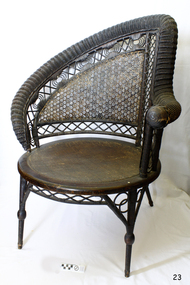
Furniture - Chair, 1855-1900
... ...rolled serpentine wicker work...The wicker nursing chair is a fine example of late 19th century light weight domestic furniture that today are very collectible items and quite rare and valuable. flagstaff hill warrnambool flagstaff hill maritime museum shipwreck coast great ocean road 19th century furniture rolled serpentine wicker work cane armchair classic wicker furniture victorian style furniture domestic furniture late 19th century heywood-wakefield company feeding chair nursing chair mother's chair nursery furniture Nurse wicker chair, wood, cane and rattan with round rushed seat. ...Heywood & Wakefield Furniture Co: The Heywood-Wakefield Company is an American furniture manufacturer established in 1897 that went on to become a major presence in the US. Its older products are considered collectibles and have been featured on television antique programs. The Heywood brothers established themselves in 1826, as furniture makers and the Wakefield Company began in 1855 as a separate company. Both firms produced wicker and rattan furniture, and as these products became increasingly popular towards the end of the century, they became serious rivals. In 1897 the companies merged as Heywood Brothers & Wakefield Company (this name was changed to Heywood-Wakefield Company in 1921), purchasing Washburn-Heywood Chair Company in 1916, Oregon Chair Company in 1920, and Lloyd Manufacturing Company in 1921. While its wooden furniture plant in Gardner, Massachusetts closed in 1979, a branch in Menominee, Michigan continued to manufacture metal outdoor seats, auditorium seats, and school furniture. The Heywood-Wakefield Company Complex in Gardner was added to the National Historic Register in 1983. The South Beach Furniture Company acquired the rights to the name in 1994 and reproduces its wooden furniture. Both founding companies produced wicker and rattan furniture in the late 19th century. The wicker styles drew on the Aesthetic Movement and Japanese influences simpler designs arose in the wake of the Arts and Crafts Movement. The merged entity stayed abreast of wicker furniture trends by hiring designers such as Paul Frankl and Donald Deskey during the 1920s. Its furniture was exhibited at the 1933 Century of Progress exhibition and the 1964 New York World's Fair. During the 1930s and 1940s, Heywood-Wakefield began producing furniture using sleek designs based on French Art Deco.The chair has social significance at a local level, because it illustrates the level of material support the Warrnambool community gave to Flagstaff Hill when the village and Museum was established. The wicker nursing chair is a fine example of late 19th century light weight domestic furniture that today are very collectible items and quite rare and valuable.Nurse wicker chair, wood, cane and rattan with round rushed seat. The one left arm being that to support the infant during feeding. 1870s-1890s. Believed to have been made by Heywood Brothers & Wakefield Company, USA. flagstaff hill, warrnambool, flagstaff hill maritime museum, shipwreck coast, great ocean road, 19th century furniture, rolled serpentine wicker work, cane armchair, classic wicker furniture, victorian style furniture, domestic furniture late 19th century, heywood-wakefield company, feeding chair, nursing chair, mother's chair, nursery furniture -
 Bendigo Historical Society Inc.
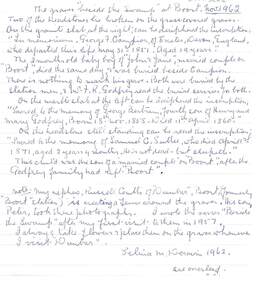
Document - HARRY BIGGS COLLECTION: BOORT CEMETERY
... Serpentine Creek. Died 1968, Melbourne, age 85), father John White, mother Mary Ann Nicholls was married to Garnet Deravin, a medical doctor. In 1928, (Electoral Roll...Serpentine Creek. Died 1968, Melbourne, age 85), father John White, mother Mary Ann Nicholls was married to Garnet Deravin, a medical doctor. In 1928, (Electoral Roll ...Selina Deravin (Born 1882, Serpentine Creek. Died 1968, Melbourne, age 85), father John White, mother Mary Ann Nicholls was married to Garnet Deravin, a medical doctor. In 1928, (Electoral Roll Bendigo) Garnet and Selina were living at 109 Queen Street, Bendigo; later at 13 Tuxon Street, North Balwyn, where Garnet died on 15th. April, 1954 (Argus, 17th April, 1954). Deravin family owned the Chateau Dore vineyard and winery. Selina published a book of her poetry. A poem ' Beside the Swamp' was written following her visit to the swamp at Boort: ' In silence by the graves I stood, of those who long had lain at rest/In lonely quiet, in the bush. Long gone are they who loved them best/The trees still whisper by the swamp; the night birds call, and vigil keep/As in those far-off yesterdays - where Campion and three children sleep........'Selina White Birth Date Abt 1882 Birth Place Serpentine Creek, Victoria Registration Year 1882 Registration Place Victoria, Australia Father John White Mother Aary Ann Nicholls Registration Number 25736 Hand written letter by Selina De Ravin, titled 'The graves beside the swamp at Boort.' dated November 1962. Two of the headstones lie broken on the grass covered graves. On the granite slab at the right is the inscription 'In memoriam. George F. Campion of Exeter Devon, England, who departed this life, May 31st 1851. Aged 19 years. The 2 month old baby boy of 'John and Jane', married couple on 'Boort', died the same day and was buried beside Campion. There is nothing to mark his grave. Both were buried by the Station men. Mr J. R. Godfrey read the burial services for both. On the marble slab at the left can be deciphered the inscription sacred to the memory of George Bertram, fourth son of Henry and Mary Godfrey, Born 18th November 1858. Died 11th April 1860. On the headstone still standing can be read the inscription Sacred to the memory of Samuel C. Sutlee, who died April 1st 1871, aged 2 years 4 months. He is not dead - but sleepeth. This child was the son of a married couple 'on Boort', after the Godfrey family had left 'Boort'. Note - My nephew Russell Coutts of 'Dunbar', Boort, (formerly 'Boort' Station) is erecting a fence around the graves. His son, Peter took these photographs. I wrote the verses 'Beside the Swamp' after my first visit to them in 1957. I always take flowers and place them on the graves whenever I visit 'Dunbar' Selina M. Deravin 1962Russell Coutts and his son Peter have restored the graves beside the Lake at 'Dunbar' and erected a graveyard. This photograph was taken by Peter and the flowers placed on the graves by his mother Wilma who helps to care for them. They also discovered a fifth unknown grave there when erecting the fence and re- erecting the broken and fallen headstones. S. M. Deravin. (Selina De Ravin) a. Typed poem on carbon copy flimsy paper: 'Beside the Swamp', signed in blue pen by Lina Deravin, January 1957'. Written on the bottom in blue pen: ' In February 1960 when on a visit to Boort I took some flowers and placed them on these graves beside the swamp'. Signed Lina Devarin.Selina M. Deravinmemorials, graveboards, boort cemetry, russell coutts, 'dunbar', peter coutts, george f. campion, boort cemetery, samuel c. sutlee?., poetry, poem, garnet deravin, selina deravin -
 Surrey Hills Historical Society Collection
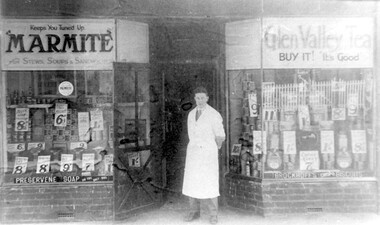
Photograph, Edward Blanchford Wright's grocery shop, Canterbury Road, Surrey Hills
... His last electoral roll entry in 1968 gives 18 Serpentine Street, Mont Albert. ...His last electoral roll entry in 1968 gives 18 Serpentine Street, Mont Albert. ...Edward Blatchford Wright was born in 1894 in Birmingham, son of Edward Wright and Florence Emuss. It is not known when he migrated to Australia but he served in the AIF during WW1, seeing action in France. On enlistment aged 20 years 9 months, he gave his occupation as farmer. He married Gertrude Matilda Wain in 1919. He came to Surrey Hills c1924. He was a grocer in the area for several decades with shops in Canterbury Road. In 1942 he is listed at 235 Union Road. This was a residential address. Alan Holt's Surrey Hills property register places him at 365 Canterbury Road (c1920-1930) and 359 Canterbury Road (c1930-1940). He died in 1972 in Mont Albert. His last electoral roll entry in 1968 gives 18 Serpentine Street, Mont Albert. He and his wife are buried in Burwood Cemetery.Black and white photo of the exterior of Edward Blanchford Wright's grocery shop in Canterbury Road, Surrey Hills. The screen door is open and William Reynolds stands in the opening, dressed in a long white coat. The window displays are stacked high with cans and packages and large signs advertising the prices of goods. There is advertising on the windows for Marmite, Glen Valley tea, Preservene soap and Brockoff's biscuits. advertising, shops, grocers, businesses, union road shops, edward blatchford wright, william reynolds, burwood cemetery, world war 1, canterbury road
