
Showing 19 items matching "roy prince"
-
 Bendigo Historical Society Inc.
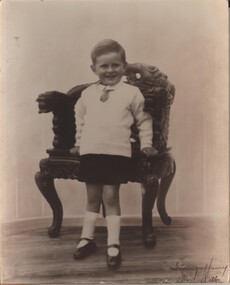
Photograph - WES HARRY COLLECTION: STUDIO PHOTOGRAPH OF ROY PRINCE WITH CHINESE WOODEN CHAIR
... WES HARRY COLLECTION: STUDIO PHOTOGRAPH OF ROY PRINCE WITH CHINESE WOODEN CHAIR......Roy Prince...Black & white photograph of Roy Prince, of Clyde Street East Kew Undated Photo by Irving Harry, Melbourne...Wes Harry photograph Roy Prince Irving Harry, Melbourne Black & white photograph of Roy Prince, of Clyde Street East Kew Undated Photo by Irving Harry, Melbourne Photograph WES HARRY COLLECTION: STUDIO PHOTOGRAPH OF ROY PRINCE WITH CHINESE WOODEN CHAIR ...Black & white photograph of Roy Prince, of Clyde Street East Kew Undated Photo by Irving Harry, MelbourneIrving Harry, Melbournewes harry, photograph, roy prince -
 Orbost & District Historical Society
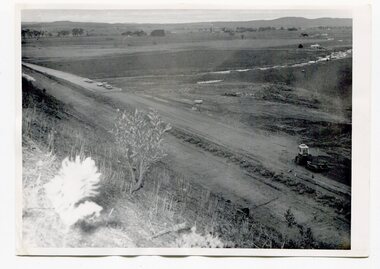
black and white photographs, first half 20th century
... 3255.1 is a photograph of the Princes Freeway construction of the roadway embankment at the foot of Newmerella Hill. 3255.2 is of the construction of the roadway, the Princes Freeway looking down from Newmerella toward Orbost. 3255.3 shows the Princes Freeway from Grandview , Newmerella, and shows the southern end of Ashby's Gulch with its bridge. 3255.4 is of the Princes Freeway showing the bridge across Ashby's Gulch and a train on the railway viaduct. Ashby's Gulch is named for the Ashby family. The Ashby family was one of the early settlers in Orbost at Newmerella. Roy...Roy Ashby, William Henry Ashby, Cordelia Valma Ashby and Edith Ashby. This photograph is associated with the construction of the main roads into Orbost. It is also connected to the Orbost to Bairnsdale Railway. road-construction-Newmerella Princes-freeway-Newmerella Ashby's-Gulch-Newmerella Orbost-railway Four black / white photographs of road construction and rail bridges. black and white photographs ...3255.1 is a photograph of the Princes Freeway construction of the roadway embankment at the foot of Newmerella Hill. 3255.2 is of the construction of the roadway, the Princes Freeway looking down from Newmerella toward Orbost. 3255.3 shows the Princes Freeway from Grandview , Newmerella, and shows the southern end of Ashby's Gulch with its bridge. 3255.4 is of the Princes Freeway showing the bridge across Ashby's Gulch and a train on the railway viaduct. Ashby's Gulch is named for the Ashby family. The Ashby family was one of the early settlers in Orbost at Newmerella. Roy Ashby, son of James Rowland Ashby and Edith Annie Hall, was born on 21 Nov 1892 in Orbost. Victoria. Australia and died in 1942 in Orbost. Victoria. Australia at age 50. Roy married Elsie May Stephens, daughter of James Stephens and Sarah Taylor, in 1920 in Victoria.Australia. Elsie was born on 15 Sep 1898 in Beaconsfield Tasmania.Australia and died in 1974 in Orbost Australia at age 76. Their children were: Roy Ashby, William Henry Ashby, Cordelia Valma Ashby and Edith Ashby. This photograph is associated with the construction of the main roads into Orbost. It is also connected to the Orbost to Bairnsdale Railway.Four black / white photographs of road construction and rail bridges.road-construction-newmerella princes-freeway-newmerella ashby's-gulch-newmerella orbost-railway -
 4th/19th Prince of Wales's Light Horse Regiment Unit History Room
Regimental Scrap Book: 1960-1969, 2010 (estimated)
... prince of wales s light horse regiment history training social activities guidons band vietnam war Archival quality A3 loose leaf slip case containing memorabilia documents, cuttings and photos about the Regiment for the period 1960-69. Contents include: Training, ceremonial, social ativities, Photo - 4th Light Horse Regt Guidon, "First 100 years" Regimental Dinner 15 July 1960. Presentation of 4th Light Horse Guidon 6 October 1963, Regimental Band, Laying up of old 4th Light Horse Guidon 27 September 1964. 1 Troop A Squadron South Vietnam. Regimental Scrap Book: 1960-1969 Roy ...Archival quality A3 loose leaf slip case containing memorabilia documents, cuttings and photos about the Regiment for the period 1960-69. Contents include: Training, ceremonial, social ativities, Photo - 4th Light Horse Regt Guidon, "First 100 years" Regimental Dinner 15 July 1960. Presentation of 4th Light Horse Guidon 6 October 1963, Regimental Band, Laying up of old 4th Light Horse Guidon 27 September 1964. 1 Troop A Squadron South Vietnam. ceremonial, 4 19 prince of wales s light horse regiment history, training, social activities, guidons, band, vietnam war -
4th/19th Prince of Wales's Light Horse Regiment Unit History Room
Regimental Scrap Book: 1970-1979, 2009
... prince of wales s light horse regiment ceremonial west gate bridge freedom of city traralgon Archival quality A3 loose leaf slip case containing memorabilia documents, cuttings and photos about the Regiment for the period 1970- 1979. Contents include: Training, ceremonial and social activities. Vale Lt Col John Dixon. Freedom of City of Traralgon 29 Nov 1970. Freedom of City of Melbourne March 1977. Freedom of City of Kyneton September 1978. Opening of West Gate Bridge Nov 1975. Regimental Scrap Book: 1970-1979 Roy ...Archival quality A3 loose leaf slip case containing memorabilia documents, cuttings and photos about the Regiment for the period 1970- 1979. Contents include: Training, ceremonial and social activities. Vale Lt Col John Dixon. Freedom of City of Traralgon 29 Nov 1970. Freedom of City of Melbourne March 1977. Freedom of City of Kyneton September 1978. Opening of West Gate Bridge Nov 1975.melbourne, kyneton, training, history 4 19 prince of wales s light horse regiment, ceremonial west gate bridge, freedom of city, traralgon -
4th/19th Prince of Wales's Light Horse Regiment Unit History Room
Regimental Scrap Book: 1980-1989, 2009
... prince of wales s light horse regiment freedom of city traralgon sale boyce Archival quality A3 loose leaf slip case containing memorabilia documents, cuttings and photos about the Regiment for the period 1980-1989. Contents include: Training, ceremonial and social activities. Freedom of City of Sale March 1982 and 1985. Freedom of City of Bairnsdale 15 March 1986. Freedom of City of Traralgon July 1988. Wedding of Commanding Officer Lt Col John Boyce 1988. Regimental Scrap Book: 1980-1989 Roy ...Archival quality A3 loose leaf slip case containing memorabilia documents, cuttings and photos about the Regiment for the period 1980-1989. Contents include: Training, ceremonial and social activities. Freedom of City of Sale March 1982 and 1985. Freedom of City of Bairnsdale 15 March 1986. Freedom of City of Traralgon July 1988. Wedding of Commanding Officer Lt Col John Boyce 1988. bairnsdale, ceremonial, training, history 4 19 prince of wales s light horse regiment, freedom of city, traralgon, sale, boyce -
4th/19th Prince of Wales's Light Horse Regiment Unit History Room
Regimental Scrap Book: 1990-1999, 2009
... Meritorious Unit Commendation to Prince of Wales Light Horse Troop while attached to 173 US Airborne Brigade, South Vietnam 1965/66. Freedom of City of Melbourne May 1992. 50th Birthday of Regiment. Closure of Traralgon Depot 1998. Regimental Scrap Book: 1990-1999 Roy ...Archival quality A3 loose leaf slip case containing memorabilia documents, cuttings and photos about the Regiment for the period 1990-1999. Contents include:Training, Ceremonial, social activities. Hansard 18 Oct 1990 re future of the Regiment. Threats to the Regiment. Chief of General Staff Commendation to A Squadron 4/19 PWLH for assistance with flood emergency in Gippsland April 1990. Meritorious Unit Commendation to Prince of Wales Light Horse Troop while attached to 173 US Airborne Brigade, South Vietnam 1965/66. Freedom of City of Melbourne May 1992. 50th Birthday of Regiment. Closure of Traralgon Depot 1998.ceremonial, training, vietnam war, history 4 19 prince of wales s light horse, freedom of city melbourne, freedom of city traralgon, traralgon army depot, commendations, gippsland floods -
4th/19th Prince of Wales's Light Horse Regiment Unit History Room
Regimental Scrap Book: 2010-2019, 2010
... ceremonial training history 4 19 prince of wales s light horse Archival quality A3 loose leaf slip case containing memorabilia documents, cuttings and photos about the Regiment for the period 2010-2019. Contents include:Training, ceremonial and social activities Regimental Scrap Book: 2010-2019 Roy Arnott ...Archival quality A3 loose leaf slip case containing memorabilia documents, cuttings and photos about the Regiment for the period 2010-2019. Contents include:Training, ceremonial and social activitiesceremonial, training, history 4 19 prince of wales s light horse -
4th/19th Prince of Wales's Light Horse Regiment Unit History Room
Booklet, Roy Arnott, The Regiment, 2008
... History 4/19 PWLH A light cardboard covered booklet giving a brief account of the history of the 4/19 Prince of Wales's Light Horse Regiment The Regiment Booklet Roy Arnott ...A light cardboard covered booklet giving a brief account of the history of the 4/19 Prince of Wales's Light Horse Regimenthistory, 4/19 pwlh -
 Bendigo Historical Society Inc.
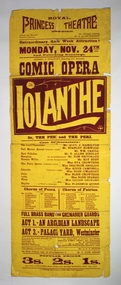
Ephemera - Royal Princes Theatre poster, 1902
... General Director Allen Bindley Performers Mr Alex J Hamilton, Stanley Horwood, William Cahill, E Allen Bindley, Tom Pritchard, Roy Eddy, Eva Crother, Beatrice English, Addie Campbellm, Rose O'Mahony, Elsie Crowther, Rose Spargo, Lilian Orchard, Florence Quinn. Printed by J. J. Miller Show Print Co. off Post Office Place Melbourne Ephemera Royal Princes Theatre poster ...Deep yellow poster with maroon printing, advertising a performance of "Iolanthe" at the Royal Princess Theatre in Bendigo on Monday November 24th, 1902, and following evenings for a week. Lessee and manager Mr Hyman White. General Director Allen Bindley Performers Mr Alex J Hamilton, Stanley Horwood, William Cahill, E Allen Bindley, Tom Pritchard, Roy Eddy, Eva Crother, Beatrice English, Addie Campbellm, Rose O'Mahony, Elsie Crowther, Rose Spargo, Lilian Orchard, Florence Quinn. Printed by J. J. Miller Show Print Co. off Post Office Place Melbourneadvertising, royal princess theatre, iolanthe, comic opera -
Port Melbourne Historical & Preservation Society
Photograph - Glee Club, Port Melbourne, 1938
... Societies Clubs Unions and other Organisations Port Melbourne Glee Club Tom COSHAM Reg WILSON Bob WALSH Col CAMERON Alan WILSON Bert LANCASTER Cowen KILPATRICK Icy BEAUMONT Bill McKAY Robert PHILLIPS Jim MALONEY Jimmy ANTANO Jerry CHAMAN Michael KALOS Harry WILSON Fred DAVIS Arthur WALSH Bull RYAN Roy COX A HART Fred BROOKS Pat NOLAN George MEDES Moss McCALL Andy POWER George AMY Jnr George AMY Snr Hector WOOD Harry PERAZZO Jim KERR Wally DIMOLINE Jim DODDER Bill BOLITHO Jack VALE All England Eleven Hotel Business and Traders - Hotels Laser copy of Glee Club group photograph with honour board, circa 1938, at side of former All England Eleven Hotel, Princes Street and Princes Place. ...Item was framed with a medallion presented to George AMY in 1924 (cat no 518 ) by the City of Port Phillip for the 1998 Lurking in Lanes exhibition.Laser copy of Glee Club group photograph with honour board, circa 1938, at side of former All England Eleven Hotel, Princes Street and Princes Place.societies clubs unions and other organisations, port melbourne glee club, tom cosham, reg wilson, bob walsh, col cameron, alan wilson, bert lancaster, cowen kilpatrick, icy beaumont, bill mckay, robert phillips, jim maloney, jimmy antano, jerry chaman, michael kalos, harry wilson, fred davis, arthur walsh, bull ryan, roy cox, a hart, fred brooks, pat nolan, george medes, moss mccall, andy power, george amy jnr, george amy snr, hector wood, harry perazzo, jim kerr, wally dimoline, jim dodder, bill bolitho, jack vale, all england eleven hotel, business and traders - hotels -
 Bendigo Historical Society Inc.
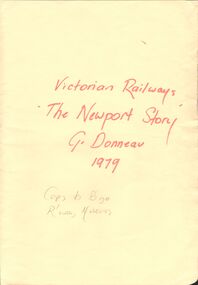
Document - VICTORIAN RAILWAYS - THE NEWPORT STORY
... Prince of Wales... Queen Victoria... W M Shannon... Sir Thomas Bent... Puffing Billy... Harold Winthrop Clapp... Francis Boardman Clapp... Melbourne Tramway & Omnibus Co... Austral Otis Engineering Co... Melbourne University... Franklin Supply Co... E H Brownbill... Heavy Harry... Locomotive Mausoleum North Melbourne... North British Locomotive Co... Walter Stinton... Thomas Smith... Peter Alexander...Peter Alexander... Robert Ferguson... King George V... English Railway Gazette... Harry Nunn May... Merz & MacLellan... Arthur Lowe... R H Roach... W H Chapman... L C Rolls... G A Swift... John McRae... Caledonian Society... Thistle Club... Bristol Hotel... James Taylor... George Allibon... Walter Grimshaw... Robert Maybin... Roy...DOCUMENT Victorian Railways The Newport Story G Donneau Melbourne and Geelong Railway Co Melbourne & Hobson's Bay United Railway Co Mr William Meikle Solomon Mirls Richard Speight Sir james Allport Midland Railway Mr Allison Dalrymple Phoenix Foundry North Melbourne Loco Depot Beyer Peacock & CO Mr A E Smith Roger Barnes Thomas Tait BHP F J Shea Commonwealth Ordnance Department James Rooks London Times Mr Merz Mr McLellan Bendigo North Railway Workshops Ballarat Shops James Taylor Donald McGregor Julius Aurelian Sylvester Barber Victor Lethlean Melbourne Institute of Technology Prince of Wales Queen Victoria W M Shannon Sir Thomas Bent Puffing Billy Harold Winthrop Clapp Francis Boardman Clapp Melbourne Tramway & Omnibus Co Austral Otis Engineering Co Melbourne University Franklin Supply Co E H Brownbill Heavy Harry Locomotive Mausoleum North Melbourne North British Locomotive Co Walter Stinton Thomas Smith Peter Alexander Peter Alexander Robert Ferguson King George V English Railway Gazette Harry Nunn May Merz & MacLellan Arthur Lowe R H Roach W H Chapman L C Rolls G A Swift John McRae Caledonian Society Thistle Club Bristol Hotel James Taylor George Allibon Walter Grimshaw Robert Maybin Roy Hodge Walter Biddle John Ramsbottom Robert Hewitt James Green Thomas Waldhuter Giles Dobney Mr Richardson Mr Arthur Sydney Express The Age Mr Speight David Syme Father Gapon Typed history of the Newport Railway Workshops. ...Typed history of the Newport Railway Workshops. Mentions the men who worked at the workshop, the locomotives that were built there, the different classes of locomotives, the equipment they used, and some of the work they did. Written by G. Donneau (who worked there) and dated 19-3-79.document, victorian railways, the newport story, g donneau, melbourne and geelong railway co, melbourne & hobson's bay united railway co, mr william meikle, solomon mirls, richard speight, sir james allport, midland railway, mr allison dalrymple, phoenix foundry, north melbourne loco depot, beyer peacock & co, mr a e smith, roger barnes, thomas tait, bhp, f j shea, commonwealth ordnance department, james rooks, london times, mr merz, mr mclellan, bendigo north railway workshops, ballarat shops, james taylor, donald mcgregor, julius aurelian sylvester barber, victor lethlean, melbourne institute of technology, prince of wales, queen victoria, w m shannon, sir thomas bent, puffing billy, harold winthrop clapp, francis boardman clapp, melbourne tramway & omnibus co, austral otis engineering co, melbourne university, franklin supply co, e h brownbill, heavy harry, locomotive mausoleum north melbourne, north british locomotive co, walter stinton, thomas smith, peter alexander, peter alexander, robert ferguson, king george v, english railway gazette, harry nunn may, merz & maclellan, arthur lowe, r h roach, w h chapman, l c rolls, g a swift, john mcrae, caledonian society, thistle club, bristol hotel, james taylor, george allibon, walter grimshaw, robert maybin, roy hodge, walter biddle, john ramsbottom, robert hewitt, james green, thomas waldhuter, giles dobney, mr richardson, mr arthur, sydney express, the age, mr speight, david syme, father gapon -
Port Melbourne Historical & Preservation Society
Book, Rosalie Thrup Bray, "32 Gellibrand Road 3207, Life and times 1941-71", Jul 2013
... Built Environment - Domestic Garden City Education War - World War II Piers and Wharves - Princes Pier Gellibrand Road Fishermans Bend Millie McLEAN Roy McLEAN Sandra SLEETH Rene SMITH Dave McLEAN Phyllis MOORE Joe WATSON Nancy CARROLL Violet POPE Len POPE June MOORE Lois MOORE Sis PEAT Mrs MILLS Mary EDWARDS Alf EDWARDS Judy FARAM Swallow & Ariell Ltd Robert Harper & Co Ltd J H Boyd Domestic College Mrs Wood MEWTON Oranje SS NAIRANA Daisy THRUP Rosalie (Rosie) BRAY nee THRUP Book "32 Gellibrand Road 3207, Life and times 1941-71". ...Written and published by the author. First edition.Book "32 Gellibrand Road 3207, Life and times 1941-71". Rosalie BRAY (THRUP). Green cover with photo of 32 Gellibrand Road on coverbuilt environment - domestic, garden city, education, war - world war ii, piers and wharves - princes pier, gellibrand road, fishermans bend, millie mclean, roy mclean, sandra sleeth, rene smith, dave mclean, phyllis moore, joe watson, nancy carroll, violet pope, len pope, june moore, lois moore, sis peat, mrs mills, mary edwards, alf edwards, judy faram, swallow & ariell ltd, robert harper & co ltd, j h boyd domestic college, mrs wood mewton, oranje, ss nairana, daisy thrup, rosalie (rosie) bray nee thrup -
Port Melbourne Historical & Preservation Society
Book, Rosalie Thrup Bray, "32 Gellibrand Road 3207, Life and times 1941-71", Jul 2013
... Second edition printed 2014 Built Environment - Domestic Garden City Education War - World War II Piers and Wharves - Princes Pier Rosalie (Rosie) BRAY nee THRUPP Gellibrand Road Fishermans Bend Millie McLEAN Roy McLEAN Sandra SLEETH Rene SMITH Dave McLEAN Phyllis MOORE Joe WATSON Nancy CARROLL Violet POPE Len POPE June MOORE Lois MOORE Sis PEAT Mrs MILLS Mary EDWARDS Alf EDWARDS Judy FARAM Swallow & Ariell Ltd Robert Harper & Co Ltd J H Boyd Domestic College Mrs Wood MEWTON Oranje SS NAIRANA Daisy THRUP Rosalie (Rosie) BRAY nee THRUP Book "32 Gellibrand Road 3207, Life and times 1941-71". ...Written and published by the author. Second edition printed 2014Book "32 Gellibrand Road 3207, Life and times 1941-71". Rosalie BRAY (THRUP). Green cover with photo of 32 Gellibrand Road on coverbuilt environment - domestic, garden city, education, war - world war ii, piers and wharves - princes pier, rosalie (rosie) bray nee thrupp, gellibrand road, fishermans bend, millie mclean, roy mclean, sandra sleeth, rene smith, dave mclean, phyllis moore, joe watson, nancy carroll, violet pope, len pope, june moore, lois moore, sis peat, mrs mills, mary edwards, alf edwards, judy faram, swallow & ariell ltd, robert harper & co ltd, j h boyd domestic college, mrs wood mewton, oranje, ss nairana, daisy thrup, rosalie (rosie) bray nee thrup -
 Port Melbourne Historical & Preservation Society
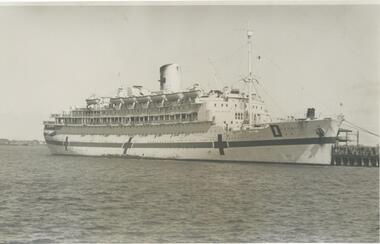
Photograph - Oranje, Princes Pier, Port Melbourne, Roy Liebig, 1945
... A series of photographs taken by Roy Liebig in the 1940s Hard copy and digital. "Oranje" berthed at Princes Pier...Karen, as administrtor of his estate, has extracted various photos and sent them to appropriate historical societies. maritime war - world war ii roy liebig karen bowden yarra river oranje piers and wharves - princes pier A series of photographs taken by Roy Liebig in the 1940s Hard copy and digital. ...The donor's (Karen Bowden) grandfather - Roy Liebig (1897-1968) - took these photos in the 1940s. Karen, as administrtor of his estate, has extracted various photos and sent them to appropriate historical societies.A series of photographs taken by Roy Liebig in the 1940s Hard copy and digital. "Oranje" berthed at Princes Piermaritime, war - world war ii, roy liebig, karen bowden, yarra river, oranje, piers and wharves - princes pier -
 Port Melbourne Historical & Preservation Society
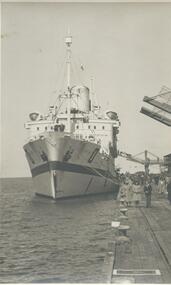
Photograph - Oranje, Princes Pier, Port Melbourne, Roy Liebig, 1945
... A series of photographs taken by Roy Liebig in the 1940s Hard copy and digital. "Oranje" bow on at Princes Pier...Karen, as administrtor of his estate, has extracted various photos and sent them to appropriate historical societies. maritime war - world war ii roy liebig karen bowden yarra river oranje piers and wharves - princes pier A series of photographs taken by Roy Liebig in the 1940s Hard copy and digital. ...The donor's (Karen Bowden) grandfather - Roy Liebig (1897-1968) - took these photos in the 1940s. Karen, as administrtor of his estate, has extracted various photos and sent them to appropriate historical societies.A series of photographs taken by Roy Liebig in the 1940s Hard copy and digital. "Oranje" bow on at Princes Piermaritime, war - world war ii, roy liebig, karen bowden, yarra river, oranje, piers and wharves - princes pier -
Merbein District Historical Society
Journal - Quarterly, Merbein Historian - Journal MDHS - No 24 (2 copies) Jun. 2006, Jun.2006
... Prince... Fred Sutherland... Hilda (Lang) Klesa... Herbert Sutherland... Smith House (Annie)... Catholic Church 50th Anniversary... Roy...Bronwyn Zrna Dorothy Prince Fred Sutherland Hilda (Lang) Klesa Herbert Sutherland Smith House (Annie) Catholic Church 50th Anniversary Roy Stanley Drury Merbein Historian - Journal MDHS - No 24 (2 copies) Jun. 2006 Journal Quarterly ...bronwyn zrna, dorothy prince, fred sutherland, hilda (lang) klesa, herbert sutherland, smith house (annie), catholic church 50th anniversary, roy stanley drury -
 Melbourne Tram Museum
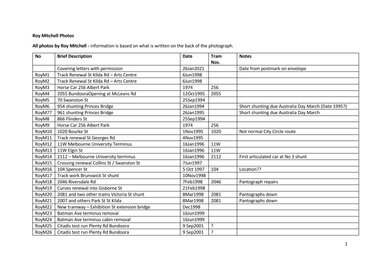
Photograph - Colour prints, Roy J Mitchell, 1974 to 1998
... Trams tramways Trackwork Horse Tram Bundoora Opening Swanston St Princes Bridge Shelters Bourke St Melbourne University Work Trams Collins St Elgin St Spencer St Riversdale Rd Gisborne St Victoria St Shunting Park St Exhibition St Batman Ave tram 256 tram 2055 tram 1020 tram 11W tram 2112 tram 104 tram 2046 tram 2081 All have information written on the rear of the photo by the photographer and the donor. Set of 24 colour prints of photos taken by Roy ...Set of 24 colour prints of photos taken by Roy Mitchell between 1974 and 1998. For a listing of the prints see htd5640list.pdf. Word file and scanning by Mal Rowe. Roy Mitchell photos.docx Roy Mitchell photos.pdf RoyM1_Arts Centre_6Jun1998_RoyMitchell.jpg RoyM2_Arts Centre_6Jun1998-2_RoyMitchell.jpg RoyM3_Horse Car 256-AlbertPark_1974_RoyMitchell.jpg RoyM4_2055_Bundoora Opening_McLeansRd_12Oct1995_RoyMitchell.jpg RoyM5_70_Swanston St_25Sep1994_Roy Mitchell.jpg RoyM6_954_Princes Bridge_26Jan1994_Roy Mitchell.jpg RoyM7_954_Princes Bridge_26Jan1994_Roy Mitchell.jpg RoyM8_866_Flinders St_25Sep1994_Roy Mitchell.jpg RoyM9_Horse Car 256-Albert Park_1974_Roy Mitchell.jpg RoyM10_1020_Bourke St_1Nov1995_Roy Mitchell.jpg RoyM11_TrackRenewal_St GeorgesRd_4Nov1995_Roy Mitchell.jpg RoyM12_11W_University Terminus_16Jan1966_Roy Mitchell.jpg RoyM13_11W_ElginSt_16Jan1966_Roy Mitchell.jpg RoyM14_2112_First Car-No 3-shunt_16Jan1966_Roy Mitchell.jpg RoyM15_104_Spencer St_5Oct1997_Roy Mitchell.jpg RoyM16_Crossing-Renewal_Swanston-CollinsSt_7Jun1997_Roy Mitchell.jpg RoyM17_Trackwork_Brunswick St-shunt_10Nov1998_Ro yMitchell.jpg RoyM18_Riversdale Rd-pantograph_7Feb1998_Roy Mitchell.jpg RoyM19_Curve-renewal-Gisborne St_21Feb1998_Roy Mitchell.jpg RoyM20_2081_Victoria St-shunt_8Mar1998_Roy Mitchell.jpg RoyM21_2007etal_Park St_St Kilda_8Mar1998_Roy Mitchell.jpg RoyM22_New-tramway_Exhibition St Extension_Dec1998_Roy Mitchell.jpg RoyM23_Batman Ave-terminus-removal_16Jun1999_Roy Mitchell.jpg RoyM24_Batman Ave-cabin-removal_16Jun1999_Roy Mitchell.jpgAll have information written on the rear of the photo by the photographer and the donor.trams, tramways, trackwork, horse tram, bundoora, opening, swanston st, princes bridge, shelters, bourke st, melbourne university, work trams, collins st, elgin st, spencer st, riversdale rd, gisborne st, victoria st, shunting, park st, exhibition st, batman ave, tram 256, tram 2055, tram 1020, tram 11w, tram 2112, tram 104, tram 2046, tram 2081 -
 City of Melbourne Libraries
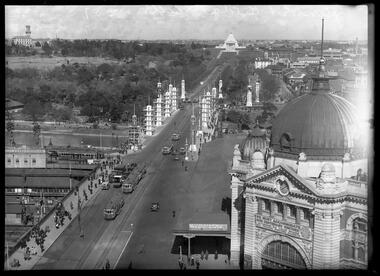
Photograph, Bull, Hugh Jones, 1897-1993, Princes Bridge Centenary pylons under construction
... The feature of the photo is the pylons erected along Princes Bridge to mark Melbourne’s Centenary in 1934. The sixteen plastered pylons were designed by Roy Prentice, the second person to qualify as an architect at The University of Melbourne’s Bachelor of Architecture degree, in 1933, aged 27. ...The feature of the photo is the pylons erected along Princes Bridge to mark Melbourne’s Centenary in 1934. The sixteen plastered pylons were designed by Roy Prentice, the second person to qualify as an architect at The University of Melbourne’s Bachelor of Architecture degree, in 1933, aged 27. ...Princes Bridge Centenary pylons under construction Possibly taken from Young and Jacksons Hotel (formerly Princes Bridge Hotel) on the corner of Flinders and Swanston streets, Flinders Street Station’s clocks and main entrance dominate, along with its distinctive copper dome and decorative façade. The time on the main clock is 1.40pm, and the sign underneath, reflecting Melbourne’s upcoming Centenary reads, “We must accommodate our Centenary visitors! Citizens! Do your share by taking paying guests.” At left is the original Princes Bridge Station, today the site of Federation Square. The riverside tram terminus advertises a Café/Tobacconist/Refreshment Room selling cigars & cigarettes, fountain drinks & confectionery, and in smaller text: “Leave your boot repairs here”. Nearly everyone is dressed in dark suits, coats and hats. The footpaths are wide and there are no traffic lights. The roadway stretches towards the Shrine of Remembrance, not yet dedicated but very dominant on the skyline. Government House is clearly visible across the wide parkland that would come to be known as Kings Domain and that is an area of deep importance to the people of the Eastern Kulin. Originally, Birrarung was part of a network of swamps and lagoons linked to the course of the river. From 1896, Public Works Department engineer Carlo Catani, oversaw a new channel to straighten the river and the swamps and lagoons were filled with spoil from the channel works. From the same vantage point today, only the top of the tower of Government House would be visible. The photo captures the pylons along Princes Bridge, mid-construction and being installed to mark Melbourne’s Centenary. The pylons were not without controversy. Both The Argus and The Age bemoaned them for being “made almost entirely of imported softwood timber”, denying work to native hardwood timber workers and sawmillers, and leading visitors to think Australia did not have its own exceptional native hardwoods. The pylons were also variously described in their incomplete state, as unimaginative and resembling an oilfield. Published: The Age 5 September 1934 Featured in "Newsworthy: Melbourne in photographs 1933-1936" exhibition at East Melbourne Library, October to December 2023. Exhibition caption by project volunteer, Louise McKenzie Photographer notations on slide: "Pylons + St Kilda Rd C57" Published: Age (Melbourne, Vic. : 1854 - 1954), Wednesday 5 September 1934, page 11 Published title: DECORATIONS -- THEN AND NOW. Published caption: "Although not completed yet, some impression of the effect of the decorations on Princes-bridge may be obtained from the first picture which shows the majestic sweep of St Kilda road with the Shrine of Remembrance and Government House dominating the horizon. The area to the left of St. Kilda-road and in front of Government House is portion of the area which it is proposed to call the King's Domain, which extends to Domain-road and Anderson-street..." Description: East-facing, elevated view of Flinders Street Station and Princes Bridge, featuring partially completed pylons erected for Melbourne's Centenary celebrations. The Shrine of Remembrance and Government House can be seen in the distance. In the foreground are trams, cars and trucks, pedestrians, Batman Avenue tram terminus and refreshment rooms. Signage on Flinders Street Station encourages citizens to accommodate Centenary visitors. The Melbourne Centenary was held 1934-35 in celebration John Batman's proclamation that Melbourne "the place for a village". Centenary events included a visit by Prince Henry, Duke of Gloucester. A Centenary Cake measuring 50 feet in height and ten tons in weight was cut into 250,000 pieces and sold at 1 shilling per piece for charity. Spectacular floodlighting of city landmarks, the creation of the Pioneer Women's Memorial Garden, and the MacRobertson Air Race from London, were other notable activities. Research by project volunteer, Louise McKenzie: The photo in The Age collage of 5 September 1934 has a slightly cropped foreground. The original photo has been taken from an elevated vantage point, most probably the roof of the Nicholas Building on the corner of Flinders and Swanston streets. The right foreground is dominated by the main “clocks” entrance to Flinders Street Station, showing its distinctive copper dome and decorative façade. The time on the main clock is 1.40 pm. The main sign on the front of the Station reads, "We Must Accommodate our Centenary Visitors! Citizens! Do your share by taking paying guests. Write to The Official Centenary Accommodation Bureau, 436 Collins St. City. Tel M 4671”. Another sign at eye level at the main entrance says: “Cheap Trips on Sundays”. The sign on the end of the roof along the eastern side of the station reads, “The Babies Need Your Help! Support Broadmeadows Foundling Hospital Appeal. July and August”. Run by the Sisters of St Joseph of the Sacred Heart, St Joseph’s Foundling Hospital was a purpose built infants’ home for up to 300 babies, plus accommodation for expectant mothers, mainly single women. In the early 1930s, the department (Victorian Children’s Welfare Department) contracted St Joseph’s Foundling Hospital to care for an additional 60 infant state wards, and up to 175 non wards at any given time. In 1931 it also operated a mothercraft training school. The centre foreground shows the commencement of Princes Bridge. Beneath the left side of the bridge was the site of the original Princes Bridge Station, by this time incorporated into Flinders Street Station, and today the area is the site of Federation Square. It was linked to Flinders Street station by the railway tracks that ran underneath the northern approach to the bridge. This photo shows a tram terminus which has a Café/Tobacconist/Refreshment Room, selling cigars & cigarettes, fountain drinks & confectionary, and a sign: Leave your boot repairs here. In the foreground is a wide roadway running south/north, comprising two vehicle lanes each heading north/south, and a central section containing two sets of tram tracks. There are cars, buses and delivery vans on the roadway. The trams visible are Glen Iris (Route No. 6; tram no. 448), Toorak (Route No. 8, tram no. 333), ? (No. 7), ? (No. 1), and ? (No. 2A). The footpaths are extremely wide. There is a square newspaper/magazine stand on the eastern side footpath. And also a “Ferry” sign. There are no traffic lights, but a policeman is visible on the roadway. There are pedestrians – men, women, children, a porter with trolley, women with prams. Clothing comprises dark suits, coats and hats for nearly everyone. There are double headed “Collins Street” lights along the side of the roadway, and along the northern riverbank. The roadway in the foreground is an extension of Swanston Street, which becomes Princes Bridge, then St Kilda Road, stretching towards the Shrine of Remembrance, and diverting past it. The Shrine had not yet been officially dedicated, and looks very white and dominant on the skyline. On the LHS of St Kilda Road, Government House is clearly visible across the wide parkland to be known as Kings Domain. The Kings Domain area is important to the people of the Eastern Kulin nation, and also has historical importance for its association with the early settlement of Melbourne and the foundation of British colonial administration in Victoria. On the southern side of the Yarra River (Birrarung) an historic rowing boathouse is visible, located adjacent to the Alexandra Gardens. Originally Birrarung was part of a network of swamps and lagoons linked to the course of the river. From 1896, under the guidance of engineer Carlo Catani* a new channel to straighten the river was created and the swamps and lagoons were filled with spoil from the channel works. The gardens were then created and completed in time for a Royal visit by the Duke of York in May 1901. The gardens are named after Alexandra of Denmark, the wife of King Edward VII. Both these areas, plus the Royal Botanic Gardens Victoria, Shrine of Remembrance Reserve, Sidney Myer Music Bowl, Government House, and the Queen Victoria Gardens together form the Domain Parklands. The extent of the subsequent plantings is evident today, where from the same vantage point only the top of the tower of Government House would be visible. *Catani was born in Florence in 1852, but after arriving in Melbourne worked as a civil engineer for the Victorian Government. His last major project was the reclamation of the foreshore of St Kilda, envisaged in the style of a European resort, complete with a split level esplanade, bathing pavilions, dance halls, amusements and a French-Italian style of landscape complete with palms. The gardens at the end of Fitzroy Street, St Kilda, now bear his name. The historic boathouse visible across the Yarra is another glimpse into Melbourne’s past. “Boathouse Row” comprises 7 amateur rowing clubs, the first established in 1859 (Melbourne University Boat Club). Other Clubs were Richmond, Melbourne, Banks, Melbourne Grammar School, Yarra Yarra and Mercantile. South of the river and west of the bridge is an area today developed into the Melbourne arts precinct of Hamer Hall and the Arts Centre. But at this time it was the home of Wirths Olympia Circus, which comprised Wirths Pleasure Park (an amusement park), a 5,000 seat auditorium – Hippodrome, a roller skating rink, a glaciarium, a cinema, and the Green Mill Dance Hall. Dog shows were also held at Olympia. The Green Mill Dance Hall closed in 1950, and the remainder of the Wirth buildings on site were destroyed by fire in December 1953. The feature of the photo is the pylons erected along Princes Bridge to mark Melbourne’s Centenary in 1934. The sixteen plastered pylons were designed by Roy Prentice, the second person to qualify as an architect at The University of Melbourne’s Bachelor of Architecture degree, in 1933, aged 27. Simon Reeves in his article marking the 100th birthday of Roy Prentice on 20 June 2006 reports that the State Electricity Commission sponsored this work, and the Argus reported that “… the pylons were “illuminated from within to give the effect of soft radiance”. Australia Home Beautiful 1 Oct 1934 reports in a very detailed and comprehensive article: The 10 taller pylons, including flagpole, were 48 ft, with a base of 8 ft. Timber-framed and faced with fibrous plaster and galvanised sheet iron, each structure was securely bolted to a concrete foundation three feet in depth. Panels of glass let into the shaft of each pylon were indirectly lit by 40, 100 watt lamps, and the upper bank of internal lamps were dyed so as to flood the panels with a deep red light. The decorative painted shields and flagpoles/pennants were illuminated by three 200 watt projectors concealed in the roof of each pylon, and were part of an electric night light decoration scheme involving 28 miles of wire to supply more than 20,000 lights. An article in the Argus on 18 October 1934 provided minute detail of the lighting erected in Melbourne for the Centenary, converting it “… into a coloured fairyland by night.” The estimated cost of 10 pounds per hour the lights were on. The display included 800 standard light poles 30 feet high which were tiered with electric bulbs concealed in inverted cones, 138 specially designed “Venetian poles” draped in flags trophies and streamers. The streets included in the electric night light decoration scheme were Bourke Street from Spring to William, the entire length of Collins Street, Flinders Street from Elizabeth to Spring, Lonsdale Street from Elizabeth to Swanston, Swanston and Elizabeth Streets from Flinders to Lonsdale, and parts of Springs and Spencer Streets. Together with the Princes Bridge pylons, approximately 28 miles of wire was required to supply power to the more than 20,000 lights. And that is just in the city of Melbourne. It was estimated the same amount of lighting was duplicated among other local councils. The pylons were not without controversy. The Argus on 28 August 1934 in an article headed “Imported Timber in Pylons” reported that the Princes Bridge pylons are “made almost entirely of imported softwood timber”, and have therefore denied work to native hardwood timber workers and sawmillers. The same day the Melbourne Age ran a similar story, bemoaning the fact that foreign oregon had been used which may lead tourists to think Australia did not have its own exceptional native hardwoods. A Camberwell City Councillor described the pylons as unimaginative, and the Herald reported that skeletons of pylons for the Centenary decorations in their present form led the area to resemble an oilfield! The Yarra River and Princes Bridge have long been a focal point of Melbourne life. In the early days of European settlement in Melbourne a rope-hauled punt carried people across the Yarra River. A surge in population and increased shipping traffic created a need for a bridge. There was difficulty in agreeing on a suitable site for the bridge (options were crossing at Elizabeth, Swanston, Queen or Market Streets), but the NSW Government favoured Swanston Street and the Melbourne Town Council decided on a temporary bridge across the Yarra spanning from the foot of Swanston Street. This first bridge was a single span timber toll bridge designed by Scottish born bridge designer David Lennox, and completed in 1845. It was 120 feet long, had a roadway of 17 feet wide, and a footpath on one side of 4 feet. It was leased to the Melbourne Bridge Company in the name of Robert A Balbirnie. The tollhouse was on the north side of the river and the toll keeper, Patrick Doherty, was credited with saving nine lives during the four years he was in charge of the toll station. The second bridge was stone (completed 1850), and named Prince’s Bridge after the HRH Prince of Wales, later Edward VII. It was designed with an elliptical single arc and an exceedingly small rise in proportion to the span. However, this design created an obstacle for flood waters, and together with Melbourne’s increasing population it was quickly apparent that a new bridge was required. At its opening on 15 November 1850 coincided with the imminent declaration of Victoria as a separate colony, it provided a moment of great celebration for Melbournians and “The opening ceremony was described as the grandest processional display witnessed in the colony.” (ToMelbourne.com.au) Princes Bridge in its present form, as depicted in this photograph, was designed by Jenkins, D’Ebro and Grainger, and constructed in 1886-88 by David Munro. John Grainger (father of Australian composer Percy Grainger) did the majority of the design work for the bridge. The structure was to have three arches each 96 feet wide measured across the river, and the banks on both sides were raised to allow more space for floodwater to flow. St Kilda Road was originally many feet below the current level. The bridge is of architectural significance for its substantial size, giant half columns, extensive use of wrought and cast iron, decorative elements (cast-iron lamps) and the skilled stonemasonry in the construction of the abutments and piers. Its main design features are similar to those of Blackfriars Bridge in London (1870). The bluestones were quarried from Footscray, the Malmsbury stones were from quarries at Kyneton, and the granite from Harcourt. The cost was met by the State of Victoria, City of Melbourne, and six out of seven of its municipalities, and their coats of arms feature on the bridge. The building of the bridge reflected the boom period of Melbourne, including the Victorian gold rush 1851- late 1860s, and its contractor, David Munro, was also responsible for the construction of Queens Bridge and Sandridge Railway Bridge. The Centenary pylons are no longer in place, but today this intersection still plays a major part in Melbourne’s daily life: people still meet “under the clocks” at Flinders Street station, and the route in and out of the city along St Kilda Road is often a feature of parades such as Moomba, the Grand Final Parade, and of course the Anzac Day Parade which commences at the Princes Bridge intersection and finishes at the Shrine of Remembrance. There are many tram routes, which cross the Bridge, and it directs pedestrians towards the Arts Precinct, the various components of Domain Park, plus the Southbank restaurant and rowing precincts. Even though this is a street scene, it feels very intimate; the viewer is instantly immersed in the activity of a Melbourne afternoon, looking down St Kilda Road from a viewpoint near today’s Federation Square. References: DECORATIONS -- THEN AND NOW. (1934, September 5). The Age (Melbourne, Vic. : 1854 - 1954), p. 11. Retrieved September 21, 2023, from http://nla.gov.au/nla.news-article205880269 'Flinders Street railway station', Wikipedia, https://en.wikipedia.org/wiki/Flinders_Street_railway_station 'St Joseph’s Foundling Hospital (1901-75)', Finding Records, Department of Health and Human Services, State of Victoria, https://www.findingrecords.dhhs.vic.gov.au/collectionresultspage/St-JosephsFoundling-Hospital-Babies-Home#departmental-administration 'Alexandra Gardens', City of Melbourne, https://www.melbourne.vic.gov.au/community/parks-open-spaces/major-parks-gardens/Pages/alexandra-gardens.aspx 'Wirths Circus', Wikipedia, https://en.wikipedia.org/wiki/Wirth's_Circus 'Roy Prentice: Centenary Architect', Built Heritage Pty Ltd, Simon Reeves, https://www.builtheritage.com.au/downloads/prentice.pdf 'Princes Bridge', Heritage Council Victoria, https://vhd.heritagecouncil.vic.gov.au/places/817 PORT PHILLIP. (1846, April 1). The Sydney Morning Herald (NSW : 1842 - 1954), p. 3. Retrieved September 21, 2023, from http://nla.gov.au/nla.news-article12886251 'Edward VII', Wikipedia, https://en.wikipedia.org/wiki/Edward_VII 'Princes Bridge', ToMelbourne.com, https://tomelbourne.com.au/princes-bridge/ 'Princes Bridge', eMelbourne, https://www.emelbourne.net.au/biogs/EM01189b.htm 'Princes Bridge', Australia for everyone, http://australiaforeveryone.com.au/files/melbourne/princes-bridge.html 'Victorian gold rush', Wikipedia, https://en.wikipedia.org/wiki/Victorian_gold_rush IMPORTED TIMBER IN PYLONS (1934, August 28). The Argus (Melbourne, Vic. : 1848 - 1957), p. 9. Retrieved September 21, 2023, from http://nla.gov.au/nla.news-article10952507 Princes-Bridge Pylons. (1934, August 28). The Age (Melbourne, Vic. : 1854 - 1954), p. 7. Retrieved September 21, 2023, from http://nla.gov.au/nla.news-article205532235 Pylons Appear Near Princes Bridge (1934, August 18). The Herald (Melbourne, Vic. : 1861 - 1954), p. 1. Retrieved September 21, 2023, from http://nla.gov.au/nla.news-article243104375 PRINCES-BRIDGE PYLONS. (1934, September 20). The Age (Melbourne, Vic. : 1854 - 1954), p. 10. Retrieved September 21, 2023, from http://nla.gov.au/nla.news-article205873535 28 Miles of Wire (1934, October 18). The Argus (Melbourne, Vic. : 1848 - 1957), p. 1 (The Junior Argus). Retrieved September 21, 2023, from http://nla.gov.au/nla.news-article10977836 'Historical references for Boathouse Row, Melbourne', http://boathouserowmelbourne.com.au/history/ 'ITALIAN DELEGATION TO HONOUR CARLO CATANI, DESIGNER OF THE ST KILDA FORESHORE, St Kilda Historical Society, 2001, https://web.archive.org/web/20070928061938/http://www.skhs.org.au/~SKHSarticles/articles/Carlo_Catani.html# HISTORY IN LIGHTS (1934, July 12). The Herald (Melbourne, Vic. : 1861 - 1954), p. 16. Retrieved September 21, 2023, from http://nla.gov.au/nla.news-article243172436 'Dressing Melbourne for the Duke', The Australian home beautiful: a journal for the home builder. Vol 12 No. 10 (1 October 1934), page 21, 58. Retrieved September 14, 2023, from http://nla.gov.au/nla.obj-2950922209Photographer notations on slide: "Pylons + St Kilda Rd C57".centenaries, bridges, lighting, flinders street railway station -
![Photograph, Bull, Hugh Jones, 1897-1993, View looking along St Kilda Road [completed Centenary pylons on Princes Bridge]](/media/collectors/68524623ad73480cc6fce59f/items/68f089892b74709eaf6d30e8/item-media/68f089af2b74709eaf6d372a/item-fit-380x285.jpg?cb=6) City of Melbourne Libraries
City of Melbourne LibrariesPhotograph, Bull, Hugh Jones, 1897-1993, View looking along St Kilda Road [completed Centenary pylons on Princes Bridge]
... The focus is on the Centenary Pylons, erected on Princes Bridge to mark Melbourne’s Centenary in 1934. The sixteen plastered pylons were designed by Roy Prentice, the second person to qualify as an architect at the University of Melbourne in 1933, and aged just 27. ...The focus is on the Centenary Pylons, erected on Princes Bridge to mark Melbourne’s Centenary in 1934. The sixteen plastered pylons were designed by Roy Prentice, the second person to qualify as an architect at the University of Melbourne in 1933, and aged just 27. ...Princes Bridge Centenary pylons complete Even though this is a street scene, it feels very intimate; we are instantly immersed in the activity of a Melbourne afternoon, looking down St Kilda Road from a viewpoint near today’s Federation Square. The focus is on the Centenary Pylons, erected on Princes Bridge to mark Melbourne’s Centenary in 1934. The sixteen plastered pylons were designed by Roy Prentice, the second person to qualify as an architect at the University of Melbourne in 1933, and aged just 27. The State Electricity Commission sponsored the work and The Argus reported that the pylons were “illuminated from within to give the effect of soft radiance”. Australia Home Beautiful reported that the taller pylons were 48 feet high. Timber-framed and faced with fibrous plaster and galvanised sheet iron, each structure was bolted to a concrete foundation three feet in depth. Panels of glass were indirectly lit by forty 100 watt lamps, and the upper bank of lamps were dyed so as to flood them with a deep red light. The shields and flagpoles were illuminated by three 200 watt concealed projectors, part of an electric night light decoration scheme involving 28 miles of wire to supply more than 20,000 lights. Melbourne was converted into “a coloured fairyland by night”. Featured in "Newsworthy: Melbourne in photographs 1933-1936" exhibition at East Melbourne Library, October to December 2023. Exhibition caption by project volunteer, Louise McKenzie Photographer notations on slide: "View looking along St Kilda Road C57" Published: (1934, September 5). The Age (Melbourne, Vic. : 1854 - 1954), p. 11. Published title: DECORATIONS -- THEN AND NOW. Published caption: "The second picture shows one of the Princes-bridge pylons completed..." Trove article identifier: http://nla.gov.au/nla.news-article205880269 Research by project volunteer, Louise McKenzie: Even though this is a street scene, it feels very intimate; we are instantly immersed in the activity of a Melbourne afternoon, looking down St Kilda Road from a viewpoint near today’s Federation Square. The focus is on the Centenary Pylons, erected on Princes Bridge to mark Melbourne’s Centenary in 1934. The sixteen plastered pylons were designed by Roy Prentice, the second person to qualify as an architect at the University of Melbourne in 1933, and aged just 27. The State Electricity Commission sponsored the work and The Argus reported that the pylons were “illuminated from within to give the effect of soft radiance”. Australia Home Beautiful reported that the taller pylons were 48 feet high. Timber-framed and faced with fibrous plaster and galvanised sheet iron, each structure was bolted to a concrete foundation three feet in depth. Panels of glass were indirectly lit by forty 100 watt lamps, and the upper bank of lamps were dyed so as to flood them with a deep red light. The shields and flagpoles were illuminated by three 200 watt concealed projectors, part of an electric night light decoration scheme involving 28 miles of wire to supply more than 20,000 lights. Melbourne was converted into “a coloured fairyland by night”. References: DECORATIONS -- THEN AND NOW. (1934, September 5). The Age (Melbourne, Vic. : 1854 - 1954), p. 11. Retrieved September 21, 2023, from http://nla.gov.au/nla.news-article205880269 'Dressing Melbourne for the Duke', The Australian home beautiful: a journal for the home builder. Vol 12 No. 10 (1 October 1934), page 21, 58. Retrieved September 14, 2023, from http://nla.gov.au/nla.obj-2950922209 28 Miles of Wire (1934, October 18). The Argus (Melbourne, Vic. : 1848 - 1957), p. 1 (The Junior Argus). Retrieved September 21, 2023, from http://nla.gov.au/nla.news-article10977836Photographer notations on slide: "View looking along St Kilda Road C57".centenaries, 1930-1939, bridges
