
Showing 105 items matching "royal australian army nursing service"
-
 Returned Nurses RSL Sub-branch
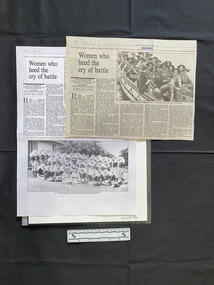
Newspaper - Newspaper clipping and photocopy of a newspaper clipping, The Weekend Review, Women who heed the cry of battle, 19920606
... ...Royal Australian Army Nursing Service... Australian Army Nursing Corps RAANC Royal Australian Army Nursing Service RAANS Thelma May McEachern (neé Bell) 'L.7.' ...A book review by Mary Rose Liverani of 'Guns and Brooches: Australian Army Nursing from the Boer War to the Gulf War' by Jan Bassett. Images of nurse from 2/12th Australian General Hospital (AGH) and 10th AGH including Thelma [May] McEachern [neé Bell].A newspaper clipping and a photocopy of same, consisting of title, five columns of text and a black and white photo (two photos on the photocopy). The photo on both the clipping and the photocopy shows a large group of women in nurse's uniforms in a boat. The photo at the bottom of the photocopy shows a large group of women in nurse's uniforms and a man in an army uniform organised for a group photo outside.'L.7.' [crossed out, blue ink, top left] 'Page 7.' [blue ink, top left] 'WWII' [only on the photocopy, half way down, right side] 'NC9' [reverse side, blue ink, top left]jan bassett, australian army nursing service, aans, royal australian army nursing corps, raanc, royal australian army nursing service, raans, thelma may mceachern (neé bell) -
 National Vietnam Veterans Museum (NVVM)
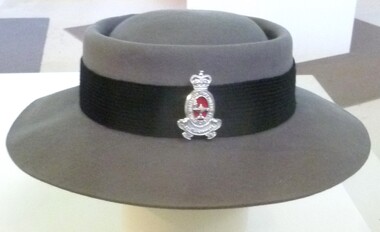
Headwear, Nurses hat
... Grey felt wide brim hat with black hatband and red and silver corps badge of the Royal Australian Army Nursing Corps. Service Dress Hat...Nurse Hat Barbara Frances Black T/Captain Hat badge - 'Royal Australian Army Nursing Corps', 'Pro Humanitate' Grey felt wide brim hat with black hatband and red and silver corps badge of the Royal Australian Army Nursing Corps. Service ...Grey felt wide brim hat with black hatband and red and silver corps badge of the Royal Australian Army Nursing Corps. Service Dress HatHat badge - 'Royal Australian Army Nursing Corps', 'Pro Humanitate'nurse, hat, barbara frances black, t/captain -
 Returned Nurses RSL Sub-branch
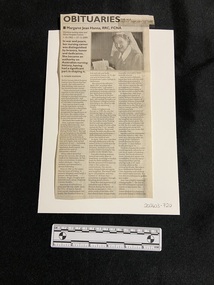
Document - Newspaper clipping, The Age, Obituaries: Margaret Jean Hanna RRC, FCNA, Friday January 12, 2001
... Royal Red Cross...Australian Army Nursing Service (AANS)...Obituary for Margaret Jean Hanna, Australian Nursing Sister, and awardee of the Royal Red Cross for outstanding military service during World War II. Published in The Melbourne Age newspaper, following her passing on December 27, 2000. World War Two WW2 WWII Australian Army ...Obituary for Margaret Jean Hanna, Australian Nursing Sister, and awardee of the Royal Red Cross for outstanding military service during World War II. Published in The Melbourne Age newspaper, following her passing on December 27, 2000.Newspaper clipping with heading typed in bold at the top and three columns of text. At the top of the first column is one paragraph in bold type. At the top of the other two columns is a photo of a woman holding a document, wearing a nurses uniform.world war two, ww2, wwii, australian army nurses, margaret jean hanna, jean hanna, royal red cross, australian army nursing service (aans) -
 Returned Nurses RSL Sub-branch
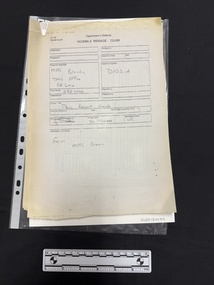
Document - Facsimilie and photocopy of Service Record, Department of Defence, 19910918
... Royal Red Cross...Australian Army Nursing Service...Information includes Shaw's biographical pre-enlistment details, ranks during service, leave details, unit served with, war service units and dates, general remarks including awards and termination information. WWII WW2 World War 2 Edith Lydia Shaw Royal Red Cross Australian Army Nursing Service AANS Document on thermal fax paper held together with a white archival paperclip. ...Faxed document containing service records including personal record card, leave information and war service of Edith Lydia Shaw. Fax was received on 18 September 1991 from the Department of Defence DNS-A from MAS Brown. Information includes Shaw's biographical pre-enlistment details, ranks during service, leave details, unit served with, war service units and dates, general remarks including awards and termination information.Document on thermal fax paper held together with a white archival paperclip. Photocopy of same document also held together with a white archival paperclip. wwii, ww2, world war 2, edith lydia shaw, royal red cross, australian army nursing service, aans -
 Returned Nurses RSL Sub-branch
Photograph - 5 x 7 coloured photograph, unknown
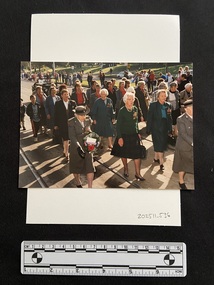
... Women participating in the ANZAC Day March in 1992 in Melbourne, representing the Nursing Services. They walk represent the Royal Australian Army Nursing Service (R.A.A.N.S.), Royal Australian Air Force Nursing Service RAAFNS), Royal Australian Army Nursing Corps (RAANC), and Queen Alexandra's Army Nursing Corps(QARANC). ...Women participating in the ANZAC Day March in 1992 in Melbourne, representing the Nursing Services. They walk represent the Royal Australian Army Nursing Service (R.A.A.N.S.), Royal Australian Air Force Nursing Service RAAFNS), Royal Australian Army Nursing Corps (RAANC), and Queen Alexandra's Army Nursing Corps(QARANC). ...Women participating in the ANZAC Day March in 1992 in Melbourne, representing the Nursing Services. They walk represent the Royal Australian Army Nursing Service (R.A.A.N.S.), Royal Australian Air Force Nursing Service RAAFNS), Royal Australian Army Nursing Corps (RAANC), and Queen Alexandra's Army Nursing Corps(QARANC). Returned Nurses and some of their family members walking along tram lines in the ANZAC Day March. Some of the women are in uniform and most are displaying their military medals and ribbons. There are onlookers lining the street in the background.'SG21-27' [Handwritten in blue ink on the back of the photo] 'ANZAC Day March 1992' [Lightly handwritten in pencil on the back]melbourne shrine of remembrance, australian army nursing service, royal austrlian army nursing corps, anzac day march, melbourne, anzac day, queen alexandra's royal army nursing corps, royal australian air force nursing service -
 Returned Nurses RSL Sub-branch
Photograph - 5 x 7 coloured photograph, 1992
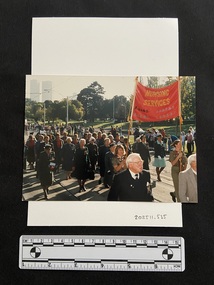
... Nursing Services. They walk behind the banner that represents Royal Australian Army Nursing Service (R.A.A.N.S.), Royal Australian Air Force Nursing Service RAAFNS), Royal Australian Army Nursing Corps (RAANC), and Queen Alexandra's Army Nursing Corps(QARANC). ...Nursing Services. They walk behind the banner that represents Royal Australian Army Nursing Service (R.A.A.N.S.), Royal Australian Air Force Nursing Service RAAFNS), Royal Australian Army Nursing Corps (RAANC), and Queen Alexandra's Army Nursing Corps(QARANC). ...Women participating in the ANZAC Day March in 1992 in Melbourne, representing the Nursing Services. They walk behind the banner that represents Royal Australian Army Nursing Service (R.A.A.N.S.), Royal Australian Air Force Nursing Service RAAFNS), Royal Australian Army Nursing Corps (RAANC), and Queen Alexandra's Army Nursing Corps(QARANC). A group of women, some wearing military uniforms and many displaying medals, marching behind two younger girls carrying the red Nursing Services banner in the ANZAC Day Parade in Melbourne. The street is lined with onlookers and there are trees and parkland in the background.'SG21-26' [Handwritten in blue ink on the back of the photo]melbourne shrine of remembrance, australian army nursing service, royal austrlian army nursing corps, anzac day march, melbourne, anzac day, queen alexandra's royal army nursing corps, royal australian air force nursing service -
 Waverley RSL Sub Branch
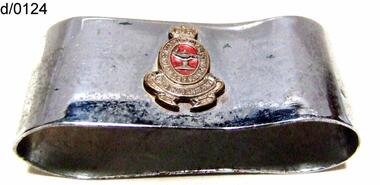
Serviette Holder with Royal Australian Army Nursing Corps. Badge
... The Royal Australian Army Nursing Corps (RAANC) is a Corps of the Australian Army. It was formed in February 1951 from the Royal Australian Army Nursing Service. ...The Royal Australian Army Nursing Corps (RAANC) is a Corps of the Australian Army. It was formed in February 1951 from the Royal Australian Army Nursing Service. ...The Royal Australian Army Nursing Corps (RAANC) is a Corps of the Australian Army. It was formed in February 1951 from the Royal Australian Army Nursing Service. A Corps Badge was introduced in 1951 with the motto Pro Humanitate (for Humanity). It embraces the values of compassion and service to others, reflecting the care and dedication provided to the wounded and sick. Approval for the Corps flag was granted on 7 February 1958. http://en.wikipedia.org/wiki/Royal_Australian_Army_Nursing_CorpsChromed metal Serviette Ring (with Royal Australian Army Nursing Corps. Badge) Royal Australian Army Nursing Corps. Badgeranc, nursing corps.australian army nursing service -
 Returned Nurses RSL Sub-branch
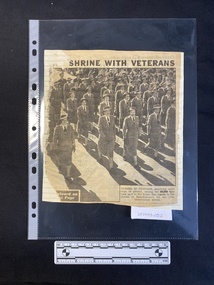
Newspaper - Newspaper clippings, The Age, '[?] shrine with veterans' [front of page], ' Memorial to nurses' [back of page], 20 Feb 1950
... A large crowd included those from the nursing and medical professions, the services as well as Lady and Miss Brooks and other dignitaries. During the service of dedication two addresses were given, with Miss Sage, Matron in Chief of the Royal Australian Army Nursing Service (RAANS), speaking on the courage, loyalty and devotion to duty that the nurses showed during the 1939-46 war. ...A large crowd included those from the nursing and medical professions, the services as well as Lady and Miss Brooks and other dignitaries. During the service of dedication two addresses were given, with Miss Sage, Matron in Chief of the Royal Australian Army Nursing Service (RAANS), speaking on the courage, loyalty and devotion to duty that the nurses showed during the 1939-46 war. ...Front page - The large photo is of nurses in uniform, marching more than 20 abreast. They join the [26,000] who were taking part in the Anzac Day march to the Shrine of Remembrance. Back page - Governor, Sir Dallas Brooks, opens the War Nurses' Memorial Centre on Feb 19 1950. A large crowd included those from the nursing and medical professions, the services as well as Lady and Miss Brooks and other dignitaries. During the service of dedication two addresses were given, with Miss Sage, Matron in Chief of the Royal Australian Army Nursing Service (RAANS), speaking on the courage, loyalty and devotion to duty that the nurses showed during the 1939-46 war. Miss Betty Jeffrey is the administrative officer of the centre that is available for use by all nursing organisations, including accommodations for nurses travelling from the country or out of state.Two newspaper clippings have been glued to either side of a lined sheet of paper. Front of page - a torn newspaper clipping of part of a title, a large black and white photo of women in nurse's uniforms marching and a caption. Back of page - a newspaper clipping of a black and white photo of a man in military uniform listening to four women in nurse's uniforms, with a story of two columns of text'Feb. 19th 1950' [blue ink, back of page, lower left]melbourne, wwii, ww2, st kilda road, jeanette brooks, muriel violet turner laing, thomas blamey, annie moriah sage, john latham, eleanor mary (ella) tobin, muriel brooks, eleanor latham, edmund herring, sydney fairbairn rowell, blanche may murison, blanche rowell, kingsley norris, richard gavin gardiner casey, ethel marian sumner (maie) ryan, ethel casey, kent hughes, edith kerr, edith hughes, college of nursing, australian nursing conference, melbourne town hall -
 Returned Nurses RSL Sub-branch
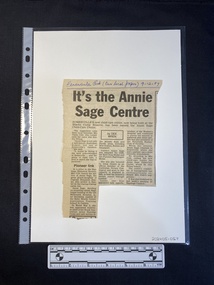
Newspaper - Newspaper clipping, [Peninsula Post], It's the Annie Sage centre, [1987]
... In World War 2 she was appointed matron-in-chief of the Royal Australian Army Nursing Corps and saw service in the Middle East and Pacific areas. ...In World War 2 she was appointed matron-in-chief of the Royal Australian Army Nursing Corps and saw service in the Middle East and Pacific areas. ...Somerville's new child-care centre has been named the Annie Sage Child-Care centre. Annie embarked on her nursing career by training at the old Melbourne Hospital, later becoming matron of the Baby Heath Centre Association Training School in Carlton. In World War 2 she was appointed matron-in-chief of the Royal Australian Army Nursing Corps and saw service in the Middle East and Pacific areas. Colonel Sage was awarded the CBE, the Red Cross Medal and the Florence Nightingale Medal. Later she appointed lady superintendent of the Women's Hospital. After retirement Annie returned to Somerville.A newspaper clipping of a story with a large title above three columns of text'Peninsula Post (Our local paper) 9-12-87' [blue ink, along top]melbourne, valda cole, hastings historical society, benjamin baxter, baxter, carrup-carrup, carlton, new guinea, borneo, singapore, australian victory contingent, england, london, returned nurses club, hastings council, raanc, order of the british empire -
 Frankston RSL Sub Branch
Plaque, Memorial, 1914-1918 Memorial Plaque, 1920 (estimated); Issued from 1920
... Families of deceased members of the Royal Australian Navy and the Australian Army Nursing Service also received plaques and scrolls ...Families of deceased members of the Royal Australian Navy and the Australian Army Nursing Service also received plaques and scrolls This plaque is significant because it commemorates the death of an Australian soldier on active service in World War 1. ...This round, bronze memorial plaque was presented to the family of Private Richard Evans Harkness, service number 3426, of the 37th Battalion, (8th Reinforcements) who was killed in action at Villers-Bretonneux on 12th August, 1918. Colloquially known as 'Dead Man's Penny' or 'King's Penny', this plaque was given to the next of kin of service personnel who died on active service in WW1. 1914-1918 Memorial Plaque In early 1920 it was announced that the next-of-kin of all Australian servicemen and women whose deaths were attributable to the First World War would receive a memorial plaque and scroll "as a solace for bereavement and as a memento". The memorial plaques were not uniquely Australian. In fact they were designed and produced in Britain and issued to commemorate all those who died as a result of war service from within the British Commonwealth. The idea for the plaques was originally conceived mid-way through the war. In 1917 a competition was announced to obtain a suitable design and 800 entries were eventually received. The winner, Mr. E. Carter Preston of Liverpool, England, was chosen in 1918. He was awarded a prize of 250 pounds. Mr Manning Pike directed the manufacture of the memorial plaques at the Memorial Plaque Factory set up at Acton, London. Some later plaques were also made at the Woolwich Arsenal. The cost of manufacturing so many plaques must have been considerable. Each plaque had the name of the soldier commemorated individually embossed (some were engraved) as part of the design. The full name was given without any indication of rank or honours to show the equality of sacrifice of all those who had lost their lives. The scroll designed to accompany the plaques was of thick paper, headed by the royal coat-of-arms, and bore the following message: "He whom this scroll commemorates was numbered among those who, at the call of King and Country, left all that was dear to them, endured hardness, faced danger, and finally passed out of the sight of men by the path of duty and self-sacrifice, giving up their own lives that others might live in freedom. Let those that come after see that his name is not forgotten". Underneath the message the serviceman or woman’s name, rank, honours and unit were written by hand in red ink. Because of the late arrival in Australia of the plaques many scrolls were sent out separately. A message from the King, "I join with my grateful people in sending you this memorial of a brave life given for others in the Great War", was included with the scroll. The first plaques were distributed in Australia in 1922. Each plaque was sent out from Base Records Office at Victoria Barracks in Melbourne by second-class mail. Approximately 60,000 plaques were issued in Australia. Families of deceased members of the Royal Australian Navy and the Australian Army Nursing Service also received plaques and scrolls This plaque is significant because it commemorates the death of an Australian soldier on active service in World War 1. It is representative of some 60,000 issued to next of kin of soldiers killed in World War 1. Although Richard Harness was living at 52 Victoria Street, Abbotsford when enlisted, together with a scroll from the King, it was donated by a Frankston Family.This round, bronze memorial plaque was presented to the family of Australian Army private Richard Evans Harkness, service number 03426, of the 37th battalion, 8th re-inforcement. Harkness was killed in action on 12th August, 1918, near the French village of Proyart, during the 3rd Division's advance along the Somme Valley. further details can be found here: https://www.awm.gov.au/collection/U51477 Colloquially known as 'Dead Man's Penny' or 'King's Penny', these plaques were awarded to the next of kin of service personnel who died on active service during WW1. refer to link for further information : http://www.awm.gov.au/encyclopedia/memorial_scroll/plaque.aspAround the edge are the words 'HE DIED FOR FREEDOM AND HONOUR' On the righthand side of the plaque is the name of the soldier, in this case Richard Evans Harkness.commemorative, memorial, plaque, dead, man s, penny, king s, richard, evans, harkness -
 Frankston RSL Sub Branch
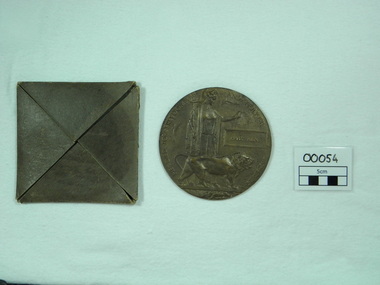
Plaque, Memorial, c. 1919
... Families of deceased members of the Royal Australian Navy and the Australian Army Nursing Service also received plaques and scrolls ...Families of deceased members of the Royal Australian Navy and the Australian Army Nursing Service also received plaques and scrolls ww1 dead mans penny kings penny memorial plaque Embossed around edge of plaque "HE DIED FOR FREEDOM AND HONOVR" Name of serviceman embossed on plaque right of centre "HARRY MILNE" Bronze Memorial Plaque 1914-1918 for 4876 Pte. ...Originally would have been issued with a scroll & letter from the King but neither with plaque. 1914-1918 Memorial Plaque In early 1920 it was announced that the next-of-kin of all Australian servicemen and women whose deaths were attributable to the First World War would receive a memorial plaque and scroll "as a solace for bereavement and as a memento". The memorial plaques were not uniquely Australian. In fact they were designed and produced in Britain and issued to commemorate all those who died as a result of war service from within the British Commonwealth. The idea for the plaques was originally conceived mid-way through the war. In 1917 a competition was announced to obtain a suitable design and 800 entries were eventually received. The winner, Mr. E. Carter Preston of Liverpool, England, was chosen in 1918. He was awarded a prize of 250 pounds. Mr Manning Pike directed the manufacture of the memorial plaques at the Memorial Plaque Factory set up at Acton, London. Some later plaques were also made at the Woolwich Arsenal. The cost of manufacturing so many plaques must have been considerable. Each plaque had the name of the soldier commemorated individually embossed (some were engraved) as part of the design. The full name was given without any indication of rank or honours to show the equality of sacrifice of all those who had lost their lives. The scroll designed to accompany the plaques was of thick paper, headed by the royal coat-of-arms, and bore the following message: "He whom this scroll commemorates was numbered among those who, at the call of King and Country, left all that was dear to them, endured hardness, faced danger, and finally passed out of the sight of men by the path of duty and self-sacrifice, giving up their own lives that others might live in freedom. Let those that come after see that his name is not forgotten". Underneath the message the serviceman or woman’s name, rank, honours and unit were written by hand in red ink. Because of the late arrival in Australia of the plaques many scrolls were sent out separately. A message from the King, "I join with my grateful people in sending you this memorial of a brave life given for others in the Great War", was included with the scroll. The first plaques were distributed in Australia in 1922. Each plaque was sent out from Base Records Office at Victoria Barracks in Melbourne by second-class mail. Approximately 60,000 plaques were issued in Australia. Families of deceased members of the Royal Australian Navy and the Australian Army Nursing Service also received plaques and scrolls Bronze Memorial Plaque 1914-1918 for 4876 Pte. Harry Milne , 46 Battalion KIA 10/5/1918, In a cardboard square envelope. http://www.awm.gov.au/research/people/roll_of_honour/person.asp?p=493414Embossed around edge of plaque "HE DIED FOR FREEDOM AND HONOVR" Name of serviceman embossed on plaque right of centre "HARRY MILNE"ww1, dead mans penny, kings penny, memorial plaque -
 Lara RSL Sub Branch
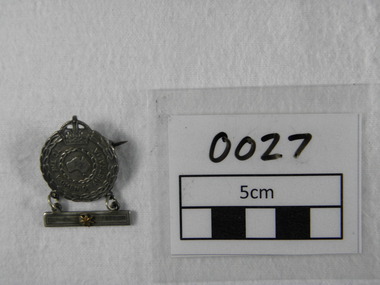
Badge, Angus and Coote, To The Woman of Australia Badge, 1942
... In the Second World War there was only one badge issued to the nearest female relative of members of the RAN, the Australian Imperial Force (including members of the Australian Army Nursing Service), and the Royal Australian Air Force on active service abroad. ...In the Second World War there was only one badge issued to the nearest female relative of members of the RAN, the Australian Imperial Force (including members of the Australian Army Nursing Service), and the Royal Australian Air Force on active service abroad. ...In the Second World War there was only one badge issued to the nearest female relative of members of the RAN, the Australian Imperial Force (including members of the Australian Army Nursing Service), and the Royal Australian Air Force on active service abroad. Stars displayed on a bar suspended below the badge represented the number of relatives involved in the war effort. Authority for the issue of the badge in the Second World War was issued under AIF Order 200 dated 14 February 1941.Metal badge with crown on top & bar underneath with 1 star.'TO THE WOMAN OF AUSTRALIA'. Map of Australia in centre of wreath. On reverse side issued by the Commonwealth Government. No 'A100853' world war two, royal australian air force, australian imperial force, australian army nursing service -
 City of Moorabbin Historical Society (Operating the Box Cottage Museum)
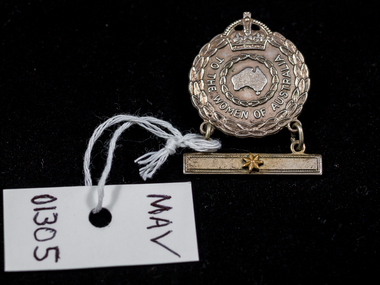
WW2 Medal for Women relatives of serving soldiers, 1942
... For active service abroad during the Second World War, a single badge was issued to the nearest female relative of members of the RAN, the Australian Imperial Force (including members of the Australian Army Nursing Service), and the Royal Australian Air Force. ...For active service abroad during the Second World War, a single badge was issued to the nearest female relative of members of the RAN, the Australian Imperial Force (including members of the Australian Army Nursing Service), and the Royal Australian Air Force. ...Female Relative Badges were issued to the nearest female relative (usually wives or mothers) of those who engaged in active service overseas during the First and Second World Wars. For active service abroad during the Second World War, a single badge was issued to the nearest female relative of members of the RAN, the Australian Imperial Force (including members of the Australian Army Nursing Service), and the Royal Australian Air Force. Stars displayed on a bar suspended below the badge represented the number of relatives involved in the war effort. Authority for the issue of the badge was given under AIF Order 200,14 February 1941. This medal was given to Veronica ( White ) Roper in 1942 because her husband Alfred William Roper was a member of the Australian Army Signals Corp serving in New Guinea. Emma Olymphia Roper of Balaclava/ Ripponlea would also have received a medal like this with 4 four stars because her 4 sons were serving in the Australian Army 1939-45 This Military Medal was given to the wives and mothers of Australian Soldiers serving during World War 2 1939-1945Silver medal, engraved wreath of leaves, crown and map of Australia and pin clasp on back . A bar with one star is suspendedAround medal : For the Women of Australia Back : Issued by the / C'wealth Govt. / A 135699 / Angus & Coote / 1942 Bar : star/ asteriskworld war 1939-1945, military medals, roper alfred william , roper veronica, moore joan catherine, roper arthur leopold, roper emma olymphia, war memorials, bentleigh, city of moorabbin, totally and permanently invalid, returned service league, victoria barracks, department of defence australia, -
 Bendigo Military Museum
Book - BOOK, RELIGIOUS, Australian Army, c1953-54
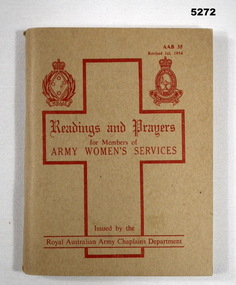
... Army Services Religion Inside front cover is written in blue ink - F3/631. Georgina M Peters. Booklet cover is khaki coloured cardboard. Printing is in red ink; centre motif is a cross. Top LHS has the crest of WRAAC. Top RHS has Crest of Army Nursing Corp. At bottom of cross is painted issued by the Royal Australian ...Refer to Service of Margaret Dodd (nee Lambie). See Cat 5019.3. Foreword is by HRH Duchess of Gloucester.Booklet cover is khaki coloured cardboard. Printing is in red ink; centre motif is a cross. Top LHS has the crest of WRAAC. Top RHS has Crest of Army Nursing Corp. At bottom of cross is painted issued by the Royal Australian Army Chaplains Department. The book has 181 pages. Printed in black ink.Inside front cover is written in blue ink - F3/631. Georgina M Peters.womens army services, religion -
 Bendigo Military Museum
Badge - BADGES, VARIOUS, Possible WW1 through to Post WW2
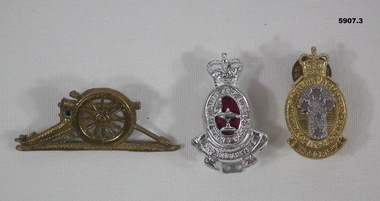
... Items in collection re John D Gardiner No 2832, refer Cat No 5892.2 for his service details. badges artillery nursing pay .2) "Royal Australian Army Pay Corps, Integrity" .3) Royal Australian Army Nursing Corps, Pro Humanitate" .1) Badge pressed brass, shape is of an old style Artillery piece on large wheels, rear has two lugs on. .2) Badge, metals crown at top, centre has 5 stars in silver, outside is oval shape with lettering, scroll under, rear has two pins. .3) Badge silver colour metal, crown at top, oval shape, raised lettering, scroll under with same, pin on rear. ...Items in collection re John D Gardiner No 2832, refer Cat No 5892.2 for his service details..1) Badge pressed brass, shape is of an old style Artillery piece on large wheels, rear has two lugs on. .2) Badge, metals crown at top, centre has 5 stars in silver, outside is oval shape with lettering, scroll under, rear has two pins. .3) Badge silver colour metal, crown at top, oval shape, raised lettering, scroll under with same, pin on rear..2) "Royal Australian Army Pay Corps, Integrity" .3) Royal Australian Army Nursing Corps, Pro Humanitate"badges, artillery, nursing, pay -
Frankston RSL Sub Branch
Plaque, Memorial
... Families of deceased members of the Royal Australian Navy and the Australian Army Nursing Service also received plaques and scrolls ...Families of deceased members of the Royal Australian Navy and the Australian Army Nursing Service also received plaques and scrolls Embossed around the edge of the plaque "HE DIED FOR FREEDOM AND HONOVR". ...1914-1918 Memorial Plaque In early 1920 it was announced that the next-of-kin of all Australian servicemen and women whose deaths were attributable to the First World War would receive a memorial plaque and scroll "as a solace for bereavement and as a memento". The memorial plaques were not uniquely Australian. In fact they were designed and produced in Britain and issued to commemorate all those who died as a result of war service from within the British Commonwealth. The idea for the plaques was originally conceived mid-way through the war. In 1917 a competition was announced to obtain a suitable design and 800 entries were eventually received. The winner, Mr. E. Carter Preston of Liverpool, England, was chosen in 1918. He was awarded a prize of 250 pounds. Mr Manning Pike directed the manufacture of the memorial plaques at the Memorial Plaque Factory set up at Acton, London. Some later plaques were also made at the Woolwich Arsenal. The cost of manufacturing so many plaques must have been considerable. Each plaque had the name of the soldier commemorated individually embossed (some were engraved) as part of the design. The full name was given without any indication of rank or honours to show the equality of sacrifice of all those who had lost their lives. The scroll designed to accompany the plaques was of thick paper, headed by the royal coat-of-arms, and bore the following message: "He whom this scroll commemorates was numbered among those who, at the call of King and Country, left all that was dear to them, endured hardness, faced danger, and finally passed out of the sight of men by the path of duty and self-sacrifice, giving up their own lives that others might live in freedom. Let those that come after see that his name is not forgotten". Underneath the message the serviceman or woman’s name, rank, honours and unit were written by hand in red ink. Because of the late arrival in Australia of the plaques many scrolls were sent out separately. A message from the King, "I join with my grateful people in sending you this memorial of a brave life given for others in the Great War", was included with the scroll. The first plaques were distributed in Australia in 1922. Each plaque was sent out from Base Records Office at Victoria Barracks in Melbourne by second-class mail. Approximately 60,000 plaques were issued in Australia. Families of deceased members of the Royal Australian Navy and the Australian Army Nursing Service also received plaques and scrolls First World War Memorial Plaque, bronze, in recognition of Private Sydney Frederick TURNER, from C Company, 9 Battalion who was KIA at Pozieres on 25 July, 1916. it is housed in a wooden surround with pattern embossed in the margins with a liking of the rising sun at the top. He is recorded on the Villers-Bretonneux Memorial and is listed with an Australian Red Cross Society Wounded and Missing Enquiry Bureau File, a copy of which is attached.Embossed around the edge of the plaque "HE DIED FOR FREEDOM AND HONOVR". The name of the serviceman is embossed on the plaque, right of centre, SYDNEY FREDERICK TURNER -
Frankston RSL Sub Branch
Collection, A. E. Bolger
... Families of deceased members of the Royal Australian Navy and the Australian Army Nursing Service also received plaques and scrolls ...Families of deceased members of the Royal Australian Navy and the Australian Army Nursing Service also received plaques and scrolls Collection of items relating to the death of Private Arthur Ernest Bolger, service number 01338, 14th Battalion, Australian Imperial Forces, who was killed in action at Gallipoli on 27th April, 1915. ...1914-1918 Memorial Plaque In early 1920 it was announced that the next-of-kin of all Australian servicemen and women whose deaths were attributable to the First World War would receive a memorial plaque and scroll "as a solace for bereavement and as a memento". The memorial plaques were not uniquely Australian. In fact they were designed and produced in Britain and issued to commemorate all those who died as a result of war service from within the British Commonwealth. The idea for the plaques was originally conceived mid-way through the war. In 1917 a competition was announced to obtain a suitable design and 800 entries were eventually received. The winner, Mr. E. Carter Preston of Liverpool, England, was chosen in 1918. He was awarded a prize of 250 pounds. Mr Manning Pike directed the manufacture of the memorial plaques at the Memorial Plaque Factory set up at Acton, London. Some later plaques were also made at the Woolwich Arsenal. The cost of manufacturing so many plaques must have been considerable. Each plaque had the name of the soldier commemorated individually embossed (some were engraved) as part of the design. The full name was given without any indication of rank or honours to show the equality of sacrifice of all those who had lost their lives. The scroll designed to accompany the plaques was of thick paper, headed by the royal coat-of-arms, and bore the following message: "He whom this scroll commemorates was numbered among those who, at the call of King and Country, left all that was dear to them, endured hardness, faced danger, and finally passed out of the sight of men by the path of duty and self-sacrifice, giving up their own lives that others might live in freedom. Let those that come after see that his name is not forgotten". Underneath the message the serviceman or woman’s name, rank, honours and unit were written by hand in red ink. Because of the late arrival in Australia of the plaques many scrolls were sent out separately. A message from the King, "I join with my grateful people in sending you this memorial of a brave life given for others in the Great War", was included with the scroll. The first plaques were distributed in Australia in 1922. Each plaque was sent out from Base Records Office at Victoria Barracks in Melbourne by second-class mail. Approximately 60,000 plaques were issued in Australia. Families of deceased members of the Royal Australian Navy and the Australian Army Nursing Service also received plaques and scrolls Collection of items relating to the death of Private Arthur Ernest Bolger, service number 01338, 14th Battalion, Australian Imperial Forces, who was killed in action at Gallipoli on 27th April, 1915. Private Bolger was from Victoria and was recorded as being the first Frankston serviceman to be killed in the ANZAC landing at Gallipoli. For more information refer: < > see items 00014.1 and 00014.2 -
 Alfred Hospital Nurses League - Nursing History Collection
Book - Illustrated Book, Richard Reid (1944-) et al, Just wanted to be there: Australian Service Nurses 1899-1999, 1999
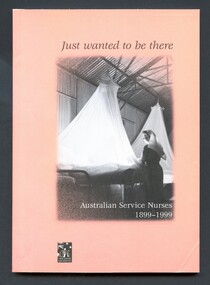
... Published to commemorate the centenary of the RAANC and to coincide with the opening of the Australian Service Nurses National Memorial on ANZAC Parade, Canberra Of significance to the AHNL as many Alfred graduates served. Military nursing-Australia-History Nurses-Australia-History Australian Army Nurses A history of the Royal Australian Army Nursing Service 1899-1999 At the bottom right of the titlepage is a printed black and white donation sticker: black Maltese cross in circle, "This book was donated to Alfred Archival Association Nursing Division by" Norma Hodge (handwritten in black ink) Also previous catalogue number handwritten in black ink on this sticker. ...A history of the Royal Australian Army Nursing Service 1899-1999Illustrated book with dust pink cover. front cover has a black and white photograph of s nurse with two hospital beds covered with mosquito tents (No 74 Camp Hospital, Katherine, NT, 1945). Part of title printed in black ink above this photo, remainder of title overprinted in white ink at the bottom of this photo. Below this is a small rectangular illustration and words: their service our heritage. Title is also printed in black ink on spine along with publishers logonon-fictionA history of the Royal Australian Army Nursing Service 1899-1999military nursing-australia-history, nurses-australia-history, australian army nurses -
 Alfred Hospital Nurses League - Nursing History Collection
Book - Illustrated Book, Richard Reid (1944-) et al, Just wanted to be there: Australian Service Nurses 1899-1999- Duplicate Copy, 1999
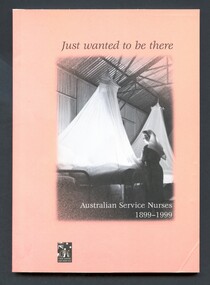
... Published to commemorate the centenary of the RAANC and to coincide with the opening of the Australian Aervice nurses National Memomorial on ANZAC Parade, Canberra Of significance to the AHNL as Alfred graduates/staff were among those who served Military nursing-Australia-History Nuses-Australia-History Australia Army-Nurses A history of the Royal Australian Army Nursing Service 1899-1999 At the bottom right of the titlepage is a printed black and white donation sticker: black Maltese cross in circle, "This book was donated to Alfred Archival Association Nursing Division by" Norma Hodge (handwritten in black ink) Also previous catalogue number handwritten in black ink on this sticker. ...A history of the Royal Australian Army Nursing Service 1899-1999Illustrated book with dust pink cover. front cover has a black and white photograph of s nurse with two hospital beds covered with mosquito tents (No 74 Camp Hospital, Katherine, NT, 1945). Part of title printed in black ink above this photo, remainder of title overprinted in white ink at the bottom of this photo. Below this is a small rectangular illustration and words: their service our heritage. Title is also printed in black ink on spine along with publishers logo.non-fictionA history of the Royal Australian Army Nursing Service 1899-1999military nursing-australia-history, nuses-australia-history, australia army-nurses -
 National Vietnam Veterans Museum (NVVM)
Medal - Medal, Replica
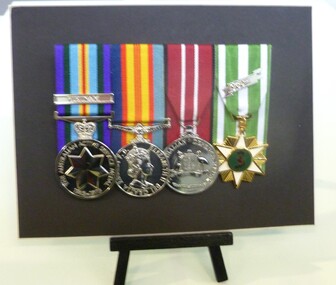
... The following replica medals belonged to Barbara Frances Black, Royal Australian Army Nursing Corps, Unit: 1 Field Hospital. Vietnam Service: 14 may 1968 - 16 April 1969. ...The following replica medals belonged to Barbara Frances Black, Royal Australian Army Nursing Corps, Unit: 1 Field Hospital. Vietnam Service: 14 may 1968 - 16 April 1969. ...The following replica medals belonged to Barbara Frances Black, Royal Australian Army Nursing Corps, Unit: 1 Field Hospital. Vietnam Service: 14 may 1968 - 16 April 1969. Date of death: 3 November 1971, Fitzroy, Victoria. Barbara Black was the only woman casualty of the Vietnam War, dying from illness incurred while on active service. Australian Active Service Medal 1945-1975 with clasp 'Vietnam'. The AASM 1945 - 75 was approved in 1997. It was awarded for service in, or in connection with, prescribed warlike operations from 3 September 1945 until 13 February 1975. Vietnam Medal: The Vietnam Medal was instituted in 1968 and awarded for service in Vietnam between 29 May 1964 and 27 January 1973. The Vietnam Medal was issued under the Imperial System but was mainly awarded to Australian and New Zealand personnel. Republic of Vietnam Campaign Medal 1960- this medal was issued by the Government of the Republic of Vietnam for service in the prescribed area of operations in Vietnam during the period from 31 July 1962 to 27 January 1973.1x Australian Active Service Medal 45-75 Vietnam 1x Vietnam Medal 1x Australian Defence Medal 1x Republic of Vietnam Campaign Medal 1960-australian, medals, barbara frances black, t/captain -
 National Vietnam Veterans Museum (NVVM)
Uniform - Royal Australian Army Nursing Corps uniform (ward)
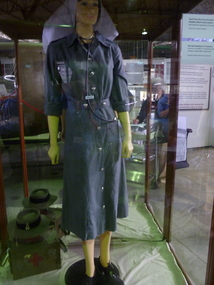
... nursing sister 1st Australian Field Hospital, South Vietnam 1969 Lt. Diane Elizabeth Lawrence Australian Army F25240 Royal Australian Army Nursing Corps 1st Australian Field Hospital Australian Army Nurses On dog tags - D.E. Lawerence - service ...Lieutenant Diane Lawrence as a nursing sister 1st Australian Field Hospital, South Vietnam 1969Australian Army Nurse uniform - grey and white veil, silver buttons, black lace up shoes, dog tags and stethescope.On dog tags - D.E. Lawerence - service no. F2540, 1st Australian Field Hospitallt. diane elizabeth lawrence, australian army, f25240, royal australian army nursing corps, 1st australian field hospital, australian army nurses -
 Alfred Hospital Nurses League - Nursing History Collection
Book - Illustrated book, Gay Halstead 1929, Story of the RAAF Nursing Service 1940-1990, 1994
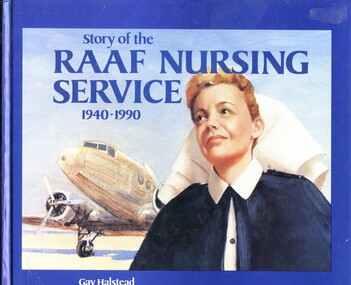
... Celebrates the first fifty years of the RAAFNS Of significance to the AHNL as it records another career path for nurses Royal Australian Air Force Nursing Service-History World War 1939-1945-Medical Care-Australia Military Nursing-Australia Nurses Nursing Established in July 1914, the Royal Australian Airforce Nursing Service (RAAFNS) personnel expanded from 45 in December 1940 to 616 in December 1945. Miss Margaret Irene Lang was appointed Matron-in -Chief and her staff's conditions in service were similar to those of the Australian Army ...Established in July 1914, the Royal Australian Airforce Nursing Service (RAAFNS) personnel expanded from 45 in December 1940 to 616 in December 1945. Miss Margaret Irene Lang was appointed Matron-in -Chief and her staff's conditions in service were similar to those of the Australian Army Nursing Service. The nurses were originally attached to RAAF bases in Australia but later served in New Guinea and the Pacific Islands. With the Medical Air Evacuation Transport Unit (MAETU), established in 1944, nurses helped with aerial evacuation of casualties and were involved with the liberation of Prisoners of War from Singapore and other areas. The service was disbanded at the end of World War Two, but in 1948 a peace-time service was formed, and the RAAF nurses have served in the Korean War, the Malayan Emergency and the Vietnam War. They continue to care for the sick and injured at RAAF hospitals. Includes honours, awards and the nominal roll of RAAFNS 1940-1952.Illustrated book with blue cover. Front cover has a coloured illustration by Vivian and Marjorie Mare of a nurse in uniform standing in front of a plane, the title is printed in blue and the author's name printed in white. Title and author's name are also printed in white on the spine. The back cover has a collage of black and white photographs of RAAF personnel including nurses. Limited edition of 1000 copies.non-fictionEstablished in July 1914, the Royal Australian Airforce Nursing Service (RAAFNS) personnel expanded from 45 in December 1940 to 616 in December 1945. Miss Margaret Irene Lang was appointed Matron-in -Chief and her staff's conditions in service were similar to those of the Australian Army Nursing Service. The nurses were originally attached to RAAF bases in Australia but later served in New Guinea and the Pacific Islands. With the Medical Air Evacuation Transport Unit (MAETU), established in 1944, nurses helped with aerial evacuation of casualties and were involved with the liberation of Prisoners of War from Singapore and other areas. The service was disbanded at the end of World War Two, but in 1948 a peace-time service was formed, and the RAAF nurses have served in the Korean War, the Malayan Emergency and the Vietnam War. They continue to care for the sick and injured at RAAF hospitals. Includes honours, awards and the nominal roll of RAAFNS 1940-1952.royal australian air force nursing service-history, world war 1939-1945-medical care-australia, military nursing-australia, nurses, nursing -
 Alfred Hospital Nurses League - Nursing History Collection
Book - Illustrated book, Rupert Goodwin 1915, Queensland nurses: Boer War to Vietnam, 1985
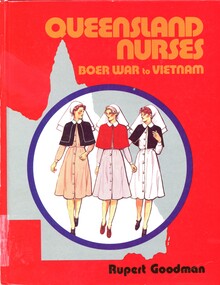
... nursing services within a blue circle. Also on the front cover is the title printed in orange and authors name printed in black. Title in orange, author's surname and publishers mark in black are also printed on the spine. On the back cover in black print on a yellow rectangle the AANS pledge of service. Above this is an illustration of the Australian Commonwealth Military Forces badge, and below is the badge of the Royal Australian Army...nursing services within a blue circle. Also on the front cover is the title printed in orange and authors name printed in black. Title in orange, author's surname and publishers mark in black are also printed on the spine. On the back cover in black print on a yellow rectangle the AANS pledge of service. Above this is an illustration of the Australian Commonwealth Military Forces badge, and below is the badge of the Royal Australian Army ...A history of the development and practice of military nursing by Queensland nurses from the Boer War to Vietnam. Includes casualty list and list of decorations awarded to Queensland nurses.Illustrated book with red cover. The front cover has an outline of Queensland on which is printed an illustration of three women in the uniforms of the three military nursing services within a blue circle. Also on the front cover is the title printed in orange and authors name printed in black. Title in orange, author's surname and publishers mark in black are also printed on the spine. On the back cover in black print on a yellow rectangle the AANS pledge of service. Above this is an illustration of the Australian Commonwealth Military Forces badge, and below is the badge of the Royal Australian Army Nursing Corps.non-fictionA history of the development and practice of military nursing by Queensland nurses from the Boer War to Vietnam. Includes casualty list and list of decorations awarded to Queensland nurses.royal australian army nursing corps-history, military nursing-queensland-history, nurses-queensland-history, medicine-military-history-australia -
 Alfred Hospital Nurses League - Nursing History Collection
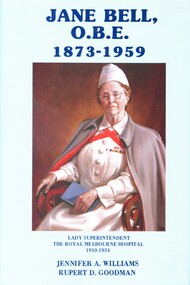
Book - Illustrated book, Jennifer Ann Williams et al, Jane Bell, O.B.E. 1873-1959: Lady Superintendent the Royal Melbourne Hospital 1910-1934, 1988
... Jane Bell Nurse administrators-Victoria-biography Royal Melbourne Hospital Nursing-Education This book explores the life and contributions of Jane Bell, who served as the Lady Superintendent at the Royal Melbourne Hospital. It provides insights into her leadership from 1910 to 1934 and highlights her legacy in the nursing profession, including a good account of her service as a Principal Matron in the Australian Army Nursing Service during World War 1. ...This book explores the life and contributions of Jane Bell, who served as the Lady Superintendent at the Royal Melbourne Hospital. It provides insights into her leadership from 1910 to 1934 and highlights her legacy in the nursing profession, including a good account of her service as a Principal Matron in the Australian Army Nursing Service during World War 1.Illustrated book with dustjacket. Book has a cerulean blue cover, with the emblem of the Royal Melbourne Hospital nurse training school embossed in gilt on the front. Abbreviated title and authors names are embossed in gilt on the spine. The dust jacket has a pale blue background, with title and authors names printed in dark blue ink on the front and spine. Also on the front cover is a coloured illustration of a nurse in uniform, wearing a cap and cape (portrait of Jane Bell O.B.E by Vernon Jones, 1948). On the back cover is a black and white photograph of doorway (What is now Jane Bell House, Lonsdale St Melbourne, formerly, the Melbourne Hospital, established 1846). non-fictionThis book explores the life and contributions of Jane Bell, who served as the Lady Superintendent at the Royal Melbourne Hospital. It provides insights into her leadership from 1910 to 1934 and highlights her legacy in the nursing profession, including a good account of her service as a Principal Matron in the Australian Army Nursing Service during World War 1.jane bell, nurse administrators-victoria-biography, royal melbourne hospital, nursing-education -
 Alfred Hospital Nurses League - Nursing History Collection
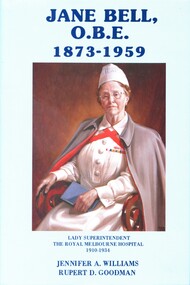
Book - Illustrated book, Jennifer Ann Williams et al, Jane Bell, O.B.E. 1873-1959: Lady Superintendent the Royal Melbourne Hospital 1910-1934, 1988
... Jane Bell Nurse administrators-Victoria-biography Royal Melbourne Hospital Nursing-Education This book explores the life and contributions of Jane Bell, who served as the Lady Superintendent at the Royal Melbourne Hospital. It provides insights into her leadership from 1910 to 1934 and highlights her legacy in the nursing profession, including a good account of her service as a Principal Matron in the Australian Army Nursing Service during World War 1. ...This book explores the life and contributions of Jane Bell, who served as the Lady Superintendent at the Royal Melbourne Hospital. It provides insights into her leadership from 1910 to 1934 and highlights her legacy in the nursing profession, including a good account of her service as a Principal Matron in the Australian Army Nursing Service during World War 1.Illustrated book with dustjacket. Book has a cerulean blue cover, with the emblem of the Royal Melbourne Hospital nurse training school embossed in gilt on the front. Abbreviated title and authors names are embossed in gilt on the spine. The dust jacket has a pale blue background, with title and authors names printed in dark blue ink on the front and spine. Also on the front cover is a coloured illustration of a nurse in uniform, wearing a cap and cape (portrait of Jane Bell O.B.E by Vernon Jones, 1948). On the back cover is a black and white photograph of doorway (What is now Jane Bell House, Lonsdale St Melbourne, formerly, the Melbourne Hospital, established 1846). non-fictionThis book explores the life and contributions of Jane Bell, who served as the Lady Superintendent at the Royal Melbourne Hospital. It provides insights into her leadership from 1910 to 1934 and highlights her legacy in the nursing profession, including a good account of her service as a Principal Matron in the Australian Army Nursing Service during World War 1.jane bell, nurse administrators-victoria-biography, royal melbourne hospital, nursing-education -
 Alfred Hospital Nurses League - Nursing History Collection
Book - text book, Frank V.G.Scholes 1885-1954, Nursing in acute infectious diseases, 1945
... A printed coloured bookfplate is affixed to the front end-page: Logo of the Royal Victorian College of Nursing, and the words ' Royal Victorian College of Nursing this Book was presentented to the college by Miss Rose Bouchaud, In memory of the Sisters of the Australian Army Nursing Service who served on the Hospital Ship - Centaur 1943- ' the path of Duty was the way to GLORY" Inside the front cover is a newspaper article from 1948 with information about the author. ...The author was medical superintendant of the Fair field Infectious Diseases Hospital 1910-1948 Of sigificance to the AHNl as it gives insight into nursing practisies in the 1940's Communicable diseases-nursing Infectious diseases-nursing nursing A textbook for the nusing of infectious dieases A printed coloured bookfplate is affixed to the front end-page: Logo of the Royal Victorian College of Nursing, and the words ' Royal Victorian College of Nursing this Book was presentented to the college by Miss Rose Bouchaud, In memory of the Sisters of the Australian Army Nursing Service who served on the Hospital Ship - Centaur 1943- ' the path of Duty was the way to GLORY" Inside the front cover is a newspaper article from 1948 with information about the author. ...A textbook for the nusing of infectious dieasesBook bound with embossed maroon cloth cover. Title, author.s surname and publisher's name embossed in gilt on spinenon-fictionA textbook for the nusing of infectious dieasescommunicable diseases-nursing, infectious diseases-nursing, nursing -
 Alfred Hospital Nurses League - Nursing History Collection
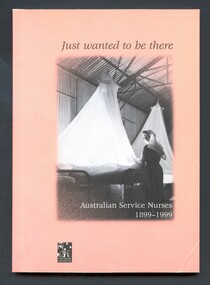
Booklet - Illustrated booklet, Richard Reid, Just wanted to be there: Australian Service Nurses 1899-1999, 1999
... Published to commemorate the centenary of the RAANC and to coincide with the opening of the Australian Service Nurses National Memorial on ANZAC Parade, Canberra Of significance to the AHNL as Alfred graduates/staff were among those who served Military Nursing-Australia Australia Army-Nurses nurses A history of the Royal Australian Army Nursing Service 1899-1999 previous catalogue number written at top right of front end page Illustrated book with dust pink cover. ...A history of the Royal Australian Army Nursing Service 1899-1999Illustrated book with dust pink cover. Front cover has a black and white photograph of a nurse with two hospital beds covered with mosquito tents (No 74 Camp Hospital, Katherine, NT, 1945) Below this is a small rectangular illustration and words: their service our heritage.non-fictionA history of the Royal Australian Army Nursing Service 1899-1999military nursing-australia, australia army-nurses, nurses -
Glen Eira Historical Society
Article - DAVIS, GERTRUDE
... It goes on to describe her distinguished career in the Australian Army Nursing Service both overseas (serving during World War 1); and her plus other nurses working at Caulfield Hospital. Royal ...This file contains 1 item: A print out of an article in the Western Mail dated 07/02/1919 entitled ‘A Woman’s Melbourne Letter, Melbourne, Jan 24’. It describes a society gathering of which one of the guests is Matron Gertrude Davis. It goes on to describe her distinguished career in the Australian Army Nursing Service both overseas (serving during World War 1); and her plus other nurses working at Caulfield Hospital.royal red cross (1st class), kaisar-i-hind, davis gertrude matron, elsternwick, caulfield hospital, australian army nursing service lemnos, victorian women’s army auxiliary corps (waac), medals, insignia, awards, hospitals, nursing, nursing homes, medical services, nurses, world war 1914-1918, wars, military history, military hospitals, hospital ships -
 Warrnambool and District Historical Society Inc.
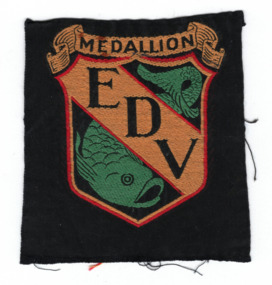
Cloth badge, Swimming award
... Mirth Marfell completed her nursing training at the Warrnambool Base Hospital and served in the Australian Army Nursing Service in World War Two for five years. She then became the first Australian nursing organizer for the Victorian Royal College of Nursing. ...Mirth Marfell completed her nursing training at the Warrnambool Base Hospital and served in the Australian Army Nursing Service in World War Two for five years. She then became the first Australian nursing organizer for the Victorian Royal College of Nursing. ...This badge was awarded to Mirth Marfell for a swimming award (Medallion - Education Department of Victoria). The award was given to students in Victorian schools for advanced prowess in swimming and lifesaving. Mirth Marfell was a student at Warrnambool High School in 1935 when she received the cloth badge for attaching to a blazer or other item of clothing. Warrnambool High School was established as an Agricultural High School in 1907 and, after a merger with Warrnambool North Technical School, it is known today as Warrnamboool College. Mirth Marfell, the daughter of Henry and Helena Marfell, was born in Warrnambool in 1919. Her grandfather, John Marfell, a Warrnambool hay and corn dealer and miller connected to the Warrnambool Co-operative Milling Company, was prominent in community and civic affairs in the town. Mirth Marfell completed her nursing training at the Warrnambool Base Hospital and served in the Australian Army Nursing Service in World War Two for five years. She then became the first Australian nursing organizer for the Victorian Royal College of Nursing. This cloth badge is of interest, firstly as an example of the badge given to students for swimming achievements in the 1930s in Victorian schools and secondly because it was awarded to Mirth Marfell, a Warrnambool person who had a distinguished nursing career.Rectangular machine embroidered cloth badge.. The front features a gold colored scroll with text, a red and gold bordered shield, a diagonal red bordered slash with text bisecting an emerald green fish on a black background. MEDALLION E D V mirth marfell, warrnambool high school, agricultural high school, warrnamboool college, warrnambool north technical school, history of warrnambool -
 Warrnambool and District Historical Society Inc.
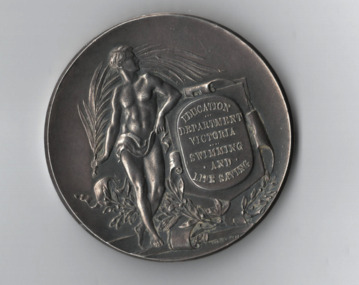
Medallion, Education Department Victoria
... Mirth Marfell completed her nursing training at the Warrnambool Base Hospital and served in the Australian Army Nursing Service in World War Two for five years. She then became the first Australian nursing organizer for the Victorian Royal College of Nursing. ...Mirth Marfell completed her nursing training at the Warrnambool Base Hospital and served in the Australian Army Nursing Service in World War Two for five years. She then became the first Australian nursing organizer for the Victorian Royal College of Nursing. ...This medallion was awarded to Mirth Marfell for swimming. The award was given to students in Victorian schools for advanced prowess in swimming and lifesaving. Mirth Marfell was a student at Warrnambool High School in 1935 when she received the medallion. Warrnambool High School was established as an Agricultural High School in 1907 and, after a merger with Warrnambool North Technical School, it is known today as Warrnamboool College. Mirth Marfell, the daughter of Henry and Helena Marfell, was born in Warrnambool in 1919. Her grandfather, John Marfell, a Warrnambool hay and corn dealer and miller connected to the Warrnambool Co-operative Milling Company, was prominent in community and civic affairs in the town. Mirth Marfell completed her nursing training at the Warrnambool Base Hospital and served in the Australian Army Nursing Service in World War Two for five years. She then became the first Australian nursing organizer for the Victorian Royal College of Nursing. This medallion is of interest, firstly as an example of the medallion given to students for swimming achievements in the 1930s in Victorian schools and secondly because it was awarded to Mirth Marfell, a Warrnambool person who had a distinguished nursing career.Circular metal medallion . Obverse features raised semi naked figure holding a cloth across the lower torso with one hand and a palm like branch in the other hand, an oval shield with text and decorative sprays of leaves. The reverse features the back of a naked female figure with long hair and a trident holding the hand of a child half immersed in the sea, another child"s head is raised above the sea. A lighthouse is featured on the distant shore. MIRTH MARFELL 1933. 34 on rim EDUCATION DEPARTMENT VICTORIA SWIMMING AND LIFE SAVINGmirth marfell, warrnambool co-operative milling company, australian army nursing service, history of warrnambool
