
Showing 211 items matching "royal bank"
-
 Bendigo Historical Society Inc.
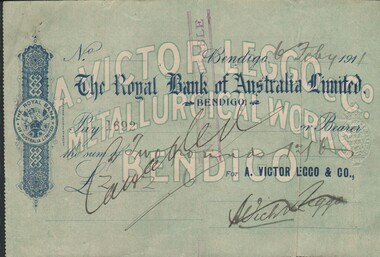
Document - CHEQUES (THE ROYAL BANK OF AUSTRALIA LIMITED), BENDIGO & MELBOURNE), 1911-1914
... CHEQUES (THE ROYAL BANK OF AUSTRALIA LIMITED), BENDIGO & MELBOURNE)...Cheques (The Royal Bank of Australia Limited), Bendigo & Melbourne) all to Account of A. ...ORGANIZATION Business bendigo businesses Cheques (The Royal Bank of Australia Limited), Bendigo & Melbourne) all to Account of A. ...Cheques (The Royal Bank of Australia Limited), Bendigo & Melbourne) all to Account of A. Victor Leggo a. No 5363 5/8/1914; b. 6/2/1911; c. 19/3/1912; d. 6/2/1911. A Victor Leggo - Metallurgical Works, Bendigo. Payments to various payees (identified only by a number).organization, business, bendigo businesses -
 Bendigo Historical Society Inc.
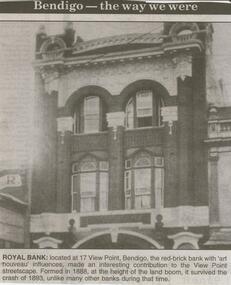
Newspaper - JENNY FOLEY COLLECTION: ROYAL BANK
... JENNY FOLEY COLLECTION: ROYAL BANK...Bendigo Advertiser ''The way we were'' from 2000. Royal Bank: located at 17 View Point, Bendigo, the red-brick bank with 'art nouveau' influences, made an interesting contribution to the View Point streetscape. ...Newspaper JENNY FOLEY COLLECTION: ROYAL BANK ...Bendigo Advertiser ''The way we were'' from 2000. Royal Bank: located at 17 View Point, Bendigo, the red-brick bank with 'art nouveau' influences, made an interesting contribution to the View Point streetscape. Formed in 1889, at the height of the land boom, it survived the crash of 1893, unlike many other banks during that time. The clip is in a folder.newspaper, bendigo advertiser, the way we were -
 Bendigo Historical Society Inc.
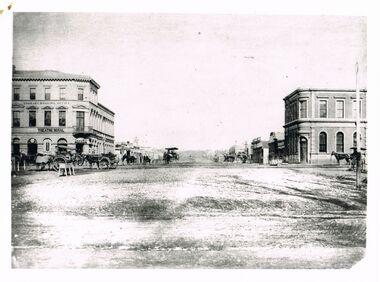
Photograph - WES HARRY COLLECTION: THEATRE ROYAL AND BANK OF AUSTRALASIA, WILLIAMSON ST. SANDHURSTG
... WES HARRY COLLECTION: THEATRE ROYAL AND BANK OF AUSTRALASIA, WILLIAMSON ST. SANDHURSTG......theatre royal... bank...Black and white image copy: image shows Theatre Royal, three storey building, on corner of Williamson Street. On opposite corner Bank of Australasia. ...PLACE Bendigo theatre royal bank of australasia Bendigo Sandhurst Bank of Australasia Theatre Royal Batchelder Black and white image copy: image shows Theatre Royal, three storey building, on corner of Williamson Street. ...Black and white image copy: image shows Theatre Royal, three storey building, on corner of Williamson Street. On opposite corner Bank of Australasia. Dirt Roads, horse and carriages on roadway. Horse trough on LH side on side of road.Batchelderplace, bendigo, theatre royal, bank of australasia, bendigo, sandhurst, bank of australasia, theatre royal -
 Wodonga & District Historical Society Inc
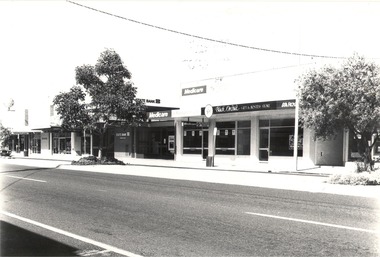
Photograph - Codling Collection 01 - Wodonga, High Street West - Gas company, State Bank, Medicare and Black Orchid, 1980s
... ...Royal Bank...The Medicare service was removed from Wodonga in 2015 and amalgamated with the Albury Service Centre. The Royal Bank (National Mutual Royal Bank) later merged with ANZ. ...Wodonga businesses High St Wodonga State Bank Medicare Wodonga Royal Bank Wodonga, High Street West Businesses including Gas company, ESANDA, State Bank of Victoria, Toyworld, Medicare, Black Orchid Gift and Hostess Store, and the Royal Bank. ...Miss Olive Codling was a Foundation Member and a Life Member of the Wodonga Historical Society. Many of her prize-winning photos are held in the Society Collection. She also held a range of roles and committee positions in a wide range of Wodonga community organisations. These included the Horticultural Society, the Wodonga Arts Council, the Wodonga Camera Club and the Wodonga Lapidary Club. This photo collection is significant as it documents how the businesses and buildings in Wodonga have evolved and contributed to community throughout the 20th century.Wodonga, High Street West Businesses including Gas company, ESANDA, State Bank of Victoria, Toyworld, Medicare, Black Orchid Gift and Hostess Store, and the Royal Bank. The State Bank of Victoria was taken over by the Commonwealth Bank in 1990. The Medicare service was removed from Wodonga in 2015 and amalgamated with the Albury Service Centre. The Royal Bank (National Mutual Royal Bank) later merged with ANZ. wodonga businesses, high st wodonga, state bank, medicare wodonga, royal bank -
 City of Ballarat Libraries
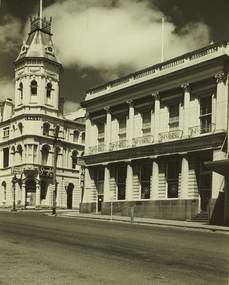
Photograph, Craig's Royal Hotel & Union Bank of Australia Building, Lydiard Street South, Ballarat
... Craig's Royal Hotel & Union Bank of Australia Building, Lydiard Street South, Ballarat......craig's royal hotel...union bank...The former Union Bank of Australia building was designed by Leonard Terry, the renowned bank architect, and was erected in 1863-4. lydiard street south craig's royal hotel union bank of australia terry, leonard Craig's Royal Hotel & Union Bank of Australia Building, Lydiard Street South, Ballarat Photograph ...An image from the Herbert Richmond collection, gifted in 1982 to the Ballarat Library. The collection contains approximately 200 photographs of Ballarat and district in the 1940s, 50s and 60s, as well as photo albums, glass negatives and other memorabilia. Herb Richmond was a keen photographer, a foundation member and a life member of the Ballarat Camera Club, and a photographer with the Ballarat Courier during the 1940s. The Ballarat Camera Club named an annual award after him. Mr Richmond died in 1981 aged 79. These images were digitally re-photographed by members of the Ballarat Camera Club in September 2006. The first site to be sold in Ballarat, where in 1853 Thomas Bath erected a timber building for use as a hotel. Parts of the present hotel date from 1862, when Walter Craig was owner. The hotel is associated with many historic figures, and no other hotel in Victoria has such an interesting succession of buildings and additions. The former Union Bank of Australia building was designed by Leonard Terry, the renowned bank architect, and was erected in 1863-4.lydiard street south, craig's royal hotel, union bank of australia, terry, leonard -
 Bendigo Historical Society Inc.
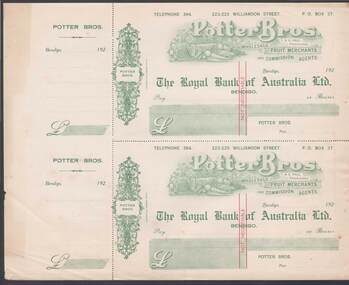
Document - CAMBRIDGE PRESS COLLECTION: CHEQUES - POTTER BROS
... ... The Royal Bank of Australia Ltd...Around this area are drawings of fruit and vegetables. The Royal Bank of Australia Ltd. Bendigo is printed in the centre. ...BUSINESS Printers cambridge press Cambridge Press Collection Potter Bros I & G Hall The Royal Bank of Australia Ltd Cambridge Press Sheet of two cheques with cheque butts. ...Sheet of two cheques with cheque butts. Printed at the top is Potter Bros. I & G Hall, Proprietors, Wholesale Fruit Merchants and Commission Agents. Around this area are drawings of fruit and vegetables. The Royal Bank of Australia Ltd. Bendigo is printed in the centre. On the left is a decorative area with Potter Bros. in the centre. Date line ends in 192-. Printed in green with red Not Negotiable across the centre.business, printers, cambridge press, cambridge press collection, potter bros, i & g hall, the royal bank of australia ltd, cambridge press -
 Federation University Historical Collection
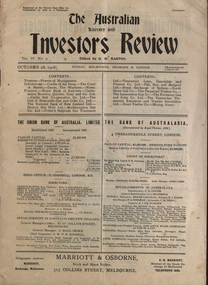
Magazine - Booklet, G.W. Barton, The Australian Literary and Investors Review, Vol IV, 1908, 28/10/1908
... ...royal bank of australia...investors g.w. barton bank of australasia royal bank of australia castlemaine brewery castle salt city of newcastle gas and coke co denton hat mills ltf national bank of new zealand potter's sulphide ore treatment ltd royal exchange of sydney north shore gas company perpetual trustee co. ltd launceston cas co footscray gas and coke co. ltd kauri timber co. new zealand 36 page magazine The Australian Literary and Investors Review, Vol IV, 1908 Magazine Booklet G.W. ...36 page magazine investors, g.w. barton, bank of australasia, royal bank of australia, castlemaine brewery, castle salt, city of newcastle gas and coke co, denton hat mills ltf, national bank of new zealand, potter's sulphide ore treatment ltd, royal exchange of sydney, north shore gas company, perpetual trustee co. ltd, launceston cas co, footscray gas and coke co. ltd, kauri timber co. new zealand -
 Bendigo Historical Society Inc.
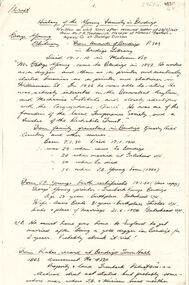
Document - MR AND MRS J B YOUNG: GEORGE YOUNG FAMILY GENEALOGY
... ... Bendigo Royal Bank...PERSON Individual Young Family Congrational Church Bendigo St Andrews College Myers Street Bendigo High School Austtralian Natives Association Ffederation League Mr Alfred Deakin Bendigo Nenevolent Asylum Bendigo Mechanice Institute Bendigo Royal Bank Bendigo Gas Company Bendigo and Eaglehawk Star Permanent Building Society Bendigo Stock Exchange. a. 7 handwritten pages (author - Grahame Robertson, 24 Duneba Avenue Pymble 2073 NSW, date?) ...a. 7 handwritten pages (author - Grahame Robertson, 24 Duneba Avenue Pymble 2073 NSW, date?) re ''History of the Young family in Bendigo''. George Young and J B Young; detailed genealogical information about both families; b.Copy of newspaper cutting (10/9/1936) re Mr and Mrs J B Young - Golden Wedding . Portrait photographs of both people. J B Young was son of George Young, one of the earliest pioneers of Bendigo (printing and stationery business). Mrs Young was daughter of Rev Joseph King, Minister of Congregational Church, Bendigo, 1874-1881. Further details in two columns of print. Other names; Anne Beale Young, John Beale Young, Frederick George Young, George Gibson Young, Miriam , Charlie Seymour, George Bolton, Fred Tuckerman, Mr Jennings, Mr. R. Gerdeson, Mr. Ron Hilton, Edith Dunlop, Sir. Michael Young.person, individual, young family, congrational church bendigo, st andrews college myers street, bendigo high school, austtralian natives association, ffederation league, mr alfred deakin, bendigo nenevolent asylum, bendigo mechanice institute, bendigo royal bank, bendigo gas company, bendigo and eaglehawk star permanent building society, bendigo stock exchange. -
 Ringwood and District Historical Society
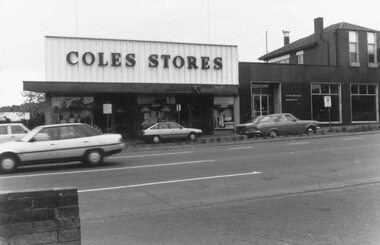
Photograph, Maroondah Highway Central, Ringwood. Coles Store and State Savings Bank of Victoria, 1986
... Bought for 1 1/4 million by Royal Bank, 1986"....Bought for 1 1/4 million by Royal Bank, 1986". Black and white photograph Maroondah Highway Central, Ringwood. ...Black and white photographWritten on back of photograph: "Coles Store, previously Foy & Gibson. Closed 1986. Bought for 1 1/4 million by Royal Bank, 1986". -
 Melbourne Tram Museum
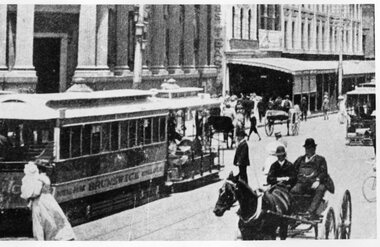
Photograph - Black & White Photograph/s, c1910
... At the corner with Collins Street. Royal Bank building on the corner....At the corner with Collins Street. Royal Bank building on the corner. Photograph Black & White Photograph/s ...Black and white copy print of a bogie cable trailer and grip car tram in Elizabeth Street, c1900 along with a horse drawn vehicle alongside. At the corner with Collins Street. Royal Bank building on the corner.On rear in ink "Melbourne, Bogie cable trailer in Elizabeth St City. Probably about." Has a Keith Kings Collection stamp.trams, tramways, cable trams, bogie cable trailers, elizabeth st, collins st -
 Bendigo Historical Society Inc.
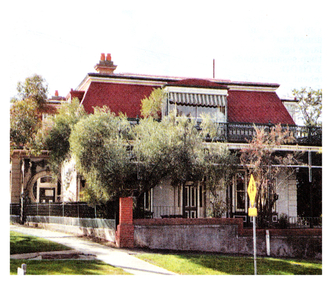
Newspaper - History Lives Article - "New Art Has Classic Touch", Jul 24 2008
... Local Examples are the Former Royal Bank Building (View Point): Built in 1908, designed by Beebe and Garin, now a restaurant. ...History Lives Article - "New Art Has Classic Touch" - The Bendigo Miner Thursday Jul 24 2008 - Author Jim Evans, photos Bill Conroy This item contains the following: 11217.13a Colour Photo of Cooloch House on the corner of View and Valentine Streets - was Lansell's 11217.12b Colour Photo of Verona at 159 Forest Street 11217.12c Colour Photo of the former Royal Bank building at View Point (now the Whirakee Restaurant) 11217.12d Part of page - New Art Has Classic Touch...Local Examples are the Former Royal Bank Building (View Point): Built in 1908, designed by Beebe and Garin, now a restaurant. ...Art Nouveau began in the 1880s as a reaction to classical, academic art. Itfeatures organic, especially floral motifs, highly stylized forms, and flowing curves. Artists aimed to integrate art into everyday life, influencing everything from architecture to furniture. Most outstanding examples are found in Riga (Latvia) and Brussels (Belgium), with Brussels townhouses recognized as UNESCO World Heritage sites for their architectural brilliance and historical importance. Local Examples are the Former Royal Bank Building (View Point): Built in 1908, designed by Beebe and Garin, now a restaurant. It survived the 1893 financial crash and stands out for its Art Nouveau influences. Denderah (now Cooloch House): Purchased and redecorated in 1910 by George Victor Lansell, featuring distinctive windows, colored glass, carved woodwork, and plaster ceilings. 159 Forest and Verona Street (Verona): Built in 1909 for Lawrence J. Murphy, notable for its cast-iron balustrade and curved woodwork, breaking traditional architectural lines.Contrast with Other StylesBendigo is known for its 19th-century classical buildings, but also features later styles like Art Nouveau and Art Deco. An upcoming Art Deco exhibition will be held at the Bendigo Art Gallery in September.History Lives Article - "New Art Has Classic Touch" - The Bendigo Miner Thursday Jul 24 2008 - Author Jim Evans, photos Bill Conroy This item contains the following: 11217.13a Colour Photo of Cooloch House on the corner of View and Valentine Streets - was Lansell's 11217.12b Colour Photo of Verona at 159 Forest Street 11217.12c Colour Photo of the former Royal Bank building at View Point (now the Whirakee Restaurant) 11217.12d Part of page - New Art Has Classic Touchnon-fictionbendigo, fortuna, george lansell, george victor lansell, denderah, cooloch, jim evans, art noveau -
 Port Fairy Historical Society Museum and Archives
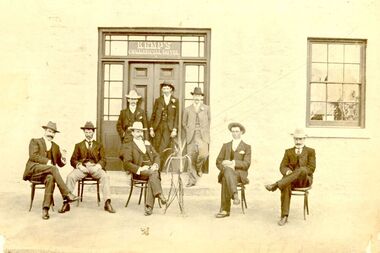
Photograph
... ...royal oak...bank...Photo possibly includes local men. hotel commercial royal oak bank street Kemp Oak and anchor Black and white Photograph of 8 males outside the entrance to the Commercial hotel Photograph Photograph ...John J. Huntly appears to have been the only licensee of the Royal Oak Hotel, built in 1858. Kemp’s Commercial Hotel c.1900 also know in its life as Royal Oak. Photo possibly includes local men.Black and white Photograph of 8 males outside the entrance to the Commercial hotelhotel, commercial, royal oak, bank street, kemp, oak and anchor -
 National Wool Museum
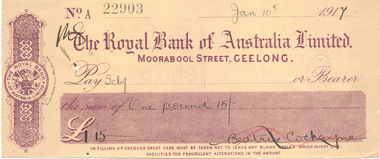
Cheque
... "The Royal Bank of Australia Lmited", Moorabol Street, Geelong, Jan 10th 1917..."The Royal Bank of Australia Lmited", Moorabol Street, Geelong, Jan 10th 1917 No. 22903 Beatrice Cockrayne Cheque ..."The Royal Bank of Australia Lmited", Moorabol Street, Geelong, Jan 10th 1917No. 22903 Beatrice Cockrayne -
 Bendigo Historical Society Inc.
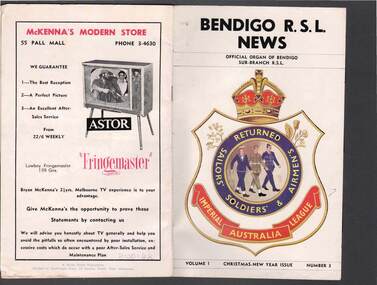
Document - R.S.L. BENDIGO COLLECTION: BENDIGO R.S.L. NEWS VOL. 1 NO. 3
... Bank... Royal Military College...F M Carson Tooranie House Brian Abe P E Dunstan A Lam Sun Don Murray Windermere Hotel Bendigo Disposals Frank A Hill & Co Fitzpatrick's Sandhurst Dairies Pty Ltd M Williamson George Symon's Dairy W H Oakley Sir Horace Robertson British Commonwealth Occupation Forces Australian Light Horse State Savings Bank Royal Military College Golden Fleece Service Station J W Williams Tomlins Simmie Pty Ltd Clark King & Co Pty Ltd McKenna's Modern Store Bryan McKenna Wicks Knott Publication Southdown Press A Wicks Knott Publication, Printed by Southdown Press, 33 Rosslyn Street, West Melbourne. ...Bendigo R.S.L. News Volume 1, Number 3 Christmas-New Year Issue. Red, blue, yellow and gold badge on the front cover. Contains advertisements from local businesses, Bendigo R.S.L. Office Bearers 1960, news, notes from Clubs, an article titled 'When the Japs Broke Out at Cowra' and a short obituary of Sir Horace Robertson.A Wicks Knott Publication, Printed by Southdown Press, 33 Rosslyn Street, West Melbourne.magazine, organization, bendigo rsl, r.s.l. bendigo collection - bendigo r.s.l. news vol. 1 no. 3, ashmans dry cleaners, h q radio service, f c straub, hampel furniture products, pierce grenfell, ron meurer, h w snell, axedale quarries, a l & k stringer, excavations, al & b g pearce, w mcculloch & co, bendigo motor co, m g taylor, fair-view upholsterers, alwyn nelson, northern terrazzo co, l fawssett & co, bendigo sub-branch r.s.s, &, a.i.l.a., col j w swatton, h a w morey, s thompson, g j baker, j k barnes, a c harridge, j harrison, t h hume, w h pinder, d e mcgregor, f e schilling, g g styles, c vaughan, j e fay, geo j baker, a v palmer, n mclaren young, e m vains & co, g e h rowell, a v & l e smith, j r palmers, graham lowe refrigeration service, a w pulfer motors, b r burns, vic palmer, golden square dry cleaners, j w carter & sons, alltyre service pty ltd, ian wills, bill nicholls jack watts, the robyn, a g power, leo a hughes, bendigo manchester house, frank wilson, hesse bros, frank bouchier, your typewriter sales and service, tom heenan, win patten, bendigo legacy, r wilson, w e p carruthers, antonian café, kairn's auto-bits, cohns, jeffreys bread, 4th armoured regt social club, g e baldwin, bendigo & district ex-p.o.w. social club, w hargreaves, d gregor, bendigo r.s.l. ladies auxiliary, mrs h morey, mrs p floyd, mrs w hocking, mrs h sims, mrs t hall, rsl women's council of victoria, mr & mrsa kersting, w coates, a bolitho, w hocking, n mcivor, perretts, martin washington, e a bennett pty ltd, john burgoyne, 38th battalion (a.i.f.) social club, j plim c findlay, ex-navelmen's club, t staley, airforce association, a stevens, t grimes, rats of tobruk association, j ferguson, catholic war veterans' association, j noonan, t coppock, dads' association, w murphy, bendigo legacy club, win patten, t h iser, t h runnalls, legacy house, 105 anti-tank regiment social club, alwyn nelson, laurie townsing, bendigo repatriation local committee, v w hosking, w rex porter, g a pethard, f t dunphy, l m porter, e h duus, lt col thomas waitson williams dso, ric coulson, r ball & son, lorraine florist, neol searle pty ltd, bendigo and district t & p i social club, e j taylor, t wellins, w phelan, g keily, l boyd, t tuddenham, e butler, g armstrong, geo j baker, easter fair society, bendigo agricultural society, 6th battalion (a.i.f.) social club, f t dunphy, w green, r c wright, bendigo showgrounds r.a.a.o.c. camp club, j j davies, e p perrett, t g heenan, w rex porter, fred coulson, harry hall, alan bath, tom hume, ted commons, geo h baker, percy floyd, stan hunter, joe wagland, railway sub-section r.s.l., g brown, don chalmer pty ltd, bendigo timber co pty ltd, g p hyett, a w comber, w nichols, maurice f noonan, allans walk delicatessen, r b webb, jack l lyons, perrow, s paints, t c sheers, provincial motors (bendigo) pty ltd, banjo paterson, will ogilvey, ben hall, joe gardiner, major bob ramsay mc, 53rd batt., major e v timms, ww1, 2nd a.i.f., f m carson, tooranie house, brian abe, p e dunstan, a lam sun, don murray, windermere hotel, bendigo disposals, frank a hill & co, fitzpatrick's, sandhurst dairies pty ltd, m williamson, george symon's dairy, w h oakley, sir horace robertson, british commonwealth occupation forces, australian light horse, state savings bank, royal military college, golden fleece service station, j w williams, tomlins simmie pty ltd, clark king & co pty ltd, mckenna's modern store, bryan mckenna, wicks knott publication, southdown press -
 Bendigo Historical Society Inc.
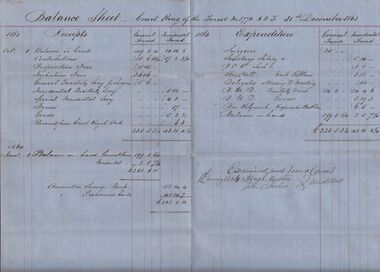
Document - ANCIENT ORDER OF FORESTERS NO. 3770 COLLECTION: CORRESPONDENCE
... Royal Oak... Savings Bank...SOCIETIES Aof correspondence Ancient Order of Foresters No. 3770 Collection - Correspondence Court King of the Forest Court Royal Oak Savings Bank Bro Holl Bro Kelynack Hugh Brown John Charles Balance Sheet for Court King of the Forest, dated 31st December 1863. ...Balance Sheet for Court King of the Forest, dated 31st December 1863. Double page Balance Sheet showing Receipts and Expenditure. Signed by the Auditors, Hugh Brown and john Charles Also dated after the Auditors signatures, 11th January 1864.societies, aof, correspondence, ancient order of foresters no. 3770 collection - correspondence, court king of the forest, court royal oak, savings bank, bro holl, bro kelynack, hugh brown, john charles -
 Bendigo Historical Society Inc.
Document - MCCOLL, RANKIN AND STANISTREET COLLECTION: NORTH DEBORAH GMC N L - GOLD BOOK, 1936 - 1942
... Bank... Royal Mint...ORGANIZATION Business north deborah gmc n l McColl Rankin& Stanistreet North Deborah GMC N L North Virginia GMC N L E S & A Bank Royal Mint gold mining Gold book McColl, Rankin & Stanistreet Document. ...Document. Dark cream & cream mottled book with brown binding containing entries of weight of gold, amount of advance, fineness, & value. Gold book for the North Virginia GMC N L. 2 pages used. 9 loose documents (1938 - 1943).McColl, Rankin & Stanistreetorganization, business, north deborah gmc n l, mccoll, rankin& stanistreet, north deborah gmc n l, north virginia gmc n l, e s & a bank, royal mint, gold mining, gold book -
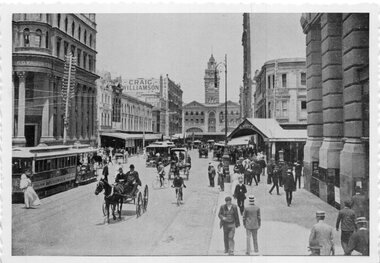 Melbourne Tram Museum
Photograph - Black & White Photograph/s, c1905
... In the background is Royal Bank, Craig Williamson, Sargent's Cafe and R. ...In the background is Royal Bank, Craig Williamson, Sargent's Cafe and R. ...Photographs, Black and White, Photo of Elizabeth St, to the north of Collins St looking south towards Flinders St and Flinders St Station. Has a bogie cable trailer in the view, along with other cable trams, horse drawn vehicles and many pedestrians. In the background is Royal Bank, Craig Williamson, Sargent's Cafe and R. White on the corner. The photograph has a serrated edge.In ink on the rear: Keith Kings stamp and number S-A-449 "Melbourne - Elizabeth St, looking south over Collins St. About 1900. Note Bogie Cable Trailer"trams, tramways, elizabeth st, collins st, cable trams -
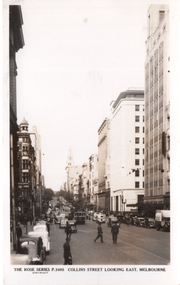 Melbourne Tram Museum
Postcard, Rose Stereograph Co, "Collins Street Looking East Melbourne", c1940s
... On the right is the newly completed Royal Bank chamber, completed in 1941, and the MLC building. ...On the right is the newly completed Royal Bank chamber, completed in 1941, and the MLC building. ...Rose Series postcard P.3495 titled "Collins Street looking east, Melbourne" from west of Elizabeth Street. Has a W2 class tram at the Elizabeth Street stop. On the right is the newly completed Royal Bank chamber, completed in 1941, and the MLC building. Yields information about Collins St from near Elizabeth St looking east. 1940'sPostcard - printed real photograph with Rose Stereograph Co. name on the rear. Unused.trams, tramways, w2 class, collins st, elizabeth st, rose series -
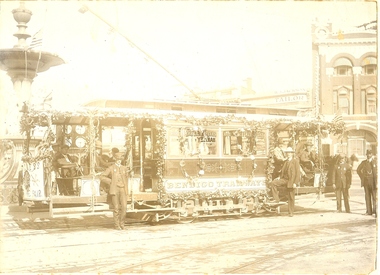 Bendigo Historical Society Inc.
Photograph - BASIL MILLER COLLECTION: ELECTRIC TRAM, 1910 ?
... Jackson's Tailor and Royal Bank in background. Mounted on heavy cream card. ...Jackson's Tailor and Royal Bank in background. Mounted on heavy cream card. ...Black and white photo: Bendigo tramways electric tram stopped at Alexandra fountain destined for Eaglehawk. Conductor standing on road, left of centre, inspector and motor on extreme right. Tram decorated with paper flowers and vines. W.J. Jackson's Tailor and Royal Bank in background. Mounted on heavy cream card. Stamp on back ' W.H. Robinson, photographer, Mundy Street, Bendigo. On pencil on back ' Camp hill Parkson 2. April 1910 Easter 10 ?? June' Part of Basil Miller Collectionperson, individual, basil miller -
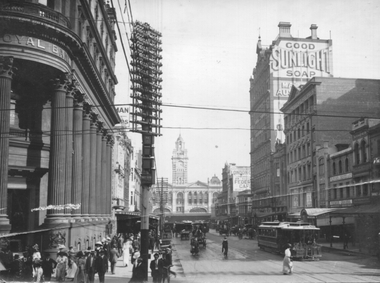 Melbourne Tram Museum
Photograph - Elizabeth St at Collins St, c1910
... The photo has the Royal Bank, Flinders St station, and many other buildings. ...The photo has the Royal Bank, Flinders St station, and many other buildings. ...The photograph shows Elizabeth St looking south from Collins St. The northbound cable tram set has the destination of Royal Park. The photo has the Royal Bank, Flinders St station, and many other buildings. In the view are Griffith Teas, Federal Cafe, Fletcher Chester & Co Grocers and a large sign for Good Sunlight Soap.Yields information about Elizabeth St c1910.Black and White photograph - printed on plain paper.On the rear has pencil number "KM-M-057".cable trams, tramways, collins st, elizabeth st -
 Melbourne Tram Museum
Negative - cable trams - Collins and Elizabeth Sts, c1914
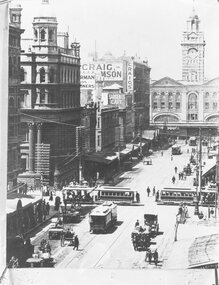
... The major building in the photo is the "Royal Bank" on the south east cnr. of Collins and Elizabeth Street."...The major building in the photo is the "Royal Bank" on the south east cnr. of Collins and Elizabeth Street." ...Photograph of cable cars in Elizabeth St at the corner with Collins St. Has the Flinders St station in the view, along with Craigs and the Royal Bank. Rod Atkins advised 24/08/2020: "Dates from around 1914. taken 11.53 am in high summer. The Flinders Street Railway station looks complete, but we still have all the telephone cables on poles in both Elizabeth and Collins Streets. I don't know the year they all went underground. We have two standard "Fitzroy" trams in Collins Street and one West Melbourne tram with standard eight-window trailer - no bogie trailers in the photo. Some of the West Melbourne trailers were still six window cars in the 1920's. The major building in the photo is the "Royal Bank" on the south east cnr. of Collins and Elizabeth Street."Yields information about the intersection of Collins and Elizabeth St.Copy negative of an illustration and a black and white print.On rear of print in ink "T153, Melbourne Tramways Co, later MMTB. North Fitzroy cable in Collins St. West Melb & Brunswick in Elizabeth St, about 1920?. " W Jack photo" and in top right hand corner "28"trams, tramways, cable trams, collins st, elizabeth st -
 Bendigo Historical Society Inc.
Document - Euro Fest menu and leaflet from 'Nostalgia Restaurant', Bendigo
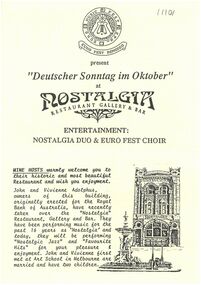
... The building which housed the 'Nostalgia Restaurant, Gallery and Bar' at 17 View Point Street, Bendigo was designed by William Beene and George Garvin and opened in 1908 as a branch of the Royal Bank of Australia. Erected on the site of the old Oriental Hotel, the area was once known as the 'View Point Rocks'. ...The building which housed the 'Nostalgia Restaurant, Gallery and Bar' at 17 View Point Street, Bendigo was designed by William Beene and George Garvin and opened in 1908 as a branch of the Royal Bank of Australia. Erected on the site of the old Oriental Hotel, the area was once known as the 'View Point Rocks'. ...The building which housed the 'Nostalgia Restaurant, Gallery and Bar' at 17 View Point Street, Bendigo was designed by William Beene and George Garvin and opened in 1908 as a branch of the Royal Bank of Australia. Erected on the site of the old Oriental Hotel, the area was once known as the 'View Point Rocks'. The contractors were W. H. Deague & Son, and the foundation stone was laid by the then Premier of Victoria, Sir Thomas Bent. The building was purchased by John and Viviene Adolphus in 1991. Menu and brochure leaflet from 'Nostalgia' restaurant gallery and bar, 17 View Point Street, Bendigo. A4 piece of paper, folded in half, and tan in color. Menu is from 'Deutscher Sonntag im Oktober'. Menu included Entree, Main Course, and Dessert. Leaflet gives description of chef and manager of the venue. nostalgia restaurant, dining, euro fest, garvin, beebe -
 Melbourne Tram Museum
Photograph - Scrubber 8 Elizabeth St at Collins St - set of 3, George Stevens, 25/1/1970
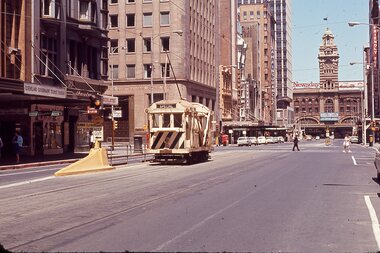
... In the background is the Queensland Government Tourist Bureau, The ES&A Royal Bank Chambers, another ES&A Bank, Ezywalkin shoes, Norman Bros, ANA Insurance, Commonwealth bank, Elizabeth St station with a Newsday advert, Sitmar line, Datsun cars, and the Friendly Societies House. 2 Tram 8 ditto 3 Tram 8 Scrubber northbound in Elizabeth St, Crossing SW6 950 in Collins St. ...In the background is the Queensland Government Tourist Bureau, The ES&A Royal Bank Chambers, another ES&A Bank, Ezywalkin shoes, Norman Bros, ANA Insurance, Commonwealth bank, Elizabeth St station with a Newsday advert, Sitmar line, Datsun cars, and the Friendly Societies House. 2 Tram 8 ditto 3 Tram 8 Scrubber northbound in Elizabeth St, Crossing SW6 950 in Collins St. ...Set of three digital images from slides taken by George Stevens on 25/1/1970 of: 1 Tram 8 Scrubber southbound in Elizabeth St at Collins St. In the background is the Queensland Government Tourist Bureau, The ES&A Royal Bank Chambers, another ES&A Bank, Ezywalkin shoes, Norman Bros, ANA Insurance, Commonwealth bank, Elizabeth St station with a Newsday advert, Sitmar line, Datsun cars, and the Friendly Societies House. 2 Tram 8 ditto 3 Tram 8 Scrubber northbound in Elizabeth St, Crossing SW6 950 in Collins St. Yields information about the intersection of Collins and Elizabeth St and the use of scrubber tram No. 8.Set of three digital images scanned from slides.tramways, scrubber, tram 8, sw6 class, tram 950, elizabeth st, collins st -
 Melbourne Tram Museum
Postcard, Rose Stereograph Co, "Elizabeth Street & Flinders St Station, Melbourne", 1940s
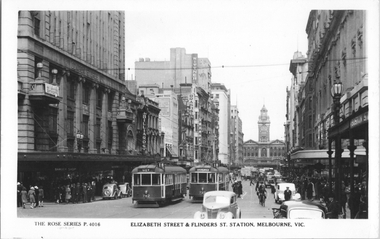
... Other retailers in Elizabeth Street are Brash's music and Wittner Shoes. The new Royal Bank building is visible on the corner south east corner of Collins Street. ...Other retailers in Elizabeth Street are Brash's music and Wittner Shoes. The new Royal Bank building is visible on the corner south east corner of Collins Street. ...Rose Series postcard P. 4016 titled "Elizabeth Street & Flinders St Station, Melbourne", showing W5 class 742 and 737, both on route 18 in Elizabeth St looking south from Bourke Street. It is a very busy and congested scene with motor and horse-drawn trucks, cars, cyclist and pedestrians. Note the man in a peaked cap in the bottom right-hand corner - a Chauffeur? There is advertisement for "War Saving Certificates" on the balcony of London Stores. Other retailers in Elizabeth Street are Brash's music and Wittner Shoes. The new Royal Bank building is visible on the corner south east corner of Collins Street. Yields information about a busy scene in Elizabeth Street Melbourne in the 1940's .Postcard - printed real photograph with Rose Stereograph Co. name on the rear. Two copies held.Second copy has the K. J Magor stamp on the rear.tramways, trams, elizabeth st, tram 742, tram 737, w5 class, world war ii, route 18, bourke st, rose series -
 Federation University Historical Collection
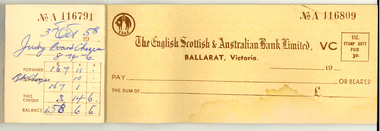
Booklet - English Scottish and Australian Bank Cheque Book, 1950s, English, Scottish & Australian Bank Ltd Cheque Book, 1950s, c1950
... The bank took over the Commercial Bank of Tasmania Limited and the London Bank of Australia Limited in 1921 and the Royal Bank of Australia Limited in 1927. On 1 October 1970, the bank merged with the Australia and New Zealand Bank to form the Australia and New Zealand Banking Group Limited. ...The bank took over the Commercial Bank of Tasmania Limited and the London Bank of Australia Limited in 1921 and the Royal Bank of Australia Limited in 1927. On 1 October 1970, the bank merged with the Australia and New Zealand Bank to form the Australia and New Zealand Banking Group Limited. ...This cheque book was found in a shop on the corner of Sturt and Camp Streets, Ballarat by a builder around 2004. The English, Scottish & Australian Bank Limited was founded in 1852 by Royal Charter in London as the English, Scottish and Australian Chartered Bank. The bank opened its first Australian branch in Sydney in 1853. Australian banknotes were printed by the bank and issued at branches in Sydney, Adelaide, Hobart and Melbourne. In 1893, the bank was renamed the English, Scottish & Australian Bank following the financial upheaval. The bank was one of 16 banks which supplied blank note forms to the Australian Government in 1911 which were superscribed as redeemable in gold and issued as the first Commonwealth notes. The bank took over the Commercial Bank of Tasmania Limited and the London Bank of Australia Limited in 1921 and the Royal Bank of Australia Limited in 1927. On 1 October 1970, the bank merged with the Australia and New Zealand Bank to form the Australia and New Zealand Banking Group Limited. (http://en.wikipedia.org/wiki/English,_Scottish_and_Australian_Bank, accessed 27/03/2014)A half used cheque book from the English, Scottish & Australian Bank Ltd. The used cheques date from 1858 to 1860. Cheques are made out to the Old Colonists Club and Hotel Warrnambool. Notes on the inside cover are precautions against fraud.bank, banking, english scottish and australian bank, anz bank, cheque book -
 City of Greater Bendigo - Civic Collection
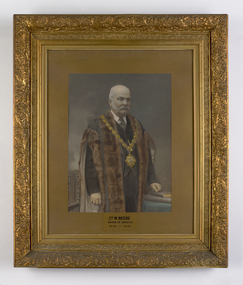
Photograph - Mayor Portrait Cr William Beebe (Jnr), Bartlett Bros, Cr W. Beebe, 1917
... In 1892 Beebe decided to concentrate on his profession as an architect and was responsible for a large number of buildings and homes around Bendigo including the A.N.A Hall (now demolished), Fire Station on View Street (1898) and the Former Royal Bank at View Point (1908). Beebe employed a variation of the Arts and Crafts style popular in England and America from the 1870s and manifested in various forms including the Queen Anne revival style. ...In 1892 Beebe decided to concentrate on his profession as an architect and was responsible for a large number of buildings and homes around Bendigo including the A.N.A Hall (now demolished), Fire Station on View Street (1898) and the Former Royal Bank at View Point (1908). Beebe employed a variation of the Arts and Crafts style popular in England and America from the 1870s and manifested in various forms including the Queen Anne revival style. ...William Beebe junior (1857-1920) was born in Bull Street Sandhurst. His father owned a stone and monument business in Mitchell Street and William commenced work with his father as a small boy. At age 19 William Snr took his into partnership and he continued to study architectural drawing at the School of Mines during this time. Beebe and Son designed and built several buildings during the 1880's to complement their main business which was stonemasonry. In 1892 Beebe decided to concentrate on his profession as an architect and was responsible for a large number of buildings and homes around Bendigo including the A.N.A Hall (now demolished), Fire Station on View Street (1898) and the Former Royal Bank at View Point (1908). Beebe employed a variation of the Arts and Crafts style popular in England and America from the 1870s and manifested in various forms including the Queen Anne revival style. William Beebe served was elected to the Bendigo City Council in 1913, becoming Mayor twice. He died of a heart attack while in office in 1920. Three quarter standing portrait of Cr William Beebe in mayoral robes. Framed and mounted photograph with separate hand-inscribed title panel. Ornamental frame with a gold window mount. Photograph has been hand coloured.Cr W Beebe / Mayor of Bendigo / 1915 - 16 -- 1916 - 17councilor beebe, mayor beebe -
 Bendigo Historical Society Inc.
Document - MCCOLL, RANKIN AND STANISTREET COLLECTION: OLD NOTES OF THE LATE ALEXANDER RANKIN OF POONCAIRA RE EUREKA STOCKADE BALLARAT 1854, 1901
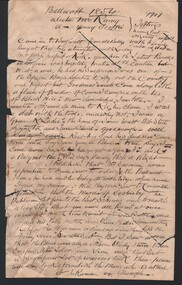
... Envelope has stamped on bottom left corner - McColl, Rankin & Stanistreet, Chartered Accountants (Aust), Royal Bank Chambers, 70 Elizabeth St, Melbourne. ...Envelope has stamped on bottom left corner - McColl, Rankin & Stanistreet, Chartered Accountants (Aust), Royal Bank Chambers, 70 Elizabeth St, Melbourne. ...Document. Business sized envelope marked 'Old notes & jottings of the late Alexander Rankin? Of Pooncaira re Eureka Stockade Ballarat 1854'. Envelope has stamped on bottom left corner - McColl, Rankin & Stanistreet, Chartered Accountants (Aust), Royal Bank Chambers, 70 Elizabeth St, Melbourne. Envelope contains three documents. Document 1 is about part of the Eureka Stockade and mentions Scobie, Wise, Denovan, Campbell, Peter Lalor, Grant Vern? And Paddy O'Connel?. Document 2 is titled 'Little Dedlingtron and the Pump Handle' and mentions Mitchell, King John of Pooncaira, Citizen Nelson, Citizen Rankin, Citizen Ofarrell? And Alick Foo Chow (Grand Mandarin from the Court of Foo Chow Foo. It mentions about a representative gathering and says 'look place re site for new Govt. Officers/offices. Document 3 is dated 3 Jan 1901, 1902 or 1907 and appears to be written from Pooncaira by a John Chambers. The document talks about Pooncaira and mentions the funeral of Bob Bayley after Christmas time. The document appears to be written for inclusion in a newspaper. See enclosed transcriptions of the three documents and additional information on an Alexander Rankin of Pooncaira who may be the Alexander Rankin of Pooncaira mentioned on the envelope. Also enclosed information on Scobie and Wise mentioned in document 1 about the Eureka Stockade. Eureka Stockade document is of historical importance.cottage, miners, old notes & jottings of the late alexander rankin? of pooncaira, eureka stockade -
 Bendigo Historical Society Inc.
Document - ROYAL PRINCESS THEATRE COLLECTION: PROGRAM OF COMING EVENTS, 1916
... Ph 805. Next to Royal Bank (above Hampton's). Bendigo Business College: Evening Commercial Classes, book-keeping, typewriting, shorthand. ...Ph 805. Next to Royal Bank (above Hampton's). Bendigo Business College: Evening Commercial Classes, book-keeping, typewriting, shorthand. ...Princess Theatre Bendigo - Program of coming events in c1917. Coming Events: Gonsalez, Italian Grand Opera Company, commencing Monday May 7, for 3 nights' season. The Brilliant and Incomparable Gonzalez, Italian Grand Opera Company. Opening Production_Verdi's Immortal Masterpiece Il Trovatore. Page 3. Monday, May 7, 1917. Il Trovatore. Opera in 4 acts. Music by G Verdi. Cast of Characters: Signorinas: De Revers, Russ, Capelli. Signors: Scamuzzi, Cacialli. Chorus of voices. Overture at 8pm sharp. Director of Orchestra: Giovanni Gonsalez. Leader of Orchestra: Mr S de Tarczynski. Cello Soloist: Mr Laurie Kennedy. Page 9 Farewell Night. Wednesday, May 9, 1917 Faust, Opera in 5 acts. Music by Gounod. Cast of Characters: Signors Balboni, Cacialli, Filippini, Cesaroni. Signorinas: Visoni, Russ, Piccolo. Overture at 7.45pm sharp. Director of Orchestra: Giovanni Gonsalez. Leader of Orchestra: Mr S de Tarczynski. Cello: Mr Laurie Kennedy. Cast members: Signors Balboni, Cacialli, Filippini and Cesaroni. Signorinas: Visoni, Russ and Piccolo. Director of Orchestra: Giovanni Gonzalez. Leader of Orchestra: Mr S de Tarczynski. Cello Soloist: Mr Laurie Kennedy. Page 11, Repertoire of Operas to be produced by the Gonsalez Opera Company to Wednesday, May 9. Monday, May 7, at 8pm. Cavalleia Rusticana, I Pagliacci. Wednesday, May 9 at 7.45pm. Faust. Between the acts. The story of 'Cavalleria Rusticana' is based on truth and reality alone. It is built up on the fact Turridu, a young peasant, has loved and wooed Lola before . . . . . . Of all the many successful productions in which Mme. Petrova, the celebrated Metro star, appeared, 'The Black Butterfly,' in which she appears in this Theatre, on Thursday, Friday and Saturday, next, is considered her greatest, In 'The Black Butterfly . . . The story of 'Rigoletto' is taken from Victor Hugo's drama 'Le roi S'amuse.' In it the Duke of Mantua a wild and unprincipled youth makes love to every . . . Programme Compiled. Wholly Set Up and Printed by The Cambridge Press, Phone 130. Market Sq., Bendigo. Many ads appear throughout the brochure: Allan's, 253 Mitchell Street Bendigo. Ph 244. W Brown, 171 Mitchell Street, 'Centerway' 105 View Street, Bendigo's Leading Pastrycook & Caterer. Hume & Iser: English and Canadian wallpapers. Timber Merchants & Iron Mongers, full range of stoves, Mantlepieces, grates, tiles, bath-heaters, bathroomware, Berger's Paints. Phones: Yard 48, Showroom 470. Cambridge Press: For artistic programmes, menus, concert tickets, At-Home Cards, and Commercial Printing. Ph 130. Delves' Café, Dainty Service. 'Class' Suppers at moderate Cost. Ph 805. Next to Royal Bank (above Hampton's). Bendigo Business College: Evening Commercial Classes, book-keeping, typewriting, shorthand. Applications to James E Holland, F.P.S.A. Pianoforte & Organ Tuning. A B Challen, Qualified Tuner Ph 319, 42 Rowan St., Bendigo. Chatfield Bros. The Motor Experts, High Street, Bendigo. Ph 609. Car repairs, New cars, hire cars, something for your car. Service Station for Ford car parts, Dunlop & Goodyear tyres. Accessories of all kinds stocked. Oxy Acetylene welding of all metals. Bartlett Bros. Photographers. Bartlett Bros' Studios, (R W Bugg, Proprietor) Williamson St, (opp Hotel Shamrock). Half & Half (Registered) Non-Alcoholic and Invigorating. Manufactured by C J Glover, Ph 343, Chapel Street, Bendigo. R D Ellis, Ladies & Gents Tailor, 241 Mitchell Street, (opposite Morley Johnson's). Nursery (Rose) at Epsom, Stock to be Sold at Half Usual Price. Mr S H Hunt, who has 33 prizes & championships, has accepted a position with Brunning's of Bendigo and has sold the of his 10,000 Roses to them. There are . . . Baker & Woods, 313 Hargreaves St, Ph 209. Electric light installed in your home. 'THE BEEHIVE' Bendigo's Famous Store. Blouses of Beauty, Coats of Comfort, Costumes of Character, Dresses of Delight, Skirts of Style, Millinery of Merit are Permantant Features of Bendigo's Famous Store 'The Beehive'. Best by Test, Leggos of Bendigo 'Progress' Tomato Sauce on the table, wether at home or in the restaurant, there should always be Leggos of Bendigo 'Progress' Tomato Sauce. It's the kind of Sauce you enjoy to the last-no bitting acidity-but a Delicious and Delicate Flavor combined with a Smoothness always agreeable to the palate,. Leggo's 'Progress' Sauce is the result of the . . . H M Leggo& Co Manufacturers, Bendigo. Est. 1881.The Cambridge Press, Market Sq. Bendigo Ph 130program, theatre, princess theatre bendigo -
 Bendigo Historical Society Inc.
Book - CITY OF BENDIGO HISTORICAL WALK BOOK, 2001
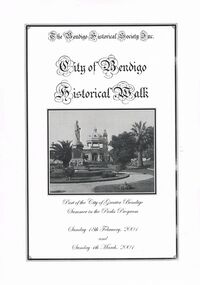
... Prison Bendigo, Camp Hill Police Barracks, Sandhurst Corporate High School, Central State School No. 1976, The Cascades, District Lands Office (Dudley House), Masonic Temple and Hall, Sandhurst Volunteer Rifle Brigade Orderly Room, Bank of Victoria, Henry Jackson's Store View Point,Alexandra Fountain, Beehive Store/Mining Exchange, Colonial Bank. Hustlers Royal Reserve NO. 2/R.S.L. Memorial Hall, Post Office 3rd 4th and final, Bendigo Law Courts, Shamrock Hotel 2nd and another view. ...Prison Bendigo, Camp Hill Police Barracks, Sandhurst Corporate High School, Central State School No. 1976, The Cascades, District Lands Office (Dudley House), Masonic Temple and Hall, Sandhurst Volunteer Rifle Brigade Orderly Room, Bank of Victoria, Henry Jackson's Store View Point,Alexandra Fountain, Beehive Store/Mining Exchange, Colonial Bank. Hustlers Royal Reserve NO. 2/R.S.L. Memorial Hall, Post Office 3rd 4th and final, Bendigo Law Courts, Shamrock Hotel 2nd and another view. ...Photocopy mock up of original booklet of The Bendigo Historical Society Inc. 'City of Bendigo Historical Walk' containing photographs of historic buildings to be seen on the walk. Front cover Queen Victorian Gardens, Town hall, Mechanics Institute/School Of Mines and Industry, H. M. Prison Bendigo, Camp Hill Police Barracks, Sandhurst Corporate High School, Central State School No. 1976, The Cascades, District Lands Office (Dudley House), Masonic Temple and Hall, Sandhurst Volunteer Rifle Brigade Orderly Room, Bank of Victoria, Henry Jackson's Store View Point,Alexandra Fountain, Beehive Store/Mining Exchange, Colonial Bank. Hustlers Royal Reserve NO. 2/R.S.L. Memorial Hall, Post Office 3rd 4th and final, Bendigo Law Courts, Shamrock Hotel 2nd and another view. Important Bendigo Dates; 1851, April gold discovered at Golden Square by Margaret Kennedy,1851 Approx. 200,000Troy oz. of gold found in Bendigo, 1852 475,857 Troy oz. Gold for the year, 1853 November 31st Bendigo Hospital admits first patient,1853 December 9th Bendigo Advertiser first issue printed, 1854 First Land Sales and streets are surveyed and named for the first time, 1854 Census of Bendigo showed 15,480 residents plus 4,000 Chinese, 1855 Sandhurst Municipal District formed, 1861 Sandhurst Proclaimed a Town. 1862 Railway to Melbourne opened, 1867 Visit by His Royal Highness the Duke of Edinburgh, 1871 July 21st Sandhurst proclaimed a City, 1881 Population of Sandhurst 14,577 residents, 1882 First telephone communications introduced, 1890 Electric trams (battery) commenced running, 1891 May 18th City of Sandhurst changes its name to City of Bendigo.book, bendigo, buildings, historic -
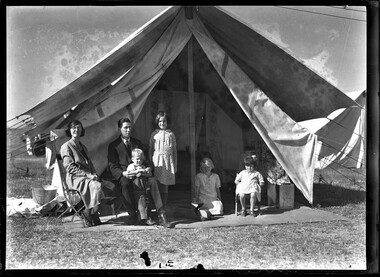 City of Melbourne Libraries
Photograph, Bull, Hugh Jones, 1897-1993, Seventh Day Adventists Camp at Hampton: E. Gane + family
... A visit to the cafe itself — it is next the Royal Bank in Collins-street — will surprise anyone used to the average vegetarian restaurant. ...A visit to the cafe itself — it is next the Royal Bank in Collins-street — will surprise anyone used to the average vegetarian restaurant. ...Photographer notations on slide: Seventh Day Adventists Camp. E Gane + family Published: 28 December 1933 Published title: SEVENTH DAY ADVENTISTS. Published caption: “I. — The Annual Camp of the Seventh Day Adventists in Highett-road, Hampton, comprising more than 250 tents and accommodating over a thousand persons. II. —W. J. Westerman (vice-president of Australasian) and Pastor G. G. Stewart (president of Victoria), conversing with Pastor C. H. Watson (world president of the Seventh Day Adventists).- III.— Evangelist E. R. Gane and family.” SEVENTH DAY ADVENTISTS. (1933, December 28). The Age (Melbourne, Vic. : 1854 - 1954), p. 9. Retrieved August 1, 2025, from http://nla.gov.au/nla.news-article203356427 Research by project volunteer, Fiona Collyer: In December 1933, evangelist Mr E.R. Gane and his family gather outside their tent during the ten day Seventh Day Adventist Conference held in Highett Road, Hampton. Description: A woman, man and four small children sit and stand in front of a tent. One child plays with a toy train. In December 1933, delegates from all over Victoria and beyond travelled to Melbourne for the annual Seventh Day Adventists Conference of Victoria, held over ten days on a vacant allotment at Highett Road Hampton. A canvas town of 250 tents for over 1000 campers was created along with large marquees for lectures, devotional services and kitchens. Many daily visitors also attended the lectures and services. The principal speaker was Victorian born world president of the Seventh Day Adventists, Pastor Charles H. Watson (1877-1962), who travelled from Washington DC for the event. The Highett Street campers attended a busy schedule of bible readings, devotional services and health lectures during the ten days of the camp. Lecture subjects included- “Among the Head Hunters of the Solomon Islands”, “ Looking Through the Prophetic Telescope into 1934”, “Soul Surgery”, “Viewing the Celestial Land Through the Prophetic Telescope”and “The Four Horsemen of the Apocalypse”. The Seventh Day Adventist religion was established in the USA in 1863. One of its co-founders was American Ellen G. White whose writings are regarded as divinely inspired and are still adhered to today. Ellen preached on the “Eight Laws of Health”- Nutrition, exercise, water, sunshine, temperance, air, rest and trust in God. Adventists regard their bodies as holy temples and avoid food deemed by the Bible as unclean. They eat a mainly plant based diet with no caffeinated beverages and abstain from alcohol and tobacco. They believe in the observance of Saturday, the seventh day of the week in the Christian (Gregorian) and Hebrew calendars as the sabbath and the literal and imminent second coming of Jesus Christ. New converts are baptised by immersion in water. The Adventists opened the Warburton Sanitarium in 1910 as a health retreat, integrating their holistic health philosophy of physical, mental and spiritual well being. It was a resort in the hills “among picturesque mountain scenery…surrounded by tall forests and deep fern gullies…” where highly strung Melburians could alleviate their digestive maladies, stress and jaded nerves as “…worn down nervous systems mend quickly in this peaceful environment…invigorating air and an abundance of home-grown fruit, vegetables, fresh eggs, milk, and cream help to build healthy bodies”. The resort also offered hydrotherapy, massage and electrical treatments. An advertisement in The Argus- 1 December 1947 assured readers- “EVERYTHING SUNNY AGAIN." “That's how you'll feel when you say farewell to Warburton Sanitarium and Hospital after spending a holiday here. Victoria's Hydro is famous far and wide for wonders worked with sufferers from nervous and digestive disorders. Wholesome food, perfectly cooked; splendid air, regulated exercise, sweet natural sleep; these quickly correct faulty digestion, restore vitality, bring back that sunny optimism natural to healthy people. Massage and curative baths under medical supervision…” Later, after further building work, it became the Warburton Hospital with medical, casualty and obstetrics wards as well as offering strategies to stop smoking, lose weight and for stress management. The hospital ceased operation in 2001. Ellen G. White wrote “God sent me to Australia” and in 1891, accompanied by her son William C. White she arrived in Australia to start a Bible school, spread her health philosophy and for missionary work. At first health food products were imported from America, but it soon became apparent that due to the expense and the food becoming stale over the long journey, that local manufacturing was necessary. In 1898 William secured the services of American Adventist baker Edward C. Halsey, who had worked at Dr Kellogg’s Battle Creek (“Cereal City”), Sanitarium, Michigan, USA. They rented the St George’s bakery in Northcote, Melbourne, producing the first ready to eat breakfast cereal Granola, Caramel Cereal, and peanut butter. The fledgling company relocated to larger premises in Cooranbong, NSW soon after. The Sanitarium Health Food Company opened a factory in Warburton in 1925, manufacturing Granose Biscuits, Cerix Puffed Wheat, San-Bran, Bixies malted wheat flakes, Betta peanut butter, Marmite, “Kwic-Bru - A delicious health “coffee” made from choicest cereals and free from drugs that affect the heart and nerves” In 1928, Sanitarium bought out Grain Products Limited who were manufacturing a sweet cereal biscuit called Weet-Bix which soon became Australia’s favourite breakfast cereal. The Warburton factory closed in 1997, with manufacturing shifting interstate. Sanitarium breakfast cereal boxes offered free collectable cards inside and children could buy albums from grocers for sixpence and mount the cards. Subjects of the albums included- “Aboriginal Tribes, Legends, Customs”, “Australia- Yesterday and Today”, “Marvels of the Great Barrier Reef”, “Advance Australia- a Pageant of the Years”. In 1902 the Adventist’s opened the “Pure Food Vegetarian Cafe” in Sydney (In 1907 the name was changed to “Sanitarium Health Food Cafe”), Eating vegetarian food was definitely a curiosity. “Cristina” reviewed the cafe for The Australasian-27 October 1906. Topics For The Block. “Feeling somewhat like a criminal, and hoping to escape detection, I stealthily made my way into a vegetarian restaurant the other day... If my friends happened to catch me walking in there, I should henceforth be considered a crank, a faddist, and little short of a lunatic! Whom did I find within, seated with the air of habitués at the small tables, but heaps of my friends. They had all this while been pursuing their vegetarian way, layin' low and sayin' nuffin'. Flesh-eaters, now that the Sydney summer has set in apparently in good earnest, are beginning to wonder if the vegetarians are not wiser in their day and generation. Roast beef, hot cornea beef, ragouts, and meat curries, the very thought of them makes one feel hot. Frosted lemon pudding, stewed fruits, wheatmeal rolls, and tomatoes sound nice when you look at their names on the vegetarian menu. Such weird messes are served, square, unintelligible blocks of some brown substance, a few bites of which form a full and satisfying meal. Cold nut foods, granose, nuttose, and jam protose, bromose, with jelly and various "ose" sandwiches, impossible for the unbeliever to diagnose, are put before you. You drink malted nut broth, you eat gluten sticks, stewed beans, lentil patties, with vegetable sauce, any or all of which are distinctly nourishing and filling at the price. A mock (decidedly mock) veal cutlet or a red lentil roast is sufficient lunch, it appears, for anyone. Thus, "you obtain the best working results from your machinery with the least possible expenditure..." In December 1906 the Adventists branched out to Melbourne, opening the Sanitarium Health Food Cafe at 289 Collins Street next to the Royal Bank building. (corner Collins and Elizabeth Streets, demolished in 1939). Their motto was “Quality and Purity”. “Cynthia” of The Leader “Social Circle” column reviewed the cafe in 9 March 1907- “Hundreds of people have a feeling of positive affection for a diet that will be satisfying, appetising and nourishing, without having meat for its backbone. It will come as news that we have in Melbourne a cafe where you can really enjoy yourself without eating anything in the way of meat. Cream, custard, cheese and the like are not cold shouldered out of the menu, and the housewife in search of new dishes will find here ever so much in the way of suggestions. Nuts figure conspicuously in the menu, and lentil and walnut cutlets may be instanced among the delicacies. Beans are cooked in quite alluring fashion, while creamed parsnips are excellent. For sandwiches you could hardly desire anything more appetising than granosi biscuits, and nut cheese. The combination is suggestive of school lunches, and nut meat might well be employed as a variant. A visit to the cafe itself — it is next the Royal Bank in Collins-street — will surprise anyone used to the average vegetarian restaurant. Every thing is fresh, fragrant, and thoroughly modern… It is run, in connection with that curious people the Seventh Day Adventists.” However, “Adele” writing for the Evelyn Observer and Bourke East Record -13 December 1907 had a different experience- CITY RESTAURANTS. “There is no glamour from the outside. We enter the dining room at six and secure a seat at a small table, for this night we are going to dine on vegetables. Some people pride themselves on being vegetarians, and devote a great deal of their spare cash and energy to disseminating vegetarian principles. I shall not in a hurry forget the dinner we tried to get through at this vegetarian restaurant. There was put before us plate after plate of vegetables not soaked, but sodden with water, not an atom of flavouring or dressing; no attempt was made to give the slightest piquancy to potato, cabbage, turnip or carrot. I beg pardon, I am unjust, there were two caterpillars in the cabbage. It is astonishing how persistently ordinary cooks spoil vegetables in the process of cooking and how little they understand the value of vegetables on a menu.” From the extensive menu of 1924, you could order cream of green pea soup, followed by nut meat with Yorkshire pudding, egg timbales, stewed brown lentils, savoury rissoles with piquant sauce. Among the dessert offerings were creamed sago, steamed figs and walnut drops. Washed down with fermented wine and to finish, “Frucerea”, a coffee substitute essence made from fruit and cereal. A four course meal of soup, entree, vegetables and sweets cost 1/6 in 1924. Proving that plant-based food was not just a novelty, 67,000 meals were served at the cafe in 1918, rising to 73,000 in 1921. Later the Sanitarium Cafe moved to 293 Little Collins Street, (opposite Royal Arcade) sharing the building with The Lilliput Golf Course, a miniature golf course of 18 holes. The course was a replica of the fashionable Lido Course in France and was open daily from 10am to midnight with a green fee of one shilling. It featured goldfish, waterfalls and dance music. Lilliput boasted that they were “Melbourne’s coolest indoor course” Miniature golf (mini, minnie, midget, miget, Tom Thumb, Wee golf, putt-putt, pigmy, peewee, crazy golf, obstacle golf) swept the globe in the 1930s, starting in the USA, then Europe. The courses provided affordable recreation during uncertainty at the start of the Great Depression. The craze arrived in Sydney September 1930 with the first mini golf course opening in the basement of the State Theatre. It featured a replica Sydney Harbour Bridge and attracted over 1000 players a day at one shilling per game. The miniature golf bug hit Melbourne hard in 1930-31 with nearly 200 courses springing up in the CBD and suburbs within a few months. The first miniature golf course to open in Melbourne was on 4 October 1930 in the basement of recently built art deco style Wentworth House at 203 Collins Street, designed by architect Cedric Heise Ballantyne, (also designed Regent Theatre, Plaza Ballroom, Athenaeum Club, National Theatre, St Kilda, built in 1930, demolished in 1974 for the City Square) It was managed by J. C. Williamson who advertised for a “Girl Spruiker” who “Must be Young, Attractive Personality, and Able to Talk to the Public” to work at the course. The Age 26 September 1930 reported - “The Wentworth House management have spared no expense in preparing the links. Water hazards, sand bunkers, running streams, ancestral castles, moats and a cunning drawbridge have each been devised to test the skill of players, while the walls and ceiling have been "atmospherically" treated to convey an exterior effect”. Even Melbourne City Council jumped on the bandwagon, leasing the lower hall of Melbourne Town Hall to colourful car dealer and racehorse owner Mr A. G. Barlow for £43 per week for the “Kit Kat Tiny Golf Course”, opening on 11 December 1930. (Turf identity, Mr Alexander George Barlow, (1880-1937) who raced under the nom de course “A. G. Vauxhall”, owned filly Frances Tressady, who in 1923 won the Victoria Derby and Oaks Stakes double and came fifth in the Melbourne Cup. The “Frances Tressady Stakes” is held each March at Flemington Racecourse in honour of the horse, the last filly to win the Derby. Barlow was the proprietor of Barlow Brothers Pty Ltd car dealership at 442 Elizabeth Street, Melbourne. He played 14 games for Carlton Football Club (VFL) on the half-forward line from 1901-1903). Patrons could vie for The Herald Miniature Golf Championship Cup, a gold cup worth £7/7, in an eight week long competition. Sports newspaper The Sporting Globe also offered a Cup and prize money. Many courses offered prizes of theatre tickets, cash and cigarettes. Myer’s department store, hoping to cash in on the fad, advertised in Melbourne’s newspapers that their Sports Department could design and equip complete miniature golf courses using “Fairway” imitation turf at 4/6 a yard. Newspaper cartoonists loved to lampoon the fad. Both Percy Leason, cartoonist for society magazine Table Talk and Syd Miller of Smith’s Weekly depicted “real” golfers causing havoc on a mini golf course, showing that being a “real” golf player was no advantage to playing miniature golf. But bust often follows boom. With such rapid market saturation, expensive novel hazards, waning interest, long opening hours, often to midnight, and price cutting of game fees from one shilling to sixpence and then to threepence amongst some courses, the bubble was bound to burst. The Sporting Globe columnist J.M.Dillon on 20 May 1931 lamented- £100,000 LOST Failure of ‘Minnie’ Golf. “Miniature golf might have provided fun and jokes for thousands of people in Australia, but there were many for whom it panned out a tragedy. It is likely that the dead losses of those who attempted to make money out of the game in Australia were in the vicinity of £100,000. …For a while there was hardly a spare block of land, or a possible “site” in the shape of a hall, or a showroom, in Sydney and Melbourne, that some one was not after to set upon it a “minnie links.” Big amusement firms and private individuals anxious to make money began to run courses. Practically every individual who touched the game had his finger’s financially burnt. …From the approximately £60,000 invested in Melbourne alone, there must have been £25,000 lost. …There are now dozens of courses going to ruin, and many more that the owners would be happy to give away if the takers would remove from them obligations of leases, &c…” The lease on the “Kit Kat Tiny Golf Club” at the Melbourne Town Hall expired on 30 April 1931, with Mr Barlow losing £798 on the venture. The hazards and fittings, which cost £400 and included a large replica of the Town Hall, now worthless. Due to declining patronage, the Little Collins Street cafe closed in 1938, although the adjacent shop continued to sell Sanitarium products. In New Zealand, the first Sanitarium factory opened in Christchurch in 1900, with the company later opening factories in Palmerston North and Auckland. The Adventists opened vegetarian cafes, firstly at 37 Taranaki Street Wellington in 1906, followed by cafes in Auckland, Christchurch and Dunedin. Weet-Bix is also New Zealand’s favourite cereal- there the jingle is “Kiwi kids are Weet-Bix kids.” In 1955, the Australian Women’s Weekly ran an illustrated, full colour advertisement featuring New Zealand born Edmund Hillary (later Sir) 1919-2008, who, along with Sherpa Tenzing Norgay, was the first climber to reach the summit of Mount Everest on 29 March 1953. The Australian Women’s Weekly, 30 March, 1955- “WEET-BIX carried by Hillary on Himalayan adventure! c/- N.Z. Alpine Club Inc., Dunedin, New Zealand. The Manager, Sanitarium Health Food Company, Christchurch, N.Z. Dear Sir. …Weet-Bix was chosen at my special request as I had always felt that some easily prepared form of breakfast was essential to the primitive conditions of high camps. Weet-Bix fulfilled its task very well indeed. We usually had them with hot milk (powdered) and sugar, and even when we were unable to eat anything else, we usually managed to have a little Weet-Bix . . . I regard them as a great success and expect they will be more widely used in the Himalayas in future. Yours faithfully, (Signed) E.P. Hillary. Sanitarium Marmite - motto- “Too much spoils the flavour”- is as beloved with Kiwis as Vegemite is with Australians. In 1966, a fire gutted the Christchurch Marmite factory causing a nation wide shortage. Once the factory was rebuilt, Sanitarium relaunched the yeasty extract in reusable glass tumblers with printed designs such as yachts, New Zealand birds and vintage cars. These popular collectibles can still be found in the kitchen cupboards of many New Zealand baches (holiday homes). After the devastating 2011 earthquake in Christchurch damaged the Marmite factory causing shortages and panic buying, a “Marmageddon” was declared with jars of the “black gold” advertised online for up to NZ$800. Consumers were advised to spread their Marmite sparingly until production resumed. (The Christchurch plant reportedly produces around 640,000kg of Marmite per year). Sanitarium Health and Wellbeing Company is exempt from paying company income tax on their profits due to their ownership by a religious organisation. Although not a compulsory rule for salvation, Adventists are encouraged to pay a tithe of 10% of their income to the church to support the ministry in God’s work. Nowadays, there are over 25 million members of the Seventh Day Adventists Church in 200 countries. ITEMS OF INTEREST (1933, December 22). The Argus (Melbourne, Vic. : 1848 - 1957), p. 8. Retrieved July 21, 2025, from http://nla.gov.au/nla.news-article11723188 SEVENTH DAY ADVENTISTS. (1933, December 28). The Age (Melbourne, Vic. : 1854 - 1954), p. 9. Retrieved July 1, 2025, from http://nla.gov.au/nla.news-article203356427 EVANGELISTS' CAMP (1933, December 20). The Herald (Melbourne, Vic. : 1861 - 1954), p. 30. Retrieved July 1, 2025, from http://nla.gov.au/nla.news-article243213209 Master Butchers Have A Time Pilots FOR School Air Race Charity Golf At Riversdale (1931, May 1). The Sun News-Pictorial (Melbourne, Vic. : 1922 - 1954; 1956), p. 14-15. Retrieved September 4, 2025, from http://nla.gov.au/nla.news-article276159136 2000 ADVENTISTS UNDER CANVAS (1933, December 27). The Herald (Melbourne, Vic. : 1861 - 1954), p. 17. Retrieved July 1, 2025, from http://nla.gov.au/nla.news-article243223698 TOPICS FOR THE BLOCK. (1906, October 27). The Australasian (Melbourne, Vic. : 1864 - 1946), p. 45. Retrieved August 30, 2025, from http://nla.gov.au/nla.news-article139178204 https://en.wikipedia.org/wiki/Seventh-day_Adventist_Church https://www.sanitarium.com/au/about/sanitarium-story/profits-for- ENTERTAINMENT AT MENZIES'. (1906, December 6). Punch (Melbourne, Vic. : 1900 - 1918; 1925), p. 26. Retrieved August 3, 2025, from http://nla.gov.au/nla.news-article175380296 https://encyclopedia.adventist.org/article?id=9HN0&highlight=Conference SOCIAL CIRCLE (1907, March 9). Leader (Melbourne, Vic. : 1862 - 1918, 1935), p. 41. Retrieved August 3, 2025, from http://nla.gov.au/nla.news-article196649677 CITY RESTAURANTS. (1907, December 13). Evelyn Observer and Bourke East Record (Vic. : 1902 - 1917), p. 1 (MORNING.). Retrieved August 3, 2025, from http://nla.gov.au/nla.news-article61133109 Advertising (1924, May 6). The Sun News-Pictorial (Melbourne, Vic. : 1922 - 1954; 1956), p. 9. Retrieved August 3, 2025, from http://nla.gov.au/nla.news-article274271406 1930, December 5). The Herald (Melbourne, Vic. : 1861 - 1954), p. 14. Retrieved August 5, 2025, from http://nla.gov.au/nla.news-page26374135 Thousands Are Still Playing Miniature Golf (1931, January 2). The Herald (Melbourne, Vic. : 1861 - 1954), p. 11. Retrieved August 8, 2025, from http://nla.gov.au/nla.news-article242880087 MINIATURE GOLF. (1930, October 16). The Argus (Melbourne, Vic. : 1848 - 1957), p. 10. Retrieved August 8, 2025, from http://nla.gov.au/nla.news-article4209280 THE REAL GOLFER WHO FORGOT HIMSELF ON THE MINIATURE GOLF COURSE (1930, November 13). Table Talk (Melbourne, Vic. : 1885 - 1939), p. 13. Retrieved August 8, 2025, from http://nla.gov.au/nla.news-article146706596 Advertising (1930, December 5). The Herald (Melbourne, Vic. : 1861 - 1954), p. 14. Retrieved August 8, 2025, from http://nla.gov.au/nla.news-article242761991 Advertising (1931, January 9). The Herald (Melbourne, Vic. : 1861 - 1954), p. 12. Retrieved August 8, 2025, from http://nla.gov.au/nla.news-article242887972 1955, March 30). The Australian Women's Weekly (1933 - 1982), p. 38. Retrieved August 9, 2025, from http://nla.gov.au/nla.news-page4812489 £100,000 LOST (1931, May 20). Sporting Globe (Melbourne, Vic. : 1922 - 1954), p. 1 (Edition1). Retrieved August 14, 2025, from http://nla.gov.au/nla.news-article183023946 1930, December 5). The Herald (Melbourne, Vic. : 1861 - 1954), p. 14. Retrieved August 15, 2025, from http://nla.gov.au/nla.news-page26374135 Advertising (1931, January 23). The Herald (Melbourne, Vic. : 1861 - 1954), p. 14. Retrieved August 15, 2025, from http://nla.gov.au/nla.news-article242887795 MINIATURE GOLF. (1931, February 5). The Dandenong Journal (Vic. : 1927 - 1954), p. 6. Retrieved August 16, 2025, from http://nla.gov.au/nla.news-article201082526 Still Time To Enter Midge (1931, January 16). The Herald (Melbourne, Vic. : 1861 - 1954), p. 12. Retrieved August 16, 2025, from http://nla.gov.au/nla.news-article242888830 WIT OF THE WEEK (1930, October 23). Table Talk (Melbourne, Vic. : 1885 - 1939), p. 23. Retrieved August 29, 2025, from http://nla.gov.au/nla.news-article146455050 Advertising (1930, October 2). Table Talk (Melbourne, Vic. : 1885 - 1939), p. 16. Retrieved August 18, 2025, from http://nla.gov.au/nla.news-article146454620 MIDGET GOLF LINKS. (1930, September 26). The Age (Melbourne, Vic. : 1854 - 1954), p. 6. Retrieved August 18, 2025, from http://nla.gov.au/nla.news-article202235074 https://www.smh.com.au/national/fairfax-archive-mini-golf-20131125-2y608.html TURF NOTES (1923, November 6). The Ballarat Star (Vic. : 1865 - 1924), p. 6. Retrieved September 3, 2025, from http://nla.gov.au/nla.news-article213855201 Advertising (1930, October 4). The Herald (Melbourne, Vic. : 1861 - 1954), p. 10. Retrieved October 14, 2025, from http://nla.gov.au/nla.news-article242937272 LAUGHTER AND TEARS. (1930, November 15). Smith's Weekly (Sydney, NSW : 1919 - 1950), p. 21. Retrieved September 9, 2025, from http://nla.gov.au/nla.news-article234426874 Advertising (1947, December 1). The Argus (Melbourne, Vic. : 1848 - 1957), p. 5. Retrieved September 15, 2025, from http://nla.gov.au/nla.news-article22523355Photographer notations on slide: "Seventh Day Adventists Camp. E Gane + family".religion, health food, mini golf, 1930-1939, tents, churches, camps
