
Showing 6 items matching "royal easter show sydney"
-
 National Wool Museum
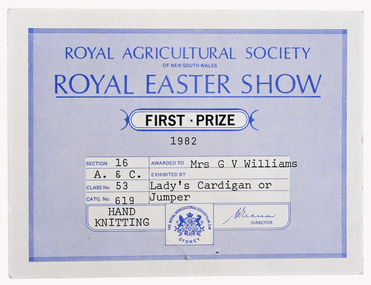
Award - First Prize Card, Gladys Victoria Williams et al, 1982
... ...Royal Easter Show Sydney...This First Prize card was awarded at the 1982 Royal Easter Show in Sydney, New South Wales, for a hand-knitted cardigan made by Gladys Victoria Williams (née Kearns). ...This First Prize card was awarded at the 1982 Royal Easter Show in Sydney, New South Wales, for a hand-knitted cardigan made by Gladys Victoria Williams (née Kearns). ...This First Prize card was awarded at the 1982 Royal Easter Show in Sydney, New South Wales, for a hand-knitted cardigan made by Gladys Victoria Williams (née Kearns). Gladys crafted the piece in 1981 while living in Albury with her husband, Kelvin, winning first place in the ‘Lady’s Cardigan or Jumper’ category. Gladys was born in 1911 in Casino, New South Wales and alongside working as a telephonist, volunteering for school, community and church groups and raising three sons she developed a passion for knitting, crochet and needlework, undertaking many projects in her spare time. Her youngest son Neil recalls her connection to handicrafts: “Mum lived at a time when hand knitting skills were relied on for family clothing needs as well as for making items for free distribution to charitable organisations and humanitarian relief. Her knitting skills were kindled at an early age by her mother, and she often boasted that she could knit a sock at the age of five. Back in that time hand knitting expertise was highly valued and drew much attention and fierce competition at the yearly regional agricultural shows. Her competitive knitting began in 1948 when she won First Prize for a pair of knitted woollen gloves at the Albury Spring Show. Until the 1980’s she continued to place entries in shows in Albury, Wagga Wagga, Wentworth, Young and Sydney in NSW; Wodonga and Melbourne in Victoria; and Launceston in Tasmania. Mum always had entries in several categories at the Albury shows. Dad and I would go to the show each day and listen to the comments about the entries. Upon returning home we would tell mum who said what about her entries. After she moved into aged care in Canberra, she maintained her interest in knitting and was the “go to” person whenever neighbours and carers ran into problems with their knitting projects or needed advice on matter such as wools, patterns or needle sizes. Wool was the yarn of choice until the mid to late 20th century when man made fibres became popular. However, mum always continued to use wool yarn (usually Patons) for the garments and other items she made. After mum’s death we found amongst her personal effects a large envelope crammed full of prize certificates that she had been awarded for her handicraft work over a 56 year period, spanning the years 1926 – 1982. These certificates document mum’s interest and skills as a knitter, needleworker and cook. She was particularly proud of her First Prize Award at the Royal Easter Show in Sydney for ‘Hand Knitted Lady’s Cardigan’”. Single sided card with printed black and blue text. Two pin holes are shown at the bottom. front [printed]: ROYAL AGRICULTURAL SOCIETY / OF NEW SOUTH WALES / ROYAL EASTER SHOW / FIRST PRIZE / 1982 gladys victoria williams, hand knitting, agricultural show, royal easter show sydney, handicraft, needlework, patons, domestic life, prize, award, cardigan, textile handicrafts, wool -
 National Wool Museum
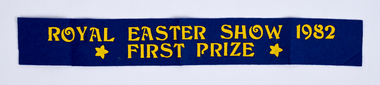
Award - First Prize Ribbon, Gladys Victoria Williams et al, 1982
... ...Royal Easter Show Sydney...This First Prize ribbon was awarded at the 1982 Royal Easter Show in Sydney, New South Wales, for a hand-knitted cardigan made by Gladys Victoria Williams (née Kearns). ...This First Prize ribbon was awarded at the 1982 Royal Easter Show in Sydney, New South Wales, for a hand-knitted cardigan made by Gladys Victoria Williams (née Kearns). ...This First Prize ribbon was awarded at the 1982 Royal Easter Show in Sydney, New South Wales, for a hand-knitted cardigan made by Gladys Victoria Williams (née Kearns). Gladys crafted the piece in 1981 while living in Albury with her husband, Kelvin, winning first place in the ‘Lady’s Cardigan or Jumper’ category. Gladys was born in 1911 in Casino, New South Wales and alongside working as a telephonist, volunteering for school, community and church groups and raising three sons she developed a passion for knitting, crochet and needlework, undertaking many projects in her spare time. Her youngest son Neil recalls her connection to handicrafts: “Mum lived at a time when hand knitting skills were relied on for family clothing needs as well as for making items for free distribution to charitable organisations and humanitarian relief. Her knitting skills were kindled at an early age by her mother, and she often boasted that she could knit a sock at the age of five. Back in that time hand knitting expertise was highly valued and drew much attention and fierce competition at the yearly regional agricultural shows. Her competitive knitting began in 1948 when she won First Prize for a pair of knitted woollen gloves at the Albury Spring Show. Until the 1980’s she continued to place entries in shows in Albury, Wagga Wagga, Wentworth, Young and Sydney in NSW; Wodonga and Melbourne in Victoria; and Launceston in Tasmania. Mum always had entries in several categories at the Albury shows. Dad and I would go to the show each day and listen to the comments about the entries. Upon returning home we would tell mum who said what about her entries. After she moved into aged care in Canberra, she maintained her interest in knitting and was the “go to” person whenever neighbours and carers ran into problems with their knitting projects or needed advice on matter such as wools, patterns or needle sizes. Wool was the yarn of choice until the mid to late 20th century when man made fibres became popular. However, mum always continued to use wool yarn (usually Patons) for the garments and other items she made. After mum’s death we found amongst her personal effects a large envelope crammed full of prize certificates that she had been awarded for her handicraft work over a 56 year period, spanning the years 1926 – 1982. These certificates document mum’s interest and skills as a knitter, needleworker and cook. She was particularly proud of her First Prize Award at the Royal Easter Show in Sydney for ‘Hand Knitted Lady’s Cardigan’”. Long blue wool felt ribbon with yellow text and two yellow stars. front: ROYAL EASTER SHOW 1982 / FIRST PRIZE gladys victoria williams, hand knitting, agricultural show, royal easter show sydney, handicraft, needlework, patons, domestic life, prize, award, cardigan, textile handicrafts, wool -
 National Wool Museum
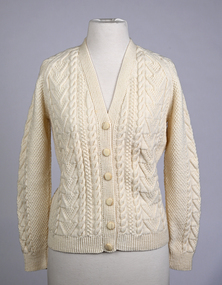
Textile - Cardigan, Gladys Victoria Williams, 1981
... ...Royal Easter Show Sydney...It won first prize in the hand knitting category for ‘Lady’s Cardigan or Jumper’ at the Royal Easter Show in Sydney, New South Wales in 1982. ...It won first prize in the hand knitting category for ‘Lady’s Cardigan or Jumper’ at the Royal Easter Show in Sydney, New South Wales in 1982. ...This cardigan was made by Gladys Victoria Williams (nee Kearns) in 1981 while living with her husband Kelvin in Albury. It won first prize in the hand knitting category for ‘Lady’s Cardigan or Jumper’ at the Royal Easter Show in Sydney, New South Wales in 1982. Gladys was born in 1911 in Casino, New South Wales and alongside working as a telephonist, volunteering for school, community and church groups and raising three sons she developed a passion for knitting, crochet and needlework, undertaking many projects in her spare time. Her youngest son Neil recalls her connection to handicrafts: “Mum lived at a time when hand knitting skills were relied on for family clothing needs as well as for making items for free distribution to charitable organisations and humanitarian relief. Her knitting skills were kindled at an early age by her mother, and she often boasted that she could knit a sock at the age of five. Back in that time hand knitting expertise was highly valued and drew much attention and fierce competition at the yearly regional agricultural shows. Her competitive knitting began in 1948 when she won First Prize for a pair of knitted woollen gloves at the Albury Spring Show. Until the 1980’s she continued to place entries in shows in Albury, Wagga Wagga, Wentworth, Young and Sydney in NSW; Wodonga and Melbourne in Victoria; and Launceston in Tasmania. Mum always had entries in several categories at the Albury shows. Dad and I would go to the show each day and listen to the comments about the entries. Upon returning home we would tell mum who said what about her entries. After she moved into aged care in Canberra, she maintained her interest in knitting and was the “go to” person whenever neighbours and carers ran into problems with their knitting projects or needed advice on matter such as wools, patterns or needle sizes. Wool was the yarn of choice until the mid to late 20th century when man made fibres became popular. However, mum always continued to use wool yarn (usually Patons) for the garments and other items she made. After mum’s death we found amongst her personal effects a large envelope crammed full of prize certificates that she had been awarded for her handicraft work over a 56 year period, spanning the years 1926 – 1982. These certificates document mum’s interest and skills as a knitter, needleworker and cook. She was particularly proud of her First Prize Award at the Royal Easter Show in Sydney for ‘Hand Knitted Lady’s Cardigan’”. Hand knitted cream ladies Classic Aran Cable V-neck Cardigan, with six cream buttons down the front and a label hand sewn at the neck. label [printed]: Specially Hand Made By / Gladys gladys victoria williams, hand knitting, agricultural show, royal easter show sydney, handicraft, needlework, patons, domestic life, prize, award, cardigan, textile handicrafts, wool -
 Vision Australia
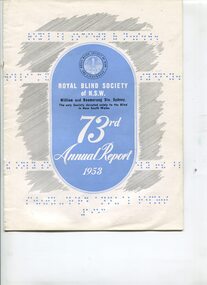
Administrative record - Text, 73rd Annual Report Royal Blind Society of N.S.W. (1953), 1953
... Teulan and are ready for work, Neville Neich won the Adult Braille reading contest at the City of Sydney Eisteddfod and was asked to later broadcast this over the ABC National Network, winners of the other sections were broadcast over the 'Glow Worm' sessions, Nola Dekyvere accepted her fourth Presidency for the Black and White Ball at the Trocadero, an exhibition of handicrafts organised by Goodie Reeve resulted in the Royal Agricultural Society of NSW including a special section for Blind participants in their Handicraft section of the 1954 Royal Easter Show, NSW Cricket and Athletic Club continues to play regular fixtures at suburban and country centres - winning 12, losing 4 and drawing 4, the establishment of the NSW Blind Bowling Club, and the Coronation medal has been awarded to E.T Herford (CEO), W.A. ...Teulan and are ready for work, Neville Neich won the Adult Braille reading contest at the City of Sydney Eisteddfod and was asked to later broadcast this over the ABC National Network, winners of the other sections were broadcast over the 'Glow Worm' sessions, Nola Dekyvere accepted her fourth Presidency for the Black and White Ball at the Trocadero, an exhibition of handicrafts organised by Goodie Reeve resulted in the Royal Agricultural Society of NSW including a special section for Blind participants in their Handicraft section of the 1954 Royal Easter Show, NSW Cricket and Athletic Club continues to play regular fixtures at suburban and country centres - winning 12, losing 4 and drawing 4, the establishment of the NSW Blind Bowling Club, and the Coronation medal has been awarded to E.T Herford (CEO), W.A. ...Articles in the annual report include: alterations and additions to the Victor Maxwell House Nursery to modernise and provide accommodation for up to 20 children due to the success in the 2UW Blind Babies Appeal and Hoyts Theatres Ltd Charity Drive, opening in December of the North Branch Blind Welfare Centre in Bull Street Newcastle, the need for more finance to extend the Helen Keller hostel and to build a Blind Men and Youths Hostel to satisfy demand for supportive accommodation, thanks to Butler's Air Transport in providing free travel to Stuart Kerry and C. Rae who travel around the state teaching people in their own homes, two prisoners serving life sentences continue to transcribe books - one solely for St Lucy's and the other has handled requests for text books from Sydney University, the Braille Printing Press has produced 'The Commonsense Cookery Book' in Braille as it has been in constant demand, a heartfelt thanks to Rivis Mead who has been sewing and repairing books but is unable to continue this role, however she will continue to transcribe as she also has done for almost 30 years, a donation of 4 guineas was made to the City of Sydney Eisteddfod for two trophies for Braille reading in the Children's section of the 1953 Eisteddfod, there is a pool of trained switchboard operators who have trained under Miss E. Teulan and are ready for work, Neville Neich won the Adult Braille reading contest at the City of Sydney Eisteddfod and was asked to later broadcast this over the ABC National Network, winners of the other sections were broadcast over the 'Glow Worm' sessions, Nola Dekyvere accepted her fourth Presidency for the Black and White Ball at the Trocadero, an exhibition of handicrafts organised by Goodie Reeve resulted in the Royal Agricultural Society of NSW including a special section for Blind participants in their Handicraft section of the 1954 Royal Easter Show, NSW Cricket and Athletic Club continues to play regular fixtures at suburban and country centres - winning 12, losing 4 and drawing 4, the establishment of the NSW Blind Bowling Club, and the Coronation medal has been awarded to E.T Herford (CEO), W.A. Davis (Northern Rep), C. Rae (Braille instructor) and J. Wilston (worker). 1 volume of text and images royal blind society of new south wales, annual report, victor maxwell kindergarten, helen keller hostel, stuart kerry, c rae, rivis mead, e teulan, neville neich, nola dekyvere, goodie reeve, cricket, bowling, e t herford, w.a. davis, j wilston, parramatta gaol -
 Merbein District Historical Society
Medal - Medal in box, 1963
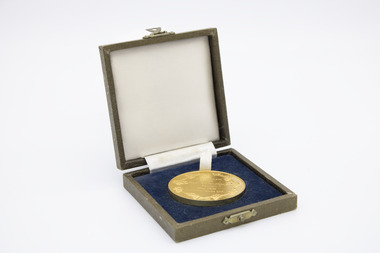
... Front of medal picture of coat of arms with inscription of of Royal agricultural society of NSW Sydney reverse side side RAS of NSW 1963 Royal Easter show Brandy open class Mildara wines LTD ...Gold medal won by Mildara Brandy wines at the Royal Easter Show in 1963. 1963 mildara winery brandy spirits royal easter show nsw Front of medal picture of coat of arms with inscription of of Royal agricultural society of NSW Sydney reverse side side RAS of NSW 1963 Royal Easter show Brandy open class Mildara wines LTD Golden medal in small wooden brown box Medal Medal in box ...Gold medal won by Mildara Brandy wines at the Royal Easter Show in 1963. Golden medal in small wooden brown box Front of medal picture of coat of arms with inscription of of Royal agricultural society of NSW Sydney reverse side side RAS of NSW 1963 Royal Easter show Brandy open class Mildara wines LTD 1963, mildara, winery, brandy, spirits, royal easter show, nsw -
 Melbourne Royal
Award - Trophy, Marshwood Perpetual Challenge Trophy, 1974
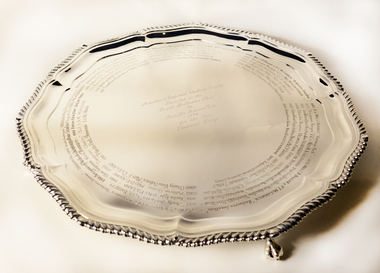
... shows in Australia, Sweden and France. He probably last judged in Australia at the Sydney Easter Show in 1981. By this time Major Cox must have been in his late 70s as he was a reserve cavalry man in 1918. The silver-footed salver trophy was made in Scotland in 1916. It is possible that Major Cox brought it with him to Australia when he was judging Shetland ponies at the Royal...shows in Australia, Sweden and France. He probably last judged in Australia at the Sydney Easter Show in 1981. By this time Major Cox must have been in his late 70s as he was a reserve cavalry man in 1918. The silver-footed salver trophy was made in Scotland in 1916. It is possible that Major Cox brought it with him to Australia when he was judging Shetland ponies at the Royal ...The Marshwood Challenge Trophy was first awarded in 1974. This valuable trophy was donated by Major Maurice Charles Cox and his wife Betty, who were devoted to the Shetland Pony. Why is it called Marshwood? The Coxes both worked to maintain high standards of the Shetland breed. They did this in Great Britain by starting The Marshwood Stud in 1922. They also both took on the role of president of the Shetland Pony Major Stud Book Society and started a scheme to use only the best stallions for breeding. Major Cox and Australia The Coxes promoted the Shetland pony elsewhere too. Major Cox judged Shetland ponies at shows in Australia, Sweden and France. He probably last judged in Australia at the Sydney Easter Show in 1981. By this time Major Cox must have been in his late 70s as he was a reserve cavalry man in 1918. The silver-footed salver trophy was made in Scotland in 1916. It is possible that Major Cox brought it with him to Australia when he was judging Shetland ponies at the Royal Melbourne Show in the 1970s. The Marshwood Challenge Cup was awarded for the best Shetland pony at the show. Major Cox drew on his experiences examining Shetlands all around the world when he wrote The Shetland Pony (first published in 1965). (Mandy Bede) Silver tray on four feet. The 14-sided silver tray has wavy edges giving a floral appearance. Marshwood Perpetual Challenge Trophy / Presented to the / Royal Melbourne Show / by / Mr & Mrs Maurice Cox / 1974 / for the best / Shetland Pony / horses, pony, shetland pony, melbourne royal show, horses in action, melbourne royal horses in action competition, blue ribbon competitions, marshwood, cox, major maurice charles cox, betty cox
