
Showing 8 items matching "royal red cross 2nd class"
-
 Returned Nurses RSL Sub-branch
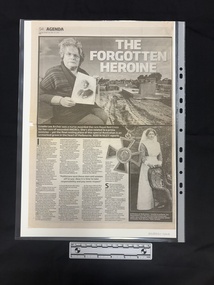
Newspaper - Newspaper clipping, Robyn Riley, The forgotten heroine, Sunday May 20, 2012
... ...Royal Red Cross 2nd class...Estelle Lee Archer WWI WW1 World War One Royal Red Cross 2nd class Grave Office of Australian War Graves Margaret Leyden Full page newspaper clipping with two large black and white photographs and four columns of text. ...Article about Estelle Lee Archer a WWI nurse who at the time of the article was in a forgotten grave in the New Cheltenham Cemetary. The article details how her great niece Margaret Leyden is asking the Office of Australian War Graves to restore and maintain the grave of this significant war nurse. The article also contains some biographical details of Estelle Lee Archer's service in WWI.Full page newspaper clipping with two large black and white photographs and four columns of text. The largest photograph is of an older woman sitting in a cemetary holding an old portrait photograph of a woman in a nurses uniform. Ther is also an old photograph of a woman in a nurses uniform standing behind a chair.estelle lee archer, wwi, ww1, world war one, royal red cross 2nd class, grave, office of australian war graves, margaret leyden -
 Returned Nurses RSL Sub-branch
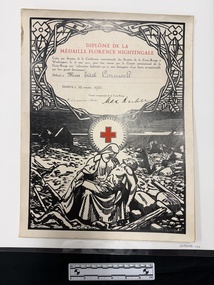
Certificate - Copy of Diplôme de la Médaille Florence Nightingale (Florence Nightingale Medal Diploma) - Edith Cornwell, International Committee of the Red Cross (ICRC), unknown
... Already a recipient of the Royal Red Cross 2nd class and 1st class, this medal is the highest international distinction a nurse can receive. ...Already a recipient of the Royal Red Cross 2nd class and 1st class, this medal is the highest international distinction a nurse can receive. ...Copy of the certificate Diplôme de la Médaille Florence Nightingale (Florence Nightingale Medal Diploma) given to Edith Cornwell with her medal in Geneva in 1933. Already a recipient of the Royal Red Cross 2nd class and 1st class, this medal is the highest international distinction a nurse can receive. It is given by the International Committee of the Red Cross.A large board mounted copy of a certificate that has black print artwork of a woman holding a man on her lap in a landscape that has broken wood, ground and a half sunken ship present. The middle of the certificate has a red cross in a white circle and the top half has text bordered with thorns and foliage.wwi, ww1, world war one, australian army nursing service, aans, edith cornwell, florence nightingale medal, royal red cross -
 Melbourne Legacy
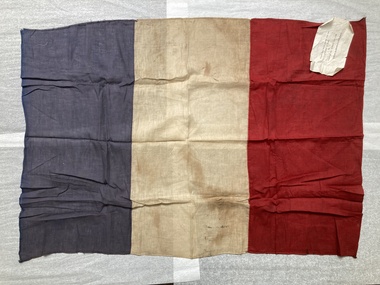
Flag, French Flag
... She was awarded the Royal Red Cross (2nd Class) for her service in World War One. ...She was awarded the Royal Red Cross (2nd Class) for her service in World War One. ...A French flag that was flown in Rouen, France on Armistice Day in 1918. The note says it was donated to Legacy by Matron H. E. Tait RRC. There are no details how she came to have the flag or why she gave it to Melbourne Legacy. From the AWM Matron HE Tait is Helen Elizabeth Tait, from Maffra who had trained at the Alfred Hospital and joined the Australian Army Nursing Service. She was awarded the Royal Red Cross (2nd Class) for her service in World War One. Her full record is available from the National Archive of Australia. It shows she was serving at the 1st Australian General Hospital in Rouen in November of 1918 when the war ended. RRC is The Royal Red Cross (RRC) which is a military decoration awarded in the United Kingdom and Commonwealth for exceptional services in military nursing. After the war she returned to Melbourne and was Matron of Melbourne Grammar School. She never married and died in 1976.The founding Legatees all fought in World War One and momentos like this flag would have been appreciated by them.A French flag from World War One.Note with the flag is typed and says ' French Flag which floated over the Town Hall in Rouen on Armistice Day November 11th 1918. Donated by Matron H. E. Tait, R.R.C.'france, world war one, rouen, nurse, souvenir -
 Alfred Hospital Nurses League - Nursing History Collection
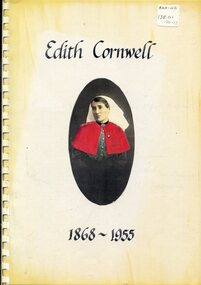
Booklet, Alison Cornwell et al, Edith Cornwell 1868-1955, 1992
... In February 1917 Edith was awarded the Royal Red Cross, 2nd Class. In 1918, she worked as Matron at AGHs in France and England. ...In February 1917 Edith was awarded the Royal Red Cross, 2nd Class. In 1918, she worked as Matron at AGHs in France and England. ...Edith Cornwell was born in 1868; she completed her nursing training at the Alfred Hospital in 1896. After this she worked at several different hospitals, including qualifying as a midwife, and the role of matron at Hay, Wagga Wagga, and the Women's Hospital, Melbourne. In 1902 Edith had joined the Australian Army Nursing Service as a reserve. At the outbreak of war in 1914 Edith formally enlisted and served overseas twice. in Egypt (1915-1916) as Matron of the No2 Australian General Hospital (AGH) at Heliopolis. Returning to Australia Edith became Matron of No 5 Base Hospital, Melbourne. In February 1917 Edith was awarded the Royal Red Cross, 2nd Class. In 1918, she worked as Matron at AGHs in France and England. In 1919 Edith was awarded the Royal Red Cross, 1st Class. After the war Edith was active in the formation of the Returned Nurses Club.After leaving the army in 1922 Edith joined Victoria's Neglected Children Department as Matron of their Receiving House. Edith retired in 1932, in 1933 she was awarded the Florence Nightingale Medal. In 1937 Edith was chosen to represent Australian nurses at the coronation of King George V.Biography of a significant graduate of the Alfred Hospital School of NursingComb-bound book with clear plastic front cover and white cardboard back cover. Title page visible through clear plastic: - coloured photograph of Edith Corwell wearing the World War I uniform of matron in the Australian Army Nursing Service. Title printed above and below this photo. White comb binding visible at left. Previous catalogue number handwritten on small white sticker at top right of front cover. On page after title page is a handwritten dedication 'Presented to the Archives of the Alfred Hospital/ Alison Cornwell/ Elaine White (nee Cornwell)/ June 1993, Melbourneedith cornwell, alfred hospital, world war 1914-1918, australian army nursing service -
 Creswick Museum
Badge, medal collection
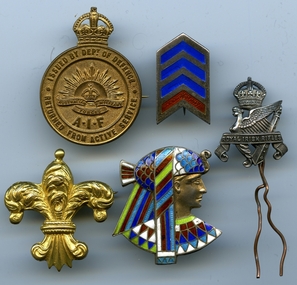
... February 1917 she was attached to the 2nd Auxiliary Hospital Southhall, one of the hospitals specializing in fitting artificial limbs. 2 June 1916, she was awarded the Royal Red Cross Medal 2nd class for her valuable services....February 1917 she was attached to the 2nd Auxiliary Hospital Southhall, one of the hospitals specializing in fitting artificial limbs. 2 June 1916, she was awarded the Royal Red Cross Medal 2nd class for her valuable services. ...This collection belonged to Sister Tessa Thomas R.R.M. (Nee Youngman) Sister Thomas was born at Creswick 1882, died Brisbane 1948. She trained at the Alfred Hospital for 3 years from 1909. On the 28th November 1914, as a staff nurse she embarked on the "Shyarra" from Australia and served at the 1st Australian General Hospital, Egypt. February 1917 she was attached to the 2nd Auxiliary Hospital Southhall, one of the hospitals specializing in fitting artificial limbs. 2 June 1916, she was awarded the Royal Red Cross Medal 2nd class for her valuable services.WW1 Active Service Return Medal WW1 Return from Overseas Services Chevron, Lapel badge WW1 Royal Irish Rifles badge WW1 Manchester Regiment Fleur de Lis Egyptian Enamel Broach -
 Returned Nurses RSL Sub-branch
Document - Photocopy of newspaper clipping and related documents, Sunday Herald, The forgotten heroine, 5 December 1914 - May 20 2012
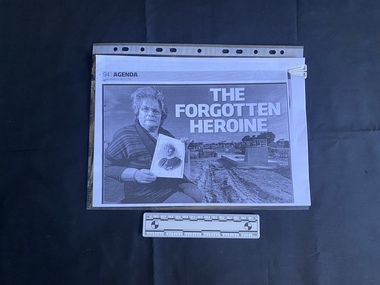
... Margaret, who never met her aunt, has pieced together her history, including that Estelle's medals, including the prestigious Royal Red Cross 2nd Class for services in support of our ANZACs have ended up in the MAryborough Military & Colonial Museum after they were bought at a second hand shop. ...Margaret, who never met her aunt, has pieced together her history, including that Estelle's medals, including the prestigious Royal Red Cross 2nd Class for services in support of our ANZACs have ended up in the MAryborough Military & Colonial Museum after they were bought at a second hand shop. ...Newspaper - 'The forgotten heroine' Visitors to New Cheltenham Cemetery in Melbourne would not know that a highly decorated and dedicated nurse was buried there. Her grave is unmarked, there is no reference to her achievements or selfless dedication. Estelle Lee Archer died in 1960, at the Repatriation General Hospital, Heidelberg, age 78 from a perforated ulcer. Margaret Leyden wants the Office of Australian War Graves to recognise that her great-aunt died from war-related injuries and to restore and maintain her grave. Margaret, who never met her aunt, has pieced together her history, including that Estelle's medals, including the prestigious Royal Red Cross 2nd Class for services in support of our ANZACs have ended up in the MAryborough Military & Colonial Museum after they were bought at a second hand shop. Estelle served in seven army units and was in the Middle East, England and France for the duration of World War 1. After the war she continued to dedicate her life to the care of soldiers. Document 1 - digitised copy of 'First Wold War Embarkation Roll' for Estelle Frances Lee-Archer Document 2 - photocopy of 'Austraalian Imperial Force - Nominal Roll' page 7 (Lee-Archer, Estelle Frances listed) Document 3 - photocopy of unknown document (Sis. Lee-Archer, Estelle (RRC) listed) Five photocopied pages held together with a plastic paperclip. Two pages are of a newspaper story, the first showing a full page black and white photo of a seated older woman holding a photo of a woman in nurse's uniform. The second page of the newspaper story has four columns of text with a photo of a war medal and a photo of a standing woman in nurse's uniform beside them. The final three pages are war-time documents.dr collopy, kildonian castle, london, caulfield, tasmania, john lee archer, mary anne lyons, joseph lyons, parlianment house, hobart, ross bridge, alfred hospital, kyarra, 1st australian general hospital, swanage, dorset, gallipoli, 2nd australian general hospital, 3rd australian general hospital, 25th australian general hospital, 47th australian casualty clearing station, 3rd australian casualty clearing station, 7th australian general hospital, john saddington -
![Medal - Court-mounted set of miniature medals: Royal Red Cross, Australian Service Medal 1945-75 with PNG clasp, Elizabeth II Silver Jubilee Medal 1977, Defence Force Service Medal, National Medal and Australian Defence Medal, [unknown]](/media/collectors/64a5077bc83bd7b7b94f4211/items/6a697004154863c24685a486/item-media/6a6971d6154863c246863334/item-fit-380x285.jpg?cb=6) Returned Nurses RSL Sub-branch
Returned Nurses RSL Sub-branchMedal - Court-mounted set of miniature medals: Royal Red Cross, Australian Service Medal 1945-75 with PNG clasp, Elizabeth II Silver Jubilee Medal 1977, Defence Force Service Medal, National Medal and Australian Defence Medal, [unknown]
... Royal Red Cross in early 1972. The medal, presented by the Governor of Victoria, Sir Rohan Delacombe, was awarded for ‘exceptional competence and devotion to duty’. Also awarded were Sergeant Leslie Bending of the Naval Police (left) who received the British Empire Medal for dedicated service, and Lieutenant Commander Winston James (right) who received the Distinguished Service Cross in recognition of outstanding leadership and bravery while serving as commander of the RAN Helicopter Flight in Vietnam. During that time (1971-1980) she was also appointed an Honorary Nursing Sister to Queen Elizabeth II. In 1972 Patricia was awarded a Royal Red Cross (RRC) 2nd Class...Royal Red Cross in early 1972. The medal, presented by the Governor of Victoria, Sir Rohan Delacombe, was awarded for ‘exceptional competence and devotion to duty’. Also awarded were Sergeant Leslie Bending of the Naval Police (left) who received the British Empire Medal for dedicated service, and Lieutenant Commander Winston James (right) who received the Distinguished Service Cross in recognition of outstanding leadership and bravery while serving as commander of the RAN Helicopter Flight in Vietnam. During that time (1971-1980) she was also appointed an Honorary Nursing Sister to Queen Elizabeth II. In 1972 Patricia was awarded a Royal Red Cross (RRC) 2nd Class ...These medals were awarded to Patricia Catherine Vines of the Australian Navy and Royal Australian Navy Nursing Service (RANNS). Extracts from Sea Power Centre website (listed in references): "Patricia Catherine Vines was born in Fairfield, Melbourne on 5 September 1925. Educated at the Catholic Ladies College, East Melbourne, on completion of her Intermediate Certificate, Vines undertook secretarial training before working at the Department of Aircraft Productions and then the Gun Turret Factory at Fairfield where she was still working when World War II ended in 1945. It was while she was working in the X-Ray Department at St Vincent’s Hospital that she decided to become a nurse, beginning her training in December 1948 and becoming a Registered Nurse in 1952, and a qualified midwife two years later. In 1959, in search of something different, Vines applied for a civilian nursing role at HMAS Cerberus, Flinders Naval Depot where she was employed until leaving to travel to New Zealand, Canada and the United States in 1962." "Commander Vines was presented with a Royal Red Cross in early 1972. The medal, presented by the Governor of Victoria, Sir Rohan Delacombe, was awarded for ‘exceptional competence and devotion to duty’. Also awarded were Sergeant Leslie Bending of the Naval Police (left) who received the British Empire Medal for dedicated service, and Lieutenant Commander Winston James (right) who received the Distinguished Service Cross in recognition of outstanding leadership and bravery while serving as commander of the RAN Helicopter Flight in Vietnam. During that time (1971-1980) she was also appointed an Honorary Nursing Sister to Queen Elizabeth II. In 1972 Patricia was awarded a Royal Red Cross (RRC) 2nd Class in the New Year Honours List and in January 1981 this was upgraded to a Royal Red Cross 1st class. The awards officially recognised her exceptional devotion and competency in performance of nursing duties in the RAN." "Following a 16-year career in the Navy and having reached retirement age, Patricia Vines retired from the RAN in 1980 and ran her own nursing business in Melbourne until 1995. Patricia Catherine Vines passed away in Melbourne on 15 February 2010, aged 85 years." Vines was a consistent paid member of the Returned Nurses Club (Returned Nurses Sub Branch RSL Victoria) from 1989 to her passing.A mounted set of six miniature medals (approximately a quarter of the size of the medals they represent) of various coloured metals with ribbons of many colours. The Royal Red Cross miniature medal is in the "shape of a golden cross... the obverse enamelled red, with a circular medallion, bearing an effigy of the reigning monarch [Queen Elizabeth II] at its centre. The words "Faith", "Hope" and "Charity" are inscribed on the upper limbs of the cross, with the year "1883" in the lower limb. The reverse is plain except a circular medallion bearing the royal cypher of the reigning monarch" [Wikipedia - see References], on this miniature medal the initials are ER. The ribbon is a dark blue stripe between crimson edge stripes and forms a landscape oriented bow that the medal hangs from the middle. The Australian Service Medal 1945-75 is "nickel-silver with the Australian Coat of Arms surrounded by the words The Australian Service Medal 1945-1975 on the obverse. The reverse has a Federation Star... The ribbon has central stripes of yellow and green, flanked by navy blue, khaki and light blue stripes from the Australia Service Medal 1939-45. A nickel-silver clasp with the name of the theatre or action for which the award is made is presented with the medal." [Australian Government Defence website - see References] This miniature has the PNG clasp and the navy blue stripe has faded to look more purple in colour. The Elizabeth II Silver Jubilee Medal 1977 comprises a "silver disc with, on the obverse, the words ELIZABETH II DEI GRA. REGINA FID. DEF. (Latin abbreviation for "Elizabeth II, by the Grace of God, Queen, Defender of the Faith") surrounding an effigy of Queen Elizabeth II, symbolising her role as fount of honour.[6] On the reverse is a crown atop a wreath that contains the words THE 25th YEAR OF THE REIGN OF QUEEN ELIZABETH II 6 February 1977 in six lines... The ribbon is white with cardinal red bands along the edges...and a... garter blue stripe down the centre, bisected by another... line of cardinal red" [Wikipedia - see References] The Defence Force Service Medal is a "cupro-nickel circular chamfered medal. The obverse has the Joint Service emblem. The reverse is inscribed For Efficient Service In The Permanent Forces around the circumference. The ribbon has 3 equal stripes of gold and azure-blue edged with azure-blue. The colours were the national colours of Australia at the time of introduction." [Australian Government Defence website - see References] the blue stripes have faded to look more purple in colour. The National Medal is "bronze. The obverse shows the Arms of the Commonwealth of Australia within a rim carrying the inscription The National Medal For Service. The reverse is plain. The ribbon has 15 alternating gold and blue stripes. The colours were the national colours of Australia at the time of introduction." [Australian Government Defence website - see References] Again, blue has faded to purple on the ribbon. The Australian Defence Medal is "cupronickel. The obverse has a stylised version of the Commonwealth Coat of Arms as used on the Australia Service Medal 1939-45. This is surrounded by the inscription The Australian Defence Medal above a sprig of wattle. The reverse has the inscription For Service below the Crown of St Edward surrounded by 2 sprays of wattle leaves and blossom. The ribbon is red with black edges, the colours of the Flanders poppy that represent the Anzac spirit of the Australian armed forces. The white stripes divide the ribbon into 3 to denote the three Services and represent service contributing to the peace of Australia." [Australian Government Defence website - see References] The miniature medals are court-mounted on a rigid backing with a long pin and the backing covered with a full size strip of ribbon in the Royal Red Cross medal colours.royal red cross, royal australian naval nursing service, royal australian navy, ranns, ran, papua new guinea, medals -
 Bendigo Military Museum
Award - MEDAL SET WW1 & BADGE, 1914 - post 1919
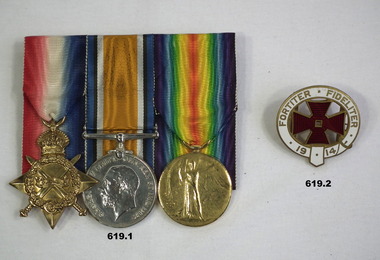
... She was awarded the ARRC (2nd class) for her work at a CCS on the Western Front. Articles written about her state that she was also awarded an "MM". ARRC, (Royal Red Cross...She was awarded the ARRC (2nd class) for her work at a CCS on the Western Front. Articles written about her state that she was also awarded an "MM". ARRC, (Royal Red Cross ...Leah Rosenthal ARRC (Born Melbourne) Enlisted in 1915 and embarked 18.12.15 from Australia to join the QAIMNSP service. Her service was terminted on 9.5.19. She was awarded the ARRC (2nd class) for her work at a CCS on the Western Front. Articles written about her state that she was also awarded an "MM". ARRC, (Royal Red Cross). CCS, (Casualty Clearing Station). MM, (Military Medal) QAIMNSP, (Queen Alexandria's Imperial Military Nursing Service) A brother Samuel was KIA in the war, refer 620. The badge was an “Empress Club 1914 Emergency Voluntary Aid Committee badge”which was a Ladies Club in Dover street Piccadilly. “Fortiter Fideliter” meaning “Strongly Faithful”. The centre of the badge is a Maltese Cross. There is a ribbon with the badge but missing. During WW1 the Club was used as a War Supply Depot. In 1917 a Red Cross hut was opened on the roof of the building. Pre war Leah had done her training at Alfred Hospital. After the war Leah and close friend Isabella Jobson bought St Lukes Private Hospital and renamed it “Vimy House”. Leah passed away in 1930. Isabella inaugurated and annual prize in Leah’s name at the Alfred Hospital for the best Theatre Nurse. Isabella had gone with Leah to England and they both served together during WW1..1) Medals, court mounted set of (3) re L.Rosenthal. 1, 1914-1915 Star. 2. War Medal 1914 -1918. 3. Victory Medal 1914 - 19 replica not engraved. .2) Badge metal slightly oval Red cross centre with white and gold trimming. In gold lettering "Fortiter Fideliter 1914" around the outside.,1) Sister L Rosenthal Q.A.I.M.N.S.Pmedals, hospitals, military, nursing
