
Showing 90 items matching "royal seal"
-
 Red Cliffs Military Museum
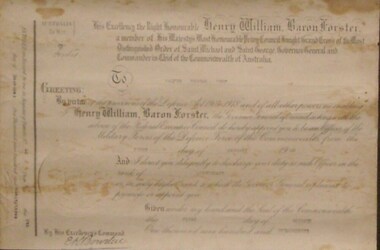
Certificate, Certificate of Promotion in Rank, 5/12/1923 (exact)
... Official Australian Government Certificate.Possibly written in old English script and carries the Royal Seal....Official Australian Government Certificate.Possibly written in old English script and carries the Royal Seal. Certificate of Promotion in Rank Certificate Certificate Unknown ...This certificate and 5 other documents from the Walter Thomas West Collection, are in a frame 90.40cm x 66.50cm, which has non reflecting glass.Official Australian Government Certificate.Possibly written in old English script and carries the Royal Seal.Main face of Certificate. "His Excellency the Right Honorable Henry William Baron Forster a member of his Majesty's Most Honorable Privy Council Knight Grand Cross of the most Distinguished Order of Saint Michael and Saint George, Governor General and Commander In Chief of the Commonwealth of Australia. To Walter Thomas West Greeting: By virtue of the provisions of the Defence Act 1903 - 1918 and of all the other powers me enabling I, Henry William Baron Forster, the Goveneror General a foresaid acting with the advice of the Federal Executive Council, do gereby appoint you to be an officer of the Military Forces of the Defence Force of the Commonwealth from the First Day of January 1920. And I direct you diligently to discharge your duty as such officer in the rank of Lieutenant or in any higher rank to which the Governor General is pleased to promote or appoint you. Given under my hand and the seal of the Commonwealth this first day of October One Thousand Nine Hundred and Twenty Three. By the Excellency's Command. (signed) E.K. Bowden" Left Hand side Margin: Entered on record by me, in Register of Patents No 40 Page 2 this 5th day of December, One Thousand Nine Hundred and Twenty Three.of, ww1, walter, thomas, west, mm, mc, photo, register, patents, no40, page, 2, , 1923, collection -
 University of Melbourne, Burnley Campus Archives
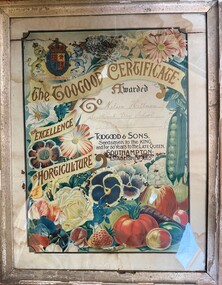
Certificate (item) - Award Certificate, Toogood & Sons, The Toogood Certificate - Framed, 1910
... ...Royal seal...English Award from Southampton - possibly brought to Australia by an emigrant. awards certificates toogood & sons seedsmen Nelson Hillman Royal seal 1910 The Toogood Certificate for Excellence in Horticulture Awarded to ... ...English Award from Southampton - possibly brought to Australia by an emigrant. The Toogood Certificate for Excellence in Horticulture Awarded to ... (in faded brown inked hand writing) Nelson Hillman, Southwick Day School Gardens 1910.... Toogood & Sons Seedsmen to the King, and for 50 Years to the Late Queen, SOUTHAMPTON. Established 1815. Latin on Royal Coat of Arms Dieu et mon droitawards, certificates, toogood & sons, seedsmen, nelson hillman, royal seal, 1910 -
 Yarrawonga and Mulwala Pioneer Museum
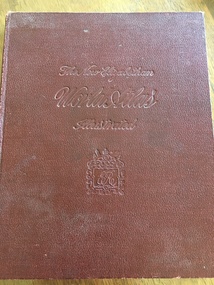
Book, The Specialty Press, The New Elizabethan World Atlas Illustrated, 1952
... Front embossed with title and royal seal. 152 pages. Contains detailed maps of world countries in colour. ...Front embossed with title and royal seal. 152 pages. Contains detailed maps of world countries in colour. ...Provides names of countries and their borders as they were during the 1950'sMaroon hard cover illustrated atlas. Front embossed with title and royal seal. 152 pages. Contains detailed maps of world countries in colour. Early world history and it's development and comprehensive gazetteer.Owners name written in front pagesmaps -
 Bendigo Historical Society Inc.
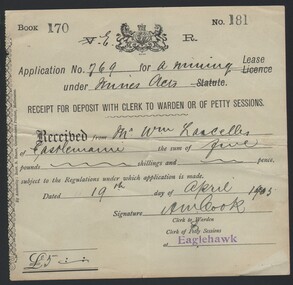
Document - MINING LEASE RECEIPT, 1905
... Eaglehawk is stamped in purple ink at bottom of receipt. Royal seal at top of document read V. R. The V has been crossed out and replaced with an E....Eaglehawk is stamped in purple ink at bottom of receipt. Royal seal at top of document read V. R. The V has been crossed out and replaced with an E. ...Document. Mining Lease Receipt. Receipt for a Mining Lease dated 19 April 1905 for a Mr William Lascelles of Castlemaine. The receipt is marked Book 170 No. 181. The cost for the Mining Lease was Five pounds. Receipt is printed in black ink and is signed by ? Cook. Eaglehawk is stamped in purple ink at bottom of receipt. Royal seal at top of document read V. R. The V has been crossed out and replaced with an E.cottage, miners, mining lease receipt, mr william lascelles -
 National Vietnam Veterans Museum (NVVM)
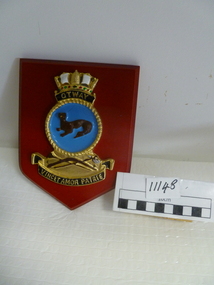
Plaque, Otway
... Red veneer wooden shield with gold bordered emblem featuring royal crown above a seal in blue centre and aboriginal weapons below, Motto "Vincet Amor Patrie"...Plaque Otway Aboriginal Red veneer wooden shield with gold bordered emblem featuring royal crown above a seal in blue centre and aboriginal weapons below, Motto "Vincet Amor Patrie" Otway Plaque Plaque ...Red veneer wooden shield with gold bordered emblem featuring royal crown above a seal in blue centre and aboriginal weapons below, Motto "Vincet Amor Patrie"plaque, otway, aboriginal -
 Bendigo Historical Society Inc.
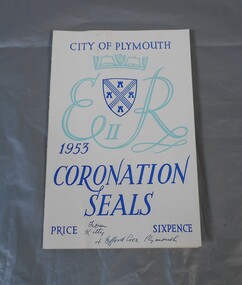
Memorabilia - Lydia Chancellor collection: City of Plymouth 1953 Coronation seals
... Vanguard, Winstanley's Lighthouse, Smeaton Tower, Mayflower, Ile de France, Elizabethan House 32 New Street, Old Town Street, Buckland Abbey and Royal Parade. The Coronation seals have been issued by the Port of Plymouth junior Chamber of Commerce and the proceeds are in aid of the following charities: the Lord Mayor's Christmas fund, the Patient's Voluntary Welfare fund and the Plymouth Council of Social Service. ...Vanguard, Winstanley's Lighthouse, Smeaton Tower, Mayflower, Ile de France, Elizabethan House 32 New Street, Old Town Street, Buckland Abbey and Royal Parade. The Coronation seals have been issued by the Port of Plymouth junior Chamber of Commerce and the proceeds are in aid of the following charities: the Lord Mayor's Christmas fund, the Patient's Voluntary Welfare fund and the Plymouth Council of Social Service. ...Unlike regular postage stamps, Cinderella stamps were privately produced and had could not be used for postage. They were produced for a number of reasons:- 1. as souvenirs of a specific event, 2. as promotional tools either for a business our tourism, 3. to raise funds for a particular project. Ref. Stanley Gibbons philately Card by the City of Plymouth for the 1953 Coronation. The card has the logo of E.R. II on the front. Inside a strip of 10 Cinderella stamps showing Plymouth old and new. The designs are: Sir Franci Drake and the Golden Hind, H.M.S. Vanguard, Winstanley's Lighthouse, Smeaton Tower, Mayflower, Ile de France, Elizabethan House 32 New Street, Old Town Street, Buckland Abbey and Royal Parade. The Coronation seals have been issued by the Port of Plymouth junior Chamber of Commerce and the proceeds are in aid of the following charities: the Lord Mayor's Christmas fund, the Patient's Voluntary Welfare fund and the Plymouth Council of Social Service. Price: sixpence.From Kitty 4 Efford Crescent, Plymouth1953 coronation, city of plymouth, cinderella stamps -
 Flagstaff Hill Maritime Museum and Village
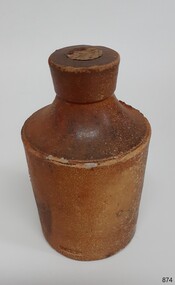
Container - Ink Bottle, Royal Doulton, 1853-1878
... Through is associated with the worst and best-known shipwreck in Victoria's history. flagstaff hill warrnambool flagstaff hill maritime museum shipwreck coast flagstaff hill maritime village great ocean road loch line loch ard captain gibbs eva carmichael tom pearce glenample station mutton bird island loch ard gorge ink bottle bulk ink bottle writing accessory stationery stoneware Doulton Lambeth Royal Doulton writing equipment Stamped into clay "DOULTON LAMBETH" Salt glazed stoneware ink bottle, large capacity, tapered lip and body, two-tone brown with some encrustation on surface, still sealed with cork. ...The ink bottle was made by the Royal Doulton company which began as a partnership between John Doulton, Martha Jones, and John Wattis an English ceramic and home accessories manufacturer founded in 1815. Operating initially in Vauxhall, London, it later moved to Lambeth, In1882 it opened a factory in Burslem, Stoke on Trent, in the centre of English pottery. The business specialised in making salt-glazed stoneware articles, including utilitarian or decorative bottles, jugs and jars, much of it intended for inns and pubs. The backbone of the business was a wide range of utilitarian wares, mostly stoneware's, including storage jars, tankards and the like, and later extending to pipes for drains, lavatories and other bathroom ceramics. From 1853 to 1902 its wares were marked Doulton & Co., then from 1902, when a royal warrant was given, wares were marked Royal Doulton. The company always made some more decorative items, initially still mostly stoneware, and from the 1860s the firm made considerable efforts to get a reputation for design, in which it was largely successful, as one of the first British makers of art pottery. Initially, this was done through artistic stoneware made in Lambeth, but in 1882 the firm bought a Burslem factory, which was mainly intended for making bone china table wares and decorative items. History of the Loch Ard: The Loch Ard got its name from ”Loch Ard” a loch that lies to the west of Aberfoyle, and the east of Loch Lomond. It means "high lake" in Scottish Gaelic. The vessel belonged to the famous Loch Line which sailed many vessels from England to Australia. The Loch Ard was built in Glasgow by Barclay, Curdle and Co. in 1873, the vessel was a three-masted square-rigged iron sailing ship that measured 79.87 meters in length, 11.58 m in width, and 7 m in depth with a gross tonnage of 1693 tons with a mainmast that measured a massive 45.7 m in height. Loch Ard made three trips to Australia and one trip to Calcutta before its fateful voyage. Loch Ard left England on March 2, 1878, under the command of 29-year-old Captain Gibbs, who was newly married. The ship was bound for Melbourne with a crew of 37, plus 17 passengers. The general cargo reflected the affluence of Melbourne at the time. Onboard were straw hats, umbrellas, perfumes, clay pipes, pianos, clocks, confectionery, linen and candles, as well as a heavier load of railway irons, cement, lead and copper. There were other items included that were intended for display in the Melbourne International Exhibition of 1880. The voyage to Port Phillip was long but uneventful. Then at 3 am on June 1, 1878, Captain Gibbs was expecting to see land. But the Loch Ard was running into a fog which greatly reduced visibility. Captain Gibbs was becoming anxious as there was no sign of land or the Cape Otway lighthouse. At 4 am the fog lifted and a lookout aloft announced that he could see breakers. The sheer cliffs of Victoria's west coast came into view, and Captain Gibbs realised that the ship was much closer to them than expected. He ordered as much sail to be set as time would permit and then attempted to steer the vessel out to sea. On coming head-on into the wind, the ship lost momentum, the sails fell limp and Loch Ard's bow swung back towards land. Gibbs then ordered the anchors to be released in an attempt to hold their position. The anchors sank some 50 fathoms - but did not hold. By this time the ship was among the breakers and the tall cliffs of Mutton Bird Island rose behind. Just half a mile from the coast, the ship's bow was suddenly pulled around by the anchor. The captain tried to tack out to sea, but the ship struck a reef at the base of Mutton Bird Island, near Port Campbell. Waves subsequently broke over the ship and the top deck became loosened from the hull. The masts and rigging came crashing down knocking passengers and crew overboard. When a lifeboat was finally launched, it crashed into the side of Loch Ard and capsized. Tom Pearce, who had launched the boat, managed to cling to its overturned hull and shelter beneath it. He drifted out to sea and then on the flood tide came into what is now known as Lochard Gorge. He swam to shore, bruised and dazed, and found a cave in which to shelter. Some of the crew stayed below deck to shelter from the falling rigging but drowned when the ship slipped off the reef into deeper water. Eva Carmichael a passenger had raced onto the deck to find out what was happening only to be confronted by towering cliffs looming above the stricken ship. In all the chaos, Captain Gibbs grabbed Eva and said, "If you are saved Eva, let my dear wife know that I died like a sailor". That was the last Eva Carmichael saw of the captain. She was swept off the ship by a huge wave. Eva saw Tom Pearce on a small rocky beach and yelled to attract his attention. He dived in and swam to the exhausted woman and dragged her to shore. He took her to the cave and broke the open case of brandy which had washed up on the beach. He opened a bottle to revive the unconscious woman. A few hours later Tom scaled a cliff in search of help. He followed hoof prints and came by chance upon two men from nearby Glenample Station three and a half miles away. In a complete state of exhaustion, he told the men of the tragedy. Tom then returned to the gorge while the two men rode back to the station to get help. By the time they reached Loch Ard Gorge, it was cold and dark. The two shipwreck survivors were taken to Glenample Station to recover. Eva stayed at the station for six weeks before returning to Ireland by steamship. In Melbourne, Tom Pearce received a hero's welcome. He was presented with the first gold medal of the Royal Humane Society of Victoria and a £1000 cheque from the Victorian Government. Concerts were performed to honour the young man's bravery and to raise money for those who lost family in the disaster. Of the 54 crew members and passengers on board, only two survived: the apprentice, Tom Pearce and the young woman passenger, Eva Carmichael, who lost her family in the tragedy. Ten days after the Lochard tragedy, salvage rights to the wreck were sold at auction for £2,120. Cargo valued at £3,000 was salvaged and placed on the beach, but most washed back into the sea when another storm developed. The wreck of Lochard still lies at the base of Mutton Bird Island. Much of the cargo has now been salvaged and some items were washed up into Lochard Gorge. Cargo and artefacts have also been illegally salvaged over many years before protective legislation was introduced in March 1982. One of the most unlikely pieces of cargo to have survived the shipwreck was a Minton majolica peacock- one of only nine in the world. The peacock was destined for the Melbourne 1880 International Exhibition. It had been well packed, which gave it adequate protection during the violent storm. Today the Minton peacock can be seen at the Flagstaff Hill Maritime Museum in Warrnambool. From Australia's most dramatic shipwreck, it has now become Australia's most valuable shipwreck artifact and is one of very few 'objects' on the Victorian State Heritage Register.An early utilitarian stoneware item made by a well-known company that specialised in making salt-glazed items that later earned a reputation for making stoneware art objects. Of additional significance is that it was recovered from the wreck of the Loch Ard. A shipwreck that is of additional significance as it is registered on the Victorian Heritage Register ( S 417). Flagstaff Hill has a varied collection of artefacts from Loch Ard and its collection is significant for being one of the largest accumulations of artefacts from this notable Victorian shipwreck of which the subject items are a small part. The collections objects give us a snapshot of how we can interpret the story of this tragic event. The collection is also archaeologically significant as it represents aspects of Victoria's shipping history that allows us to interpret Victoria's social and historical themes of the time. Through is associated with the worst and best-known shipwreck in Victoria's history. Salt glazed stoneware ink bottle, large capacity, tapered lip and body, two-tone brown with some encrustation on surface, still sealed with cork. Inscription in clay. Recovered from the wreck of the LOCH ARD.Stamped into clay "DOULTON LAMBETH"flagstaff hill, warrnambool, flagstaff hill maritime museum, shipwreck coast, flagstaff hill maritime village, great ocean road, loch line, loch ard, captain gibbs, eva carmichael, tom pearce, glenample station, mutton bird island, loch ard gorge, ink bottle, bulk ink bottle, writing accessory, stationery, stoneware, doulton lambeth, royal doulton, writing equipment -
 Federation University Historical Collection
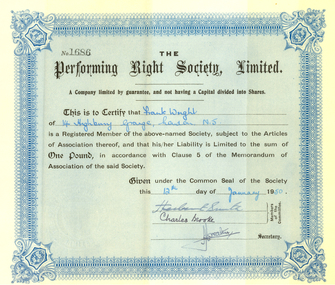
Correspondence, The Performing Right Society, Ltd, Performing Right Society Ltd to Frank Wright, 1950, 12/1/1950
... Royal South Street competition is awarded to an individual recognized as making an outstanding contribution to brass music in Australia. frank wright, the performing right society limited, certificate, brass band 1). The Performing Right Society, Limited. This is to certify that Frank Wright of 14 Highbury Grange, London, N.5 is a Registered Member..., Signed on this12th day of January 1950, by Herbert Smith, Charles Brooke and the Secretary. On the lower left side is the embossed seal ...Frank Wright was a renown resident of Smeaton, where he was born on 2 August 1901. He lived at Laura Villa, and attended Smeaton State School. His father William was a gold miner and his mother's name was Sarah. Their family won many singing and instrumental awards. Frank was tutored by Percy Code and was awarded a gold medal for the highest marks in the ALCM examinations in the British Colonies at the age of seventeen years. He became the Australian Open Cornet Champion by the age of eighteen. A year later, Frank conducted the City of Ballarat Band, and later the Ballarat Soldiers’ Memorial Band. He formed the Frank Wright Frisco Band and Frank Wright and his Coliseum Orchestra. These bands won many South Street awards, and Frank as conductor won many awards in the Australian Band Championship contest. In 1933 Frank Wright sailed to England to conduct the famous St Hilda’s Band and was later appointed Musical Director of the London County Council, where he organized many amazing concerts in parks, in and around the London district. He was made Professor of Brass and Military Band Scoring and conducted at the Guildhall of Music and Drama. Frank was often invited to adjudicate Brass Band Championships around Europe, in Australia, including South Street and in New Zealand. The Frank Wright Medal at the Royal South Street competition is awarded to an individual recognized as making an outstanding contribution to brass music in Australia.1). Paper Certificate - cream background with a blue overlay and darker blue ornate border, containing black printing, a stamped number and blue pen filled in information. 2). Paper envelope with printed name and address on top left side, Frank Wright's address in the middle and English stamped postage stamp on top right.1). The Performing Right Society, Limited. This is to certify that Frank Wright of 14 Highbury Grange, London, N.5 is a Registered Member..., Signed on this12th day of January 1950, by Herbert Smith, Charles Brooke and the Secretary. On the lower left side is the embossed seal of the society. 2). Printed on top - The Performing Right Society, Ltd., Copyright House, 33, Margaret Street, London, W.1. Typed in middle - Frank Wright Esq., 14 Highbury Grange, London, N.5.frank wright, the performing right society limited, certificate, brass band -
 Flagstaff Hill Maritime Museum and Village
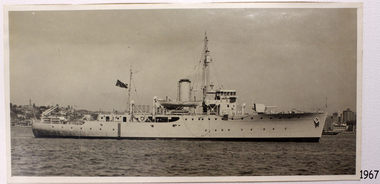
Photograph - Vessel, Steam Ship, H.M.A.S. Warrnambool J202, 1941-1947
... Royal Australian Navy...RAN...Sydney built ship...Bass Strait patrol...sea mine patrol...Mine sweeper...Mine clearance...Navy divers...Great Barrier Reef...Cockburn Reef...Southern Cross Diving and Salvage...Warrnambool City Council...Cr J R Astbury...Mayor J R Astbury...Warrnambool Patriotic Fund...Seal...Warrnambool HMAS Warrnambool HMAS Warrnambool I HMAS Warrnambool J202 HMAS Swan II J202 World War II Bathurst class corvette Royal Australian Navy RAN Sydney built ship Bass Strait patrol sea mine patrol Mine sweeper Mine clearance Navy divers Great Barrier Reef Cockburn Reef Southern Cross Diving and Salvage Warrnambool City Council Cr J R Astbury Mayor J R Astbury Warrnambool Patriotic Fund Seal Coat of Arms Ship’s Bell HMAS Warrnambool 1941 Shipwreck by sea mine 1947 Sinking ship Sunk ship Sea rescue life saving Lifesaving minesweeper Photograph, black and white, HMAS Warrnambool J202 in water with land and buildings in background. ...This photograph is connected to the first HMAS Warrnambool J202, which was commissioned by the Royal Australian Navy for use as a minesweeper during World War II. The Bathurst Class Corvette, fitted out with a range of armaments, was launched in Sydney 1941. The ship began service in Bass Strait in 1941. At the end of the year it called into its namesake city, Warrnambool, where the crew paraded for the public marching eastwards along Timor Street. A gift of books for the ship’s personnel and a plaque bearing the City of Warrnambool’s Coat of Arms were presented to the ship. The ship was involved in evacuating a family of nine from the Dutch East Indies that was later successful in its challenge of Australia’s Immigration Restriction Act (White Australia Polity). The ship had many other appointments around Australia. On 13th September 1947 HMAS Warrnambool was leading a flotilla of minesweepers in northern Queensland’s coastal waters, clearing mines previously laid to defend Australia. The ship hit a mine, which exploded and very quickly sunk the ship. Boats from the nearby ships rescued most of the seamen although one was killed at the time. The survivors were taken by the HMAS Swan II to Darwin, and they went from there to hospitals in Brisbane and Sydney. Three of these men later died from their injuries. A number of items were recovered by Navy divers in 1948 including the ship’s bell and a plaque with Warrnambool’s Coat of Arms. In 1972-75 the wreck was sold and other items were salvaged. In 1995 a memorial plaque was erected in Warrnambool near the RSL. NOTE: The RAN built a second HMAS Warrnambool FCPB204, launched in 1981 and decommissioned in 2005. There was also a steam ship SS Warrnambool built in London 1892 and broken up in 1926. [A more detailed history can be found in our Collection Record 3477.] This photograph is significant for its association with Royal Australian Navy and its vessel, HMAS Warrnambool (j202). The HMAS Warrnambool played a nationally significant role in overturning Australia’s Immigration Restriction Act 1901 (colloquially known as the White Australia policy). The ship rescued, and brought to Australia, Samuel and Annie Jacob and their family after they evacuated Dutch East India. The family was threatened with deportation and made the first successful appeal to High Court regarding that Act. The HMAS Warrnambool has - Local significance for being the namesake of the City of Warrnambool - Local significance, having docked in Warrnambool Harbour - Local significance, the crew having paraded in Timor Street, Warrnambool - State significance for its first patrol being in Bass Strait. - National significance, being present in Timor at the Japanese surrender - National significance as part of Australia’s defence force history, being one of only four Bathurst class corvettes lost while in Australian service, the only Bathurst class corvette lost after World War II, the only RAN vessel to be sunk by a mine, and associated with the last four Navy deaths of WWIIPhotograph, black and white, HMAS Warrnambool J202 in water with land and buildings in background. Ship is flying a dark flag with Union Jack in corner and star below it. Lifeboat suspended above deck in centre of ship. Top of funnel has a black band. flagstaff hill, warrnambool, shipwrecked-coast, flagstaff-hill, flagstaff-hill-maritime-museum, maritime-museum, shipwreck-coast, flagstaff-hill-maritime-village, maritime village, maritime museum, shipwreck coast, mort's dock & engineering co ltd, h.m.a.s. warrnambool, hmas warrnambool, hmas warrnambool i, hmas warrnambool j202, hmas swan ii, j202, world war ii, bathurst class corvette, royal australian navy, ran, sydney built ship, bass strait patrol, sea mine patrol, mine sweeper, mine clearance, navy divers, great barrier reef, cockburn reef, southern cross diving and salvage, warrnambool city council, cr j r astbury, mayor j r astbury, warrnambool patriotic fund, seal, coat of arms, ship’s bell, hmas warrnambool 1941, shipwreck by sea mine 1947, sinking ship, sunk ship, sea rescue, life saving, lifesaving, minesweeper -
 Flagstaff Hill Maritime Museum and Village
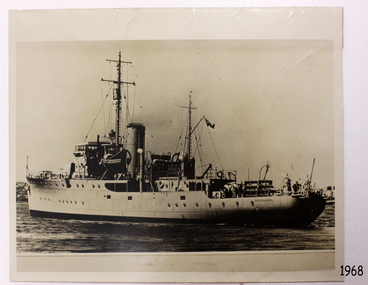
Photograph - Vessel, Steam Ship, HMAS Warrnambool J202, Between 1941-1947
... Royal Australian Navy...RAN...Sydney built ship...Bass Strait patrol...sea mine patrol...Mine sweeper...Mine clearance...Navy divers...Great Barrier Reef...Cockburn Reef...Southern Cross Diving and Salvage...Warrnambool City Council...Cr J R Astbury...Mayor J R Astbury...Warrnambool Patriotic Fund...Seal...Warrnambool HMAS Warrnambool HMAS Warrnambool I HMAS Warrnambool J202 HMAS Swan II J202 World War II Bathurst class corvette Royal Australian Navy RAN Sydney built ship Bass Strait patrol sea mine patrol Mine sweeper Mine clearance Navy divers Great Barrier Reef Cockburn Reef Southern Cross Diving and Salvage Warrnambool City Council Cr J R Astbury Mayor J R Astbury Warrnambool Patriotic Fund Seal Coat of Arms Dedicatory plaque HMAS Warrnambool 1941 Shipwreck by sea mine 1947 Sinking ship Sunk ship minesweeper On side of ship "WARRNAMBOOL" Photograph of HMAS Warrnambool near land. ...The photograph shows the vessel HMAS Warrnambool J202, which was commissioned by the Royal Australian Navy for use as a minesweeper during World War II. The Bathurst Class Corvette, fitted out with a range of armaments, was launched in Sydney 1941. The ship began service in Bass Strait in 1941. At the end of the year it called into its namesake city, Warrnambool, where the crew paraded for the public marching eastwards along Timor Street. A gift of books for the ship’s personnel and a plaque bearing the City of Warrnambool’s Coat of Arms were presented to the ship. The ship was involved in evacuating a family of nine from the Dutch East Indies that was later successful in its challenge of Australia’s Immigration Restriction Act (White Australia Polity). The ship had many other appointments around Australia. On 13th September 1947 HMAS Warrnambool was leading a flotilla of minesweepers in northern Queensland’s coastal waters, clearing mines previously laid to defend Australia. The ship hit a mine, which exploded and very quickly sunk the ship. Boats from the nearby ships rescued most of the seamen although one was killed at the time. The survivors were taken by the HMAS Swan II to Darwin, and they went from there to hospitals in Brisbane and Sydney. Three of these men later died from their injuries. A number of items were recovered by Navy divers in 1948 including the ship’s bell and a plaque with Warrnambool’s Coat of Arms. In 1972-75 the wreck was sold and other items were salvaged. In 1995 a memorial plaque was erected in Warrnambool near the RSL. NOTE: The RAN built a second HMAS Warrnambool FCPB204, launched in 1981 and decommissioned in 2005. There was also a steam ship SS Warrnambool built in London 1892 and broken up in 1926. [A more detailed history can be found in our Collection Record 3477.] This photograph of HMAS Warrnambool is significant for its association with Royal Australian Navy and its vessel, HMAS Warrnambool (J202). The HMAS Warrnambool played a nationally significant role in overturning Australia’s Immigration Restriction Act 1901 (colloquially known as the White Australia policy). The ship rescued, and brought to Australia, Samuel and Annie Jacob and their family after they evacuated Dutch East India. The family was threatened with deportation and made the first successful appeal to High Court regarding that Act. The HMAS Warrnambool has - Local significance for being the namesake of the City of Warrnambool - Local significance, having docked in Warrnambool Harbour - Local significance, the crew having paraded in Timor Street, Warrnambool - State significance for its first patrol being in Bass Strait. - National significance, being present in Timor at the Japanese surrender - National significance, shown by the significance of the ship’s bell being curated as Military Heritage and Technology at the Australian War Memorial. - National significance as part of Australia’s defence force history, being one of only four Bathurst class corvettes lost while in Australian service, the only Bathurst class corvette lost after World War II, the only RAN vessel to be sunk by a mine, and associated with the last four Navy deaths of WWIIPhotograph of HMAS Warrnambool near land. Black and white photograph shows a steam and sail vessel in calm water beside land. Figures are standing on board. A flag flies on a mast. The ship's name is on the stern. The light coloured funnel has emitted a small amount of smoke.On side of ship "WARRNAMBOOL"flagstaff hill, maritime village, maritime museum, warrnambool, shipwreck coast, mort's dock & engineering co ltd, h.m.a.s. warrnambool, hmas warrnambool, hmas warrnambool i, hmas warrnambool j202, hmas swan ii, j202, world war ii, bathurst class corvette, royal australian navy, ran, sydney built ship, bass strait patrol, sea mine patrol, mine sweeper, mine clearance, navy divers, great barrier reef, cockburn reef, southern cross diving and salvage, warrnambool city council, cr j r astbury, mayor j r astbury, warrnambool patriotic fund, seal, coat of arms, dedicatory plaque, hmas warrnambool 1941, shipwreck by sea mine 1947, sinking ship, sunk ship, minesweeper -
 Flagstaff Hill Maritime Museum and Village
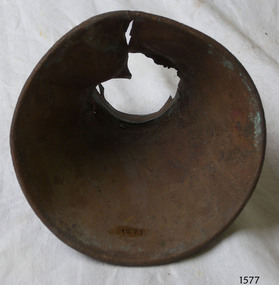
Equipment - Speaking Tube, Morts Dock & Engineering Co. Ltd, circa 1941
... Royal Australian Navy...RAN...Sydney built ship...Bass Strait patrol...sea mine patrol...Mine sweeper...Mine clearance...Navy divers...Great Barrier Reef...Cockburn Reef...Southern Cross Diving and Salvage...Warrnambool City Council...Cr J R Astbury...Mayor J R Astbury...Warrnambool Patriotic Fund...Seal...Warrnambool HMAS Warrnambool HMAS Warrnambool I HMAS Warrnambool J202 HMAS Swan II J202 World War II Bathurst class corvette Royal Australian Navy RAN Sydney built ship Bass Strait patrol sea mine patrol Mine sweeper Mine clearance Navy divers Great Barrier Reef Cockburn Reef Southern Cross Diving and Salvage Warrnambool City Council Cr J R Astbury Mayor J R Astbury Warrnambool Patriotic Fund Seal Coat of Arms Ship’s Bell HMAS Warrnambool 1941 Shipwreck by sea mine 1947 Sinking ship Sunk ship Sea rescue life saving Lifesaving speaking tube voice pipe communication on ship marine technology marine equipment minesweeper Speaking tube or voice pipe, brass, conical shape, broken off at base. ...This brass speaking tube or voice pipe was used by the crew to communicate within the ship. It was recovered from the wreck of the Royal Australian Navy vessel, HMAS Warrnambool in 1948. The HMAS Warrnambool J202 was commissioned by the Royal Australian Navy for use as a minesweeper during World War II. The Bathurst Class Corvette, fitted out with a range of armaments, was launched in Sydney 1941 and was. The ship began service in Bass Strait in 1941. At the end of the year it called into its namesake city, Warrnambool, where the crew paraded for the public marching eastwards along Timor Street. A gift of books for the ship’s personnel and a plaque bearing the City of Warrnambool’s Coat of Arms were presented to the ship. The ship was involved in evacuating a family of nine from the Dutch East Indies that was later successful in its challenge of Australia’s Immigration Restriction Act (White Australia Polity). The ship had many other appointments around Australia. On 13th September 1947 HMAS Warrnambool was leading a flotilla of minesweepers in northern Queensland’s coastal waters, clearing mines previously laid to defend Australia. The ship hit a mine, which exploded and very quickly sunk the ship. Boats from the nearby ships rescued most of the seamen although one was killed at the time. The survivors were taken by the HMAS Swan II to Darwin, and they went from there to hospitals in Brisbane and Sydney. Three of these men later died from their injuries. A number of items were recovered by Navy divers in 1948 including the ship’s bell and a plaque with Warrnambool’s Coat of Arms. In 1972-75 the wreck was sold and other items were salvaged. In 1995 a memorial plaque was erected in Warrnambool near the RSL. NOTE: The RAN built a second HMAS Warrnambool FCPB204, launched in 1981 and decommissioned in 2005. There was also a steam ship SS Warrnambool built in London 1892 and broken up in 1926. [A more detailed history can be found in our Collection Record 3477.] This speaking tube is an example of communication used in the mid-1900s on board a vessel. It is significant is significant for its association with Royal Australian Navy and its vessel, HMAS Warrnambool (J202). The HMAS Warrnambool played a nationally significant role in overturning Australia’s Immigration Restriction Act 1901 (colloquially known as the White Australia policy). The ship rescued, and brought to Australia, Samuel and Annie Jacob and their family after they evacuated Dutch East India. The family was threatened with deportation and made the first successful appeal to High Court regarding that Act. The HMAS Warrnambool has - Local significance for being the namesake of the City of Warrnambool - Local significance, having docked in Warrnambool Harbour - Local significance, the crew having paraded in Timor Street, Warrnambool - State significance for its first patrol being in Bass Strait. - National significance, being present in Timor at the Japanese surrender - National significance, shown by the significance of the ship’s bell being curated as Military Heritage and Technology at the Australian War Memorial. - National significance as part of Australia’s defence force history, being one of only four Bathurst class corvettes lost while in Australian service, the only Bathurst class corvette lost after World War II, the only RAN vessel to be sunk by a mine, and associated with the last four Navy deaths of WWIISpeaking tube or voice pipe, brass, conical shape, broken off at base. Wide end has a rolled edge. Recovered from HMAS Warrnambool, sunk on 13-09-1947.flagstaff hill, maritime village, maritime museum, warrnambool, shipwreck coast, mort's dock & engineering co ltd, h.m.a.s. warrnambool, hmas warrnambool, hmas warrnambool i, hmas warrnambool j202, hmas swan ii, j202, world war ii, bathurst class corvette, royal australian navy, ran, sydney built ship, bass strait patrol, sea mine patrol, mine sweeper, mine clearance, navy divers, great barrier reef, cockburn reef, southern cross diving and salvage, warrnambool city council, cr j r astbury, mayor j r astbury, warrnambool patriotic fund, seal, coat of arms, ship’s bell, hmas warrnambool 1941, shipwreck by sea mine 1947, sinking ship, sunk ship, sea rescue, life saving, lifesaving, speaking tube, voice pipe, communication on ship, marine technology, marine equipment, minesweeper -
 Mission to Seafarers Victoria
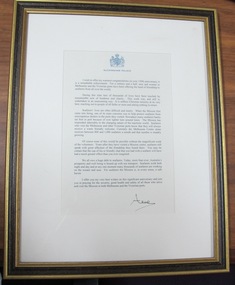
Letter - Framed letter, Art Conservation Framers, Buckingham Palace, Letter from HRH Anne, the Princess Royal, 2007 - 2008
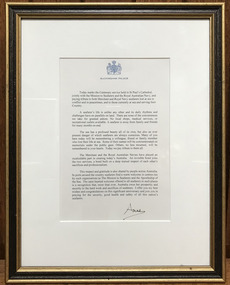
... This letter is one of 3 letters held in the collection and received from Royal patrons. mission to seafarers sesquicentenary commemorations princess anne princess royal letter 2007 Signature bottom right in Black ink "Anne" / Conservation Framer's label initials in black ink : "E LH 22/2/08" Letter, signed, on Buckingham Palace letterhead mounted and housed in gilt painted frame, glazed . Fitted with single twist hanging wire, and 4 felt stoppers; Core flute backing with Brown paper tape to seal ...The author of the letter the Princess Royal is patron of the Mission to Seafarers in Australia. The letter marks the 150th anniversary in 2007 of the establishment of the Mission to Seafarers in Australia. It acknowledges the work of the Mission and the men and women in Melbourne and the Victorian Ports offering the "hand of friendship to seafarers from all over the world".It also acknowledges the significant role of volunteers in supporting the work of the Missions. This letter is one of 3 letters held in the collection and received from Royal patrons. Letter, signed, on Buckingham Palace letterhead mounted and housed in gilt painted frame, glazed . Fitted with single twist hanging wire, and 4 felt stoppers; Core flute backing with Brown paper tape to seal. Signature bottom right in Black ink "Anne" / Conservation Framer's label initials in black ink : "E LH 22/2/08"mission to seafarers, sesquicentenary, commemorations, princess anne, princess royal, letter, 2007 -
 Mission to Seafarers Victoria
Letter - Framed letter, Princess Anne, Buckingham Palace, Letter from HRH Anne, the Princess Royal, 2007 - 2008
... The letter marks the centenary in 2007 of the establishment of the Seafarers Service in Australia. mission to seafarers commemorations princess anne princess royal letter 2007 centenary seafarers service Signature bottom right in Black ink "Anne" / Conservation Framer's label initials in black ink : "E LH 22/2/08" Letter, signed, on Buckingham Palace letterhead mounted and housed in gilt painted frame, glazed . Fitted with single twist hanging wire, and 4 felt stoppers; Core flute backing with Brown paper tape to seal ...The author of the letter the Princess Royal is patron of the Mission to Seafarers in Australia. The letter marks the centenary in 2007 of the establishment of the Seafarers Service in Australia. Letter, signed, on Buckingham Palace letterhead mounted and housed in gilt painted frame, glazed . Fitted with single twist hanging wire, and 4 felt stoppers; Core flute backing with Brown paper tape to seal. Signature bottom right in Black ink "Anne" / Conservation Framer's label initials in black ink : "E LH 22/2/08"mission to seafarers, commemorations, princess anne, princess royal, letter, 2007, centenary, seafarers service -
 Federation University Historical Collection
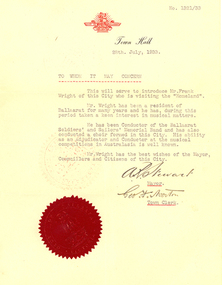
Document, F R Stewart, Mayor of City of Ballaarat, Reference for Frank Wright from the City of Ballarat, 1933, 28/7/1933
... The Frank Wright Medal at the Royal South Street competition is awarded to an individual recognized as making an outstanding contribution to brass music in Australia. city of ballarat seal city of ballarat crest city of ballarat coat of arms ballaarat soldiers' and sailors' memorial band frank wright arthur r. stewart george f. norton Municipal seal Council seal Watermark - Mitre Bond Signatures in black pen This single sheet of paper has the City of Ballaarat red printed Crest and waxed Seal and a typed letter of introduction and referral by the Mayor, A R Stewart and Town Clerk, Geo F Norton for Frank Wright. ...Frank Wright was a renown resident of Smeaton, where he was born on 2 August 1901. He lived at Laura Villa, and attended Smeaton State School. His father William was a gold miner and his mother's name was Sarah. Their family won many singing and instrumental awards. Frank was tutored by Percy Code and was awarded a gold medal for the highest marks in the ALCM examinations in the British Colonies at the age of seventeen years. He became the Australian Open Cornet Champion by the age of eighteen. A year later, Frank conducted the City of Ballarat Band, and later the Ballarat Soldiers’ Memorial Band. He formed the Frank Wright Frisco Band and Frank Wright and his Coliseum Orchestra. These bands won many South Street awards, and Frank as conductor won many awards in the Australian Band Championship contest. In 1933 Frank Wright sailed to England to conduct the famous St Hilda’s Band and was later appointed Musical Director of the London County Council, where he organized many amazing concerts in parks, in and around the London district. He was made Professor of Brass and Military Band Scoring and conducted at the Guildhall of Music and Drama. Frank was often invited to adjudicate Brass Band Championships around Europe, in Australia, including South Street and in New Zealand. The Frank Wright Medal at the Royal South Street competition is awarded to an individual recognized as making an outstanding contribution to brass music in Australia.This single sheet of paper has the City of Ballaarat red printed Crest and waxed Seal and a typed letter of introduction and referral by the Mayor, A R Stewart and Town Clerk, Geo F Norton for Frank Wright.Watermark - Mitre Bond Signatures in black pencity of ballarat seal, city of ballarat crest, city of ballarat coat of arms, ballaarat soldiers' and sailors' memorial band, frank wright, arthur r. stewart, george f. norton, municipal seal, council seal -
 Lara RSL Sub Branch
Book, Fly for your Life Author Larry Forrester, March 1956
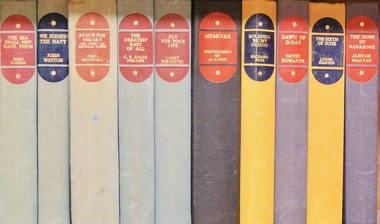
... royal air force distinguished flying cross italian bombers 257 squadron spitfire prison camp The story of R.R. Stanford Tuck, D.S.O D.F.C with two bars To my wife and eight other proud travellers of the inner circle. Part of Companion Book Club Hard Cover - colour blue- on spine red seal ...The story of Stanford Tuck's military career.Hard Cover - colour blue- on spine red seal with gold star on top and bottom. Photographs, The story of R.R. Stanford Tuck, D.S.O D.F.C with two bars To my wife and eight other proud travellers of the inner circle. Part of Companion Book Clubtuck, forrester, 65 squadron, distinguished service medal, royal air force, distinguished flying cross, italian bombers, 257 squadron, spitfire, prison camp -
 Flagstaff Hill Maritime Museum and Village
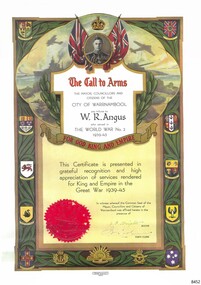
Certificate - Call to Arms, Osboldstone & Co. Pty. Ltd, W.R. Angus, ca. 1945
... Seal and the signatures of the Mayor and the Town Clerk. The top of the certificate has a portrait of King George VI below a crown emblem. The border has logos for countries of the British Commonwealth - Canada, South Africa, Inda and New Zealand - and the Australian States of Queensland, South Australia, Victoria, West Australia and Tasmania. The bottom has the badges of the Royal...Seal and the signatures of the Mayor and the Town Clerk. The top of the certificate has a portrait of King George VI below a crown emblem. The border has logos for countries of the British Commonwealth - Canada, South Africa, Inda and New Zealand - and the Australian States of Queensland, South Australia, Victoria, West Australia and Tasmania. The bottom has the badges of the Royal ...This copy of the Certificate of Call to Arms was presented to Dr William Roy Angus at the completion of World War II by the May, Councillors and Citizens of Warrnambool in appreciation for his service. It is now part of Flagstaff Hill’s comprehensive W.R. Angus Collection, donated by the family of Dr W R Angus, 1901-1970, surgeon and oculist. During World War II between 1942-45, Dr Angus served with the Australian Department of Defence as a Surgeon Captain in Ballarat, Victoria, and in Bonegilla, N.S.W., completing his service just before the end of the war due to suffering from a heart attack. The Certificate is headed by a crown above the portrait of King George VI, the reigning British monarch at the time of WWII and afterwards. King George was King of the United Kingdom and the Dominions of the British Commonwealth, which is illustrated by the emblems of the Commonwealth countries and of the states of Australia. It also has symbols for the three Australian Military Forces; Navy, Army and Air Vorce. The Certificate also carries the Common Seal of the Mayor, Councillors and Citizens of the City of Warrnambool, and the signatures of the Mayor and Town Clerk. The W.R. Angus Collection: - The W.R. Angus Collection includes historical medical equipment, surgical instruments and material belonging to Dr Edward Ryan and Dr Thomas Francis Ryan, (both of Nhill, Victoria) and Dr Angus’ own belongings. The Collection’s history spans the medical practices of the two Doctors Ryan, from 1885-1926 plus that of Dr Angus, up until 1969. It includes historical medical and surgical equipment and instruments from the doctors Edward and Thomas Ryan of Nhill, Victoria. Dr Angus married Gladys in 1927 at Ballarat, the nearest big city to Nhill where he began as a Medical Assistant. He was also Acting House surgeon at the Nhill hospital where their two daughters were born. During World War II He served as a Military Doctor in the Australian Defence Force. Dr Angus and his family moved to Warrnambool in 1939, where Dr Angus operated his own medical practice. He later added the part-time Port Medical Officer responsibility and was the last person appointed to that position. Both Dr Angus and his wife were very involved in the local community, including the planning stages of the new Flagstaff Hill and the layout of the gardens there. Dr Angus passed away in March 1970.This is an example of objects used by or issued to Doctor Angus during and after his military service as Surgeon Captain in Australia during World War II. The W.R. Angus Collection is significant for still being located at the site it is connected with, Doctor Angus being the last Port Medical Officer in Warrnambool. The Collection includes historical medical objects that date back to the late 1800s.Call to Arms; certificate of service awarded as a tribute to W. R. Angus by the Mayor, Councillors and Citizens of the City of Warrnambool and sealed with Common Seal and the signatures of the Mayor and the Town Clerk. The top of the certificate has a portrait of King George VI below a crown emblem. The border has logos for countries of the British Commonwealth - Canada, South Africa, Inda and New Zealand - and the Australian States of Queensland, South Australia, Victoria, West Australia and Tasmania. The bottom has the badges of the Royal Australian Navy, the Australian Commonwealth Military Forces and the Royal Australian Air Force. The Certificate was printed by Osboldstone & Co. of Melbourne, with the registered serial number 55319. This copy of the original certificate is part of the W. R. Angus Collection.Printed; "The Mayor, Councillors and citizens of the City of Warrnambool pay tribute to W.R. Angus who served in The World War No. 2 1939-45, for God, King and Empire" "This Certificate is presented in grateful recognition and high appreciation of services rendered for King and Empire in the Great War 1939-45." "In witness whereof, the Common Seal of the Mayor, Councillors and Citizens of Warrnambool was affixed hereto in the presence of " (Signatures of "J.F. Knights" [Mayor] "H.J. Worland" [Town Clerk]) Printed under the certificate: "Osboldstone & Co. Pty. Ltd. Printers, Melbourne" and "55319"flagstaff hill, warrnambool, maritime village, maritime museum, shipwreck coast, great ocean road, flagstaff hill maritime museum and village, dr w r angus, dr ryan, warrnambool base hospital, nhill base hospital, mira hospital, flying doctor, w.r. angus collection, australian department of defence, australian army, world war ii, wwii, surgeon captain, ballarat, bonegilla, certificate, call to arms, warrnambool mayor, j.f. knights, warrnambool town clerk, h.j. worland", city of warrnambool, world war no. 2', 1939-45, great war 1939-45, common seal of city of warrnambool, osboldstone & co. pty ltd., 55319, king george vi, british commonwealth, canada, south aftrica, india, new zealand, australian commonwealth military forces -
 Glenelg Shire Council Cultural Collection
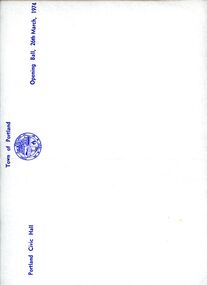
Souvenir - Paper Serviette - Souvenir Portland Civic Hall Opening Ball 1974, c. 1974
... Printed in royal blue, ' Town of Portland'; town of Portland seal, 'Portland Civic Hall'; ' Opening Ball, 26 March, 1974'...Printed in royal blue, ' Town of Portland'; town of Portland seal, 'Portland Civic Hall'; ' Opening Ball, 26 March, 1974' Souvenir Paper Serviette - Souvenir Portland Civic Hall Opening Ball 1974 ...Paper serviette, white, scalloped edge. Printed in royal blue, ' Town of Portland'; town of Portland seal, 'Portland Civic Hall'; ' Opening Ball, 26 March, 1974' -
 Ballan Shire Historical Society
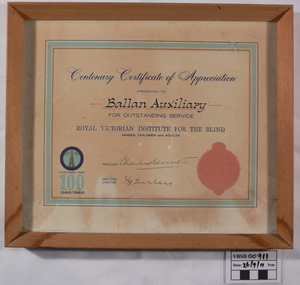
Certificate - Certificate. RVIB
... Royal Victorian Institute for the Blind, babies, children and adults. It bears the RVIB Seal, a logo and the words Centenary Year 100 1866/1966. ...Royal Victorian Institute for the Blind, babies, children and adults. It bears the RVIB Seal, a logo and the words Centenary Year 100 1866/1966. ...A Centenary Certificate of Appreciation presented by the RVIB to the Ballan Auxiliary for outstanding service.A Centenary Certificate of Appreciation presented to Ballan Auxiliary for outstanding service. Royal Victorian Institute for the Blind, babies, children and adults. It bears the RVIB Seal, a logo and the words Centenary Year 100 1866/1966. It is signed by the President and the Executive Director. The certificate is cream coloured with a light blue border, under glass in a plain, beveled, light coloured timber frame.This registration number is marked on the back of the frame.certificate, royal victorian institute for the blind, ballan auxiliary -
 Orbost & District Historical Society
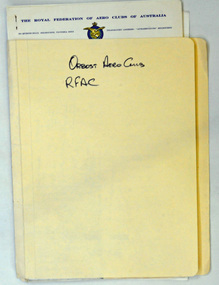
documents in folder, late 1960 - 1990's
... Royal Federation of Aero Clubs of Australia. It contains membership cards, receipts, correspondence, minutes, application forms for gold, silver and bronze seals....Royal Federation of Aero Clubs of Australia. It contains membership cards, receipts, correspondence, minutes, application forms for gold, silver and bronze seals. documents in folder Orbost Aero Club ...The Royal Federation of Aero Clubs of Australia is the national body of Aero Clubs and other aviation associations. The prime objectives of the Federation are to foster aviation in Australia, to ensure adequate flying training is available to all pilots and to encourage national and local competitions, air races and other aviation events.(ref R.F.A.C. web site) Orbost Aero Club began in 1969 with Basil Dowie as Chair, David Nixon as Secretary/Treasurer. The group went into recess from 1977-1991 closing in 1997. The mid 1960s were boom years in flying training in Australia and the number of Aero Clubs grew rapidly. The Club played a significant role in the establishment of the small airport at Marlo and in the ongoing operation and development of the airport over the years particularly for patient transfer by aerial ambulance. The Orbost Aero Club Club played a significant role in the establishment of the small airport at Marlo and in the ongoing operation and development of the airport over the years.A cream coloured folder ( NORMAN BROS) containing documents pertaining to membership of the Royal Federation of Aero Clubs of Australia. It contains membership cards, receipts, correspondence, minutes, application forms for gold, silver and bronze seals.On front - Orbost Aero Club R F A Corbost-aero-club royal-federation-aero-clubs -
 Ringwood and District Historical Society
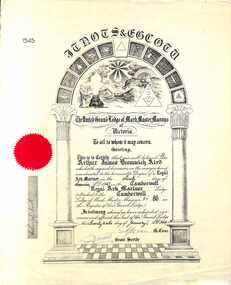
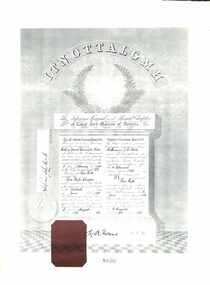
Certificate, Elevation Certificate, United Grand Lodge of Mark Master Masons - Collection of Masonic Degrees and Correspondence maintained by Aird family of Ringwood, Victoria
... seal. Certification that Bro. Arthur James Bromwich Aird was elevated to the honorable Degree of a Royal Ark Mariner on 9th November 1943 in the Camberwell Royal Ark Mariner Lodge attached to the Camberwell Lodge of Mark Master Masons No. 86. ...seal. Certification that Bro. Arthur James Bromwich Aird was elevated to the honorable Degree of a Royal Ark Mariner on 9th November 1943 in the Camberwell Royal Ark Mariner Lodge attached to the Camberwell Lodge of Mark Master Masons No. 86. ...Buff coloured certificate with red Lodge seal. Certification that Bro. Arthur James Bromwich Aird was elevated to the honorable Degree of a Royal Ark Mariner on 9th November 1943 in the Camberwell Royal Ark Mariner Lodge attached to the Camberwell Lodge of Mark Master Masons No. 86. Signed and dated 26th January, 1944. -
 Ringwood and District Historical Society
Certificate, Enrolment Certificate, Box Hill Chapter No.51 - Collection of Masonic Degrees and Correspondence maintained by Aird family of Ringwood, Victoria
... Certification Arthur James Bromwich Aird is a regular Royal Arch Mason admitted to Box Hill Chapter No.51 on 30th June AL 5936. Certificate signed and seal imprinted on 3rd August, 1936....Certification Arthur James Bromwich Aird is a regular Royal Arch Mason admitted to Box Hill Chapter No.51 on 30th June AL 5936. Certificate signed and seal imprinted on 3rd August, 1936. ...Certification Arthur James Bromwich Aird is a regular Royal Arch Mason admitted to Box Hill Chapter No.51 on 30th June AL 5936. Certificate signed and seal imprinted on 3rd August, 1936. -
 Ringwood and District Historical Society
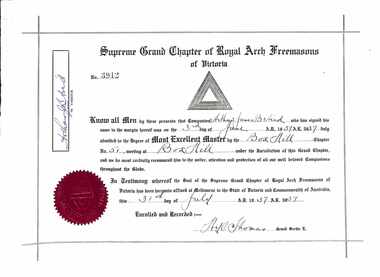
Certificate, Supreme Grand Chapter of Royal Arch Freemasons of Victoria - Collection of Masonic Degrees and Correspondence maintained by Aird family of Ringwood, Victoria
... Enrolled, recorded, signed and Seal affixed at Melbourne on 31st July, 1937. Supreme Grand Chapter of Royal Arch Freemasons of Victoria - Collection of Masonic Degrees and Correspondence maintained by Aird family of Ringwood, Victoria Certificate ...Certification Arthur James B. Aird admitted to the Degree of Most Excellent Master by the Box Hill Chapter, No. 51 meeting at Box Hill, Victoria. Enrolled, recorded, signed and Seal affixed at Melbourne on 31st July, 1937. -
 Ringwood and District Historical Society
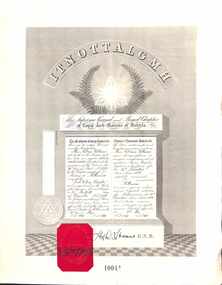
Certificate, Supreme Grand and Royal Chapter of Royal Arch Masons, Victoria - Collection of Masonic Degrees and Correspondence maintained by Aird family of Ringwood, Victoria
... Signed and Seal affixed at Melbourne on 31st May A.L. 5940, A.D. 1940. Supreme Grand and Royal Chapter of Royal Arch Masons, Victoria - Collection of Masonic Degrees and Correspondence maintained by Aird family of Ringwood, Victoria Certificate ...Buff coloured certificate with red Lodge seal. Certification that Alan Aubrey Williams is admitted into the Order on 24th November AL 5939 by the Lord Kelvin Chapter no.77 meeting at Melbourne, and is registered in the Books of the Supreme Grand Chapter on30th December A.L.5939. Signed and Seal affixed at Melbourne on 31st May A.L. 5940, A.D. 1940. -
 Ringwood and District Historical Society
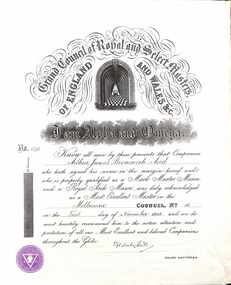
Certificate, (x2) Grand Council of Royal and Select Masters of England and Wales & c - Collection of Masonic Degrees and Correspondence maintained by Aird family of Ringwood, Victoria
... seal. Certification that Brother Arthur James Bromwich Aird, being properly qualified as a Mark Master Mason and Royal Arch Mason, was - (a) duly acknowledged as a Most Excellent Master, and (b) received and greeted as a Royal Select and Super Excellent Master - in the Melbourne Council No. 56 on 1st November, 1955 & recommended to the notice, attention and protection of all illustrious and well beloved companions throughout the globe....seal. Certification that Brother Arthur James Bromwich Aird, being properly qualified as a Mark Master Mason and Royal Arch Mason, was - (a) duly acknowledged as a Most Excellent Master, and (b) received and greeted as a Royal Select and Super Excellent Master - in the Melbourne Council No. 56 on 1st November, 1955 & recommended to the notice, attention and protection of all illustrious and well beloved companions throughout the globe. ...Two buff coloured certificates with purple seal. Certification that Brother Arthur James Bromwich Aird, being properly qualified as a Mark Master Mason and Royal Arch Mason, was - (a) duly acknowledged as a Most Excellent Master, and (b) received and greeted as a Royal Select and Super Excellent Master - in the Melbourne Council No. 56 on 1st November, 1955 & recommended to the notice, attention and protection of all illustrious and well beloved companions throughout the globe. -
 Flagstaff Hill Maritime Museum and Village
Photograph - Shipwreck rescue, 13-09-1947
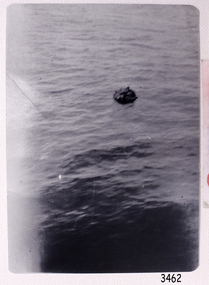
... Royal Australian Navy...RAN...Sydney built ship...Bass Strait patrol...sea mine patrol...Mine sweeper...Mine clearance...Navy divers...Great Barrier Reef...Cockburn Reef...Southern Cross Diving and Salvage...Warrnambool City Council...Cr J R Astbury...Mayor J R Astbury...Warrnambool Patriotic Fund...Seal...Warrnambool HMAS Warrnambool HMAS Warrnambool I HMAS Warrnambool J202 HMAS Swan II J202 World War II Bathurst class corvette Royal Australian Navy RAN Sydney built ship Bass Strait patrol sea mine patrol Mine sweeper Mine clearance Navy divers Great Barrier Reef Cockburn Reef Southern Cross Diving and Salvage Warrnambool City Council Cr J R Astbury Mayor J R Astbury Warrnambool Patriotic Fund Seal Coat of Arms Dedicatory plaque HMAS Warrnambool 1941 Shipwreck by sea mine 1947 Sinking ship Sunk ship Sea rescue life saving Lifesaving lifeboat minesweeper Photograph of rescue of crew from H.M.A.S. ...This photograph was taken at the scene of the wreck of the HMAS Warrnambool J202 on September 13th 1947.The photographer has captured the crew in a lifeboat surrounded by sea. The lifeboat is approaching the HMAS Swan II. The HMAS Warrnambool J202 was commissioned by the Royal Australian Navy for use as a minesweeper during World War II. The Bathurst Class Corvette, fitted out with a range of armaments, was launched in Sydney in May 1941. The ship began service in Bass Strait in 1941. At the end of the year it called into its namesake city, Warrnambool, where the crew paraded for the public marching eastwards along Timor Street. A gift of books for the ship’s personnel and a plaque bearing the City of Warrnambool’s Coat of Arms were presented to the ship. The ship was involved in evacuating a family of nine from the Dutch East Indies that was later successful in its challenge of Australia’s Immigration Restriction Act (White Australia Polity). The ship had many other appointments around Australia. On 13th September 1947 HMAS Warrnambool was leading a flotilla of minesweepers in northern Queensland’s coastal waters, clearing mines previously laid to defend Australia. The ship hit a mine, which exploded and very quickly sunk the ship. Boats from the nearby ships rescued most of the seamen although one was killed at the time. The survivors were taken by the HMAS Swan II to Darwin, and they went from there to hospitals in Brisbane and Sydney. Three of these men later died from their injuries. A number of items were recovered by Navy divers in 1948 including the ship’s bell and a plaque with Warrnambool’s Coat of Arms. In 1972-75 the wreck was sold and other items were salvaged. In 1995 a memorial plaque was erected in Warrnambool near the RSL. NOTE: The RAN built a second HMAS Warrnambool FCPB204, launched in 1981 and decommissioned in 2005. There was also a steam ship SS Warrnambool built in London 1892 and broken up in 1926. [A more detailed history can be found in our Collection Record 3477.] This photograph is significant for its association with the lifesaving rescue of the crew and the sinking Royal Australian Navy vessel, HMAS Warrnambool (J202). The HMAS Warrnambool played a nationally significant role in overturning Australia’s Immigration Restriction Act 1901 (colloquially known as the White Australia policy). The ship rescued, and brought to Australia, Samuel and Annie Jacob and their family after they evacuated Dutch East India. The family was threatened with deportation and made the first successful appeal to High Court regarding that Act. The HMAS Warrnambool has - Local significance for being the namesake of the City of Warrnambool - Local significance, having docked in Warrnambool Harbour - Local significance, the crew having paraded in Timor Street, Warrnambool - State significance for its first patrol being in Bass Strait. - National significance, being present in Timor at the Japanese surrender - National significance, shown by the significance of the ship’s bell being curated as Military Heritage and Technology at the Australian War Memorial. - National significance as part of Australia’s defence force history, being one of only four Bathurst class corvettes lost while in Australian service, the only Bathurst class corvette lost after World War II, the only RAN vessel to be sunk by a mine, and associated with the last four Navy deaths of WWII Photograph of rescue of crew from H.M.A.S. Warrnambool, sunk on 13-09-1947. Men in life boat surrounded by water. This black and white photograph is one of a series of photographs taken at that time. flagstaff hill, maritime village, maritime museum, warrnambool, shipwreck coast, mort's dock & engineering co ltd, h.m.a.s. warrnambool, hmas warrnambool, hmas warrnambool i, hmas warrnambool j202, hmas swan ii, j202, world war ii, bathurst class corvette, royal australian navy, ran, sydney built ship, bass strait patrol, sea mine patrol, mine sweeper, mine clearance, navy divers, great barrier reef, cockburn reef, southern cross diving and salvage, warrnambool city council, cr j r astbury, mayor j r astbury, warrnambool patriotic fund, seal, coat of arms, dedicatory plaque, hmas warrnambool 1941, shipwreck by sea mine 1947, sinking ship, sunk ship, sea rescue, life saving, lifesaving, lifeboat, minesweeper -
 Flagstaff Hill Maritime Museum and Village
Photograph - Ship's Bell, Royal Australian Navy (RAN), HMAS Warrnambool 1941, 1948
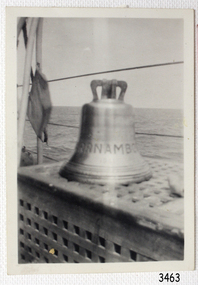
... Royal Australian Navy...RAN...Sydney built ship...Bass Strait patrol...sea mine patrol...Mine sweeper...Mine clearance...Navy divers...Great Barrier Reef...Cockburn Reef...Southern Cross Diving and Salvage...Warrnambool City Council...Cr J R Astbury...Mayor J R Astbury...Warrnambool Patriotic Fund...Seal...Warrnambool HMAS Warrnambool HMAS Warrnambool I HMAS Warrnambool J202 HMAS Swan II J202 World War II Bathurst class corvette Royal Australian Navy RAN Sydney built ship Bass Strait patrol sea mine patrol Mine sweeper Mine clearance Navy divers Great Barrier Reef Cockburn Reef Southern Cross Diving and Salvage Warrnambool City Council Cr J R Astbury Mayor J R Astbury Warrnambool Patriotic Fund Seal Coat of Arms Dedicatory plaque HMAS Warrnambool 1941 Shipwreck by sea mine 1947 Sinking ship Sunk ship Sea rescue life saving Lifesaving HMAS Warrnambool ship’s bell Ship’s Bell minesweeper In photograph, inscription on bell "- ARNAMB-" [WARRNAMBOOL] Photograph of ship bell from shipwreck of HMAS Warrnambool, sunk on 13-09-1947. ...This photograph was taken at the wreck site of the HMAS Warrnambool J202, wrecked on September 13th 1947. The bell was recovered in 1948 by the Royal Australian Navy. The ship's bell has been of great importance to a ship for hundreds of years. The bell is used for the timing of ships watches, for emergencies and many other purposes. It is also a prized possession when a ship is wrecked or broken up, as lasting memorial of the ship's existence. The HMAS Warrnambool J202 was commissioned by the Royal Australian Navy for use as a minesweeper during World War II. The Bathurst Class Corvette, fitted out with a range of armaments, was launched in Sydney 1941 and was. The ship began service in Bass Strait in 1941. At the end of the year it called into its namesake city, Warrnambool, where the crew paraded for the public marching eastwards along Timor Street. A gift of books for the ship’s personnel and a plaque bearing the City of Warrnambool’s Coat of Arms were presented to the ship. The ship was involved in evacuating a family of nine from the Dutch East Indies that was later successful in its challenge of Australia’s Immigration Restriction Act (White Australia Polity). The ship had many other appointments around Australia. On 13th September 1947 HMAS Warrnambool was leading a flotilla of minesweepers in northern Queensland’s coastal waters, clearing mines previously laid to defend Australia. The ship hit a mine, which exploded and very quickly sunk the ship. Boats from the nearby ships rescued most of the seamen although one was killed at the time. The survivors were taken by the HMAS Swan II to Darwin, and they went from there to hospitals in Brisbane and Sydney. Three of these men later died from their injuries. A number of items were recovered by Navy divers in 1948 including the ship’s bell and a plaque with Warrnambool’s Coat of Arms. In 1972-75 the wreck was sold and other items were salvaged. In 1995 a memorial plaque was erected in Warrnambool near the RSL. NOTE: The RAN built a second HMAS Warrnambool FCPB204, launched in 1981 and decommissioned in 2005. There was also a steam ship SS Warrnambool built in London 1892 and broken up in 1926. [A more detailed history can be found in our Collection Record 3477.] This photograph is significant for its association with the lifesaving rescue of the crew and the sinking Royal Australian Navy vessel, HMAS Warrnambool (J202). The HMAS Warrnambool played a nationally significant role in overturning Australia’s Immigration Restriction Act 1901 (colloquially known as the White Australia policy). The ship rescued, and brought to Australia, Samuel and Annie Jacob and their family after they evacuated Dutch East India. The family was threatened with deportation and made the first successful appeal to High Court regarding that Act. The HMAS Warrnambool has - Local significance for being the namesake of the City of Warrnambool - Local significance, having docked in Warrnambool Harbour - Local significance, the crew having paraded in Timor Street, Warrnambool - State significance for its first patrol being in Bass Strait. - National significance, being present in Timor at the Japanese surrender - National significance, shown by the significance of the ship’s bell being curated as Military Heritage and Technology at the Australian War Memorial. - National significance as part of Australia’s defence force history, being one of only four Bathurst class corvettes lost while in Australian service, the only Bathurst class corvette lost after World War II, the only RAN vessel to be sunk by a mine, and associated with the last four Navy deaths of WWII Photograph of ship bell from shipwreck of HMAS Warrnambool, sunk on 13-09-1947. The black and white photograph of the bell shows its inverted 'U' shaped fitting on top and inscribed letters around it. The flared base of the bell has concentric rings as decoration. In photograph, inscription on bell "- ARNAMB-" [WARRNAMBOOL]flagstaff hill, maritime village, maritime museum, warrnambool, shipwreck coast, mort's dock & engineering co ltd, h.m.a.s. warrnambool, hmas warrnambool, hmas warrnambool i, hmas warrnambool j202, hmas swan ii, j202, world war ii, bathurst class corvette, royal australian navy, ran, sydney built ship, bass strait patrol, sea mine patrol, mine sweeper, mine clearance, navy divers, great barrier reef, cockburn reef, southern cross diving and salvage, warrnambool city council, cr j r astbury, mayor j r astbury, warrnambool patriotic fund, seal, coat of arms, dedicatory plaque, hmas warrnambool 1941, shipwreck by sea mine 1947, sinking ship, sunk ship, sea rescue, life saving, lifesaving, hmas warrnambool ship’s bell, ship’s bell, minesweeper -
 Flagstaff Hill Maritime Museum and Village
Photograph - Shipwreck rescue, Royal Australian Navy (RAN), 13-09-1947
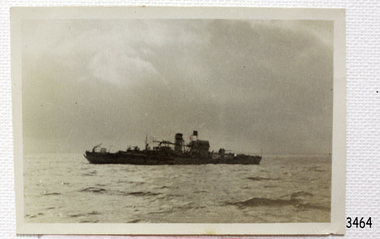
... Royal Australian Navy...RAN...Sydney built ship...Bass Strait patrol...sea mine patrol...Mine sweeper...Mine clearance...Navy divers...Great Barrier Reef...Cockburn Reef...Southern Cross Diving and Salvage...Warrnambool City Council...Cr J R Astbury...Mayor J R Astbury...Warrnambool Patriotic Fund...Seal...Warrnambool HMAS Warrnambool HMAS Warrnambool I HMAS Warrnambool J202 HMAS Swan II J202 World War II Bathurst class corvette Royal Australian Navy RAN Sydney built ship Bass Strait patrol sea mine patrol Mine sweeper Mine clearance Navy divers Great Barrier Reef Cockburn Reef Southern Cross Diving and Salvage Warrnambool City Council Cr J R Astbury Mayor J R Astbury Warrnambool Patriotic Fund Seal Coat of Arms Dedicatory plaque HMAS Warrnambool 1941 Shipwreck by sea mine 1947 Sinking ship Sunk ship minesweeper Photograph of the sinking of the ship HMAS Warrnambool, sunk on 13-09-1947. ...This photograph was taken at the scene of the wreck of the HMAS Warrnambool J202 on September 13th 1947. The photographer has captured the ship as it sinks at sea. The HMAS Warrnambool J202 was commissioned by the Royal Australian Navy for use as a minesweeper during World War II. The Bathurst Class Corvette, fitted out with a range of armaments, was launched in Sydney in 1941. The ship began service in Bass Strait in 1941. At the end of the year it called into its namesake city, Warrnambool, where the crew paraded for the public marching eastwards along Timor Street. A gift of books for the ship’s personnel and a plaque bearing the City of Warrnambool’s Coat of Arms were presented to the ship. The ship was involved in evacuating a family of nine from the Dutch East Indies that was later successful in its challenge of Australia’s Immigration Restriction Act (White Australia Polity). The ship had many other appointments around Australia. On 13th September 1947 HMAS Warrnambool was leading a flotilla of minesweepers in northern Queensland’s coastal waters, clearing mines previously laid to defend Australia. The ship hit a mine, which exploded and very quickly sunk the ship. Boats from the nearby ships rescued most of the seamen although one was killed at the time. The survivors were taken by the HMAS Swan II to Darwin, and they went from there to hospitals in Brisbane and Sydney. Three of these men later died from their injuries. A number of items were recovered by Navy divers in 1948 including the ship’s bell and a plaque with Warrnambool’s Coat of Arms. In 1972-75 the wreck was sold and other items were salvaged. In 1995 a memorial plaque was erected in Warrnambool near the RSL. NOTE: The RAN built a second HMAS Warrnambool FCPB204, launched in 1981 and decommissioned in 2005. There was also a steam ship SS Warrnambool built in London 1892 and broken up in 1926. [A more detailed history can be found in our Collection Record 3477.] This photograph is significant for its association with the lifesaving rescue of the crew and the sinking Royal Australian Navy vessel, HMAS Warrnambool (J202). The HMAS Warrnambool played a nationally significant role in overturning Australia’s Immigration Restriction Act 1901 (colloquially known as the White Australia policy). The ship rescued, and brought to Australia, Samuel and Annie Jacob and their family after they evacuated Dutch East India. The family was threatened with deportation and made the first successful appeal to High Court regarding that Act. The HMAS Warrnambool has - Local significance for being the namesake of the City of Warrnambool - Local significance, having docked in Warrnambool Harbour - Local significance, the crew having paraded in Timor Street, Warrnambool - State significance for its first patrol being in Bass Strait. - National significance, being present in Timor at the Japanese surrender - National significance, shown by the significance of the ship’s bell being curated as Military Heritage and Technology at the Australian War Memorial. - National significance as part of Australia’s defence force history, being one of only four Bathurst class corvettes lost while in Australian service, the only Bathurst class corvette lost after World War II, the only RAN vessel to be sunk by a mine, and associated with the last four Navy deaths of WWII Photograph of the sinking of the ship HMAS Warrnambool, sunk on 13-09-1947. This black and white photograph showing the vessel at sea is one of a series of photographs taken at the time.flagstaff hill, maritime village, maritime museum, warrnambool, shipwreck coast, mort's dock & engineering co ltd, h.m.a.s. warrnambool, hmas warrnambool, hmas warrnambool i, hmas warrnambool j202, hmas swan ii, j202, world war ii, bathurst class corvette, royal australian navy, ran, sydney built ship, bass strait patrol, sea mine patrol, mine sweeper, mine clearance, navy divers, great barrier reef, cockburn reef, southern cross diving and salvage, warrnambool city council, cr j r astbury, mayor j r astbury, warrnambool patriotic fund, seal, coat of arms, dedicatory plaque, hmas warrnambool 1941, shipwreck by sea mine 1947, sinking ship, sunk ship, minesweeper -
 Flagstaff Hill Maritime Museum and Village
Photograph - Shipwreck rescue, Royal Australian Navy (RAN), 13-09-1947
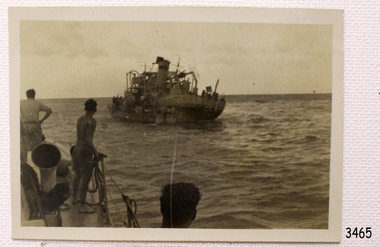
... Royal Australian Navy...RAN...Sydney built ship...Bass Strait patrol...sea mine patrol...Mine sweeper...Mine clearance...Navy divers...Great Barrier Reef...Cockburn Reef...Southern Cross Diving and Salvage...Warrnambool City Council...Cr J R Astbury...Mayor J R Astbury...Warrnambool Patriotic Fund...Seal...Warrnambool HMAS Warrnambool HMAS Warrnambool I HMAS Warrnambool J202 HMAS Swan II J202 World War II Bathurst class corvette Royal Australian Navy RAN Sydney built ship Bass Strait patrol sea mine patrol Mine sweeper Mine clearance Navy divers Great Barrier Reef Cockburn Reef Southern Cross Diving and Salvage Warrnambool City Council Cr J R Astbury Mayor J R Astbury Warrnambool Patriotic Fund Seal Coat of Arms Dedicatory plaque HMAS Warrnambool 1941 Shipwreck by sea mine 1947 Sinking ship Sunk ship Sea rescue life saving Lifesaving minesweeper Photograph of the sinking of the ship HMAS Warrnambool, sunk on 13-09-1947. ...This photograph was taken at the scene of the wreck of the HMAS Warrnambool J202 on September 13th 1947. The photographer has captured the ship as it sinks at sea. The photograph is taken from a nearby vessel, likely to be the HMAS Swan II, which took the survivors onboard. The HMAS Warrnambool J202 was commissioned by the Royal Australian Navy for use as a minesweeper during World War II. The Bathurst Class Corvette, fitted out with a range of armaments, was launched in Sydney in 1941. The ship began service in Bass Strait in 1941. At the end of the year it called into its namesake city, Warrnambool, where the crew paraded for the public marching eastwards along Timor Street. A gift of books for the ship’s personnel and a plaque bearing the City of Warrnambool’s Coat of Arms were presented to the ship. The ship was involved in evacuating a family of nine from the Dutch East Indies that was later successful in its challenge of Australia’s Immigration Restriction Act (White Australia Polity). The ship had many other appointments around Australia. On 13th September 1947 HMAS Warrnambool was leading a flotilla of minesweepers in northern Queensland’s coastal waters, clearing mines previously laid to defend Australia. The ship hit a mine, which exploded and very quickly sunk the ship. Boats from the nearby ships rescued most of the seamen although one was killed at the time. The survivors were taken by the HMAS Swan II to Darwin, and they went from there to hospitals in Brisbane and Sydney. Three of these men later died from their injuries. A number of items were recovered by Navy divers in 1948 including the ship’s bell and a plaque with Warrnambool’s Coat of Arms. In 1972-75 the wreck was sold and other items were salvaged. In 1995 a memorial plaque was erected in Warrnambool near the RSL. NOTE: The RAN built a second HMAS Warrnambool FCPB204, launched in 1981 and decommissioned in 2005. There was also a steam ship SS Warrnambool built in London 1892 and broken up in 1926. [A more detailed history can be found in our Collection Record 3477.] This photograph is significant for its association with the lifesaving rescue of the crew and the sinking Royal Australian Navy vessel, HMAS Warrnambool (J202). The HMAS Warrnambool played a nationally significant role in overturning Australia’s Immigration Restriction Act 1901 (colloquially known as the White Australia policy). The ship rescued, and brought to Australia, Samuel and Annie Jacob and their family after they evacuated Dutch East India. The family was threatened with deportation and made the first successful appeal to High Court regarding that Act. The HMAS Warrnambool has - Local significance for being the namesake of the City of Warrnambool - Local significance, having docked in Warrnambool Harbour - Local significance, the crew having paraded in Timor Street, Warrnambool - State significance for its first patrol being in Bass Strait. - National significance, being present in Timor at the Japanese surrender - National significance, shown by the significance of the ship’s bell being curated as Military Heritage and Technology at the Australian War Memorial. - National significance as part of Australia’s defence force history, being one of only four Bathurst class corvettes lost while in Australian service, the only Bathurst class corvette lost after World War II, the only RAN vessel to be sunk by a mine, and associated with the last four Navy deaths of WWII Photograph of the sinking of the ship HMAS Warrnambool, sunk on 13-09-1947. Figures onboard a vessel are looking towards figures on the sinking vessel. This black and white photograph is one of a series of photographs taken at the time.flagstaff hill, maritime village, maritime museum, warrnambool, shipwreck coast, mort's dock & engineering co ltd, h.m.a.s. warrnambool, hmas warrnambool, hmas warrnambool i, hmas warrnambool j202, hmas swan ii, j202, world war ii, bathurst class corvette, royal australian navy, ran, sydney built ship, bass strait patrol, sea mine patrol, mine sweeper, mine clearance, navy divers, great barrier reef, cockburn reef, southern cross diving and salvage, warrnambool city council, cr j r astbury, mayor j r astbury, warrnambool patriotic fund, seal, coat of arms, dedicatory plaque, hmas warrnambool 1941, shipwreck by sea mine 1947, sinking ship, sunk ship, sea rescue, life saving, lifesaving, minesweeper -
 Flagstaff Hill Maritime Museum and Village
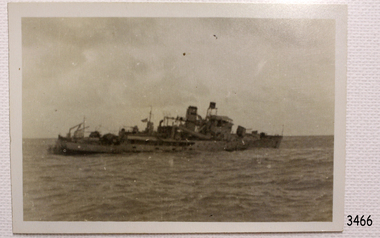
Photograph - Shipwreck rescue, Royal Australian Navy (RAN), HMAS Warrnambool J202, 13-09-1947
... Royal Australian Navy...RAN...Sydney built ship...Bass Strait patrol...sea mine patrol...Mine sweeper...Mine clearance...Navy divers...Great Barrier Reef...Cockburn Reef...Southern Cross Diving and Salvage...Warrnambool City Council...Cr J R Astbury...Mayor J R Astbury...Warrnambool Patriotic Fund...Seal...Warrnambool HMAS Warrnambool HMAS Warrnambool I HMAS Warrnambool J202 HMAS Swan II J202 World War II Bathurst class corvette Royal Australian Navy RAN Sydney built ship Bass Strait patrol sea mine patrol Mine sweeper Mine clearance Navy divers Great Barrier Reef Cockburn Reef Southern Cross Diving and Salvage Warrnambool City Council Cr J R Astbury Mayor J R Astbury Warrnambool Patriotic Fund Seal Coat of Arms Dedicatory plaque HMAS Warrnambool 1941 Shipwreck by sea mine 1947 Sinking ship Sunk ship Sea rescue life saving Lifesaving minesweeper Photograph of the starboard side of the sinking ship HMAS Warrnambool, sunk on 13-09-1947. ...This photograph was taken at the scene of the wreck of the HMAS Warrnambool J202 on September 13th 1947. The photographer has captured the ship as it sinks at sea. The HMAS Warrnambool J202 was commissioned by the Royal Australian Navy for use as a minesweeper during World War II. The Bathurst Class Corvette, fitted out with a range of armaments, was launched in Sydney in 1941. The ship began service in Bass Strait in 1941. At the end of the year it called into its namesake city, Warrnambool, where the crew paraded for the public marching eastwards along Timor Street. A gift of books for the ship’s personnel and a plaque bearing the City of Warrnambool’s Coat of Arms were presented to the ship. The ship was involved in evacuating a family of nine from the Dutch East Indies that was later successful in its challenge of Australia’s Immigration Restriction Act (White Australia Polity). The ship had many other appointments around Australia. On 13th September 1947 HMAS Warrnambool was leading a flotilla of minesweepers in northern Queensland’s coastal waters, clearing mines previously laid to defend Australia. The ship hit a mine, which exploded and very quickly sunk the ship. Boats from the nearby ships rescued most of the seamen although one was killed at the time. The survivors were taken by the HMAS Swan II to Darwin, and they went from there to hospitals in Brisbane and Sydney. Three of these men later died from their injuries. A number of items were recovered by Navy divers in 1948 including the ship’s bell and a plaque with Warrnambool’s Coat of Arms. In 1972-75 the wreck was sold and other items were salvaged. In 1995 a memorial plaque was erected in Warrnambool near the RSL. NOTE: The RAN built a second HMAS Warrnambool FCPB204, launched in 1981 and decommissioned in 2005. There was also a steam ship SS Warrnambool built in London 1892 and broken up in 1926. [A more detailed history can be found in our Collection Record 3477.] This photograph is significant for its association with the lifesaving rescue of the crew and the sinking Royal Australian Navy vessel, HMAS Warrnambool (J202). The HMAS Warrnambool played a nationally significant role in overturning Australia’s Immigration Restriction Act 1901 (colloquially known as the White Australia policy). The ship rescued, and brought to Australia, Samuel and Annie Jacob and their family after they evacuated Dutch East India. The family was threatened with deportation and made the first successful appeal to High Court regarding that Act. The HMAS Warrnambool has - Local significance for being the namesake of the City of Warrnambool - Local significance, having docked in Warrnambool Harbour - Local significance, the crew having paraded in Timor Street, Warrnambool - State significance for its first patrol being in Bass Strait. - National significance, being present in Timor at the Japanese surrender - National significance, shown by the significance of the ship’s bell being curated as Military Heritage and Technology at the Australian War Memorial. - National significance as part of Australia’s defence force history, being one of only four Bathurst class corvettes lost while in Australian service, the only Bathurst class corvette lost after World War II, the only RAN vessel to be sunk by a mine, and associated with the last four Navy deaths of WWII Photograph of the starboard side of the sinking ship HMAS Warrnambool, sunk on 13-09-1947. This black and white photograph is one of a series of photographs taken at the time.flagstaff hill, maritime village, maritime museum, warrnambool, shipwreck coast, mort's dock & engineering co ltd, h.m.a.s. warrnambool, hmas warrnambool, hmas warrnambool i, hmas warrnambool j202, hmas swan ii, j202, world war ii, bathurst class corvette, royal australian navy, ran, sydney built ship, bass strait patrol, sea mine patrol, mine sweeper, mine clearance, navy divers, great barrier reef, cockburn reef, southern cross diving and salvage, warrnambool city council, cr j r astbury, mayor j r astbury, warrnambool patriotic fund, seal, coat of arms, dedicatory plaque, hmas warrnambool 1941, shipwreck by sea mine 1947, sinking ship, sunk ship, sea rescue, life saving, lifesaving, minesweeper -
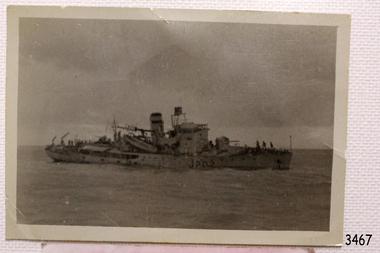 Flagstaff Hill Maritime Museum and Village
Photograph - Shipwreck rescue, Royal Australian Navy (RAN), HMAS Warrnambool J202, 13-09-1947
... Royal Australian Navy...RAN...Sydney built ship...Bass Strait patrol...sea mine patrol...Mine sweeper...Mine clearance...Navy divers...Great Barrier Reef...Cockburn Reef...Southern Cross Diving and Salvage...Warrnambool City Council...Cr J R Astbury...Mayor J R Astbury...Warrnambool Patriotic Fund...Seal...Warrnambool HMAS Warrnambool HMAS Warrnambool I HMAS Warrnambool J202 HMAS Swan II J202 World War II Bathurst class corvette Royal Australian Navy RAN Sydney built ship Bass Strait patrol sea mine patrol Mine sweeper Mine clearance Navy divers Great Barrier Reef Cockburn Reef Southern Cross Diving and Salvage Warrnambool City Council Cr J R Astbury Mayor J R Astbury Warrnambool Patriotic Fund Seal Coat of Arms Dedicatory plaque HMAS Warrnambool 1941 Shipwreck by sea mine 1947 Sinking ship Sunk ship Sea rescue life saving Lifesaving minesweeper Text on side of ship "J202" Photograph of the sinking ship HMAS Warrnambool, sunk on 13-09-1947. ...This photograph was taken at the scene of the wreck of the HMAS Warrnambool J202 on September 13th 1947. The photographer has captured the sinking ship with the crew still onboard. The HMAS Warrnambool J202 was commissioned by the Royal Australian Navy for use as a minesweeper during World War II. The Bathurst Class Corvette, fitted out with a range of armaments, was launched in Sydney in 1941 . The ship began service in Bass Strait in 1941. At the end of the year it called into its namesake city, Warrnambool, where the crew paraded for the public marching eastwards along Timor Street. A gift of books for the ship’s personnel and a plaque bearing the City of Warrnambool’s Coat of Arms were presented to the ship. The ship was involved in evacuating a family of nine from the Dutch East Indies that was later successful in its challenge of Australia’s Immigration Restriction Act (White Australia Polity). The ship had many other appointments around Australia. On 13th September 1947 HMAS Warrnambool was leading a flotilla of minesweepers in northern Queensland’s coastal waters, clearing mines previously laid to defend Australia. The ship hit a mine, which exploded and very quickly sunk the ship. Boats from the nearby ships rescued most of the seamen although one was killed at the time. The survivors were taken by the HMAS Swan II to Darwin, and they went from there to hospitals in Brisbane and Sydney. Three of these men later died from their injuries. A number of items were recovered by Navy divers in 1948 including the ship’s bell and a plaque with Warrnambool’s Coat of Arms. In 1972-75 the wreck was sold and other items were salvaged. In 1995 a memorial plaque was erected in Warrnambool near the RSL. NOTE: The RAN built a second HMAS Warrnambool FCPB204, launched in 1981 and decommissioned in 2005. There was also a steam ship SS Warrnambool built in London 1892 and broken up in 1926. [A more detailed history can be found in our Collection Record 3477.] This photograph is significant for its association with the lifesaving rescue of the crew and the sinking Royal Australian Navy vessel, HMAS Warrnambool (J202). The HMAS Warrnambool played a nationally significant role in overturning Australia’s Immigration Restriction Act 1901 (colloquially known as the White Australia policy). The ship rescued, and brought to Australia, Samuel and Annie Jacob and their family after they evacuated Dutch East India. The family was threatened with deportation and made the first successful appeal to High Court regarding that Act. The HMAS Warrnambool has - Local significance for being the namesake of the City of Warrnambool - Local significance, having docked in Warrnambool Harbour - Local significance, the crew having paraded in Timor Street, Warrnambool - State significance for its first patrol being in Bass Strait. - National significance, being present in Timor at the Japanese surrender - National significance, shown by the significance of the ship’s bell being curated as Military Heritage and Technology at the Australian War Memorial. - National significance as part of Australia’s defence force history, being one of only four Bathurst class corvettes lost while in Australian service, the only Bathurst class corvette lost after World War II, the only RAN vessel to be sunk by a mine, and associated with the last four Navy deaths of WWII Photograph of the sinking ship HMAS Warrnambool, sunk on 13-09-1947. Figures can be seen onboard the damaged vessel. The number of the ship-type is clearly visible on this starboard profile of the ship. This black and white photograph is one of a series of photographs taken at the time.Text on side of ship "J202"flagstaff hill, maritime village, maritime museum, warrnambool, shipwreck coast, mort's dock & engineering co ltd, h.m.a.s. warrnambool, hmas warrnambool, hmas warrnambool i, hmas warrnambool j202, hmas swan ii, j202, world war ii, bathurst class corvette, royal australian navy, ran, sydney built ship, bass strait patrol, sea mine patrol, mine sweeper, mine clearance, navy divers, great barrier reef, cockburn reef, southern cross diving and salvage, warrnambool city council, cr j r astbury, mayor j r astbury, warrnambool patriotic fund, seal, coat of arms, dedicatory plaque, hmas warrnambool 1941, shipwreck by sea mine 1947, sinking ship, sunk ship, sea rescue, life saving, lifesaving, minesweeper
