
Showing 51 items matching "rules of the air"
-
 Moorabbin Air Museum
Manual - CASA VFR flight guides, CASA VFR Flight Guide Issued December 1999
... ...Rules of the Air...VFR flight guides Licensing Pilot responsibilities Radio telephony procedures Conversions Altimeter setting Rules of the Air Aerodrome markings Pre flight procedures Operations CASA overview of regulations / restrictions circa 1999 Spiral bound CASA VFR Flight Guide Issued December 1999 Manual CASA VFR flight guides ...CASA overview of regulations / restrictions circa 1999Spiral boundnon-fictionCASA overview of regulations / restrictions circa 1999licensing, pilot responsibilities, radio telephony procedures, conversions, altimeter setting, rules of the air, aerodrome markings, pre flight procedures, operations -
 B-24 Liberator Memorial Restoration Australia Inc
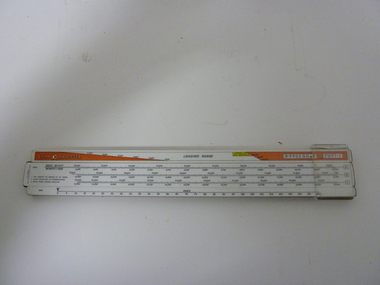
Load Adjuster, Bomb Load Adjuster No. 31629, 1945
... 1945 Slide Rule US Army Air Force from Prof. Allan Bromley....1945 Slide Rule US Army Air Force from Prof. Allan Bromley. ...1945 Slide Rule US Army Air Force from Prof. Allan Bromley.Works by adding Angular moments together to find centre of gravity (COG) of a plane (adds bombs, ammunition and crew on board).Brown Leather Case with 'Slide Rule' inner.Load Adjuster, Property of US Government. 102630 on case. 81629. Airplane serial No. 44-4-1195, Model B-24Jbomb load adjuster, a16 -
 Bendigo Historical Society Inc.
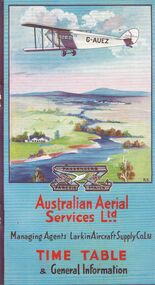
Document - BASIL WATSON COLLECTION: AUSTRALIAN FLIGHT TIMETABLES, a. & b. 1927/29; c. 1927?
... Australian Aerial Services Ltd. booklet contains timetables, educational notes on aerial transport, first flight impressions, coach connections with airports, rules of the air, 1920's although no date on booklet. ...Australian Aerial Services Ltd. booklet contains timetables, educational notes on aerial transport, first flight impressions, coach connections with airports, rules of the air, 1920's although no date on booklet. ...Australian Flight Timetables,3 booklets: 1. Australian Aerial Services Ltd. booklet contains timetables, educational notes on aerial transport, first flight impressions, coach connections with airports, rules of the air, 1920's although no date on booklet. Aerial route map shows route from Melbourne to Hay, then to Adelaide, and east to Cootamundra. 2. AHS Timetable and general information booklet. Issued 1st March 1929, contains timetables, general information re flights, image of passengers 'emplaning' at Essendon Airport. 3. 'Fly There' booklet of timetable information and passenger fares and parcel rates. West Australian Airways.person, individual, basil watson -
 Ballarat Tramway Museum
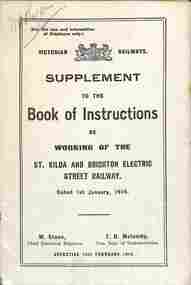
Booklet, Victorian Railways (VR), "Supplement to the Book of Instructions re the working of the St Kilda and Brighton Electric Street Railway", 1917
... Gives changes to a previous issued rule book, bell signals, air brake orders, operating orders, operation while running and instructions cancelled. ...Gives changes to a previous issued rule book, bell signals, air brake orders, operating orders, operation while running and instructions cancelled. ...Titled "Supplement to the Book of Instructions re the working of the St Kilda and Brighton Electric Street Railway, dated 1/1/1915". Gives changes to a previous issued rule book, bell signals, air brake orders, operating orders, operation while running and instructions cancelled. Effective 12/2/1917. Issued under the name of W. Stone Chief Electrical Engineer and T. B. Molomby General Superintendent of Transportation.Demonstrates a Victorian Railway Rule book for electric tramways or Street Railways.Booklet - 12 off white or light brown pages + white cloth card cover centre stapled.On inside of front cover an inscription from Gerald Dee to Richard Gilbert dated 22/10/1999.tramways, trams, victorian railways, vr, st kilda - brighton tramway, rules, employees, safe working -
 Melbourne Tram Museum
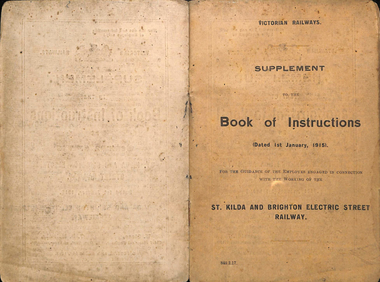
Document - Instruction, Victorian Railways, "Supplement to the Book of Instructions re the working of the St Kilda and Brighton Electric Street Railway, dated 1/1/1915", Jan. 1915
... Gives changes to a previous issued rule book, bell signals, air brake orders, operating orders, operation while running and instructions cancelled. ...Gives changes to a previous issued rule book, bell signals, air brake orders, operating orders, operation while running and instructions cancelled. ...Instruction - 12 off white or light brown pages + white cloth card cover centre stapled titled "Supplement to the Book of Instructions re the working of the St Kilda and Brighton Electric Street Railway, dated 1/1/1915". Gives changes to a previous issued rule book, bell signals, air brake orders, operating orders, operation while running and instructions cancelled. Issued under the name of W. Stone Chief Electrical Engineer and T. B. Molomby General Superintendent of Transportation.trams, tramways, victorian railways, vr, st kilda brighton, rules, employees, safeworking -
 Wangaratta RSL Sub Branch
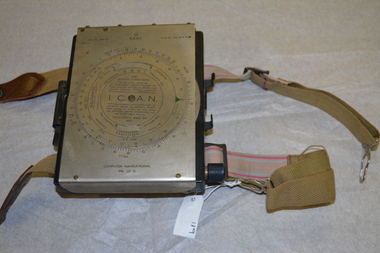
Instrument - Aircraft Navigation Computer
... The navigational computer was a circular slide rule used for calculating height and air speed corrections when flying an aircraft. ...The navigational computer was a circular slide rule used for calculating height and air speed corrections when flying an aircraft. ...The navigational computer was a circular slide rule used for calculating height and air speed corrections when flying an aircraft. The front cover lifts to reveal a further calculator used to solve vector triangles and plot course alterations. The device was intended to be strapped to a pilot's leg. The instrument was made by White and Gillespie (Melbourne) Pty Ltd c 1940 for the RAAF and used during WW2.Black metal box with silver metal flap top cover affixed with rotating circular rule . Two adjustable belts are affixed to the base of black box. A small spiral bound note book is contained beneath the flap top. RAAF Computer Navigational system MK. III. D. Serial No WG 2833navigation, raaf, computer, aircraft, ww2, 1940 -
 Federation University Historical Collection
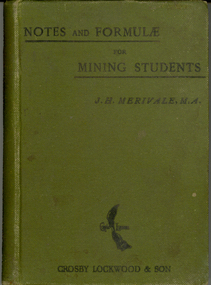
Book, Notes and formulae for mining students, 1897, 1897
... Bulman was an associate of the Institution of Civil Engineers and a member of the federated Institution of Mining Engineers. mining brook mining students mathematics newcastle coal field ropes chains seams dykes dams timber measure timber costing mines act rules explosives act horses windmills horse power boilers explosions compressed air wire ropes steam water power electricity sinking winding draining hauling chemistry gases ventilation boring formulae Green hard covered book of 188 pages. ...J.H. Merivale was a prodfessor of mining in the Durham College of Science, Newcastle-Upon-Tyne. H.F. Bulman was an associate of the Institution of Civil Engineers and a member of the federated Institution of Mining Engineers. Green hard covered book of 188 pages. mining, brook, mining students, mathematics, newcastle coal field, ropes, chains, seams, dykes, dams, timber measure, timber costing, mines act, rules, explosives act, horses, windmills, horse power, boilers explosions, compressed air, wire ropes, steam, water power, electricity, sinking, winding, draining, hauling, chemistry, gases, ventilation, boring, formulae -
 Nhill Aviation Heritage Centre
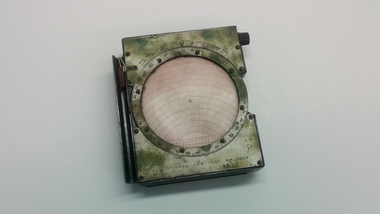
Navigational Computer
... Calibration, height correction, air speed correction Metal slide rule type calculator, with scrolling graph. ...Metal slide rule type calculator, with scrolling graph. Has pencil/pen saddle and clip on left sideNavigational Computer Mk. IIIH Reg No. 68/250 Front. True Course, drift port Drift stbd Rear. I.C.A.N. Calibration, height correction, air speed correction -
 Lara RSL Sub Branch
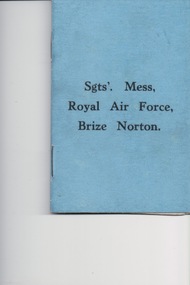
Booklet, Sgts' Mess Royal Air Force Brize Norton, R.A.F. Station, Oxfordshire, U.K, circ 1939
... Sgt's Mess Royal Air Force Brize Norton, R.A.F. Station, Oxfordshire, U.K. - Rules of Sergeant's Mess...Sgt's Mess Royal Air Force Brize Norton, R.A.F. Station, Oxfordshire, U.K. - Rules of Sergeant's Mess Sgts' Mess Royal Air Force Brize Norton, R.A.F. ...Sargent's, Mess Royal Air Force, Brize Norton Royal Air Force Brize Norton or RAF Brize Norton in Oxfordshire, about 65 mi (105 km) west north-west of London, is the largest station of the Royal Air Force. It is close to the settlements of Brize Norton, Carterton and Witney.Sgt's Mess Royal Air Force Brize Norton, R.A.F. Station, Oxfordshire, U.K. - Rules of Sergeant's Mess -
 City of Moorabbin Historical Society (Operating the Box Cottage Museum)
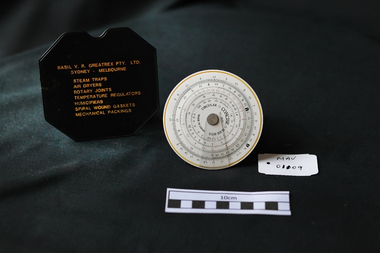
Measuring Equipment, circular slide-scale, 20thC
... on face ; CIRCULAR 'CONCISE' SLIDE RULE MADE IN JAPAN on protector sleeve ; BASIL V R GREATREX PTY LTD / SYDNEY MELBOURNE / STEAM TRAPS / AIR DRYERS / ROTARY JOINTS / TEMPERATURE REGULATORS / HUMIDIFIERS / SPIRAL WOUND GASKETS,/ MECHANICAL PACKINGS...A mathematical slide rule Calculator used by engineers, mechanics, and similar trades A typical precision slide rule used in City of Moorabbin 20thC measurements slide-rule slide scale moorabbin cheltenham bentleigh precision instruments concise pty ltd on face ; CIRCULAR 'CONCISE' SLIDE RULE MADE IN JAPAN on protector sleeve ; BASIL V R GREATREX PTY LTD / SYDNEY MELBOURNE / STEAM TRAPS / AIR DRYERS / ROTARY JOINTS / TEMPERATURE REGULATORS / HUMIDIFIERS / SPIRAL WOUND GASKETS,/ MECHANICAL PACKINGS A plastic, circular slide-rule Measuring Equipment, circular slide-scale Concise Ltd ...A mathematical slide rule Calculator used by engineers, mechanics, and similar tradesA typical precision slide rule used in City of Moorabbin 20thCA plastic, circular slide-ruleon face ; CIRCULAR 'CONCISE' SLIDE RULE MADE IN JAPAN on protector sleeve ; BASIL V R GREATREX PTY LTD / SYDNEY MELBOURNE / STEAM TRAPS / AIR DRYERS / ROTARY JOINTS / TEMPERATURE REGULATORS / HUMIDIFIERS / SPIRAL WOUND GASKETS,/ MECHANICAL PACKINGSmeasurements, slide-rule, slide scale, moorabbin, cheltenham, bentleigh, precision instruments, concise pty ltd -
 Geelong RSL Sub Branch
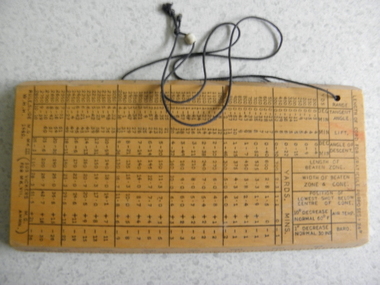
Slide Rule Calculator, 1940
... The Slide Rule was made in 1940 and used by the Royal Australian Air Force during WW2....The Slide Rule was made in 1940 and used by the Royal Australian Air Force during WW2. ...The Slide Rule was made in 1940 and used by the Royal Australian Air Force during WW2.This is an original Slide Rule that was used by RAAF during WW2Wooden Slide Rule CalculatorRule, Slide M.G. Mk III. W.H.H. 1940slide rule ww2 raaf -
Glenelg Shire Council Cultural Collection
Leisure object - Board Game, Strategy, n.d
... Inside, land, sea, air depicted by different colours, leaflet of rules b) Rothman's cigarette packet containing coloured metal counters for use with Strategy. 12 army, 8 navy, 4 airforce...Inside, land, sea, air depicted by different colours, leaflet of rules b) Rothman's cigarette packet containing coloured metal counters for use with Strategy. 12 army, 8 navy, 4 airforce Strategy Leisure object Board Game ...a)'Strategy' war board game. heavy card board, folds in half, red and blue outside with black and white photo of 3 servicemen (army, navy, airforce) playing strategy. Inside, land, sea, air depicted by different colours, leaflet of rules b) Rothman's cigarette packet containing coloured metal counters for use with Strategy. 12 army, 8 navy, 4 airforcestrategy, game, board game, recreation, leisure -
 Bendigo Military Museum
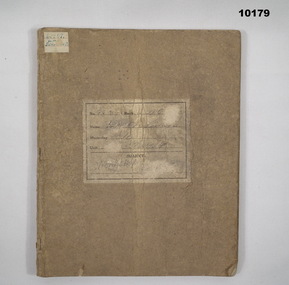
Book - MANUAL, AIR ENGINE REPAIR, c1939-45
... ruled pages. On those pages of hand written notes, in pencil, on Aero engine repairs and operating principles. There are also pages devoted to workshop practices. Book MANUAL, AIR ...Collection re Frederick Simons. Refer to Cat No 10159. This book has personal training notes for working on; Merlin Engines, Bristol Hercules Engines, Workshop practices, Engine components. This is a plain exercise book, Govt issue, quarto size, khaki cover. Inside are ruled pages. On those pages of hand written notes, in pencil, on Aero engine repairs and operating principles. There are also pages devoted to workshop practices.On front cover is a label with the following; "994 PARK A.G." Name - "L.A.C. SIMONS MUSTERING C/O" Unit - illegible, "Subject - Workshop" On the LHS - stamp size label = "41707 LAC SIMONS F."book, training notes, aircraft maintenance -
 Bendigo Military Museum
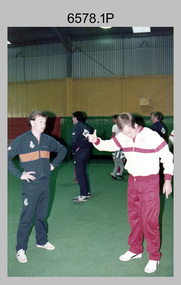
Photograph - Continuous Indoor Cricket World Record Attempt, Seymour, Victoria, 1986
... rules allowed a five-minute rest break every hour which could be accrued, so we played for 64 hours straight then had a five hour sleep. "When everybody got up and went straight back into the game with no grumbling, I knew we had the record," Capt Alsford said. The event was held at the Seymour Indoor Cricket Centre, an iron-roofed building with no air...rules allowed a five-minute rest break every hour which could be accrued, so we played for 64 hours straight then had a five hour sleep. "When everybody got up and went straight back into the game with no grumbling, I knew we had the record," Capt Alsford said. The event was held at the Seymour Indoor Cricket Centre, an iron-roofed building with no air ...This is a set of 12 photographs of Army teams from the Army Survey Regiment, Bendigo and the Army School of Transport, Puckapunyal attempting a world record playing indoor cricket, at Seymour Victoria from the 31st of January to the 5th of February 1986. The following article appeared on the back page of the ARMY Newspaper on Thursday 6th of March 1986. 'INDOOR CRICKET RECORD SMASHED. ARMY TEAMS from Puckapunyal and Bendigo recently played indoor cricket for 124 hours to set a new world record. The two eight-man teams, from Army School of Transport and Army Survey Regiment, broke the 120 hour record set by Corrimal High School, NSW earlier this year. Organiser of the event, Capt Marty Alsford of AST told ARMY the teams had played 107 games, scoring 15,000 runs in their chase for the record. "The rules allowed a five-minute rest break every hour which could be accrued, so we played for 64 hours straight then had a five hour sleep. "When everybody got up and went straight back into the game with no grumbling, I knew we had the record," Capt Alsford said. The event was held at the Seymour Indoor Cricket Centre, an iron-roofed building with no air-conditioning, and all players had to battle the effect of the stifling heat in addition to fatigue. One player dropped out through exhaustion, but this did not prejudice the record attempt as the rules permitted each team to lose a player who cannot return to the game nor be replaced. The Army teams' effort are now awaiting recognition by the Guinness Book of Records. During the marathon event, the soldiers raised money for Legacy, through sponsorships and a raffle. At the time ARMY went to press, the final figure was not available.’ Army Survey Regiment Routine Orders Part 1 Issue No 16/86 Notices on Page 7 stated: ‘World Record Indoor Cricket. 1. Congratulations to the following members for their successful attempt on the Guinness Book of Records, Record for continuous playing of indoor cricket: John Whaling, Peter Ball, Brenton McDonald, Per Andersen, John Anderson, Brian Fauth, Brett McAllister and Daryl South. 2. Our team, playing a team from Army School of Transport at Seymour played continuous Indoor Cricket for 124 hours, beating the existing record by 4 hours. During that time the two teams amassed a total in excess of 16,000 runs. 3. Congratulations also to Peter Ball for picking up the Trophy for the most outstanding player during the record attempt.’This is a set of 12 photographs of Army teams from Bendigo and Puckapunyal attempting a world record playing indoor cricket, at Seymour Victoria in February 1986. The photographs were printed on photographic paper and are part of the Army Survey Regiment’s Collection. The colour photographs were scanned at 300 dpi. .1) - Photo, colour, 1986, L to R: John ‘Junior’ Whaling, Marty Alsford. Background L to R: Peter Ball, unidentified, John ‘Flash’ Anderson. .2) - Photo, colour, 1986, L to R: John ‘Junior’ Whaling, unidentified, Peter Ball. .3) to .7) - Photo, colour, 1986, unidentified participants. .8) - Photo, colour, 1986, L to R: unidentified, Peter Ball, Brett McAllister, John ‘Junior’ Whaling. .9) - Photo, colour, 1986, L to R: unidentified, John ‘Flash’ Anderson, Brian Fauth, unidentified, Peter Ball, unidentified (x2). .10) - Photo, colour, 1986, Army School of Transport (red & white uniform) - back row L to R: unidentified (x4), front row L to R: unidentified (x3), Marty Alsford. Army Survey Regiment (dark green uniform) - back row L to R: Brett McAllister, John ‘Flash’ Anderson, Brian Fauth, Per Andersen, front row L to R: John ‘Junior’ Whaling, Daryl South, Brenton McDonald, Peter Ball. .11) & .12) - Photo, colour, 1986, Army Survey Regiment (dark green uniform) - back row L to R: Peter Ball, Per Andersen, Brett McAllister, Brian Fauth, front row L to R: Brenton McDonald, John ‘Flash’ Anderson, Daryl South, John ‘Junior’ Whaling..1P to .12P –No personnel are identified. ‘Attempt at World Record for Indoor Cricket 31 Jan - 5 Feb 1986’ annotated on cover sleeve.royal australian survey corps, rasvy, army survey regiment, army svy regt, fortuna -
 Bendigo Military Museum
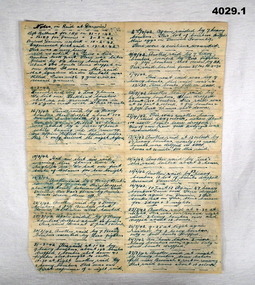
Literary work - DIARIES WW2, C. 1942
... .1) Diary, ruled paper, blue ink, both sides, dated 31-1-1942 to 24-11-42 detailing the raids on Darwin. .2) Document, typed in black re: Darwin air raids beginning 19-2-42, 4-3-42 and 16-3-42. ...Diary lierary work raaf darwin .1) Diary, ruled paper, blue ink, both sides, dated 31-1-1942 to 24-11-42 detailing the raids on Darwin. .2) Document, typed in black re: Darwin air raids beginning 19-2-42, 4-3-42 and 16-3-42. ...Diary written by LAC John Morrison No. 42562 RAAF. Enlisted 22-8-1941, Discharged 5-12-1945. Serving in 9 Transport and Movement..1) Diary, ruled paper, blue ink, both sides, dated 31-1-1942 to 24-11-42 detailing the raids on Darwin. .2) Document, typed in black re: Darwin air raids beginning 19-2-42, 4-3-42 and 16-3-42. This is .1) beginning to be typed out.diary, lierary work, raaf, darwin -
 Bendigo Military Museum
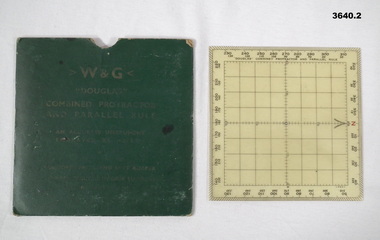
Equipment - PROTRACTOR, SQUARE
... Used in map reading & air navigation. navigation maps equipment .1) Printed on front: W & G DOUGLAS COMBINED PROTRACTOR AND PARALLEL RULE .2) Handwritten in pencil on back: 410533 DAVEY F.G. .1) Square green coloured card pocket for storing protractor / rule. ...Item re Frederick Gardner DAVEY DFC No 410533. Refer Reg No 3536P for his service details. Used in map reading & air navigation. .1) Square green coloured card pocket for storing protractor / rule. Instructions for using the protractor / rule printed on reverse of pocket. .2) Combined protractor & rule. Square clear plastic with degrees markings around the outer edge. North marked in red. Centre area gridded in one centimeter squares..1) Printed on front: W & G DOUGLAS COMBINED PROTRACTOR AND PARALLEL RULE .2) Handwritten in pencil on back: 410533 DAVEY F.G.navigation, maps, equipment -
 Monbulk RSL Sub Branch
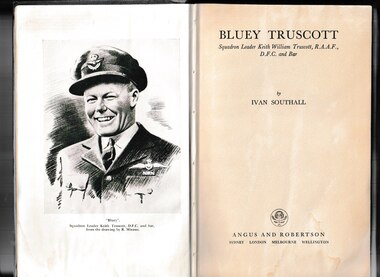
Book, Ivan Southall, Bluey Truscott, 1958
... air pilots - military - biography truscott keith william 1916-1943 Biography of Keith William Truscott (1916-1943) ('Bluey') concentrating on his service during World War II. Truscott, born at Prahran, Melbourne became one of Australia's best-known flying aces of the Second World War. Already famous as a footballer, playing Australian Rules ...Biography of Keith William Truscott (1916-1943) ('Bluey') concentrating on his service during World War II. Truscott, born at Prahran, Melbourne became one of Australia's best-known flying aces of the Second World War. Already famous as a footballer, playing Australian Rules for Melbourne's premiership team in 1939, Truscott enlisted in the RAAF in 1940 amidst considerable publicity.p.202Biography of Keith William Truscott (1916-1943) ('Bluey') concentrating on his service during World War II. Truscott, born at Prahran, Melbourne became one of Australia's best-known flying aces of the Second World War. Already famous as a footballer, playing Australian Rules for Melbourne's premiership team in 1939, Truscott enlisted in the RAAF in 1940 amidst considerable publicity.air pilots - military - biography, truscott keith william 1916-1943 -
Port Melbourne Historical & Preservation Society
Document, VFA Souvenir Grand Final 'Recorder' Sunday 21 Sep 1980, 1980
... From the collection of Terry KEENAN Port Melbourne Football Club PMFC Sport - Australian Rules Football Victorian Football Association VFA The Victorian Football Association 'Football Recorder' Grand Final Sunday 21 Sep 1980, . Booklet of 28pp inc. coloured cover with photograph of four footballers with one in mid-air. ...From the collection of Terry KEENANThe Victorian Football Association 'Football Recorder' Grand Final Sunday 21 Sep 1980, . Booklet of 28pp inc. coloured cover with photograph of four footballers with one in mid-air.port melbourne football club, pmfc, sport - australian rules football, victorian football association, vfa -
 National Vietnam Veterans Museum (NVVM)
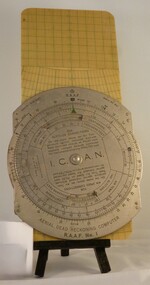
Functional Object - Functional Object - Computer Navigation RAAF Mk1, 1960 (Approximate)
... Royal Australian Air Force Navigation Air Sped RAAF Indent No. G6B/2087 Serial No. WG/442 Slide Rule type navigation computer. ...Slide Rule type navigation computer. Stainless steel/plastic. Uses dead reckoning. See media for more information.RAAF Indent No. G6B/2087 Serial No. WG/442royal australian air force, navigation, air sped -
Moorabbin Air Museum
Equipment (item) - Graviscope for Lincoln (Australian) RAAF Ident No G6C/3972, Graviscope for Lincoln
... Air Force in operations against Malayan Communist terrorists during the Malayan Emergency, 1948-1960. This graviscope is of the type designed for and used by RAAF and RAF aircrew who operated this aircraft. Many by W and G Australia A circular slide rule ...Description White plastic doubled sided Graviscope stored in protective leather carry case. Case is fitted with pair of press studs, pocket in front for holding instructions and is stamped "Graviscope / for / Lincoln / (Australian) / Manufactured by / Melb > W & G < Aust / R.A.A.F / Ident. No G6C/3972". Plastic graviscope consists of a 277mm white disc, printed on both sides, overlaid on one side by a 224mm disc and the other side by a 175mm disc. All discs located by central screw, to which is attached a 160mm long x 25mm wide clear celluloid strip. History / Summary The graviscope is a computing device, which in aircraft was used for measuring the centre of gravity in an aircraft. This would vary depending on crew, bomb load, fuel and stores carried. It was used in the British designed but Australian manufactured, Government Aircraft Factory (GAF) Lincoln heavy bomber, which was operated by the Royal Australian Air Force (RAAF) in the years following the Second World War. This aircraft was originally a derivative of the famous Avro Lancaster bomber. The Lincoln was used by both the RAAF and the Royal Air Force in operations against Malayan Communist terrorists during the Malayan Emergency, 1948-1960. This graviscope is of the type designed for and used by RAAF and RAF aircrew who operated this aircraft.Many by W and G Australia -
Moorabbin Air Museum
Booklet (item) - Statutory Rules and Regulations under the Air Navigation Act 1920-1936, Statutory Rules 1937 No. 81
... Small manilla folder Statutory Rules 1937 No. 81 Booklet Statutory Rules and Regulations under the Air Navigation Act 1920-1936 ... -
 Bendigo Military Museum
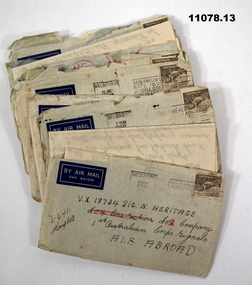
Letter - CORRESPONDENCE, WW2, WW2
... ruled paper. Handwritten black and blue ink pen. Envelopes, airmail weight paper with "BY AIR MAIL/ PAR AVION" printed top left of envelope. ...ruled paper. Handwritten black and blue ink pen. Envelopes, airmail weight paper with "BY AIR MAIL/ PAR AVION" printed top left of envelope. ...Correspondence to Neil Ernest HERITAGE VX 18734 (34025). Refer Cat No. 11076.2 for his service details.1. - 13. Series of 13 letters and envelopes from "Your loving sister Mervyl" to "Dear Neil". Envelopes addressed to "VX 18734 Sig. N. Heritage/ No.2 Company 1st Australian/ Corps Signals/ A.I.F. ABROAD". The letters qre airmail weight ruled paper. Handwritten black and blue ink pen. Envelopes, airmail weight paper with "BY AIR MAIL/ PAR AVION" printed top left of envelope. Includes a variety of postage stamps and postmark ink stamps. Dated letters and envelopes. - (1) Wed April 23rd. (2) May 11th. (3) May 18th Sunday. (4.) 3rd June 1941. (5) 19th June 1941. (6) No date. (7) Sunday 21st June 1941. (8) 16th July 1941. (9) Wed 23rd July 1941. (10) 155AA42. (11) Wed January 14th (mentions Telegram). (12) March 29. (13) illegible,correspondenc, heritage collection, ww2 -
 Chiltern Athenaeum Trust
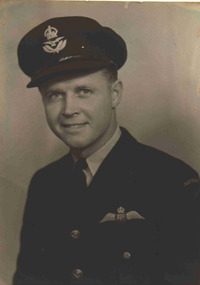
Photograph
... Air Base as it is now owned by the traditional people of the Wunambal Gaambera. The Airfield is now used for commercial and private flying and is heritage listed under the National Trust of Australia (W.A.) due to its historical significance relating to WW2 and the remaining artefacts that are still in place presently. Bluey Truscott was also a well known Australian Rules...Air Base as it is now owned by the traditional people of the Wunambal Gaambera. The Airfield is now used for commercial and private flying and is heritage listed under the National Trust of Australia (W.A.) due to its historical significance relating to WW2 and the remaining artefacts that are still in place presently. Bluey Truscott was also a well known Australian Rules ...Photo of Bluey Truscott. Squadron Leader Keith William (Bluey) Truscott was regarded as one of Australia’s most well known WW2 fighter pilot aces. He was born on the 17/5/1916 and died over Exmouth, Western Australia on 28/3/1943 in an Aircraft accident whilst on duty. He initially trained under the Commonwealth Empire Training Scheme In Canada at the beginning of WW2, and later on was posted to Number 452 Squadron England where he flew Spitfires over Europe. He was awarded the distinguished Flying Cross in 1941 for his Air action and bravery. In 1942 he was further awarded the DFC Bar for further outstanding Air action and bravery. He returned to Australia and commanded number 76 Squadron who undertook duties in Papua New Guinea, specifically Milne Bay. When with 76 Squadron they largely flew Kittyhawks. There is a club named after SQN LDR Truscott, called the Truscott Club, at Airforce Base Darwin. There is also a decommissioned WW2 Airfield in the Kimberley’s called after him ( Truscott Air Base). Truscott has more recently been called Mungalu-Truscott Air Base as it is now owned by the traditional people of the Wunambal Gaambera. The Airfield is now used for commercial and private flying and is heritage listed under the National Trust of Australia (W.A.) due to its historical significance relating to WW2 and the remaining artefacts that are still in place presently. Bluey Truscott was also a well known Australian Rules Football player prior to WW2 having played for Melbourne. Photograph of Keith William (Bluey) Truscott in uniform.ww2, bluey truscott, flying cross -
 Numurkah & District Historical Society
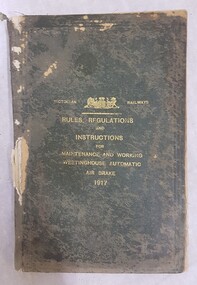
Book - Victorian Railways Book, Rules, Regulations & Instructions for maintenance and working Westinghouse Automatic Air Brake 1917
... Part of a collection of old railway items from closed Numurkah Railway Station Title (as above) / Victorian Railways heading and coat of arms Green covered hardcover book Rules, Regulations & Instructions for maintenance and working Westinghouse Automatic Air Brake 1917 Book Victorian Railways Book ...Part of a collection of old railway items from closed Numurkah Railway StationGreen covered hardcover bookTitle (as above) / Victorian Railways heading and coat of arms -
 Ballarat Tramway Museum
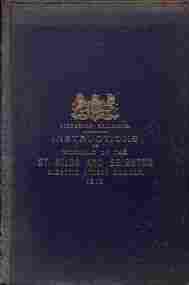
Book, Victorian Railways (VR), "Instructions re working of the St Kilda Brighton Electric Street Railway", 1915
... Has an index - general instructions, hand signals, working of cars, working of traffic over single and double line, staff and ticket systems, air brakes, permanent way, overhead, fares, appeals of employees against penalty and electric shock. Demonstrates a Victorian Railway Rule book for electric tramways or Street Railways. tramways trams victorian railways vr St Kilda - Brighton Tramway rules employees safe working On inside of front cover an inscription from Gerald Dee to Richard Gilbert dated 22/10/1999. ...Book - "Instructions re Working of the St Kilda and Brighton Electric Street Railway", dated 1 January 1915. Has an index - general instructions, hand signals, working of cars, working of traffic over single and double line, staff and ticket systems, air brakes, permanent way, overhead, fares, appeals of employees against penalty and electric shock.Demonstrates a Victorian Railway Rule book for electric tramways or Street Railways.Book - 104 pages with sewn and bound dark blue rexine covers with gold blocked title and glue end papers.On inside of front cover an inscription from Gerald Dee to Richard Gilbert dated 22/10/1999.tramways, trams, victorian railways, vr, st kilda - brighton tramway, rules, employees, safe working -
 Ballarat Tramway Museum
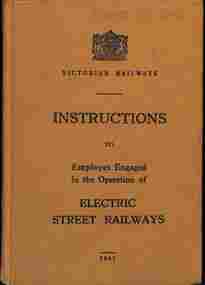
Book, Victorian Railways (VR), "Instructions to Employes Engaged in the Operation of Electric Street Railways", 1942
... In the rear are drawings for: 1 - Bogie car wiring diagram 2 - Air and brake equipment 3 - Pneumatic equipment for one-man car 4 - Air & Brake Equipment 5 - Pneumatic Door Equipment - car nos 52,53 & 54 Demonstrates a Victorian Railway Rule book for electric tramways or Street Railways. tramways trams victorian railways vr St Kilda - Brighton Tramway rules employees safe working Sandringham Sandringham - Black Rock Black Rock On inside of front cover "R C Gilbert" has been written in, "Elwood Car Depot" stamped a number of times. ...Book -"Instructions to Employes Engaged in the Operation of Electric Street Railways", dated June 1942. Has a table of contents and index - general instructions, hand signals, working of cars, working of traffic over single and double line, staff and ticket systems, air brakes, permanent way, overhead, fares, appeals of employees against penalty and electric shock. Covers both the St Kilda to Brighton and the Sandringham to Black Rock lines. In the rear are drawings for: 1 - Bogie car wiring diagram 2 - Air and brake equipment 3 - Pneumatic equipment for one-man car 4 - Air & Brake Equipment 5 - Pneumatic Door Equipment - car nos 52,53 & 54Demonstrates a Victorian Railway Rule book for electric tramways or Street Railways.Book - 132 pages with sewn and bound brown rexine covers with printed title and glued end papers. There are five folded sheets glued and stapled into the book.On inside of front cover "R C Gilbert" has been written in, "Elwood Car Depot" stamped a number of times. On page five, the name "Hugh Griffiths" hand written in, along with the date stamp of "5 August 1942" and "Tramway Inspector" stamped.tramways, trams, victorian railways, vr, st kilda - brighton tramway, rules, employees, safe working, sandringham, sandringham - black rock, black rock -
 Ballarat Tramway Museum
Archive (series), State Electricity Commission of Victoria (SECV), "Tram car maintenance and Rules and Regulations", 1948 to 1965
... SECV Ballarat Reports depot tramcars maintenance Air Compressors closure Documents contained within a manila folder marked ""Tram car maintenance and Rules and Regulations" "Tram car maintenance and Rules and Regulations" Archive State Electricity Commission of Victoria (SECV) ...SECV DepotRecords of tramcar and depot procedures, office and SECV procedures, SECV documents regarding closure of the tramways and security of the depot.Hand written and typed notes in no apparent order.Comprises notes and misc. papers: Circuit for Wheel Grinding mechanism at depot Motor Transport The Schedule Above Referred To - muiltipage document dated 1/4/1952 Pressure Gauge Calibration notes on tramcars compressor types Instruction to Motormen and Tram Depot Staff - re tail lights - 1950 Notice to Motormen re curve speeds Special Order To Traffic Personnel Safety Notice To Motormen & Conductors - re mileage cards Security of Branch Records memo - re rolling stock and swapping cars between Bendigo and Ballarat - 12/8/1960 Tramways - Abandonment - 6-4-1962 - SECV and parliament document Provincial Tramways - extended period of operation regarding existing rolling stock, use of trolley buses or buses on existing routes, and building alterations needed? dated 7/5/1948 Memo re striking matches on the centre glass of trams - 28/2/1960 Safety memo re lifting and backstrain Cleaning of tramcar windows and shutting windows 6/3/1958 standing orders re depot during 'Silent hours" Visitors to premises Tramway rolling stock - stores - 22/8/1966 Loan and hire of commission equipment - 1965 Testing of air receivers - 1965 Requisitions - replacement tools and protective clothing - 1964secv, ballarat, reports, depot, tramcars, maintenance, air compressors, closuresecv, ballarat, reports, depot, tramcars, maintenance, air compressors, closure -
 Ballarat Tramway Museum
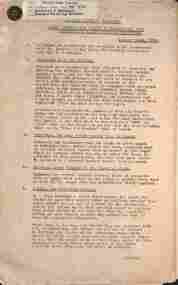
Document - Geelong, State Electricity Commission of Victoria (SECV), "Local instructions in conjunction with SECV Rules", March 1939
... Rules governing employees" and is dated March 1939. It has a label on the top left-hand corner - dated 29/9/1947, in a memo from the Manager, Geelong branch. Comprises: 1 - Local instructions - 8 sheets -including notes on the automatic signaling and the indicator at the West terminus. 2 - Tramcar Emergency Braking - 6 sheets 3 - Automatic air brake equipment - "Dead Man Control" - dated 1/7/1947 - 2 sheets 4 - Two quarto sheets - signature forms for receipt of Rule book and General Instructions 5 - General instructions for employees engaged in repair and maintenance of trams - 4 sheets 6 - First Aid Treatment - 3 sheets 7 - signature form regarding health and understanding of electrical equipment 8 - signature form regarding SECV tools and equipment See item 9874 for a Ballarat version and 9978 for the 1950 version. 2nd copy has pencil notes....Yields information about the local instructions applicable to the Geelong depot and other matters. tramways geelong rules braking First Aid forms Geelong depot tramcar maintenance instructions Air Brake Emergencies Document - 27 duplicated foolscap sheets, pinned in the top left hand corner. ...The document is titled "Local instructions issued in conjunction with Commission Rules governing employees" and is dated March 1939. It has a label on the top left-hand corner - dated 29/9/1947, in a memo from the Manager, Geelong branch. Comprises: 1 - Local instructions - 8 sheets -including notes on the automatic signaling and the indicator at the West terminus. 2 - Tramcar Emergency Braking - 6 sheets 3 - Automatic air brake equipment - "Dead Man Control" - dated 1/7/1947 - 2 sheets 4 - Two quarto sheets - signature forms for receipt of Rule book and General Instructions 5 - General instructions for employees engaged in repair and maintenance of trams - 4 sheets 6 - First Aid Treatment - 3 sheets 7 - signature form regarding health and understanding of electrical equipment 8 - signature form regarding SECV tools and equipment See item 9874 for a Ballarat version and 9978 for the 1950 version. 2nd copy has pencil notes.Yields information about the local instructions applicable to the Geelong depot and other matters.Document - 27 duplicated foolscap sheets, pinned in the top left hand corner. Two copies held.tramways, geelong, rules, braking, first aid, forms, geelong depot, tramcar maintenance, instructions, air brake, emergencies -
 Ballarat Tramway Museum
Document - Geelong, State Electricity Commission of Victoria (SECV), "Local instructions in conjunction with SECV Rules", 1950
... Yields information about the local instructions applicable to the Geelong depot and other matters. tramways geelong rules braking First Aid forms Geelong depot tramcar maintenance instructions Air Brake Emergencies Document - 17 duplicated foolscap sheets, pinned into a manila file folder. ...The document is titled "Local instructions issued in conjunction with Commission Rules governing employees," dated 1950. Comprises: 1 - Preparation and operation of trams 2 - Signalling apparatus 3 - tramcar braking 4 - Questions and Answers for Motormen 5 - Form for receipt of the document 6 - General working conditions, first aid, working on trams, electrical safety 7 - Start of employment forms See item 9874 for a Ballarat version and 9853 for the 1947 version. Yields information about the local instructions applicable to the Geelong depot and other matters.Document - 17 duplicated foolscap sheets, pinned into a manila file folder.tramways, geelong, rules, braking, first aid, forms, geelong depot, tramcar maintenance, instructions, air brake, emergencies -
 Geelong Naval and Maritime Museum
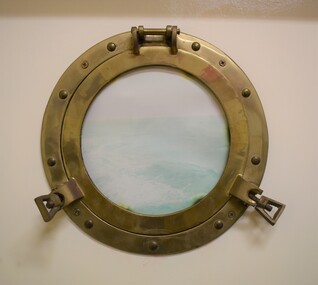
Tool - Porthole, Unsure
... air to enter the dark and often damp below-deck quarters of the vessel. It also affords below-deck occupants a limited view to the outside world. When closed, the porthole provides a strong water-tight, weather-tight and sometimes light-tight barrier (not in the case however). A porthole on a ship may also be called a side scuttle (side hole), as officially termed in the International Convention for the Safety of Life at Sea. This term is used in the U.S. Code of Federal Regulations. It is also used in related rules...air to enter the dark and often damp below-deck quarters of the vessel. It also affords below-deck occupants a limited view to the outside world. When closed, the porthole provides a strong water-tight, weather-tight and sometimes light-tight barrier (not in the case however). A porthole on a ship may also be called a side scuttle (side hole), as officially termed in the International Convention for the Safety of Life at Sea. This term is used in the U.S. Code of Federal Regulations. It is also used in related rules ...A porthole, sometimes called bull's-eye window or bull's-eye, is a circular window used on the hull of ships to admit light and air. Though the term is of maritime origin, it is also used to describe round windows on armoured vehicles, aircraft, automobiles (the Ford Thunderbird a notable example) and even spacecraft. On a ship, the function of a porthole, when open, is to permit light and fresh air to enter the dark and often damp below-deck quarters of the vessel. It also affords below-deck occupants a limited view to the outside world. When closed, the porthole provides a strong water-tight, weather-tight and sometimes light-tight barrier (not in the case however). A porthole on a ship may also be called a side scuttle (side hole), as officially termed in the International Convention for the Safety of Life at Sea. This term is used in the U.S. Code of Federal Regulations. It is also used in related rules and regulations for the construction of ships. The use of the word "side scuttle" instead of "porthole" is meant to be broad, including any covered or uncovered hole in the side of the vessel. This porthole is a useful demonstration of naval technology to give people an insight into life at see. Small windows such as this example could be all people would see on long see voyage across rough seas. Commanding officers scuttle made of brass with glass opening windowmaritime technology
