
Showing 8 items matching "rural life - ireland"
-
 Linton Mechanics Institute and Free Library Collection
Book - Memoir, Irvine, Alexander, My lady of the chimney corner, 1927 (Eighteenth impression. First impression 1913.)
... Rural life - Ireland...Rural life - Ireland Poverty Ireland - Social conditions Memoirs Biographical fiction A partially fictionalised account/memoir of the author's parents. ...A partially fictionalised account/memoir of the author's parents.250 p. ; Dark grey cardboard cover, embossed with image of Nelson's Column.fictionA partially fictionalised account/memoir of the author's parents.rural life - ireland, poverty, ireland - social conditions, memoirs, biographical fiction -
 Federation University Historical Collection
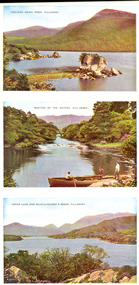
Letter Card, Six View Letter card of Killarney, Ireland
... Probably acquired because of its connection to rural life and the Irish immigrants settled in the Ballarat District...Probably acquired because of its connection to rural life and the Irish immigrants settled in the Ballarat District Chatham-Holmes family archive Killarney Ireland Six coloured images from Killarney, Ireland. * Colleen Gawn Rock * Meeting of the Waters * Upper Lake and MacGillycuddy's Reeks, Killarney * The Islands, Upper Lake * Kate Kearney's Cottage * Lower Lake and Ross Castle Six View Letter card of Killarney, Ireland Letter Card ...Probably acquired because of its connection to rural life and the Irish immigrants settled in the Ballarat DistrictSix coloured images from Killarney, Ireland. * Colleen Gawn Rock * Meeting of the Waters * Upper Lake and MacGillycuddy's Reeks, Killarney * The Islands, Upper Lake * Kate Kearney's Cottage * Lower Lake and Ross Castlechatham-holmes family archive, killarney, ireland -
 Federation University Historical Collection
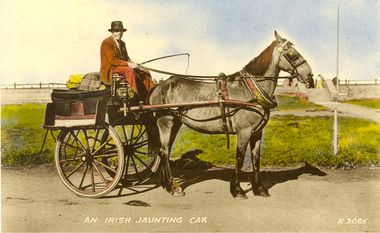
Postcard - colour, An Irish Jaunting Car
... Probably acquired because of its connection to rural life and the Irish immigrants settled in the Ballarat District...Probably acquired because of its connection to rural life and the Irish immigrants settled in the Ballarat District chatham-holmes family collection ireland irish jaunting car horse carriage cart transport A postcard of a grey horse pulling a cart with a man in a hat holding a whip. ...Probably acquired because of its connection to rural life and the Irish immigrants settled in the Ballarat DistrictA postcard of a grey horse pulling a cart with a man in a hat holding a whip.chatham-holmes family collection, ireland, irish jaunting car, horse, carriage, cart, transport -
 Federation University Historical Collection
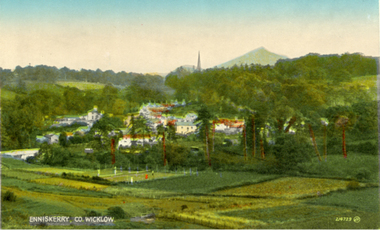
Postcard - colour, Enniskerry, County Wicklow, Ireland
... Possibly acquired because of a connection to rural life and the Irish immigrants settled in the Ballarat District. ...Possibly acquired because of a connection to rural life and the Irish immigrants settled in the Ballarat District. ...Possibly acquired because of a connection to rural life and the Irish immigrants settled in the Ballarat District. Harry and Edith Holmes visited this area with my mother, their daughter M. Elizabeth in the early 1950s. [Jane Dyer 2024]A town is surrounded by green fields and trees. A mountain is evident in the backgroundchatham-holmes family collection, enniskerry, wicklow, ireland, postcard -
 Federation University Historical Collection
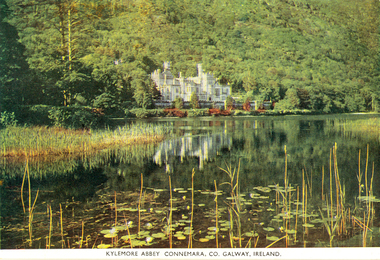
Postcard - Colour, Kylemore Abbey Connemara, County Galway, Ireland
... Possibly acquired because of a connection to rural life and the Irish immigrants settled in the Ballarat District. ...Possibly acquired because of a connection to rural life and the Irish immigrants settled in the Ballarat District. ...Possibly acquired because of a connection to rural life and the Irish immigrants settled in the Ballarat District. Harry and Edith Holmes visited this area with my mother, their daughter M. Elizabeth in the early 1950s. [Jane Dyer 2024]An abbey is surrounded by trees with a lake in the foreground.chatham-holmes family collection, kylemore abbey, connemara, galway, ireland -
 Bendigo Historical Society Inc.
Book - BOOK - THE IRISH CHIEFTAN
... Rural The Irish Chieftan. Historical 1. Patterned green cloth over cardboard cover. Titled The Irish Chieftan or the isles of Life and Death, by Edward Maturin, Esq. ...1. Patterned green cloth over cardboard cover. Titled The Irish Chieftan or the isles of Life and Death, by Edward Maturin, Esq. Inscribed inside book on flyleaf: Presented to James Adamson, by his youngest sister Sarah Adamson. June 9, 1862, Sunderland.book, rural, the irish chieftan., historical -
 Ballarat and District Irish Association
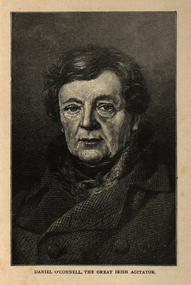
Image, Daniel O'Connell, the Great Irish Agitator, c1864, c1864
... Irish and was interested in the traditional culture of song and story still strong in Kerry at the time. He also understood how the rural mind worked which served him well in later years. In 1791 he was sent to school at St. Omer and Douai and what he saw there of the French Revolution left him with a life...Irish and was interested in the traditional culture of song and story still strong in Kerry at the time. He also understood how the rural mind worked which served him well in later years. In 1791 he was sent to school at St. Omer and Douai and what he saw there of the French Revolution left him with a life ...Daniel O’Connell was born near Cahirciveen, Co. Kerry, on 6 August 1775. His wealthy childless uncle adopted him at an early age and brought him up at Derrynane. He spoke Irish and was interested in the traditional culture of song and story still strong in Kerry at the time. He also understood how the rural mind worked which served him well in later years. In 1791 he was sent to school at St. Omer and Douai and what he saw there of the French Revolution left him with a life-long hatred of violence. He read law at Lincoln’s Inn (1794 -96) and continued his studies in Dublin where he was called to bar in 1798. He had soon built up an enormous practice. The 1798 rising and the terrible butchery that followed it confirmed his horror of violence. While he approved of the principles of the United Irishmen, their call for reform and for Catholic Emancipation, he disagreed with their methods. In 1815 O’Connell criticised harshly the Dublin corporation. O’Connell was challenged to a duel by one member D’Esterre. In the exchange of shots D’Esterre was killed and O’Connell vowed never to fight again. O’Connell was soon drawn into political action. Hopes of Catholic emancipation had been raised by promises given while the act of union was being passed. In 1823, O’Connell founded the Catholic Association. The aim of the organisation was to use all the legal means available to secure emancipation. It turned into a mass crusade with the support of the Catholic clergy. All members of the association paid a membership of a penny a month (the Catholic rent). This helped to raise a large fund. The Clare election in 1828 was a turning point. O’Connell, with the support of the forty-shilling freeholders, managed a huge victory against the government candidate. He was well supported by the clergy whose influence on the poor uneducated peasant class was enormous. The polling took place in Ennis at the old courthouse where the O’Connell monument now stands. At the final count, O’Connell was elected by a majority of about eleven hundred votes. The ascendancy party had suffered its first big knock since 1798. The whole country was aflame. The British Government feared a rising and granted Catholic emancipation in April 1829. The franchise was, however, raised to 10 pounds which excluded the forty-shilling freeholders. O’Connell was now the undisputed leader in Ireland and he gave up his practice at the bar to devote his time entirely to politics. At the King’s insistence, O’Connell was not allowed to take his seat until he had been re-elected for Clare. In February 1830, O’Connell became the first Catholic in modern history to sit in the House of Commons. For the rest of his life, he was supported by “The O’Connell Tribute”, a public collection out of which O’Connell paid all his expenses. O’Connell now decided to concentrate on winning repeal of the act of union and getting an Irish parliament for the Irish people. British political leaders feared repeal as they did not fear emancipation. They saw repeal of the Act of Union as the first step in the break-up of the act of union, as the spirit of the repeal movement was revived when the young Ireland writers wrote about it in the Nation. In 1841, O’Connell was elected Lord Mayor of Dublin and in 1843 the subscriptions to his Repeal Association, the Repeal “Rent” came to 48,400 pounds. He now began to organise monster meetings throughout the country. It is thought that three-quarters of a million people gathered on the hill of Tara to hear the man they called the “Liberator”. The government became alarmed at the strength of the Repeal Movement and a meeting which O’Connell had planned for 8 October 1843 in Clontarf, Dublin was banned. Huge crowds were already on their way when O’Connell called off the meeting to avoid the risk of violence and bloodshed. He was charged with conspiracy, arrested and sentenced to a year in jail and a fine of 2,000 pounds. The sentence was set aside after O’Connell had been three months in prison. When he was released he continued with his campaign for repeal. However, a turning point had been reached. The tactics that had won emancipation had failed. O’Connell was now almost seventy, his health failing and he had no clear plan for future action. There was discontent within the Repeal Association and the Young Irelanders withdrew. There was also some failure in the potato crop in the 1840’s, a sign of things to come in the Great Famine of 1845-1847. Aware of the fact that he had failed with his great goal, (the Repeal Movement), O’Connell left Ireland for the last time in January 1847. He made a touching speech in the House of Commons in which he appealed for aid for his country. In March, acting on the advice of his doctor, he set out to Italy. Following his death in Genoa on 15 May 1847, his body was returned to Ireland and buried in Glasnevin Cemetery. [http://www.clarelibrary.ie/eolas/coclare/people/daniel.htm, accessed 13/12/2013]Portrait of a man known as Daniel O'Connell.ballarat irish, daniel o'connell, o'connell -
 The Celtic Club
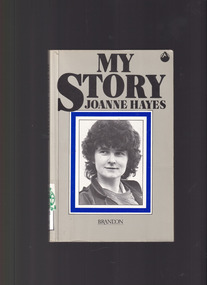
Book, Joanne Hayes, My Story, 1985
... Ireland - cultural life Joanne Hayes own account of her life and family background in rural Ireland prior to her humiliation of a public tribunal which wrongly accused her of murder. ...Joanne Hayes own account of her life and family background in rural Ireland prior to her humiliation of a public tribunal which wrongly accused her of murder.Ill, p190.non-fictionJoanne Hayes own account of her life and family background in rural Ireland prior to her humiliation of a public tribunal which wrongly accused her of murder.ireland - biography- joanne hayes., ireland - cultural life
