
Showing 9 items matching "rush> clay"
-
 Box Hill Historical Society
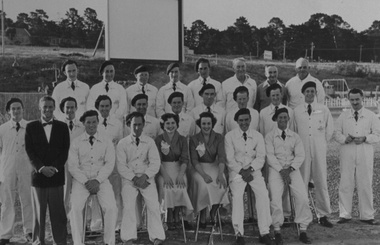
Photograph - Drive-In
... ...Rush> Clay...Humphries> Bob Gallagher> Noel Hood> John Lanham> Geoff O'Connor> Alan Ratcliffe> Joe Shannon> Doug Cavanagh> Jack Bishop> Les Naismith> Ron Riseborough> Ian Regester> Bob Anderson> Brian Bloom> Les Owen> Bryan Burton> Merle Burns> Margaret Reid> Alan Hair> Ron Scott> Lyn Rush> Clay Skyline Burwood Drive-in B&w photo Photograph Drive-In ...The staff at the Burwood Skyline Drive-In pose for a group photo with the "car hops" dressed in white overalls and the cashiers in blue linen skirts and pink blouses. B&w photodrive in theatres, o'connor> jack, mccarthy> laurie, henshall> joe, gordon> leon, robertson> dave, mccathy> - (mr.), edwards> - (mr.), coghill> - (mr.), humphries> bob, gallagher> noel, hood> john, lanham> geoff, o'connor> alan, ratcliffe> joe, shannon> doug, cavanagh> jack, bishop> les, naismith> ron, riseborough> ian, regester> bob, anderson> brian, bloom> les, owen> bryan, burton> merle, burns> margaret, reid> alan, hair> ron, scott> lyn, rush> clay, skyline, burwood drive-in -
 Wodonga & District Historical Society Inc
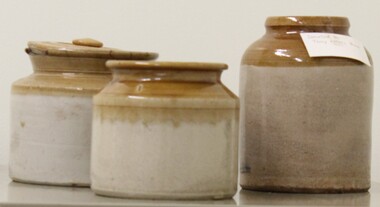
Functional object - A collection of assorted stoneware and ceramic canisters
... It was founded by George Duncan Guthrie (1828–1910) who abandoned his potter’s wheel in Scotland to join the Australian gold rush. He found a clay deposit perfectly suited for the production of ceramics, so returned to his former profession as a master potter. ...It was founded by George Duncan Guthrie (1828–1910) who abandoned his potter’s wheel in Scotland to join the Australian gold rush. He found a clay deposit perfectly suited for the production of ceramics, so returned to his former profession as a master potter. ...Stoneware or pottery canisters were widely used throughout the late 19th and early 20th centuries for storing and preserving a wide range of kitchen food ingredients. Bendigo Pottery was established in 1858 and is Victoria's oldest working pottery. It was founded by George Duncan Guthrie (1828–1910) who abandoned his potter’s wheel in Scotland to join the Australian gold rush. He found a clay deposit perfectly suited for the production of ceramics, so returned to his former profession as a master potter. The population explosion created by the Australian gold rush resulted in an increased demand for all kinds of locally manufactured goods. The Bendigo Pottery became one of regional Victoria’s most important industrial enterprises. By the late 1800s the Pottery was making all kinds of household wares. One of its most popular lines was the mass produced, affordable and functional earthenware such as these canisters.These items are significant on a state and national level due to the importance of Bendigo pottery as a major Victorian manufacturer whose products were widely used in Australian homes.A group of 3 stoneware and ceramic canisters of assorted sizes. The tallest canister bears the Bendigo Pottery makers mark. The flour canister with the lid and the third canister are unmarked. Similar canister were produced by several companies in the early to mid 20th century. They were commonly used for storing flour, salt and other commodities.At bottom of largest canister "BENDIGO POTTERY" above straight linebendigo pottery, earthernware, kitchen utensils -
 The Beechworth Burke Museum
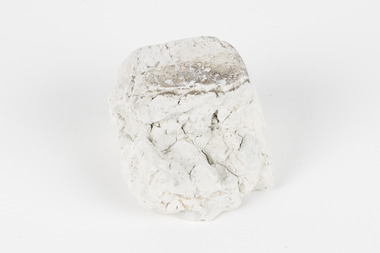
Geological specimen - Kaolin, unknown
... Rush) to study and map the geology of Victoria. Collecting geological specimens was an important part of mapping and understanding the scientific makeup of the earth. Many of these specimens were sent to research and collecting organisations across Australia, including the Burke Museum, to educate and encourage further study. Geological Specimen geology Geology Collection Burke Museum Beechworth kaolin china clay ...Kaolin is also known as china clay. This specimen came from Dunolly, Victoria and was donated to the Museum in 1868 as part of the Geological Survey of Victoria. This survey helped map and study the geology of Victoria. In Victoria, Kaolin is particularly used as a filler and coating material in paper manufacture. It can also be used in paints, ceramics, rubbers and plastics. There are many kaolin deposits in Victoria but many of these have been mined out and there is not much Kaolin left. Rocks that have a high amount of Kaolinite and it can be formed through the decomposition of other materials. There are two types of Kaolin; hard and soft kaolin. Soft kaolin's are coarse but have a soapy texture. It can also break easily. The hard kaolins have an earthly texture and are finer grained. This means that they are harder to break, unlike the soft kaolin. Hard kaolin's are formed by flocculation in salt water, a process that in basic terms, bonds particles together. Kaolin is a common material in Victoria and that is why it is significant. While this specimen was mined in Dunolly, Victoria Kaolin can also be found Pittong, Pakenham, Bulla, Hallam and Ballarat as well as many other places throughout Victoria. This specimen represents the presence of Kaolin deposits in this region of Australia. It is also significant because Kaolin has many uses and is largely beneficial to many manufacturing processes in Victoria. This specimen is part of a larger collection of geological and mineral specimens collected from around Australia (and some parts of the world) and donated to the Burke Museum between 1868-1880. A large percentage of these specimens were collected in Victoria as part of the Geological Survey of Victoria that begun in 1852 (in response to the Gold Rush) to study and map the geology of Victoria. Collecting geological specimens was an important part of mapping and understanding the scientific makeup of the earth. Many of these specimens were sent to research and collecting organisations across Australia, including the Burke Museum, to educate and encourage further study.Two pieces of Kaolinite mineral with shades of white and graygeological specimen, geology, geology collection, burke museum, beechworth, kaolin, china clay, dunolly, geological survey of victoria, kaolinite, victoria, mining, mining deposits, geology of victoria, australia, filler, coating material, paper manufacture, paint, ceramics, rubbers, plastics, decomposition, materials, soft kaolin, hard kaolin, flocculation, particles, salt water -
 The Beechworth Burke Museum
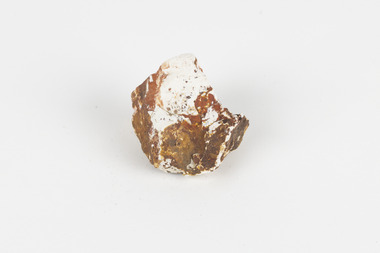
Geological specimen - Montmorillonite
... Rush) to study and map the geology of Victoria. Collecting geological specimens was an important part of mapping and understanding the scientific makeup of the earth. Many of these specimens were sent to research and collecting organisations across Australia, including the Burke Museum, to educate and encourage further study. burke museum beechworth geological geological specimen clay montmorillonite A solid tennis-ball sized chunk of aluminium silicate clay. ...Montmorillonite is a type of clay composed of aluminium silicate that forms very small particles that are not well-bonded to one another. This is why it is so soft. When in the presence of water, all types of clay swell. Montmorillonite swells even more than most types of clay, which is why it is often chosen over other types of clay in its practical uses. Montmorillonite has many different practical uses, including in the mining industry, as a soil additive, as a sealant, as a desiccant to draw water out of the air, to clean ponds, to make kitty litter and in cosmetics. Montmorillonite is a common mineral and, despite being named after Montmorillon, France, can be found all over the world, including many deposits in Australia. It is not known where this particular specimen originates from. Montmorillonite is an economically and socially significant material with a wide variety of uses. Having samples of common and important minerals allows collections, like the Burke Museum, to have a more complete view of the land on which they are located, and therefore a more complete view of heritage. This specimen is part of a larger collection of geological and mineral specimens collected from around Australia (and some parts of the world) and donated to the Burke Museum between 1868-1880. A large percentage of these specimens were collected in Victoria as part of the Geological Survey of Victoria that begun in 1852 (in response to the Gold Rush) to study and map the geology of Victoria. Collecting geological specimens was an important part of mapping and understanding the scientific makeup of the earth. Many of these specimens were sent to research and collecting organisations across Australia, including the Burke Museum, to educate and encourage further study.A solid tennis-ball sized chunk of aluminium silicate clay. It is primarily white, accented with orange and brown.burke museum, beechworth, geological, geological specimen, clay, montmorillonite -
 The Beechworth Burke Museum
Geological specimen - Feldspathic Sandstone
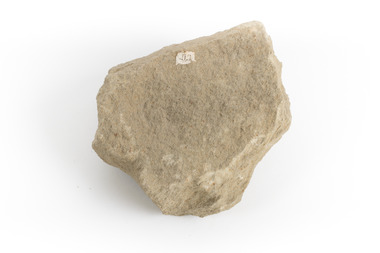
... Rush) to study and map the geology of Victoria. Collecting geological specimens was an important part of mapping and understanding the scientific makeup of the earth. Many of these specimens were sent to research and collecting organisations across Australia, including the Burke Museum, to educate and encourage further study. sandstone natural stone feldspathic sandstone burke museum geology geological geological specimen A feldspar-rich sandstone, a sandstone intermediate in composition between an arkosic sandstone and a quartz sandstone, containing 10% to 25% feldspar and less than 20% matrix material of clay, sericite, and chlorite. ...Feldspathic arenites are sandstones that contain less than 90% quartz, and more feldspar than unstable lithic fragments, and minor accessory minerals.Feldspathic sandstones are commonly immature or sub-mature.These sandstones occur in association with cratonic or stable shelf settings. Feldspathic sandstones are derived from granitic-type, primary crystalline, rocks. If the sandstone is dominantly plagioclase, then it is igneous in origin Sandstone features prominently in public buildings throughout Victoria. Most of the sandstone used as dimension stone in the State came from three sources: the Heatherlie quarry in the Grampians (Silurian), the Bacchus Marsh area (Permian), and the Barrabool Hills near Geelong (Cretaceous).Sandstone features prominently in public buildings throughout Victoria, making this specimen special as it shows the materials used by Victorian building companies. Sandstone can also be crushed, crushed stone is used in the construction of roadways and road structures such as bridges, and in buildings, both commercial and residential. This specimen is part of a larger collection of geological and mineral specimens collected from around Australia (and some parts of the world) and donated to the Burke Museum between 1868-1880. A large percentage of these specimens were collected in Victoria as part of the Geological Survey of Victoria that begun in 1852 (in response to the Gold Rush) to study and map the geology of Victoria. Collecting geological specimens was an important part of mapping and understanding the scientific makeup of the earth. Many of these specimens were sent to research and collecting organisations across Australia, including the Burke Museum, to educate and encourage further study. A feldspar-rich sandstone, a sandstone intermediate in composition between an arkosic sandstone and a quartz sandstone, containing 10% to 25% feldspar and less than 20% matrix material of clay, sericite, and chlorite. Feldspathic arenite containing less than 90 percent of the composition of quartz. Feldspar is the main composition. Feldspathic arenite may contain fragments of unstable rock, and a little amount of other minerals such as mica and heavy minerals. Some feldspathic arenite have pink or red color because of the presence of potassium feldspar or iron oxide. There are also colored light gray to white. These sandstones are usually medium to coarse grained and can contain a high percentage of granules with angular until subangular roundness. The content of the matrix can appear as the rest up to more than 15 percent, and sorting of grains can present as moderate to poorly sorted. Feldspathic sandstones are generally immature in textural maturity. Feldspathic arenite can not be judged from the structure of the sediment. Bedding can emerge from the laminate parallel to the crossbed. Fossils may appear in the layer deposited on the sea. Feldspathic arenites usually appear on the craton or the continental shelf, which can be associated with conglomerate, quartz lithic arenite, carbonate rock, or evaporites. This sandstone may also appear on the succession of sedimentary basins deposited on an unstable or deep sea, and moving arc setting. According to Pettijohn (1963) Arkose make up about 15 percent of all sandstones. Some Arkose formed in situ when the granite and related rocks disintegrate and generate granular sediments. Most of the material feldspathic sandstones derived from primary crystalline granitic rocks, such as granite or metasomatic rocks containing abundant potassium feldspar. Mineral contained in sandstones is mostly a form of plagioclase feldspar derived from quartz diorite or volcanic rock. Feldspar contained on this sandstone comes from arid to cool climates when the chemical weathering process is reduced.sandstone, natural stone, feldspathic sandstone, burke museum, geology, geological, geological specimen -
 The Beechworth Burke Museum
Geological specimen - Fossiliferous Mudstone, Unknown
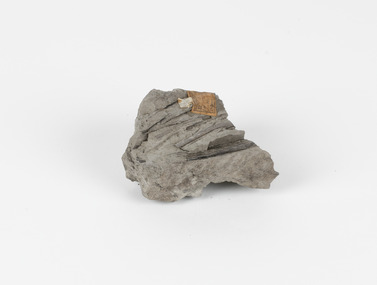
... clay/silt dries slowly and is covered by other sediment. Plants can also leave imprint fossils when they are covered by sediment. The leaf tissue degrades, leaving an imprint of where the leaf once was. This specimen is part of a larger collection of geological and mineral specimens collected from around Australia (and some parts of the world) and donated to the Burke Museum between 1868-1880. A large percentage of these specimens were collected in Victoria as part of the Geological Survey of Victoria that begun in 1852 (in response to the Gold Rush ...This specimen was found in Cape Patterson, Vic. Cape Paterson is a cape and seaside village located near the town of Wonthaggi, 132 kilometres southeast of Melbourne, in the Bass Coast Shire of Gippsland, Victoria, Australia. These dark, fossiliferous Mudstones were deposited in slow-moving water associated with sedimentary basins & continental shelves. They are rich in carbon which makes them almost black. This is typical of an anoxic, reducing environment such as deep water or stagnant conditions where carbon-rich material would remain unoxidised during subsequent deposition & diagenesis. it has an imprint of a leaf in the rock itself, displaying the fossil of the plant. This specimen is unique due to the leaf impression within the stone itself. Imprint fossils are formed from an organism moving in some way, leaving behind a trace or track. These tracks are preserved when the clay/silt dries slowly and is covered by other sediment. Plants can also leave imprint fossils when they are covered by sediment. The leaf tissue degrades, leaving an imprint of where the leaf once was. This specimen is part of a larger collection of geological and mineral specimens collected from around Australia (and some parts of the world) and donated to the Burke Museum between 1868-1880. A large percentage of these specimens were collected in Victoria as part of the Geological Survey of Victoria that begun in 1852 (in response to the Gold Rush) to study and map the geology of Victoria. Collecting geological specimens was an important part of mapping and understanding the scientific makeup of the earth. Many of these specimens were sent to research and collecting organisations across Australia, including the Burke Museum, to educate and encourage further study.These dark, fossiliferous Mudstones were deposited in slow moving water associated with sedimentary basins & continental shelves. They are rich in carbon which makes them almost black. This is typical of an anoxic, reducing environment such as deep water or stagnant conditions where carbon rich material would remain unoxidised during subsequent deposition & diagenesis. FOSSILIFEROUS MUDSTONE / Locality: Cape Patterson, Victoria | Descriptive catalogue / Pg 27 No 95 / "Grey Clay, / Cape Paterson with leaf impressions' / 15/4/21 C. William /mudstone, cape patterson, leaf imprint, fossilised leaf, fossiliferous mudstone -
 The Beechworth Burke Museum
Geological specimen - Slate with Iron pyrites
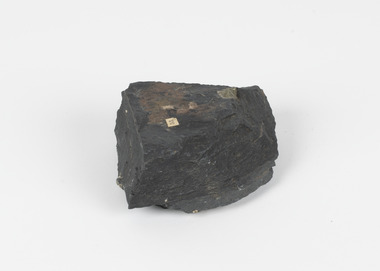
... rush at McKinnon’s ‘Mountain Creek’ station. By 1861, a township had developed on the diggings site, and on 21 October 1861 the “municipal district of Moonambel, on Mountain Creek” was proclaimed. The name 'Moonambel' is believed to be an aboriginal word meaning 'hollow in the hills'. Slate is a stone with a fine grain that is noted for its persistent strength and ability to naturally split into slabs. It forms under low temperatures and is most often created from clay...rush at McKinnon’s ‘Mountain Creek’ station. By 1861, a township had developed on the diggings site, and on 21 October 1861 the “municipal district of Moonambel, on Mountain Creek” was proclaimed. The name 'Moonambel' is believed to be an aboriginal word meaning 'hollow in the hills'. Slate is a stone with a fine grain that is noted for its persistent strength and ability to naturally split into slabs. It forms under low temperatures and is most often created from clay ...This specimen was recovered from Moonambel, Donkey Hill, Victoria. Established in the early 1860's, Moonambel is a small town in the Pyrenees region of the Australian state of Victoria. In the 1850s the location of Moonambel was part of the ‘Mountain Creek’ pastoral run, but in 1860 reports began to appear of a gold-rush at McKinnon’s ‘Mountain Creek’ station. By 1861, a township had developed on the diggings site, and on 21 October 1861 the “municipal district of Moonambel, on Mountain Creek” was proclaimed. The name 'Moonambel' is believed to be an aboriginal word meaning 'hollow in the hills'. Slate is a stone with a fine grain that is noted for its persistent strength and ability to naturally split into slabs. It forms under low temperatures and is most often created from clay. Pyrite is a crystallising compound that occurs naturally in grey and blue-black slate that is colloquially referred to as slate-rust as it resembles regular rust. This specimen is part of a larger collection of geological and mineral specimens collected from around Australia (and some parts of the world) and donated to the Burke Museum between 1868-1880. A large percentage of these specimens were collected in Victoria as part of the Geological Survey of Victoria that begun in 1852 (in response to the Gold Rush) to study and map the geology of Victoria. Collecting geological specimens was an important part of mapping and understanding the scientific makeup of the earth. Many of these specimens were sent to research and collecting organisations across Australia, including the Burke Museum, to educate and encourage further study.Pyrite is iron sulphide (also known as “fool's gold”) which is commonly found in slates.Existing label: 53 /moonambel, slate, pyrite, burke museum, beechworth, indigo shire, beechworth museum, geological, geological specimen, mineralogy, victoria -
 Warrnambool and District Historical Society Inc.
Functional object - Brick, 94 Merri Street Warrnambool, Circa 1850
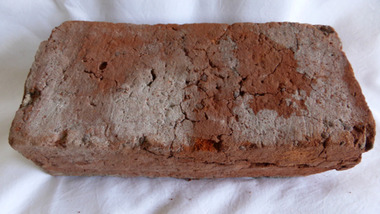
... rush of the 1850’s saw this process mechanised. A kitchen fireplace in the rear skillion included a large block of Merri Creek Mudstone, a combination of “tufa” and clay that was used in the Warrnambool District as an excellent substitute for fire bricks. ...The building at 94 Merri St is amongst the earliest buildings in Warrnambool. It was possibly constructed before 1854 and maybe as early as 1848. The original building consisted of four main rooms under a hip roof. The outer walls were masonry , apparently rubble The Heritage Council indcate that on the balance of probabilities this was the general store of Richard Osbourne and John Moffat Chisholm built in 1847-48.The building at 94 Merri Street had historical and architectural significance to the state of Victoria. It was a rare example of surviving, pre separation building with associated interest in its materials and components It is associated with Richard Osbourne who founded the Warrnambool Examiner(1851_1889) and the town’s first historian. Architecturally, the significance of the house lay in the hand -wrought timber framing. All the major timbers in this building had been hand sawn. The Gold rush of the 1850’s saw this process mechanised. A kitchen fireplace in the rear skillion included a large block of Merri Creek Mudstone, a combination of “tufa” and clay that was used in the Warrnambool District as an excellent substitute for fire bricks. The house was demolished in 2011 and items of significance were salvaged, this brick being one. While some bricks were imported, there is evidence that there were a number of brick burning businesses in operation around this time. However it is difficult to ascertain to which group this brick belongs. Red clay rectangular brick. Contains some small gravel like material, possibly ferrous buckshot, grey mortar remnants on side and diagonal crack along one side.warrnambool, 94 merri street, richard osbourne, john moffat chisholm, hand sawn timber, brick, building materials -
 Bendigo Historical Society Inc.
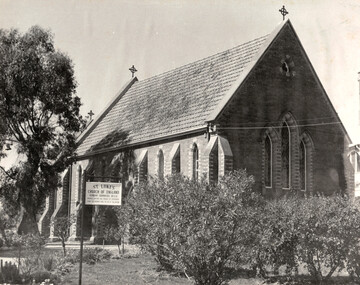
Document - National Trust Collection: Churches of Bendigo and Inglewood, Nov 7th 1965
... clay, white, satin-smooth and seemingly depthless. The men began tunnelling. Presently, the roof forming above them showered gold at their feet – the secret of Bendigo’s famous White Hills lay revealed.’ In the ‘wild rush...clay, white, satin-smooth and seemingly depthless. The men began tunnelling. Presently, the roof forming above them showered gold at their feet – the secret of Bendigo’s famous White Hills lay revealed.’ In the ‘wild rush ...St LUKES ANGLICAN CHURCH BENDIGO In 1852, a party of Cornish miners, refusing to give up and having dug, by hand, down nearly 70 feet ‘got their reward. Suddenly, their picks sank into soft pipe-clay, white, satin-smooth and seemingly depthless. The men began tunnelling. Presently, the roof forming above them showered gold at their feet – the secret of Bendigo’s famous White Hills lay revealed.’ In the ‘wild rush’ that followed, when ‘the White Hills yielded enormously and some pretty piles were made’, a young Anglican priest, John Herbert Gregory, held the first Anglican church service at White Hills in 1853. The Hamlet of White Hills was surveyed and mapped in 1854 and, by 1863, St Luke’s Church in White Hills was opened on ‘an elevated site’ in a generously sized ‘church reserve’. St AUGUSTINE'S CHURCH MYERS FLAT Early diggers to this area were men named Myers and Nicholls, hence the name - Myers Flat and Myers Creek. 1857 saw the discovery of gold in the area and in less than one month 1000 ounces of gold per week resulted. The number of diggers in the Myers Creek or Burnt Gully totalled 4000 to 5000. Myers Creek consisted of several shops and buildings, two hotels, a race course and a lock-up built of logs. On November 6th, 1864, the opening of the new church of St Augustine' took place. The first mass was celebrated by the Reverand Dean Hayes, of St Killian's Sandhurst. The church of gothic design was built by a local contractor, and with bricks made from local clay. The church also has a fire place and is widely known as "The church with the Chimney. For many years it was also a Catholic school. St AUGUSTINE'S CHURCH INGLEWOOD The church features an Early English design from 1864 and Decorated Gothic extensions from 1884.Notable elements include the sanctuary with the Catto Memorial window and interior cusped arcading of the wainscot. Architectural attribution is given to Vahland and Getzschmann for one or both sections. St JOHNS CHURCH (PRESBYTERIAN) BENDIGO The church's architect was W C Vahland VIA, and the builder was N Langstaff. It was built in April 1890, and opened in Feb 1891. The tender price was 2,481 pounds. The church style was gothic, built by the Congregational Church to replace an earlier building built in 1858. St Johns bought the church in 1949 and made additions in 1951. THE SACRED HEART CATHEDRAL BENDIGO Originally designed in 1895 by Reed, Smart and Tappin of Melbourne, the first stage opened in September 1901; the second stage began in January 1954 and was expected to finish in late 1976. Skilled stonemasons were brought from overseas for the completion. The Exterior built from Geelong sandstone and Harcourt granite, matching the original materials for color consistency. The cathedral is designed in the early English Gothic style. It Features a tower and spire weighing several thousand tons, with the spire rising 282 ft. from the floor and topped by a 10 ft. cross.Interior. The original stained glass window, made in Birmingham, England, is above the main entrance on the west side. Marble for the floor was imported from Vincenzo and Via Reggio, Italy; Sicilian Pearl marble is used in the four chapels. Ceilings in the chapels feature Western red cedar and yellow pine timbers.The transept includes Australian blackwood paneling and 12 carved shields representing the apostles. The internal height from floor to ceiling is 80 ft.Artistic Elements. Two large tapestries, specially designed and crafted by Mrs. Carrington, hang in the sanctuary as a symbolic link to Bendigo. ST PAULS BENDIGO The nave was built in 1868 and the tower in 1873. The nave is notable for unusual ceiling with metal and timber overlay members. The tower notable for early brick and bold Gothic influenced design. The church was opened on 12th Nov 1868 and a new chancel sanctuary and Transepts were added on 22 Oct 1927. The architect was Robert A Love. CONGREGATIONAL CHURCHES IN BENDIGO Three main Congregational church buildings existed in Bendigo: at the corner of Forest and Mackenzie Streets (the original site), on Quarry Hill (corner of Russell and Gladstone Streets), and on Calvin Street (later the Lutheran Church). The Calvin Street church was named in honor of John Calvin, a notable figure who lived in the area. In June 1858, 1.5 acres of land were purchased at the Forest and Mackenzie Streets corner for £1200.The first church was built on this site in November 1858 and later enlarged in May 1867 to seat 500 people. A prefabricated parsonage stood nearby until about 1920, serving as a caretaker's cottage for several years. In 1890, foundation stones for a new church designed by W.C. Vahland were laid, featuring a tall tower and two gable crossings (reduced from three to save costs). The new church opened on February 26, 1890, costing £2483. The contractor was N. Longstaff. Some architectural elements, such as the chancel, were added later when St. John's Presbyterian took over the building. Congregational attendance declined, leading to the purchase and alteration of a brick school complex in Olinda Street to serve as their headquarters.The timber church on Russell Street and the Calvin Street property were sold.The valuable Forest Street property was eventually sold to a London sect and later became an investment for the Methodist Church.Historical information on seven denominational churches in Bendigo and Inglewood. This item contains the following items: 3084.36a Black and white photo of St Lukes Bendigo Church of England, Napier Street, White Hills. 3084.36b St Augustine's Church Myers Flat 100 years newsletter 1965. The newsletter's purpose is for a Commemorative afternoon mass in memory of the pioneers of Myers Flat and district.Celebration of the 101st anniversary of the first mass at St. Augustine's Church; on Sunday, November 7th, 1965, at 2:00 PM.Location: St. Augustine's Church, Myers Flat. The invitation is extended to the recipient and their friends. This invitation serves both as a memorial and a community gathering to honour local history. Also included is some hand-written history notes of the church - See the notes in the Historical Section above. 3084.36c This document is a formal letter dated 9th November 1970 from the National Trust of Australia (Victoria) to Bishop Bernard Stewart. St. Augustine's Church in Bendigo has been awarded a "D" classification by the National Trust's expert committee. The church is now officially "recorded" by the National Trust. The letter is addressed to Bishop Bernard Stewart, with copies sent to Father Louis McDonnell (Eaglehawk), A. J. Watts (Town Clerk, Bendigo), and Mrs. R. R. Adams (Secretary, Central Victorian Branch). 3084.36d This document is a formal letter from the National Trust of Australia (Victoria) to Miss L. Doble, Registrar of the Bendigo Church of England Diocese, dated March 20, 1973. St. Augustine's Church of England in Inglewood has been officially placed on the National Trust's Classified List. This classification recognizes the church as essential to Australia's heritage and emphasizes its preservation. The church features an Early English design from 1864 and Decorated Gothic extensions from 1884.Notable elements include the sanctuary with the Catto Memorial window and interior cusped arcading of the wainscot. Architectural attribution is given to Vahland and Getzschmann for one or both sections. The church is about to celebrate the centenary of its consecration on May 13, with the Archbishop expected to attend. 3084.36e This document is a survey form used by the National Trust of Australia (Victoria) to collect detailed information about St Augustine's Church at Myers Flat. It records the original purpose, present use, and current name of the building.Requires a precise address or location description for site visits.It captures special features or points of interest not visible in photographs. It documents the present owner and occupant, including their addresses, the date of initial construction and supporting evidence for that date. 3084.36f Handwritten letter re history of St Johns Presbyterian Church Bendigo, 13th October 1980 - author unknown 3084.36g Typed notes - "Interesting information on the Sacred Heart Cathedral Bendigo", and hand-written notes on St Pauls Cathedral. 3084.36h Two pages of typed notes. Three main Congregational church buildings existed in Bendigo: at the corner of Forest and Mackenzie Streets (the original site), on Quarry Hill (corner of Russell and Gladstone Streets), and on Calvin Street (later the Lutheran Church). 3084.36i Hand-written notes on St Pauls Cathedral.history, church, national trust bendigo collection, sacred heart cathedral bendigo, st augustine's church myers flat, st pauls church bendigo, st johns presbyterian church bendigo, congregational church bendigo
