
Showing 5 items matching "ruskin body"
-
 Melbourne Tram Museum
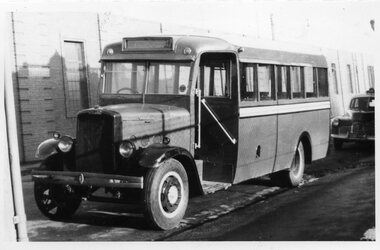
Photograph - MMTB Bus 33 Photo, Melbourne & Metropolitan Tramways Board (MMTB), MMTB Bus 33 after sale Leyland Cub Chassis with Ruskin body at 8 Aug 1954, 1930
... MMTB Bus 33 after sale Leyland Cub Chassis with Ruskin body at 8 Aug 1954......Ruskin body...Yields information about an early MMTB Bus tramways MMTB Buses Leyland Ruskin body Photo of MMTB Bus 33 at unknown location. ...The MMTB operated buses as well as trams, This was one of the early ones.Yields information about an early MMTB BusPhoto of MMTB Bus 33 at unknown location.tramways, mmtb buses, leyland, ruskin body -
 Melbourne Tram Museum
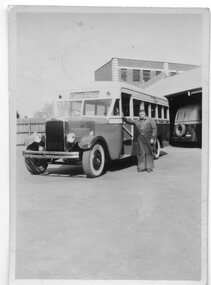
Photograph - Black and White photograph, E Melo, 1938
... The same model bus but with Ruskin's body is behind it - note the spare wheel on the back....The same model bus but with Ruskin's body is behind it - note the spare wheel on the back. ...Black and white photograph of MMTB Leyland Cub Bus No. 47 at Footscray Depot with a mechanic standing alongside. Has the destination of Deer Park. Photo date 1938. Possibly has the photographers name on the rear - E. Melo?? Rod Atkins in an email dated 5/4/2021 notes that the Leyland "Cub" with Preston Workshops body still in original condition and livery. Note the white wall tyres. The same model bus but with Ruskin's body is behind it - note the spare wheel on the back.On rear in ink "Footscray 1938 - No. 47 - E Melo"trams, tramways, buses, leyland, footscray depot, deer park, leyland cub, mmtb buses, bus 47 -
 Warrnambool and District Historical Society Inc.
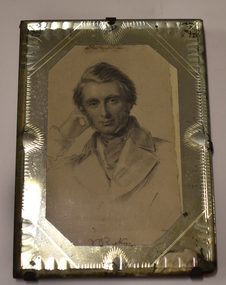
Artwork, other - Framed copy of engraving, John Ruskin, late 19th century
... This is a copy of a steel plate engraving, a black and white sketch of the head and upper body of John Ruskin. It is enclosed in a cut glass frame with a red cardboard backing attached by metal clips. ...Ruskin This is a copy of a steel plate engraving, a black and white sketch of the head and upper body of John Ruskin. ...This framed copy of a sketch of John Ruskin comes from the original steel plate engraving dating from about 1845. John Ruskin (1819-1900) was a notable English writer, philosopher, art critic and polymath in the Victorian era. He was the first Professor of Fine Art at Oxford University and was a prolific writer interested in the connection between nature, art and society, anticipating the more modern interest in environmental and sustainability issues. This framed item is from the collection of the old Warrnambool Museum which was first established in 1871 by the Warrnambool Mechanics' Institute under the curatorship of a local policeman, Joseph Archibald. This first museum faded away but was revived in 1883 by Joseph Archibald in his retirement years. The Museum continued as part of the Mechanics' Institute until 1963 as an important and much-admired institution. Most of the collection was lost over the years but some items remain, housed at the Warrnambool Art Gallery, Flagstaff Hill Maritime Museum and the Warrnambool and District Historical Society, with the John Ruskin item being part of the latter group's collection.This item is of considerable interest, firstly because it comes from the collection of the old Warrnambool Museum and secondly because it shows the local interest in the 19th century of the notable English writer and philosopher, John Ruskin. This is a copy of a steel plate engraving, a black and white sketch of the head and upper body of John Ruskin. It is enclosed in a cut glass frame with a red cardboard backing attached by metal clips. A section of the backing is torn off and there is damage to the bottom part of the glass frame.J. Ruskinold warrnambool museum, warrnambool art gallery, flagstaff hill maritime museum, warrnambool & district historical society, joseph archibald, john ruskin portrait -
 Expression Australia
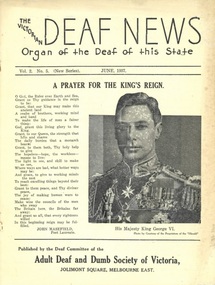
Newsletter, The Victorian Deaf News June 1937
... Published by the Deaf Committee of the Adult Deaf and Dumb Society of Victoria 'The Victorian Deaf News' Newsletter is a significant publication as an historical record giving and insight into the people, activities and events of the Deaf Community in Victoria. e. r. noble, w. a. waterstrom, w.a. paterson, r. h. luff, ed johnson, h. mckenzie, reiffel, mcdonald, hunt, j. stewart, maurice mark, e. russell, r. cornell, g. b. mortimer, g. oakley, colin johns, mrs m. thompson, w. nancarrow, g. mahoney, ambrose moloney, collins, stokes, sturcke, kitty burke, johns, stewart, o. quinton, ruskin's motor body works, underwood, e. johnson, taylor's timber mills, jennings, williams, eric johnston, gibson, hately, jim walters, roy windridge, ferguson, mona stevens, gersch, doney, moore, w. durstan, northey, allen, mrs f. johnson, iris wouda, g. mortimer, willie hately, torr, robb, cecil and vernon griffiths, c. lyfield, w. utber, w. chapman, d. jones, howe, smith sandon, f. owen, hood, j. gibson, allan salmon, j. stewart, r. bogan, nancy newton, brenda jean ashby, donald johnson, burnie higgie, ruby may mcdonald, charles ernest wesley hunt, fred lynas, margaret gibson, walter bladier, winifred gladman, mary thomson Vol. 2 No. 5 (New Series) June 1937; Size 24.5cmHx19cmW; 16 pages The Victorian Deaf News June 1937 Newsletter ...Published by the Deaf Committee of the Adult Deaf and Dumb Society of Victoria'The Victorian Deaf News' Newsletter is a significant publication as an historical record giving and insight into the people, activities and events of the Deaf Community in Victoria.Vol. 2 No. 5 (New Series) June 1937; Size 24.5cmHx19cmW; 16 pagese. r. noble, w. a. waterstrom, w.a. paterson, r. h. luff, ed johnson, h. mckenzie, reiffel, mcdonald, hunt, j. stewart, maurice mark, e. russell, r. cornell, g. b. mortimer, g. oakley, colin johns, mrs m. thompson, w. nancarrow, g. mahoney, ambrose moloney, collins, stokes, sturcke, kitty burke, johns, stewart, o. quinton, ruskin's motor body works, underwood, e. johnson, taylor's timber mills, jennings, williams, eric johnston, gibson, hately, jim walters, roy windridge, ferguson, mona stevens, gersch, doney, moore, w. durstan, northey, allen, mrs f. johnson, iris wouda, g. mortimer, willie hately, torr, robb, cecil and vernon griffiths, c. lyfield, w. utber, w. chapman, d. jones, howe, smith sandon, f. owen, hood, j. gibson, allan salmon, j. stewart, r. bogan, nancy newton, brenda jean ashby, donald johnson, burnie higgie, ruby may mcdonald, charles ernest wesley hunt, fred lynas, margaret gibson, walter bladier, winifred gladman, mary thomson -
 Mrs Aeneas Gunn Memorial Library
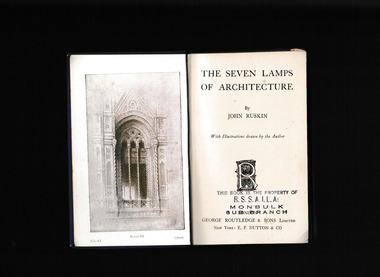
Book, George Routledge and Sons, The seven lamps of architecture
... Ruskin saw Gothic as the noblest style of architecture, but he noted that over time medieval architecture had lost the power to resist innovationt the time it was published in 1859, John Stuart Mill's On Liberty was a radical and controversial work; it argued for the right of individuals to possess freedom from the state in moral and economic matters. Mill declares that ""Over himself, over his own body ...According to Ruskin, the leading principles of architecture are the “lamps” of Sacrifice, Truth, Power, Beauty, Life, Memory, and Obedience. Ruskin saw Gothic as the noblest style of architecture, but he noted that over time medieval architecture had lost the power to resist innovationt the time it was published in 1859, John Stuart Mill's On Liberty was a radical and controversial work; it argued for the right of individuals to possess freedom from the state in moral and economic matters. Mill declares that ""Over himself, over his own body and mind, the individual is sovereign"", contrasting this with the ""tyranny of the majority."" He states that an individual can do anything they like as long as it doesn't harm another.Index, ill, p.236.non-fictionAccording to Ruskin, the leading principles of architecture are the “lamps” of Sacrifice, Truth, Power, Beauty, Life, Memory, and Obedience. Ruskin saw Gothic as the noblest style of architecture, but he noted that over time medieval architecture had lost the power to resist innovationt the time it was published in 1859, John Stuart Mill's On Liberty was a radical and controversial work; it argued for the right of individuals to possess freedom from the state in moral and economic matters. Mill declares that ""Over himself, over his own body and mind, the individual is sovereign"", contrasting this with the ""tyranny of the majority."" He states that an individual can do anything they like as long as it doesn't harm another. architecture, john ruskin 1819-1900
