
Showing 186 items matching "ruyton girls' school -- history."
-
 Kew Historical Society Inc
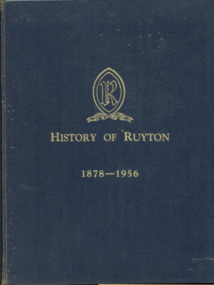
Book, Hilda Daniell, History of Ruyton 1878-1956
... ...Ruyton Girls' School -- History....Ruyton girls' school History of Ruyton 1878-1956, by Hilda Y. ...History of Ruyton 1878-1956, by Hilda Y. Daniell, O.B.E., M.A. Foreword by Robert G. Menzies. With a preface by the author (who was former Principal of the school). Illustrated with b&w photographs. Sections on the school prayer, early Kew, the foundation of Ruyton, members of staff, the debating club, school library & clubs, the house system, sport, the Ruyton fire, Ruyton jubilees, music staff, the Queen's visit, the opening of the Hilda Daniell Wing, the tuck shop, school songs, special prizes, dux of Ruyton, captains of the school, etc.Bound in publisher's original dark blue buckram cloth with bright gilt lettering & design to front board, spine unlettered. Melbourne : Ramsay, Ware Publishing, [1957?] .136 p. : ill., ports. ; 26 cm. 136ppnon-fictionHistory of Ruyton 1878-1956, by Hilda Y. Daniell, O.B.E., M.A. Foreword by Robert G. Menzies. With a preface by the author (who was former Principal of the school). Illustrated with b&w photographs. Sections on the school prayer, early Kew, the foundation of Ruyton, members of staff, the debating club, school library & clubs, the house system, sport, the Ruyton fire, Ruyton jubilees, music staff, the Queen's visit, the opening of the Hilda Daniell Wing, the tuck shop, school songs, special prizes, dux of Ruyton, captains of the school, etc. hilda daniell, history -- education -- schools -- kew (vic), private schools -- victoria -- kew -- history., ruyton girls' school -- history., ruyton girls' school -
 Kew Historical Society Inc
Book, Hilda Daniell, History of Ruyton 1878-1956
... ...Ruyton Girls' School -- History....Ruyton girls' school History of Ruyton 1878-1956, by Hilda Y. ...History of Ruyton 1878-1956, by Hilda Y. Daniell, O.B.E., M.A. Foreword by Robert G. Menzies. With a preface by the author (who was former Principal of the school). Illustrated with b&w photographs. Sections on the school prayer, early Kew, the foundation of Ruyton, members of staff, the debating club, school library & clubs, the house system, sport, the Ruyton fire, Ruyton jubilees, music staff, the Queen's visit, the opening of the Hilda Daniell Wing, the tuck shop, school songs, special prizes, dux of Ruyton, captains of the school, etc.Bound in publisher's original dark blue buckram cloth with bright gilt lettering & design to front board, spine unlettered. Melbourne : Ramsay, Ware Publishing, [1957?] .136 p. : ill., ports. ; 26 cm. 136ppnon-fictionHistory of Ruyton 1878-1956, by Hilda Y. Daniell, O.B.E., M.A. Foreword by Robert G. Menzies. With a preface by the author (who was former Principal of the school). Illustrated with b&w photographs. Sections on the school prayer, early Kew, the foundation of Ruyton, members of staff, the debating club, school library & clubs, the house system, sport, the Ruyton fire, Ruyton jubilees, music staff, the Queen's visit, the opening of the Hilda Daniell Wing, the tuck shop, school songs, special prizes, dux of Ruyton, captains of the school, etc. hilda daniell, history -- education -- schools -- kew (vic), private schools -- victoria -- kew -- history., ruyton girls' school -- history., ruyton girls' school -
 Ruyton Girls' School
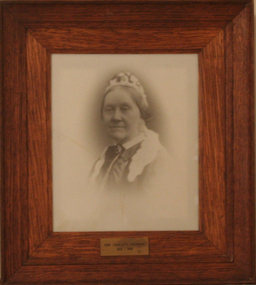
Photograph - Photographic Portrait, Mrs Charlotte Anderson
... Ruyton Girls' School, Kew. Mrs Anderson operated Ruyton initially in her own home of 63 Bulleen Road, Kew (now 63 High Street South). According to Ruyton histories...Ruyton Girls' School, Kew. Mrs Anderson operated Ruyton initially in her own home of 63 Bulleen Road, Kew (now 63 High Street South). According to Ruyton histories ...Mrs Charlotte Anderson was born Charlotte Eliza Alsop in England in 1838 and arrived in Australia in 1848. She married lawyer James Anderson in 1864, and in the year of his death in 1878 she became the founding owner-Principal of Ruyton Girls' School, Kew. Mrs Anderson operated Ruyton initially in her own home of 63 Bulleen Road, Kew (now 63 High Street South). According to Ruyton histories, Mrs Anderson is said to have begun the school with her own two sons, four daughters and some of her Alsop nieces and nephews who resided in Kew. Around the time of the addition of Maud King, the first student outside the family, the school changed to a 'Ladies College', and the boys were sent elsewhere for their education. By late 1881 Mrs Anderson began using the name 'Ruyton' for the school, in honour of a connection to Ruyton-XI-Towns, Shropshire, England where her great-grandfather had been vicar and where she was baptised. In 1882 Mrs Anderson moved the School to Edgecomb in Studley Park Road from 1882-1888. The larger premises enabled her to begin accepting boarding students from 1882. She retired due to ill health and sold the school to her friend Miss Eliza Bromby. Mrs Anderson lived at 'Bongamero', in the King Valley, Victoria until her death in 1906. She is buried in Boroondara Cemetery. One of Ruyton's four Houses, Anderson, is named for Charlotte Anderson. Artwork AC/0099 is a framed reproduction photograph of an original portrait of Mrs Anderson, c.1900-1906. The location and date of the original photograph is unknown, but may be held among Ruyton papers at the State Library of Victoria (MS 12079). The reproduction was probably created to be part of the gallery of Principals and significant people for the Conference/Boardroom, Henty House.A framed, black & white reproduction of a photographic portrait. The portrait shows the head and shoulders of a middle aged woman wearing Victorian-era clothing including a dark ribbon tied around her collar. She wears a lace cap on her head, and the cap's tail is draped around her shoulders. The woman's body is partially turned away from the camera, while her face is turned toward the camera. Plaque on frame: "Mrs Charlotte Anderson/ 1878-1888"charlotte anderson, ruyton, ruyton girls' school, kew (vic), bulleen road, high street south, studley park road, edgecomb, woman, school, teacher, principal, anderson, reproduction, 1990s -
 Ruyton Girls' School
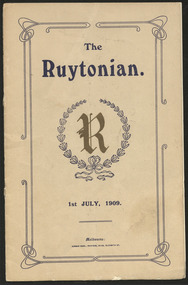
Magazine, Ruyton Girls' School, The Ruytonian, 1909
... girls' school in Victoria, Australia. Ruyton was founded in 1878 in the Bulleen Road, Kew, home of newly widowed Mrs Charlotte Anderson (now High Street South). Due to the age of the record dating back to 1909, we can infer it is one of the few remaining complete, intact and original examples of The Ruytonian from this period. Therefore, it can be considered an outstanding representation of its type, and is a reference example for research in early Victorian school history ...In July 1909, a modest 12-page booklet was put together by members of the fledgling Old Ruytonians Association (ORA) and distributed to the Ruyton Girls' School community. It was one of their first projects, and their aim was to nurture continuing interest in the School among former and current students. They named it "The Ruytonian." At first, The Ruytonian was produced twice yearly, and always bore a plain cover with a simple name banner. Initially, it was the work of volunteer editors from the ORA, but in 1913 they handed the publication over to the first student editors, Esther Gibson and Lucy Tickell. Since that time, the style and content of The Ruytonian has continuously evolved. The biggest shifts occurred in 1942 when it transitioned to a yearly publication, and in 1969 when it moved to a larger A4 format with a cover image specifically selected for that year.The record has strong historic significance as it pertains to the fourth oldest girls' school in Victoria, Australia. Ruyton was founded in 1878 in the Bulleen Road, Kew, home of newly widowed Mrs Charlotte Anderson (now High Street South). Due to the age of the record dating back to 1909, we can infer it is one of the few remaining complete, intact and original examples of The Ruytonian from this period. Therefore, it can be considered an outstanding representation of its type, and is a reference example for research in early Victorian school history. The record's significance is further enhanced by its exceptionally well-documented provenance, having remained the property of Ruyton Girls' School since its production.Colour publication printed on papyrus coloured paper. 12 pages.Front Cover: The / Ruytonian. / 1st JULY, 1909. / Melbourne: / NORMAN BROS., PRINTERS, 52-58 ELIZABETH ST. /ruyton girls' school, the ruytonian, kew, old ruytonians association, yearbook, school, publication, girls school, junior school, senior school, journal, students, teacher -
 Ruyton Girls' School
Magazine, Ruyton Girls' School, The Ruytonian, 1910
... girls' school in Victoria, Australia. Ruyton was founded in 1878 in the Bulleen Road, Kew, home of newly widowed Mrs Charlotte Anderson (now High Street South). Due to the age of the record dating back to 1910, we can infer it is one of the few remaining complete, intact and original examples of The Ruytonian from this period. Therefore, it can be considered an outstanding representation of its type, and is a reference example for research in early Victorian school history ...In July 1909, a modest 12-page booklet was put together by members of the fledgling Old Ruytonians Association (ORA) and distributed to the Ruyton Girls' School community. It was one of their first projects, and their aim was to nurture continuing interest in the School among former and current students. They named it "The Ruytonian." At first, The Ruytonian was produced twice yearly, and always bore a plain cover with a simple name banner. Initially, it was the work of volunteer editors from the ORA, but in 1913 they handed the publication over to the first student editors, Esther Gibson and Lucy Tickell. Since that time, the style and content of The Ruytonian has continuously evolved. The biggest shifts occurred in 1942 when it transitioned to a yearly publication, and in 1969 when it moved to a larger A4 format with a cover image specifically selected for that year.The record has strong historic significance as it pertains to the fourth oldest girls' school in Victoria, Australia. Ruyton was founded in 1878 in the Bulleen Road, Kew, home of newly widowed Mrs Charlotte Anderson (now High Street South). Due to the age of the record dating back to 1910, we can infer it is one of the few remaining complete, intact and original examples of The Ruytonian from this period. Therefore, it can be considered an outstanding representation of its type, and is a reference example for research in early Victorian school history. The record's significance is further enhanced by its exceptionally well-documented provenance, having remained the property of Ruyton Girls' School since its production.Colour publication printed on papyrus coloured paper. 13 pages.Front Cover: The / Ruytonian. / FEBRUARY, 1910. / Melbourne: / NORMAN BROS., PRINTERS, 52-58 ELIZABETH ST. /ruyton girls' school, the ruytonian, kew, old ruytonians association, yearbook, school, publication, girls school, junior school, senior school, journal, students, teacher -
 Ruyton Girls' School
Magazine, Ruyton Girls' School, The Ruytonian, 1910
... girls' school in Victoria, Australia. Ruyton was founded in 1878 in the Bulleen Road, Kew, home of newly widowed Mrs Charlotte Anderson (now High Street South). Due to the age of the record dating back to 1910, we can infer it is one of the few remaining complete, intact and original examples of The Ruytonian from this period. Therefore, it can be considered an outstanding representation of its type, and is a reference example for research in early Victorian school history ...In July 1909, a modest 12-page booklet was put together by members of the fledgling Old Ruytonians Association (ORA) and distributed to the Ruyton Girls' School community. It was one of their first projects, and their aim was to nurture continuing interest in the School among former and current students. They named it "The Ruytonian." At first, The Ruytonian was produced twice yearly, and always bore a plain cover with a simple name banner. Initially, it was the work of volunteer editors from the ORA, but in 1913 they handed the publication over to the first student editors, Esther Gibson and Lucy Tickell. Since that time, the style and content of The Ruytonian has continuously evolved. The biggest shifts occurred in 1942 when it transitioned to a yearly publication, and in 1969 when it moved to a larger A4 format with a cover image specifically selected for that year.The record has strong historic significance as it pertains to the fourth oldest girls' school in Victoria, Australia. Ruyton was founded in 1878 in the Bulleen Road, Kew, home of newly widowed Mrs Charlotte Anderson (now High Street South). Due to the age of the record dating back to 1910, we can infer it is one of the few remaining complete, intact and original examples of The Ruytonian from this period. Therefore, it can be considered an outstanding representation of its type, and is a reference example for research in early Victorian school history. The record's significance is further enhanced by its exceptionally well-documented provenance, having remained the property of Ruyton Girls' School since its production.Colour publication printed on papyrus coloured paper. 19 pages.Front Cover: The / Ruytonian. / MIDWINTER, 1910. / Melbourne: / NORMAN BROS., PRINTERS, 52-58 ELIZABETH ST. /ruyton girls' school, the ruytonian, kew, old ruytonians association, yearbook, school, publication, girls school, junior school, senior school, journal, students, teacher -
 Ruyton Girls' School
Magazine, Ruyton Girls' School, The Ruytonian, 1911
... girls' school in Victoria, Australia. Ruyton was founded in 1878 in the Bulleen Road, Kew, home of newly widowed Mrs Charlotte Anderson (now High Street South). Due to the age of the record dating back to 1911, we can infer it is one of the few remaining complete, intact and original examples of The Ruytonian from this period. Therefore, it can be considered an outstanding representation of its type, and is a reference example for research in early Victorian school history ...In July 1909, a modest 12-page booklet was put together by members of the fledgling Old Ruytonians Association (ORA) and distributed to the Ruyton Girls' School community. It was one of their first projects, and their aim was to nurture continuing interest in the School among former and current students. They named it "The Ruytonian." At first, The Ruytonian was produced twice yearly, and always bore a plain cover with a simple name banner. Initially, it was the work of volunteer editors from the ORA, but in 1913 they handed the publication over to the first student editors, Esther Gibson and Lucy Tickell. Since that time, the style and content of The Ruytonian has continuously evolved. The biggest shifts occurred in 1942 when it transitioned to a yearly publication, and in 1969 when it moved to a larger A4 format with a cover image specifically selected for that year.The record has strong historic significance as it pertains to the fourth oldest girls' school in Victoria, Australia. Ruyton was founded in 1878 in the Bulleen Road, Kew, home of newly widowed Mrs Charlotte Anderson (now High Street South). Due to the age of the record dating back to 1911, we can infer it is one of the few remaining complete, intact and original examples of The Ruytonian from this period. Therefore, it can be considered an outstanding representation of its type, and is a reference example for research in early Victorian school history. The record's significance is further enhanced by its exceptionally well-documented provenance, having remained the property of Ruyton Girls' School since its production.Colour publication printed on papyrus coloured paper. 17 pages.Front Cover: The / Ruytonian. / APRIL, 1911. / Melbourne: / NORMAN BROS., PRINTERS, 52-58 ELIZABETH ST. /ruyton girls' school, the ruytonian, kew, old ruytonians association, yearbook, school, publication, girls school, junior school, senior school, journal, students, teacher -
 Ruyton Girls' School
Magazine, Ruyton Girls' School, The Ruytonian, 1912
... girls' school in Victoria, Australia. Ruyton was founded in 1878 in the Bulleen Road, Kew, home of newly widowed Mrs Charlotte Anderson (now High Street South). Due to the age of the record dating back to 1912, we can infer it is one of the few remaining complete, intact and original examples of The Ruytonian from this period. Therefore, it can be considered an outstanding representation of its type, and is a reference example for research in early Victorian school history ...In July 1909, a modest 12-page booklet was put together by members of the fledgling Old Ruytonians Association (ORA) and distributed to the Ruyton Girls' School community. It was one of their first projects, and their aim was to nurture continuing interest in the School among former and current students. They named it "The Ruytonian." At first, The Ruytonian was produced twice yearly, and always bore a plain cover with a simple name banner. Initially, it was the work of volunteer editors from the ORA, but in 1913 they handed the publication over to the first student editors, Esther Gibson and Lucy Tickell. Since that time, the style and content of The Ruytonian has continuously evolved. The biggest shifts occurred in 1942 when it transitioned to a yearly publication, and in 1969 when it moved to a larger A4 format with a cover image specifically selected for that year.The record has strong historic significance as it pertains to the fourth oldest girls' school in Victoria, Australia. Ruyton was founded in 1878 in the Bulleen Road, Kew, home of newly widowed Mrs Charlotte Anderson (now High Street South). Due to the age of the record dating back to 1912, we can infer it is one of the few remaining complete, intact and original examples of The Ruytonian from this period. Therefore, it can be considered an outstanding representation of its type, and is a reference example for research in early Victorian school history. The record's significance is further enhanced by its exceptionally well-documented provenance, having remained the property of Ruyton Girls' School since its production.Colour publication printed on papyrus coloured paper. 18 pages.Front Cover: E. Willshire / The / Ruytonian / APRIL, 1912. / Melbourne: / The Shipping Newspapers Ltd., 31 William Street. / 1912. /ruyton girls' school, the ruytonian, kew, old ruytonians association, yearbook, school, publication, girls school, junior school, senior school, journal, students, teacher -
 Ruyton Girls' School
Magazine, Ruyton Girls' School, The Ruytonian, 1912
... girls' school in Victoria, Australia. Ruyton was founded in 1878 in the Bulleen Road, Kew, home of newly widowed Mrs Charlotte Anderson (now High Street South). Due to the age of the record dating back to 1912, we can infer it is one of the few remaining complete, intact and original examples of The Ruytonian from this period. Therefore, it can be considered an outstanding representation of its type, and is a reference example for research in early Victorian school history ...In July 1909, a modest 12-page booklet was put together by members of the fledgling Old Ruytonians Association (ORA) and distributed to the Ruyton Girls' School community. It was one of their first projects, and their aim was to nurture continuing interest in the School among former and current students. They named it "The Ruytonian." At first, The Ruytonian was produced twice yearly, and always bore a plain cover with a simple name banner. Initially, it was the work of volunteer editors from the ORA, but in 1913 they handed the publication over to the first student editors, Esther Gibson and Lucy Tickell. Since that time, the style and content of The Ruytonian has continuously evolved. The biggest shifts occurred in 1942 when it transitioned to a yearly publication, and in 1969 when it moved to a larger A4 format with a cover image specifically selected for that year.The record has strong historic significance as it pertains to the fourth oldest girls' school in Victoria, Australia. Ruyton was founded in 1878 in the Bulleen Road, Kew, home of newly widowed Mrs Charlotte Anderson (now High Street South). Due to the age of the record dating back to 1912, we can infer it is one of the few remaining complete, intact and original examples of The Ruytonian from this period. Therefore, it can be considered an outstanding representation of its type, and is a reference example for research in early Victorian school history. The record's significance is further enhanced by its exceptionally well-documented provenance, having remained the property of Ruyton Girls' School since its production.Colour publication printed on papyrus coloured paper. 19 pages.Front Cover: The / Ruytonian / NOVEMBER, 1912. / Melbourne: / The Shipping Newspapers Ltd., 31 William Street. / 1912. /ruyton girls' school, the ruytonian, kew, old ruytonians association, yearbook, school, publication, girls school, junior school, senior school, journal, students, teacher -
 Ruyton Girls' School
Magazine, Ruyton Girls' School, The Ruytonian, 1913
... girls' school in Victoria, Australia. Ruyton was founded in 1878 in the Bulleen Road, Kew, home of newly widowed Mrs Charlotte Anderson (now High Street South). Due to the age of the record dating back to 1913, we can infer it is one of the few remaining complete, intact and original examples of The Ruytonian from this period. Therefore, it can be considered an outstanding representation of its type, and is a reference example for research in early Victorian school history ...In July 1909, a modest 12-page booklet was put together by members of the fledgling Old Ruytonians Association (ORA) and distributed to the Ruyton Girls' School community. It was one of their first projects, and their aim was to nurture continuing interest in the School among former and current students. They named it "The Ruytonian." At first, The Ruytonian was produced twice yearly, and always bore a plain cover with a simple name banner. Initially, it was the work of volunteer editors from the ORA, but in 1913 they handed the publication over to the first student editors, Esther Gibson and Lucy Tickell. Since that time, the style and content of The Ruytonian has continuously evolved. The biggest shifts occurred in 1942 when it transitioned to a yearly publication, and in 1969 when it moved to a larger A4 format with a cover image specifically selected for that year.The record has strong historic significance as it pertains to the fourth oldest girls' school in Victoria, Australia. Ruyton was founded in 1878 in the Bulleen Road, Kew, home of newly widowed Mrs Charlotte Anderson (now High Street South). Due to the age of the record dating back to 1913, we can infer it is one of the few remaining complete, intact and original examples of The Ruytonian from this period. Therefore, it can be considered an outstanding representation of its type, and is a reference example for research in early Victorian school history. The record's significance is further enhanced by its exceptionally well-documented provenance, having remained the property of Ruyton Girls' School since its production.Colour publication printed on papyrus coloured paper. 19 pages.Front Cover: E. Willshire / The / Ruytonian / APRIL, 1913. / Melbourne: / The Shipping Newspapers Ltd., 31 William Street. / 1913. /ruyton girls' school, the ruytonian, kew, old ruytonians association, yearbook, school, publication, girls school, junior school, senior school, journal, students, teacher -
 Ruyton Girls' School
Magazine, Ruyton Girls' School, The Ruytonian, 1913
... girls' school in Victoria, Australia. Ruyton was founded in 1878 in the Bulleen Road, Kew, home of newly widowed Mrs Charlotte Anderson (now High Street South). Due to the age of the record dating back to 1913, we can infer it is one of the few remaining complete, intact and original examples of The Ruytonian from this period. Therefore, it can be considered an outstanding representation of its type, and is a reference example for research in early Victorian school history ...In July 1909, a modest 12-page booklet was put together by members of the fledgling Old Ruytonians Association (ORA) and distributed to the Ruyton Girls' School community. It was one of their first projects, and their aim was to nurture continuing interest in the School among former and current students. They named it "The Ruytonian." At first, The Ruytonian was produced twice yearly, and always bore a plain cover with a simple name banner. Initially, it was the work of volunteer editors from the ORA, but in 1913 they handed the publication over to the first student editors, Esther Gibson and Lucy Tickell. Since that time, the style and content of The Ruytonian has continuously evolved. The biggest shifts occurred in 1942 when it transitioned to a yearly publication, and in 1969 when it moved to a larger A4 format with a cover image specifically selected for that year.The record has strong historic significance as it pertains to the fourth oldest girls' school in Victoria, Australia. Ruyton was founded in 1878 in the Bulleen Road, Kew, home of newly widowed Mrs Charlotte Anderson (now High Street South). Due to the age of the record dating back to 1913, we can infer it is one of the few remaining complete, intact and original examples of The Ruytonian from this period. Therefore, it can be considered an outstanding representation of its type, and is a reference example for research in early Victorian school history. The record's significance is further enhanced by its exceptionally well-documented provenance, having remained the property of Ruyton Girls' School since its production.Colour publication printed on papyrus coloured paper. 19 pages.Front Cover: The / Ruytonian / NOVEMBER, 1913. / Melbourne: / The Shipping Newspapers Ltd., 31 William Street. / 1913. /ruyton girls' school, the ruytonian, kew, old ruytonians association, yearbook, school, publication, girls school, junior school, senior school, journal, students, teacher -
 Ruyton Girls' School
Magazine, Ruyton Girls' School, The Ruytonian, 1914
... girls' school in Victoria, Australia. Ruyton was founded in 1878 in the Bulleen Road, Kew, home of newly widowed Mrs Charlotte Anderson (now High Street South). Due to the age of the record dating back to 1914, we can infer it is one of the few remaining complete, intact and original examples of The Ruytonian from this period. Therefore, it can be considered an outstanding representation of its type, and is a reference example for research in early Victorian school history ...In July 1909, a modest 12-page booklet was put together by members of the fledgling Old Ruytonians Association (ORA) and distributed to the Ruyton Girls' School community. It was one of their first projects, and their aim was to nurture continuing interest in the School among former and current students. They named it "The Ruytonian." At first, The Ruytonian was produced twice yearly, and always bore a plain cover with a simple name banner. Initially, it was the work of volunteer editors from the ORA, but in 1913 they handed the publication over to the first student editors, Esther Gibson and Lucy Tickell. Since that time, the style and content of The Ruytonian has continuously evolved. The biggest shifts occurred in 1942 when it transitioned to a yearly publication, and in 1969 when it moved to a larger A4 format with a cover image specifically selected for that year.The record has strong historic significance as it pertains to the fourth oldest girls' school in Victoria, Australia. Ruyton was founded in 1878 in the Bulleen Road, Kew, home of newly widowed Mrs Charlotte Anderson (now High Street South). Due to the age of the record dating back to 1914, we can infer it is one of the few remaining complete, intact and original examples of The Ruytonian from this period. Therefore, it can be considered an outstanding representation of its type, and is a reference example for research in early Victorian school history. The record's significance is further enhanced by its exceptionally well-documented provenance, having remained the property of Ruyton Girls' School since its production.Colour publication printed on papyrus coloured paper. 20 pages.Front Cover: Mavis Smith / The / Ruytonian / JUNE, 1914. / Melbourne: / The Shipping Newspapers Ltd., 31 William Street. / 1914. /ruyton girls' school, the ruytonian, kew, old ruytonians association, yearbook, school, publication, girls school, junior school, senior school, journal, students, teacher -
 Ruyton Girls' School
Magazine, Ruyton Girls' School, The Ruytonian, 1914
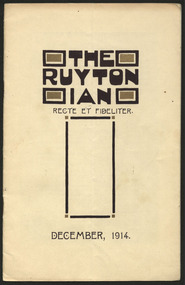
... girls' school in Victoria, Australia. Ruyton was founded in 1878 in the Bulleen Road, Kew, home of newly widowed Mrs Charlotte Anderson (now High Street South). Due to the age of the record dating back to 1914, we can infer it is one of the few remaining complete, intact and original examples of The Ruytonian from this period. Therefore, it can be considered an outstanding representation of its type, and is a reference example for research in early Victorian school history ...In July 1909, a modest 12-page booklet was put together by members of the fledgling Old Ruytonians Association (ORA) and distributed to the Ruyton Girls' School community. It was one of their first projects, and their aim was to nurture continuing interest in the School among former and current students. They named it "The Ruytonian." At first, The Ruytonian was produced twice yearly, and always bore a plain cover with a simple name banner. Initially, it was the work of volunteer editors from the ORA, but in 1913 they handed the publication over to the first student editors, Esther Gibson and Lucy Tickell. Since that time, the style and content of The Ruytonian has continuously evolved. The biggest shifts occurred in 1942 when it transitioned to a yearly publication, and in 1969 when it moved to a larger A4 format with a cover image specifically selected for that year.The record has strong historic significance as it pertains to the fourth oldest girls' school in Victoria, Australia. Ruyton was founded in 1878 in the Bulleen Road, Kew, home of newly widowed Mrs Charlotte Anderson (now High Street South). Due to the age of the record dating back to 1914, we can infer it is one of the few remaining complete, intact and original examples of The Ruytonian from this period. Therefore, it can be considered an outstanding representation of its type, and is a reference example for research in early Victorian school history. The record's significance is further enhanced by its exceptionally well-documented provenance, having remained the property of Ruyton Girls' School since its production.Colour publication printed on papyrus coloured paper. 26 pages.Front Cover: THE / RUYTON / IAN / RECTE ET FIDELITER. / DECEMBER, 1914. /ruyton girls' school, the ruytonian, kew, old ruytonians association, yearbook, school, publication, girls school, junior school, senior school, journal, students, teacher -
 Ruyton Girls' School
Magazine, Ruyton Girls' School, The Ruytonian, 1915
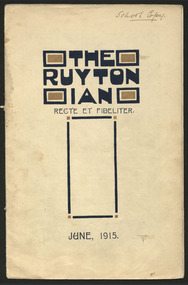
... girls' school in Victoria, Australia. Ruyton was founded in 1878 in the Bulleen Road, Kew, home of newly widowed Mrs Charlotte Anderson (now High Street South). Due to the age of the record dating back to 1915, we can infer it is one of the few remaining complete, intact and original examples of The Ruytonian from this period. Therefore, it can be considered an outstanding representation of its type, and is a reference example for research in early Victorian school history ...In July 1909, a modest 12-page booklet was put together by members of the fledgling Old Ruytonians Association (ORA) and distributed to the Ruyton Girls' School community. It was one of their first projects, and their aim was to nurture continuing interest in the School among former and current students. They named it "The Ruytonian." At first, The Ruytonian was produced twice yearly, and always bore a plain cover with a simple name banner. Initially, it was the work of volunteer editors from the ORA, but in 1913 they handed the publication over to the first student editors, Esther Gibson and Lucy Tickell. Since that time, the style and content of The Ruytonian has continuously evolved. The biggest shifts occurred in 1942 when it transitioned to a yearly publication, and in 1969 when it moved to a larger A4 format with a cover image specifically selected for that year.The record has strong historic significance as it pertains to the fourth oldest girls' school in Victoria, Australia. Ruyton was founded in 1878 in the Bulleen Road, Kew, home of newly widowed Mrs Charlotte Anderson (now High Street South). Due to the age of the record dating back to 1915, we can infer it is one of the few remaining complete, intact and original examples of The Ruytonian from this period. Therefore, it can be considered an outstanding representation of its type, and is a reference example for research in early Victorian school history. The date of the record also aligns with the First World War, and thus can offer interesting insight into how schools prepared for potential air raids, which was widely considered a threat at the time. The record's significance is further enhanced by its exceptionally well-documented provenance, having remained the property of Ruyton Girls' School since its production.Colour publication printed on papyrus coloured paper. 26 pages.Front Cover: School Copy. / THE / RUYTON / IAN / RECTE ET FIDELITER. / JUNE, 1915. /ruyton girls' school, the ruytonian, kew, old ruytonians association, yearbook, school, publication, girls school, junior school, senior school, journal, students, teacher, wwi, world war i -
 Ruyton Girls' School
Magazine, Ruyton Girls' School, The Ruytonian, 1915
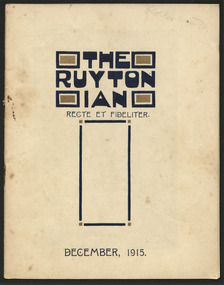
... girls' school in Victoria, Australia. Ruyton was founded in 1878 in the Bulleen Road, Kew, home of newly widowed Mrs Charlotte Anderson (now High Street South). Due to the age of the record dating back to 1915, we can infer it is one of the few remaining complete, intact and original examples of The Ruytonian from this period. Therefore, it can be considered an outstanding representation of its type, and is a reference example for research in early Victorian school history ...In July 1909, a modest 12-page booklet was put together by members of the fledgling Old Ruytonians Association (ORA) and distributed to the Ruyton Girls' School community. It was one of their first projects, and their aim was to nurture continuing interest in the School among former and current students. They named it "The Ruytonian." At first, The Ruytonian was produced twice yearly, and always bore a plain cover with a simple name banner. Initially, it was the work of volunteer editors from the ORA, but in 1913 they handed the publication over to the first student editors, Esther Gibson and Lucy Tickell. Since that time, the style and content of The Ruytonian has continuously evolved. The biggest shifts occurred in 1942 when it transitioned to a yearly publication, and in 1969 when it moved to a larger A4 format with a cover image specifically selected for that year.The record has strong historic significance as it pertains to the fourth oldest girls' school in Victoria, Australia. Ruyton was founded in 1878 in the Bulleen Road, Kew, home of newly widowed Mrs Charlotte Anderson (now High Street South). Due to the age of the record dating back to 1915, we can infer it is one of the few remaining complete, intact and original examples of The Ruytonian from this period. Therefore, it can be considered an outstanding representation of its type, and is a reference example for research in early Victorian school history. The date of the record also aligns with the First World War, and thus can offer interesting insight into how schools prepared for potential air raids, which was widely considered a threat at the time. The record's significance is further enhanced by its exceptionally well-documented provenance, having remained the property of Ruyton Girls' School since its production.Colour publication printed on papyrus coloured paper. 27 pages.Front Cover: Rothes Smith / THE / RUYTON / IAN / RECTE ET FIDELITER. / DECEMBER, 1915. /ruyton girls' school, the ruytonian, kew, old ruytonians association, yearbook, school, publication, girls school, junior school, senior school, journal, students, teacher, wwi, world war i -
 Ruyton Girls' School
Magazine, Ruyton Girls' School, The Ruytonian, 1916
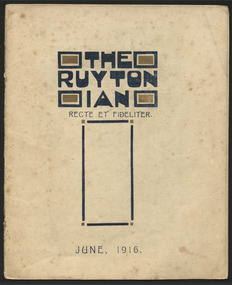
... girls' school in Victoria, Australia. Ruyton was founded in 1878 in the Bulleen Road, Kew, home of newly widowed Mrs Charlotte Anderson (now High Street South). Due to the age of the record dating back to 1916, we can infer it is one of the few remaining complete, intact and original examples of The Ruytonian from this period. Therefore, it can be considered an outstanding representation of its type, and is a reference example for research in early Victorian school history ...In July 1909, a modest 12-page booklet was put together by members of the fledgling Old Ruytonians Association (ORA) and distributed to the Ruyton Girls' School community. It was one of their first projects, and their aim was to nurture continuing interest in the School among former and current students. They named it "The Ruytonian." At first, The Ruytonian was produced twice yearly, and always bore a plain cover with a simple name banner. Initially, it was the work of volunteer editors from the ORA, but in 1913 they handed the publication over to the first student editors, Esther Gibson and Lucy Tickell. Since that time, the style and content of The Ruytonian has continuously evolved. The biggest shifts occurred in 1942 when it transitioned to a yearly publication, and in 1969 when it moved to a larger A4 format with a cover image specifically selected for that year.The record has strong historic significance as it pertains to the fourth oldest girls' school in Victoria, Australia. Ruyton was founded in 1878 in the Bulleen Road, Kew, home of newly widowed Mrs Charlotte Anderson (now High Street South). Due to the age of the record dating back to 1916, we can infer it is one of the few remaining complete, intact and original examples of The Ruytonian from this period. Therefore, it can be considered an outstanding representation of its type, and is a reference example for research in early Victorian school history. The date of the record also aligns with the First World War, and thus can offer interesting insight into how schools prepared for potential air raids, which was widely considered a threat at the time. The record's significance is further enhanced by its exceptionally well-documented provenance, having remained the property of Ruyton Girls' School since its production.Colour publication printed on papyrus coloured paper. 27 pages.Front Cover: THE / RUYTON / IAN / RECTE ET FIDELITER. / JUNE, 1916. /ruyton girls' school, the ruytonian, kew, old ruytonians association, yearbook, school, publication, girls school, junior school, senior school, journal, students, teacher, wwi, world war i -
 Ruyton Girls' School
Magazine, Ruyton Girls' School, The Ruytonian, 1917
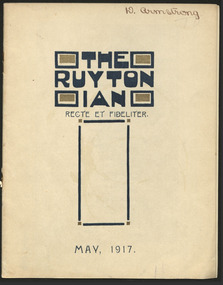
... girls' school in Victoria, Australia. Ruyton was founded in 1878 in the Bulleen Road, Kew, home of newly widowed Mrs Charlotte Anderson (now High Street South). Due to the age of the record dating back to 1917, we can infer it is one of the few remaining complete, intact and original examples of The Ruytonian from this period. Therefore, it can be considered an outstanding representation of its type, and is a reference example for research in early Victorian school history ...In July 1909, a modest 12-page booklet was put together by members of the fledgling Old Ruytonians Association (ORA) and distributed to the Ruyton Girls' School community. It was one of their first projects, and their aim was to nurture continuing interest in the School among former and current students. They named it "The Ruytonian." At first, The Ruytonian was produced twice yearly, and always bore a plain cover with a simple name banner. Initially, it was the work of volunteer editors from the ORA, but in 1913 they handed the publication over to the first student editors, Esther Gibson and Lucy Tickell. Since that time, the style and content of The Ruytonian has continuously evolved. The biggest shifts occurred in 1942 when it transitioned to a yearly publication, and in 1969 when it moved to a larger A4 format with a cover image specifically selected for that year.The record has strong historic significance as it pertains to the fourth oldest girls' school in Victoria, Australia. Ruyton was founded in 1878 in the Bulleen Road, Kew, home of newly widowed Mrs Charlotte Anderson (now High Street South). Due to the age of the record dating back to 1917, we can infer it is one of the few remaining complete, intact and original examples of The Ruytonian from this period. Therefore, it can be considered an outstanding representation of its type, and is a reference example for research in early Victorian school history. The date of the record also aligns with the First World War, and thus can offer interesting insight into how schools prepared for potential air raids, which was widely considered a threat at the time. The record's significance is further enhanced by its exceptionally well-documented provenance, having remained the property of Ruyton Girls' School since its production.Colour publication printed on papyrus coloured paper. 23 pages.Front Cover: W. Armstrong. / THE / RUYTON / IAN / RECTE ET FIDELITER. / DECEMBER, 1917. /ruyton girls' school, the ruytonian, kew, old ruytonians association, yearbook, school, publication, girls school, junior school, senior school, journal, students, teacher, wwi, world war i -
 Ruyton Girls' School
Magazine, Ruyton Girls' School, The Ruytonian, 1917
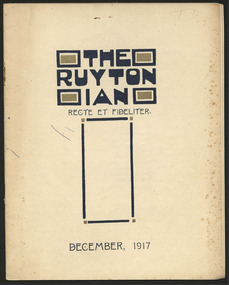
... girls' school in Victoria, Australia. Ruyton was founded in 1878 in the Bulleen Road, Kew, home of newly widowed Mrs Charlotte Anderson (now High Street South). Due to the age of the record dating back to 1917, we can infer it is one of the few remaining complete, intact and original examples of The Ruytonian from this period. Therefore, it can be considered an outstanding representation of its type, and is a reference example for research in early Victorian school history ...In July 1909, a modest 12-page booklet was put together by members of the fledgling Old Ruytonians Association (ORA) and distributed to the Ruyton Girls' School community. It was one of their first projects, and their aim was to nurture continuing interest in the School among former and current students. They named it "The Ruytonian." At first, The Ruytonian was produced twice yearly, and always bore a plain cover with a simple name banner. Initially, it was the work of volunteer editors from the ORA, but in 1913 they handed the publication over to the first student editors, Esther Gibson and Lucy Tickell. Since that time, the style and content of The Ruytonian has continuously evolved. The biggest shifts occurred in 1942 when it transitioned to a yearly publication, and in 1969 when it moved to a larger A4 format with a cover image specifically selected for that year.The record has strong historic significance as it pertains to the fourth oldest girls' school in Victoria, Australia. Ruyton was founded in 1878 in the Bulleen Road, Kew, home of newly widowed Mrs Charlotte Anderson (now High Street South). Due to the age of the record dating back to 1917, we can infer it is one of the few remaining complete, intact and original examples of The Ruytonian from this period. Therefore, it can be considered an outstanding representation of its type, and is a reference example for research in early Victorian school history. The date of the record also aligns with the First World War, and thus can offer interesting insight into how schools prepared for potential air raids, which was widely considered a threat at the time. The record's significance is further enhanced by its exceptionally well-documented provenance, having remained the property of Ruyton Girls' School since its production.Colour publication printed on papyrus coloured paper. 26 pages.Front Cover: TD / THE / RUYTON / IAN / RECTE ET FIDELITER. / DECEMBER, 1917 /ruyton girls' school, the ruytonian, kew, old ruytonians association, yearbook, school, publication, girls school, junior school, senior school, journal, students, teacher, wwi, world war i -
 Ruyton Girls' School
Magazine, Ruyton Girls' School, The Ruytonian, 1918
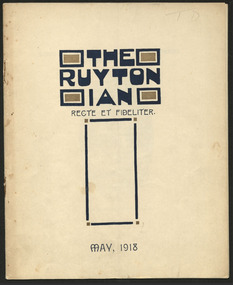
... girls' school in Victoria, Australia. Ruyton was founded in 1878 in the Bulleen Road, Kew, home of newly widowed Mrs Charlotte Anderson (now High Street South). Due to the age of the record dating back to 1918, we can infer it is one of the few remaining complete, intact and original examples of The Ruytonian from this period. Therefore, it can be considered an outstanding representation of its type, and is a reference example for research in early Victorian school history ...In July 1909, a modest 12-page booklet was put together by members of the fledgling Old Ruytonians Association (ORA) and distributed to the Ruyton Girls' School community. It was one of their first projects, and their aim was to nurture continuing interest in the School among former and current students. They named it "The Ruytonian." At first, The Ruytonian was produced twice yearly, and always bore a plain cover with a simple name banner. Initially, it was the work of volunteer editors from the ORA, but in 1913 they handed the publication over to the first student editors, Esther Gibson and Lucy Tickell. Since that time, the style and content of The Ruytonian has continuously evolved. The biggest shifts occurred in 1942 when it transitioned to a yearly publication, and in 1969 when it moved to a larger A4 format with a cover image specifically selected for that year.The record has strong historic significance as it pertains to the fourth oldest girls' school in Victoria, Australia. Ruyton was founded in 1878 in the Bulleen Road, Kew, home of newly widowed Mrs Charlotte Anderson (now High Street South). Due to the age of the record dating back to 1918, we can infer it is one of the few remaining complete, intact and original examples of The Ruytonian from this period. Therefore, it can be considered an outstanding representation of its type, and is a reference example for research in early Victorian school history. The date of the record also aligns with the First World War, and thus can offer interesting insight into how schools prepared for potential air raids, which was widely considered a threat at the time. The record's significance is further enhanced by its exceptionally well-documented provenance, having remained the property of Ruyton Girls' School since its production.Colour publication printed on papyrus coloured paper. 26 pages.Front Cover: TD / THE / RUYTON / IAN / RECTE ET FIDELITER. / MAY, 1918 /ruyton girls' school, the ruytonian, kew, old ruytonians association, yearbook, school, publication, girls school, junior school, senior school, journal, students, teacher, wwi, world war i -
 Ruyton Girls' School
Magazine, Ruyton Girls' School, The Ruytonian, 1918
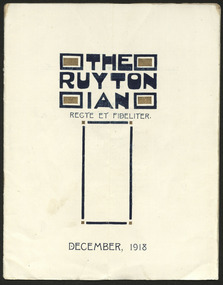
... girls' school in Victoria, Australia. Ruyton was founded in 1878 in the Bulleen Road, Kew, home of newly widowed Mrs Charlotte Anderson (now High Street South). Due to the age of the record dating back to 1918, we can infer it is one of the few remaining complete, intact and original examples of The Ruytonian from this period. Therefore, it can be considered an outstanding representation of its type, and is a reference example for research in early Victorian school history ...In July 1909, a modest 12-page booklet was put together by members of the fledgling Old Ruytonians Association (ORA) and distributed to the Ruyton Girls' School community. It was one of their first projects, and their aim was to nurture continuing interest in the School among former and current students. They named it "The Ruytonian." At first, The Ruytonian was produced twice yearly, and always bore a plain cover with a simple name banner. Initially, it was the work of volunteer editors from the ORA, but in 1913 they handed the publication over to the first student editors, Esther Gibson and Lucy Tickell. Since that time, the style and content of The Ruytonian has continuously evolved. The biggest shifts occurred in 1942 when it transitioned to a yearly publication, and in 1969 when it moved to a larger A4 format with a cover image specifically selected for that year.The record has strong historic significance as it pertains to the fourth oldest girls' school in Victoria, Australia. Ruyton was founded in 1878 in the Bulleen Road, Kew, home of newly widowed Mrs Charlotte Anderson (now High Street South). Due to the age of the record dating back to 1918, we can infer it is one of the few remaining complete, intact and original examples of The Ruytonian from this period. Therefore, it can be considered an outstanding representation of its type, and is a reference example for research in early Victorian school history. The date of the record also aligns with the First World War, and thus can offer interesting insight into how schools prepared for potential air raids, which was widely considered a threat at the time. The record's significance is further enhanced by its exceptionally well-documented provenance, having remained the property of Ruyton Girls' School since its production.Colour publication printed on papyrus coloured paper. 29 pages.Front Cover: THE / RUYTON / IAN / RECTE ET FIDELITER. / DECEMBER, 1918 /ruyton girls' school, the ruytonian, kew, old ruytonians association, yearbook, school, publication, girls school, junior school, senior school, journal, students, teacher, wwi, world war i -
 Ruyton Girls' School
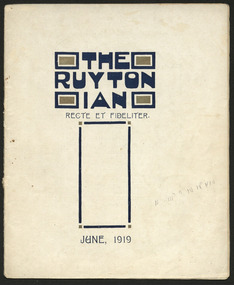
Magazine, Ruyton Girls' School, The Ruytonian, 1919
... girls' school in Victoria, Australia. Ruyton was founded in 1878 in the Bulleen Road, Kew, home of newly widowed Mrs Charlotte Anderson (now High Street South). Due to the age of the record dating back to 1919, we can infer it is one of the few remaining complete, intact and original examples of The Ruytonian from this period. Therefore, it can be considered an outstanding representation of its type, and is a reference example for research in early Victorian school history ...In July 1909, a modest 12-page booklet was put together by members of the fledgling Old Ruytonians Association (ORA) and distributed to the Ruyton Girls' School community. It was one of their first projects, and their aim was to nurture continuing interest in the School among former and current students. They named it "The Ruytonian." At first, The Ruytonian was produced twice yearly, and always bore a plain cover with a simple name banner. Initially, it was the work of volunteer editors from the ORA, but in 1913 they handed the publication over to the first student editors, Esther Gibson and Lucy Tickell. Since that time, the style and content of The Ruytonian has continuously evolved. The biggest shifts occurred in 1942 when it transitioned to a yearly publication, and in 1969 when it moved to a larger A4 format with a cover image specifically selected for that year.The record has strong historic significance as it pertains to the fourth oldest girls' school in Victoria, Australia. Ruyton was founded in 1878 in the Bulleen Road, Kew, home of newly widowed Mrs Charlotte Anderson (now High Street South). Due to the age of the record dating back to 1919, we can infer it is one of the few remaining complete, intact and original examples of The Ruytonian from this period. Therefore, it can be considered an outstanding representation of its type, and is a reference example for research in early Victorian school history. The record's significance is further enhanced by its exceptionally well-documented provenance, having remained the property of Ruyton Girls' School since its production.Colour publication printed on papyrus coloured paper. 29 pages.Front Cover: THE / RUYTON / IAN / RECTE ET FIDELITER. / II III> B IV IV VIV / JUNE, 1919 /ruyton girls' school, the ruytonian, kew, old ruytonians association, yearbook, school, publication, girls school, junior school, senior school, journal, students, teacher -
 Ruyton Girls' School
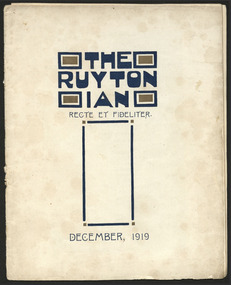
Magazine, Ruyton Girls' School, The Ruytonian, 1919
... girls' school in Victoria, Australia. Ruyton was founded in 1878 in the Bulleen Road, Kew, home of newly widowed Mrs Charlotte Anderson (now High Street South). Due to the age of the record dating back to 1919, we can infer it is one of the few remaining complete, intact and original examples of The Ruytonian from this period. Therefore, it can be considered an outstanding representation of its type, and is a reference example for research in early Victorian school history ...In July 1909, a modest 12-page booklet was put together by members of the fledgling Old Ruytonians Association (ORA) and distributed to the Ruyton Girls' School community. It was one of their first projects, and their aim was to nurture continuing interest in the School among former and current students. They named it "The Ruytonian." At first, The Ruytonian was produced twice yearly, and always bore a plain cover with a simple name banner. Initially, it was the work of volunteer editors from the ORA, but in 1913 they handed the publication over to the first student editors, Esther Gibson and Lucy Tickell. Since that time, the style and content of The Ruytonian has continuously evolved. The biggest shifts occurred in 1942 when it transitioned to a yearly publication, and in 1969 when it moved to a larger A4 format with a cover image specifically selected for that year.The record has strong historic significance as it pertains to the fourth oldest girls' school in Victoria, Australia. Ruyton was founded in 1878 in the Bulleen Road, Kew, home of newly widowed Mrs Charlotte Anderson (now High Street South). Due to the age of the record dating back to 1919, we can infer it is one of the few remaining complete, intact and original examples of The Ruytonian from this period. Therefore, it can be considered an outstanding representation of its type, and is a reference example for research in early Victorian school history. The record's significance is further enhanced by its exceptionally well-documented provenance, having remained the property of Ruyton Girls' School since its production.Colour publication printed on papyrus coloured paper. 30 pages.Front Cover: THE / RUYTON / IAN / RECTE ET FIDELITER. / DECEMBER, 1919 /ruyton girls' school, the ruytonian, kew, old ruytonians association, yearbook, school, publication, girls school, junior school, senior school, journal, students, teacher -
 Ruyton Girls' School
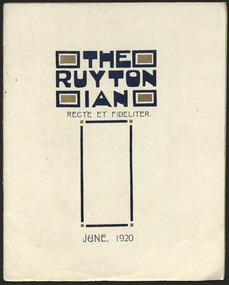
Magazine, Ruyton Girls' School, The Ruytonian, 1920
... girls' school in Victoria, Australia. Ruyton was founded in 1878 in the Bulleen Road, Kew, home of newly widowed Mrs Charlotte Anderson (now High Street South). Due to the age of the record dating back to 1920, we can infer it is one of the few remaining complete, intact and original examples of The Ruytonian from this period. Therefore, it can be considered an outstanding representation of its type, and is a reference example for research in early Victorian school history ...In July 1909, a modest 12-page booklet was put together by members of the fledgling Old Ruytonians Association (ORA) and distributed to the Ruyton Girls' School community. It was one of their first projects, and their aim was to nurture continuing interest in the School among former and current students. They named it "The Ruytonian." At first, The Ruytonian was produced twice yearly, and always bore a plain cover with a simple name banner. Initially, it was the work of volunteer editors from the ORA, but in 1913 they handed the publication over to the first student editors, Esther Gibson and Lucy Tickell. Since that time, the style and content of The Ruytonian has continuously evolved. The biggest shifts occurred in 1942 when it transitioned to a yearly publication, and in 1969 when it moved to a larger A4 format with a cover image specifically selected for that year.The record has strong historic significance as it pertains to the fourth oldest girls' school in Victoria, Australia. Ruyton was founded in 1878 in the Bulleen Road, Kew, home of newly widowed Mrs Charlotte Anderson (now High Street South). Due to the age of the record dating back to 1920, we can infer it is one of the few remaining complete, intact and original examples of The Ruytonian from this period. Therefore, it can be considered an outstanding representation of its type, and is a reference example for research in early Victorian school history. The record's significance is further enhanced by its exceptionally well-documented provenance, having remained the property of Ruyton Girls' School since its production.Colour publication printed on papyrus coloured paper. 33 pages.Front Cover: THE / RUYTON / IAN / RECTE ET FIDELITER. / JUNE, 1920 /ruyton girls' school, the ruytonian, kew, old ruytonians association, yearbook, school, publication, girls school, junior school, senior school, journal, students, teacher -
 Ruyton Girls' School
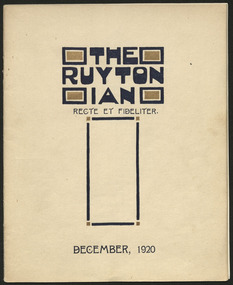
Magazine, Ruyton Girls' School, The Ruytonian, 1920
... girls' school in Victoria, Australia. Ruyton was founded in 1878 in the Bulleen Road, Kew, home of newly widowed Mrs Charlotte Anderson (now High Street South). Due to the age of the record dating back to 1920, we can infer it is one of the few remaining complete, intact and original examples of The Ruytonian from this period. Therefore, it can be considered an outstanding representation of its type, and is a reference example for research in early Victorian school history ...In July 1909, a modest 12-page booklet was put together by members of the fledgling Old Ruytonians Association (ORA) and distributed to the Ruyton Girls' School community. It was one of their first projects, and their aim was to nurture continuing interest in the School among former and current students. They named it "The Ruytonian." At first, The Ruytonian was produced twice yearly, and always bore a plain cover with a simple name banner. Initially, it was the work of volunteer editors from the ORA, but in 1913 they handed the publication over to the first student editors, Esther Gibson and Lucy Tickell. Since that time, the style and content of The Ruytonian has continuously evolved. The biggest shifts occurred in 1942 when it transitioned to a yearly publication, and in 1969 when it moved to a larger A4 format with a cover image specifically selected for that year.The record has strong historic significance as it pertains to the fourth oldest girls' school in Victoria, Australia. Ruyton was founded in 1878 in the Bulleen Road, Kew, home of newly widowed Mrs Charlotte Anderson (now High Street South). Due to the age of the record dating back to 1920, we can infer it is one of the few remaining complete, intact and original examples of The Ruytonian from this period. Therefore, it can be considered an outstanding representation of its type, and is a reference example for research in early Victorian school history. The record's significance is further enhanced by its exceptionally well-documented provenance, having remained the property of Ruyton Girls' School since its production.Colour publication printed on papyrus coloured paper. 39 pages.Front Cover: THE / RUYTON / IAN / RECTE ET FIDELITER. / DECEMBER, 1920 /ruyton girls' school, the ruytonian, kew, old ruytonians association, yearbook, school, publication, girls school, junior school, senior school, journal, students, teacher -
 Ruyton Girls' School
Magazine, Ruyton Girls' School, The Ruytonian, 1921
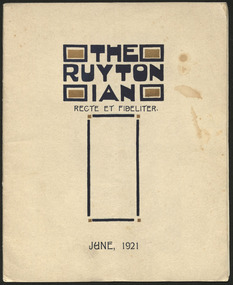
... girls' school in Victoria, Australia. Ruyton was founded in 1878 in the Bulleen Road, Kew, home of newly widowed Mrs Charlotte Anderson (now High Street South). Due to the age of the record dating back to 1921, we can infer it is one of the few remaining complete, intact and original examples of The Ruytonian from this period. Therefore, it can be considered an outstanding representation of its type, and is a reference example for research in early Victorian school history ...In July 1909, a modest 12-page booklet was put together by members of the fledgling Old Ruytonians Association (ORA) and distributed to the Ruyton Girls' School community. It was one of their first projects, and their aim was to nurture continuing interest in the School among former and current students. They named it "The Ruytonian." At first, The Ruytonian was produced twice yearly, and always bore a plain cover with a simple name banner. Initially, it was the work of volunteer editors from the ORA, but in 1913 they handed the publication over to the first student editors, Esther Gibson and Lucy Tickell. Since that time, the style and content of The Ruytonian has continuously evolved. The biggest shifts occurred in 1942 when it transitioned to a yearly publication, and in 1969 when it moved to a larger A4 format with a cover image specifically selected for that year.The record has strong historic significance as it pertains to the fourth oldest girls' school in Victoria, Australia. Ruyton was founded in 1878 in the Bulleen Road, Kew, home of newly widowed Mrs Charlotte Anderson (now High Street South). Due to the age of the record dating back to 1921, we can infer it is one of the few remaining complete, intact and original examples of The Ruytonian from this period. Therefore, it can be considered an outstanding representation of its type, and is a reference example for research in early Victorian school history. The record's significance is further enhanced by its exceptionally well-documented provenance, having remained the property of Ruyton Girls' School since its production.Colour publication printed on papyrus coloured paper. 26 pages.Front Cover: THE / RUYTON / IAN / RECTE ET FIDELITER. / JUNE, 1921 /ruyton girls' school, the ruytonian, kew, old ruytonians association, yearbook, school, publication, girls school, junior school, senior school, journal, students, teacher -
 Ruyton Girls' School
Magazine, Ruyton Girls' School, The Ruytonian, 1921
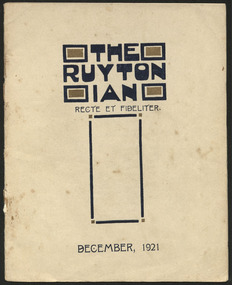
... girls' school in Victoria, Australia. Ruyton was founded in 1878 in the Bulleen Road, Kew, home of newly widowed Mrs Charlotte Anderson (now High Street South). Due to the age of the record dating back to 1921, we can infer it is one of the few remaining complete, intact and original examples of The Ruytonian from this period. Therefore, it can be considered an outstanding representation of its type, and is a reference example for research in early Victorian school history ...In July 1909, a modest 12-page booklet was put together by members of the fledgling Old Ruytonians Association (ORA) and distributed to the Ruyton Girls' School community. It was one of their first projects, and their aim was to nurture continuing interest in the School among former and current students. They named it "The Ruytonian." At first, The Ruytonian was produced twice yearly, and always bore a plain cover with a simple name banner. Initially, it was the work of volunteer editors from the ORA, but in 1913 they handed the publication over to the first student editors, Esther Gibson and Lucy Tickell. Since that time, the style and content of The Ruytonian has continuously evolved. The biggest shifts occurred in 1942 when it transitioned to a yearly publication, and in 1969 when it moved to a larger A4 format with a cover image specifically selected for that year.The record has strong historic significance as it pertains to the fourth oldest girls' school in Victoria, Australia. Ruyton was founded in 1878 in the Bulleen Road, Kew, home of newly widowed Mrs Charlotte Anderson (now High Street South). Due to the age of the record dating back to 1921, we can infer it is one of the few remaining complete, intact and original examples of The Ruytonian from this period. Therefore, it can be considered an outstanding representation of its type, and is a reference example for research in early Victorian school history. The record's significance is further enhanced by its exceptionally well-documented provenance, having remained the property of Ruyton Girls' School since its production.Colour publication printed on papyrus coloured paper. 30 pages.Front Cover: THE / RUYTON / IAN / RECTE ET FIDELITER. / DECEMBER, 1921 /ruyton girls' school, the ruytonian, kew, old ruytonians association, yearbook, school, publication, girls school, junior school, senior school, journal, students, teacher -
 Ruyton Girls' School
Magazine, Ruyton Girls' School, The Ruytonian, 1922
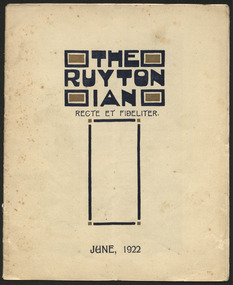
... girls' school in Victoria, Australia. Ruyton was founded in 1878 in the Bulleen Road, Kew, home of newly widowed Mrs Charlotte Anderson (now High Street South). Due to the age of the record dating back to 1922, we can infer it is one of the few remaining complete, intact and original examples of The Ruytonian from this period. Therefore, it can be considered an outstanding representation of its type, and is a reference example for research in early Victorian school history ...In July 1909, a modest 12-page booklet was put together by members of the fledgling Old Ruytonians Association (ORA) and distributed to the Ruyton Girls' School community. It was one of their first projects, and their aim was to nurture continuing interest in the School among former and current students. They named it "The Ruytonian." At first, The Ruytonian was produced twice yearly, and always bore a plain cover with a simple name banner. Initially, it was the work of volunteer editors from the ORA, but in 1913 they handed the publication over to the first student editors, Esther Gibson and Lucy Tickell. Since that time, the style and content of The Ruytonian has continuously evolved. The biggest shifts occurred in 1942 when it transitioned to a yearly publication, and in 1969 when it moved to a larger A4 format with a cover image specifically selected for that year.The record has strong historic significance as it pertains to the fourth oldest girls' school in Victoria, Australia. Ruyton was founded in 1878 in the Bulleen Road, Kew, home of newly widowed Mrs Charlotte Anderson (now High Street South). Due to the age of the record dating back to 1922, we can infer it is one of the few remaining complete, intact and original examples of The Ruytonian from this period. Therefore, it can be considered an outstanding representation of its type, and is a reference example for research in early Victorian school history. The record's significance is further enhanced by its exceptionally well-documented provenance, having remained the property of Ruyton Girls' School since its production.Colour publication printed on papyrus coloured paper. 23 pages.Front Cover: THE / RUYTON / IAN / RECTE ET FIDELITER. / JUNE, 1922 /ruyton girls' school, the ruytonian, kew, old ruytonians association, yearbook, school, publication, girls school, junior school, senior school, journal, students, teacher -
 Ruyton Girls' School
Magazine, Ruyton Girls' School, The Ruytonian, 1922
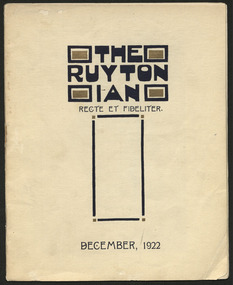
... girls' school in Victoria, Australia. Ruyton was founded in 1878 in the Bulleen Road, Kew, home of newly widowed Mrs Charlotte Anderson (now High Street South). Due to the age of the record dating back to 1922, we can infer it is one of the few remaining complete, intact and original examples of The Ruytonian from this period. Therefore, it can be considered an outstanding representation of its type, and is a reference example for research in early Victorian school history ...In July 1909, a modest 12-page booklet was put together by members of the fledgling Old Ruytonians Association (ORA) and distributed to the Ruyton Girls' School community. It was one of their first projects, and their aim was to nurture continuing interest in the School among former and current students. They named it "The Ruytonian." At first, The Ruytonian was produced twice yearly, and always bore a plain cover with a simple name banner. Initially, it was the work of volunteer editors from the ORA, but in 1913 they handed the publication over to the first student editors, Esther Gibson and Lucy Tickell. Since that time, the style and content of The Ruytonian has continuously evolved. The biggest shifts occurred in 1942 when it transitioned to a yearly publication, and in 1969 when it moved to a larger A4 format with a cover image specifically selected for that year.The record has strong historic significance as it pertains to the fourth oldest girls' school in Victoria, Australia. Ruyton was founded in 1878 in the Bulleen Road, Kew, home of newly widowed Mrs Charlotte Anderson (now High Street South). Due to the age of the record dating back to 1922, we can infer it is one of the few remaining complete, intact and original examples of The Ruytonian from this period. Therefore, it can be considered an outstanding representation of its type, and is a reference example for research in early Victorian school history. The record's significance is further enhanced by its exceptionally well-documented provenance, having remained the property of Ruyton Girls' School since its production.Colour publication printed on papyrus coloured paper. 34 pages.Front Cover: THE / RUYTON / IAN / RECTE ET FIDELITER. / DECEMBER, 1922 /ruyton girls' school, the ruytonian, kew, old ruytonians association, yearbook, school, publication, girls school, junior school, senior school, journal, students, teacher -
 Ruyton Girls' School
Magazine, Ruyton Girls' School, The Ruytonian, 1923
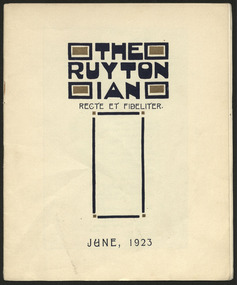
... girls' school in Victoria, Australia. Ruyton was founded in 1878 in the Bulleen Road, Kew, home of newly widowed Mrs Charlotte Anderson (now High Street South). Due to the age of the record dating back to 1923, we can infer it is one of the few remaining complete, intact and original examples of The Ruytonian from this period. Therefore, it can be considered an outstanding representation of its type, and is a reference example for research in early Victorian school history ...In July 1909, a modest 12-page booklet was put together by members of the fledgling Old Ruytonians Association (ORA) and distributed to the Ruyton Girls' School community. It was one of their first projects, and their aim was to nurture continuing interest in the School among former and current students. They named it "The Ruytonian." At first, The Ruytonian was produced twice yearly, and always bore a plain cover with a simple name banner. Initially, it was the work of volunteer editors from the ORA, but in 1913 they handed the publication over to the first student editors, Esther Gibson and Lucy Tickell. Since that time, the style and content of The Ruytonian has continuously evolved. The biggest shifts occurred in 1942 when it transitioned to a yearly publication, and in 1969 when it moved to a larger A4 format with a cover image specifically selected for that year.The record has strong historic significance as it pertains to the fourth oldest girls' school in Victoria, Australia. Ruyton was founded in 1878 in the Bulleen Road, Kew, home of newly widowed Mrs Charlotte Anderson (now High Street South). Due to the age of the record dating back to 1923, we can infer it is one of the few remaining complete, intact and original examples of The Ruytonian from this period. Therefore, it can be considered an outstanding representation of its type, and is a reference example for research in early Victorian school history. The record's significance is further enhanced by its exceptionally well-documented provenance, having remained the property of Ruyton Girls' School since its production.Colour publication printed on papyrus coloured paper. 28 pages.Front Cover: THE / RUYTON / IAN / RECTE ET FIDELITER. / JUNE, 1923 /ruyton girls' school, the ruytonian, kew, old ruytonians association, yearbook, school, publication, girls school, junior school, senior school, journal, students, teacher -
 Ruyton Girls' School
Magazine, Ruyton Girls' School, The Ruytonian, 1923
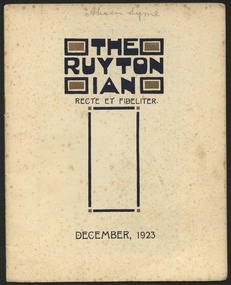
... girls' school in Victoria, Australia. Ruyton was founded in 1878 in the Bulleen Road, Kew, home of newly widowed Mrs Charlotte Anderson (now High Street South). Due to the age of the record dating back to 1923, we can infer it is one of the few remaining complete, intact and original examples of The Ruytonian from this period. Therefore, it can be considered an outstanding representation of its type, and is a reference example for research in early Victorian school history ...In July 1909, a modest 12-page booklet was put together by members of the fledgling Old Ruytonians Association (ORA) and distributed to the Ruyton Girls' School community. It was one of their first projects, and their aim was to nurture continuing interest in the School among former and current students. They named it "The Ruytonian." At first, The Ruytonian was produced twice yearly, and always bore a plain cover with a simple name banner. Initially, it was the work of volunteer editors from the ORA, but in 1913 they handed the publication over to the first student editors, Esther Gibson and Lucy Tickell. Since that time, the style and content of The Ruytonian has continuously evolved. The biggest shifts occurred in 1942 when it transitioned to a yearly publication, and in 1969 when it moved to a larger A4 format with a cover image specifically selected for that year.The record has strong historic significance as it pertains to the fourth oldest girls' school in Victoria, Australia. Ruyton was founded in 1878 in the Bulleen Road, Kew, home of newly widowed Mrs Charlotte Anderson (now High Street South). Due to the age of the record dating back to 1923, we can infer it is one of the few remaining complete, intact and original examples of The Ruytonian from this period. Therefore, it can be considered an outstanding representation of its type, and is a reference example for research in early Victorian school history. The record's significance is further enhanced by its exceptionally well-documented provenance, having remained the property of Ruyton Girls' School since its production.Colour publication printed on papyrus coloured paper. 27 pages.Front Cover: Alison Syme / THE / RUYTON / IAN / RECTE ET FIDELITER. / DECEMBER, 1923 /ruyton girls' school, the ruytonian, kew, old ruytonians association, yearbook, school, publication, girls school, junior school, senior school, journal, students, teacher
