
Showing 551 items matching "s.s."
-
 Wodonga & District Historical Society Inc
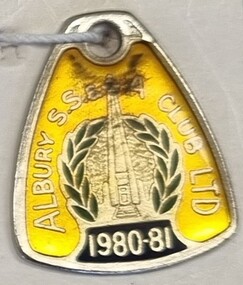
Badge - Membership Albury S.S & A, Perfection Badges, 1980 - 1981
... Membership Albury S.S & A ...Membership Albury S.S & A ...Albury S.S & A Club...Enamelled membership badges for the S.S & A. Club in Albury. Many people from both Albury and Wodonga hold membership the club which provides employment and social activities for people from both sides of the Murray RIver....Red Badge, around the centre image of the Albury War Memorial: "ALBURY S.S.& A CLUB LTD/ 1981-82" On reverse: "MEMBER/NOT TRANSFERABLE/2302/PERFECTION BADGES/SYDNEY/770775" Yellow Badge, around the centre image of the Albury War Memorial: "ALBURY S.S.& A CLUB LTD/ 1980-81"...Many people from both Albury and Wodonga hold membership the club which provides employment and social activities for people from both sides of the Murray RIver. Membership Albury S.S & A Badge Membership Albury S.S & A New South Wales Sydney Perfection Badges ...The Albury Sailors, Soldiers and Airmen’s Club traces its origins back to the Albury and District War Services Hall Appeal Committee. This group of the World War I diggers, service groups and parents of men serving in World War II set out to raise 14,000 pounds for a Services Memorial Hall. After the war ended, the Memorial Hall Fund was far short of its target. Also, different attitudes prevailed when the boys came home. Instead of a memorial hall, the idea of a licensed club gained favour. This was to be not merely for RSL men who had served overseas, but for many ex-servicemen who had not left Australia. Using the Memorial Hall Fund, the RSL bought the old Commercial Club buildings at 611 Dean Street, which had been a Service Rest Room throughout the war and up to February 1946. The SS&A Club was formally opened in October 1946 and was registered under the Liquor Act in 1947. The foundation stone of the new building in Olive Street was laid by Lt General Sir John Northcott, May 2, 1959. The building was opened July 15,1960 by Governor of NSW, Sir Eric Woodward. It has since undergone many extensions and developments to become a modern facility but still continues to honour its origins with the inclusion of its War Memorial This badge is representative of the role played by licensed clubs in the local community. Enamelled membership badges for the S.S & A. Club in Albury. Many people from both Albury and Wodonga hold membership the club which provides employment and social activities for people from both sides of the Murray RIver. Red Badge, around the centre image of the Albury War Memorial: "ALBURY S.S.& A CLUB LTD/ 1981-82" On reverse: "MEMBER/NOT TRANSFERABLE/2302/PERFECTION BADGES/SYDNEY/770775" Yellow Badge, around the centre image of the Albury War Memorial: "ALBURY S.S.& A CLUB LTD/ 1980-81" albury s.s & a club, social clubs, licensed clubs albury -
 Mission to Seafarers Victoria
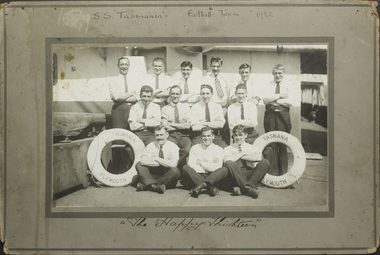
Photograph - Mounted photograph, Sepia, S.S. Tasmania's Football Team, 1922
... S.S. Tasmania's Football Team......s.s. tasmania...This is a photograph of crew members that formed the football team of the S.S. Tasmania. Taken place on the deck of the ship, it is a snapshot in time...Black and white photograph of S.S. Tasmania football team in 1922. The photograph is mounted onto a grey green cardboard frame with the text, 'S.S. ...On front mount with photograph: 'S.S "Tasmania's" Football Team 1922' / The Happy Thirteen Inscribed back:of mount names in ink : Thomas Holohay / William Bridges / James. ...Franks Black and white photograph of S.S. Tasmania football team in 1922. The photograph is mounted onto a grey green cardboard frame with the text, 'S.S. ...This is a photograph of crew members that formed the football team of the S.S. Tasmania. Taken place on the deck of the ship, it is a snapshot in time An addition to the collection of crew photographs in the MTSV Collection with all crew members featured in the image named and dated with name of ship making it a useful research and reference image. Black and white photograph of S.S. Tasmania football team in 1922. The photograph is mounted onto a grey green cardboard frame with the text, 'S.S. "Tasmania's" Football Team 1922' on the top. The bottom reads, 'The Happy Thirteen', handwritten in black ink. The photograph itself is of 13 men in three rows, 6 on top row standing, 4 in the middle row sitting on a bench and 3 on the bottom row sitting with their legs crossed. All men have their arms crossed across their chest. On either side of the front row is a lifesaver with the text "S.S. Tasmania/Plymouth". The men are posed on the ships deck. On front mount with photograph: 'S.S "Tasmania's" Football Team 1922' / The Happy Thirteen Inscribed back:of mount names in ink : Thomas Holohay / William Bridges / James. H. Stone / George Angus / James Arthurs / George Arthurs / C. Quinell / C. (Lawrence/labence ?) / W. Manon / M. Zard / I. Ancell LT/JL ?. Chipperfield / F. Franks uniform, team, s.s. tasmania, 1922, football, crew, life buoy, crews and ships -
 Wodonga & District Historical Society Inc
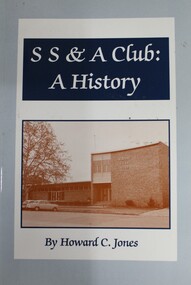
Book - S.S.& A Club : A History, Howard C Jones, 1994
... S.S.& A Club : A History...S.S.& A Club : A History...Albury S.S & A Club...S.S.& A Club : A History Book S.S.& A Club : A History Howard C Jones ...This book traces the History of the Sailors, Soldiers and Airmen's Club in Albury NSW from early fundraising efforts in 1994 to development to an important services club and modern entertainment facility.non-fiction This book traces the History of the Sailors, Soldiers and Airmen's Club in Albury NSW from early fundraising efforts in 1994 to development to an important services club and modern entertainment facility. albury s.s & a club, veterans, service clubs nsw -
 Flagstaff Hill Maritime Museum and Village
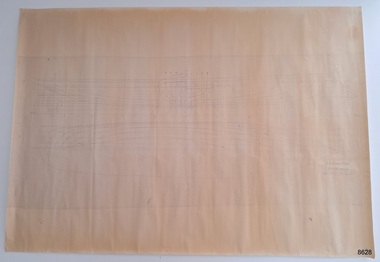
Plan - Lines Plan, S.S. Rowitta, ca 1909
... S.S. Rowitta......s.s. rowitta...The lines plan was drawn for the building of the steamship S.S. Rowitta, a passenger steam ferry built in Hobart for use in Tasmania's rivers, the Derwent and the Tamar. ...Lines Plan, copy, of the steamship S.S. Rowitta. Rectangular drawing paper with copy of the hand drawn lines plan showing several profiles of the vessel. ...Printed on the plan: "S.S. ROWITTA / LINES PLAN / SCALE 1/4" TO 12" " Blue ink writing on the back: "Rowitta" Blue ink on label: "56"...The lines plan was drawn for the building of the steamship S.S. Rowitta, a passenger steam ferry built in Hobart for use in Tasmania's rivers, the Derwent and the Tamar. ...The lines plan was drawn for the building of the steamship S.S. Rowitta, a passenger steam ferry built in Hobart for use in Tasmania's rivers, the Derwent and the Tamar. It is a copy of the original lines plan. The S.S. Rowitta was built by Purdon & Featherstone, at Battery Point, Hobart (Tasmania) in 1909 from Huon Pine and Kauri planking. Her final configuration included three masts and a ship rig. S.S. Rowitta took its first voyage from Hobart to Launceston in 1909 and operated for 30 years as a passenger ferry on the Tamar and Derwent Rivers. She also served as a freighter, an army supply ship, a luxury charter ferry and a floating restaurant as well as a prawn boat at Lakes Entrance. (She has also been named “Sorrento” and “Tarkarri”.). In the very early days of Flagstaff Hill ‘Rowitta’ was purchased from Lakes Entrance by Warrnambool City Council and the Victorian State Government for $20,000. The Rowitta had a hull configuration very similar to a local boat named the SPECULANT, which played a key role in the Port of Warrnambool in the early 1900s. The Speculant was the largest ship ever registered with Warrnambool as her home port. Local owner and trader P J McGennan & Co, (Peter McGennan) used her as a freight carrier to Melbourne and timber trader between New Zealand and Victoria. She sunk at Cape Otway in 1911 on a voyage to Melbourne. In 1974 Rowitta was delivered to Port Fairy and then later sailed to Warrnambool’s Breakwater where she was lifted out of Lady Bay and loaded onto the back of a long transport truck and slowly and carefully driven along Pertobe Road, through the Surfside Caravan Park and over the railway line, into Flagstaff Hill’s Maritime Village. Transfer arrangements were coordinated by Jack Morse, of Morse Engineering, a member of the Flagstaff Hill Planning Board, and Ken Goyen, a local crane operator. The ‘Rowitta’ was originally acquired to be rebuilt to match the original SPECULANT. When finances became tight in 1976 a review of all plans ended in the decision to restore the “Rowitta” to her original configuration. She was then restored, renamed the original name of “Rowitta” and installed in the Village’s Harbour Lake to become one of the popular vessels on display for visitors to enjoy. It was the decision of the Advisory Committee to Flagstaff Hill to have Rowitta demolished in April 2015 due to extensive deterioration. Items associated with the Rowitta continue to be held in Flagstaff Hill Maritime Village’s Collection. The lines plan of the passenger ferry S.S. Rowitta.is significant for its association with Tasmanian history from the early to mid-1900s. It is also connected to the history of the Rowitta, which was a large exhibit on display at Flagstaff Hill Maritime Village from the museum’s early beginnings until the vessel’s end of life 40 years later. The Rowitta represents the importance of coastal traders to transport, trade and communication along the coast of Victoria, between states, and in Australia before rail and motor vehicles. The vessel was an example of a ferry built in the early 20th century that served many different roles over its lifetime of over 100 years. Lines Plan, copy, of the steamship S.S. Rowitta. Rectangular drawing paper with copy of the hand drawn lines plan showing several profiles of the vessel. The vessel was built in 1909 by Purdon & Featherstone, Hobart. On the revers is handwritten inscription, and a white label with a handwritten number. Printed on the plan: "S.S. ROWITTA / LINES PLAN / SCALE 1/4" TO 12" " Blue ink writing on the back: "Rowitta" Blue ink on label: "56" flagstaff hill, warrnambool, shipwrecked-coast, flagstaff-hill, flagstaff-hill-maritime-museum, maritime-museum, shipwreck-coast, flagstaff-hill-maritime-village, photograph, s.s. rowitta, charles street wharf,, launceston., purdon & featherstone, rowitta, tarkarri, speculant, purdon & featherstone of hobart, passenger ferry 1909, sorrento, lines drawing, ship's plan, lines plan, line plan, shipbuilding, ferry -
 Flagstaff Hill Maritime Museum and Village
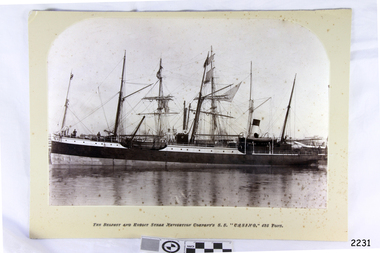
Photograph - Vessels, Sailing Ships, The Belfast and Koroit Steam Navigation Company's S.S. "Casino, 425 Ton, Late 19th to early 20th centuries
... The Belfast and Koroit Steam Navigation Company's S.S. "Casino, 425 Ton......s.s. casino...This black and white photograph shows the image of the coastal trading vessel S.S. Casino, with both sail masts and steam funnel. ...Under the photograph "The Belfast and Koroit Steam Navigation Company's S.S. "Casino," 425 Tons"...This black and white photograph shows the image of the coastal trading vessel S.S. Casino, with both sail masts and steam funnel. ...This black and white photograph shows the image of the coastal trading vessel S.S. Casino, with both sail masts and steam funnel. Men in hats are clearly visible on deck. The ship is in calm water and only light rigging is on the masts. Other vessels are in the background. Photograph is taken 1882-1932. The S.S. Casino was a passenger and freight steamer built in Dundee, Scotland, in 1882 for the Newcastle and Hunter River Steam Navigation Company of N.S.W. She weighed 425 tons gross with a length of 160.4 feet, beam of 24.1 feet and depth of 10.2 feet. She had saloon accommodation for 35 people, forecabin for 25 more people, and she carried 300 tons of cargo. While on her delivery journey on May 30th 1882 the S.S. Casino called in at the Port of Warrnambool for coal ., narrowly escaping going ashore in gale force winds due to the quick action of the pilot. At that time, still at anchor, she impressed the directors of the Belfast and Koroit Steam Navigation Company so much that they bought her immediately; she was ideal for trade in along the West Coast of Victoria. (Belfast is the original name for Port Fairy, South West Victoria. The Belfast and Koroit Steam Navigation Company was first managed by Messers. Saltau and Osburne and after the passing of Mr. Osburne, by produce merchants Messers H. Sautau and Sons, whose had a hay and corn store and shipping agency was on the corner of Liebig and Koroit Streets in Warrnambool. ) The S.S. Casino became “the most famous steamer to operate in Victorian waters along the West Coast” by author Jack Loney. Captain Boyd was her first Master, followed by Captain Chapman, who stayed with her 1890 until 1924. Captain W. Robertson followed for a short term, then Captain Middleton then took command 1925 - 1932. The S.S. Casino had several mishaps during her life. One was on 3rd January 1898 when she collided with the S.S. Flinders in Apollo Bay with minor damage. Another was on 24th October 1924 when she grounded on a reef at Point Hawdon near Grey River and most of her cargo (of Christmas goods) had to be dumped into the sea. Then in February 1929 she was ‘holed’ when she struck a submerged object as she entered Lady Bay, Warrnambool. On the morning of 10th July 1932, after attempting to berth at Apollo Bay jetty in heavy seas, Captain Middleton decided to take her out into the bay and wait until the seas abated. It was not realised that the anchor used to steady her as she manoeuvred to her berth had pierced her hull. She put about and headed for the beach but sank. Captain Middleton and nine others lost their lives; nine people were rescued including the two female passengers . Captain Middleton had been in charge of the S.S. Casino for seven years. He was the first ship’s Master to lose his life through shipwreck in the West Coast trade. In the years following the turn of the century the S.S. Casino remained the only regular trader with normal passenger accommodation along the West Coast. From 1882 she had made at least 2,500 voyages on the one run. Flagstaff Hill’s collection has a photograph of a portrait of Captain Chapman, , a ship model of the S.S. Casino that shows both forms of power under which she sailed, steam and sail. The ship is painted green and flies three flags. The inscription across the case of the ship model, incorrectly dated, tells the sad story of the wreck of the ship and the loss of lives on July 10th 1932 at Apollo Bay. A print in the Collection show S.S. Casino underway in heavy sea off Point Lonsdale, another two photographs show her at the Port of Warrnambool, leaving from the Breakwater in Lady Bay and another identifies the S.S. Casino as a ship from the Belfast and Koroit Steam Navigation Company. (Belfast is the original name for the township of Port Fairy). This photograph is significant because of its association with the coastal trader S.S. Casino and its significance to trade along Victoria's West Coast in the late 19th and early 20th century. It was taken 1882-1932 The wreck of the S.S. Casino is considered an important part of Victorian and Australian cultural heritage and as such has been declared and protected as an Historic Shipwreck under State and Commonwealth Law in the Commonwealth Historic Shipwrecks Act (1976). Photograph, black and white, taken 1882-1932. Foreground is vessel SS Casino, the Belfast and Koroit Steam Navigation Company's coastal trading ship. The ship, in calm water, has light rigging on its masts and also a steam funnel. One lifeboat is visible. People are on the deck. The background shows other vessels. Under the photograph "The Belfast and Koroit Steam Navigation Company's S.S. "Casino," 425 Tons" flagstaff hill, warrnambool, shipwrecked coast, flagstaff hill maritime museum, maritime museum, shipwreck coast, flagstaff hill maritime village, great ocean road, newcastle and hunter river steam navigation company, belfast and koroit steam navigation company, h. sautau and sons, s.s. casino, west coast trader s.s. casino, victorian coastal trader, captain boyd, captain w. robertson, captain chapman, captain middleton, apollo bay shipwreck, s.s. casino at lady bay warrnambool, saltau and osburne -
 Glenelg Shire Council Cultural Collection
Negative - Glass Plate Negative - S.S. 'Eumeralla' at berth, 1890-1910
... Glass Plate Negative - S.S. 'Eumeralla' at berth...Glass plate negative S.S. 'Eumeralla' at berth...Front: S.S. Eumeralla...Front: S.S. Eumeralla Glass plate negative S.S. 'Eumeralla' at berth Negative Glass Plate Negative - S.S. ...Glass plate negative S.S. 'Eumeralla' at berth Front: S.S. Eumeralla -
 Flagstaff Hill Maritime Museum and Village
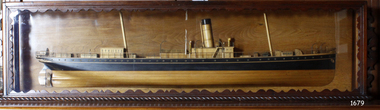
Craft - Ship Model, S.S. Nelson, 1877 - 1984
... S.S. Nelson......s.s. nelson steam ship 1877...This beautifully made ship model is a side relief of the steam ship “S.S. Nelson”, which was launched in 1877. ...Ship model; relief of the S.S. Nelson, showing deck superstructure, ventilators and single funnel. ...This beautifully made ship model is a side relief of the steam ship “S.S. Nelson”, which was launched in 1877. ...This beautifully made ship model is a side relief of the steam ship “S.S. Nelson”, which was launched in 1877. The model’s case stands out because of its ornately carved internal frame. Relief models of ships, sometimes called half models, were often built by the shipbuilders as an exact scale model of the finished ship. The shipbuilders would use the model to ensure that the design was balanced. They would use the model as a point of reference during building. Also, ship models were used to demonstrate the designs to prospective buyers. It is not known whether this model of the “S.S. Nelson” was made for these purposes. HISTORY of the “S.S. Nelson” During the period 1840-1890 shipping was the cheapest and most practical means of carrying produce and goods to and from coastal towns such as Warrnambool. In the 1850s regular domestic steamer services began and by 1870 the passenger trade was booming. Passengers were taken to the ship’s side in small boats called lighters, which took it to ships at anchorage in Lady Bay, then climbed aboard up ladders or gangways. Their fare covered accommodation Saloon/Cabin section (higher class and more expensive) or the Steerage section (lower class and less expensive, below deck level). Produce included livestock such as pigs and fowls, and dairy products, bales of wool, and potatoes. The goods were loaded from the Warrnambool Jetty into the lighters. The S.S. Nelson was built by Messrs Blackwood and Gordon of Port Glasgow for a cost £25,000 in 1877. She was an iron screw steamer with an overall length of 200 feet, beam 25.5 feet and a depth of hold of 19.4 feet, which gave her a gross measurement of 649 tons. Her engines gave her a best speed of 13 knots and a maintainable speed of 12 knots. She was described as a handsome, star decked, efficient steamship, fitted with accommodating for 75 first class passengers in a saloon, and 40 second class passengers in a cabin. The S.S. Nelson arrived in the colony of Victoria on March 9th, 1877. She was first registered in Warrnambool by the Warrnambool Steam Packet Company under the management of Mr William Evans, and employed in the coastal trade of south west Victoria. She was very popular in 1878, registered under the new ownership of the Western Steamship Navigation Company, trading between Melbourne, Warrnambool and Portland. Captained John Nicholson commanded the S.S. Nelson after the previous captain, Thomas Smith, was suspended in 1882 for six months by the Victorian Steam Navigation Board following the collision between the S.S. Nelson and the S.S. Julia Percy. Other Captains include S Drewet and John Thompson. The S.S. Nelson was sold to Messrs. Huddart, Parker and Co. and re-registered in Melbourne on June 23rd, 1890. The new owners intended to use her for their Bass Strait crossing between Melbourne, Victoria and Launceston, Tasmania. On the night of Friday, June 27th 1890, under the command of Captain Carrington, she was on her way to Launceston on her first crossing for her new owners. She had no passengers and very little cargo and was to return to Melbourne with passengers the following morning. She was only 21 hours out of the dock when she struck Porpoise Rock in the Tamar River. All crew of 25 were saved but the bulkheads gave way and she rapidly filled before keeling over and disappearing in approximately 130 feet of water. The new owners had fully insured the almost 14-year-old S.S. Nelson with the Australian Alliance Insurance Company and she had only been in their possession for four days. This ship model of the S.S. Nelson is significant for its connection with the steam screw ship S.S. Nelson, one of a fleet of vessels owned by the Warrnambool Steam Packet Company. The S.S. Nelson was specifically built and purchased for the Victorian coastal trade business of the late 19th century, when shipping was the cheapest and most practical means of transporting goods and passengers between Victoria’s coastal towns and the major port at Melbourne. Once the railway came to Warrnambool in 1889, the steam shipping industry began to decline. Ship model; relief of the S.S. Nelson, showing deck superstructure, ventilators and single funnel. Ship's name is painted on the bow "NELSON". Wood model, varnished finish over natural wood and black painted areas. Timber case with ornate edging and glass front and sides. "NELSON" painted on bow flagstaff hill, warrnambool, shipwrecked-coast, flagstaff-hill, flagstaff-hill-maritime-museum, maritime-museum, shipwreck-coast, flagstaff-hill-maritime-village, s.s. nelson steam ship 1877, screw steamer, 1877 vessel, ship model s.s. nelson, blackwood and gordon port glasgow, warrnambool steam packet company, western steam navigation company, south west coast trader, sea transport melbourne to portland, victorian steam navigation board, s.s. julia percey, captain john nicholson, captain thomas smith, captain s drewet, captain john thompson, captain carrington, huddart, parker and co, bass strait crossing 1890, sea transport melbourne to launceston, porpoise rock tamar river, australian alliance insurance company, ship model making, vessels, victorian coastal trader -
 Mission to Seafarers Victoria
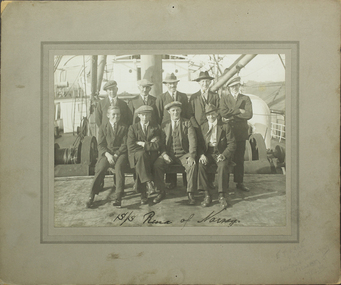
Photograph - Mounted photograph, Sepia, S.S. Rine? of Norvag, early to mid 20th C
... S.S. Rine? of Norvag......s.s. norvag...Black and white photograph of S.S. R-? Norvag crewmen in suits and caps or fedoras . ...On front with photograph:: S.S. Rine-? of Norvag Lwr r. corner very faint in pencil: E.T Lake photo. ...This is a photograph of crew members on the S.S. R-? Norvag. Inscription and Exact name of ship to be checked.. norvag s.s. norvag crews and ships On front with photograph:: S.S. ...This is a photograph of crew members on the S.S. R-? Norvag. Inscription and Exact name of ship to be checked.. Black and white photograph of S.S. R-? Norvag crewmen in suits and caps or fedoras . The photograph has been mounted onto a cardboard frame. The bottom reads, 'S.S. r-? Norvag" handwritten in black ink. The photograph itself is of 9 men in two rows, 5 on top row standing and 4 in the bottom row sitting on a bench.The men are posed on the ship's deck. On front with photograph:: S.S. Rine-? of Norvag Lwr r. corner very faint in pencil: E.T Lake photo. Lincoln inn , CH-? William Street / Melb norvag, s.s. norvag, crews and ships -
Glenelg Shire Council Cultural Collection
Photograph - Photograph - S.S. 'Eumeralla, n.d
... Photograph - S.S. 'Eumeralla...Black and white photo taken from glass plate negative. S.S. 'Eumeralla'...Front: S.S. Eumeralla...S.S. 'Eumeralla' Photograph Photograph - S.S. ...Black and white photo taken from glass plate negative. S.S. 'Eumeralla' Front: S.S. Eumeralla -
 Flagstaff Hill Maritime Museum and Village
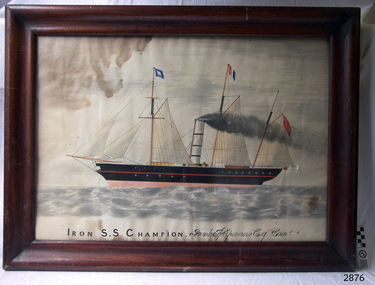
Painting - Lithograph, Iron S.S. Champion Frank Helpmann Esq. Comr, 1853 or later
... Iron S.S. Champion Frank Helpmann Esq. Comr...Captain Benjamin Francis (Frank) Helpmann was once the owner of the S.S. CHAMPOIN, then owned it in partnership with S. ...Unusual cross member bracing on the corners of the frame (one missing). Title "Iron S.S. Champion Frank Helpmann Esq. Comr" (in script) on bottom of picture....On the bottom of the painting "Iron S.S. Champion" (in printing), "Frank Helpmann Esq. ...Captain Benjamin Francis (Frank) Helpmann was once the owner of the S.S. CHAMPOIN, then owned it in partnership with S. ...Captain Benjamin Francis (Frank) Helpmann was once the owner of the S.S. CHAMPOIN, then owned it in partnership with S. G. Henty. S.S. CHAMPION was an early steamship and one of the first coastal traders to operate between Melbourne and Portland in Victoria from December 1853 until August 1857, when she collided with the S.S. LIRDY BIRD in the open sea off Cape Otway. CHAMPION was returning from Melbourne, and sank with thirty-two people still on board. The thirty others were saved by the LIRDY BIRD (ref. The Story of a Port : Portland, Victoria, by Noel F. Learmonth) This picture Lithograph) is associated with the S.S. Champion, which is listed on the Victorian Heritage Database VHR S110. The wreck of the SS Champion is significant historically as one of Victoria's worst shipwrecks. As an early steamship it played an important part in the development of and communications between the Western district and Melbourne . Although the site has not yet been located it is predicted to be highly significant archaeologically with the potential to yield information about early coastal shipping and the western district passenger and cargo trade. It is significant technically as an example of an early iron screw steamship, and is part of the western district steamship resource including the SS Casino, SS Coramba and SS Julia Percy. Painting. Lithograph of the schooner S S Champion, hand coloured watercolour, in a cedar frame behind glass. Unusual cross member bracing on the corners of the frame (one missing). Title "Iron S.S. Champion Frank Helpmann Esq. Comr" (in script) on bottom of picture. On the bottom of the painting "Iron S.S. Champion" (in printing), "Frank Helpmann Esq. Comr" (in script) shipwrecked coast, flagstaff hill, flagstaff hill maritime museum, maritime museum, shipwrecked artefact, flagstaff hill maritime village, shipwreck coast, warrnambool, lithograph, frank helpmann, henty -
 Mission to Seafarers Victoria
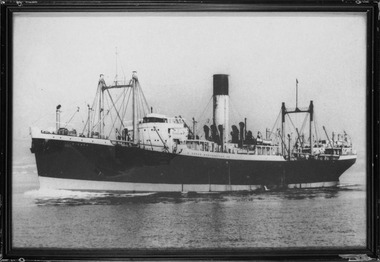
Photograph - Photograph, Black and white, S.S. Diomed, unknown
... S.S. Diomed...s.s. diomed...The S.S.'Diomed' was the last of the Blue Funnel Line's coal-burning cargo ships. ...A black and white photograph of a ship at sea, the s.s. "Diomed", in a glazed, thin, black, wooden frame: verso detailed labels and information on torn brown-paper backing. ...The S.S.'Diomed' was the last of the Blue Funnel Line's coal-burning cargo ships. ...The S.S.'Diomed' was the last of the Blue Funnel Line's coal-burning cargo ships. Launched in 1922 she made her last voyage from Australia to England in 1952 where she was broken up. The ship had been in service in Australia for thirty years, and as a parting gesture the ship's bell was presented to the Mission to Seafarers, Victoria by Alfred Holt & Co, the ship's owner in 1953 (see MTSV 0084 for the catalogue record of the ship's bell). Lay reader, Randall Stewart Murray, was a regular visitor to the s.s. Diomed over a number of years and accepted the offer of the ships brass bell when the ship was being broken up in 1953. This bell was on display in the Port Melbourne Mission and is now on the stage in the Flinders Street Mission. A black and white photograph of a ship at sea, the s.s. "Diomed", in a glazed, thin, black, wooden frame: verso detailed labels and information on torn brown-paper backing. String hanging system. Three labels. Label 1, Blue funnel line description of four ships. Label 2, "deans" framer's label with hand-written numbers: D13290 and 239/021. Label 3, Seabridge Australia Pty Ltd with donor details. s.s. diomed, blue funnel line shipping, seabridge australia pty ltd, deans melbourne, steamship, cargo ship, port melbourne, r. stewart murray, randall stewart murray, 1953, seabridge australia -
 Mission to Seafarers Victoria
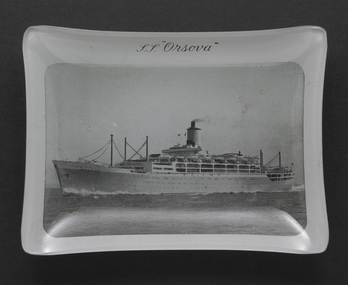
Domestic object - Ashtray, S.S. Orsova, 1950-1960
... S.S. Orsova...Glass ashtray or trinket dish with black and white printed transfer image of the S.S. Orsova at sea....S.S. "Orsova"...Orsova at sea. S.S. Orsova Domestic object Ashtray ...Several items were given by a seafarer, Mr Nicholas Garlick (1926-2009) into the care of Father Brady who retired from St Pauls Cathedral, Melbourne in 2018. Father Brady later donated the collection of; objects, documents and an extensive collection of cruise ship menus (1937-end of 20thC) to the Mission via the intermediary William Hastie, volunteer at the Mission for Seafarers. There are several references in the Mission records to both this ship and an earlier vessel with the same name. Glass ashtray or trinket dish with black and white printed transfer image of the S.S. Orsova at sea. S.S. "Orsova" nicolas garlick (1926-2006), sailors, seafarers, ss orsova, ship, nick garlick, ship engineer, seamen, orient steam navigation company -
 Flagstaff Hill Maritime Museum and Village
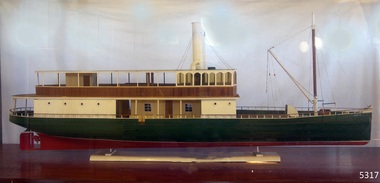
Craft - Ship Model, S.S. Rowitta
... S.S. Rowitta......s.s. rowitta...This remote-controlled ship model was made by the blacksmith at Flagstaff Hill Maritime Village in the likeness of the Village's display passenger ferry, the S.S. Rowitta. SS ROWITTA: - The 1909 steam ferry, SS Rowitta, was installed as an exhibit at Flagstaff Hill in 1975 and was enjoyed by many visitors for 40 years. ...Model of the wooden steam ferry "S.S. Rowitta". This is a radio-controlled model built by the Flagstaff Hill blacksmith....This is a radio-controlled model built by the Flagstaff Hill blacksmith. S.S. Rowitta Craft Ship Model ...This remote-controlled ship model was made by the blacksmith at Flagstaff Hill Maritime Village in the likeness of the Village's display passenger ferry, the S.S. Rowitta. SS ROWITTA: - The 1909 steam ferry, SS Rowitta, was installed as an exhibit at Flagstaff Hill in 1975 and was enjoyed by many visitors for 40 years. Rowitta was a timber steam ferry built in Hobart in 1909 using planks of Huon and Karri wood. She was a favourite of sightseeing passengers along Tasmania’s Tamar and Derwent rivers for 30 years. Rowitta was also known as Tarkarri and Sorrento and had worked as a coastal trading vessel between Devonport and Melbourne, and Melbourne Queenscliff and Sorrento. In 1974 Rowitta was purchased by Flagstaff Hilt to convert into a representation of the Speculant, a historic and locally significant sailing ship listed on the Victorian Heritage Database. (The Speculant was built in Scotland in 1895 and traded timber between the United Kingdom and Russia. Warrnambool’s P J McGennan & Co. then bought the vessel to trade pine timber from New Zealand to Victorian ports and cargo to Melbourne. She was the largest ship registered with Warrnambool as her home port, playing a key role in the early 1900s in the Port of Warrnambool. In 1911, on her way to Melbourne, she was wrecked near Cape Otway. None of the nine crew lost their lives.) The promised funds for converting Rowitta into the Speculant were no longer available, so she was restored back to her original configuration. She represented the importance of coastal traders to transport, trade and communication in Australian times before rail and motor vehicles. Sadly, in 2015 the time had come to demolish the Rowitta due to her excessive deterioration and the high cost of ongoing repairs. She had given over 100 years of service and pleasure to those who knew her. The remote-controlled model of the S.S. Rowitta is significant for its association with the Tasmanian early to mid-1900s passenger ferry, the wooden screw steamer Rowitta. It is is connected to the history of the Rowitta, that was a large exhibit on display at Flagstaff Hill Maritime Village from the museum’s early beginnings until the vessel’s end of life 40 years later. The display was used as an aid to maritime education. The Rowitta represents the importance of coastal traders to transport, trade and communication along the coast of Victoria, between states, and in Australia before rail and motor vehicles. The vessel was an example of a ferry built in the early 20th century that served many different roles over its lifetime of over 100 years. Model of the wooden steam ferry "S.S. Rowitta". This is a radio-controlled model built by the Flagstaff Hill blacksmith. flagstaff hill, warrnambool, shipwrecked coast, flagstaff hill maritime museum, maritime museum, shipwreck coast, flagstaff hill maritime village, great ocean road, ship model, remote controlled steam ship model, s.s. rowitta, tarkarri, speculant, purdon & featherstone of hobart, passenger ferry 1909, tasmanian passenger ferry, vessel, charles street wharf launceston, sorrento, remote control boat, rowitta model, remote-controlled model -
 Mission to Seafarers Victoria
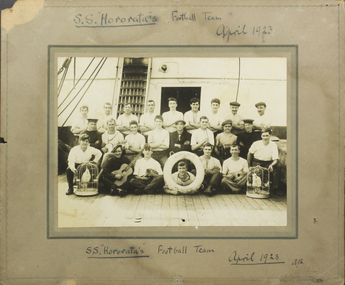
Photograph - Photograph, Black and white, S.S. "Hororata's" Football Team, April 1923, April 1923
... S.S. "Hororata's" Football Team, April 1923...This is a photograph of crew members that formed the football team of the S.S. Hororata. The vessel was ordered by the New Zealand Shipping Co Ltd of London, completed in 1914. ...Sepia toned photograph of the S.S. "Hororata" Football Team dated April 1923. ...On lower edge of mount handwritten in black ink: S.S. "Hororata" Football Team April 1923...This is a photograph of crew members that formed the football team of the S.S. Hororata. The vessel was ordered by the New Zealand Shipping Co Ltd of London, completed in 1914. ...This is a photograph of crew members that formed the football team of the S.S. Hororata. The vessel was ordered by the New Zealand Shipping Co Ltd of London, completed in 1914. In august of that year she was requisitioned ( as A20) for transport of the Australian expeditionary force in WW1. In WW2 she was known as the SS Waroonga and torpedoed in 1943. (Internet ref 2018) This vessel was a regular visitor to Melbourne and crews visited and contributed donations to the MTS. This photograph provides an early record of the many crew based football (soccer) teams that would enjoy matches when ashore with other crews. The Mission to seamen organised and promoted many such matches and encouraged the friendly competition during outings. In addition this particular group photograph is of interest as it indicates the many talents and interests of the crew through the items and animals the individuals are posed with. Sepia toned photograph of the S.S. "Hororata" Football Team dated April 1923. The photograph has been mounted onto a brown cardboard frame with the text 'S.S. "Hororata's" Football Team/April 1923' on the top and the bottom. The photograph itself is of 24 men in three rows, 9 on the top row, 8 in the middle row and 7 on the bottom row. The man in the bottom row furthest left is kneeling behind a bird cage with a cockatoo in it. The man second from the left is holding a guitar. The man third from the left is holding a cat. The man fourth from the left is lying down peeking through the buoy with the text "S.S. Hororata's/Plymouth". The man second from the right is holding a lute and the man furthest right on the bottom row is also kneeling behind a bird cage with a cockatoo. In the middle row, the man second from the left is holding a banjo. The man third from the right is holding a flute. The man second from the right is holding an accordion. All other men in the middle and top rows have their arms crossed. The men are situated on the ships deck. Behind them is a ladder and what appears to be a door opening and on the left side of the photograph are some ropes and a pulley system. On lower edge of mount handwritten in black ink: S.S. "Hororata" Football Team April 1923 hat, 1923, uniform, pulley, cap, banjo, guitar, rope, cockatoo, accordion, flute, cat, ladder, ss hororata football team, ss hororata, lute, ww1, ww2, troopship, ship crew, deck, soccer, football, sports, crew photo, crews and ships -
 Wodonga & District Historical Society Inc
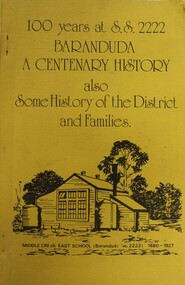
Booklet - 100 YEARS AT S.S. 2222 BARANDUDA: a centenary history, Rosemary Boyes, 1980
... 100 YEARS AT S.S. 2222 BARANDUDA: a centenary history...100 YEARS AT S.S. 2222 BARANDUDA: a centenary history...The primary school was opened in 1880. 100 YEARS AT S.S. 2222 BARANDUDA: a centenary history Booklet 100 YEARS AT S.S. 2222 BARANDUDA: a centenary history Rosemary Boyes ...This booklet tells the story of Baranduda State School 2222 and was produced to celebrate its centenary. It also includes information about the history of the district and some of its pioneer families. Baranduda pastoral run was taken up in 1845 and it is thought that the name was derived from an Aboriginal expression relating to a swamp or a water rat. A few kilometres south-west there is the beginning of the Baranduda Range, of which the summit is Mount Baranduda. Baranduda was a rural hamlet with numerous German farm selectors, who came from South Australia. Beginning with the grazing of cattle and later dairying and sawmilling were added, serving markets in Wodonga and providing timber sleepers for railway construction. The primary school was opened in 1880.non-fiction This booklet tells the story of Baranduda State School 2222 and was produced to celebrate its centenary. It also includes information about the history of the district and some of its pioneer families. Baranduda pastoral run was taken up in 1845 and it is thought that the name was derived from an Aboriginal expression relating to a swamp or a water rat. A few kilometres south-west there is the beginning of the Baranduda Range, of which the summit is Mount Baranduda. Baranduda was a rural hamlet with numerous German farm selectors, who came from South Australia. Beginning with the grazing of cattle and later dairying and sawmilling were added, serving markets in Wodonga and providing timber sleepers for railway construction. The primary school was opened in 1880. baranduda state school, education victoria, community history baranduda -
 Glenelg Shire Council Cultural Collection
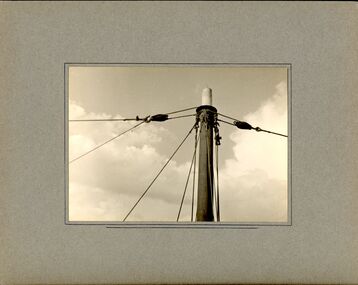
Photograph - Photograph - "S.S. Pan", n.d
... Photograph - "S.S. Pan"...Black & White photograph of the bow sprit of the S.S. Pan, mounted on grey card....Weak evening sunlight S.S. Pan with x 1 filter. C.O. Kroker "Kia Ora" P.B. ...Horsham Vic Black & White photograph of the bow sprit of the S.S. Pan, mounted on grey card. Photograph Photograph - "S.S. ...Con Kroker Private Collection Black & White photograph of the bow sprit of the S.S. Pan, mounted on grey card. Front: Pencil- A.P.R Competition July Open class senior. Idle Rigging. Weak evening sunlight S.S. Pan with x 1 filter. C.O. Kroker "Kia Ora" P.B. Horsham Vic -
 Flagstaff Hill Maritime Museum and Village
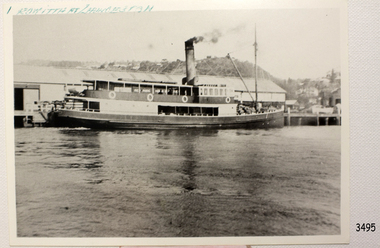
Photograph - Vessel, Steam Ship, S.S. Rowitta, Early 20th century
... S.S. Rowitta......s.s. rowitta...The photograph shows her docked at the Charles Street Wharf in Launceston. The S.S. Rowitta was built by Purdon & Featherstone, at Battery Point, Hobart (Tasmania) in 1909 from Huon Pine and Kauri planking. ...Black and white photograph of the steamship S.S. Rowitta at Charles Street Wharf, Launceston. ...The vessel was built in 1909 by Purdon & Featherstone, Hobart. S.S. Rowitta Photograph Vessel, Steam Ship ...The subject of this photograph is the S.S.Rowilla, a passenger steam ferry built in Hobart for use in Tasmania's rivers, the Derwent and the Tamar. The photograph shows her docked at the Charles Street Wharf in Launceston. The S.S. Rowitta was built by Purdon & Featherstone, at Battery Point, Hobart (Tasmania) in 1909 from Huon Pine and Kauri planking. Her final configuration included three masts and a ship rig. S.S. Rowitta took its first voyage from Hobart to Launceston in 1909 and operated for 30 years as a passenger ferry on the Tamar and Derwent Rivers. She also served as a freighter, an army supply ship, a luxury charter ferry and a floating restaurant as well as a prawn boat at Lakes Entrance. (She has also been named “Sorrento” and “Tarkarri”.). In the very early days of Flagstaff Hill ‘Rowitta’ was purchased from Lakes Entrance by Warrnambool City Council and the Victorian State Government for $20,000. The Rowitta had a hull configuration very similar to a local boat named the SPECULANT, which played a key role in the Port of Warrnambool in the early 1900s. The Speculant was the largest ship ever registered with Warrnambool as her home port. Local owner and trader P J McGennan & Co, (Peter McGennan) used her as a freight carrier to Melbourne and timber trader between New Zealand and Victoria. She sunk at Cape Otway in 1911 on a voyage to Melbourne. In 1974 Rowitta was delivered to Port Fairy and then later sailed to Warrnambool’s Breakwater where she was lifted out of Lady Bay and loaded onto the back of a long transport truck and slowly and carefully driven along Pertobe Road, through the Surfside Caravan Park and over the railway line, into Flagstaff Hill’s Maritime Village. Transfer arrangements were coordinated by Jack Morse, of Morse Engineering, a member of the Flagstaff Hill Planning Board, and Ken Goyen, a local crane operator. The ‘Rowitta’ was originally acquired to be rebuilt to match the original SPECULANT. When finances became tight in 1976 a review of all plans ended in the decision to restore the “Rowitta” to her original configuration. She was then restored, renamed the original name of “Rowitta” and installed in the Village’s Harbour Lake to become one of the popular vessels on display for visitors to enjoy. It was the decision of the Advisory Committee to Flagstaff Hill to have Rowitta demolished in April 2015 due to extensive deterioration. Items associated with the Rowitta continue to be held in Flagstaff Hill Maritime Village’s Collection. The photograph of the passenger ferry S.S. Rowitta.is significant for its association with Tasmanian history from the early to mid-1900s. It is also connected to the history of the Rowitta, which was a large exhibit on display at Flagstaff Hill Maritime Village from the museum’s early beginnings until the vessel’s end of life 40 years later. The Rowitta represents the importance of coastal traders to transport, trade and communication along the coast of Victoria, between states, and in Australia before rail and motor vehicles. The vessel was an example of a ferry built in the early 20th century that served many different roles over its lifetime of over 100 years. Black and white photograph of the steamship S.S. Rowitta at Charles Street Wharf, Launceston. It shows the vessel docked at the Charles Street Wharf in Launceston. Smoke is coming from its funnel and there are people on board. There is a handwritten inscription on the top edge of the photograph. The vessel was built in 1909 by Purdon & Featherstone, Hobart. Blue-green handwriting on top left margin "ROWITTA AT LAUNCESTON" flagstaff hill, warrnambool, shipwrecked-coast, flagstaff-hill, flagstaff-hill-maritime-museum, maritime-museum, shipwreck-coast, flagstaff-hill-maritime-village, photograph, s.s. rowitta, charles street wharf,, launceston., purdon & featherstone, rowitta, tarkarri, speculant, purdon & featherstone of hobart, passenger ferry 1909, sorrento -
 Ballarat Heritage Services
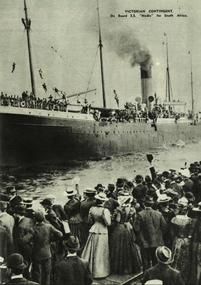
Photograph - Image, Victorian Contingent on Board S.S. Medic for South Africa, 1890
... Victorian Contingent on Board S.S. Medic for South Africa...S.S. Medic...Black and white photographic of the Victorian Contingent on Board S.S. Medic for South Africa. A number of people wave the vessel off....S.S. Medic Boer War ships army Black and white photographic of the Victorian Contingent on Board S.S. ...Black and white photographic of the Victorian Contingent on Board S.S. Medic for South Africa. A number of people wave the vessel off. s.s. medic, boer war, ships, army -
 Flagstaff Hill Maritime Museum and Village
Craft - Ship Model, S.S. Casino
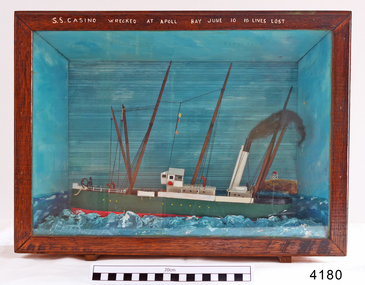
... S.S. Casino......s.s. casino...One was on 3rd January 1898 when she collided with the S.S. Flinders in Apollo Bay with minor damage. ...One was on 3rd January 1898 when she collided with the S.S. Flinders in Apollo Bay with minor damage. ...Ship model of coastal trader SS Casino in glass fronted case with stained wood frame. Ship has both steam and sail. Background of lighthouse on cliff, sea and sky. Ship painted green, 3 flags flying. Details (incorrect) of ship painted in white across top frame of case. The S.S. Casino was a passenger and freight steamer built in Dundee, Scotland, in 1882 for the Newcastle and Hunter River Steam Navigation Company of N.S.W. She weighed 425 tons gross with a length of 160.4 feet, beam of 24.1 feet and depth of 10.2 feet. She had saloon accommodation for 35 people, forecabin for 25 more people, and she carried 300 tons of cargo. While on her delivery journey on May 30th 1882 the S.S. Casino called in at the Port of Warrnambool for coal ., narrowly escaping going ashore in gale force winds due to the quick action of the pilot. At that time, still at anchor, she impressed the directors of the Belfast and Koroit Steam Navigation Company so much that they bought her immediately; she was ideal for trade in along the West Coast of Victoria. (Belfast is the original name for Port Fairy, South West Victoria. The Belfast and Koroit Steam Navigation Company was first managed by Messers. Saltau and Osburne and after the passing of Mr. Osburne, by produce merchants Messers H. Sautau and Sons, whose had a hay and corn store and shipping agency was on the corner of Liebig and Koroit Streets in Warrnambool. ) The S.S. Casino became “the most famous steamer to operate in Victorian waters along the West Coast” by author Jack Loney. Captain Boyd was her first Master, followed by Captain Chapman, who stayed with her 1890 until 1924. Captain W. Robertson followed for a short term, then Captain Middleton then took command 1925 - 1932. The S.S. Casino had several mishaps during her life. One was on 3rd January 1898 when she collided with the S.S. Flinders in Apollo Bay with minor damage. Another was on 24th October 1924 when she grounded on a reef at Point Hawdon near Grey River and most of her cargo (of Christmas goods) had to be dumped into the sea. Then in February 1929 she was ‘holed’ when she struck a submerged object as she entered Lady Bay, Warrnambool. On the morning of 10th July 1932, after attempting to berth at Apollo Bay jetty in heavy seas, Captain Middleton decided to take her out into the bay and wait until the seas abated. It was not realised that the anchor used to steady her as she manoeuvred to her berth had pierced her hull. She put about and headed for the beach but sank. Captain Middleton and nine others lost their lives; nine people were rescued including the two female passengers . Captain Middleton had been in charge of the S.S. Casino for seven years. He was the first ship’s Master to lose his life through shipwreck in the West Coast trade. In the years following the turn of the century the S.S. Casino remained the only regular trader with normal passenger accommodation along the West Coast. From 1882 she had made at least 2,500 voyages on the one run. Flagstaff Hill’s collection has a photograph of a portrait of Captain Chapman, , a ship model of the S.S. Casino that shows both forms of power under which she sailed, steam and sail. The ship is painted green and flies three flags. The inscription across the case of the ship model, incorrectly dated, tells the sad story of the wreck of the ship and the loss of lives on July 10th 1932 at Apollo Bay. A print in the Collection show S.S. Casino underway in heavy sea off Point Lonsdale, another two photographs show her at the Port of Warrnambool, leaving from the Breakwater in Lady Bay and another identifies the S.S. Casino as a ship from the Belfast and Koroit Steam Navigation Company. (Belfast is the original name for the township of Port Fairy). This ship model is significant because of its association with the coastal trader S.S. Casino 1882-1932 and its significance to trade along Victoria's West Coast in the late 19th and early 20th century. The wreck of the S.S. Casino is considered an important part of Victorian and Australian cultural heritage and as such has been declared and protected as an Historic Shipwreck under State and Commonwealth Law in the Commonwealth Historic Shipwrecks Act (1976). Ship model SS Casino in glass fronted case with stained wood frame. Ship has both steam and sail. Background of lighthouse on cliff, sea and sky. Ship painted green, 3 flags flying. Details of ship painted in white across top frame of case. NOTE: Correct details for shipwreck is 10 July 1932, at Apollo Bay Painted in white on wood across top of case "SS CASINO WRECKED AT APOLL BAY JUNE 10 10 LIVES LOST". flagstaff hill, warrnambool, shipwrecked coast, flagstaff hill maritime museum, maritime museum, shipwreck coast, flagstaff hill maritime village, great ocean road, newcastle and hunter river steam navigation company, belfast and koroit steam navigation company, h. sautau and sons, s.s. casino, west coast trader s.s. casino, victorian coastal trader, captain boyd, captain w. robertson, captain chapman, captain middleton, apollo bay shipwreck, s.s. casino at lady bay warrnambool, ship model s.s. casino, saltau and osburne -
 Mission to Seafarers Victoria
Photograph - Photograph, Colour, Allan Charles Quinn, New York to Cape Town - S.S. 'Morgenster', 19 February 1948
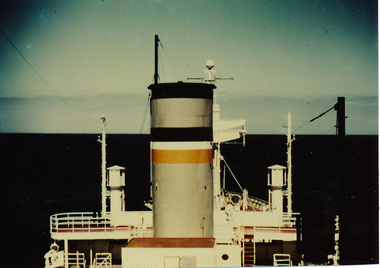
... New York to Cape Town - S.S. 'Morgenster'...This photograph is part of series of colour photographs taken by Allan Quinn while sailing to Cape Town from New York on the S.S. Morgenster. This ship is mentioned in some of Allan's letters (such as Object 0152)....A colour photograph of the S.S Morgenster, sailing from New York to Cape Town....New York to Cape Town - S.S. 'Morgenster' Photograph Photograph, Colour Allan Charles Quinn ...This photograph is part of series of colour photographs taken by Allan Quinn while sailing to Cape Town from New York on the S.S. Morgenster. This ship is mentioned in some of Allan's letters (such as Object 0152). This is a photograph from the Allan Charles Quinn collection which is a collection of letters and photographs depicting aspects of life at sea for a young man in the era immediately following World War II. A colour photograph of the S.S Morgenster, sailing from New York to Cape Town. Date on verso: 19-2-48 allan-quinn, colour-photograph, morgenster, cape-town, new-york -
 Mission to Seafarers Victoria
Photograph - Photograph, Colour, Allan Charles Quinn, New York to Cape Town - S.S. 'Morgenster', 19 February 1948
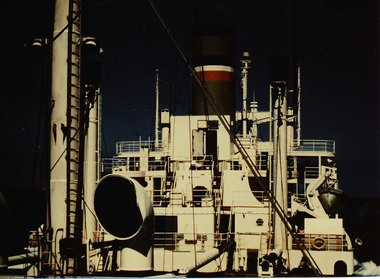
... New York to Cape Town - S.S. 'Morgenster'...This photograph is part of series of colour photographs taken by Allan Quinn while sailing to Cape Town from New York on the S.S. Morgenster. This ship is mentioned in some of Allan's letters (such as Object 0152)....A colour photograph of the S.S Morgenster, sailing from New York to Cape Town, ...A colour photograph of the S.S Morgenster, sailing from New York to Cape Town, New York to Cape Town - S.S. ...This photograph is part of series of colour photographs taken by Allan Quinn while sailing to Cape Town from New York on the S.S. Morgenster. This ship is mentioned in some of Allan's letters (such as Object 0152). This is a photograph from the Allan Charles Quinn collection which is a collection of letters and photograph depicting aspects of life at sea for a young man in the era immediately following World War II. A colour photograph of the S.S Morgenster, sailing from New York to Cape Town, Date on verso: 19-2-48. allan-quinn, colour-photograph, morgenster, cape-town, new-york -
 Mission to Seafarers Victoria
Photograph - Photograph, Colour, Allan Charles Quinn, New York to Cape Town - S.S. 'Morgenster', 19 February 1948
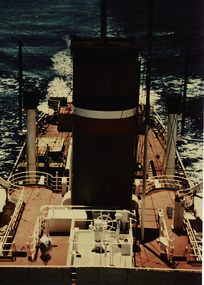
... New York to Cape Town - S.S. 'Morgenster'...This photograph is part of series of colour photographs taken by Allan Quinn while sailing to Cape Town from New York on the S.S. Morgenster. This ship is mentioned in some of Allan's letters (such as Object 0152)....A colour photograph of the S.S Morgenster, sailing from New York to Cape Town....New York to Cape Town - S.S. 'Morgenster' Photograph Photograph, Colour Allan Charles Quinn ...This photograph is part of series of colour photographs taken by Allan Quinn while sailing to Cape Town from New York on the S.S. Morgenster. This ship is mentioned in some of Allan's letters (such as Object 0152). This is a photograph from the Allan Charles Quinn collection which is a collection of letters and photograph depicting aspects of life at sea for a young man in the era immediately following World War II. A colour photograph of the S.S Morgenster, sailing from New York to Cape Town. Date on verso: 19-2-48 allan-quinn, colour-photograph, morgenster, cape-town, new-york -
 Mission to Seafarers Victoria
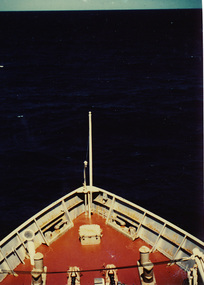
Photograph - Photograph, Colour, Allan Charles Quinn, New York to Cape Town - S.S. 'Morgenster', 19 February 1948
... New York to Cape Town - S.S. 'Morgenster'...This photograph is part of series of colour photographs taken by Allan Quinn while sailing to Cape Town from New York on the S.S. Morgenster. This ship is mentioned in some of Allan's letters (such as Object 0152)....A colour photograph of the ocean and the S.S Morgenster, sailing from New York to Cape Town....New York to Cape Town - S.S. 'Morgenster' Photograph Photograph, Colour Allan Charles Quinn ...This photograph is part of series of colour photographs taken by Allan Quinn while sailing to Cape Town from New York on the S.S. Morgenster. This ship is mentioned in some of Allan's letters (such as Object 0152). This is a photograph from the Allan Charles Quinn collection which is a collection of letters and photograph depicting aspects of life at sea for a young man in the era immediately following World War II. A colour photograph of the ocean and the S.S Morgenster, sailing from New York to Cape Town. Date on verso: 19-2-48 allan-quinn, colour-photograph, morgenster, cape-town, new-york -
 Mission to Seafarers Victoria
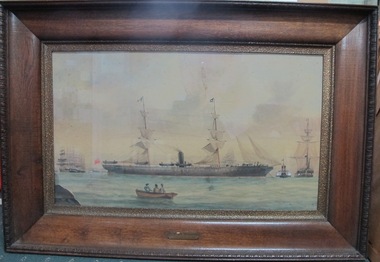
Painting, George Frederick Gregory (1821-1887), P&O S.S. Bangalore, 1867 - 1886
... P&O S.S. Bangalore...s.s. bangalore...Painted in black on plaque and coloured black: "P & O S.S. "BANGALORE" / 2342 tons Built 1867"...The painting may have been purchased during one of these two events. s.s. bangalore marine painting sailing ships 1867 william denny artwork-paintings peninsular and oriental steam navigation company steamship p&o sandridge port melbourne hobson's bay charles dickson gregory centenary maritime exhibition george frederick gregory (1821-1887) ss bangalore Painted in black on plaque and coloured black: "P & O S.S. ...This ship was number 1 of 2 ships named Bangalore and run by P & O. This ship has listed the same tonnage as that on the inscription on the frame of this work. The ship was subsequently sold in 1886 sold to Hajee Cassum Joosub and used for passengers on pilgrimage into Jeddah. Another view of the history of the Bangalore is that to be found at the Maritime Museums of Sydney listing of another painting of the Bangalore which provides a somewhat different history. It is possible that the story of Bangalore 1 and Bangalore 2 have become conflated further research is needed to verify. see Links field. SS BANGALORE was built in 1867 by William Denny of Dumbarton. Owned by P&O, SS BANGALORE operated from Bombay and Galle to Melbourne and Sydney from 1872 to 1886 as a passenger and mail ship. In 1891 BANGALORE was sold to Wilh. Wilhelmsen, Norway and renamed SS CORINGA. Marine art, Maritime art P&O S.S. Bangalore by George Frederick Gregory (1821-1887) Thinly painted image on board featuring centrally a moored, at anchor, 19th C dual masted steamship with black funnel and flying at the stern a red ensign. To either side are conventional rigged clippers or sailing ships. Near the bow of the steamship there seems to be a tug or paddle steamer face on. In the foreground is a small rowing boat with boatman and two passengers, a male and a female. The painting on board is mounted in a large polished or varnished cedarwood frame with edge carving and a decorative pitted slip which holds in place a thin piece of glazing. Backing paper and seal has all been removed except for hanging wire. Central at front lower edge of frame is a small chipped wood plaque with inscription. Painted in black on plaque and coloured black: "P & O S.S. "BANGALORE" / 2342 tons Built 1867" s.s. bangalore, marine painting, sailing ships, 1867, william denny, artwork-paintings, peninsular and oriental steam navigation company, steamship, p&o, sandridge, port melbourne, hobson's bay, charles dickson gregory, centenary maritime exhibition, george frederick gregory (1821-1887), ss bangalore -
 Mission to Seafarers Victoria
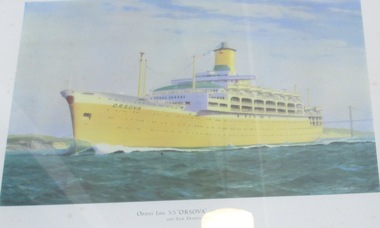
Print - Print, framed, William Howard Jarvis (1903-1964), Orient Line S.S. Orsova off San Francisco, 1954-1966
... Orient Line S.S. Orsova off San Francisco...s.s. orsova...Printed inscription on border of print at lower centre edge: "Orient Line S.S. Orsova / Off San Francisco"...Print is mounted glazed with thin gilded and moulded frame. Orient Line S.S. Orsova off San Francisco Print Print, framed William Howard Jarvis (1903-1964) ...British painter Howard Jarvis was best known for his maritime landscape paintings. An early member of the Society of Marine Artists (UK), formed in 1939, he went to sea on merchant ships and served in the Royal Navy during World War II. His works were influenced by marine artist Kenneth Shoesmith. Jarvis was commissioned by the Cunard-White Star Cruises to create a stone litho poster, which was quite well known, giving passengers a birds-eye view of a cruise ship. SS Orsova, built in 1954, was a British ocean liner for the Orient Steam Navigation Company until 1960, then P&O Orient Lines between 1960-1966, although the Orient ships retained their corn-coloured hulls and sailed under their own house flag. The colour of the hull on the print indicates it was made between 1954 and 1966. On 24 May 1956, Orsova ran aground off Port Phillip Bay, Melbourne, for twelve hours. In 1966 P&O acquired the balance of the Orient Line shares and all their ships were painted white. In the 1960s, Orsova carried many thousands of emigrants from Greece and Italy to Australia. It was staffed by approximately 600 crew and carried over a 1000 passengers. Maritime Art, Marine art Colour printed reproduction of a painting or lithograph print featuring 20th C passenger liner, hull and superstructure primarily painted pale yellow, under steam at sea. Print is mounted glazed with thin gilded and moulded frame. Printed inscription on border of print at lower centre edge: "Orient Line S.S. Orsova / Off San Francisco" s.s. orsova, passengers ships, steamship, emigration, greece, italy, australia, passenger liner, melbourne, port phillip bay, artwork-paintings, w. howard jarvis, orient line, p and o, peninsular and oriental steam navigation company, ocean liner, passengers liners, passenger ships -
Glenelg Shire Council Cultural Collection
Photograph, S.S. (Turbine) 'Ixion', 1959
... S.S. (Turbine) 'Ixion'...Black and white photograph.View of S.S. Ixion berthing at K.S.Anderson wharf, Port of Portland. ...Front: S.S. (Turbine) 'Ixion' (upper centre) First ship to berth at the K.S.Anderson Wharf/ Portland Victoria/ 9th October 1959 (lower centre) Back: (no inscriptions)...Port of Portland maritime SSIxion K S Anderson Wharf Front: S.S. (Turbine) 'Ixion' (upper centre) First ship to berth at the K.S.Anderson Wharf/ Portland Victoria/ 9th October 1959 (lower centre) Back: (no inscriptions) Black and white photograph.View of S.S. ...Port of Portland Authority archives. Front: S.S. (Turbine) 'Ixion' (upper centre) First ship to berth at the K.S.Anderson Wharf/ Portland Victoria/ 9th October 1959 (lower centre) Back: (no inscriptions) port of portland, maritime, ssixion, k s anderson wharf -
Victorian Maritime Centre
Mustard Cup
... ...S.S Ormiston...Silver souvenir mustard cup with logo S.S Ormiston...S.S Ormiston...At the time of ocean liner holiday cruising, many people purchased these souvenirs to keep or give away as gifts. merchant souvenir S.S Ormiston Cup S.S Ormiston Silver souvenir mustard cup with logo S.S Ormiston Mustard Cup ...The souvenir silver metal mustard cup was purchased sometime during a cruise by an unknown person. It is part of a cruise liner collection by D. Benson and Family over a period of years. D. Benson sold part of the collection to the V.M.C who purchased the remaining part. It is a great source of information to visitors to the V.M.C. At the time of ocean liner holiday cruising, many people purchased these souvenirs to keep or give away as gifts. Silver souvenir mustard cup with logo S.S Ormiston S.S Ormiston merchant souvenir, s.s ormiston, cup -
Victorian Maritime Centre
Dish - Glass
... ...S.S Orcades...Glass Dish with a photo of the S.S Orcades on right side....Logo S.S Orcades...At the time of ocean liner holiday cruising, many people purchased these souvenirs to keep or give away as gifts. souvenir cruise liners S.S Orcades Logo S.S Orcades Glass Dish with a photo of the S.S Orcades on right side. ...The glass dish was purchased sometime during a cruise by an unknown person. It is part of a cruise liner collection by D. Benson and Family over a period of years. D. Benson sold part of the collection to the V.M.C who purchased the remaining part. It is a great source of information to visitors to the V.M.C. At the time of ocean liner holiday cruising, many people purchased these souvenirs to keep or give away as gifts. Glass Dish with a photo of the S.S Orcades on right side. Logo S.S Orcades souvenir, cruise liners, s.s orcades -
 Mission to Seafarers Victoria
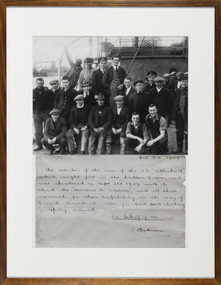
Photograph - Reproduction, Black and white, Mission to Seafarers Victoria, The members of the crew S.S. Siltonhall 1929, c. 2009
... The members of the crew S.S. Siltonhall 1929...This photograph is part of reproductions of images from the MTS archive collection: the members of the crew S.S. Siltonhall sent the thank you letter and the attached photograph to the Mission after their shipwreck in 1929....Framed and mounted black and white reproduction of photograph from the archive: group photograph of the crew S.S. Siltonhall after the shipwreck in 1929 with the attached letter sent to thank the mission for helping them....The members of the crew S.S. Siltonhall 1929 Photograph Reproduction, Black and white Mission to Seafarers Victoria ...This photograph is part of reproductions of images from the MTS archive collection: the members of the crew S.S. Siltonhall sent the thank you letter and the attached photograph to the Mission after their shipwreck in 1929. Framed and mounted black and white reproduction of photograph from the archive: group photograph of the crew S.S. Siltonhall after the shipwreck in 1929 with the attached letter sent to thank the mission for helping them. mission to seafarers, mission to seamen, flinders street, melbourne, seafarers, seamen, padre oliver, crew, ships, seafaring life, sailors -
Victorian Maritime Centre
Serviette Ring
... ...S.S Strathnaver...A metal triangular serviette ring with logo S.S Strathnaver embedded thereon....S.S Strathnaver...At the time of ocean liner holiday cruising, many people purchased these souvenirs to keep or give away as gifts. merchant souvenir S.S Strathnaver S.S Strathnaver A metal triangular serviette ring with logo S.S Strathnaver embedded thereon. ...The souvenir metal serviette ring was purchased sometime during a cruise by an unknown person. It is part of a cruise liner collection by D. Benson and Family over a period of years. D. Benson sold part of the collection to the V.M.C who purchased the remaining part. It is a great source of information to visitors to the V.M.C. At the time of ocean liner holiday cruising, many people purchased these souvenirs to keep or give away as gifts. A metal triangular serviette ring with logo S.S Strathnaver embedded thereon. S.S Strathnaver merchant souvenir, s.s strathnaver
