
Showing 4 items matching "s.s. graves"
-
 Federation University Historical Collection
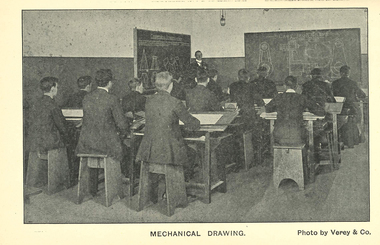
Booklet, Leader Printing Works, The Castlemaine Technical School and Trade Workshops Prospectus 1919, For Engineering, Trade and Art Students, 1919
... ...s.s. graves...The objectives of the Castlemaine School and Trade Workshops is "to fully equip all Students in the full basic principles of Science, Engineering or Art: and from an establishment of such, to then specialise in the various branches of the same; hence it affords opportunity for investigation into Chemistry, Metallurgy, and the various avenues of Engineering Science and Art." castlemaine technical school castlemaine technical school prospectus trade workshops w.v. dam m.t. fogarty a.d. freeman w. corlett t.h. mccreery a. verey j. bennett a.c. elvish colonel j.w.b. field Reverend f.a. hagenauer j. lowry h.s.w. lawson j.w.c. short h.t. govett j. stell s.s. graves f.w. adams c.w. steiner geo chaster c.w. joy e.r. lewis s.j. ellis e. dann t.t. wells j. robertson v. henderson f.a. moran f. barry j. colbert h. payne schools of mines principal registrar science engineering art chemistry metallurgy Brown soft covered booklet with 36 pages and information on office bearers, teaching staff, objects of the school, information for parents, courses, subjects and fees. ...Used at Ballarat School of Mines and Industries Ballarat. The objectives of the Castlemaine School and Trade Workshops is "to fully equip all Students in the full basic principles of Science, Engineering or Art: and from an establishment of such, to then specialise in the various branches of the same; hence it affords opportunity for investigation into Chemistry, Metallurgy, and the various avenues of Engineering Science and Art."Brown soft covered booklet with 36 pages and information on office bearers, teaching staff, objects of the school, information for parents, courses, subjects and fees.castlemaine technical school, castlemaine, technical school, prospectus, trade workshops, w.v. dam, m.t. fogarty, a.d. freeman, w. corlett, t.h. mccreery, a. verey, j. bennett, a.c. elvish, colonel j.w.b. field, reverend f.a. hagenauer, j. lowry, h.s.w. lawson, j.w.c. short, h.t. govett, j. stell, s.s. graves, f.w. adams, c.w. steiner, geo chaster, c.w. joy, e.r. lewis, s.j. ellis, e. dann, t.t. wells, j. robertson, v. henderson, f.a. moran, f. barry, j. colbert, h. payne, schools of mines, principal, registrar, science, engineering, art, chemistry, metallurgy -
 Victorian Interpretive Projects Inc.
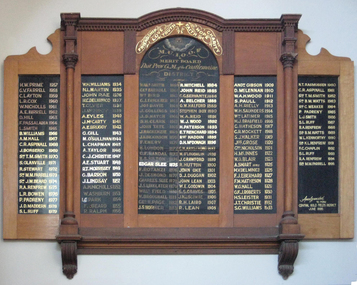
Photograph - Honour Board, Clare Gervasoni, Manchester Unity Indipendant Order of Oddfellows (MUIOOF+ Honour Board, 2013
... Duggan 1903 john Lean 1904 W.E. Goodwin 1905 S.S. graves 1906 J.H. Liscombe 1907 R.H. Laird 1908 R. ...Duggan 1903 john Lean 1904 W.E. Goodwin 1905 S.S. graves 1906 J.H. Liscombe 1907 R.H. Laird 1908 R. ...The original Honour Board for the Castlemaine branch of the Manchester Unity Independent Order of Oddfellows was hanging in the Castlemaine Market Building in 2013.Colour photograph of a timber honour board for the Provincial Grand Masters of the Castlemaine Branch of the Manchester Unity Independent order of Oddfellows. The Provincial Grand Masters are: 1859 Wal Smith 1861 George Farroll 1862 William Bird 1863 G.J. Fawkner 1864 Joseph Davie 1865 J. Collings 1866 J.D. Hatch 1867 S.H. Clark 1868 John Tate 1869 J. Mackenzie 1870 J.H. Dickinson 1871 F. Emery 1872 H. London 1873 C.F. Randal 1874 H.S. Hilton 1875 Edgar Slee 1876 Francis Rotanzi 1877 J. Desmond 1878 Charles Slee 1879 J.S. Unklater 1880 William Field 1881 W. Broughall 1882 George H. Page 1883 J.S. Horner 1884 R. Mitchell 1885 John Reid 1886 C.C Servante 1888 A. Belcher 1889 G.W. Halford 1890 Stephen Box 1891 W.A. Reid 1892 W.J. Wood 1893 H. Paterson 1894 E. Trenchard 1895 Robert Maddin 1896 D.H. McDonach 1897 C.W. Armstrong 1898 M. O'Loughlan 1899 J. Crawford 1900 R. Hutton 1901 John Oke 1902 D.J. Duggan 1903 john Lean 1904 W.E. Goodwin 1905 S.S. graves 1906 J.H. Liscombe 1907 R.H. Laird 1908 R. Leanmanchester unity independent order of oddfellows, muioof, castlemaine -
 Bendigo Military Museum
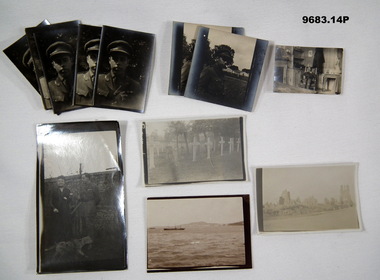
Photograph - VARIOUS PHOTOGRAPHS, WW1, C.1916 - 1919
... McQuie MM, refer Cat No 9680P for his service details. .1) - .7) Portraits are of McQuie MM. .8) .9) McQuie MM. .10) Identity unsure. .11) McQuie MM. .12) The first grave on the left is No 860 S.S. Scott 6th Bn, D.O.W's 12.6.1918....McQuie MM, refer Cat No 9680P for his service details. .1) - .7) Portraits are of McQuie MM. .8) .9) McQuie MM. .10) Identity unsure. .11) McQuie MM. .12) The first grave on the left is No 860 S.S. Scott 6th Bn, D.O.W's 12.6.1918. photos McQuie .1) - .7) Six B & W portrait photos of an Officer in a peak Cap wearing ribbons one being the "MM". .8) - .9) Two B & W photos of an Officer with a building in the background. .10) B & W photo of an Officer sitting in a chair in a house. .11) B & W photo shows a Lady and an Officer with a brick wall in the background, the Officer is wearing ribbons and "A" for ANZAC on his shoulder patch. .12) B & W photo of a grave yard with 6 graves in one row. .13) Sepia photo of a bombed town. .14) Sepia photo showing a ship on the ocean with land in the background. ...These photos were in the collection relating to C.J.C. McQuie MM, refer Cat No 9680P for his service details. .1) - .7) Portraits are of McQuie MM. .8) .9) McQuie MM. .10) Identity unsure. .11) McQuie MM. .12) The first grave on the left is No 860 S.S. Scott 6th Bn, D.O.W's 12.6.1918..1) - .7) Six B & W portrait photos of an Officer in a peak Cap wearing ribbons one being the "MM". .8) - .9) Two B & W photos of an Officer with a building in the background. .10) B & W photo of an Officer sitting in a chair in a house. .11) B & W photo shows a Lady and an Officer with a brick wall in the background, the Officer is wearing ribbons and "A" for ANZAC on his shoulder patch. .12) B & W photo of a grave yard with 6 graves in one row. .13) Sepia photo of a bombed town. .14) Sepia photo showing a ship on the ocean with land in the background. photos, mcquie -
 Geelong Naval and Maritime Museum
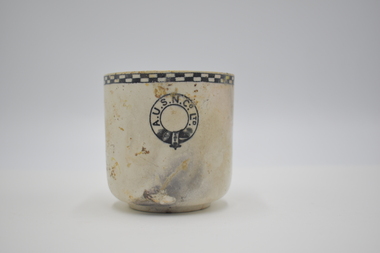
Teacup
... The Orungal was originally built in Glasgow in 1923 for the Khedival Mail Steamship & Graving Dock Company of Egypt and named the S.S. Fezara. Due to the effects on steamship companies of the Great Depression including the steep costs of building new ships and increases in running costs and port charges, no new passenger ships had been ordered in Australia since before World War One. ...The Orungal was originally built in Glasgow in 1923 for the Khedival Mail Steamship & Graving Dock Company of Egypt and named the S.S. Fezara. Due to the effects on steamship companies of the Great Depression including the steep costs of building new ships and increases in running costs and port charges, no new passenger ships had been ordered in Australia since before World War One. ...The Orungal was originally built in Glasgow in 1923 for the Khedival Mail Steamship & Graving Dock Company of Egypt and named the S.S. Fezara. Due to the effects on steamship companies of the Great Depression including the steep costs of building new ships and increases in running costs and port charges, no new passenger ships had been ordered in Australia since before World War One. To meet demand for passenger berths, the Fezara (5826 tons) along with its sister ship the Famaka (5856 tons, renamed Ormiston), were chartered by the Australasian United Steam Navigation Company Ltd (A.U.S.N.Co.) in 1927. Both the A.U.S.N.Co and the Khedival Mail Steamship Co. were part of the P&O Group. The Orungal operated in this role as an interstate passenger and mail steamer between 1927 and 1940, being used mainly on the Melbourne to Queensland and Western Australian runs, with 240 single class berths. Following the outbreak of World War Two six of the nine large passenger liners servicing mainland Australian passenger and mail trades were requisitioned by the Government to ferry equipment, troops and supplies. Some of them were converted to armed merchant cruisers and used for patrol work and escort duties in the Indian and Pacific Oceans. The Orungal had originally been requisitioned by the government along with the Zealandia on 25 June 1940, to transport troops to Darwin, but was returned to commercial service because "of her unsuitability", perhaps too slow for the demands of the work. Despite being rejected for patrol and convoy duties the Orungal still had a vital role as one of only three passenger liners left to service the mainland Australian trade. Following its requisitioning by the Government shortly after war broke out, it had been fitted out with defensive armament. On its final voyage arriving at Port Phillip Heads from Sydney, Captain Gilling was attempting to enter the Heads ahead of a worsening south-westerly storm and, with a minefield known to have been laid in the area, had been warned by the Navy not to deviate from the swept channel. The captain and crew held fears that in the stormy seas a mine may have been carried away. In the worsening weather a blur of lights at Barwon Heads was mistaken for Port Lonsdale, and the Orungal steamed ashore onto Formby Reef, just east of the entrance of the Barwon River - instead of passing safely through the middle of the Rip. At the Marine Board Inquiry Capt. Gilling - who had been master of the Orungal since 1926 - stated that after becoming uneasy about his position and changing course to starboard one point: " At 10.21 pm I ordered the engine room to stand by and gave instructions for the patent log to be hauled in and for the sounding-gear to be got ready. Approximately two minutes later, in a flash of lightning, I saw land off the port beam. I immediately recognised it as Barwon Heads, and ordered the helm to be put hard to starboard, but the vessel struck before she had time to answer the helm" Barwon Heads and Ocean Grove residents were startled to hear the shrill blast of the ship's whistle, followed by the bright flares and explosions of signal rockets. The Queenscliff lifeboat crew, who had responded to the tragic collision between the Goorangai and another passenger liner the Duntroon in Port Phillip Bay less than 24 hours earlier, were later praised for their efforts in safely taking off all the passengers and crew. Most of the passengers were asleep at the time of the wreck, and were woken up by the commotion, the ship shaking "from stem to stern" and stewards ordering them to lifeboat stations in driving rain. It was a dramatic time with the ship siren wailing and distress rockets being fired. It was reported that "When it was found the ship was safe, the passengers all went to the music room. There they sang and danced for several hours. The ship's orchestra played merrily, and amateur performers among the passengers clowned, danced and sang to keep the laughter going. In the early hours of the morning passengers went to their cabins, most of them to sleep soundly while the keel grated on the rocks". At dawn the Queenscliff lifeboat arrived at the scene having been launched at 2.30am, and cautiously approached the ship which was being "battered by mountainous seas". By 5am oil from a burst oil line was helping to calm seas around the Orungal sufficiently enough for the lifeboat to approach, and all the passengers and crew were taken off in several trips by the lifeboat. A Court of Inquiry later found that the wreck was caused by an abnormal set of current to the north-west and cleared the officers and crew of neglect of duty. The sight of a huge liner almost on the beach saw an unprecedented amount of traffic as people drove an estimated 10,000 cars, using some 60,000 gallons of fuel in a time of strict petrol rationing, to see the spectacle. Salvage operations began in an attempt to refloat the vessel, scheduled for the high tide on 15 December 1940. However, during these operations, at 2.30 am on 13 December 1940, a major fire broke out, believed to have been caused by spontaneous combustion in the boiler room. The ship was soon ablaze, with smoke pouring from its hatches and ventilators, and at mid-morning the magazine exploded fiercely. Of the 60 men working aboard the vessel two were severely burned and had to be taken to Geelong Hospital. The gathered spectators witnessed the eerie sight of the ship's hull glowing red when night fell. The well-known building demolition contractor Whelan the Wrecker bought the salvage rights, and methodically proceeded to dismantle the ship and its fittings. The drama was not yet over for the wreckers when - without warning - the burnt-out hulk was 'attacked' by RAAF for strafing practice. Salvage rights were transferred to another private owner in 1963. By 1945 the combined effects of the exposed location, fire and salvage had seen what was left of the wreck disappear beneath the waves. The site today is marked by two of the four Scotch type boilers sitting upright and exposed at low tide, just north-east of the small boats channel at the entrance to Barwon Heads. Large sections of steel hull plating and framing, and impressively large pieces of ships structure and machinery including masts, booms, deck winches, propeller shaft, flywheel, and a thrust block lie scattered about and make the site an interesting shallow dive. It is interesting to compare the site of the Orungal with the intact remains of similar large passenger ships scuttled in deep water in the Ships' Graveyard, such as the Milora and Malaita. The site is subject to waves and surge, and is best dived on flat calm days The teacup originated from the SS Orungal and was likely used heavily in the ship's life as a passenger, mail and cargo carrier around Australia. The teacup is significant for its connections to SS Orungal and of this ships connected story of being sunk in extraordinary circumstances in the local region. A.U.S.N. Co. Ltd. Teacup salvaged from SS Orungal ss orungal, fezara, world war two, barwon heads, ocean grove
