
Showing 295 items matching "safety equipment."
-
 Moorabbin Air Museum
Manual (Item) - QANTAS Boeing 707-338C Safety Equipment and Emergency Procedures
... QANTAS Boeing 707-338C Safety Equipment and Emergency Procedures...QANTAS Boeing 707-338C Safety Equipment and Emergency Procedures...Moorabbin Air Museum Moorabbin Airport 12 First Street Moorabbin melbourne QANTAS Boeing 707-338C Safety Equipment and Emergency Procedures Manual QANTAS Boeing 707-338C Safety Equipment and Emergency Procedures ... -
Moorabbin Air Museum
Manual (item) - Douglas DC-4 Safety Equipment & Emergency Procedures - QANTAS
... Douglas DC-4 Safety Equipment & Emergency Procedures - QANTAS...Douglas DC-4 Safety Equipment & Emergency Procedures - QANTAS...Moorabbin Air Museum Moorabbin Airport 12 First Street Moorabbin melbourne Douglas DC-4 Safety Equipment & Emergency Procedures - QANTAS Manual Douglas DC-4 Safety Equipment & Emergency Procedures - QANTAS ... -
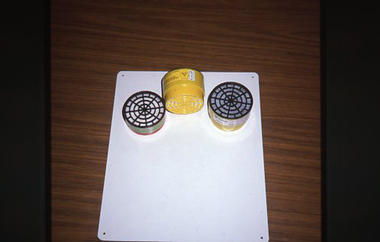 University of Melbourne, Burnley Campus Archives
Album - Colour slides, Kodachrome, Arboriculture - Safety Equipment, 1986-1998
... Arboriculture - Safety Equipment......safety equipment...Collection of Colour slides demonstrating safety equipment. 14 May 1986. 8 undated. Some duplicatred....University of Melbourne, Burnley Campus Archives 500 Yarra Boulevard Richmond melbourne demonstration safety equipment gloves masks respirators boots arboriculture Collection of Colour slides demonstrating safety equipment. 14 May 1986. 8 undated. ...Collection of Colour slides demonstrating safety equipment. 14 May 1986. 8 undated. Some duplicatred.demonstration, safety equipment, gloves, masks, respirators, boots, arboriculture -
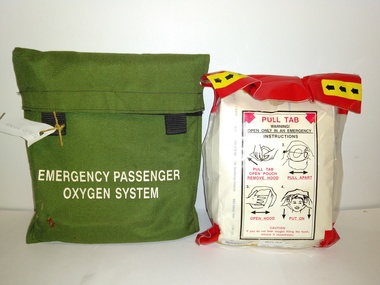 The 5th/6th Battalion Royal Victoria Regiment Historical Collection
Equipment - Safety Equipment, Emergency Passenger Oxygen System, 1997
... Safety Equipment...safety equipment from a C130 most likely acquired by a member of the battalion...Emergency Passenger Oxygen System Equipment Safety Equipment ...safety equipment from a C130 most likely acquired by a member of the battalionGreen Cordura bag with Velcro closure. Inside is a complete EPOS system still sealed in a plastic bag.Emergency Passenger Oxygen System -
Moorabbin Air Museum
Booklet (Item) - Ansett Technical Training Centre Ramp Safety And Ground Equipment
... Ansett Technical Training Centre Ramp Safety And Ground Equipment....Ansett Technical Training Centre Ramp Safety And Ground Equipment....Moorabbin Air Museum Moorabbin Airport 12 First Street Moorabbin melbourne Ansett Technical Training Centre Ramp Safety And Ground Equipment. Booklet Ansett Technical Training Centre Ramp Safety And Ground Equipment. ... -
National Vietnam Veterans Museum (NVVM)
Photograph, Never too late to say thank you
... ...2 Squadron Safety Equipment Section...The b/w photo shows the members of 2 Squadron, Safety Equipment Section - Vietnam 1971. The coloured photo is of Lindsay Tucker in later years....National Vietnam Veterans Museum (NVVM) 25 Veterans Drive Newhaven phillip-island-and-the-bass-coast John Downing Lindsay Tucker 2 Squadron Safety Equipment Section 2 photos. 1 b/w & 1 coloured. ...2 photos. 1 b/w & 1 coloured. The b/w photo shows the members of 2 Squadron, Safety Equipment Section - Vietnam 1971. The coloured photo is of Lindsay Tucker in later years.john downing, lindsay tucker, 2 squadron safety equipment section -
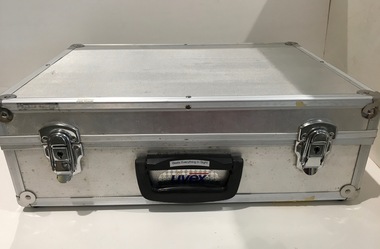 Federation University Historical Collection
Equipment - Equipment - Safety Glasses, VIOSH: Polarised Safety Glasses by UVEX of Germany
... Equipment - Safety Glasses...The produce safety equipment - polarised safety glasses. These have a combination of different coatings on the lens suitable for a wide range of workplaces. ...The produce safety equipment - polarised safety glasses. These have a combination of different coatings on the lens suitable for a wide range of workplaces. ...Victorian Institute of Occupational Safety and Health (VIOSH) Australia is the Asia-Pacific centre for teaching and research in occupational health and safety (OHS) and is known as one of Australia's leaders on the field. VIOSH has a global reputation for its innovative approach within the field of OHS management. VIOSH had its first intake of students in 1979. At that time the Institution was known as the Ballarat College of Advanced Education. In 1990 it became known as Ballarat University College, then in 1994 as University of Ballarat. It was 2014 that it became Federation University. VIOSH Australia students are safety managers, senior advisors and experienced OHS professionals. They come from all over Australia and industry. Students are taught active research and enquiry; rather than textbook learning and a one-size fits all approach. VIOSH accepts people into the Graduate Diploma of Occupational Hazard Management who have no undergraduate degree - on the basis of extensive work experience and knowledge. UVEX is a German company with over 95 years experience. The produce safety equipment - polarised safety glasses. These have a combination of different coatings on the lens suitable for a wide range of workplaces. Also have self tinting coating that darkens when exposed to UV.Silver metal case. Interior has two removable trays, each divided into sections. Top tray has various lenses, bottom tray has various frames.viosh, victorian institute of occupational safety and health, uvex, germany, polarised safety glasses, coating on lens of glasses, self tinting -
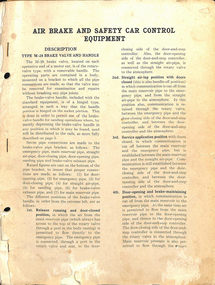 Melbourne Tram Museum
Document - Instruction, "Air Brake Safety Car Control Equipment", 1920's
... "Air Brake Safety Car Control Equipment"...Instruction - 24 pages, with two punch holes and stapled on the left hand side titled "Air Brake Safety Car Control Equipment" number 84450.1B, pages 3 to 26. ..."Air Brake Safety Car Control Equipment" Document Instruction ...Instruction - 24 pages, with two punch holes and stapled on the left hand side titled "Air Brake Safety Car Control Equipment" number 84450.1B, pages 3 to 26. Details the M28 brake valve, sanding features, operation, door and step controllers, check valve, CP-25C air compressor, brake valves, air compressor governors, drawings of piping, maintenance, testing, faults and general operation. See Reg Item. 3478 for another similar document. No details as to who published it or dates.trams, tramways, electrical engineering, electrical equipment, air compressors, brakes, instructions, maintenance, controllers -
 Melbourne Tram Museum
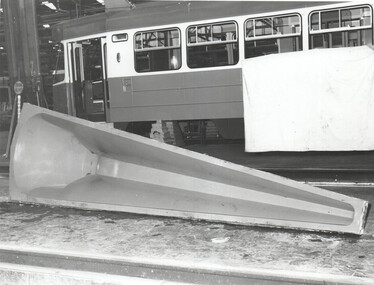
Photograph - MMTB Safety Zones equipment - set of 2, Melbourne & Metropolitan Tramways Board (MMTB), 1970s
... MMTB Safety Zones equipment - set of 2...Set of 2 photos showing equipment provided at MMTB Safety Zones 1 - a new safety zone prow with a new Z class tram on stands at Preston Workshops behind. 2 - safety zone tubular steel fence at the Collins St stop for Elizabeth St with the National Bank building behind....Photograph MMTB Safety Zones equipment - set of 2 Melbourne & Metropolitan Tramways Board (MMTB) ...Set of 2 photos showing equipment provided at MMTB Safety Zones 1 - a new safety zone prow with a new Z class tram on stands at Preston Workshops behind. 2 - safety zone tubular steel fence at the Collins St stop for Elizabeth St with the National Bank building behind.Demonstrates the work of the MMTB in the provision of safety zones at tram stops.Black and white print - set of 2, photo 2 has MMTB Stamp on the rear.tramways, safety zones, collins st -
 Melbourne Tram Museum
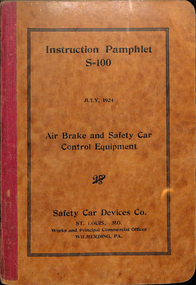
Document - Instruction, Safety Car Devices Co. St Louis, "Instruction Pamphlet S-100, Air Brake and Safety Car Control Equipment", Jul. 1924
... "Instruction Pamphlet S-100, Air Brake and Safety Car Control Equipment"...Titled "Instruction Pamphlet S-100, Air Brake and Safety Car Control Equipment", published July 1924 by the Safety Car Devices Co. ...equipment. Book scanned into three sections. See also Reg Item 3513 for another similar document. "Instruction Pamphlet S-100, Air Brake and Safety Car Control Equipment" Document Instruction Safety Car Devices Co. ...Instruction - 108 pages + 9 fold out drawings glued and stapled in at the rear + card covers with red cloth binding, rounded right hand edges, centre stapled. Titled "Instruction Pamphlet S-100, Air Brake and Safety Car Control Equipment", published July 1924 by the Safety Car Devices Co. St Louis. Includes the M28 Brake valve. Describes in detail the rules for operation, parts, description, M28 Brake Valves, Maintenance, Practical car tests, hints, defects. The 9 drawings at the rear of the document give detail arrangements of the piping and control equipment. Book scanned into three sections. See also Reg Item 3513 for another similar document.on top of first page "C. Hodgson"trams, tramways, electrical engineering, electrical equipment, air compressors, brakes, instructions, maintenance, controllers -
 Flagstaff Hill Maritime Museum and Village
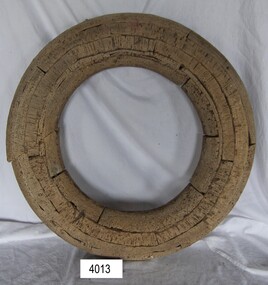
Equipment - Lifebuoy, late 19th to early 20th century
... ...safety equipment...They are part of a ship's safety equipment. The cork material is very buoyant. ...They are part of a ship's safety equipment. The cork material is very buoyant. ...Lifebuoys are flotation devices used to rescue and save people whose lives are at risk in the water. They are part of a ship's safety equipment. The cork material is very buoyant. The first use of life saving devices in recent centuries was by the Nordic people, who used light weight wood or cork blocks to keep afloat. From the early 20th century Kapok fibre was used as a filling for buoys. Light weight balsa wood was used as a filler after WW1. In 1928 Peter Markus invented and patented the first inflatable life-preserver. By WW2 foam was combined with Kapok. Laws were passed over time that has required aeroplanes and water going-vessels to carry life-preservers on board. The lifebuoy is an example of equipment carried on vessels in the late 19th and early 20th century to help preserve life. There were many lives lost in Australia’s colonial period, particularly along the coast of South West Victoria.Lifebuoy, round cork inner only, no canvas covering.flagstaff hill, warrnambool, shipwrecked-coast, flagstaff-hill, flagstaff-hill-maritime-museum, maritime-museum, shipwreck-coast, flagstaff-hill-maritime-village, lifebuoy, cork lifebuoy, flotation device, safety equipment, life rings, safety ring, life-saving buoy, ring buoy, life preserver, personal floating device, floatation device -
 Flagstaff Hill Maritime Museum and Village
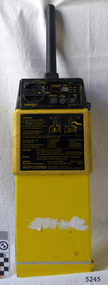
Equipment - EPIRB Transmitter
... ...Safety equipment...Offshore cruising vessels must have such a unit as part of its essential safety equipment. This model EPIRB relies on four satellites with orbit times of approximately 100 minutes. ...Offshore cruising vessels must have such a unit as part of its essential safety equipment. This model EPIRB relies on four satellites with orbit times of approximately 100 minutes. ...This distress EPIRB unit (Emergency Position Indication Radio Beacon) was found on the beach at Levy's Point, Warrnambool, in December 2000 by a Warrnambool resident. Local police were alerted at the time. This distress signal unit is a world-wide COSPAS/SARSAT, satellite assisted, SAR (Search and Rescue) system for location of distress transmissions emitted by an EPIRB. Offshore cruising vessels must have such a unit as part of its essential safety equipment. This model EPIRB relies on four satellites with orbit times of approximately 100 minutes. Earlier units relied solely on aircraft flying overhead to detect and forward on the EPIRB’s location to Search And Rescue authorities, whereas this new system utilises satellites. An employee from the Lokata firm provided additional information about the Lokata EPIRB units. They had a machined aluminium case with labels that were also made on site. The units could be activated manually or automatically released when a magnetic switch in the case casing was activated. This later model, circa 1983, would have been mounted externally on a vessel's bulkhead in a spring-loaded, stainless-steel protective 'skeleton' mounting, The unit released when the water pressure sensor detected a set time it was under the water, in a similar way that life crafts were released. Each unit was registered to a particular vessel - the vessel's details on this unit are indecipherable. The Lokata Company was established in 1970, designing and manufacturing marine products including communications. The company no longer makes products with the “Lokata” brand. In 2001 Sartech Engineering Ltd. took over the support for the Lokata EPIRB beacons. This emergency location device is a late 20th century invention to help save lives at sea. It adds to the history of maritime life, its risks, the lives lost as sea, and the many inventions aimed as rescuing and saving lives. The local area is notorious for the number of lives lost through shipwreck. It also carries stories of heroic efforts to save lives, and other inventions to help reduce the chance of accidents at sea.EPIRB unit; “Emergency Position Indication Radio Beacon”. A distress communication unit for sending a distress location transmission in an emergency at sea. The EPIRB is a yellow, rectangular box with dials, buttons, indicator lights and instruction. An antenna protrudes from the top of the unit. The EPIRB unit sends a 406P (X) EPIRB, with 406M-Hz frequency, 48-hour duration signal. The maker was LOKATA Ltd in England. Remnants of a white label remain on the side. Circa 1980s."NAME OF VESSEL 'SERVICE IF SELF TEST FAILS' " “LO-KATA” moulded into the body. "406P (X) EPIRB" “Model 406” "Lokata Type No 92408" "UK Type approved to MPT 1278" "Class 2" "Made by Lokata Ltd, Falmouth Cornwall England TR10 8AE"" "LOKATE LTD. New North Road Hainault, Ilford Essex IG6 2UR" "ARMED / SAFE / TRANSMIT / CODE / DISPLAY / SET / wait / pass / fail / TEST" "IDENTIFIER / 1349:24034234N" [some characters may be different] "COUNTRY / DENMARK" "VESSEL IDENTITY / 124 [the rest is indecipherable]flagstaff hill, warrnambool, shipwrecked-coast, flagstaff-hill, flagstaff-hill-maritime-museum, maritime-museum, shipwreck-coast, flagstaff-hill-maritime-village, emergency position indicating radio beacon, epirb, lokata ltd, marine safety equipment, satellite transmitting beacon, safety equipment, distress signal, life saving, safety at sea, shipwreck location, lo-kata, falmouth, emergency, beacon, radio signal, communication, marine equipment -
 Ringwood RSL Sub-Branch
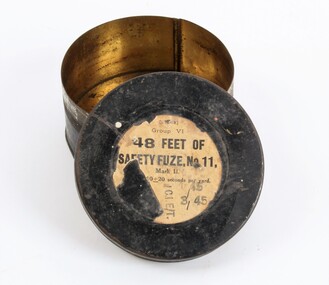
Equipment - Equipment, Safety Fuze No11 metal container
... Equipment, Safety Fuze No11 metal container....Stamped on base. Equipment Equipment, Safety Fuze No11 metal container. ...Black metal round container. Paper sticker label listing contents on lid. Stamped on base. 48 feet of saftey fuse no11 3/45 20 seconds per yard burn rate, Group VI metal container, fuse no 11, explosive -
 Moorabbin Air Museum
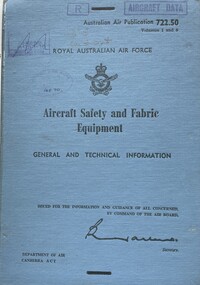
Manual (Item) - (SP) AAP RAAF Pub 722:50 Vol 1 and 6 Aircraft Safety and Fabric Equipment General and Technical Information
... (SP) AAP RAAF Pub 722:50 Vol 1 and 6 Aircraft Safety and Fabric Equipment General and Technical Information...Moorabbin Air Museum Moorabbin Airport 12 First Street Moorabbin melbourne Manual (SP) AAP RAAF Pub 722:50 Vol 1 and 6 Aircraft Safety and Fabric Equipment General and Technical Information ... -
 Bendigo Military Museum
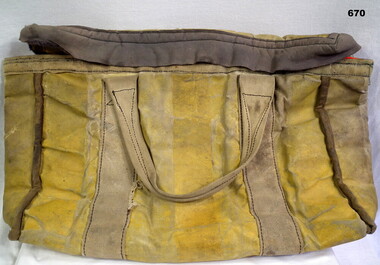
Container - CHEAP CHARLIE BAG VIETNAM, No 2 Sqd Safetry Equipment Section, est 1971
... Yellow canvas with red lining made of aircraft safety equipment materials. Two carry handles....Served Vietnam as a LAC with No 2 Sd RAAF 25.3.71 to 2.6.71, 35 Sqd RAAF 2.6.71 to 5.2.72. military equipment - bags personal effects - containers Vietnam RAAF Yellow canvas with red lining made of aircraft safety equipment materials. Two carry handles. Container CHEAP CHARLIE BAG VIETNAM No 2 Sqd Safetry Equipment Section ...Item brought home from South Vietnam by Brian Patten (born Castlemaine) No A317583. Served Vietnam as a LAC with No 2 Sd RAAF 25.3.71 to 2.6.71, 35 Sqd RAAF 2.6.71 to 5.2.72.Yellow canvas with red lining made of aircraft safety equipment materials. Two carry handles.military equipment - bags, personal effects - containers, vietnam raaf -
 Queenscliffe Maritime Museum
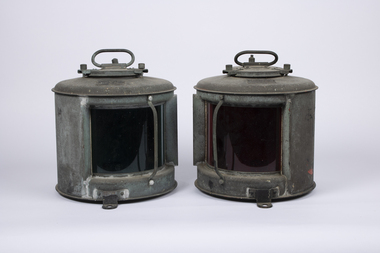
Functional object - Navigation Lights
... ...Safety equipment...Navigation Light Marine Safety Navigation Safety equipment S/N Side Light (red) Elect. S/N 432 Side Light (Green) Elect. ...The Marine Safety Act, Victoria requires that lights must be displayed from sunset to sunrise and in times of restricted visibility during daylight hours. A vessel's lights should indicate: what type of vessel it is, what the vessel is doing, the direction that the vessel is travelling in. E.G. For vessels under 50 m in length, a second masthead light is optional. For vessels under 12 m in length, sidelights may be a combined lantern on fore and aft centreline. Every vessel at sea must show light to indicate type of vessel, directionof travel and speed.Three metal navigational lights; red port, green starboad and clear head light. S/N Side Light (red) Elect. S/N 432 Side Light (Green) Elect. S/N 433 Head Light Elect.navigation light, marine safety, navigation, safety equipment -
 Bendigo Historical Society Inc.
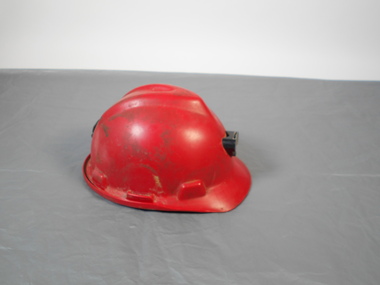
Functional object - Red Helmet
... ...Safety equipment...History House 11 Mackenzie Street Bendigo goldfields Helmet Safety equipment No manufacturing name Australian Standards Sticker inside. ...Red helmet, very worn. Holder on front of the Helmet for fitting light a detachable light. Ridges in top of Helmet. Vents at either side. Adjustable fittings inside. No manufacturing name Australian Standards Sticker inside. Sticker with Name Jim E. helmet, safety equipment -
 Bendigo Historical Society Inc.
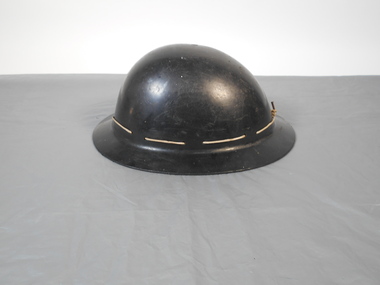
Domestic object - Safety helmet
... ...Safety equipment...History House 11 Mackenzie Street Bendigo goldfields Helmets Safety equipment No manufacturing name. Australian Standards Sticker inside. ...Black helmet with adjustable head fittings inside made of leather and Cotton tape. Thin cord threaded through the top of helmet to hold head the fittings. Very worn. Smooth surface. No manufacturing name. Australian Standards Sticker inside. Name on label Jim E. helmets, safety equipment -
 Flagstaff Hill Maritime Museum and Village
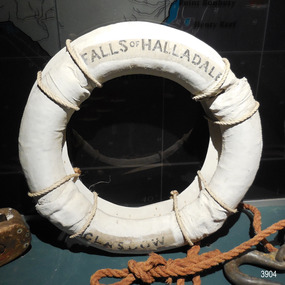
Equipment - Lifebuoy
... ...Safety equipment...The wreck is protected as a Historic Shipwreck under the Commonwealth Historic Shipwrecks Act (1976). flagstaff hill warrnambool shipwrecked coast flagstaff hill maritime museum maritime museum shipwreck coast flagstaff hill maritime village great ocean road Life rings Lifebuoy Safety ring Life-saving buoy Ring buoy Life preserver Personal floating device Floatation device Safety equipment Falls of Halladale Glasgow Falls Line rocket crew lifeboat peterborough “FALLS OF HALLADALE” “GLASGOW” Lifebuoy; round white canvas ring, joined with hand stitching. ...This lifebuoy is part of the lifesaving equipment from the sailing ship the Falls of Halladale. It is filled with cork and covered with canvas and reinforcing bands. The name of the ship and its origin is printed on the lifebuoy. It has been sealed with several coats of white paint. A lifebuoy, or life-preserver, is used as a buoyancy device to keep a person afloat in the. It is usually connected by a rope to a person in a safe area such a nearby vessel or on shore. The lifebuoy is thrown to a person in distress in the water, allowing the rescuer to pull the person to safety. The lifebuoy is a made from a buoyant material such as cork or rubber and is usually covered with canvas for protection and to make it easy to grip. The first use of life saving devices in recent centuries was by the Nordic people, who used light weight wood or cork blocks to keep afloat. From the early 20th century Kapok fibre was used as a filling for buoys. Light weight balsa wood was used as a filler after WW1. In 1928 Peter Markus invented and patented the first inflatable life-preserver. By WW2 foam was combined with Kapok. Laws were passed over time that has required aeroplanes and water going-vessels to carry life-preservers on board. The Falls of Halladale 1886-1908 The vessel ‘Falls of Halladale’ was a four-masted iron-hulled barque, launched in July 1886, by Russell & Co of Greenock, Scotland and owned by the Glasgow Falls Line, which named its ships after Scottish waterfalls. The ship was built for long distance cargo trade. The Falls of Halladale was one of the last windjammers that sailed the Trade Route. The ship was on its way from New York to Melbourne via the Cape of Good Hope when, after 102 days at sea, its journey suddenly ended. During the night of November 14, 1908, in calm seas with some coastal fog, an ocean swell raised the vessel up then let it down on a submerged reef wrecked at Curdies Inlet, Peterborough. The ship was stranded and the Port Campbell Rocket Crew were sent for, to perform a rescue. However by the time they arrived, all on board had already travelled by lifeboat to the nearby beach at the Bay of Islands. The sight of the slowly disintegrating ship on the rocks attracted many sightseers. This lifebuoy is significant for its association with the famous ship the Falls of Halladale. It is significant for its association with lifesaving equipment used on board vessels in the early 20th century. The Falls of Halladale shipwreck is listed on the Victorian Heritage Register (No. S255). She was one of the last ships to sail the Trade Routes. She is one of the first vessels to have fore and aft lifting bridges. She is an example of the remains of an International Cargo Ship and also represents aspects of Victoria’s shipping industry. The wreck is protected as a Historic Shipwreck under the Commonwealth Historic Shipwrecks Act (1976).Lifebuoy; round white canvas ring, joined with hand stitching. Stencil with inscription is printed in black on first and third quadrant. The canvas has been repainted in white but avoiding the inscription in the lifebuoy. A hanging board for display is attached with white rope. Lifesaving equipment from the Falls of Halladale.“FALLS OF HALLADALE” “GLASGOW”flagstaff hill, warrnambool, shipwrecked coast, flagstaff hill maritime museum, maritime museum, shipwreck coast, flagstaff hill maritime village, great ocean road, life rings, lifebuoy, safety ring, life-saving buoy, ring buoy, life preserver, personal floating device, floatation device, safety equipment, falls of halladale, glasgow falls line, rocket crew, lifeboat, peterborough -
 Flagstaff Hill Maritime Museum and Village
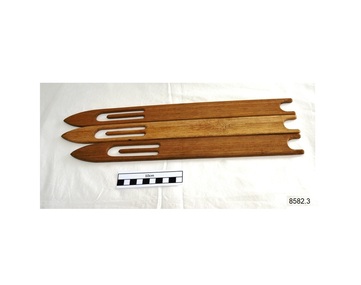
Tool - Netting Shuttle, Early-to-mid 20th century
... ...safety equipment...Nets were used on sailing ships for the crew's safety, often saving the sailor's lives in stormy seas Examples are the ship mast nets or shrouds that are wide at the base on the deck and taper to a point at the top of the mast, and railing nets that encircle the rails around the deck and prevent people and objects from rolling or falling into the sea. The shuttles were donated to Flagstaff Hill Maritime Village by the family of Doctor William Roy Angus, Surgeon and Oculist. It is part of the “W.R. Angus Collection” that includes historical medical equipment...Nets were an essential part of the life-saving safety equipment on sailing vessels. The set of netting shuttles is an example of net-making tools used in the 18th to 20th centuries and continues into modern times to create and repair safety equipment. ...Maritime trades included making and mending nets. Netcraft skills have been taught and applied for centuries and are ongoing. Shuttles, or net needles, are used in the netting process, along with twine or cord, and a sharp knife or scissors. The twine is wound onto the shuttle and dispensed as the shuttle knots and weaves the cord to make the net. These shuttles are lightweight, compact and portable too. Nets were used on sailing ships for the crew's safety, often saving the sailor's lives in stormy seas Examples are the ship mast nets or shrouds that are wide at the base on the deck and taper to a point at the top of the mast, and railing nets that encircle the rails around the deck and prevent people and objects from rolling or falling into the sea. The shuttles were donated to Flagstaff Hill Maritime Village by the family of Doctor William Roy Angus, Surgeon and Oculist. It is part of the “W.R. Angus Collection” that includes historical medical equipment, surgical instruments and material belonging to Dr Edward Ryan and Dr Thomas Francis Ryan, (both of Nhill, Victoria) and Dr Angus’ own belongings. The Collection’s history spans the medical practices of the two Doctors Ryan, from 1885-1926 plus that of Dr Angus, until 1969. Nets were an essential part of the life-saving safety equipment on sailing vessels. The set of netting shuttles is an example of net-making tools used in the 18th to 20th centuries and continues into modern times to create and repair safety equipment. The shuttles are part of the W.R. Angus Collection, which is significant for still being located at the site it is connected with, Doctor Angus being the last Port Medical Officer in Warrnambool. Shuttles, set of three; wooden slats, one end pointed, the other a concave shape. The centre is cut-out, leaving a straight tab in the centre lengthwise. The set is part of the W.R. Angus Collection. warrnambool, shipwreck coast, flagstaff hill, flagstaff hill maritime museum, flagstaff hill maritime village, net making, net mending, net shuttle, net making tool, maritime trade, darning, shuttle, tool, 20th century, w.r. angus, weaving, netting shuttle, net craft, net needles, safety nets, safety equipment -
 Flagstaff Hill Maritime Museum and Village
Equipment - Distant Signal, 1897-1931
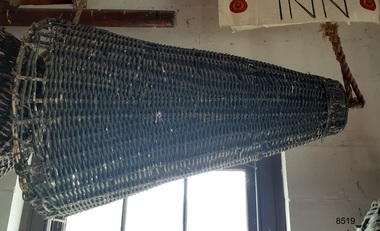
... ...safety equipment...The same shapes continue to be used today for the sets of Day Shapes used as marine navigational signals that are mandatory on certain-sized vessels. flagstaff hill warrnambool flagstaff Hill Maritime Museum and village Shipwreck Coast Marine Navigation Marine communications Communication Signal Lifesaving ship at sea day shape masthead signal day signal day mark signals marine technology safety equipment navigation equipment marine day shape day marker cane day shape signal cone day signal cone cone signal cone day shape distant signal flagstaff signal signal station communications signals marine signals flaghoists International Marine Conference International Code of Signals signal codes marine safety signal flags daymark day symbol navigation Warrnambool flagstaff 1854 1857 1931 1887 1897 Distant Signal Cone, part of a Flagstaff signal set. ...This three-dimensional Distant Signal is part of a Flagstaff Signal set of ball, cone and drum shapes. It has been woven and then fabricated with strong metal swivel fittings and loops for suspending from a high point on a flagstaff at a signal station or on a ship’s masthead. The cane signal was constructed to withstand all weather and to be visible from a long distance. The gaps between the woven cane allow air to pass through, minimising possible swaying. Similar sets were made from rope or fabric. Warrnambool's Flagstaff was erected in 1854. Its primary use was to display visual signals that could convey messages between land and sea. It was also used to notify the local population of the approach of ships. One of the popular signalling codes in use in the early-to-mid 1800s was the Marryat’s Code but there were others in use as well; there was no one standard code. In 1857 the International Marine Conference adopted an International Code of Signals as a standard communications system for all vessels that could be understood in many different languages. The Normanby Advertiser reported on June 5th 1857 a query from the Post Master General as to whether the request of the Chief Harbour Master would be carried out, in that Warrnambool would receive a new flagstaff and a set of Marryatt’s signal flags. The Table of Codes was published, showing how to use combinations of these flags to send messages. The Code was revised in 1887 to cover situations where distance, light, wind and weather conditions affected the visibility of the flags and prevented clear communication. The first report of the International Code of Signals Committee of 1897 warned signalmen not to rely on ordinary semaphore flags and introduced a Distant Signal Code using either particular semaphore flags or the three-dimensional shapes of a ball, cone and drum that aligned with the semaphore flag shapes of a circle, pennant and square. International Code of Signals In 1931, after World War I’s experiences in using signal codes, the International Code of Signals conference in Washington revised and published the rules for the conduct of signalling. One of the changes was that “the use of the Distant Signals and of fixed semaphore was abandoned”. It is of interest to know that modern marine law in many countries insists that a set of Day Shapes must be carried onboard vessels of a certain size. These highly visible geometric shapes are used at sea in daylight to communicate messages between vessels. They are used in a similar way to the Distant Signals, in that different combinations of shapes represent different messages. The set of shapes includes a ball, cylinder, cone and diamond. The shapes are hung between the top of the vessel’s foremast and the front of the vessel. They are only coloured black and are about 1.5 metres high. The vertical line of shapes can mean messages such as Boat not under command, Fishing, and Under sail and power.Distant Signals were an important means of marine communication from the late 1880s to the early 1930s, including during World War I. They were an advancement to the International Shipping Codes and safety. The cane signals’ shapes appear to be the same from whatever direction they are viewed, removing confusion about the message they convey. The same shapes continue to be used today for the sets of Day Shapes used as marine navigational signals that are mandatory on certain-sized vessels.Distant Signal Cone, part of a Flagstaff signal set. A woven cane cone, painted black, with a metal rod passing through the centre and two crossed metal bars at the base. The central rod has a loop at the top and passes through the bars at the base, finishing in a metal loop. The rod has swivels at each end.flagstaff hill, warrnambool, flagstaff hill maritime museum and village, shipwreck coast, marine navigation, marine communications, communication signal, lifesaving, ship at sea, day shape, masthead signal, day signal, day mark signals, marine technology, safety equipment, navigation equipment, marine day shape, day marker, cane day shape, signal cone, day signal cone, cone signal, cone day shape, distant signal, flagstaff signal, signal station, communications, signals, marine signals, flaghoists, international marine conference, international code of signals, signal codes, marine safety, signal flags, daymark, day symbol, navigation, warrnambool flagstaff, 1854, 1857 1931, 1887, 1897 -
 Flagstaff Hill Maritime Museum and Village
Equipment - Navigation Lamp, Starboard
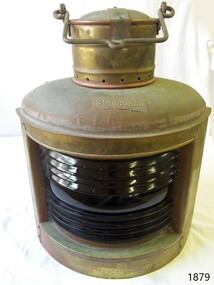
... ...safety equipment...Flagstaff Hill Flagstaff Hill Maritime Museum and Village Warrnambool Maritime Museum Maritime Village Great Ocean Road Shipwreck Coast ship's lamp kerosene lamp navigation lamp Starboard lamp ship's equipment safety equipment Engraved on plaque: “STARBOARD“ Navigation lamp; Starboard side. ...This item appears to be a 20th-century lamp, modelled after an earlier version of a wall-mounted kerosene lamp. Authentic kerosene lamps were typically crafted from copper or brass, renowned for their durability and traditional aesthetic. In contrast, contemporary reproductions are often manufactured using alternative materials and processes, reflecting changes in production methods and cost considerations.The lamp is modelled after marine kerosene navigation lamps that were widely used throughout the 19th and early 20th centuries. These lamps played a significant role in maritime history, providing essential lighting for navigation on vessels during this era. As a representation of this period’s maritime lighting technology, the lamp serves as an example of the type of equipment that would have been commonplace aboard ships of the time.Navigation lamp; Starboard side. Metal kerosene lamp with two flat sides and a curved front with a rippled, green glass window. The chimney on top has a catch and an opening lid. and the name "Starboard" is inscribed on a fixed brass plaque. The fuel tank and wick can be removed through the base. Engraved on plaque: “STARBOARD“flagstaff hill, flagstaff hill maritime museum and village, warrnambool, maritime museum, maritime village, great ocean road, shipwreck coast, ship's lamp, kerosene lamp, navigation lamp, starboard lamp, ship's equipment, safety equipment -
 Flagstaff Hill Maritime Museum and Village
Equipment - Boat hook head
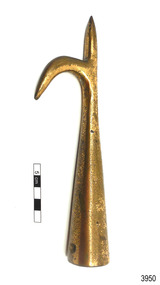
... ...Safety equipment...Flagstaff Hill Warrnambool Maritime Village Maritime Museum Shipwreck coast Great Ocean Road boat hook marine fishing boating equipment boat hook head rigging Safety equipment Marine boat hook head, all brass. ...This boat hook head is in very good condition and has been manufactured. It would be attached to a pole or handle to give it a long reach. A boat hook is a common piece of marine equipment and many have been made by boat owners to suit their own purpose. They would also have been forged byblacksmiths and shipsmiths and have been available from ship's chandlers over the centuries. A boat hook can be used for many situations such as catching mooring ropes and chains, reaching rigging, pulling things or people out of the water, and a variety of fishing applications.This boat hook head is an example of equipment carried on vessels over hundreds of years for safety purposes and for general applications. Marine boat hook head, all brass. The body is a conical shape with a pointed end and curved, horn-shaped hook moulded into the side. The body is hollow until it reaches the hook's height. A screw hole is close to the base, in line with the hook.flagstaff hill, warrnambool, maritime village, maritime museum, shipwreck coast, great ocean road, boat hook, marine, fishing, boating, equipment, boat hook head, rigging, safety equipment -
 Flagstaff Hill Maritime Museum and Village
Equipment - Lifebuoy, late 19th to early 20th century
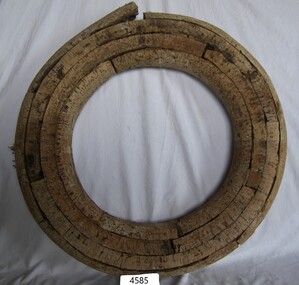
... ...Safety equipment...equipment that would be carried on vessels in the late 19th and early 20th century. The strips of cork wood have been joined together to make the ring shape. A lifebuoy, or life-preserver, is used as a buoyancy device to keep a person afloat in the. It is usually connected by a rope to a person in a safe area such a nearby vessel or on shore. The lifebuoy is thrown to a person in distress in the water, allowing the rescuer to pull the person to safety...equipment carried on vessels in the late 19th and early 20th century to help preserve life. There were many lives lost in Australia’s colonial period, particularly along the coast of South West Victoria. Flagstaff Hill Warrnambool Shipwrecked-coast Flagstaff-Hill Flagstaff-Hill-Maritime-Museum Maritime-Museum Shipwreck-coast Flagstaff-Hill-Maritime-Village Life rings Lifebuoy Safety ring Life-saving buoy Ring buoy Life preserver Personal floating device Floatation device Safety equipment Lifebuoy; round, cork filling of lifebuoy. ...This lifebuoy is part of the lifesaving equipment that would be carried on vessels in the late 19th and early 20th century. The strips of cork wood have been joined together to make the ring shape. A lifebuoy, or life-preserver, is used as a buoyancy device to keep a person afloat in the. It is usually connected by a rope to a person in a safe area such a nearby vessel or on shore. The lifebuoy is thrown to a person in distress in the water, allowing the rescuer to pull the person to safety. The lifebuoy is a made from a buoyant material such as cork or rubber and is usually covered with canvas for protection and to make it easy to grip. The first use of life saving devices in recent centuries was by the Nordic people, who used light weight wood or cork blocks to keep afloat. From the early 20th century Kapok fibre was used as a filling for buoys. Light weight balsa wood was used as a filler after WW1. In 1928 Peter Markus invented and patented the first inflatable life-preserver. By WW2 foam was combined with Kapok. Laws were passed over time that has required aeroplanes and water going-vessels to carry life-preservers on board. The lifebuoy is an example of equipment carried on vessels in the late 19th and early 20th century to help preserve life. There were many lives lost in Australia’s colonial period, particularly along the coast of South West Victoria.Lifebuoy; round, cork filling of lifebuoy. The nails joining the layers are visible. flagstaff hill, warrnambool, shipwrecked-coast, flagstaff-hill, flagstaff-hill-maritime-museum, maritime-museum, shipwreck-coast, flagstaff-hill-maritime-village, life rings, lifebuoy, safety ring, life-saving buoy, ring buoy, life preserver, personal floating device, floatation device, safety equipment -
 Flagstaff Hill Maritime Museum and Village
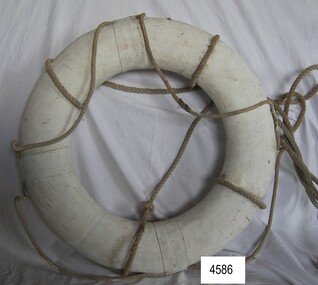
Equipment - Lifebuoy, late 19th to early 20th century
... ...Safety equipment...equipment that would be carried on vessels in the late 19th and early 20th century. The strips of cork wood have been joined together to make the ring shape. A lifebuoy, or life-preserver, is used as a buoyancy device to keep a person afloat in the. It is usually connected by a rope to a person in a safe area such a nearby vessel or on shore. The lifebuoy is thrown to a person in distress in the water, allowing the rescuer to pull the person to safety...equipment carried on vessels in the late 19th and early 20th century to help preserve life. There were many lives lost in Australia’s colonial period, particularly along the coast of South West Victoria. Flagstaff Hill Warrnambool Shipwrecked-coast Flagstaff-Hill Flagstaff-Hill-Maritime-Museum Maritime-Museum Shipwreck-coast Flagstaff-Hill-Maritime-Village Life rings Lifebuoy Safety ring Life-saving buoy Ring buoy Life preserver Personal floating device Floatation device Safety equipment Lifebuoy, round cork filling inside white canvas cover with four reinforced bands. ...This lifebuoy is part of the lifesaving equipment that would be carried on vessels in the late 19th and early 20th century. The strips of cork wood have been joined together to make the ring shape. A lifebuoy, or life-preserver, is used as a buoyancy device to keep a person afloat in the. It is usually connected by a rope to a person in a safe area such a nearby vessel or on shore. The lifebuoy is thrown to a person in distress in the water, allowing the rescuer to pull the person to safety. The lifebuoy is a made from a buoyant material such as cork or rubber and is usually covered with canvas for protection and to make it easy to grip. The first use of life saving devices in recent centuries was by the Nordic people, who used light weight wood or cork blocks to keep afloat. From the early 20th century Kapok fibre was used as a filling for buoys. Light weight balsa wood was used as a filler after WW1. In 1928 Peter Markus invented and patented the first inflatable life-preserver. By WW2 foam was combined with Kapok. Laws were passed over time that has required aeroplanes and water going-vessels to carry life-preservers on board. The lifebuoy is an example of equipment carried on vessels in the late 19th and early 20th century to help preserve life. There were many lives lost in Australia’s colonial period, particularly along the coast of South West Victoria.Lifebuoy, round cork filling inside white canvas cover with four reinforced bands. Four ropes are attached.flagstaff hill, warrnambool, shipwrecked-coast, flagstaff-hill, flagstaff-hill-maritime-museum, maritime-museum, shipwreck-coast, flagstaff-hill-maritime-village, life rings, lifebuoy, safety ring, life-saving buoy, ring buoy, life preserver, personal floating device, floatation device, safety equipment -
 Flagstaff Hill Maritime Museum and Village
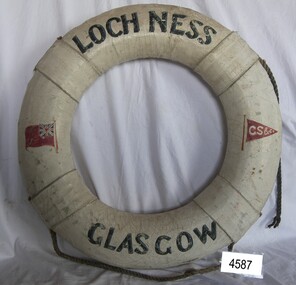
Equipment - Lifebuoy, Loch Ness, 1869-1909
... ...Safety equipment...The lifebuoy is significant for its connection to the ship Loch Ness on which William Carmichael, brother of Eva Carmichael, travelled to lay a memorial to their parents and all of their other siblings who lost their lives in the Loch Ard disaster of 1878 near Peterborough, Victoria. flagstaff hill warrnambool shipwrecked-coast flagstaff-hill flagstaff-hill-maritime-museum maritime-museum shipwreck-coast flagstaff-hill-maritime-village Loch Ness Loch Ard William Carmichael Eva Carmichael lifebuoy Glasgow sailing ship Loch Ness of Glasgow Life rings Safety ring Life-saving buoy Ring buoy Life preserver Personal floating device Floatation device Safety equipment G S C Glasgow Shipping Company HMAS Melbourne Cruiser Melbourne "LOCH NESS", "GLASGOW" "G S Co" Lifebuoy, round, cork filling inside canvas cover, painted white, with rope attached. ...This lifebuoy bears the name of the ship, its origin, the shipping company and the red ensign. These details mean that the lifebuoy was part of the lifesaving equipment on the sailing ship the Loch Ness, part of the Glasgow Shipping Company’s Loch Line (G.S.C. on the red pennant) and a British-registered ship (the red flag with the Union Jack on it). Lifebuoys were part of the emergency lifesaving equipment carried on vessels in the late 19th and early 20th century. The ring was made of strips of cork wood joined together to make the ring shape then covered in canvas and sealed usually with white paint. Four evenly spaced canvas reinforcing bands would be added for strength and for a place to thread a rope or line. A lifebuoy, or life-preserver, is used as a buoyancy device often thrown to an endangered or distressed person in the water to keep them afloat while they receive help. It is usually connected by a rope to a person in a safe area such a nearby vessel or on shore. Lifebuoys is a made from a buoyant materials such as cork or foam and ae usually covered with canvas for protection and to make it easy to grip. The first use of life saving devices in recent centuries was by the Nordic people, who used light weight wood or cork blocks to keep afloat. Cork lifebuoys were used from the late 19th to early 20th century. Kapok fibre was then used as a filling for buoys but wasn’t entirely successful. Light weight balsa wood was used as a filler after WW1. In 1928 Peter Markus invented and patented the first inflatable life-preserver. By WW2 foam was combined with Kapok. Laws were passed over time that has required aeroplanes and water going-vessels to carry life-preservers on board. The ship LOCH NESS 1869-1922 … The ship Loch Ness, of Glasgow, was the same ship what William Carmichael sailed on to Australia when he laid the commemoration stone on behalf of his sister Eva and himself, dedicated to their parents, brothers and sisters. The family members lost their lives on June 1, 1878, when their ship, the Loch Ard, was wrecked at Mutton Bird Island in south west Victoria. Eva Carmichael was one of the two survivors from that shipwreck, the other 52 tragically lost their lives. The ship Loch Ness was a three-masted sailing ship built in 1869 for the Loch Line owned by the Glasgow Shipping Company. The line transported cargo and passengers from Glasgow, Scotland, to Australian ports. The Loch Ness was sold in 1908 to Stevedore & Shipping Co, Sydney for use as a coal hulk. In 1914 the Australian Government took over the ship for naval defence purposeless. In 1926 the ship was sunk during gunfire practice by the 1922 built, light cruiser HMAS Melbourne, near Fremantle, Western Australia. The lifebuoy is an example of equipment carried on vessels in the late 19th and early 20th century to help preserve life. There were many lives lost in Australia’s colonial period, particularly along the coast of South West Victoria. The lifebuoy is significant for its connection to the ship Loch Ness on which William Carmichael, brother of Eva Carmichael, travelled to lay a memorial to their parents and all of their other siblings who lost their lives in the Loch Ard disaster of 1878 near Peterborough, Victoria. Lifebuoy, round, cork filling inside canvas cover, painted white, with rope attached. Lifebuoy has printed name of vessel Loch Ness, Glasgow. Symbols of red flag with white initials G S Co. There is also a red ensign."LOCH NESS", "GLASGOW" "G S Co"flagstaff hill, warrnambool, shipwrecked-coast, flagstaff-hill, flagstaff-hill-maritime-museum, maritime-museum, shipwreck-coast, flagstaff-hill-maritime-village, loch ness, loch ard, william carmichael, eva carmichael, lifebuoy, glasgow sailing ship, loch ness of glasgow, life rings, safety ring, life-saving buoy, ring buoy, life preserver, personal floating device, floatation device, safety equipment, g s c, glasgow shipping company, hmas melbourne, cruiser melbourne -
 Flagstaff Hill Maritime Museum and Village
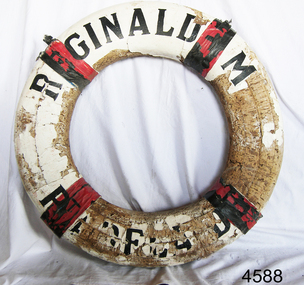
Equipment - Lifebuoy, John Murch, 1922
... ...Safety equipment...The lifebuoy is significant for its connection with the Australian built, 1922 coastal trader, Reginald M. flagstaff hill warrnambool shipwrecked-coast flagstaff-hill flagstaff-hill-maritime-museum maritime-museum shipwreck-coast flagstaff-hill-maritime-village lifebuoy lifesaving ship equipment reginald m Life rings Safety ring Life-saving buoy Ring buoy Life preserver Personal floating device Floatation device Safety equipment coastal trader john murch reg webb "REGINALD M / Pt ADELAIDE". ...Lifebuoy is from the ketch Reginald M, built in Port Adelaide by John Murch in 1922. Lifebuoys were part of the emergency lifesaving equipment carried on vessels in the late 19th and early 20th century. The ring was made of strips of cork wood joined together to make the ring shape then covered in canvas and sealed usually with white paint. Four evenly spaced canvas reinforcing bands would be added for strength and for a place to thread a rope or line. A lifebuoy, or life-preserver, is used as a buoyancy device often thrown to an endangered or distressed person in the water to keep them afloat while they receive help. It is usually connected by a rope to a person in a safe area such a nearby vessel or on shore. Lifebuoys is a made from a buoyant materials such as cork or foam and ae usually covered with canvas for protection and to make it easy to grip. The first use of life saving devices in recent centuries was by the Nordic people, who used light weight wood or cork blocks to keep afloat. Cork lifebuoys were used from the late 19th to early 20th century. Kapok fibre was then used as a filling for buoys but wasn’t entirely successful. Light weight balsa wood was used as a filler after WW1. In 1928 Peter Markus invented and patented the first inflatable life-preserver. By WW2 foam was combined with Kapok. Laws were passed over time that has required aeroplanes and water going-vessels to carry life-preservers on board. The Reginald M 1922- The two-masted coastal trading ketch Reginald M was built by John (Jack) Murch in Port Adelaide, South Australia, in 1922 and it was launched there in Largs Bay in the same year. It is thought that the keel was hewn from two telegraph poles - its owner was a regular visitor to salvage yards. Its cargo at times included Guano, Barley, Wool, Horses, Cattle, Timber, Explosives, Potatoes, Shell Grit and Gypsum. At one time the vessel was used as a customs boat, renamed 'HMC No. 3, Pt Adelaide'. In 1969 she was used by a mining and railway company as a barge to carry explosives. In 1972 the vessel was renamed 'T.S. Macquarie' and planned to be used for sea cadet training.; this did not eventuate. It was sold again and went to Melbourne to be used for pleasure sailing, and again sold for use as a ferry. Late in 1975 Flagstaff Hill purchased the vessel to be used as an exhibit at the Maritime Village where many visitors enjoyed being able to board and explore a real ship with a long history. Sadly, in late 2016, the decision was made to 'decommission' the vessel due to the continuing high cost of maintenance and the risk to public safety. Many of the components of the vessel are held as part of Flagstaff Hill's collection.The lifebuoy is an example of equipment carried on vessels in the late 19th and early 20th century to help preserve life. There were many lives lost in Australia’s colonial period, particularly along the coast of South West Victoria. The lifebuoy is significant for its connection with the Australian built, 1922 coastal trader, Reginald M. Lifebuoy, round , cork, filled, white canvas cover with four red tabs. Text is printed in black on quarters 1 and 3. This lifebuoy once belonged to the vessel 'Reginald M' , Pt Adelaide. "REGINALD M / Pt ADELAIDE".flagstaff hill, warrnambool, shipwrecked-coast, flagstaff-hill, flagstaff-hill-maritime-museum, maritime-museum, shipwreck-coast, flagstaff-hill-maritime-village, lifebuoy, lifesaving, ship equipment, reginald m, life rings, safety ring, life-saving buoy, ring buoy, life preserver, personal floating device, floatation device, safety equipment, coastal trader, john murch, reg webb -
 Flagstaff Hill Maritime Museum and Village
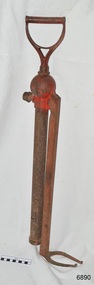
Fire Pump, 20th century
... ...safety equipment...Dr Angus assisted Dr Tom Ryan, a pioneer in the use of X-rays and in ocular surgery. flagstaff hill warrnambool shipwrecked coast flagstaff hill maritime museum maritime museum shipwreck coast flagstaff hill maritime village great ocean road dr w r angus dr ryan surgical instrument t.s.s. largs bay warrnambool base hospital nhill base hospital mira hospital flying doctor water pump fire pump fire extinguisher safety equipment Moulded into metal "STOKES" and “MELB”. ...This water pump was owned by Dr. W.R. Angus AND was donated to Flagstaff Hill Maritime Village by the family of Doctor William Roy Angus, Surgeon and Oculist. It is part of the “W.R. Angus Collection” includes historical medical equipment, surgical instruments and material once belonging to Dr Edward Ryan and Dr Thomas Francis Ryan, (both of Nhill, Victoria) as well as Dr Angus’ own belongings. The Collection’s history spans the medical practices of the two Doctors Ryan, from 1885-1926 plus that of Dr Angus, up until 1969. ABOUT THE “W.R.ANGUS COLLECTION” Doctor William Roy Angus M.B., B.S., Adel., 1923, F.R.C.S. Edin.,1928 (also known as Dr Roy Angus) was born in Murrumbeena, Victoria in 1901 and lived until 1970. He qualified as a doctor in 1923 at University of Adelaide, was Resident Medical Officer at the Royal Adelaide Hospital in 1924 and for a period was house surgeon to Sir (then Mr.) Henry Simpson Newland. Dr Angus was briefly an Assistant to Dr Riddell of Kapunda, then commenced private practice at Curramulka, Yorke Peninsula, SA, where he was physician, surgeon and chemist. In 1926, he was appointed as new Medical Assistant to Dr Thomas Francis Ryan (T.F. Ryan, or Tom), in Nhill, Victoria, where his experiences included radiology and pharmacy. In 1927 he was Acting House Surgeon in Dr Tom Ryan’s absence. Dr Angus had become engaged to Gladys Forsyth and they decided he further his studies overseas in the UK in 1927. He studied at London University College Hospital and at Edinburgh Royal Infirmary and in 1928, was awarded FRCS (Fellow from the Royal College of Surgeons), Edinburgh. He worked his passage back to Australia as a Ship’s Surgeon on the on the Australian Commonwealth Line’s T.S.S. Largs Bay. Dr Angus married Gladys in 1929, in Ballarat. (They went on to have one son (Graham 1932, born in SA) and two daughters (Helen (died 12/07/1996) and Berenice (Berry), both born at Mira, Nhill ) According to Berry, her mother Gladys made a lot of their clothes. She was very talented and did some lovely embroidery including lingerie for her trousseau and beautifully handmade baby clothes. Dr Angus was a ‘flying doctor’ for the A.I.M. (Australian Inland Ministry) Aerial Medical Service in 1928 . Its first station was in the remote town of Oodnadatta, where Dr Angus was stationed. He was locum tenens there on North-South Railway at 21 Mile Camp. He took up this ‘flying doctor’ position in response to a call from Dr John Flynn; the organisation was later known as the Flying Doctor Service, then the Royal Flying Doctor Service. A lot of his work during this time involved dental surgery also. Between 1928-1932 he was surgeon at the Curramulka Hospital, Yorke Peninsula, South Australia. In 1933 Dr Angus returned to Nhill and purchased a share of the Nelson Street practice and Mira hospital (a 2 bed ward at the Nelson Street Practice) from Dr Les Middleton one of the Middleton Brothers, the current owners of what previously once Dr Tom Ryan’s practice. Dr Tom and his brother had worked as surgeons included eye surgery. Dr Tom Ryan performed many of his operations in the Mira private hospital on his premises. He had been House Surgeon at the Nhill Hospital 1902-1926. Dr Tom Ryan had one of the only two pieces of radiology equipment in Victoria during his practicing years – The Royal Melbourne Hospital had the other one. Over the years Dr Tom Ryan had gradually set up what was effectively a training school for country general-practitioner-surgeons. Each patient was carefully examined, including using the X-ray machine, and any surgery was discussed and planned with Dr Ryan’s assistants several days in advance. Dr Angus gained experience in using the X-ray machine there during his time as assistant to Dr Ryan. When Dr Angus bought into the Nelson Street premises in Nhill he was also appointed as the Nhill Hospital’s Honorary House Surgeon 1933-1938. His practitioner’s plate from his Nhill surgery is now mounted on the doorway to the Port Medical Office at Flagstaff Hill Maritime Village, Warrnambool. When Dr Angus took up practice in the Dr Edward and Dr Tom Ryan’s old premises he obtained their extensive collection of historical medical equipment and materials spanning 1884-1926. A large part of this collection is now on display at the Port Medical Office at Flagstaff Hill Maritime Village in Warrnambool. In 1939 Dr Angus and his family moved to Warrnambool where he purchased “Birchwood,” the 1852 home and medical practice of Dr John Hunter Henderson, at 214 Koroit Street. (This property was sold in1965 to the State Government and is now the site of the Warrnambool Police Station. and an ALDI sore is on the land that was once their tennis court). The Angus family was able to afford gardeners, cooks and maids; their home was a popular place for visiting dignitaries to stay whilst visiting Warrnambool. Dr Angus had his own silk worm farm at home in a Mulberry tree. His young daughter used his centrifuge for spinning the silk. Dr Angus was appointed on a part-time basis as Port Medical Officer (Health Officer) in Warrnambool and held this position until the 1940’s when the government no longer required the service of a Port Medical Officer in Warrnambool; he was thus Warrnambool’s last serving Port Medical Officer. (Masters of immigrant ships arriving in port reported incidents of diseases, illness and death and the Port Medical Officer made a decision on whether the ship required Quarantine and for how long, in this way preventing contagious illness from spreading from new immigrants to the residents already in the colony.) Dr Angus was a member of the Australian Medical Association, for 35 years and surgeon at the Warrnambool Base Hospital 1939-1942, He served with the Australian Department of Defence as a Surgeon Captain during WWII 1942-45, in Ballarat, Victoria, and in Bonegilla, N.S.W., completing his service just before the end of the war due to suffering from a heart attack. During his convalescence he carved an intricate and ‘most artistic’ chess set from the material that dentures were made from. He then studied ophthalmology at the Royal Melbourne Eye and Ear Hospital and created cosmetically superior artificial eyes by pioneering using the intrascleral cartilage. Angus received accolades from the Ophthalmological Society of Australasia for this work. He returned to Warrnambool to commence practice as an ophthalmologist, pioneering in artificial eye improvements. He was Honorary Consultant Ophthalmologist to Warrnambool Base Hospital for 31 years. He made monthly visits to Portland as a visiting surgeon, to perform eye surgery. He represented the Victorian South-West subdivision of the Australian Medical Association as its secretary between 1949 and 1956 and as chairman from 1956 to 1958. In 1968 Dr Angus was elected member of Spain’s Barraquer Institute of Barcelona after his research work in Intrasclearal cartilage grafting, becoming one of the few Australian ophthalmologists to receive this honour, and in the following year presented his final paper on Living Intrasclearal Cartilage Implants at the Inaugural Meeting of the Australian College of Ophthalmologists in Melbourne In his personal life Dr Angus was a Presbyterian and treated Sunday as a Sabbath, a day of rest. He would visit 3 or 4 country patients on a Sunday, taking his children along ‘for the ride’ and to visit with him. Sunday evenings he would play the pianola and sing Scottish songs to his family. One of Dr Angus’ patients was Margaret MacKenzie, author of a book on local shipwrecks that she’d seen as an eye witness from the late 1880’s in Peterborough, Victoria. In the early 1950’s Dr Angus, painted a picture of a shipwreck for the cover jacket of Margaret’s book, Shipwrecks and More Shipwrecks. She was blind in later life and her daughter wrote the actual book for her. Dr Angus and his wife Gladys were very involved in Warrnambool’s society with a strong interest in civic affairs. He had an interest in people and the community They were both involved in the creation of Flagstaff Hill, including the layout of the gardens. After his death (28th March 1970) his family requested his practitioner’s plate, medical instruments and some personal belongings be displayed in the Port Medical Office surgery at Flagstaff Hill Maritime Village, and be called the “W. R. Angus Collection”. The W.R. Angus Collection is significant for still being located at the site it is connected with, Doctor Angus being the last Port Medical Officer in Warrnambool. The collection of medical instruments and other equipment is culturally significant, being an historical example of medicine from late 19th to mid-20th century. Dr Angus assisted Dr Tom Ryan, a pioneer in the use of X-rays and in ocular surgery. Fire pump, part of the W.R. Angus Collection. Red metal water pump. "D" shaped pump handle slides within pump cylinder, stand has 'U" shaped footrest. Pump has threaded fitting for pipe at top and wire filter at bottom. Made by Stokes, Melbourne. Remnants of red paint left on pump. Card label is attached. Moulded into metal "STOKES" and “MELB”. Label attached with string to handle (no text visible).flagstaff hill, warrnambool, shipwrecked coast, flagstaff hill maritime museum, maritime museum, shipwreck coast, flagstaff hill maritime village, great ocean road, dr w r angus, dr ryan, surgical instrument, t.s.s. largs bay, warrnambool base hospital, nhill base hospital, mira hospital, flying doctor, water pump, fire pump, fire extinguisher, safety equipment -
 City of Moorabbin Historical Society (Operating the Box Cottage Museum)
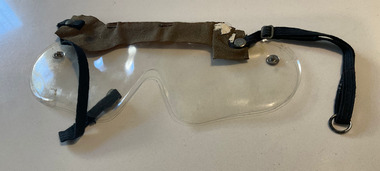
Equipment - Eyeshields, Anti-Gas, Mk.II, World War II, c 1943
... ...safety equipment...City of Moorabbin Historical Society (Operating the Box Cottage Museum) Joyce Park Jasper Road Ormond melbourne Safety Eyeshields which were issued to protect the eyes from liquid irritant sprayed from enemy aircraft. during WWII These eyeshields were the property of one of the pioneer families in the city of Moorabbin. world war ii safety equipment Eye shields anti-gas eyeshields Eyeshields, Anti-Gass, Mk. ...Safety Eyeshields which were issued to protect the eyes from liquid irritant sprayed from enemy aircraft. during WWIIThese eyeshields were the property of one of the pioneer families in the city of Moorabbin. 2 One-piece transparent plastic eyeshield visor, mounted on green green fabric band that is secured by three metal staples. At each end of the fabric band is secured two lengths of black elastic, one end features a metal hook, the other a metal ring, and when joined secure the eyeshields to the wearer's head. The elastic straps are joined to the to fabric by metal pop studs, and these press down into two further pop studs located on the visor making the plastic bend to the shape of the wearer's face. Cardboard case is made of heavy duty card, open one end to form and envelope for storage. A felt material is attached as a cushioned nose strip. They are in a brown paper envelope and contained within a Cardboard case is made of heavy duty card, open one end to form and envelope for storage. There are printed with instruction on how to use them.Eyeshields, Anti-Gass, Mk. II. Air Spray Immediate action to be taken to prevent blisters - with instructions.world war ii, safety equipment, eye shields, anti-gas, eyeshields -
 Flagstaff Hill Maritime Museum and Village
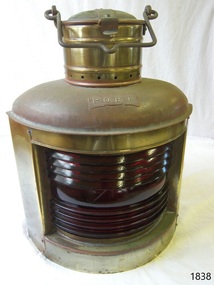
Equipment - Navigation Lamp, Port, Bef. 08-02-1984
... ...safety equipment...As a representation of this period’s maritime lighting technology, the lamp serves as an example of the type of equipment that would have been commonplace aboard ships of the time. flagstaff hill flagstaff hill maritime museum and village warrnambool maritime museum maritime village great ocean road shipwreck coast ship's lamp kerosene lamp navigation lamp ship's equipment safety equipment port lamp Inscribed on the plaque; "PORT" Marine lamp: navigation lamp, portside. ...This item appears to be a 20th-century lamp, modelled after an earlier version of a wall-mounted kerosene lamp. Authentic kerosene lamps were typically crafted from copper or brass, renowned for their durability and traditional aesthetic. In contrast, contemporary reproductions are often manufactured using alternative materials and processes, reflecting changes in production methods and cost considerations.The lamp is modelled after marine kerosene navigation lamps that were widely used throughout the 19th and early 20th centuries. These lamps played a significant role in maritime history, providing essential lighting for navigation on vessels during this era. As a representation of this period’s maritime lighting technology, the lamp serves as an example of the type of equipment that would have been commonplace aboard ships of the time. Marine lamp: navigation lamp, portside. Metal Kerosene lamp with two flat sides and a curved, rippled red glass front window. The name "port" is inscribed on a fixed brass plaque. A round chimney is on top of the lid opens with a catch. The fuel tank and wick can be removed through the base. The metal appears to be electroplated.Inscribed on the plaque; "PORT"flagstaff hill, flagstaff hill maritime museum and village, warrnambool, maritime museum, maritime village, great ocean road, shipwreck coast, ship's lamp, kerosene lamp, navigation lamp, ship's equipment, safety equipment, port lamp
