
Showing 12 items matching "sailor’s shirt"
-
 Flagstaff Hill Maritime Museum and Village
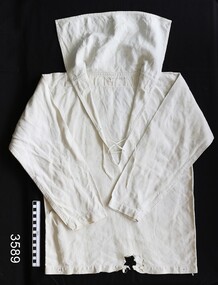
Uniform - Sailor's Shirt, 1920's
... Sailor's Shirt......Sailor’s shirt...This sailor's white linen shirt or top was acquired by Dr Angus when working as a Ship's Surgeon on S.S. ...Sailor’s shirt (or top); white linen 1920s-era shirt with a square collar at the back. ...Angus Collection Uniform Sailor's Shirt ...This sailor's white linen shirt or top was acquired by Dr Angus when working as a Ship's Surgeon on S.S. 'Larg's Bay' returning from the U.K. in 1928 after studies. It was donated to Flagstaff Hill Maritime Village by the family of Doctor William Roy Angus, Surgeon and Oculist. It is part of the “W.R. Angus Collection” which includes historical medical equipment, surgical instruments and material once belonging to Dr Edward Ryan and Dr Thomas Francis Ryan, (both of Nhill, Victoria) as well as Dr Angus’ belongings. The Collection’s history spans the medical practices of the two Doctors Ryan, from 1885-1926 plus that of Dr Angus, up until 1969. ABOUT THE “W.R.ANGUS COLLECTION” Doctor William Roy Angus M.B., B.S., Adel., 1923, F.R.C.S. Edin.,1928 (also known as Dr Roy Angus) was born in Murrumbeena, Victoria in 1901 and lived until 1970. He qualified as a doctor in 1923 at University of Adelaide, was Resident Medical Officer at the Royal Adelaide Hospital in 1924 and for a period was house surgeon to Sir (then Mr.) Henry Simpson Newland. Dr Angus was briefly an Assistant to Dr Riddell of Kapunda, then commenced private practice at Curramulka, Yorke Peninsula, SA, where he was physician, surgeon and chemist. In 1926, he was appointed as new Medical Assistant to Dr Thomas Francis Ryan (T.F. Ryan, or Tom), in Nhill, Victoria, where his experiences included radiology and pharmacy. In 1927 he was Acting House Surgeon in Dr Tom Ryan’s absence. Dr Angus had become engaged to Gladys Forsyth and they decided he would take time to further his studies overseas in the UK in 1927. He studied at London University College Hospital and at Edinburgh Royal Infirmary and in 1928, was awarded FRCS (Fellow from the Royal College of Surgeons), Edinburgh. He worked his passage back to Australia as a Ship’s Surgeon on the on the Australian Commonwealth Line’s SS Largs Bay. Dr Angus married Gladys in 1929, in Ballarat. (They went on to have one son (Graham 1932, born in SA) and two daughters (Helen (died 12/07/1996) and Berenice (Berry), both born at Mira, Nhill ) Dr Angus was a ‘flying doctor’ for the A.I.M. (Australian Inland Ministry) Aerial Medical Service in 1928 . The organisation began in South Australia through the Presbyterian Church in that year, with its first station being in the remote town of Oodnadatta, where Dr Angus was stationed. He was locum tenens there on North-South Railway at 21 Mile Camp. He took up this ‘flying doctor’ position in response to a call from Dr John Flynn; the organisation was later known as the Flying Doctor Service, then the Royal Flying Doctor Service. A lot of his work during this time involved dental surgery also. Between 1928-1932 he was surgeon at the Curramulka Hospital, Yorke Peninsula, South Australia. In 1933 Dr Angus returned to Nhill where he’d previously worked as Medical Assistant and purchased a share of the Nelson Street practice and Mira hospital from Dr Les Middleton one of the Middleton Brothers, the current owners of what was once Dr Tom Ryan’s practice. Dr L Middleton was House Surgeon to the Nhill Hospital 1926-1933, when he resigned. [Dr Tom Ryan’s practice had originally belonged to his older brother Dr Edward Ryan, who came to Nhill in 1885. Dr Edward saw patients at his rooms, firstly in Victoria Street and in 1886 in Nelson Street, until 1901. The Nelson Street practice also had a 2 bed ward, called Mira Private Hospital ). Dr Edward Ryan was House Surgeon at the Nhill Hospital 1884-1902 . He also had occasions where he successfully performed veterinary surgery for the local farmers too. Dr Tom Ryan then purchased the practice from his brother in 1901. Both Dr Edward and Dr Tom Ryan work as surgeons included eye surgery. Dr Tom Ryan performed many of his operations in the Mira private hospital on his premises. He too was House Surgeon at the Nhill Hospital 1902-1926. Dr Tom Ryan had one of the only two pieces of radiology equipment in Victoria during his practicing years – The Royal Melbourne Hospital had the other one. Over the years Dr Tom Ryan gradually set up what was effectively a training school for country general-practitioner-surgeons. Each patient was carefully examined, including using the X-ray machine, and any surgery was discussed and planned with Dr Ryan’s assistants several days in advance. Dr Angus gained experience in using the X-ray machine there during his time as assistant to Dr Ryan. Dr Tom Ryan moved from Nhill in 1926. He became a Fellow of the Royal Australasian College of Surgeons in 1927, soon after its formation, a rare accolade for a doctor outside any of the major cities. He remained a bachelor and died suddenly on 7th Dec 1955, aged 91, at his home in Ararat. Scholarships and prizes are still awarded to medical students in the honour of Dr T.F. Ryan and his father, Dr Michael Ryan, and brother, John Patrick Ryan. ] When Dr Angus bought into the Nelson Street premises in Nhill he was also appointed as the Nhill Hospital’s Honorary House Surgeon 1933-1938. His practitioner’s plate from his Nhill surgery states “HOURS Daily, except Tuesdays, Fridays and Saturday afternoons, 9-10am, 2-4pm, 7-8pm. Sundays by appointment”. This plate is now mounted on the doorway to the Port Medical Office at Flagstaff Hill Maritime Village, Warrnambool. Dr Edward Ryan and Dr Tom Ryan had an extensive collection of historical medical equipment and materials spanning 1884-1926 and when Dr Angus took up practice in their old premises he obtained this collection, a large part of which is now on display at the Port Medical Office at Flagstaff Hill Maritime Village in Warrnambool. During his time in Nhill Dr Angus was involved in the merging of the Mira Hospital and Nhill Public Hospital into one public hospital and the property titles passed on to Nhill Hospital in 1939. In 1939 Dr Angus and his family moved to Warrnambool where he purchased “Birchwood,” the 1852 home and medical practice of Dr John Hunter Henderson, at 214 Koroit Street. (This property was sold in1965 to the State Government and is now the site of the Warrnambool Police Station. ). The Angus family was able to afford gardeners, cooks and maids; their home was a popular place for visiting dignitaries to stay whilst visiting Warrnambool. Dr Angus had his own silk worm farm at home in a Mulberry tree. His young daughter used his centrifuge for spinning the silk. Dr Angus was appointed on a part-time basis as Port Medical Officer (Health Officer) in Warrnambool and held this position until the 1940’s when the government no longer required the service of a Port Medical Officer in Warrnambool; he was thus Warrnambool’s last serving Port Medical Officer. (The duties of a Port Medical Officer were outlined by the Colonial Secretary on 21st June, 1839 under the terms of the Quarantine Act. Masters of immigrant ships arriving in port reported incidents of diseases, illness and death and the Port Medical Officer made a decision on whether the ship required Quarantine and for how long, in this way preventing contagious illness from spreading from new immigrants to the residents already in the colony.) Dr Angus was a member of the Australian Medical Association, for 35 years and surgeon at the Warrnambool Base Hospital 1939-1942, He served as a Surgeon Captain during WWII1942-45, in Ballarat, Victoria, and in Bonegilla, N.S.W., completing his service just before the end of the war due to suffering from a heart attack. During his convalescence he carved an intricate and ‘most artistic’ chess set from the material that dentures were made from. He then studied ophthalmology at the Royal Melbourne Eye and Ear Hospital and created cosmetically superior artificial eyes by pioneering using the intrascleral cartilage. Angus received accolades from the Ophthalmological Society of Australasia for this work. He returned to Warrnambool to commence practice as an ophthalmologist, pioneering in artificial eye improvements. He was Honorary Consultant Ophthalmologist to Warrnambool Base Hospital for 31 years. He made monthly visits to Portland as a visiting surgeon, to perform eye surgery. He represented the Victorian South-West subdivision of the Australian Medical Association as its secretary between 1949 and 1956 and as chairman from 1956 to 1958. In 1968 Dr Angus was elected member of Spain’s Barraquer Institute of Barcelona after his research work in Intrasclearal cartilage grafting, becoming one of the few Australian ophthalmologists to receive this honour, and in the following year presented his final paper on Living Intrasclearal Cartilage Implants at the Inaugural Meeting of the Australian College of Ophthalmologists in Melbourne In his personal life Dr Angus was a Presbyterian and treated Sunday as a Sabbath, a day of rest. He would visit 3 or 4 country patients on a Sunday, taking his children along ‘for the ride’ and to visit with him. Sunday evenings he would play the pianola and sing Scottish songs to his family. One of Dr Angus’ patients was Margaret MacKenzie, author of a book on local shipwrecks that she’d seen as an eye witness from the late 1880’s in Peterborough, Victoria. In the early 1950’s Dr Angus, painted a picture of a shipwreck for the cover jacket of Margaret’s book, Shipwrecks and More Shipwrecks. She was blind in later life and her daughter wrote the actual book for her. Dr Angus and his wife Gladys were very involved in Warrnambool’s society with a strong interest in civic affairs. Their interests included organisations such as Red Cross, Rostrum, Warrnambool and District Historical Society (founding members), Wine and Food Society, Steering Committee for Tertiary Education in Warrnambool, Local National Trust, Good Neighbour Council, Housing Commission Advisory Board, United Services Institute, Legion of Ex-Servicemen, Olympic Pool Committee, Food for Britain Organisation, Warrnambool Hospital, Anti-Cancer Council, Boys’ Club, Charitable Council, National Fitness Council and Air Raid Precautions Group. He was also a member of the Steam Preservation Society and derived much pleasure from a steam traction engine on his farm. He had an interest in people and the community He and his wife Gladys were both involved in the creation of Flagstaff Hill, including the layout of the gardens. After his death (28th March 1970) his family requested his practitioner’s plate, medical instruments and some personal belongings be displayed in the Port Medical Office surgery at Flagstaff Hill Maritime Village, and be called the “W. R. Angus Collection”. The W.R. Angus Collection is significant for still being located at the site it is connected with, Doctor Angus being the last Port Medical Officer in Warrnambool. The collection of medical instruments and other equipment is culturally significant, being a historical example of medicine from late 19th to mid-20th century. Dr Angus assisted Dr Tom Ryan, a pioneer in the use of X-rays and ocular surgery. Sailor’s shirt (or top); white linen 1920s-era shirt with a square collar at the back. The neck slit has eyelets with lacing threaded across. Pocket inside on left breast. Hem has four eyelet holes, two at the front, and two at the back. It is part of the W.R. Angus CollectionMaker's tag "MADE BY / - - - - JONES / S - - - - E -", size tag "2.", hand written "LOGAN". flagstaff hill, flagstaff hill maritime museum and village, warrnambool, maritime museum, maritime village, great ocean road, shipwreck coast, sailor’s shirt, sailor’s top, sailor’s uniform, uniform, w r angus, largs bay, 1928, 1920s, ship’s doctor -
 Running Rabbits Military Museum operated by the Upwey Belgrave RSL Sub Branch
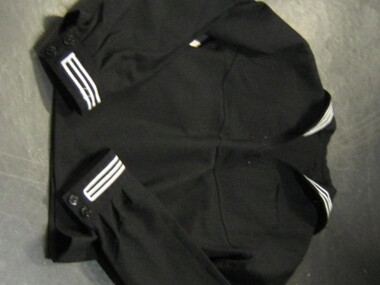
Shirt
... USA Navy Sailors Shirt...Uniform 2000 USA Navy Sailors Shirt Shirt ...USA Navy Sailors Shirtuniform, 2000 -
 Running Rabbits Military Museum operated by the Upwey Belgrave RSL Sub Branch
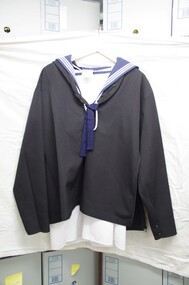
Uniform Sailor Incomplete
... Uniform Sailor jacket, shirt, scarf (bib), silk sash with tie and lanyard...Uniform 2010 RAN Uniform Sailor jacket, shirt, scarf (bib), silk sash with tie and lanyard Uniform Sailor Incomplete ...Uniform Sailor jacket, shirt, scarf (bib), silk sash with tie and lanyarduniform, 2010, ran -
 Surrey Hills Historical Society Collection
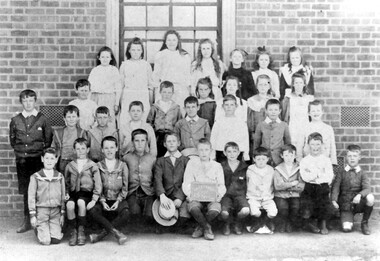
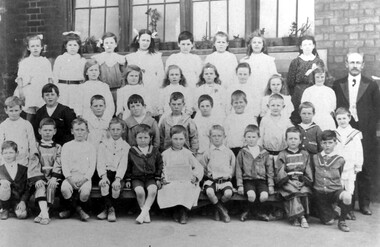
Photograph, Surrey Hills Primary School class photo, circa 1911, 1911
... One boy holds the class identification board (illegible); another holds a boater hat; several are dressed in 'sailor shirts'....One boy holds the class identification board (illegible); another holds a boater hat; several are dressed in 'sailor shirts'. Surrey Hills Primary School class photo, circa 1911 Photograph Photograph ...One of the boys is believed to be John Reaburn; date is approximate.Black and white photo of a class of 32 children at Surrey Hills Primary School taken outside against a brick wall with a central window. It may be a class of mixed-age children. There are 21 boys and 11 girls. One boy holds the class identification board (illegible); another holds a boater hat; several are dressed in 'sailor shirts'."J C Reaburn (underlined) (Surrey Hills Neighbourhood C...) / 857 - 7463 (underlined)" in pencil down RH edge.surrey hills primary school, schools, education, primary education, children, john reaburn -
 Surrey Hills Historical Society Collection
Photograph, Surrey Hills Primary School class photo, circa 1911, 1911
... One boy holds the class identification board (illegible); several are dressed in 'sailor shirts' and a couple in oriental-looking costumes. ...One boy holds the class identification board (illegible); several are dressed in 'sailor shirts' and a couple in oriental-looking costumes. ...One of the boys is believed to be John Reaburn; date is approximate.Black and white photo of a class of 34 children at Surrey Hills Primary School taken outside against a brick wall with a central window. It may be a class of mixed age children. There are 20 boys and 14 girls. One boy holds the class identification board (illegible); several are dressed in 'sailor shirts' and a couple in oriental-looking costumes. The children are flanked by a senior male teacher and a junior female teacher.surrey hills primary school, schools, education, primary education, children, john reaburn -
 Mission to Seafarers Victoria
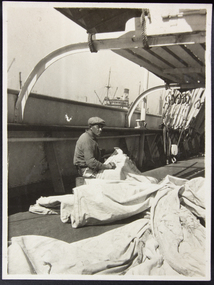
Photograph - Photograph, Black and white, Freda Kathleen Oxley (1882-1969), Chilean Sailmaker on the Skaregrøm, 1925-1926
... Sailor with grey shirt and cap sitting on the deck of the ship, repairing sails. ...Number 14 was added later in black ink Sailor with grey shirt and cap sitting on the deck of the ship, repairing sails. ...The Skaregrøm was a swedish windjammer. On his log during his time on the Skaregrøm Captain Archie Horka often mentions "Chile John" or "Chileno/Chilano John". He also mentions his real name John Oyarzo, probably Juan Oyarzo (see Sea History Magazine). His name, although misspelled, is written in the Freda Oxley album.The picture shows one of the work on board a sailing ship. It also demonstrates how international ship crew were at the time. The photograph was published in the annual report for 1926.Sailor with grey shirt and cap sitting on the deck of the ship, repairing sails. Around his right hand is one of the sailmaker tool: the sailmaker sewing palm is a leather strap with metal piece on the palm called the eye. This piece has indentations to accept the head of the needle as you push it through the cloth. The number 14 at the back indicates the photograph was previously on one of the grey album pages with the legend: "Chilean sailmaker on the Skaregrom".in pencil: "cut off"is written twice on the top and bottom of the photograph. Number 14 was added later in black inkskaregrom, sailing ship, sailmaker, skaregrøm, chilean, sailor, reverend john reginald weller (1880-1969), weller album, windjammer, freda kathleen oxley 1882-1969, juan oyarzo, john oyarzo -
 Kiewa Valley Historical Society
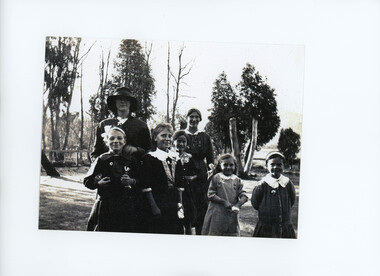
Photo - Family dressed in the fashion of the early 1900s
... Girls' hair was kept long, with curls and tied with ribbons.Boys' clothing was fashioned on sailor suits, blouses/shirts with a collar and trousers or knickerbockers. ...Girls' hair was kept long, with curls and tied with ribbons.Boys' clothing was fashioned on sailor suits, blouses/shirts with a collar and trousers or knickerbockers. ...During the early 1900s little girls' dresses were fashioned on the style worn by older women. Girls dresses were knee length with trimmings of lace and ribbon. Collars were often removable for ease of washing. Leather lace-up boots and woollen stocking or socks were usually worn with these dresses. A pinafore or apron would be worn over the dresses to help keep them clean. Girls' hair was kept long, with curls and tied with ribbons.Boys' clothing was fashioned on sailor suits, blouses/shirts with a collar and trousers or knickerbockers. Woollen jackets, shirts and ties were suitable attire for older boys. Children's fashion of this time was dictated by long lasting durability, local manufacture, earthy colours and ease of mobility. Because of the long distance to haberdashery stores, the majority of children's garments would have been hand made by a local seamstress, mother or relation.Black and white photo of a family with 5 children in the foreground with trees in the background.children's clothing -
 Montmorency–Eltham RSL Sub Branch
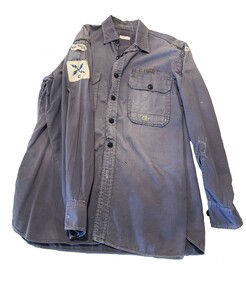
Uniform - Shirt, blue, RAN Sailor Dress No.8
... Shirt, Blue, RAN Sailor dress No.8...Badge Electronic Technician - Communication Badge Australia Shirt, Blue, RAN Sailor dress No.8 RAN Sailor Dress No.8 Uniform Shirt, blue ...Shirt, Blue, RAN Sailor dress No.8Badge Electronic Technician - Communication Badge Australia -
 Bendigo Military Museum
Uniform - UNIFORM, RAN - Summer Ceremonial, Red Anchor/Tailored garments
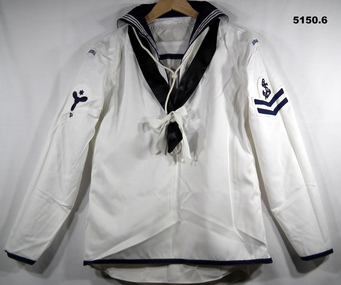
... Shirt - white polyester/cotton fabric, short sleeve, navy blue trim to square neckline. Insignia to left sleeve. 4. Silk - Black polyester black fabric to arrange around the collar. 5. Bow - white cotton tape. 6. Lanyard - white cord to arrange around neck. 7. Lid - white with black "Tally" band, sailors...Shirt - white polyester/cotton fabric, short sleeve, navy blue trim to square neckline. Insignia to left sleeve. 4. Silk - Black polyester black fabric to arrange around the collar. 5. Bow - white cotton tape. 6. Lanyard - white cord to arrange around neck. 7. Lid - white with black "Tally" band, sailors ...Royal Australian Navy - Uniform belonged to LS MTP E Rayner.1. Jumper/Barathea - long sleeve white polyester/cotton fabric with Navy blue collar attached, side zip under arm. Insignia to left sleeve depicting rank. Right side insignia depicts category. 2. Trousers - white polyester/cotton fabric, bell bottom. 3. Shirt - white polyester/cotton fabric, short sleeve, navy blue trim to square neckline. Insignia to left sleeve. 4. Silk - Black polyester black fabric to arrange around the collar. 5. Bow - white cotton tape. 6. Lanyard - white cord to arrange around neck. 7. Lid - white with black "Tally" band, sailors cap with Navy blue tape - chin strap. 1., 2. - Hand embroidered red cotton - "E RAYNER", 7. Handwritten, black ink, "LS MTP RAYNOR inside on the crown, Tally band - Embroidered gold thread "HMAS DERWENT'", on black band. " RED ANCHOR/TAILORED GARMENTS/ 65% POLYESTER 35% COTTON/ DO NOT BOIL, DRIP DRY, WARM IRON"ran, uniform -
 Bendigo Military Museum
Uniform - UNIFORM, RAN - Winter Ceremonial, RED ANCHOR TAILORING CO
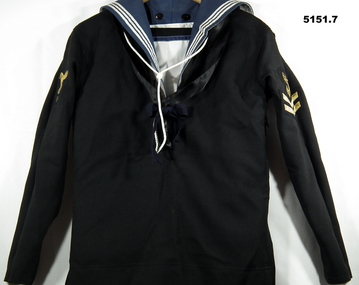
... Shirt - white polyester/cotton fabric, short sleeve, navy blue trim to square neckline. Insignia on left sleeve. 4. Collar - Navy blue with three white stripes, cotton fabric - lined. 5. Silk - black polyester fabric. 6. Bow - Navy blue cotton tape. 7. Lanyard - white cotton cord. 8. Lid - Sailor's...Sailor cap/lid belonged to LS MTP Ross. Uniform RAN 1 & 2. Maker's label - Red and white print. Hand embroidered red cotton "E. RAYNER". 3. Handwritten blue ink "44" on back of neckline. 4. stamped in black ink " E.W. RAYNER", makers label. 8. Handwritten, black ink "LS MTP ROSS" inside on crown. Tally band embroidered gold thread "H.M.A.S. CERBERUS' on black band. 1. Jumper/Barathea - Long sleeve, black wool/polyester fabric. Insignia - left sleeve depicting rank - right sleeve - depicting category. 2. Trousers - bell bottom, black wool/polyester fabric. 3. Shirt ...Royal Australian Navy Uniform belonging to E Rayner. Sailor cap/lid belonged to LS MTP Ross.1. Jumper/Barathea - Long sleeve, black wool/polyester fabric. Insignia - left sleeve depicting rank - right sleeve - depicting category. 2. Trousers - bell bottom, black wool/polyester fabric. 3. Shirt - white polyester/cotton fabric, short sleeve, navy blue trim to square neckline. Insignia on left sleeve. 4. Collar - Navy blue with three white stripes, cotton fabric - lined. 5. Silk - black polyester fabric. 6. Bow - Navy blue cotton tape. 7. Lanyard - white cotton cord. 8. Lid - Sailor's cap - white plastic with black band with Navy blue chin strap.1 & 2. Maker's label - Red and white print. Hand embroidered red cotton "E. RAYNER". 3. Handwritten blue ink "44" on back of neckline. 4. stamped in black ink " E.W. RAYNER", makers label. 8. Handwritten, black ink "LS MTP ROSS" inside on crown. Tally band embroidered gold thread "H.M.A.S. CERBERUS' on black band.uniform, ran -
 Surrey Hills Historical Society Collection
Photograph, Beryl and Geoffrey Mair, 1916, 1916
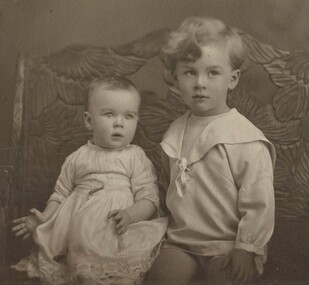
... The top of the boy's shirt has a 'sailor' collar....The top of the boy's shirt has a 'sailor' collar. Beryl and Geoffrey Mair, 1916 Photograph ...David Miller (Dave) Mair (1879-1938) married Lily Vipond Deakin (1890-1945) in 1910. They had 5 children: Geoffrey David (1913-1970), Beryl (1916-1976), Gwynneth (1917-1997), Isabel Lillian (1921-1997) and Shirley Inez (1928-1968). His parents were Isabella Brown (1856-1944) and William Mair (1850-1924). Personal communication from Laurie Newton, Beryl's daughter: Dave and Beryl initially lived in East Melbourne after they married. Geoffrey, Beryl and Gwynneth were born in East Melbourne. They subsequently moved to Louise Avenue, Mont Albert and Isabel may have been born while they were there. Later they purchased 20 Barton Street, Mont Albert. Shirley was born after they moved to Barton Street. The children attended Mont Albert Central School. Dave was an extremely keen sportsman (particularly bowls and cricket). He started the Kangaroo Cricket Club and worked for the Melbourne Cricket Club.This is part of a large donation related to the Deakin, Mair and Young families with connections to the Surrey Hills / Mont Albert area.A sepia coloured post card photo of (?) a studio portrait with a cream border of 2 children sitting on a couch. The infant is in a light-coloured dress with a lacy border along the hemline and lace embellishments to the sleeves and bodice. The top of the boy's shirt has a 'sailor' collar.REAR: In black ink - "Beryl taken at 8 months / Geoff " " (taken at) 3 years. / 10 Nov. 1916" Handwriting is thought to that of Lily Vipond Mair (nee Deakin). beryl mair, geoffrey david mair, children -
 Beechworth RSL Sub-Branch
Shirt Service Dress “S tens”, July 2007
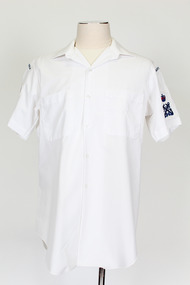
... Standard summer dress shirt indicative of that worn by sailors of all rank post WWII until present time. ...Standard summer dress shirt indicative of that worn by sailors of all rank post WWII until present time. ...Standard summer dress shirt indicative of that worn by sailors of all rank post WWII until present time. Summer, tropical dress shirt white worn by from post WWII to present day. Shirt was worn on service duty by CPO (R’td) Craig Duff; This style shirt is still in use by the RANShirt Service Dress White short sleeved with two breast pockets; Insignia embroided Naval Police Coxswain on the right sleeve; shoulder patch embroided in navy blue cotton with the word Australia embroided on both sleeves, Insignia Rank Petty Officer, buttoned down the front.Inside seam right hand side there is laundry instructions label measuring 45mm x 50mm; Collar label 45mm x 68mm/ DNJ9CC/ July 2007/ 8405-66-051-8334/ SIZE 40,/ NAME/ Service No., 65% polyester/ 35% viscose Rayonshirt short sleeved white, shirt white
