
Showing 48 items matching "sailor cap"
-
 The 5th/6th Battalion Royal Victoria Regiment Historical Collection
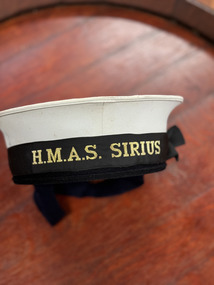
Headwear - HMAS Sirius Cap, HMAS Sirius sailor Cap
... HMAS Sirius sailor Cap...RAN sailor cap with HMAS Sirius on the cap, with blue strip...RAN sailor cap with HMAS Sirius on the cap, with blue strip HMAS Sirius sailor Cap Headwear HMAS Sirius Cap ...RAN sailor cap with HMAS Sirius on the cap, with blue strip -
 Lilydale RSL Sub Branch
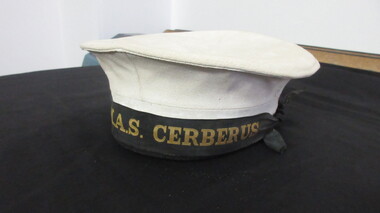
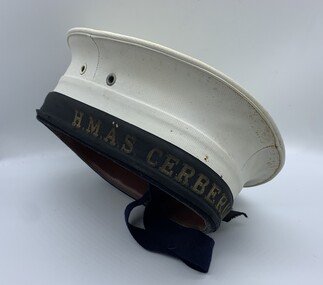
Uniform - Sailor Uniform Cap
... Sailor Uniform Cap...Australian Navy sailors cap with tally band ' HMAS Cerberus'...HMAS Cerberus Australian Navy sailors cap with tally band ' HMAS Cerberus' Uniform Sailor Uniform Cap ...Australian Navy sailors cap with tally band ' HMAS Cerberus'HMAS Cerberus -
 Port Fairy Historical Society Museum and Archives
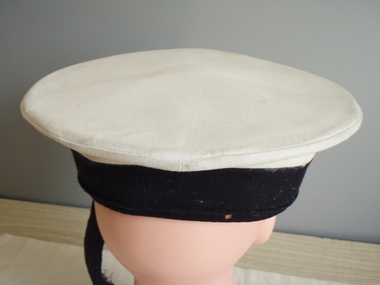
Uniform - Sailor Hat, c. 1890s
... Sailor's cap: Navy and white topped sailor's cap with grey lining and navy ribbon...RAN reserves local history uniforms navy robertson mr or captain william s.s.casino royal australian naval reserve hats 6 7/8 size marking / 157 red inking marking on crown lining Sailor's cap: Navy and white topped sailor's cap with grey lining and navy ribbon Uniform Sailor Hat ...Part of Capt. William Robertson's collection. Early career in navy. Captain of S.S.Casino. RAN reservesSailor's cap: Navy and white topped sailor's cap with grey lining and navy ribbon6 7/8 size marking / 157 red inking marking on crown lininglocal history, uniforms, navy, robertson, mr or captain william, s.s.casino, royal australian naval reserve, hats -
 Mission to Seafarers Victoria
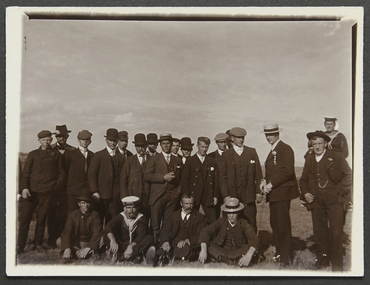
Photograph - Photograph, Sepia, Picnic at Orchard House, Cup Day 1907
... ...sailor cap...Typical outdoor photo of group of seafarers benefitting from a mission excursion out to one of the larger properties, in this case Orchard House, Malvern. orchard house 1907 malvern george higgins picnic cup day beatrice elizabeth higgins (nee shuter) charles shuter picnics entertainments social events goldsmith album bowler hat boater hat sailor cap Group o 21 seamen standing or sitting on the grass, with Reverend Gurney Goldsmith standing on the right. ...Typical outdoor photo of group of seafarers benefitting from a mission excursion out to one of the larger properties, in this case Orchard House, Malvern.Group o 21 seamen standing or sitting on the grass, with Reverend Gurney Goldsmith standing on the right.orchard house, 1907, malvern, george higgins, picnic, cup day, beatrice elizabeth higgins (nee shuter), charles shuter, picnics, entertainments, social events, goldsmith album, bowler hat, boater hat, sailor cap -
 Montmorency–Eltham RSL Sub Branch
Uniform - Cap, Navy, RAN HMAS Cerberus cap
... RAN Sailor's Cap; detachable tally band...CEREBUS (around rim) H.C.HART (hand-written, inside) RAN Sailor's Cap; detachable tally band RAN HMAS Cerberus cap Uniform Cap, Navy ...RAN Sailor's Cap; detachable tally bandH.M.A.S. CEREBUS (around rim) H.C.HART (hand-written, inside) -
 Bendigo Military Museum
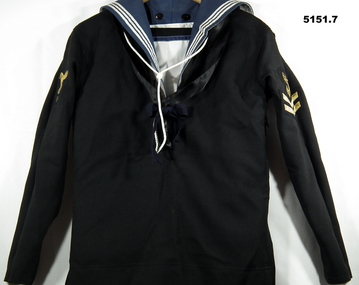
Uniform - UNIFORM, RAN - Winter Ceremonial, RED ANCHOR TAILORING CO
... Royal Australian Navy Uniform belonging to E Rayner. Sailor cap/lid belonged to LS MTP Ross....Lanyard - white cotton cord. 8. Lid - Sailor's cap - white plastic with black band with Navy blue chin strap....Royal Australian Navy Uniform belonging to E Rayner. Sailor cap/lid belonged to LS MTP Ross. Uniform RAN 1 & 2. ...Royal Australian Navy Uniform belonging to E Rayner. Sailor cap/lid belonged to LS MTP Ross.1. Jumper/Barathea - Long sleeve, black wool/polyester fabric. Insignia - left sleeve depicting rank - right sleeve - depicting category. 2. Trousers - bell bottom, black wool/polyester fabric. 3. Shirt - white polyester/cotton fabric, short sleeve, navy blue trim to square neckline. Insignia on left sleeve. 4. Collar - Navy blue with three white stripes, cotton fabric - lined. 5. Silk - black polyester fabric. 6. Bow - Navy blue cotton tape. 7. Lanyard - white cotton cord. 8. Lid - Sailor's cap - white plastic with black band with Navy blue chin strap.1 & 2. Maker's label - Red and white print. Hand embroidered red cotton "E. RAYNER". 3. Handwritten blue ink "44" on back of neckline. 4. stamped in black ink " E.W. RAYNER", makers label. 8. Handwritten, black ink "LS MTP ROSS" inside on crown. Tally band embroidered gold thread "H.M.A.S. CERBERUS' on black band.uniform, ran -
 Montmorency–Eltham RSL Sub Branch
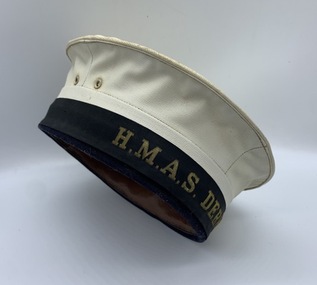
Uniform - RAN sailor’s cap, HMAS Derwent sailor’s cap
... RAN sailor’s cap Tally Band Detachable Name Band...HMAS Derwent H.C.Hart RAN sailor’s cap Tally Band Detachable Name Band HMAS Derwent sailor’s cap Uniform RAN sailor’s cap ...RAN sailor’s cap Tally Band Detachable Name BandHMAS Derwent H.C.Hart -
 Colac RSL Sub Branch
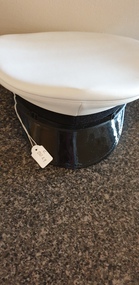
Uniform - Sailor's peaked cap belonging to Mr. George Turner, Formal cap with removalable white cover
... Sailor's cap with white, detachable cover. Black peak and band. ...No insignia or badges Formal cap with removalable white cover Uniform Sailor's peaked cap belonging to Mr. ...Worn by Mr. George Turner while serving on HMAS Melbourne and other Australian shipsImportantSailor's cap with white, detachable cover. Black peak and band. No insignia or badgesexample of australian naval uniform -
 Bendigo Military Museum
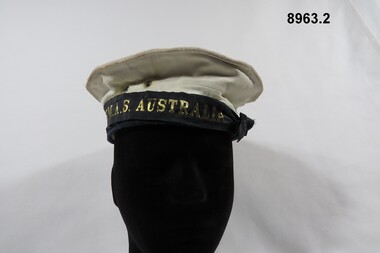
Headwear - SAILORS CAP, Unknown
... 1. Sailors cap with HMAS AUSTRALIA Tally band. 2. ...Tally band with “HMAS” Headwear SAILORS CAP ...2. HMAS Tally band used during war time so the identity of a particular ship was not known.1. Sailors cap with HMAS AUSTRALIA Tally band. 2. Tally band with “HMAS”1. ”HMAS AUSTRALIA ON CAP” 2. “HMAS” passchendaele barracks trust, pbt21, headwear -
 Ringwood RSL Sub-Branch
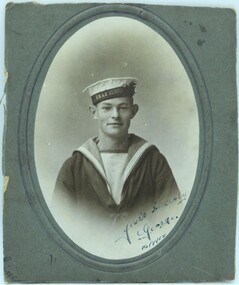
Photographs, Yours sincerely George 6/9/18
... Yours sincerely George, 16/9/18 Sailor with Cap band H.M.A.S Sydney....Yours sincerely George, 16/9/18 Sailor with Cap band H.M.A.S Sydney. Photograph Yours sincerely George 6/9/18 Photographs ...Photograph Yours sincerely George, 16/9/18 Sailor with Cap band H.M.A.S Sydney. -
 Lara RSL Sub Branch
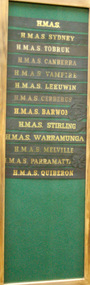
H.M.A.S.Tally Bands, HMAS Tally Bands - H.M.A.S., H.M.A.S. Sydney, H.M.A.S. Tobruk, H.M.A.S. Canderra,, H.M.A.S. Leeuwin, H.M.A.S. Cerberbus
... Sailors cap cloth Band, known as a Tally Band, a collection of: - H.M.A.S., H.M.A.S. ...Cerberbus, tally bands Cloth Tally bands, mounted in a wooden and glass display frame. Sailors cap cloth Band, known as a Tally Band, a collection of: - H.M.A.S., H.M.A.S. ...Australian Navy Tally bands for H.M.A.S., H.M.A.S. Sydney, H.M.A.S. Tobruk, H.M.A.S. Canderra, H.M.A.S. Vampire, H.M.A.S. Leeuwin, H.M.A.S. Cerberbus, Royal Australian Navy Tally Bands, for H.M.A.S., H.M.A.S. Sydney, H.M.A.S. Tobruk, H.M.A.S. Canderra, H.M.A.S. Vampire, H.M.A.S. Leeuwin, H.M.A.S. Cerberbus,Sailors cap cloth Band, known as a Tally Band, a collection of: - H.M.A.S., H.M.A.S. Sydney, H.M.A.S. Tobruk, H.M.A.S. Canderra, H.M.A.S. Vampire, H.M.A.S. Leeuwin, HMAS Vampire H.M.A.S. Cerberbus, mounted in a wooden and glass display frame.Cloth Tally bands, mounted in a wooden and glass display frame.tally bands -
 Running Rabbits Military Museum operated by the Upwey Belgrave RSL Sub Branch
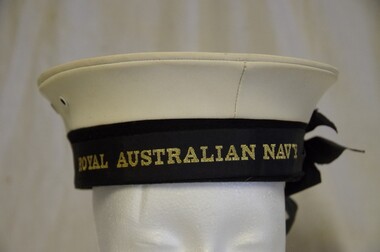
Cap
... Cap sailors with Royal Australian Navy tally band...Headgear WW2 RAN Cap sailors with Royal Australian Navy tally band Cap ...Cap sailors with Royal Australian Navy tally bandheadgear, ww2, ran -
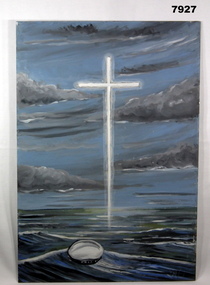 Bendigo Military Museum
Painting - ORIGINAL OIL PAINTING, Unknown
... Depicting - sea, sky with shimmering cross and two sailors caps floaing on the water. Painted on glass. ...Depicting - sea, sky with shimmering cross and two sailors caps floaing on the water. Painted on glass. ...Item in the collection re: "William Anthony (Bill) Theodore" DSM. Refer Cat No. 7926P for his service record.Painting - black, blue, grey, white, green colours, oil artists paint. Depicting - sea, sky with shimmering cross and two sailors caps floaing on the water. Painted on glass. Painting appears to be signed by artist with two capital letters "WG". Glass sheet used for painting and provides the frame.Artist signature "WG".framed accessories, painting, william theodore -
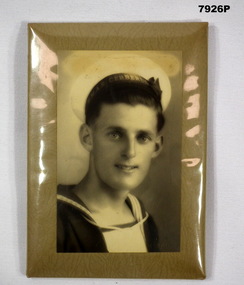 Bendigo Military Museum
Photograph - PORTRAIT PHOTOGRAPH, RAN WW1, C. WW2
... Photograph, B&W portrait of an RAN Sailor on photographic paper, noted on Sailors Cap "HMAS Cerberus". Frame , metal backing with stand, front shallow convex shape with light brown colour paper mount, heavy plastic cover moulded to shape over photo and mount, owners white adhesive label on the back....He was awarded a Life Membership & a Certificate of Appreciation for his services. framed accessories RAN Theodore DSM photograph portrait Information on label, "THEODORE William Anthony", in black ink print, "Preferred name: Bill/19.03.1917" Photograph, B&W portrait of an RAN Sailor on photographic paper, noted on Sailors Cap "HMAS Cerberus". Frame , metal backing with stand, front shallow convex shape with light brown colour paper mount, heavy plastic cover moulded to shape over photo and mount, owners white adhesive label on the back. ...Item in the collection re William Anthony (Bill) Theodore DSM. The Sailor is Willam Anthony Theodore DSM, (born Bendigo, enlisted Port Melbourne) on 2.9.1940 in the RAN No PM2981. He served in the Seige of Tobruk, Greece, Crete, Matapan, Singapore, Pacific Islands, New Guinea to the Phillipine's. The HMAS Vendetta he was sailing on made 39 trips into Tobruk Harbour during the siege. In October 1941 so many bombs were dropped around the Vendetta that her Boilers and Engines shifted on their mountings and was ordered to Singapore for repairs. After Bill served on HMAS Arunta and was awarded the Distinguished Service Medal for "Gallantry, Skill and Devotion to Duty" during the Assault Operations at Lingayen Gulf. Bill was discharged from the RAN on 21.11.1945. From 1956 - 1995 over specific years Bill held the positions of President, Vice President, Treasurer & Welfare Officer of the "Bendigo Rats of Tobruk Association". He was awarded a Life Membership & a Certificate of Appreciation for his services.Photograph, B&W portrait of an RAN Sailor on photographic paper, noted on Sailors Cap "HMAS Cerberus". Frame , metal backing with stand, front shallow convex shape with light brown colour paper mount, heavy plastic cover moulded to shape over photo and mount, owners white adhesive label on the back.Information on label, "THEODORE William Anthony", in black ink print, "Preferred name: Bill/19.03.1917"framed accessories, ran, theodore dsm, photograph, portrait -
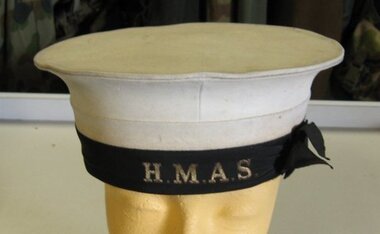 Running Rabbits Military Museum operated by the Upwey Belgrave RSL Sub Branch
Cap
... Cap RAN sailors with HMAS tallyband...Headgear C1970's RAN Cap RAN sailors with HMAS tallyband Cap ...Cap RAN sailors with HMAS tallybandheadgear, c1970's, ran -
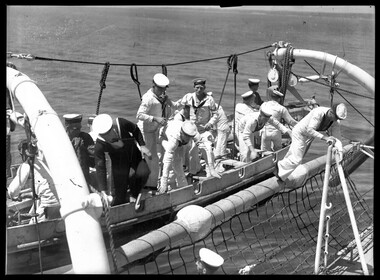 City of Melbourne Libraries
Photograph, Bull, Hugh Jones, 1897-1993, Group of sailors
... A group of sailors, wearing caps that likely say 'HMAS Cerberus', at work on a ship. ...A group of sailors, wearing caps that likely say 'HMAS Cerberus', at work on a ship. ...A group of sailors, wearing caps that likely say 'HMAS Cerberus', at work on a ship. Photographer notations on slide: noneships, australian navy, sailors, clothing and dress, 1930-1939 -
 Bendigo Military Museum
Uniform - UNIFORM, RAN - Summer Ceremonial, Red Anchor/Tailored garments
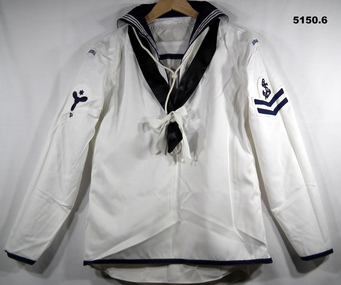
... Lid - white with black "Tally" band, sailors cap with Navy blue tape - chin strap. ...Lid - white with black "Tally" band, sailors cap with Navy blue tape - chin strap. ...Royal Australian Navy - Uniform belonged to LS MTP E Rayner.1. Jumper/Barathea - long sleeve white polyester/cotton fabric with Navy blue collar attached, side zip under arm. Insignia to left sleeve depicting rank. Right side insignia depicts category. 2. Trousers - white polyester/cotton fabric, bell bottom. 3. Shirt - white polyester/cotton fabric, short sleeve, navy blue trim to square neckline. Insignia to left sleeve. 4. Silk - Black polyester black fabric to arrange around the collar. 5. Bow - white cotton tape. 6. Lanyard - white cord to arrange around neck. 7. Lid - white with black "Tally" band, sailors cap with Navy blue tape - chin strap. 1., 2. - Hand embroidered red cotton - "E RAYNER", 7. Handwritten, black ink, "LS MTP RAYNOR inside on the crown, Tally band - Embroidered gold thread "HMAS DERWENT'", on black band. " RED ANCHOR/TAILORED GARMENTS/ 65% POLYESTER 35% COTTON/ DO NOT BOIL, DRIP DRY, WARM IRON"ran, uniform -
 Melbourne Legacy
Leisure object - Toy Bear, Legacy Bear $20 - Salty, 2021
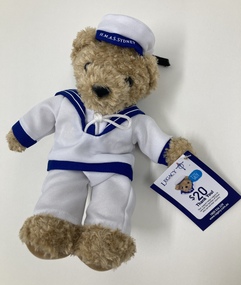
... This bear is in an Australian navy sailor outfit and white cap with the band saying HMAS Sydney. ...This bear is in an Australian navy sailor outfit and white cap with the band saying HMAS Sydney. ...In the 2000s Legacy released a range of Legacy Bears to expand the merchandise available for sale during Legacy Week and at other fundraising opportunities during the year. This bear is in an Australian navy sailor outfit and white cap with the band saying HMAS Sydney. He was given the name Salty. A previous edition had The Australian Navy on the cap band. Sometimes special editions of the bears were produced. In 2021 the price was increased to $20 per bear.An example of the type of products sold along with Legacy Badges for fundraising in the 2010-2020s.Legacy bear dressed in a white navy uniform with HMAS on his cap band with a printed cardboard tag.Printed tag gives the price as $20.legacy appeal, fundraising, legacy bear -
 Eltham District Historical Society Inc
Folder, Commercial Bank of Australia Eltham Branch Hold-Up, 15 December 1949
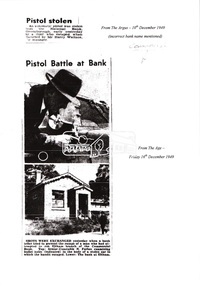
... The man is wearing a sailor’s cap and disappears along the railway track toward Montmorency. ...The man is wearing a sailor’s cap and disappears along the railway track toward Montmorency. ...Thursday, December 15, 1949, the quiet little bank was embroiled in an infamous wild shoot-out between a daring thief and two bank officers. Today, the building still carries the scars ; a bullet hole remains visible in a cedar bench testifying to the events that played out that day. 3.30 a.m., Friday, December 9. The manager of the Commercial Bank branch at Greensborough, Mr Harry Wallace and his wife are asleep in their bedroom of the little house behind the branch. Harry is awakened by a noise and sees an intruder in a corner of the bedroom. He calls out but the intruder who has switched off the power in anticipation flees through a side door and scarpers down Main Street. Harry summons the police but a search by First Constable Thomas of the Greensborough Police assisted by a wireless patrol car is unsuccessful. A report is filed noting the theft of a .25 calibre pistol from the wardrobe. Thursday, December 15th. It is 1pm and the Commercial Bank has just opened. The branch is only open Mondays and Thursdays from 1-3pm. The morning started off a little cool with some scattered showers but it has fined up and the temperature is now around 61 degrees (16 C). A new grey Singer sports car with soft-top pulls up on the opposite side of the road and a young man, neatly dressed in a dark blue suit, wearing a grey hat and carrying a brief case exits the vehicle. He looks around then crosses the road and walks up the steps and through the door into the bank. There are three people inside; Mr. Jack Burgoyne whose grocery store is situated just 50 yards up the road, Mr. Lindsay A. Spears, the Eltham Agency Receiving Officer and by chance, Mr Harry Wallace, manager of the Greensborough branch. Jack Burgoyne takes note of the young stranger; thinking to himself he appears nervous. The man approaches the counter and introduces himself as John Henderson of Greensborough and explains that he wishes to open a new account. He places his hat and £3 on the counter. Mr Spears attends to the paperwork. He asks the young man to sign two forms, which he does but then he withdraws from the counter and starts walking towards the door. Suddenly he spins around pulling an automatic pistol from his right-hand pocket. He exclaims forcefully; “The game’s on! I’ll take the lot!” Spears appears to comply by pretending to open a drawer. The man shouts loudly, “Keep your hand away from that drawer.” Spears instead reaches for a pistol in his pocket and challenges the man, “Here it is. Come and get it!” At the same time, Harry Wallace pulls a pistol from his pocket as well. The bandit fires a shot but misses, the bullet striking the counter. Both Spears and Wallace open fire and Jack Burgoyne ducks for cover. As the bandit turns and runs for the door leaving his £3 behind, he fires another shot, which strikes the ceiling. Spears fires back, and thinks he may have hit him in the foot. The bandit flees the bank and heads for the grey Singer car, registration NO-106, parked opposite. Wallace and Spears pursue him to the door and open fire again, striking the car three times around the driver’s door. Spears lets off eight shots and Wallace, seven before his gun jams. The getaway car initially heads slowly down Main Road towards Bridge Street. About 100 yards down the road, Dave Adams, a PMG employee, who has heard the shots, throws a steel manhole step at the driver. It hits the roof of the car nine inches above the driver’s head and tears the hood. Another witness claims to have seen the door blow open and the driver raise his hand. The car gathers speed and swings left into Bridge Street racing along at about 60 miles an hour careering recklessly past council employee, Mr. Percy Williams, who is driving a dray along Smarts Road [believed to be Bridge Street]. At the end of the road the Singer fails to get round the sharp turn and crashes into an embankment skidding to a stop outside the home of Mr John Clifford. One side of the car is wrecked. Mr Clifford, an aircraft engineer hears the fast travelling car bump heavily into the road bank at about 1.25 p.m. Hearing the whine of an engine he goes outside to find the grey Singer parked at the side of the road. Jack George also lives at the corner and hears the car crash. “The bandit opened the car door, ran 50 yards, and suddenly turned back,” exclaims Jack. “He took something from the car. It might have been a gun.” In his haste, the bandit drops his grey felt hat, size 6 7/8, on the road and dashes up Sherbourne Road for about 200 yards then disappears into the scrub carrying a brief case and a bundle in which a sailor’s cap can be seen. About 3 p.m., Mr H.D. Pettie of Mountain View Road, Montmorency is looking through his field glasses and notices a young man walking through thick scrub on private property some distance from his house. The man is wearing a sailor’s cap and disappears along the railway track toward Montmorency. As the day progresses, ten police cars, one motor cycle, and about 40 police led by Det. Sgt. McMennemin of Malvern CIB are searching for him. They believe he is hiding in thick scrub along the bank of the creek about half-a-mile outside Eltham township. Wireless patrol cars, four mobile traffic cars and the CIB area cars from Malvern and Kew are taking part. Police check the thief’s car and discover it was stolen from Helen Baxter, of Doncaster Road, North Balwyn from outside Victoria Barracks. Harry Wallace informs the police that he believes he recognised the bandit as the man who took his pistol from his bedroom the previous Friday morning. As night falls, armed police are posted at strategic points in the Eltham-Greensborough district. Police in cars are watching the roads. Others are searching the bush and checking passengers on trains. Little do they realise the young man has already slipped out of the net. SEQUEL YOUTH OF 19 CHARGED WITH ATTEMPTED ARMED ROBBERY OF BANK AT ELTHAM Weekly Times, Wednesday 15 February 1950, page 6 Detectives who raided a house in Bell St., Coburg, Melbourne, charged a 19-year-old youth, of South Yarra, with attempted armed robbery at the Commercial Bank’s Eltham (Vic.) receiving depot on Dec. 15. Police say they recovered a loaded automatic pistol, diamond and signet rings worth more than £200, a complete set of house-breaking instruments, a sailor’s uniform, and chloroform gauze in the raid. The youth was charged that while armed with an offensive weapon, he attempted to rob Lindsay George Spears of a sum of money. He was further charged on six counts of breaking, entering and stealing. Police allege that the person who tried to hold up Mr Spears in the Commercial Bank receiving depot at Eltham on December 15. escaped in a stolen car, after Mr Spears and Mr Henry Wallace, manager of the bank’s Greensborough branch, had fired at him. After the car crashed, he escaped into thick scrub and is alleged to have changed into a sailor’s uniform. On December 9 an automatic pistol was stolen from Mr Wallace’s bedroom at the Greensborough bank. The chloroform pad recovered is alleged to have been stolen from the Dental Supply Company, Plenty Road, Preston. The rings are alleged to have been taken in a £513 burglary from the shop of James Paton. Sydney Road, Coburg. Det. Sgt. H. McMennemin conducted the investigations with Senior Dets. R. Newton and M Downie, Detectives l. Dent, R. Rayner, P. Pedersen and M. Handley and First Constable A. Thomas. The youth will appear at Eltham Court on February 22. Manager’s Gun Used in Holdup at Bank The Age, Thursday 23 February 1950, page 4 It was stated in Eltham court yesterday that a youth who robbed a bank manager of his pistol, later used it in an attempt to hold-up the bank. Kay Arthur Morgan, 19, draftsman, of Castle-street, South Yarra, was committed for trial on charges of breaking and entering, and stealing a pistol and attempted robbery while armed with an offensive weapon. He pleaded guilty. The manager of Eltham branch of the Commercial Bank of Australia Ltd., Henry Clifton Cabot Wallace, said he disturbed someone in the bedroom, in which he and his wife were sleeping, at 3 a.m. on December. 9, 1949. Later he found that his automatic- pistol was missing. On December 15 a youth, who said his name was John Henderson, entered the bank and opened a new account. As the youth was leaving the bank he turned round with a pistol in his hand and said: — “I want the lot.” Spear indicated a drawer under the counter; and said.— “Here it is. Come and get it.” The youth said:— “Keep your hand away from that drawer.” Witness said Spear then drew his pistol from his hip pocket. The youth fired at them, and Spear returned the fire. “I pulled my pistol and fired, too” said witness. The youth fired again, ran out to a car and drove off. Witness and Spear fired several shots at the car. The youth was the accused Morgan, sitting in court, witness said. Evidence was given that one bullet was found in the celling and the other in the bank. Morgan was allowed £100 bail on each charge. Morgan ended up serving three years for the failed armed robbery and became a notorious criminal. He had twin sons, Peter and Doug and even though only ten years old, Morgan would get his sons to act as lookouts whilst he committed burglaries. The lads became building contractors but when the industry suffered a downturn in 1977 and they were short on cash, they returned to the family business. Over the following 23 months they undertook 24 raids on country and outer-suburban TABs and banks. Whilst robbing one country bank for the third time, just like their father, it all went wrong ending up with a police officer shot. They were nick-named the “After-dark” bandits and are considered to be Australia’s last bushrangers. They were convicted and served 17 years in prison.5 x A4 photocopied pagesbank hold-up, cba bank, det sgt mcmennemin, eltham, h.d. pettie, harry wallace, jack burgoyne, kay arthur morgan, lindsay a. spears, main road -
 Flagstaff Hill Maritime Museum and Village
Furniture - Rail and Base, circa 1944
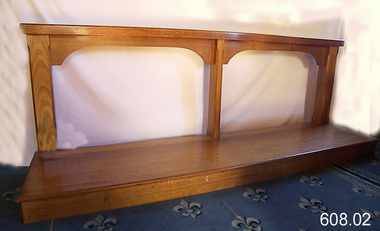
... Kerr Johnston, a Church of England clergyman, and operated from a hulk moored in Hobson’s Bay; later the Mission occupied buildings in Williamstown and Port Melbourne. flagstaff hill warrnambool shipwrecked-coast flagstaff-hill flagstaff-hill-maritime-museum maritime-museum shipwreck-coast flagstaff-hill-maritime-village rail for kneeling rail kneeling rail religion religious service sailors rest bethel sailors’ church bethel floating church ladies harbour light guild missions to seamen victoria mission to seafarers st nicholas seaman’s church williamstown st nicholas mission to seamen church williamstown mission to seamen williamstown st nicholas seamen’s church flagstaff hill 139 nelson place williamstown church furniture religious furniture religious worship flying angel club altar rail kneeler prayer ceremonial furniture Rail and base, one of a pair of two kneeling rails. Three varnished wood pillars and cap ...This is one of a pair of kneeling rails that were part of the original furnishings of the St Nicholas Mission to Seamen's Church at 139 Nelson Place, Williamstown, Victoria. A kneeling rail is a part of the church's furniture and is used during religious prayer to assist the person in assuming the kneeling position. A padded kneeling mat or cushion would also be provided for comfort. THE MISSIONS TO SEAMEN (Brief History): - The Missions to Seamen was an Anglican charity in Great Britain that has served the world's seafarers since 1856. Its symbol is a Flying Angel, inspired by a Bible verse. Today, there are centres in over 200 ports worldwide where seamen of all backgrounds are offered a warm welcome and provided with a wide range of facilities. In Victoria, the organisation began in Williamstown in 1857 as a Sailors’ Church, also known as ‘Bethel’ or the ‘Floating Church’ in an old hulk floating in Hobson’s Bay, Port of Melbourne. It soon became part of the Missions to Seamen, Victoria. In 2000, the organisation, now named Mission to Seafarers, still operated locally in Melbourne, Portland, Geelong and Hastings. The Ladies’ Harbour Lights Guild was formed in 1906 to support the Missions to Seamen in Melbourne and other centres, such as Williamstown. Two of the most significant ladies of the Guild were founder Ethel Augusta Godfrey and foundation member Alice Sibthorpe Tracy (who established a branch of the Guild in Warrnambool in 1920). The Guild continued its work until the 1960s. In 1943, a former Williamstown bank was purchased for the Missions to Seamen Club. The chapel was named St Nicholas’ Seamen’s Church and was supported by the Ladies’ Harbour Lights Guild, the Williamstown Lightkeepers’ Auxiliary and the League of Soldiers’ and Sailors’ Friends. It ceased operation in 1966. A Missions to Seamen Chapel and Recreation Room was a significant feature of ports during the late 1800s and 1900s. It seemed appropriate for Flagstaff Hill to include such a representation within the new Maritime Village, and the Melbourne Board of Management of Missions to Seamen Victoria gave its permission on 21st May 1979 for the entire furnishings of the Williamstown chapel to be transferred to Flagstaff Hill. The St Nicholas Seamen’s Church was officially opened on October 11, 1981, and resembles the Williamstown chapel. This pair of kneeling rails is significant through its association with the St Nicholas' Mission to Seamen Church in Williamstown, Melbourne, established in 1857. The items in our collection from the Missions to Seamen in Williamstown, Victoria, have historical and social significance. They show that people of the 1800s and 1900s cared about the seafarers’ religious, moral, and social welfare, no matter what the religion, social status or nationality. It had its origins in Bristol, England when a Seamen's Mission was formed in 1837. The first Australian branch was started in 1856 by the Rev. Kerr Johnston, a Church of England clergyman, and operated from a hulk moored in Hobson’s Bay; later the Mission occupied buildings in Williamstown and Port Melbourne. Rail and base, one of a pair of two kneeling rails. Three varnished wood pillars and cap rail, mounted on a rectangular box-shaped base: a kneeling rail is used in religious worship. These kneeling rails are part of the St Nicholas Seamen's Church Williamstown Collection.flagstaff hill, warrnambool, shipwrecked-coast, flagstaff-hill, flagstaff-hill-maritime-museum, maritime-museum, shipwreck-coast, flagstaff-hill-maritime-village, rail for kneeling, rail, kneeling rail, religion, religious service, sailors rest, bethel sailors’ church, bethel floating church, ladies harbour light guild, missions to seamen victoria, mission to seafarers, st nicholas seaman’s church williamstown, st nicholas mission to seamen church williamstown, mission to seamen williamstown, st nicholas seamen’s church flagstaff hill, 139 nelson place williamstown, church furniture, religious furniture, religious worship, flying angel club, altar rail, kneeler, prayer, ceremonial furniture -
 Flagstaff Hill Maritime Museum and Village
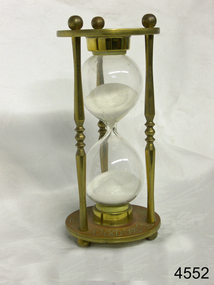
Instrument - Hourglass
... caps. The length of time can be adjusted by adding or removing sand particles. The use of the marine sandglass (or hourglass) has been recorded in the 14th century in European shipping. A one minute sandglass was used in conjunction with the ship’s log for ‘dead reckoning’, (see below) that is, for measuring the ship’s speed through the water. They were also used to regulate ringing the ship’s timetable; for example a 4 hour sandglass was used for the length of the sailors...caps. The length of time can be adjusted by adding or removing sand particles. The use of the marine sandglass (or hourglass) has been recorded in the 14th century in European shipping. A one minute sandglass was used in conjunction with the ship’s log for ‘dead reckoning’, (see below) that is, for measuring the ship’s speed through the water. They were also used to regulate ringing the ship’s timetable; for example a 4 hour sandglass was used for the length of the sailors ...An hourglass or sandglass is an instrument for measuring a defined time and can be used perpetually by simply turning it over immediately the top bulb empties. The clear blown glass is shaped into two equal sized bulbs with a narrow passage in the centre and contains uniform sized sand or glass particles in the lower bulb. The width of the neck regulates the constant flow of the particles. The glass is held in a stand with top and bottom of equal shape and size. Hourglasses can measure an infinite variety of time by gauging the size of the particles, the shape and size of the bulbs and the size of the passage between the bulbs, thus measuring hours or minutes or even seconds. Generally an hourglass sits between discs of wood at the ends, which are joined by long wooden spindles between the ends and tightened by screw caps. The length of time can be adjusted by adding or removing sand particles. The use of the marine sandglass (or hourglass) has been recorded in the 14th century in European shipping. A one minute sandglass was used in conjunction with the ship’s log for ‘dead reckoning’, (see below) that is, for measuring the ship’s speed through the water. They were also used to regulate ringing the ship’s timetable; for example a 4 hour sandglass was used for the length of the sailors’ watch, and a half hour timer for taking of readings for the ship’s log; the ship’s bell would be rung every half hour. It was usually the role of the cabin boy to watch and turn the sandglasses over at the exact time of them emptying their upper chambers and to ring the ship’s bell. Hourglasses have been used historically for many hundreds of years. Some have been used for timing church sermons, in cooking, in industry and at sea. Even today they are used for measuring the cooking time of eggs and timing a player’s turn in games such as Boggle and Pictionary. The sandglasses at sea were gradually replaced in the late 1700’s to early 1800’s by the more accurate chronometers (marine clocks) when they became reliable instruments. DEAD RECKONING (or Deduced Reckoning) Dead reckoning is the term used to describe the method of calculating the ship’s position from its speed and direction, used in early maritime travel, mostly in European waters. Both the (1) speed and the (2) direction of travel were recorded on a Traverse Board at half-hourly intervals during a helmsman’s watch of 4 hours. The navigator would record the readings in his ship’s log, plot them on his navigational chart and give his updated course directions to the next helmsman on watch, along with the cleared Traverse Board. This was a very approximate, but none-the-less helpful, method of navigation. The wooden Traverse Board was a simple pegboard with a diagram of a compass with eight peg holes along the radius to each of the compass points, plus a grid with ascending half hours in the left column and increasing ship’s speed in knots in a row across the column headings, with a peg hole in each of the intersecting cells. A number of wooden pegs were attached to strings on the board. By placing one peg consecutively in the direction’s radius hole, starting from the centre, and the speed holes when the half hourly reading was taken, a picture of speed and direction for the whole 4 hour watch was created. (1) To measure the ship’s speed a one minute hourglass timer was usually used to measure the ship’s speed through the water and help to calculate its longitude. A rope, with knots at regular standard intervals and a weight such as a log at the end, would be thrown overboard at the stern of the ship. At the same time the hourglass would be turned over and a seaman would start counting the number of knots on the rope that passed freely through his hands as the ship travelled. When the timer ran out the counting would be stopped. A timer of one minute (one-sixtieth of an hour), knots spaced one-sixtieth of a nautical mile apart, and simple arithmetic easily gave the speed of the ship in nautical miles per hour ("knots"). This would be recorded every half hour. The speed could however be inaccurate to the travel being affected by ocean currents and wind. (2) To calculate the ship’s direction a compass sighting would be recorded each half hour.Marine hourglasses or sandglasses were used from around the 14th to 19th century during the time of sailing ships. This hourglass is representative of that era, which is during the time of the colonisation of Australia. Hourglass or sandglass; an instrument used to measure time. Two equal sized clear glass bulbs joined with a narrow passage between them, containing equal sized particles of sand grains in lower bulb. Glass sits in a brass collar at each end, in a frame comprising 3 decorative brass columns or posts, each attached top and bottom, using round screw-on feet, to round brass discs. Disc have Roman numerals for the numbers 1 - 12 pressed into their inner surfaces and hieroglyphics on the outer surfaces. Roman numerals on inner surface of discs " I II III IV V VI VII VIII IX X XI XII " Hieroglyphics impressed on outer surface of discsflagstaff hill, warrnambool, shipwrecked coast, flagstaff hill maritime museum, maritime museum, shipwreck coast, flagstaff hill maritime village, great ocean road, horology, hourglass, hour glass, sandglass, sand glass, timing instrument, dead reckoning, deduced reckoning, finding latitude at sea, sandglass with hieroglyphics and roman numerals, hourglass with hieroglyphics and roman numerals, brass hourglass -
 Mission to Seafarers Victoria
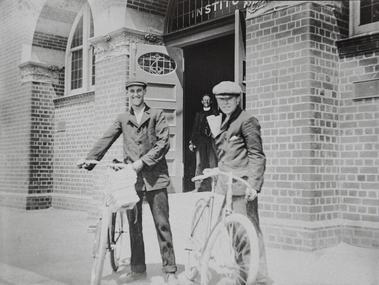
Photograph - Photograph, Sepia
... Butler. bicycles reverend alfred gurney goldsmith siddeley street central institute australian wharf mission to seafarers seamen's mission mission to seamen sailors caps literature Small monochrome photograph, quite faded/poor contrast Photograph Photograph, Sepia ...Two young couriers with their bikes are ready to deliver their parcel - letters or newsletter - picked up from the Seamen's Institute, Siddeley Street. The Reverend A Gurney Goldsmith is standing on the stairs in the lobby.This photograph is a rare depiction of the Siddeley Street Institute, the first central Institute built by Walter R. Butler.Small monochrome photograph, quite faded/poor contrastbicycles, reverend alfred gurney goldsmith, siddeley street, central institute, australian wharf, mission to seafarers, seamen's mission, mission to seamen, sailors, caps, literature -
 Mission to Seafarers Victoria
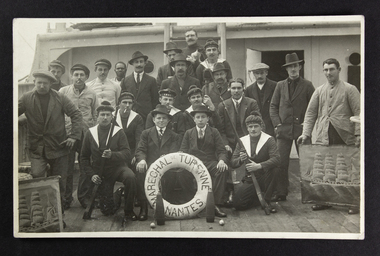
Postcard - Photograph, Black and white, Green Bros, 1918
... cap-hornier" in French. In a book written in 1973 by Georges Aubin, "La mer douce et cruelle", ed. France-Empire, a chapter "Une traversée du trois-mâts nantais Maréchal de Turenne" (page 285 to 319) tells how the ship was navigating from London to New-York to load barrels of petrol bound for Melbourne. The photograph demonstrates how prepared the merchant navy was during the First World War. The French Merchant Navy had additional men from the Navy: the six sailors ...The Maréchal de Turenne, a three mast barque, was built in the "Chantiers de la Loire" shipyard in Nantes, port in the West of France, in 1899 by the company René Guillon et René Fleury. Capacity of 3000 barrels. The barque is called a "cap-hornier" in French. In a book written in 1973 by Georges Aubin, "La mer douce et cruelle", ed. France-Empire, a chapter "Une traversée du trois-mâts nantais Maréchal de Turenne" (page 285 to 319) tells how the ship was navigating from London to New-York to load barrels of petrol bound for Melbourne.The photograph demonstrates how prepared the merchant navy was during the First World War. The French Merchant Navy had additional men from the Navy: the six sailors in uniform and sailor "bachi" bonnet with the AMBC inscription were on the ship to support the crew in case of enemy attack. Two of those soldiers carry a bayonet. One of the sailors is wearing headphones: World War One saw telecommunication progress. At sea, the threat were the German submarines: the U-boats.The photograph depicting the 22 members of the crew was taken in October 1918 onboard the Marechal de Turenne. The two on the right and left side are holding a picture of the barque. One man at the back is holding a cat. 11 names are written at the back. The photograph was turned into a postcard.Printed at the back: On the left: Green Bros/Photo/251 Nelson Place, Williamstown Centered: Post Card/Correspondence/Address only Top right corner for the stamp: Kodak Australia Written at the back: octobre 1918 Souvenir du navire Maréchal de Turenne Berthot Jacquet Renaut R. Renaut H. Lecoq Mercier Berger Dubas Lorie Coat Tilloncrew, barque, french, 1918, marechal de turenne, nantes, wwi, world war one, first world war, great war, buoy, ship mascot, cat, a.m.b.c, bayonet, african, black man, apprentices, armement militaire des bâtiments de commerce, bachi, sailor beret, radio transmitters, telegraph, morse, telecommunication, german submarines, u-boats, cigarettes, smoking, williamstown, mission to seafarers, seamen's mission, nelson place, crews and ships -
 Mission to Seafarers Victoria
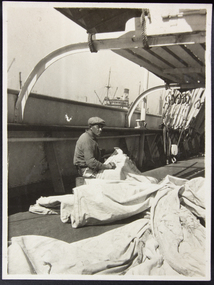
Photograph - Photograph, Black and white, Freda Kathleen Oxley (1882-1969), Chilean Sailmaker on the Skaregrøm, 1925-1926
... Sailor with grey shirt and cap sitting on the deck of the ship, repairing sails. ...Number 14 was added later in black ink Sailor with grey shirt and cap sitting on the deck of the ship, repairing sails. ...The Skaregrøm was a swedish windjammer. On his log during his time on the Skaregrøm Captain Archie Horka often mentions "Chile John" or "Chileno/Chilano John". He also mentions his real name John Oyarzo, probably Juan Oyarzo (see Sea History Magazine). His name, although misspelled, is written in the Freda Oxley album.The picture shows one of the work on board a sailing ship. It also demonstrates how international ship crew were at the time. The photograph was published in the annual report for 1926.Sailor with grey shirt and cap sitting on the deck of the ship, repairing sails. Around his right hand is one of the sailmaker tool: the sailmaker sewing palm is a leather strap with metal piece on the palm called the eye. This piece has indentations to accept the head of the needle as you push it through the cloth. The number 14 at the back indicates the photograph was previously on one of the grey album pages with the legend: "Chilean sailmaker on the Skaregrom".in pencil: "cut off"is written twice on the top and bottom of the photograph. Number 14 was added later in black inkskaregrom, sailing ship, sailmaker, skaregrøm, chilean, sailor, reverend john reginald weller (1880-1969), weller album, windjammer, freda kathleen oxley 1882-1969, juan oyarzo, john oyarzo -
 Mission to Seafarers Victoria
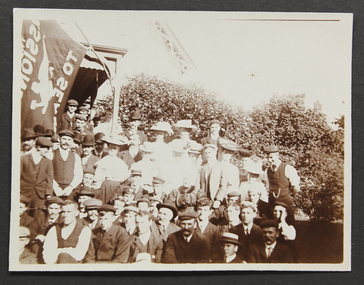
Photograph - Photograph, Sepia, Anne Treverton Goldsmith (nee Lobb), Picnic at Glenfern, King's Birthday 1906, 9 November 1906
... Thanks to the article in the Standard, Saturday 17 November 1906, page 4, we learn that some of the early sepia photographs were taken by Mrs Gurney Goldsmith herself. 1906 glenfern st kilda east picnic lhlg king's birthday edward vii mary alice isabelle danne nee johnston, 1851-1926 reverend kerr johnston, 1812-1887 boyd family sailors seamen seafarers bowler hat cap boater hat snapshots camera photographer sports cricket football ethel augusta godfrey 1861-1935 mr axell fairy rock charles arthur holmes (-1947) mrs gurney goldsmith anne treverton goldsmith (nee lobb) cedric campbell Small monochrome photograph depicting a group of seamen and ladies with the Mission's Flagstaff. ...Gathering of seafarers and MTS clergy and LHLG members, at Glenfern 1906. Mrs Mary Danne daughter of Reverend Kerr Johnston was a widow at the time and was renting Glenfern, the property once owned by the Boyd family, and started a private primary school she called Newington College. A member of the Mission's committee from 1905 to 1926 when she passed away, a bras plaque was made in her memory and placed in the chapel of the Flinders Street Mission. (see item 0690) In the Standard published on Saturday 17 November 1906, page 4 we could read: "In connection with the Victoria Missions to Seamen a successful and pleasant outing, was given to the sailors in port on King's Birth day. Mrs. Danne, of "Glenfern," St. Kilda, threw her house and grounds open tor sports and tea. Cricket, football and sports were enthusiastically pursued, and ample justice was done to the substantial tea provided by Mrs. Danne and her friends. The Misses Danne, Miss Godfrey and other ladies were untiring in their attentions. Mr. Axell, first officer of brig Fairy Rock, in a few appropriate words thanked Mrs. Danne and the ladies, on behalf of the sailors, for their kind hospitality. Snapshots of the party were taken by Mrs. Goldsmith. Mr. C A. Holmes and Mr. Cedric Campbell acted as stewards and starters for the races. On the invitation of the chaplain (Rev. A G. Goldsmith*) ringing cheers were given for Mrs. Danne and the ladies. Before the party broke up Mrs Danne addressed a few kind words to the men and gave them all a shake of the band at the gate. The rest of the evening was spent at the Institute, Beach street, where games and competitions were carried on to the accompaniment of vocal and instrumental music. The prizes won at the sports etc., were distributed, and after singing the National Anthem the party broke up."Thanks to the article in the Standard, Saturday 17 November 1906, page 4, we learn that some of the early sepia photographs were taken by Mrs Gurney Goldsmith herself.Small monochrome photograph depicting a group of seamen and ladies with the Mission's Flagstaff.1906, glenfern, st kilda east, picnic, lhlg, king's birthday, edward vii, mary alice isabelle danne nee johnston, 1851-1926, reverend kerr johnston, 1812-1887, boyd family, sailors, seamen, seafarers, bowler hat, cap, boater hat, snapshots, camera, photographer, sports, cricket, football, ethel augusta godfrey 1861-1935, mr axell, fairy rock, charles arthur holmes (-1947), mrs gurney goldsmith, anne treverton goldsmith (nee lobb), cedric campbell -
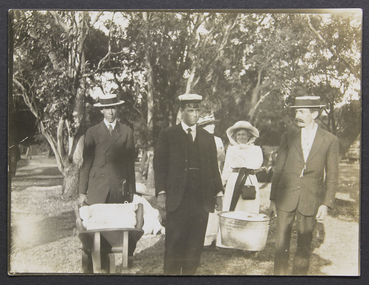 Mission to Seafarers Victoria
Photograph - Photograph, Sepia, 26 December 1905
... cap is Mr Charles A. Holmes, Honorary Lay Reader of the Mission and behind him is Ethel Godfrey. The following day in the Age we could read: "Yesterday the scene of festivities was the Zoological Gardens, where a number of seamen from fifteen of the ships in the harbor had a sailors' picnic. ...cap is Mr Charles A. Holmes, Honorary Lay Reader of the Mission and behind him is Ethel Godfrey. The following day in the Age we could read: "Yesterday the scene of festivities was the Zoological Gardens, where a number of seamen from fifteen of the ships in the harbor had a sailors' picnic. ...On Boxing Day 1905, Mr Dudley Le Souef, the director of Melbourne Zoological Gardens, offered the grounds for a picnic. The seamen of the fifteen ships anchored in the harbour were invited. In the centre wearing a white cap is Mr Charles A. Holmes, Honorary Lay Reader of the Mission and behind him is Ethel Godfrey. The following day in the Age we could read: "Yesterday the scene of festivities was the Zoological Gardens, where a number of seamen from fifteen of the ships in the harbor had a sailors' picnic. The director of the gardens, Mr. Dudley Le Souef, kindly, allowed the picnickers the free use of the picnic ground, and also provided them with milk and hot water. A lengthy programme of sports was gone through, and those who were not inclined for athletics spent their time in strolling round examining the zoo logical inmates of the gardens. It was noticeable that the large carnivora were the favorites with the English sailors, whilst foreign seamen were immensely attracted by the kangaroos, wallabies and other Australian marsupials. After tea Mr. Le Souef delivered an interesting illustrated lecture entitled Sea Birds and Their Homes. In carrying out the two days' arrangements Mr. Goldsmith was energetically assisted by voluntary helpers, both ladies and gentlemen, and also received many contributions. " The Age, Wednesday 27 December 1905, page 5.Small monochrome outdoor photograph, very clearly focussed, depicting three men delivering or collecting teacups, and two ladies watching on in backgroundMr Holmes distributing cups Zoo Miss Godfrey Centrezoo, boxing day, mr dudley le souef, ethel augusta godfrey, mr c.a. holmes, picnic, 1905, charles arthur holmes -
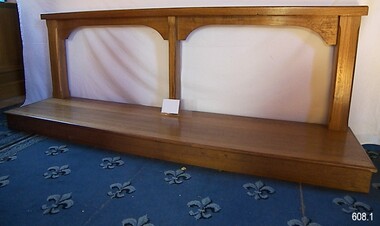 Flagstaff Hill Maritime Museum and Village
Furniture - Rail and Base, circa 1944
... Kerr Johnston, a Church of England clergyman, and operated from a hulk moored in Hobson’s Bay; later the Mission occupied buildings in Williamstown and Port Melbourne. flagstaff hill warrnambool shipwrecked-coast flagstaff-hill flagstaff-hill-maritime-museum maritime-museum shipwreck-coast flagstaff-hill-maritime-village rail for kneeling rail kneeling rail religion religious service sailors rest bethel sailors’ church bethel floating church ladies harbour light guild missions to seamen victoria mission to seafarers st nicholas seaman’s church williamstown st nicholas mission to seamen church williamstown mission to seamen williamstown st nicholas seamen’s church flagstaff hill 139 nelson place williamstown church furniture religious furniture religious worship flying angel club altar rail kneeler prayer ceremonial furniture Rail and base; one of a pair of two kneeling rails. Three varnished wood pillars and a cap ...This pair of kneeling rails was part of the original furnishings of the St Nicholas' Mission to Seamen's Church at 139 Nelson Place, Williamstown, Victoria. A kneeling rail is part of the furniture of a church and is used during religious prayer, assisting the person to be in the position of kneeling. A padded kneeling mat or cushion would also be provided for comfort. THE MISSIONS TO SEAMEN (Brief History): - The Missions to Seamen was an Anglican charity in Great Britain that has served the world's seafarers since 1856. Its symbol is a Flying Angel, inspired by a Bible verse. Today, there are centres in over 200 ports worldwide where seamen of all backgrounds are offered a warm welcome and provided with a wide range of facilities. In Victoria, the organisation began in Williamstown in 1857 as a Sailors’ Church, also known as ‘Bethel’ or the ‘Floating Church’ in an old hulk floating in Hobson’s Bay, Port of Melbourne. It soon became part of the Missions to Seamen, Victoria. In 2000, the organisation, now named Mission to Seafarers, still operated locally in Melbourne, Portland, Geelong and Hastings. The Ladies’ Harbour Lights Guild was formed in 1906 to support the Missions to Seamen in Melbourne and other centres, such as Williamstown. Two of the most significant ladies of the Guild were founder Ethel Augusta Godfrey and foundation member Alice Sibthorpe Tracy (who established a branch of the Guild in Warrnambool in 1920). The Guild continued its work until the 1960s. In 1943, a former Williamstown bank was purchased for the Missions to Seamen Club. The chapel was named St Nicholas’ Seamen’s Church and was supported by the Ladies’ Harbour Lights Guild, the Williamstown Lightkeepers’ Auxiliary and the League of Soldiers’ and Sailors’ Friends. It ceased operation in 1966. A Missions to Seamen Chapel and Recreation Room was a significant feature of ports during the late 1800s and 1900s. It seemed appropriate for Flagstaff Hill to include such a representation within the new Maritime Village, and the Melbourne Board of Management of Missions to Seamen Victoria gave its permission on 21st May 1979 for the entire furnishings of the Williamstown chapel to be transferred to Flagstaff Hill. The St Nicholas Seamen’s Church was officially opened on October 11, 1981, and resembles the Williamstown chapel. This pair of kneeling rails is significant through its association with the St Nicholas' Mission to Seamen Church in Williamstown, Melbourne, established in 1857. The items in our collection from the Missions to Seamen in Williamstown, Victoria, have historical and social significance. They show that people of the 1800s and 1900s cared about the seafarers’ religious, moral, and social welfare, no matter what the religion, social status or nationality. It had its origins in Bristol, England when a Seamen's Mission was formed in 1837. The first Australian branch was started in 1856 by the Rev. Kerr Johnston, a Church of England clergyman, and operated from a hulk moored in Hobson’s Bay; later the Mission occupied buildings in Williamstown and Port Melbourne. Rail and base; one of a pair of two kneeling rails. Three varnished wood pillars and a cap rail, mounted on a rectangular box-shaped base: a kneeling rail used in religious worship. These are part of the St Nicholas Seamen's Church Williamstown Collection.flagstaff hill, warrnambool, shipwrecked-coast, flagstaff-hill, flagstaff-hill-maritime-museum, maritime-museum, shipwreck-coast, flagstaff-hill-maritime-village, rail for kneeling, rail, kneeling rail, religion, religious service, sailors rest, bethel sailors’ church, bethel floating church, ladies harbour light guild, missions to seamen victoria, mission to seafarers, st nicholas seaman’s church williamstown, st nicholas mission to seamen church williamstown, mission to seamen williamstown, st nicholas seamen’s church flagstaff hill, 139 nelson place williamstown, church furniture, religious furniture, religious worship, flying angel club, altar rail, kneeler, prayer, ceremonial furniture -
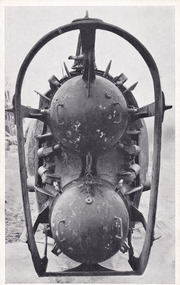 The Beechworth Burke Museum
Postcard, 30/07/1942
... caps in position of a Japanese midget submarine that was involed in the attack on Sydney Harbour on May 31st, 1942. On the 31st of May 1942, in the midst of World War Two, Sydney found itself under attack from three Japanese midget submarines that entered Sydney Harbour under the cover of night. The first submarine became trapped in anti-torpedo nets and the third submarine was sunk in Taylor Bay. The second submarine fired on the heavy cruiser the USS Chicago. One of the torpedoes exploded near the depot ship the HMAS Kuttabul, killing 21 sailors ...The postcard image depicts the torpedo tubes with caps in position of a Japanese midget submarine that was involed in the attack on Sydney Harbour on May 31st, 1942. On the 31st of May 1942, in the midst of World War Two, Sydney found itself under attack from three Japanese midget submarines that entered Sydney Harbour under the cover of night. The first submarine became trapped in anti-torpedo nets and the third submarine was sunk in Taylor Bay. The second submarine fired on the heavy cruiser the USS Chicago. One of the torpedoes exploded near the depot ship the HMAS Kuttabul, killing 21 sailors.Black and white rectangular postcard printed on cardReverse: 7525-1/ POST CARD/ 2/ This postcard is a/ souvenir of the Exhibition/ of Japanese Midget Sub-/ marines sunk in Sydney Har-/ bour on the night of Sunday,/ May 31st, 1942, the night/ that the first attack on/ Sydney by a foreign power/ took place and was/ frustrated./ caps of the/ torpeto tubes/ 30th JULY 1942/ SERIAL No. 2/ Torpedo tubes of Japanese midget submarine with/ caps in position/military album, beechworth, burke museum, ww2, world war two, wwii, maritime, sydney harbour, sydney, japanese, japan, submarine, torpedo -
 Mission to Seafarers Victoria
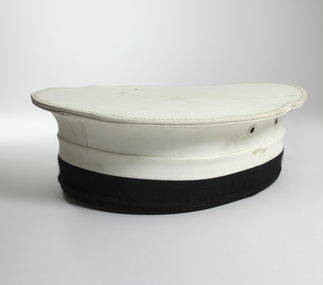
Headwear - Sailor's Cap, 20th C
... Stiffened size 17 white nylon-covered cap with air-vents and leather and black felt headband, with navy-blue woollen chin strap; lined with fabric and calico and stitched and printed nylon label. Headwear Sailor's Cap Australian Government Clothing Factory ...The cap was found in 2017 during a clear up. It May have been donated or possibly left behind by a cadet who stayed at the Mission in the 20th C. The Mission was host to both Officers and Cadets during much of the 20th C.An example of trainee cadet clothing produced in the 20th C (ID No. 8405.66.075.6069).Stiffened size 17 white nylon-covered cap with air-vents and leather and black felt headband, with navy-blue woollen chin strap; lined with fabric and calico and stitched and printed nylon label.Combination of printing and hand-written; see image attached. Hand-printing "Reynold/ATC" (which possibly stands for Australian Trainee Cadet).sailor cadet, ran, trainee cadet, royal australian navy, agcf, reynold -
 Seaworks Maritime Museum
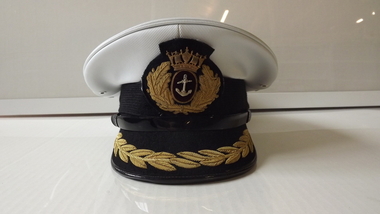
Merchant sailors hat
... cap and merchant navy insignia. Hat is a part of a set which includes hat, jacket and pants. Merchant sailors hat ...Merchant Navy hat with gold wreath on cap and merchant navy insignia. Hat is a part of a set which includes hat, jacket and pants.
