
Showing 10 items matching "sales of australian leather"
-
 Bendigo Historical Society Inc.
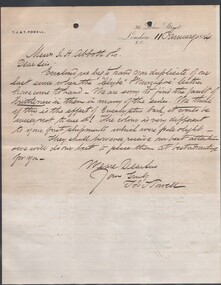
Administrative record - Abbott Collection: 1884 correspondence between J. H. Abbott and suppliers, 1884
... of sales...sales of Australian leather...sales from leather arriving on the "Ballarat", "Peterborough", and "Rome" 2403.99zr 23/12/1884 two-page letter from T.J. & T. Powell references quality, notably colour of hides, and possible classing as inferior - leaving Abbott to decide options for tanning improvement through Sydney or Melbourne, and therefore sales 2403.99zs 10/12/1884 T.J. & T. Powell reports on 13 bales of Australian...business records/correspondence dispute on condition of sales sales of Australian leather shipments ofhides to England Abbott Collection: 1884 correspondence between J. ...business records/correspondenceAbbott Collection: 1884 correspondence between J. H. Abbott and suppliers ( all handwritten correspondence, but difficult to decifer): 2403.99a 10/01/1884 T. J. & T. Powell issues with leather shipment from Abbott to London 2403.99b 11/01/1884 Ullathorne & Co. 12 bales of leather 2403.99c 18/01/1884 Memorandum from Ullathorne & Co. confirming 11 Jan consignment of leather 2403.99d 1/02/1884 Ullathorne & Co. confirming the assignment issues 2403.99e 8/02/1884 J.J. Schweizer & Co. concerning consignment quantities of not less than 5 to 10 tons 2403.99f 8/02/1884 T.J. & J. Powell acknowledging 19 Dec exchange re 12 bales pf leather per "Carlisle Castle" 2403.99g 5/02/1884 2-page letter Ullathorne & Co. requesting authorisation by Abbott of a consignment of leather for sale at 10/04 2403.99h 8/02/1884 most difficult to decipher double page letter re "Oakwood Buffalo Brand" 2403.99i 7/03/1884 T.J. & J. Powell acknowledging past correspondence of 29/02 and that they have sold 12 bales @ 10/4; also noting past shipment contained a good many brittle grained sides. 2403.99j 29/02/1884 T.J. & J. Powell referring to issues with shipment of plants (a supply of ripe acorns) 2403.99k 7/03/1884 Ullathorne & Co. pleased with the shipment and sale 2403.99l 21/03/1884 Ullathorne & Co. confirming correspondence of 7/03 re the consignment sent by the "Clyde" 2403.99m 7/03/1884 two-page letter from Ullathorne & Co. noting costs for a shipment and adjustment in favour of Abbotts. 2403.99n 27/03/1884 two-page letter from T.J. & J. Powell noting agreement that "a good market is better than a good article" when there is a bad market things are dull and people look with magnifying spectacles at faults in goods" 2403.99o 28/03/1884 memorandum from Ullathorne & Co re financial issue quoted surplus should be noted as a deficit 2403.99p 18/04/1844 letter from T.J. & t. Powell acknowledging the shipment of hides, and reporting a good market and firm prices 2403.99q 21/03/1884 small double-sided letter (difficult to decipher) 2403.99r 24/04/1884 small note (even more difficult to decipher) 2403.99s 1/05/1884 letter from T.J. & T. Powell reporting the market for Australian leather has improved with increased prices, no report of the "Carlisle Castle" anmd its cargo arrival 2403.99t 3/05/1884 letter from T.J. & T. Powell leather from the "Carlisle Castle" has arrived 2403.99u 30/05/1884 letter from Ullathorne & Co. reporting on the arrival of goods from the "Castlisle Castlre" and coment the "your tanning has improved" 2403.99v 5/06/1884 W. & A. Shammers (!) discussion on the quality of goods provided, notably hunting and jig whips 2403.99w 6/06/1884 Ullathorne & Co. a report on prices achieved and charged to Abbott 2403.99x 10/06/1884 Ullathorne & Co. reports on prices for Abbott's goods received and sold from both the "MacCallum More and Carlisle Castle" 2403.99y 20/06/1884 Ullathorne & Co. reports on rerceipt of an order, shipping documents fo the "Peterborough" noting prices are presently favourable to consigners. 2403.99z 27/06/1884 T.J. & T. Powell referencing goods anticipated from the "Peterborough", and looking forward to goods on the "Loch Katrine" 2403.99za 4/07/1884 Ullathorne & Co. acknowledges receoipt of and order from 16/06 2403.99zb 11/07/1884 Ullathorne & Co. encloses acount sales from the "Carlisle Castle" 2403.99zc 25/07/1884 T.J. & T. Powell encloses their monthly report. Noting the "Loch Katrine" has arrived but goods has not yet been discharged 2403.99zd 15/08/1884 two-page letter from W & A Shamman (!) difficult to decipher re dispute or query on prices quoted, charged and received for goods. 2403.99ze 22/08/1884 two-page letter from Ullathorne & Co. referencing costs, beeswax, honey and shipments coming by "Dumbarton , Loch Katrine and Hereward (!)" 2403.99zf 22/08/1884 T.J. & T. Powel re sales from the "Loch Katrine" and acknowledge letter advising 15 bales per the "Narvenne" 2403.99zg 5/09/1884 two-page letter orders dispatched from "Dumbarton and Hereward" make orders up to date; but could not obtain a quotation for Australian honey either by tins or kegs - suggesting a small trial consignment as the best plan to introduce the honey 2403.99zh 10/09/1884 doubler sided letter on blue paper from Ullathorne & Co. difficult to decipher 2403.99zi 26/09/1884 T.J. & T. Powell letter - difficult to decipher 2403.99zj 13/09/1884 Ullathorne & Co. a two-page report on 15 bales of Australian leather from "Ravenna" and per the "Peterborough" 2403.99zk 5/10/1884 T.J. & T. Powell letter 2403.99zl 9/10/1884 two-page blue notes, addressed to Ullathorne & Co.; referencing 7 casks beeswax from "Peterborough" and 3 casks beeswax from "Raveena" 2403.99zm 16/10/1884 T.J. & T. Powell letter reports "since last writing there is nothing fresh to report.... you may rely on our best attention to your consignments and interests" 2403.99zn 17/10/1884 T.J. & T. Powell memorandum re sales of leather from the "Peterborough" 2409.99zo 5/12/1884 small letter from A Shamman (!) Birmingham re late invoice 2403.99zp 12/12/1884 T.J. & T. Powell letter reporting on arrival leather from "Ballarat", "Peterborough", and "Rome" 2403.99zq 19/12/1884 Ullathorne & Co. also reports on sales from leather arriving on the "Ballarat", "Peterborough", and "Rome" 2403.99zr 23/12/1884 two-page letter from T.J. & T. Powell references quality, notably colour of hides, and possible classing as inferior - leaving Abbott to decide options for tanning improvement through Sydney or Melbourne, and therefore sales 2403.99zs 10/12/1884 T.J. & T. Powell reports on 13 bales of Australian leather from the "Rome" shipment, noting four different classifications for sales, focused on colour 2403.99t 3/01 to 21/05/1884 Abbott documentation of hides produced through its Edinburgh Tannery, Bendigodispute on condition of sales, sales of australian leather, shipments ofhides to england -
 Bendigo Historical Society Inc.
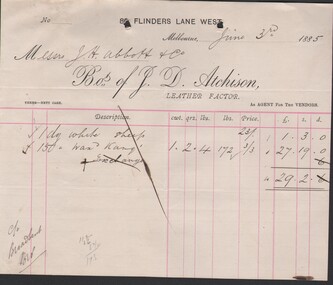
Administrative record - Abbott Collection: 1885 correspondence between J. H. Abbott and suppliers, 1885
... sales of Australian leather...business records/correspondence sales of Australian leather shipments ofhides to England shipments from Melbourne & England Abbott Collection: 1885 correspondence between J. ...business records/correspondenceAbbott Collection: 1885 correspondence between J. H. Abbott and suppliers (all handwritten correspondence, but difficult to decipher): 2403.100a 3 June 1885 - J. D. Atkinson, Flinders Lane Melbourne, leather factor - sheep and kangaroo hides 2403.100b 17 & 31 Jan 1885 - The Apollo Company Limited, Collins St Melbourne, Stearine Candles & Soap Manufacturers, Oil & Glycerine Refiners 2403.100c June-July 1885 - Briscoe & Co., Melbourne, Wholesale Ironmongers, Iron & Machinery Merchants; copper rivets & washers 2403.100d April-May 1885, 4 documents (1 invoice and 3 letters) - Birchard & Raspe, London & Hamburg 2403.100e Feb-June 1885, 7 invoices, William Dean & Co., Oil & Color Merchants, White Lead, Paperhangers and General Importers 2403.100g 5 invoices Feb-Oct 1885; Gavin Gibson, Melbourne, importers of Boots & Shoes, Leather & Grindery, Machinery, etc. 2403.100h 3 invoices Mar-Jun 1885; Guthridge Power & Co., East Melbourne, Wholesale Saddlers, Saddlers, Ironmongers & Importers. 2403.100i 2 invoices, Jan & Apr 1885, J. Hodges. Little Bourke Street West, Melbourne; American Hame & Saddle Tree Manufacturers. 2403.100j 1 invoice, Apr 1885, Alfred E. Hobbs, Elizabeth Street Melbourne, Rope Manufacturers 2403.100k 2 invoices, Mar & July 1885, Andrew Jack & Co., Flinders Lane West, Melbourne; Importers and Wholesale Stationers. 2403.100l 3 invoice, Apr-Jun 1885, J. Kitchen & Sons & Apollo Company, Flinders Lane West, Melbourne, Sterine Candle, Soap & Soda Crystal Manufacturers Glyuerine & Oil Refiners. 2403.100m 1 invoice, Feb 1885, Lister Henry, Flinders Lane West, Melbourne. 2403.100n 1 invoice, Jun 1885, Thomas Mitchell, Little Bourke Street West Melbourne, Paint & General Brush Manufacturer. 2403.100o 4 invoices, Feb-Jun 1885, New Zealand Loan & Mercantile Agency Company Limited; Colins Street West, Melbourne; Melbourne Wool & Grain Warehouses. 2403.100p 1 invoice & 2 letters, Jan-Apr 1885, T. J. & T. Powell, Lime Street London. 2403.100q 3 letters, Feb -Mar 1885, W. Shammon. Mosley Street, Birmingham, Whip Manufacturer, Cach & Saddler Ironmonger. 2403.100qq 1invoice, May 1885, James C. Steel, Kensington Tannery, Hotham. 2403.100 r 3 invoices, Jan-Mar 1885, G. V. Sydenham, Lonsdale Street West Melbourne, importers of Saddlers' Ironmongery, Hodskins, Patent Leather, etc. 2403.100s 1 invoice, May 1885, Frederick Tate, Market Street, Melbourne, Tate's Parcel Post Express. 2403.100t 2 invoices, Feb & Apr 1885, Taylor & Currie, Bourke Street West Melbourne. 2403.100u 1 invoice, Mar 1885, Eliza Tinsley, Iron Merchant & Manufacturer of Nail Chains, Patent Wrought Nails, Rivets etc. 2403.100v 1 invoice, Mar 1885, Reid & Marshall, Hawthorn Tannery, Melbourne, Tanners & Curriers, Kangaroo Leather Manufacturers. 2403.100w 17 invoices, 2 reports & 18 letters, Jan-Dec 1885, Ullathorne & Co. Lonsdale Street Melbourne and Lincolns Inn Fields, London; Leather Shoe Mersey, Grindery Merchants, etc. Importers of Tanners and Curriers Tools, oils, Dyes & Twines, Shoe and Saddlers Thread, Silks, etc. 2403.100x 62 invoices, Jan-Dec 1885, compiled by J. H. Abbott & Co., Edinburgh Tannery.sales of australian leather, shipments ofhides to england, shipments from melbourne & england -
 Bendigo Historical Society Inc.
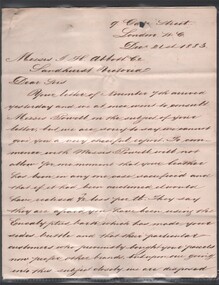
Administrative record - Abbott Collection: 1883 Correspondence between J. H. Abbott and suppliers, 1883
... sales Abbott Collection: correspondence regarding a dispute on the condition of hides supplied to Messrs. Powell & Ullathorne throughout 1883: 2403.98a five page handwritten correspondence between Mr Ullathorne of 9 Gate Street, London nd J. H. Abbott tegarding the condition of hides supplied and their investigation of the issues 2403.98b 20 Mar - Dec 1883 correspondence regarding 18 bales of Australian leather, between T. ...business records/correspondenceAbbott Collection: correspondence regarding a dispute on the condition of hides supplied to Messrs. Powell & Ullathorne throughout 1883: 2403.98a five page handwritten correspondence between Mr Ullathorne of 9 Gate Street, London nd J. H. Abbott tegarding the condition of hides supplied and their investigation of the issues 2403.98b 20 Mar - Dec 1883 correspondence regarding 18 bales of Australian leather, between T. J. & T. Powell 36 Lime Street, London and Mr Ullathorne (Melbourne) and J. H. Abbott (Sandhurst/Bendigo) regarding the hides 2403.98 c 28 Msay - Dec 1883 coprrespondence from Ullathorne & Co. with J. H> Abbott re th condition of the hides 2403.98d 10 Nov 1883 A3 page letter folded as a an encvelope ddressed to Messr J. H. Abbott & Co. Market Place, Sandhurst , Viuctoria from John Horischer regarding Valencia plants shipped dispute on condition of sales -
 Warrnambool and District Historical Society Inc.
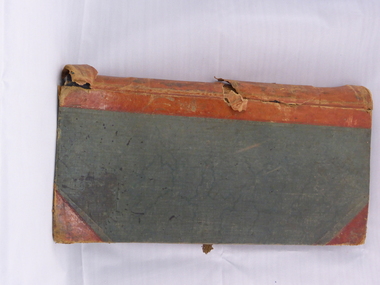
Book, Swintons Stock book 1869, 1860s
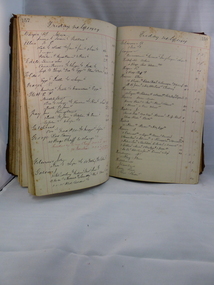
... sales in the 19th century and has material relating to the assets of the founder of the business, William Swinton at the time of his death. It is of great interest to researchers. The current family business in Timor Street Warrnambool is the oldest family business in Warrnambool and, with the Swinton name associated with businesses in Timor Street for 152 years, is among the oldest family businesses in Australia. swinton family, warrnambool ‘Day Book’ ‘Stock Book Warrnambool September 2nd 1869’ This is a dark green hard cover ledger with light brown leather bindings on the spine and cover edges. ...This ledger is a Warrnambool Swintons Store stock book and contains the sales of stock from September 1869 to an unknown date (perhaps to the end of 1870) and entries for 1871, 1872 and 1873, 1889, the 1890s and some dates early in the 20th century. William and Ann Swinton migrated to Australia in 1854 and for a decade William Swinton worked as a builder and carpenter in the Warrnambool area, erecting many buildings, including the Wangoom Presbyterian Church. In 1865 he opened a store in Timor Street, Warrnambool selling groceries, glassware and china. In 1888 the business was known as William Swinton and Sons. Branch shops were opened in Cudgee, Nullawarre, Wangoom, South Warrnambool and West Warrnambool. When William died his son Robert became the first managing director of Swintons Pty Ltd. In 1934 the business split in two with George Swinton and Sons selling furnishings, clothing and glassware and Swintons Pty Ltd selling seeds, hardware and produce. Today the Swinton family still operates a furniture and bedding store in Timor Street. This ledger is very important as an early memento of the Swinton Stores in Warrnambool. It gives details of sales in the 19th century and has material relating to the assets of the founder of the business, William Swinton at the time of his death. It is of great interest to researchers. The current family business in Timor Street Warrnambool is the oldest family business in Warrnambool and, with the Swinton name associated with businesses in Timor Street for 152 years, is among the oldest family businesses in Australia. This is a dark green hard cover ledger with light brown leather bindings on the spine and cover edges. There is gold lettering on the spine. The cover is stained and the leather is torn and partly detached in places. The insides of the cover have a blue and white mottled patterning. The pages are blue with printed red lines. The entries are handwritten in black ink. There are four loose pages and two pieces of a plant dried and preserved between two pages. ‘Day Book’ ‘Stock Book Warrnambool September 2nd 1869’ swinton family, warrnambool -
 Warrnambool and District Historical Society Inc.
Ledger, Ledger (Swinton Sales), Early 20th century
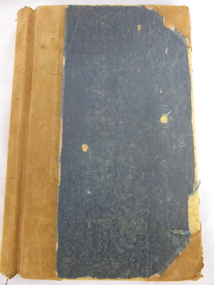
... sales for the years 1907 to 1922 and contains the names of the customers and their purchases over that time. It will be very useful to researchers. The current Swinton business in Timor Street is the oldest family business in Warrnambool and, with the Swinton name associated with businesses in Timor Street for 152 years, it is among the oldest family businesses in Australia. Swinton Family, Warrnambool ‘Day Book’ This ledger has a black cover with brown leather ...This ledger contains lists of sales of the Warrnambool business of Swintons Pty Ltd from 1907 to 1922. William and Ann Swinton migrated to Australia in 1854 and for a decade William Swinton worked as a builder and carpenter , erecting many buildings in the Warrnambool area, including the Wangoom Presbyterian Church. In 1865 he opened a shop in Timor Street, Warrnambool selling groceries, glassware, china and hardware. In 1888 the business became known as William Swinton and Sons. Branch stores were opened in Cudgee, Nullawarre, Wangoom, West Warrnambool and South Warrnambool. When William died his son Robert became the first managing director of Swintons Pty Ltd. In 1934 the business split in two with George Swinton and Sons selling furniture, clothing and glassware and Swintons Pty Ltd selling seeds, hardware and produce. Today the Swinton family still operates a furniture and bedding store in Timor Street. This ledger is of considerable significance as it is associated with the Swinton family Warrnambool businesses. It gives lists of sales for the years 1907 to 1922 and contains the names of the customers and their purchases over that time. It will be very useful to researchers. The current Swinton business in Timor Street is the oldest family business in Warrnambool and, with the Swinton name associated with businesses in Timor Street for 152 years, it is among the oldest family businesses in Australia. This ledger has a black cover with brown leather binding with a label on the spine with gold lettering on a red background. The insides of the cover have black and blue mottled patterning and the binding here has been reinforced with white tape. The pages are white with printed red lines. The entries are handwritten in black ink with some names underlined in red ink. The ledger cover is stained and one page is loose. There is also one loose page containing pencilled writing. ‘Day Book’ swinton family, warrnambool -
 Warrnambool and District Historical Society Inc.
Ledger, Swintons Records, 1909
... sales and financial situation of the Warrnambool business of Swintons Pty Ltd for most of the 20th century. The information in the ledger will be of great help to researchers. The current Swinton business in Timor Street Warrnambool is the oldest family business in Warrnambool and, with the Swinton name associated with businesses in Timor Street for 152 years, it is amongst the oldest family businesses in Australia. Swinton Family, Warrnambool History of Warrnambool This ledger of 152 pages has a dark blue cover with leather ...This ledger comes from the Warrnambool business of Swintons Pty Ltd and records the wages of employees and stock supplies and sales from 1909 to 1982. William and Ann Swinton migrated to Australia in 1854 and for a decade William Swinton worked as a builder and carpenter in the Warrnambool district, erecting many buildings, including the Wangoom Presbyterian Church. In 1865 he opened a store in Timor Street Warrnambool selling groceries, china and glassware and hardware. By 1888 the business was known as William Swinton and Sons. Branch stores were opened in Cudgee, Nullawarre, Wangoom, West Warrnambool and South Warrnambool. After William Swinton died his son Robert became the first managing director of Swintons Pty Ltd. In 1934 the business split with George Swinton and Sons selling furnishings, clothing and glassware and Swintons Pty Ltd selling seed, produce and hardware. Today the Swinton family still operates a furniture and bedding shop in Timor Street. This ledger is of great interest as it gives details of the sales and financial situation of the Warrnambool business of Swintons Pty Ltd for most of the 20th century. The information in the ledger will be of great help to researchers. The current Swinton business in Timor Street Warrnambool is the oldest family business in Warrnambool and, with the Swinton name associated with businesses in Timor Street for 152 years, it is amongst the oldest family businesses in Australia. This ledger of 152 pages has a dark blue cover with leather binding on the spine and cover corners. The cover material is worn away in parts. The ledger has reinforced binding stitched with white cotton. The insides of the cover have red and blue mottled patterning. The pages are white with printed ruled red lines. The entries are handwritten in black ink. swinton family, warrnambool, history of warrnambool -
 Tatura Irrigation & Wartime Camps Museum
Book, Registered Sales Committee Minute Book
... Contains minutes of meetings (glued in) of the registered sales committee of the Australian Society of Breeders of British Sheep Ltd.1985 - 2009 Australian Society of Breeders of British Sheep minute book Registered sales committee minute book Hard cover book, red with fawn leather spine and corners. ...Contains minutes of meetings (glued in) of the registered sales committee of the Australian Society of Breeders of British Sheep Ltd.1985 - 2009Hard cover book, red with fawn leather spine and corners. Spine has red and gold panel. Pages are numbered. Registered sales committee minute bookaustralian society of breeders of british sheep, minute book -
 Trafalgar Holden Museum
Vehicle - HD Holden Premier, 1965
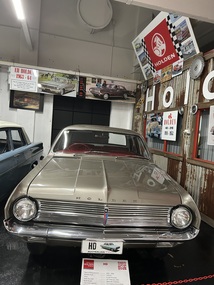
... sales. The vehicle had both the 149 and 179 cubic inch capacity red engines with either the hydromatic or 3 speed manual was a good vehicle. The HD model also introduced the X2/ which was the first attempt by GMH to produce a performance vehicle. Our HD also has the leather seats in the premier version and this was the last model to have dealership leather seats. This vehicle has 13.000 miles on the clock and is probably the most absolutely original and lowest mileage HD model in Australia ...The HD Holden was introduced by GMH in 1965 and for a variety of reasons was considered the ugly duckling. The HD replaced the large selling and very popular EH (1964) model. the dramatic change in design from the square slopped EH to the sharp edged shape of the HD was met with some buyer resistance and was highly criticised by the motor writing fraternity. The unusual front guard shape, which became known as kidney cutters, which assisted with the unpopular impression, resulted in lower sales. The vehicle had both the 149 and 179 cubic inch capacity red engines with either the hydromatic or 3 speed manual was a good vehicle. The HD model also introduced the X2/ which was the first attempt by GMH to produce a performance vehicle. Our HD also has the leather seats in the premier version and this was the last model to have dealership leather seats. This vehicle has 13.000 miles on the clock and is probably the most absolutely original and lowest mileage HD model in Australia, the vehicle in every aspect is "as new" and in fantastic condition of this model Holden which has significant motoring history.1965 Holden Premier sedan with 179 motorPremier on rear as well as a 179 badge. HOLDEN across bonnet Registered number 63456-Hvehicle, holden, 1965, car -
 City of Melbourne Libraries
Photograph, Bull, Hugh Jones, 1897-1993, Commercial Travellers' Association, Victoria, Board Room
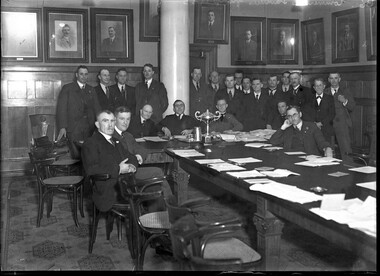
... Australian artists Hans Heysen, Walter Withers, John Mather, Jan Hendrik Scheltema. The Argus 30 May 1914 quipped “Around the walls hang evidences that the commercial traveller's soul has not been killed in his pursuit of commerce”. The blackwood panelled room was furnished with Queen Anne style tables and chairs and green leather armchairs with inviting rocker foot rests allowing weary travellers to relax after traversing the railways and dusty roads of Victoria while planning their next sales trip. ...Australian artists Hans Heysen, Walter Withers, John Mather, Jan Hendrik Scheltema. The Argus 30 May 1914 quipped “Around the walls hang evidences that the commercial traveller's soul has not been killed in his pursuit of commerce”. The blackwood panelled room was furnished with Queen Anne style tables and chairs and green leather armchairs with inviting rocker foot rests allowing weary travellers to relax after traversing the railways and dusty roads of Victoria while planning their next sales trip. ...Seven seated and fifteen standing men dressed in suits around a long table in a panelled room hung with formal portraits of men. A trophy sits on the long table amongst loose paper sheets. Research by project volunteer, Fiona Collyer: The Commercial Travellers’ Association of Victoria (CTA) was formed at a meeting of 40 commercial travellers held at the Duke of Rothesay Hotel, 24 Elizabeth Street on 1 December 1880. Their charter was to advocate for better working conditions for commercial travelling salesmen, including improved accommodation at discounted rates and travel concession fares. At first by locomotive, horse and buggy, steamers and horseback, later also by motor car and motorcycle, “The Man on the Road” went into the back-blocks of the country to extend the interests of commerce to the stores and households of Australian regional towns and isolated settlements. Affiliated organisations existed in all states and New Zealand and in 1895 they integrated to form the United Commercial Travellers’ Association of Australasia (UCTAA). By the turn of the 20th century, the Victorian branch of the CTA had 421 Association Members and 520 Club members. The CTA continued to hold meetings in leased rooms in hotels and offices until 1898 when they commissioned purpose-built premises at 190-192 Flinders Street (extant, now the Macstore, next to former Metropolitan Gas Company Buildings). Designed by leading architectural firm of brothers H.W. & F.B.Tompkins (Dimmey’s Model Store, Swan Street, London Stores, Herald and Weekly Times, Myer building, Diamond House, Centreway Arcade, Manton’s Store) in the Queen Anne Revival style at the cost of £20,000, the four storey building had a facade of red Northcote bricks and an entrance of Pyrmont stone. It was very modern for the time, featuring elevators, offices, bars, kitchen, dining, card and billiard rooms and 31 bedrooms with shared bathrooms for the footsore travellers. However, despite adding two storeys in 1901, and another storey and a basement in 1905, they soon outgrew their premises, and in 1912 the CTA commissioned a new building at 328 Flinders Street. At this time, buildings in Melbourne were constrained by the city height limit of 132 feet (40 metres)- the maximum height of firefighting ladders. The new CTA building was the tallest building in Melbourne until 1932 when regulations changed allowing the Manchester Unity Building to be built. The new CTA headquarters was the epitome of comfort and luxury with cutting edge facilities to ease the fatigued salesman and prepare him for another stint on the road. General Secretary, James Davies travelled to Britain and America to acquire the very best and latest innovations. After visiting the new premises, Punch magazine 11 June 1914 reported “furnishings, appliances, and labour-saving conveniences which were more than up to date- they were up to-morrow.” The Edwardian Baroque style building was again designed by architects H.W. & F.B. Tompkins at the cost of £100,000 and built by contractors F.E. Shillabeer and Sons (Nicholas Building, Kellow-Falkiner Pty Ltd car showroom). The nine storey plus basement building is of steel frame construction with concrete floors. The ground floor facade is of grey granite and above that it is faced with cream glazed bricks chosen to combat discolouration from the pollution emitted by Flinders Street Station trains across the road. The facade is decorated with mascarons, gum leaf trim and balconies with classical style balustrade. The club was entered through revolving doors into a two storey high, circular, domed lobby with white columns, American oak panelled walls and intricate mosaic flooring. The ceiling is festooned with plaster gum leaf and gum nut detail, a theme that is repeated throughout the building. The basement kitchen had modern, labour saving appliances that would be the envy of any Edwardian housewife, including an electric toaster, a potato peeling machine, heated dumb waiter, dishwashing machine and electric refrigeration and cooking. It serviced the commodious second floor dining room which seated 200 people and the cafe/breakfast room, 80 people. Members were permitted to entertain their lady friends there for afternoon tea between the hours of 3 and 5 pm every day, except Sunday. The members’ facilities included a barbershop, clothes pressing machine, boot cleaning chair, pipe and cigar stall with electric humidor, public telephones, lockers and safe deposit. The building was serviced with five elevators, a built in vacuum cleaning plant, hot water radiators and linen and postal chutes. The first floor was devoted to business and relaxing, containing the Board, Writing, Reading and four Business Rooms. The board room had Queensland maple panelling with huge blackwood tables topped with blue morocco and golden tortoise-shell trim and cane bottomed chairs. Large framed photographs of past presidents since 1884 lined the walls. The Reading Room ran the whole width of the building. Arthur Streeton’s painting “Between the Lights, Princes Bridge 1888” and Frederick McCubbin’s “Looking North from Mount Macedon” were hung there, as well as paintings by renowned Australian artists Hans Heysen, Walter Withers, John Mather, Jan Hendrik Scheltema. The Argus 30 May 1914 quipped “Around the walls hang evidences that the commercial traveller's soul has not been killed in his pursuit of commerce”. The blackwood panelled room was furnished with Queen Anne style tables and chairs and green leather armchairs with inviting rocker foot rests allowing weary travellers to relax after traversing the railways and dusty roads of Victoria while planning their next sales trip. “The Australasia Traveller” Volume 10, Number 2, April 1914 page 35 noted “An attendant will be constantly employed on this floor to take care of the stationary supply, to tidy up newspapers, and generally study the convenience of members.” The third floor was for amusements with billiards, a bar and four rooms for playing cards, dominoes and chess. The huge billiard room had seven Alcock billiard tables including a table in a partitioned match-room for tournaments, exhibitions and matches. The walls were lined with members’ cues and for spectators, comfortable lounges with marble topped tables and electric bell pushes for drinks service. There were 150 bedrooms over five floors, each with their own telephone and wash basin and five suites with a private sitting room attached. There were four bathrooms per bedroom floor and capacious, well-lighted shaving rooms. Top rate club tariff for bed and breakfast - 6 shillings, if called for a country train leaving Melbourne before 8am - 4 shillings, suite and breakfast- 9 shillings, sixpence. “The Australasia Traveller” Volume 10, Number 2, April 1914 page 35 reported “All “early calls” will be made from the Club Office to Bedrooms by means of the Telephone, so that instead of waking everybody else up on the corridor, only the member concerned will know that it is his unpleasant duty to get up.” The new CTA premises was widely regarded as the finest club in the Southern Hemisphere. The CTA also built the adjacent six storey Commerce House with 52 sample rooms for travellers to display their wares with the remainder rented to retail businesses and a post and telegraph office. After the CTA moved into their new, larger premises in 1914, neighbouring department store Ball & Welch expanded into the former CTA. The CTA saw themselves in a nation building role and were an influential lobby group to the Government. They advocated for inter city trunk telephone lines, standard gauge railway lines between NSW and Victoria, improved roads and highways, the Murray River water scheme and maintaining the White Australia Policy. They were very active in fund raising for the war efforts. The CTA offered its members support in other ways with benevolent funds for widows and orphans, mortuary, accident, sickness and an annuities fund for members over 65 years. There were scholarships for members’ children and home purchase scheme to assist with home ownership. A secondary membership scheme provided access to non commercial travellers (men only) to its exclusive club premises. They also organised social events and activities such as billiard tourneys, golf tournaments, dances and an annual “Smoke Social” which was a social event where men gathered for a formal dinner, community singing, lectures, speeches and of course, to smoke! Daylesford born James Davies OBE, (1865-1931) worked at the CTA for 50 years, starting as an office boy and working his way up to General Secretary and editor of the monthly trade journal for UCTAA members, “The Traveller” (1890-1905, later “The Australasian Traveller” 1905-1924 and then “The Australian Traveller” 1925-1976) and the annual colour supplement magazine “Australia To-Day” (1904-1973). “The Australasia Traveller” featured commentary on the issues of the day like wars, tariffs and trade, articles on new products and hotel recommendations and their rates and lots of advertising, especially alcohol, tobacco and accommodation in regional hotels. There were regular columns, each illustrated with a line drawing and these included “Our Immigration Record” a state by state summary of arrivals of “desirable immigrants” to Australia, while bemoaning the declining (white) birth rate. The column followed the arrival of British boys sent to Australia as agricultural apprentices to work on rural properties which were short of labour. Between 1913-1928, 1750 “Barwell Boys”, some as young as 14 years of age arrived in South Australia to work. NSW had a similar program known as the Dreadnaught Boys Scheme where 5595 boys immigrated between 1911-1939. The boys were considered of “good British stock”. There was a “Home Page For The Ladies” showcasing the latest fashions in women’s clothing, millinery and hairstyles and tips and trends in home furnishings.“Children’s Corner for Dear Little Folks” which featured puzzles, jokes and stories and members could send in photographs of their children. “Road Echoes” devoted to “The Man On The Road” and his doings. “Face Massage, Smiling is the Best Face Massage”, the humour page full of jokes and funny stories. “Railway Rumbles” news of innovations, timetables, tickets and grumbles about lavatories, food and drinking water on trains and at railway stations. And in case we forget that members had a home away from their CTA home, gardening tips with “The C.T. as Gardener”column. The annual magazine “Australia To-Day” was a vehicle to promote Australia here and overseas as a modern, prosperous country with abundant opportunities and pleasant climate. It sought to showcase its manufacturing, agriculture and tourism and encourage British immigration to Australia. The magazine featured articles about recently arrived migrants at work, quirky native flora and fauna, beach culture, recreation and the Australian way of life in the settler nation. Many of the articles were written by politicians of the day, including Robert Menzies. The UCTAA commissioned original artwork for the front covers and feature articles of “Australia To-day” from leading Australian artists. These included Norman Lindsay, Frederick McCubbin, Napier Waller, Lionel Lindsay, Hans Heysen, C Dudley Wood, Louis McCubbin, Penleigh Boyd, Louis Buvelot, Christian Waller and Ellis Rowan and her Australian wildflowers. Some of the photographs in “Australia To-Day” were provided by state and federal government departments as well as manufacturers, newspapers and mining companies. Amongst of the credited photographers was Helmut Newton who later earned world acclaim as a fashion photographer and architectural and industrial photographer Wolfgang Sievers (unfortunately their photographs remain in copyright and aren’t available online). Also featured was Richard C. Strangman, a professional photographer from Canberra, William Howieson of Melbourne, who has 22 photographs in the collection of NGV, Tasmanian wilderness photographer Frederick Smithies, Athol Shmith, portrait photographer and educator from Melbourne, Gordon de Lisle, a Melbourne commercial, industrial, aerial and society portrait photographer. (One of Gordon’s assignments was as the stills photographer for the 1959 movie “On The Beach” filmed in Melbourne). Photographs taken by acclaimed Antarctic and official war photographer Captain Frank Hurley OBE for Adelaide’s Centenary were also featured. The Australian Government was keenly aware of the influence and quality of the UCTAA publications. On 1 June 1914 The Age reported that to advertise Australia in Great Britain and elsewhere, the Department of External Affairs purchased 6500 copies of “Australia To-Day” magazine for £515 to distribute free to “places where they are most likely to come under the notice of a desirable class of immigrants.” In 1950, the office of Prime Minister Robert Menzies ordered 2550 copies of that year’s issue of “Australia To-Day” for the Department of Commerce and Information to distribute. The CTA donated their archives to University of Melbourne Archives which includes original artworks and photos used in “Australia To-Day” (Melbourne University has digitised 1114 photos) and sundry items including trophies, ashtrays, commemorative souvenirs, menus, a rare “Safechek” sovereign changer, a bust of James Davies and even a CTA embossed wash bowl and chamber pot. After the death of General Secretary James Davies in 1931, the CTA held the annual “James Davies Memorial Cup” golf tournament at various Melbourne golf courses, the winner receiving a splendid silver cup. “Table Talk” magazine photographs from 29 June 1933 depict the travellers beautifully (and I would say correctly) attired in tweedy plus fours, Fair Isle knitwear, flat caps and of course fringed brogues. I have been unable to ascertain whether the trophy in our photo is for golf or another CTA social activity. The CTA Victoria membership peaked in 1951 with 4,672 Aassociation members and 3,693 Club members. In 1959, Hollywood came to Melbourne when film stars Gregory Peck, Ava Gardner, Anthony Perkins and Fred Astaire descended to film ‘On the Beach,’ directed by Stanley Kramer. The film is based on the bestselling Neville Shute novel about the aftermath of World War Three, a nuclear war that has obliterated most of the Northern Hemisphere. Radioactive dust is heading toward Australia and everyone is preparing for death. Scenes with Anthony Perkins were filmed in the CTA billiards room as the exclusive Pastoral Club. Anthony Perkins’ character, Lieutenant Commander Peter Holmes of RAN tells Gregory Peck’s character, Commander Dwight Lionel, that The Pastoral Club is…”A mahogany and polished brass sort of place-some people claim it was the stuffiest club in the Commonwealth” before assuring him that despite shortages, the club is likely to have some Scotch left. In a scene at the Pastoral Club two, old (probably red faced) codgers discuss the challenge of drinking all of the 400 bottles of Gould Campbell vintage port in the club wine cellar before they succumb to radiation sickness in five months time. The NGV has 12 photographs in their collection of wardrobe stills of Ava Gardner modelling costumes designed by the Fontana Sisters of Rome for “On The Beach”, taken by Italian photographer G.B.Poletto. During the filming, Gregory Peck and his family stayed at “Kurneh” 206 Domain Road, South Yarra, the former home of three times Grand Slam winner Norman Brookes. Through the decades, Australian society was changing and in order to stay relevant, the CTA had to change too. In 1971, two women were elected for club membership, although they were only granted limited access to the club’s facilities and in 1972, women were invited for the first time to participate in the previously men only annual “Smoke Social”. In 1975, dwindling membership forced the closure of The Commercial Travellers’ Association building and in 1977, the building was sold, with the CTA ceasing to operate in 2014. It was the end of the road for the “Knights of the Road”. In 1992, the CTA building at 328 Flinders Street was placed on the Victorian Heritage Register in recognition of its architectural and cultural significance. The building has been meticulously restored with many of the original fittings, decorative plasterwork, mosaic flooring, stained glass windows, columns, chandeliers and the panelling made from Australian timbers retained. After renovations the building became first the Euro Asia Hotel, then the Duxton Hotel and in 2005 The Rendezvous Hotel, Melbourne. In tribute to the history of the building and the film “On The Beach”, the Rendezvous Hotel has the Ms Ava Bar, Perkins room, Mr Tompkins restaurant, Commerce Room and the Davies Room. References: COMMERCIAL TRAVELLERS' ASSOCIATION OF VICTORIA. (1899, May 27). The Australasian (Melbourne, Vic. : 1864 - 1946), p. 25. Retrieved February 21, 2025, from http://nla.gov.au/nla.news-article138615498 COMMERCIAL TRAVELLERS. (1914, May 30). The Argus (Melbourne, Vic. : 1848 - 1957), p. 8. Retrieved February 13, 2025, from http://nla.gov.au/nla.news-article7272511 NEWS OF THE DAY. (1914, June 1). The Age (Melbourne, Vic. : 1854 - 1954), p. 8. Retrieved February 19, 2025, from http://nla.gov.au/nla.news-article189414314 COMMERCIAL TRAVELLERS' "AT HOME." (1914, June 11). Punch (Melbourne, Vic. : 1900 - 1918; 1925), p. 32. Retrieved March 19, 2025, from http://nla.gov.au/nla.news-article129699692 https://archives.library.unimelb.edu.au/nodes/view/69669 https://vhd.heritagecouncil.vic.gov.au/places/757 http://www.pikitiapress.com/blog/2015/1/26/australia-today Commercial Travellers at Yarra Yarra (1933, June 29). Table Talk (Melbourne, Vic. : 1885 - 1939), p. 6. Retrieved February 28, 2025, from http://nla.gov.au/nla.news-article149547845 https://archives.library.unimelb.edu.au/nodes/view/537460 https://viewer.slv.vic.gov.au/?entity=IE7420895&file=FL19171568&mode=browse https://www.history.sa.gov.au/wp-content/uploads/2021/03/Barwell_Boys_Catalogue-compressed-compressed-compressed.pdf Australia Today," 1927 (1926, December 11). Weekly Times (Melbourne, Vic. : 1869 - 1954), p. 15. Retrieved March 17, 2025, from http://nla.gov.au/nla.news-article223844810 https://blogs.unimelb.edu.au/librarycollections/2020/12/19/an-inhabited-space-helmut-newtons-lovers/ https://www.ngv.vic.gov.au/explore/collection/artist/2075/ https://www.ngv.vic.gov.au/?s=Poletto+&type=collection https://rendezvousmelbourne.com.au/digital-history-tour/Photographer notations on slide: "Commercial Travellers Group B6".clubs, department stores, 1930-1939, commerce, manufacturing, federation/edwardian style architecture, railways, tourism, games, agriculture -
 Emerald Museum & Nobelius Heritage Park
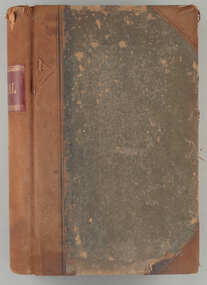
Administrative record - Nobelius Nursery Day Book 14 May 1913 - 24 May 1916, 14 May 1913 - 24 May 1916
... sales to clients in Victoria, Australia and overseas and contains the names and places of hundreds of clients thus giving an insight into the scale of the nursery operations at the time. C. A. Nobelius & Sons Gembrook Nurseries horticulture Accounting Emerald On spine with gold embossed script: 'JOURNAL' Inside front cover, bookmaker's sticker: 'D. W. PATERSON CO.' Inside front cover, handwritten: 'No stock, Date 16/10/1012' Nobelius Nursery Day Book - 802 pages. Hard cover bound in black leather ...The Cash Accounts contain the names and transaction details of all Gembrook Nursery clients and gives an insight into the scale of the Nursery operations. At its peak, this Nursery was said to be the biggest in the Southern Hemisphere.This daybook May 1913-May 1916 was used to record Gembrook Nursery stock sales to clients in Victoria, Australia and overseas and contains the names and places of hundreds of clients thus giving an insight into the scale of the nursery operations at the time.Nobelius Nursery Day Book - 802 pages. Hard cover bound in black leather with sides in tan suede. On spine with gold embossed script: 'JOURNAL' Inside front cover, bookmaker's sticker: 'D. W. PATERSON CO.' Inside front cover, handwritten: 'No stock, Date 16/10/1012'c. a. nobelius & sons, gembrook nurseries, horticulture, accounting, emerald
