
Showing 6 items matching "salisbury uk"
-
 Bendigo Military Museum
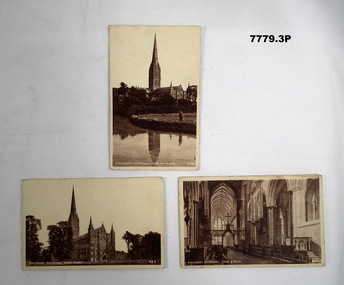
Postcard - POSTCARD - SALISBURY, UK, J Welch and Sons, c. WW1
... POSTCARD - SALISBURY, UK......Salisbury UK...Baron Cooper Collection Postcards Salisbury UK WW1 1. Salisbury Cathedral, West front. ...Postcards sent by R.H. Baron to his mother, sisters and Elsie. Part of the "Robert H. Baron" No 3596 and Cooper Collections. See Catalogue No. 1981P for details of Baron's service.1. Sepia toned photograph of the exterior of a gothic style cathedral with spire and two lantern towers. 2. Sepia toned photograph of a cathedral with spire from a river location. 3. Sepia toned photograph of the nave and choir of a gothic style cathedral.1. Salisbury Cathedral, West front. Handwritten in pencil on back: 'Letter to R.H. Baron's sisters' - no date. 2. Salisbury Cathedral from the River. Handwritten in pencil and black ink: ' Letter to R. H. Baron's mother. Ink section indecipherable. - no date. 3. Salisbury Cathedral, choir and nave. Handwritten in black ink: 'Dear Elsie etc'.robert h. baron, cooper collection, postcards, salisbury uk, ww1 -
 4th/19th Prince of Wales's Light Horse Regiment Unit History Room
Framed Photograph, Mena Camp -The 1st Australian Division, Australian Imperial Force - Egypt, 1914-15, abt 1915
... On mobilisation, the Australian 4th Light Horse Regiment was originally destined to go to the Salisbury Plain UK for training. However the Australian troops were diverted to Egypt to defend the Suez Canal from a threat from Turkey. ...On mobilisation, the Australian 4th Light Horse Regiment was originally destined to go to the Salisbury Plain UK for training. However the Australian troops were diverted to Egypt to defend the Suez Canal from a threat from Turkey. ...On mobilisation, the Australian 4th Light Horse Regiment was originally destined to go to the Salisbury Plain UK for training. However the Australian troops were diverted to Egypt to defend the Suez Canal from a threat from Turkey. A camp was set up at Mena, near the Pyramids.Framed black & white photo of Mena Camp in wood frameMay your comradeship be as lasting as that still prevailing in our Regiment. With compliments from 4 ALH. -
 Bendigo Military Museum
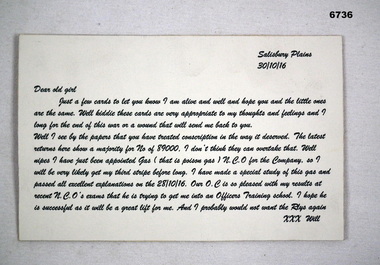
Letter - LETTER TO "Dear Old Girl" from soldier "Will", Oct 1916
... This letter was written from Salisbury Plains, UK on 30 October 1916. It mentions the conscription vote. ...This letter was written from Salisbury Plains, UK on 30 October 1916. It mentions the conscription vote. ...This letter was written from Salisbury Plains, UK on 30 October 1916. It mentions the conscription vote. He has also passed his course for dealing with poison gas. He has been promoted to CPL. He hopes for promotion to Office. The soldier just signs as "Will".This letter is printed on cardboard. It is in italics. The colour of the ink is green. It is probably a modern day reproduction.passchendaele barracks trust, ww1, conscription, poison gas -
 Bendigo Military Museum
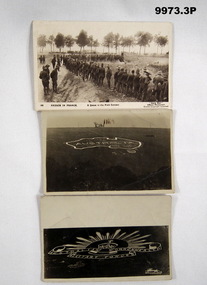
Postcard - PHOTOGRAPHIC POSTCARDS WW1
... Two postcard signs likely taken on Salisbury Plains in UK. Other photo is of NZ Troops lined up in France for meals. ...Photo of image of map of Australia and the word "Australia" inside on a plain in the UK, most likely Salisbury. 3P. Photo of large scale image of the Australian Rising Sun Emblem laid out on a plain. ...Two postcard signs likely taken on Salisbury Plains in UK. Other photo is of NZ Troops lined up in France for meals. ...Two postcard signs likely taken on Salisbury Plains in UK. Other photo is of NZ Troops lined up in France for meals. Photo taken by Daily Mail as Official War Photo.1P. Black and white photo of troops lined up in France for meals. Postcard format on back. 2P. Photo of image of map of Australia and the word "Australia" inside on a plain in the UK, most likely Salisbury. 3P. Photo of large scale image of the Australian Rising Sun Emblem laid out on a plain. Assumed to be Salisbury Plain.No writing on postcards.selby collection, photographic postcards -
 Ringwood RSL Sub-Branch
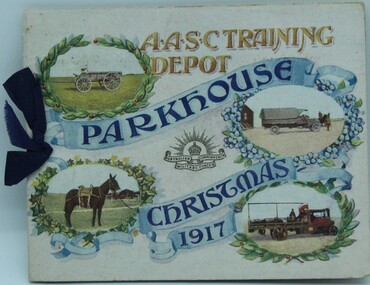
Booklet WW1, AASC Training Depot UK
... From Harold with best love (Harold Redmond Macoboy) Coloured Christmas card dated 1917 from AASC Depot Salisbury contains photos inside and colour patches on back AASC Training Depot UK Booklet WW1 ...Coloured Christmas card dated 1917 from AASC Depot Salisbury contains photos inside and colour patches on backFrom Harold with best love (Harold Redmond Macoboy) -
 Ballarat Heritage Services
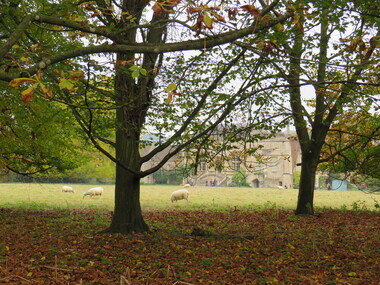
Photograph - Digital Photograph, Dorothy Wickham, Abbey, Lacock, United Kingdom, 2016
... Salisbury in 1229 for Augustinian Canonesses. It prospered throughout the middle ages. It was bought by William Henry Fox Talbot (1800-77). He was part of a scientific and enlightened group of men, which led him to discover the process of photography. The first photograph is said to have been taken from the windows of Lacock Abbey.In August 1835 Talbot made the earliest known surviving photographic negative using a wooden camera.The rare small photogenic image of the latticed window in the south gallery of Lacock is now in the collection of the Science Museum at Bradford, UK....Salisbury in 1229 for Augustinian Canonesses. It prospered throughout the middle ages. It was bought by William Henry Fox Talbot (1800-77). He was part of a scientific and enlightened group of men, which led him to discover the process of photography. The first photograph is said to have been taken from the windows of Lacock Abbey.In August 1835 Talbot made the earliest known surviving photographic negative using a wooden camera.The rare small photogenic image of the latticed window in the south gallery of Lacock is now in the collection of the Science Museum at Bradford, UK. ...The abbey was founded by the Countess of Salisbury in 1229 for Augustinian Canonesses. It prospered throughout the middle ages. It was bought by William Henry Fox Talbot (1800-77). He was part of a scientific and enlightened group of men, which led him to discover the process of photography. The first photograph is said to have been taken from the windows of Lacock Abbey.In August 1835 Talbot made the earliest known surviving photographic negative using a wooden camera.The rare small photogenic image of the latticed window in the south gallery of Lacock is now in the collection of the Science Museum at Bradford, UK.Colour photograph of Abbey, Lacock, United Kingdomlacock abbey, church
