
Showing 4 items matching "salvage supervisor"
-
 Flagstaff Hill Maritime Museum and Village
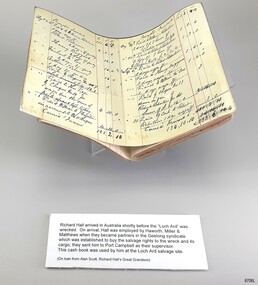
Book - Cash Book, Richard Hall, Manager of Loch Ard salvage site, 1878
... ...salvage supervisor...On arrival, Hall was employed by the partners Haworth, Miller & Matthews, a Geelong syndicate established to buy the salvage rights to the wreck and its cargo. The firm sent Hall to Port Campbell as their supervisor. ...Flagstaff Hill Maritime Museum and Village Great Ocean Road Shipwreck Coast Richard Hall Loch Ard cash book financial record salvage Haworth Miller and Matthews Geelong salvage syndicate 1878 wreck Port Campbell SS napier salvage supervisor salvage manager salvage workers Richard Hall's cash book Loch Ard cash book Handwritten entries in pen and ink. ...Richard Hall arrived in Australia shortly before the "Loch Ard" was wrecked at Port Campbell in June 1878. On arrival, Hall was employed by the partners Haworth, Miller & Matthews, a Geelong syndicate established to buy the salvage rights to the wreck and its cargo. The firm sent Hall to Port Campbell as their supervisor. Hall used this cash book at the Loch Ard salvage site, keeping a record of the date, the workers’ names, hours worked and amount paid. The wreck was difficult to access from the shore, so the firm sent its recently purchased steamer, the SS Napier, to allow access from the sea. Sadly, the steamer hit rocks in the process, and it sank nearby with a cargo of general stores for settlers along the coast. Rochard Hall’s cash book has been passed down through his family’s generations. Currently, it belongs to his great-grandson, who has generously loaned it for display with other significant Loch Ard relics. Richard Hall’s cash book is significant as a record of essential details regarding the salvage process in the 1870s, including the date of work, the names of workers involved, the hours they worked, and the payments made. The use of this cash book ensured meticulous documentation of the workforce and financial transactions during the salvage period. Richard Hall’s cash book has been carefully preserved within his family for generations. Today, it is in the possession of his great-grandson, who has generously loaned it for public exhibition alongside other important relics from the Loch Ard shipwreck. The cash book serves as a tangible link to the events surrounding the salvage and the individuals involved in this historic episode. The Loch Ard shipwreck itself is a landmark event in Victoria’s maritime history and is registered on the Victorian Heritage Register (Ref S 417). The Flagstaff Hill Maritime Village houses a diverse and substantial collection of artefacts recovered from the Loch Ard, representing one of the largest assemblies of items from this significant shipwreck. The collection serves as a vital snapshot of history, enabling interpretation of the circumstances and impact of the tragic Loch Ard event. Additionally, the artefacts hold archaeological importance, offering insights into Victoria’s shipping history and early social and historical themes. The collection’s historical significance is further emphasised by its association with what is regarded as the worst and best-known shipwreck in Victoria’s history. Cash book: a small cash book with printed blue lines and red columns. Entries are handwritten in blue ink. They show the date, the name of the person paid, the amount paid, and the cheque number, or cash. The book is kindly on loan from Alan Scott, Richard Hall's great-grandson.Handwritten entries in pen and ink.flagstaff hill maritime museum and village, great ocean road, shipwreck coast, richard hall, loch ard, cash book, financial record, salvage, haworth miller and matthews, geelong salvage syndicate, 1878 wreck, port campbell, ss napier, salvage supervisor, salvage manager, salvage workers, richard hall's cash book, loch ard cash book -
 Flagstaff Hill Maritime Museum and Village
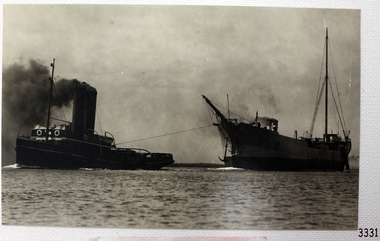
Photograph, C. 1915 - 09/07/1917
... supervising engineer during the building was William Cumming. He accompanied every ship he’d built on their maiden voyages from UK to Melbourne.) In 1916 she was purchased by A/S Christiansand (Sven O. Stray), Kristiansand, Norway and renamed SVARTSKOG. In October 1920 she disappeared at sea, carrying a cargo of coal, and all hands were lost. The steam powered NYORA was a powerful tugboat and a salvage...supervising engineer during the building was William Cumming. He accompanied every ship he’d built on their maiden voyages from UK to Melbourne.) In 1916 she was purchased by A/S Christiansand (Sven O. Stray), Kristiansand, Norway and renamed SVARTSKOG. In October 1920 she disappeared at sea, carrying a cargo of coal, and all hands were lost. The steam powered NYORA was a powerful tugboat and a salvage ...This black and white photograph of the tugboat NYORA towing the steam ship INVERNESS-SHIRE was taken between 1915, when the INVERNESS-SHIRE was dis-masted, and 9the July 1917, when NYORA tragically sank. The sailing ship INVERNESS-SHIRE was a four masted steel barque built in 1894 by Robert Duncan & Co. Limited, Glasgow, U.K. (The supervising engineer during the building was William Cumming. He accompanied every ship he’d built on their maiden voyages from UK to Melbourne.) In 1916 she was purchased by A/S Christiansand (Sven O. Stray), Kristiansand, Norway and renamed SVARTSKOG. In October 1920 she disappeared at sea, carrying a cargo of coal, and all hands were lost. The steam powered NYORA was a powerful tugboat and a salvage vessel built by J.P. Rennoldson & Sons Ltd, South Shields, Tyne and Wear, UK. She was originally launched with the name NEPEAN in May 1909, then as NYORA in August 1909 and registered in Melbourne in November 1909 by owners Huddart Parker Pty Ltd. She was made of steel, had triple-compounded steam engines, and her dimensions were 306 ton, 135.0 x 25.1 x 13.6ft. The Melbourne tug NYORA was known as “one of the best known tugs in Victoria, and carried the latest appliances for firefighting and salvage purposes.” She serviced the Port of Melbourne for most of her career. In July 1917 NYORA was towing the American schooner ASTORIA from Port Pirie to Sydney, because ASTORIA’s engines had broken down; she had been delivering a large cargo of timber. On July 9th the vessels were two days out from Port Pirie. At 10:30am NYORA foundered after casting off at Cape Jaffa, 50 miles south of Kingston, South Australia, and sank. Only 2 of the 16 crew survived; NYORA’s Master, Captain W.M. McBain (William Murray) and helmsman, able seaman Gordon Lansley. They were rescued by the two Cape Jaffa light keepers, Jamieson & Clark, who launched the rescue from the Cape Jaffa lighthouse on Margaret Brock Reef. Both men were brought to the lighthouse keeper’s cottage where they recuperated after their long exposure to the rough. (The Queenscliff Sentinal of 14th July 1917 noted that both saved men originated from the same district; Gordon Lansley was from Queenscliff and Captain McBain formerly from Point Lonsdale.) The ASTORIA was “in a very dangerous position ten miles west of the Margaret Brock reef near the Cape Jaffa lighthouse, setting towards the land.” Captain Solly from Beachport later said “Owing to the position … the ship was very fortunate in making Guichen Bay in safety, as she did” (Guichen Bay is south of Robe). Captain Bull, manager of Huddart Packer Pty Ltd, NYORA’s owner, was unable to see any reason for the foundering, as the NYORA was well known for its seaworthiness. At a hearing later on, the Marine Board could blame on no-one either, but found that the ship had been swamped by heavy seas, and had listed to one side when a load of 40 tons of coal in sacks on her deck shifted. The tow line to the ASTORIA was cut to try and save the tug but a huge wave swamped her, crashed open the engine room door and flooded the compartment. It was impossible to launch the lifeboats due to the listing of the sea and NYORA sank within 15 minutes. There was some criticism of the length of time it took Captain Solly and the lifeboat crew to get from Beachport to Cape Jaffa to help with the rescue. However, they had great difficulty in the very strong seas, taking 9 hours just to reach Robe, which was only 32 miles away. There they filled the tanks with ample benzene for the task ahead (impossible to do at sea at the time), took in food and brought on board the Robe Harbour Master, Mr Sneath. The Harbour Master was then able to safely pilot the lifeboat to Cape Jaffa in the smoother coastal waters, saving very much time, but by the time they arrived at Cape Jaffa the 2 survivors had already been taken to the lighthouse on the mainland. There was also a question as to the chances of the ship ASTORIA lowering a lifeboat to help with the disaster. Captain Solly explained that it would have been impossible without sacrificing the lives of the lifeboat crew , due to the great height of the ship out of the water and the roughness of the sea. Captain Svenson, of the ASTORIA, said himself “We are ourselves in a helpless position” and “"Cannot see anything of lifeboats”. One of the 14 lost crew of the NYORA was Hugh Edwards, whose body was not recovered. The descendants of Captain William McBain have continued the seafaring heritage. His son was also a tugboat captain (Captain Norman Clive McBain), working mostly from Reid Street Pier, Williamstown, who would often take his own grandson out to sea to spend time with him on his tugboat. Now that grandson has built a tugboat in memory of his heritage and spends time in it with his own grandson. The Cape Jaffa original lighthouse has been dismantled and moved to Kingston and is now a Lighthouse Museum. The attached photographs of Margaret Brock Reef, and the Cape Jaffa Lighthourse keeper's cottage (now in ruins) is courtesy of Capt. William McBain's great grandson, who visited the area in 2015. There is a model of the NYORA in Museum Victoria, donated by Huddart Packer & Co Ltd. in 1937. This photograph is significant for its association with the tugboat NYORA, that is part of the seafaring history of the Port of Melbourne and associated Victorian ports. Black and White photograph of the tugboat NYORA and steam ship INVERNESS-SHIRE. C. 1915-1917.flagstaff hill, warrnambool, shipwrecked-coast, flagstaff-hill, flagstaff-hill-maritime-museum, maritime-museum, shipwreck-coast, flagstaff-hill-maritime-village, historic maritime photograph, lighthouses, shipwrecks, steamships, j.p. rennoldson & sons ltd, huddart parker pty ltd, nepean, nyora, inverness-shire, astoria, captain w.m. mcbain, william cummings supervising engineer, cape jaffa lighthouse, beachport lifeboat, captain solly, captain svenson, margaret brock reef -
 Flagstaff Hill Maritime Museum and Village
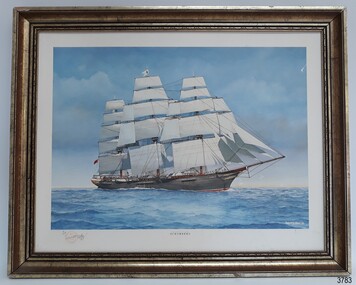
Print - Maritme, Colonial Clipper Schomberg, 1992
... supervision. He identifies the company logo of the Black Ball Ship Line by the flapping white flag with its black circle. Divers from Flagstaff Hill including Peter Ronald (former director) salvaged artefacts and personal effects from the wreck, to be preserved and displayed. ...supervision. He identifies the company logo of the Black Ball Ship Line by the flapping white flag with its black circle. Divers from Flagstaff Hill including Peter Ronald (former director) salvaged artefacts and personal effects from the wreck, to be preserved and displayed. ...This framed print of the famous clipper ship “Schomberg” is associated with Flagstaff Hill’s collection of artefacts from the wreck of the “Schomberg”. The original was painted in 1992 by maritime artist Philip J. Gray. This limited edition print is number 9/1000. ABOUTH THE SUBJECT – “Schomberg” The Schomberg was a luxury ship built in 1855 to bring immigrants from the UK to Australia in superior comfort. The voyage could take three months or longer but Captain ‘Bully’ Forbes thought that he could sail the Schomberg from Liverpool to Melbourne in a record time of 60 days. On October 6th 1855 the Schomberg left Liverpool on its maiden voyage. She carried 430 passengers plus 3000 tons cargo including rail lines for Geelong and iron for a bridge in Melbourne. After 78 days at sea, on December 27th, Schomberg ran aground near Peterborough, Victoria. All on board were rescued the next day by the passing steamer SS Queen. Gray is well known for his depiction of maritime history. His meticulous attention to detail shows the enormity of the immigrant clipper with its huge billowing sails compared to the tiny figures at work on the deck. The busy crew can be seen attending to the rigging, as can a group of sailors working on the bow under supervision. He identifies the company logo of the Black Ball Ship Line by the flapping white flag with its black circle. Divers from Flagstaff Hill including Peter Ronald (former director) salvaged artefacts and personal effects from the wreck, to be preserved and displayed. Amongst these is the famous Schomberg Diamond ring. ABOUT THE ARTIST – Philip James Gray “Philip is one of Australia’s leading maritime artists and his meticulous research and social commentary paintings of ships, such as, the Loch Ard and Schomberg form an important part of Warrnambool’s Flagstaff Hill Maritime Museum.” [ref. Dr Marion Manifold, Artist and Art Historian, 2014] Philip James Gray was born in London but has lived most of his life in Australia. He graduated from a London school of art as an illustrator, specialising in technical and scientific illustration as well as other commercial and applied art. He was also a student for a time of Fyffe Christie - British figurative artist, mural painter and humanitarian – who had a great influence on his career. Philip has always worked as a professional artist and illustrator. Many publications on maritime history have featured his work. His paintings have been released and sold all over the world as limited edition prints. The State Library of Victoria’s ‘Latrobe Collection’ holds two of his paintings. His street painting of ‘The Ashes Contest’ decorates the brick wall of Old Bakery Laneway in Sunbury and a Sunbury café owner commissioned him to paint the ‘Sunbury Pop Festival’ as a remembrance of local history. [ref. Sunbury Leader, Nov 15 2013] Philip has been an active member of the Sunbury Art Society in Victoria for several years, serving on the committee for some of that time and being involved in exhibitions. He enjoys helping new artists and sharing his skills and experience. The subject of the sailing ship “Schomberg” is significant for is connection with the 1800s vessel “Schomberg” and the historic role the ship, and other similar ships, played to transport migrants and goods into Australia. The print is significant as it is a limited edition of an Australian maritime artist. Print in gilt timber frame. "The Colonial Clipper Schomberg" by Australian maritime artist Philip J Gray, 1992. Signed and numbered, Limited Edition print 9/1000. Depicts clipper ship “Schomberg”, in full sail at sea with land in background. Backing of frame has illegible adhesive label and pencilled text. Stamp In pencil “FLAGSTAFF HILL” and “FLAGSTAFF C”. Illegible text on adhesive label. Signature [Philip J Gray] Stamped as a limited edition of SCHOMBERG Handwritten edition "9/1000"flagstaff hill, warrnambool, shipwrecked coast, flagstaff hill maritime museum, maritime museum, shipwreck coast, flagstaff hill maritime village, great ocean road, sailing ships, schomberg, clipper ship, colonial clipper, limited edition print, 9/1000, philip j gray, marine artist -
 Wangaratta RSL Sub Branch
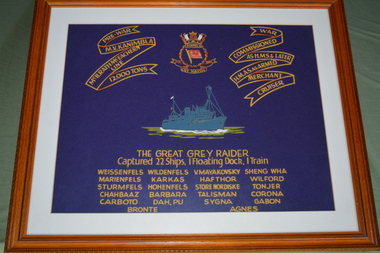
Print - Framed print, The Great Grey Raider
... She remained in the region until October 11, supervising the port and carrying out salvage work on the captured vessels, including salvage work on the German freighter Hohenfels. ...She remained in the region until October 11, supervising the port and carrying out salvage work on the captured vessels, including salvage work on the German freighter Hohenfels. ...On the night of August 24, 1941 HMS Kanimbla, with 300 Indian troops on board led a flotilla in a surprise attack on the Iranian port of Bandar Shahpur capturing eight German and Italian merchant vessels all containing valuable cargoes, as well as two Iranian gunboats and a floating dock. Kanimbla went alongside the burning Italian tanker Bronte and fought the fires while engaging a train with her main armament and with her 3-inch guns. She remained in the region until October 11, supervising the port and carrying out salvage work on the captured vessels, including salvage work on the German freighter Hohenfels. After further work in Indian waters during the latter part of October and November, Kanimbla proceeded to Singapore and escorted the first convoy out of that city after the Japanese attack on Malaya. She arrived in Melbourne on Christmas Day. She carried out further convoy work off the Australian coast and in both the Indian and the Pacific Oceans. At the end of the war HMAS Kanimbla was employed in repatriating Australian servicemen from the Pacific Islands and also in returning Dutch dependents to the East Indies (Indonesia). Between October 1946 and June 1948 she sailed between Australia and Japan transporting British Commonwealth Occupation Forces. MS Kanimbla was unique for many reasons, she was the only passenger liner in history to have a fully operational radio broadcasting station built into the ship at the time of construction. The equipment was manufactured by AWA in Australia and had been shipped to Ireland for installation whilst the ship was still under construction.Brown timber frame housing white mount and dark blue print with grey ship in the centre above list of names below and top right and left corners.THE GREAT GREY RAIDER Captured 22 Ships, / Floating Dock, / 1Train Ships captured: Weissenfels, Wildenfels, V. Mayakovsky, Sheng Wha, Marienfels, Karakoram, Hathor, Winford, Sturmfels, Hohenfels, Store Nordiske, Tonjer, Chahbaaz, Barbara, Talisman, Corona, Carboto, Dah Pu, Sygna, Gabon, Bronte, Agnes Pre War: M.V. Kanimbla, McIlrath McEachern Line, 12000 Tons War: Commissioned as H.M.S. & Later H.M.A.S as armed Merchant Cruiserkanimbla, great grey raider, hohenfels, bronte, ww2, 1941
