
Showing 8 items matching "sawmill locations"
-
 Marysville & District Historical Society
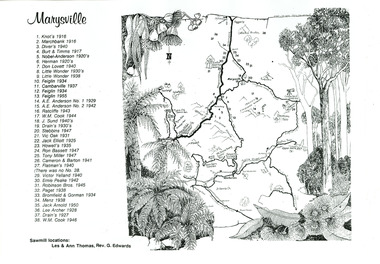
Map (item) - Sawmill locations, Ann Thomas, Unknown
... Sawmill locations......sawmill locations...Map Sawmill locations Ann Thomas Reverend G. Edwards ...A map with a key showing the locations of the many timber mills in the district surrounding Marysville.A map with a key showing the locations of the many timber mills in the district surrounding Marysville.marysville, victoria, australia, sawmill, sawmill locations, map, knot's, marchbank, diver's, burt & timms, nobel-anderson, herman, don lovett, little wonder, feiglin, cambarville, a.e. anderson, ratcliffe, w.m. cook, j. sund, drain's, stebbins, vic oak, jack elliott, howell's, ron bassett, tony miller, cameron & barton, flatman's, victor yelland, ernie peake, robinson bros, paget, bromfield & gorman, menz, jack arnold, lee archer -
 Marysville & District Historical Society
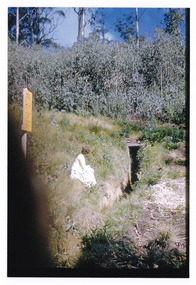
Photograph (item) - Colour photograph, 04-1960
... Few dugouts were built in other forest regions of Australia, but those that did exist in these Victorian ranges saved dozens of lives in the fires of Black Friday 1939. mount margaret marysville victoria fire dugout sawmilling industry black friday 1939 bushfire 27 'Fire Dug out' Mt Margaret April 1960 A colour photograph of the entrance to a fire dugout on Mount Margaret near Marysville in Victoria. The subject, location ...A colour photograph of the entrance to a fire dugout on Mount Margaret near Marysville in Victoria.A colour photograph of the entrance to a fire dugout on Mount Margaret near Marysville in Victoria. The fire refuge dugout, which developed in the era of bush sawmilling in the early twentieth century, was a distinctive cultural response to the history of fire in the tall Victorian forests. Few dugouts were built in other forest regions of Australia, but those that did exist in these Victorian ranges saved dozens of lives in the fires of Black Friday 1939.27 'Fire Dug out' Mt Margaret April 1960mount margaret, marysville, victoria, fire dugout, sawmilling industry, black friday 1939, bushfire -
 Orbost & District Historical Society
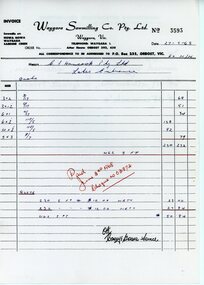
Document - Invoice - Waygara Sawmilling Co. Pty. Ltd, Waygara Sawmilling co, 1968
... Sawmill from 1968. This mill was located at Waygara (near Orbost), adjacent to the Bairnsdale-Orbost Railway Line. It was one of many mills developed in East Gippsland after World War II and benefited from its strategic location next to the railway line. ...Sawmill from 1968. This mill was located at Waygara (near Orbost), adjacent to the Bairnsdale-Orbost Railway Line. It was one of many mills developed in East Gippsland after World War II and benefited from its strategic location next to the railway line. ...This is an invoice from the Waygara Sawmill from 1968. This mill was located at Waygara (near Orbost), adjacent to the Bairnsdale-Orbost Railway Line. It was one of many mills developed in East Gippsland after World War II and benefited from its strategic location next to the railway line. Timber was cut at this mill and loaded directly onto trains for transport to Melbourne. This milling company had other mills at Sardine Creek and Nowa Nowa. Waygara Sawmills were owned by Harry Lederman of Melbourne. This item is significant because it relates to one of the many large saw milling companies which developed in the Orbost district during the 1960s-1970s. This mill was at Waygara near Orbost. One white page, b/w lettering, also with some writing in red. Waygara Sawmilling Co Pty Ltd, Waygara Victoria, Invoice 27.5.68 Telephone Waygara 1 Messrs. C F Hancock Pty Ltd, Lakes Entrance sawmill, waygara, orbost -
 Ringwood and District Historical Society
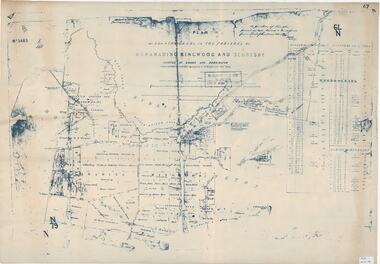
Map, Plan of Country Lands in the Parishes of Nunawading Ringwood and Scoresby - circa 1855
... Inset map showing location of (*proposed) cemetery on southern corner of Lillydale Road from Melbourne and Sawmill Road, later Mount Dandenong Road. ...Inset map showing location of (*proposed) cemetery on southern corner of Lillydale Road from Melbourne and Sawmill Road, later Mount Dandenong Road. ...Blueprint copy of Survey Map detailing original Selectors' names and property locations. List of Parish map references including property bearings, distances in Links, and markings on trees. Descriptive remarks include areas marked "Farmer's Common", "Poor soil thickly/moderately timbered with stringy bark", and location of water and firewood reserves."Surveyed and plotted by N.M. Bickford, Superintendant of Mr. Hodgkinson's Field Party". "The land comprised in this survey is of inferior quality, moderately undulating, and thickly wooded. It is watered by Dandenong Creek and Deep Creek." Inset map showing location of (*proposed) cemetery on southern corner of Lillydale Road from Melbourne and Sawmill Road, later Mount Dandenong Road. (*Cemetery did not eventuate.) -
 Halls Gap & Grampians Historical Society
Photograph - B/W, C 1910
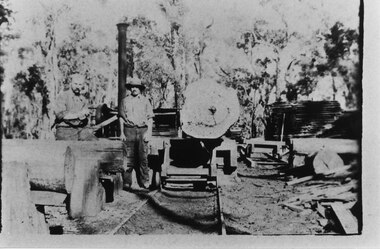
... location nor the people are known. Note: The photo may have been taken by Guy E. Neate of "Rosebank" on Neates Road in the Victoria Valley, however Guy Neate did not buy that property until June 1926 (see the book "Water Between the Hills". TIMBER INDUSTRIES Logging Sawmilling ...The photo shows a timber mill in the Grampians. Neither the location nor the people are known. Note: The photo may have been taken by Guy E. Neate of "Rosebank" on Neates Road in the Victoria Valley, however Guy Neate did not buy that property until June 1926 (see the book "Water Between the Hills".The photo shows two men standing beside a trolley with a large log on it. There are other logs to the left and some sawn wood is visible stacked towards the back.timber industries, logging, sawmilling -
 Clunes Museum
Photograph - PHOTOGRAPHS
... Bates (Brother); and 'Afghan Worker' .2 Location "Mile Creek" sawmill...Bates (Brother); and 'Afghan Worker' .2 Location "Mile Creek" sawmill Two laminated black and white photographs of groups of men in front of what appears to be a mine site. ...Two laminated black and white photographs of groups of men in front of what appears to be a mine site..1 on Reverse; McClean great grandfather was Bates Four individuals noted on front as Richard Bates (Mine Manager); John Bates (Brother); ? Bates (Brother); and 'Afghan Worker' .2 Location "Mile Creek" sawmillbates, afghan -
 Department of Energy, Environment and Climate Action
Dugout sign, Post 1966
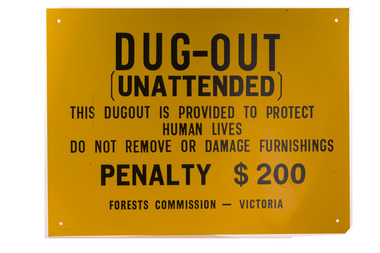
... Well-constructed dugouts had saved the lives of many sawmill workers and their families during the 1939 bushfires. But in some locations, they had proved fatal. ...Well-constructed dugouts had saved the lives of many sawmill workers and their families during the 1939 bushfires. But in some locations, they had proved fatal. ...Considered in terms of both loss of property and loss of life, the Black Friday bushfires on 13 January 1939 were one of the worst disasters to have occurred in Australia and certainly the worst bushfire up to that time. The fires burnt 2 million hectares, 69 sawmills were destroyed, 71 people died, and several towns and sawmills were entirely obliterated. Among those killed were four men from the Commission The subsequent Royal Commission conducted by Judge Leonard Stretton has been described as one of the most significant inquiries in the history of Victorian public administration. Its recommendations led to sweeping changes. In addition to building dams and water points, the Stretton Royal Commission recommended expanding and controlling the use of bushfire dugouts at forest sawmills. Well-constructed dugouts had saved the lives of many sawmill workers and their families during the 1939 bushfires. But in some locations, they had proved fatal. Dugouts became mandatory for those few sawmills that remained in the forest after the 1939 fires. Many remote logging coupes and FCV roading camps also had dugouts. The local District Forester was required to make annual pre-season inspections of all dugouts on State forests and those within the Fire Protected Area (FPA). Some were built privately on private land. Most were primitive construction with a log or corrugated iron roof covered with earth. A hessian bag often hung at the entrance to keep the heat and smoke out. But they were dark and damp with snakes and other creepy crawlies often lurking inside. By 1940-41 there were 19 new dugouts constructed by the Commission and a further 128 by forest licensees. Ten years later there were 8 new Commission dugouts and 21 new ones built by other interests. By 1960-61 the rate of new builds was declining but the Commission still managed 103 dugouts while 127 were looked after by others. However, as the forest road network improved and gave all-weather access to modern two-wheel-drive vehicles the reliance on dugouts receded.Large metal sign that was positioned near forest dugoutsbushfire, forest signs, forests commission victoria (fcv) -
 Emerald Museum & Nobelius Heritage Park
Photograph, Legg's Sawmill Emerald, c. 1920-40
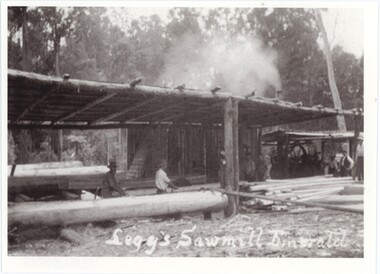
... This photograph depicts a sawmill in Emerald operated by the Legg family - most likely by James Henry Legg (1860-1940) and his son Percy (1893-1968), who operated the mill business. They established 'spot mills' - smaller or temporary mills establish on the location of timber harvesting - around the local area, including at least this one and one in Macclesfield - though it is possible the caption is wrong and this IS the mill in Macclesfield. ...This photograph depicts a sawmill in Emerald operated by the Legg family - most likely by James Henry Legg (1860-1940) and his son Percy (1893-1968), who operated the mill business. They established 'spot mills' - smaller or temporary mills establish on the location of timber harvesting - around the local area, including at least this one and one in Macclesfield - though it is possible the caption is wrong and this IS the mill in Macclesfield. ...This photograph depicts a sawmill in Emerald operated by the Legg family - most likely by James Henry Legg (1860-1940) and his son Percy (1893-1968), who operated the mill business. They established 'spot mills' - smaller or temporary mills establish on the location of timber harvesting - around the local area, including at least this one and one in Macclesfield - though it is possible the caption is wrong and this IS the mill in Macclesfield. There are at least two other copies of this photograph in our collection.This image depicts a notable local business from the early 20th century, owned by a significant local family.This item is a modern printed copy of a black and white photograph. It depicts an open-walled wooden structure, with a closed roof held up by posts. Behind the main structure is a smaller structure covering a machine with steam flowing out of its chimney - a mechanical component of the mill, making the work of processing timber easier. To the left of the image, several unprocessed logs sit on the ground, while to the right is a pile of processed, cut, timber. Several workers - may five - are in frame, all standing near or under the wooden structure. In the background, dense trees rise above the structure, rising high enough to leave the frame. The reverse of the photograph reveals logos for a modern photograph paper brand and a handwritten accession number, but no other annotation.Obverse, Caption: "Legg's Sawmill Emerald"forestry, industry, emerald, macclesfield, legg family, james legg, percy legg
