
Showing 5 items matching "scarlet piping"
-
 Wangaratta RSL Sub Branch
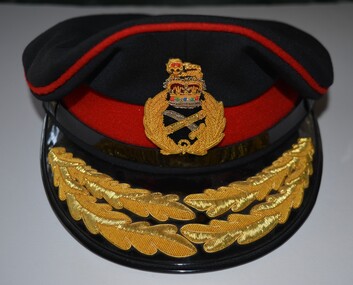
Headwear - General Officer Cap, Mountcastle Pty Ltd, 2001
... It is a ceremonial peaked cap worn with the Dress Uniform, typically featuring distinctive scarlet piping/band and oak leaf embroidery on the peak for high-ranking officers....Dark blue fabric peaked cap featuring distinctive scarlet piping/band with badge and oak leaf embroidery on the peak....It is a ceremonial peaked cap worn with the Dress Uniform, typically featuring distinctive scarlet piping/band and oak leaf embroidery on the peak for high-ranking officers. ...Australian General Officers' "Blues" cap issued to Lt Gen Brian “Ash” POWER. It is a ceremonial peaked cap worn with the Dress Uniform, typically featuring distinctive scarlet piping/band and oak leaf embroidery on the peak for high-ranking officers.Worn by General Staff Officers and high-ranking personnel during ceremonial duties.Dark blue fabric peaked cap featuring distinctive scarlet piping/band with badge and oak leaf embroidery on the peak.Size 57blues cap, lt gen ash power -
 Flagstaff Hill Maritime Museum and Village
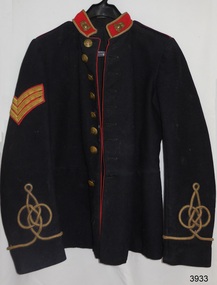
Uniform - Tunic, 1899-1903
... ...scarlet piping...Moncton garrison dress uniform tunic scarlet collar red collar scarlet piping red piping gold bullion artillery emblem light horse artillery mounted troops Victorian Garrison Artillery Corps Button front: Artillery emblem on front (field cannon facing left, in front of a muzzle-loading ram rod). ...This original tunic or jacket is part of the full dress uniform of the pre-Federation Victorian Permanent Artillery regiment. Its owner had the rank of Sergeant, as indicated by the three inverted chevrons. The Artillery design of the badges and buttons indicate the date of the tunic to be from 1893 to 1903. However the maker of the tunic, W. Moncton, began manufacture in Melbourne in 1899, so this the tunic can be dated between 1899 and 1903. The donor's grandfather was given this tunic but not the name of the original owner. It has since been suggested to the family that the tunic was worn by a local Western District Light Horse member. This could very well have been the case because mounted troops were officially referred to as the Light Horse in the late 19th to early 20th century. Several local men were involved in the Light Horse during the First World War. The donor's grandfather wore this tunic in the local district when riding a penny farthing bicycle. The donor's father also wore the tunic when dressed as a 'Captain' hosting a local disco dance. BRIEF MILITARY HISTORY- The Crimean War began In 1854 and many people in colonial Australia were afraid of a Russian attack. Volunteer forces were established to strengthen the British Imperial troops posted here. A battery of artillery was raised in Victoria as well as in other Australian states. In 1870 Australia became responsible for its own naval and military defence. The Volunteer Corps and Victorian Navy shared the responsibility of defending the existing forts, assisted by volunteer coastal and mobile field batteries. The Permanent Victorian Artillery force was established. It was disbanded in 1880 then re-formed in 1882 as the Victorian Garrison Artillery Corps. In 1895 the Geelong, Warrnambool, Port Fairy and Portland Batteries became part of the Western District Garrison Artillery. Many of the volunteers who served in the Artillery were from rural areas. They belonged to rifle clubs and were experience horsemen as well. Australia's defence at this time relied on these mounted troops, or Light Horse men. In 1899 the Victorian Garrison Artillery Corps amalgamated with the New South Wales and Queensland Permanent Artillery to become the Victorian Regiment of the Royal Australian Artillery (RAA). Then prior to Federation, the RAA and the Permanent Artillery of South Australia, Western Australia and Tasmania all combined, becoming the Royal Australian Artillery Regiment with two Batteries of Field Artillery; Battery A from Sydney and Battery B from Melbourne.This original uniform tunic of the pre-Federation Victorian Permanent Artillery is significant for its association with Australia's military defence and the fortifications of our district, state and country. The tunic is also significant, representing part of the history and evolution of uniforms in the Australian military forces. The tunic is also significant in its representation of Australia's independence in forming its own defences. The tunic has local significance in its connection with local social events.Tunic or jacket, part of the full dress uniform of the pre-Federation Victorian Permanent Artillery operating from 1893 to 1903. Original, single-breasted tunic of dark blue wool, red piping trim, black cotton lining in body. Sleeves lined with blue striped, white cotton. Front closure has eight brass buttons. Red band-style collar with hook-and-eye closure has gold bullion braid trim and a brass badge pinned each side at the front. Upper right sleeve has three inverted chevrons on red fabric with gold bullion braid trim (rank of Sergeant). Both sleeves have gold bullion braid 'Austrian knot' emblems stitched onto lower arm, with ends finishing on the inner sleeve. Shoulder epaulettes have red piping and smaller brass buttons. Closed back vent has vertical scalloped design with six brass buttons, in two columns of three, and red piping trim. Brass belt hook is attached to the left back waist, close to the seam (right side has a mark indicating a previous similar clip). Inside left breast is a concealed pocket. Tunic has both machine and hand stitching. All brass shank-style buttons have matching Artillery emblems with inscriptions on the back. The two brass collar badges have additional artillery emblems of exploding grenade and star as well as an inscription. Buttons were made for W. Moncton, of Melbourne and marked with his name. He traded from 1899, dating the tunic to between 1899 and 1903.Button front: Artillery emblem on front (field cannon facing left, in front of a muzzle-loading ram rod). Button back: engraved "W. MONCTON . MELBOURNE ." Collar badges: Artillery emblem (field cannon facing right | stars | exploding grenade | "AUSTRALIA")flagstaff hill, warrnambool, shipwrecked coast, flagstaff hill maritime museum, maritime museum, shipwreck coast, flagstaff hill maritime village, great ocean road, uniform jacket, uniform tunic, garrison volunteer uniform, fortifications in victoria, victorian permanent artillery, pre-federation military uniform, sergeant's uniform, jacket, militia, victoria, victorian volunteer forces, victorian regiment, royal australian artillery, raa, field gun, sergeant, w. moncton, garrison, dress uniform, tunic, scarlet collar, red collar, scarlet piping, red piping, gold bullion, artillery emblem, light horse, artillery, mounted troops, victorian garrison artillery corps -
 4th/19th Prince of Wales's Light Horse Regiment Unit History Room
Jacket, 9th Australian Light Horse, abt 1903
... Jacket, dark khaki, cream piping at cuffs and epaulettes, a scarlet bar over cream patches under the badges at the throat. ...jacket taylor 9 light horse Jacket, dark khaki, cream piping at cuffs and epaulettes, a scarlet bar over cream patches under the badges at the throat. ...Jacket, dark khaki, cream piping at cuffs and epaulettes, a scarlet bar over cream patches under the badges at the throat. Pale brass buttons with monogram "GR VII" inscribed "Australian Commonwealth". The regimental badges at the throat combine the Colonial Victorian Mounted Rifles badge with the Australian Light Horse. They show a golden kangaroo surrounded by two silver wattle branches and the motto "Pro Gloria" over "VMR" on a ribbon, all in silver. Beneath is a gold ribbon inscribed "9th AUS Lt HORSE" jacket, taylor, 9 light horse -
 The 5th/6th Battalion Royal Victoria Regiment Historical Collection
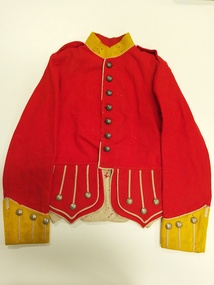
Uniform - VSR OR scarlet doublet, c 1898-1912
... Scarlet wool doublet with yellow stand collar and cuffs and Inverness skirts. Lower edge of collar, left front of doublet, cuffs and Inverness skirts all edged with white piping. ...Printed in black ink on the centre back lining is '5/8 38' Scarlet wool doublet with yellow stand collar and cuffs and Inverness skirts. Lower edge of collar, left front of doublet, cuffs and Inverness skirts all edged with white piping. ...Scarlet wool doublet with yellow stand collar and cuffs and Inverness skirts. Lower edge of collar, left front of doublet, cuffs and Inverness skirts all edged with white piping. Cuffs and skirts are decorated with three rows of doubled, twisted white wool braid; each row completed with a large whitemetal coloured metal "King Edward VII Australian Commonwealth" button of the period 1901-1911. Shoulder straps are scarlet wool with MISSING whitemetal 'VSR' title, a MISSING whitemetal 'letter' title, a small ERVII Australian Commonwealth button on left shoulder, and a small silver coloured metal Victorian Military Forces button on the right shoulder. Seven large buttons at front of tunic (one missing), and two at back waist. Two large brass belt hooks at side waist of doublet. Lower front skirt flaps have welt pockets lined with linen. Body of tunic lined with a white wool mixture, lightly padded around the underarms. Lower skirt flaps lined with a medium weight cream wool twill and upper smaller flaps lined with a finer cream wool twill. Sleeves lined with cream cotton twill and printed in black ink on the centre back lining is '5/8 38'. Collar lined with red wool and neck fastened with a single brass hook and eye over a black patent leather tab.Printed in black ink on the centre back lining is '5/8 38' -
 The 5th/6th Battalion Royal Victoria Regiment Historical Collection
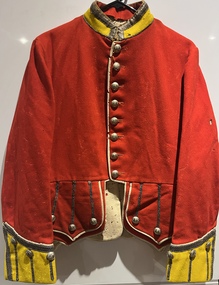
Uniform - Victorian Scottish Regiment Officers Scarlet Full Dress Doublet c. 1898, c1901-1911
... Officer's full dress scarlet wool doublet with yellow stand collar and cuffs, and Inverness skirts. Left front of doublet, cuffs and Inverness skirts all edged with white piping. ...VSR Victorian Scottish Regiment Australian Army 5th Battalion 5th Battalion Victorian Scottish Regiment Royal Australian Infantry Corps RAINF 5/6 RVR 5th/6th Battalion Royal Victoria Regiment Pipes and Drums Officer Full Dress Doublet Scottish Dress blue ink on lotter right opening lining is '5-7 37' Officer's full dress scarlet wool doublet with yellow stand collar and cuffs, and Inverness skirts. Left front of doublet, cuffs and Inverness skirts all edged with white piping. ...The Victorian Scottish Regiment was an infantry unit of the Colony of Victoria Australia raised in 1898. It became part of the Australian Commonwealth Military forces in 1901 and was later renamed the 5th Battalion, Victorian Scottish Regiment. In 1960 the Victorian Scottish Regiment became the Royal Victoria Regiment and the present 5th/6th Battalion, Royal Victoria Regiment is today the custodian of its Australian-Scottish customs and traditions. Officer's full dress scarlet wool doublet with yellow stand collar and cuffs, and Inverness skirts. Left front of doublet, cuffs and Inverness skirts all edged with white piping. Lower edge of collar, cuffs and skirts are decorated with three rows of doubled, 1/8” silver Russian braid; each row completed with a large whitemetal coloured metal "King Edward VII Australian Commonwealth" button of the period 1901-1911. 5/8” silver lace around top of collar, and top and seam of gauntlet cuff. Silver braid shoulder straps and screw buttons MISSING. Eight large buttons at front of tunic, and two at back waist. Two large brass belt hooks at side waist of doublet. Lower front skirt flaps have welt pockets lined with linen. Body of tunic lined with a white wool mixture, lightly padded around the underarms. Lower skirt flaps lined with a medium weight cream wool twill and upper smaller flaps lined with a finer cream wool twill. Sleeves lined with cream cotton twill and written in blue ink on lotter right opening lining is '5-7 37'. Collar lined with red wool and neck fastened with two brass hook and eyes. No black patent leather tab at collar.blue ink on lotter right opening lining is '5-7 37'vsr, victorian scottish regiment, australian army, 5th battalion, 5th battalion victorian scottish regiment, royal australian infantry corps, rainf, 5/6 rvr, 5th/6th battalion, royal victoria regiment, pipes and drums, officer, full dress, doublet, scottish dress
