
Showing 5 items matching "school writing implements"
-
 Kiewa Valley Historical Society
Pen with Nib, No Name, circa 1950
... ...school writing implements...schools in the Kiewa Valley. The plastic shaft suggests this pen was at the time when fountain pens started to emerge. The dip pen was becoming outdated and too slow for a faster pace of written communications Historically and socially this form of written communication was becoming too slow for a faster pace of commerce and life. Circa 1950s onwards the level of the written word increased by the proportion of literacy among the populous in the Kiewa Valley education writing literacy ink well school writing implements ...Pen was probably last used in one of the schools in the Kiewa Valley. The plastic shaft suggests this pen was at the time when fountain pens started to emerge. The dip pen was becoming outdated and too slow for a faster pace of written communications Historically and socially this form of written communication was becoming too slow for a faster pace of commerce and life. Circa 1950s onwards the level of the written word increased by the proportion of literacy among the populous in the Kiewa Valley Plastic shaft black coloured pen with metal nib (non drip). Nib is removable, fastened to shaft by strategically placed slots education, writing, literacy, ink well, school writing implements, pen, nib -
 Ringwood and District Historical Society
Magazine, Ringwood High School Magazine 1964 - Yakkity Hi
... school houses. The contents of Yakkity Hi ends with the results from 1963, both sporting and academic. Bifold light pale green/beige cardboard cover with 72 page insert, with a photograph of the Ringwood clock-tower in the old location on the corner of Warrandyte Road and Maroondah Highway. The cover also has the RHS logo and a stylised drawing of the title, ie Yakkity Hi, and a drawing of three writing implements ...Bifold light pale green/beige cardboard cover with 72 page insert, with a photograph of the Ringwood clock-tower in the old location on the corner of Warrandyte Road and Maroondah Highway. The cover also has the RHS logo and a stylised drawing of the title, ie Yakkity Hi, and a drawing of three writing implements Magazine includes a message from Headmaster, G.S. Ormandy, a list and a photo of staff, the Editorial, a photo and a list of prefects. Many contributions from students are included, encompassing essays, cartoons, comedy pieces, opinions on current affairs, sketches, poems. Photos of school groups and clubs feature, including AFS (American Field Service Exchange Scholarships), cadets, photos of all Form 1 classes, photos of Form Captains and short essays about said classes, many sporting team photos and reports of the progress of the four school houses. The contents of Yakkity Hi ends with the results from 1963, both sporting and academic. -
 Ringwood and District Historical Society
Magazine, Ringwood High School 1965 - Yakkity Hi
... It also has the RHS logo and a stylised drawing of the title, ie Yakkity Hi, and a drawing of three writing implements Ringwood High School 1965 - Yakkity Hi Magazine ...Cover has a photograph of the Ringwood clock-tower in the old location on the corner of Warrandyte Road and Maroondah Highway. It also has the RHS logo and a stylised drawing of the title, ie Yakkity Hi, and a drawing of three writing implements Insert has black and white print and photos, with the middle 4 pages either in shades of yellow with brown print or the middle 2 pages consisting of several photos, all in shades of orange. Page 1 has a photo of the new headmaster, Mr R.T. Hodge and his message to all.The rest consists of a photo and a list of the staff, the magazine committee, office staff and the advisory council. The Editorial follows, along with a list of and a photograph of the prefects. Student and staff contributions cover many pages. Cadet news is covered, and also many sporting items. Photos of all the Form 1s follow this; then all the forms of all levels contribute a short summary of their news. Academic results from 1964 and sporting results and photos from 1965 finish the contents of the insert. -
 Wodonga & District Historical Society Inc
Domestic object - Ceramic ink pen cleaner, 1900 - 1920s
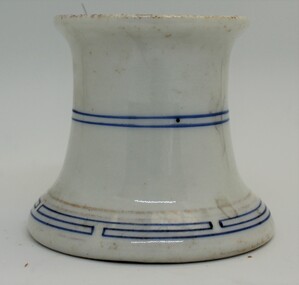
... School. This item is was donated by Mrs. Betty Barberis, a well-known artist in the Wodonga district. Domestic items writing implements Pen and ink ThIs ceramic pen wiper/ cleaner was produced to clean and maintain the nib on an ink pen. ...Pen-wipers or pen-cleaners were invented to prolong the usefulness of their pens by keeping them clean and dry between uses. This helped to prevent rusting of the nib from water-based inks. In the 1890s and 1900s, with the rise of the fountain pen, pen-cleaners remained a popular desktop accessory, since they could still be used to wipe away the excess ink from the nib and feed of a pen, once it had been refilled in an inkwell. Pen-cleaners died out in the second half of the 1900s when people started using ballpoint pens. This wiper was used by the teacher at Upper Gundowring Primary school, Victoria. The school, number 2733, opened on 13 July 1886. Due to changing demographics in the region, in 1953 the school was merged with schools from Dederang North, Kergunyah, Gundowring, Kiewa, Red Bluff, Charleroi and Gundowing North on a 10 acre site with 11 rooms at Kiewa to become Kiewa Valley Consolidated School. This item is was donated by Mrs. Betty Barberis, a well-known artist in the Wodonga district. ThIs ceramic pen wiper/ cleaner was produced to clean and maintain the nib on an ink pen. It has a blue line pattern at the base, middle and inside the rim. domestic items, writing implements, pen and ink -
 Emerald Museum & Nobelius Heritage Park
Equipment - Ink bottle, 1920s-1940s
... writing implements cheaper but also more portable. Prior to innovations in fountain pen nibs and filling systems that made them cleaner and more reliable to use, writing may have been conducted at a writing desk which held an inkwell which was refilled from a larger bottle or (prior to the beginning of the Nineteenth Century) filled with ink reconstituted from powder form or dissolved from a tablet or cake of dry ink. The item is significant for the insights it provides into the development of writing technologies generally and the application of these to writing practices used by schools ...This item is an ink bottle used to store a quantity of ink ready for writing at a desk or table, with a small brush that could be used to stir the ink to prevent separation of the ink into components or sediment at the bottom of the bottle. The brush could also be used as a direct applicator if larger text was required. The bottle is thought to date from the mid-period of the Twentieth Century, and is likely to have been purchased full of ink rather than filled and refilled from a bulk bottle of household ink. Similarly, in this time period, the ink is likely to have been used to refill a fountain pen with an internal storage reservoir via an eye-dropper or converter mechanism rather than used by a writer who dipped their pen in the ink frequently as they wrote. Ink bottles were typically designed to have a broad, stable base that decreased the likelihood of the article tipping when a pen or converter was dipped into the ink. Bottles were produced in a wide variety of shapes and colours, primarily dictated by product differentiation and aesthetic appeal in the growing retail market that emerged due to improvements in fountain pen design which made access to convenient writing implements cheaper but also more portable. Prior to innovations in fountain pen nibs and filling systems that made them cleaner and more reliable to use, writing may have been conducted at a writing desk which held an inkwell which was refilled from a larger bottle or (prior to the beginning of the Nineteenth Century) filled with ink reconstituted from powder form or dissolved from a tablet or cake of dry ink. The item is significant for the insights it provides into the development of writing technologies generally and the application of these to writing practices used by schools and businesses and offices in Emerald and the surrounding region, including the commercial and economic practices required to support these activities. Oval shaped flat-bottomed clear glass bottle with tiered ripples on the upper surface slanting towards the juncture with the bottle's circular metal lid. The lid has a nub-shaped handle for the user to grasp. The inside of the lid contains a metal pipe on the end of which is a small brush for stirring the ink. This item is an ink bottle used to store a quantity of ink ready for writing at a desk or table, with a small brush that could be used to stir the ink to prevent separation of the ink into components that might cause sedimentation at the bottom of the bottle. The brush could also be used as a direct applicator if larger text was required. Base: VEMU 2001 / ISM-I52 or 1SM-152 / 3 / 1930s and 1940s, 1950s, ink, ink bottle, writing equipment, writing, schools, businesses, office equipment
