Flagstaff Hill Maritime Museum and Village
Book - A Fictional Adventure Story, Jules Verne, The Captain of The Guidara, 1884
... science fiction novels.
This edition was translated from French to English by Henry Frith, a frequent Verne translator active in the 1880s who handled multiple Voyages Extraordinaires titles for Sampson Low Marston Searle and Rivington. Henry Frith was an Irish civil engineer, author, and prolific translator best known for rendering Jules Verne's Voyages Extraordinaires into English during the 1870s and 1880s. Born in Dublin on May 2, 1840, he moved to England...science fiction novels.
This edition was translated from French to English by Henry Frith, a frequent Verne translator active in the 1880s who handled multiple Voyages Extraordinaires titles for Sampson Low Marston Searle and Rivington. Henry Frith was an Irish civil engineer, author, and prolific translator best known for rendering Jules Verne's Voyages Extraordinaires into English during the 1870s and 1880s. Born in Dublin on May 2, 1840, he moved to England ...
"The Captain of the Guidara" refers to the English title of the first volume of Jules Verne's 1883 novel Kéraban le Têtu, part of his Voyages Extraordinaire series. The second novel features “Scarpante the Spy” to complete the two part volume of “Kéraban the Inflexible”. in the English edition, the story is following The Captain of the Guidara. Originally published in French in 1883 and in Britain with two volumes in 1887. The story follows a stubborn Turkish merchant, Keraban, who refuses to pay a new tax on crossing the Bosporus and instead embarks on a lengthy journey around the Black Sea. The "Guidara" refers to the ship central to this Ottoman era adventure. It features two Dutchmen and the obstinate Keraban navigating political, cultural, and geographical challenges. The novel is richly illustrated and reflects Verne’s signature blend of travel, exploration, and historical detail.
Hard cover book,The Captain of The Guidara.
Author: Jules Verne
Publisher: Sampson Low Marston Searle and Rivington, Crown Buildings 188 Fleet Street, London. W1.
Date: 1884
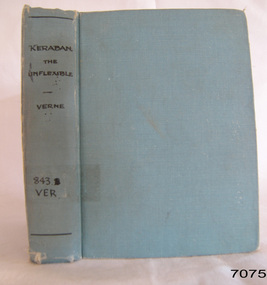
Light blue hardcover with the title on the spine having lettering to spine in black hand written text pen. fiction"The Captain of the Guidara" refers to the English title of the first volume of Jules Verne's 1883 novel Kéraban le Têtu, part of his Voyages Extraordinaire series. The second novel features “Scarpante the Spy” to complete the two part volume of “Kéraban the Inflexible”. in the English edition, the story is following The Captain of the Guidara. Originally published in French in 1883 and in Britain with two volumes in 1887. The story follows a stubborn Turkish merchant, Keraban, who refuses to pay a new tax on crossing the Bosporus and instead embarks on a lengthy journey around the Black Sea. The "Guidara" refers to the ship central to this Ottoman era adventure. It features two Dutchmen and the obstinate Keraban navigating political, cultural, and geographical challenges. The novel is richly illustrated and reflects Verne’s signature blend of travel, exploration, and historical detail. warrnambool, shipwrecked-coast, flagstaff-hill, flagstaff-hill-maritime-museum, maritime-museum, flagstaff-hill-maritime-village, shipwrecked-artefact, book, warrnambool mechanics’ institute, pattison collection, warrnambool library, corangamite regional library service, warrnambool city librarian, mechanics’ institute library, victorian library board, warrnambool books and records, warrnambool children’s library, ralph eric pattison, jules verne, voyages extraordinaire series, l’école des robinson's

 Mrs Aeneas Gunn Memorial Library
 Flagstaff Hill Maritime Museum and Village