
Showing 8 items matching "scottish outfit"
-
 El Dorado Museum Association Inc.
Photograph - Digital Image
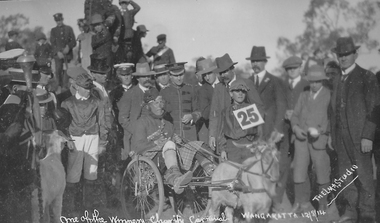
... ...scottish outfit...Digital image copied from a black and white photograph of a person dressed in Scottish outfit (kilt, tam-o-shanter cap) seated in buggy harnessed to a goat, surrounded by crowd of onlookers including two children dressed as jockeys (one wearing number 25)...Charity Day, Wangaratta, 1914. wangaratta goat race charity carnival wangaratta charity carnival goat race scottish outfit animals Captions written and printed on photograph 'One of the [?] ...Charity Day, Wangaratta, 1914.Digital image copied from a black and white photograph of a person dressed in Scottish outfit (kilt, tam-o-shanter cap) seated in buggy harnessed to a goat, surrounded by crowd of onlookers including two children dressed as jockeys (one wearing number 25)Captions written and printed on photograph 'One of the [?] Charity Carnival', 'WANGARATTA 12/8/14', 'Thelma Studio'wangaratta, goat, race, charity carnival, wangaratta charity carnival, goat race, scottish outfit, animals -
 Bendigo Historical Society Inc.
Photograph - GROUP PORTRAIT - MALE
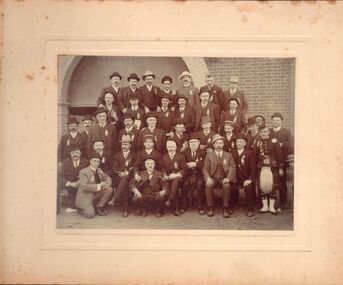
... Men are wearing three piece suits, hats, one man on Right hand side of front row is wearing a Scottish outfit. Men have a ribbon attached to their lapels. ...Men are wearing three piece suits, hats, one man on Right hand side of front row is wearing a Scottish outfit. Men have a ribbon attached to their lapels. ...Black and white image mounted on cream board. Group of 35 men, 4 rows, standing in a tiered arrangement in front of a brick building. Building has dark (red ? ) bricks, archway, with cream brick surround, over entrance, with wooden infill, doors. Men are wearing three piece suits, hats, one man on Right hand side of front row is wearing a Scottish outfit. Men have a ribbon attached to their lapels. Could be a Lodge ? Early 1900 ? Stamped on back of board ' W.H. Robinson, Photographer, Mundy St., Bendigo'W.H. Robinson, Bendigoperson, group, lodge ?, bendigo, males. photographer , w. h. robinson, mu8ndy street, bendigo. -
 National Wool Museum
Clothing - Knitted Outfit, Inge Cammans, 1998
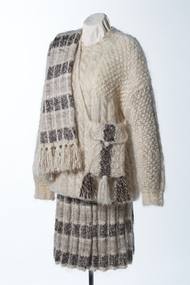
... tag [front]: [handwritten] SCOTTISH OUTFIT / DESIGNED HAND- / SPUN + KNITTED OUT / OF PERRIDALE + / MOHAIR BY / Inge Cammans / [printed] BUCHAN / BLACK MARBLE HUT / GALLERY / Main Street, Box 9, / Buchan, Vic. 3885 / (051) 55 9296 / AUSTRALIA tag [back]: Theo Cammans / is an exceptionally talented individual. / He is responsible for not only / the beautiful paintings and / woodwork throughout the / shop, but also fashions the / unique Buchan Marble / into many varied and / stunning designs. / Inge Cammans / using her own hand spun / wool she has made multi / award winning garments / and wall hangings. / Each item in unique and / renowned world wide / She has taken first prize at - / National Wool Awards, / Melbourne, Lakes, Bairnsdale, Omeo / Paris Exhibitor front [rosette]: OMEO & DIST. ...Knitting Handicrafts Cammans Mr Theo Knitting Handicrafts East Gippsland Inge Cammas Buchan Migration Buchan Black Marble Hut awards tag [front]: [handwritten] SCOTTISH OUTFIT / DESIGNED HAND- / SPUN + KNITTED OUT / OF PERRIDALE + / MOHAIR BY / Inge Cammans / [printed] BUCHAN / BLACK MARBLE HUT / GALLERY / Main Street, Box 9, / Buchan, Vic. 3885 / (051) 55 9296 / AUSTRALIA tag [back]: Theo Cammans / is an exceptionally talented individual. / He is responsible for not only / the beautiful paintings and / woodwork throughout the / shop, but also fashions the / unique Buchan Marble / into many varied and / stunning designs. / Inge Cammans / using her own hand spun / wool she has made multi / award winning garments / and wall hangings. / Each item in unique and / renowned world wide / She has taken first prize at - / National Wool Awards, / Melbourne, Lakes, Bairnsdale, Omeo / Paris Exhibitor front [rosette]: OMEO & DIST. ...Inge Cammans was born Ingenborg Flachs on 13 March 1932 in the Netherlands. She married Theodore Cammans on 27 April 1959 in Valkenburg. Inge was a dressmaker, and Theo a butcher. Later that year they emigrated to Canada, then in the mid 1960’s arrived in Australia. After arriving in Australia, they settled in East Gippsland. After some time in Sale, they moved to the small country town of Buchan and for two years they operated the local butcher shop and then took over the kiosk at Buchan Caves Reserve, which they ran for 13 years while raising their four children. Around 1980 they retired to the main street of Buchan. There they bought and restored the "Callemondah" property and opened a small craft and gallery space called the Buchan Black Marble Hut to display and sell Theo’s beautiful woodwork, stone craft and paintings. Although they were quite busy with the tourist trade, Inge fast became restless and borrowed a spinning wheel from a friend to try out. She taught herself how to spin and knit over the course of two months. From there, Inge went on to win a vast array of awards for her knitting - the house was full of walls upon walls covered in certificates, sashes, newspaper articles and pennants. She never used dye and only ever worked with natural wool, and would regularly travel out to the local farms to choose the colour of sheep she wanted. She would take the fleece to spin and then design and knit, crochet or latch hook every item from scratch, often inspired by techniques from dressmaking, and make knitted garments appear or behave the same way, despite its very different construction. This outfit was made by Inge in 1998. She was intrigued to figure out how to create the kilt pleats, the plaid pattern and the structure of the head piece. It was never intended to be worn out and about. She did knit items to wear, gift or sell, but the vast majority of her creative pieces were specifically intended as show submissions. This outfit was entered in the National Wool Awards competition in 1999 and won first prize. Hand knitted cream and brown outfit consisting of a skirt (kilt), jumper, hat (beret), scarf, socks and bag. Outfit is made using hand spun wool from local East Gippsland area, Perendale and Mohair. An artist tag and rosette award accompany the outfit.tag [front]: [handwritten] SCOTTISH OUTFIT / DESIGNED HAND- / SPUN + KNITTED OUT / OF PERRIDALE + / MOHAIR BY / Inge Cammans / [printed] BUCHAN / BLACK MARBLE HUT / GALLERY / Main Street, Box 9, / Buchan, Vic. 3885 / (051) 55 9296 / AUSTRALIA tag [back]: Theo Cammans / is an exceptionally talented individual. / He is responsible for not only / the beautiful paintings and / woodwork throughout the / shop, but also fashions the / unique Buchan Marble / into many varied and / stunning designs. / Inge Cammans / using her own hand spun / wool she has made multi / award winning garments / and wall hangings. / Each item in unique and / renowned world wide / She has taken first prize at - / National Wool Awards, / Melbourne, Lakes, Bairnsdale, Omeo / Paris Exhibitor front [rosette]: OMEO & DIST. A.&P. SOCIETY / WOOL DESIGN AWARDS / 1stknitting handicrafts, cammans, mr theo, knitting, handicrafts, east gippsland, inge cammas, buchan, migration, buchan black marble hut, awards -
 Clunes Museum
Clothing - RIDING APPAREL, KINOCH CLOTHES, CIRCA 1927
... OUTFIT .1 LADIES JACKET. TWEED WITH GREY SATIN LINING. 2 BUTTONS MISSING. LINING TORN. MADE BY KYNOCH CLOTHES OF SCOTLAND .2 BROWN JODHPURS. 1 BUTTON MISSING AT WAIST. ...OUTFIT .1 LADIES JACKET. TWEED WITH GREY SATIN LINING. 2 BUTTONS MISSING. LINING TORN. MADE BY KYNOCH CLOTHES OF SCOTLAND .2 BROWN JODHPURS. 1 BUTTON MISSING AT WAIST. ...THE OUTFIT BELONGED TO MRS W FAWCETT (CHRYSSIE) NEE McLENNAN. BORN 23/12/1897 DIED 29/3/1979.LADIES RIDING OUTFIT .1 LADIES JACKET. TWEED WITH GREY SATIN LINING. 2 BUTTONS MISSING. LINING TORN. MADE BY KYNOCH CLOTHES OF SCOTLAND .2 BROWN JODHPURS. 1 BUTTON MISSING AT WAIST. LACING ON LEGS FROM BELOW KNEE TO ANKLE. .3 2 LEATHER RIDING GLOVES WITH FUR LINING AND METAL BUCKLES.fawcett family, riding habit, clothing -
 Kew Historical Society Inc
Postcard, Newhaven Fishwife, c.1928
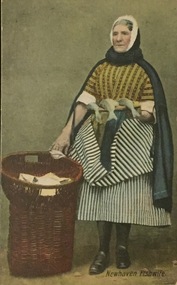
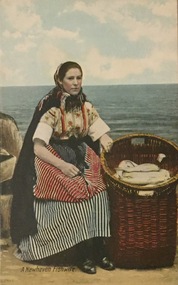
... Scotland. Portraits of fishwives were popular subjects for postcards due to the colourful, layered, striped outfits that they wore. ...Scotland. Portraits of fishwives were popular subjects for postcards due to the colourful, layered, striped outfits that they wore. ...Collection of thirty-nine postcards donated by Jillian Rigby which had been owned by her grandparents, George and Edith Weir, who from c.1917 lived at 84 Princess Street, Kew. The mostly 'mint' postcards were purchased in Victoria and while travelling overseas. The sole dated postcard is dated from 1929. The postcards are numbered sequentially from 2017.0058.01-39. The remainder of the collection donated by Jill Rigby which was once owned by the Weirs of Broken Hill and Kew consist of costumes, costume accessories, photographs, and documents.The postcards in the Weir collection, especially those purchased on a trip or trips to the mother country, i.e. United Kingdom, represent a representative sample of sites that were considered significant to those Australians undertaking a reverse grand tour by member of the erstwhile colonies. Those postcards which are early views of Melbourne must have been produced commercially for some decades from the early part of the 20th century.Newhaven is in Edinburgh, Scotland. Portraits of fishwives were popular subjects for postcards due to the colourful, layered, striped outfits that they wore. The elderly fishwife stands beside a cane basket of fish. The postcard would appear to be a studio portrait. The postcard was probably purchased by George and Edith Weir on a trip to England and Scotland, circa 1928.NEWHAVEN FISHWIFEpostcards, george and edith weir, newhaven - east sussex, fishwife series -
 Kew Historical Society Inc
Postcard, A Newhaven Fishwife, c.1928
... Scotland. Portraits of fishwives were popular subjects for postcards due to the colourful, layered, striped outfits that they wore. ...Scotland. Portraits of fishwives were popular subjects for postcards due to the colourful, layered, striped outfits that they wore. ...Collection of thirty-nine postcards donated by Jillian Rigby which had been owned by her grandparents, George and Edith Weir, who from c.1917 lived at 84 Princess Street, Kew. The mostly 'mint' postcards were purchased in Victoria and while travelling overseas. The sole dated postcard is dated from 1929. The postcards are numbered sequentially from 2017.0058.01-39. The remainder of the collection donated by Jill Rigby which was once owned by the Weirs of Broken Hill and Kew consist of costumes, costume accessories, photographs, and documents.The postcards in the Weir collection, especially those purchased on a trip or trips to the mother country, i.e. United Kingdom, represent a representative sample of sites that were considered significant to those Australians undertaking a reverse grand tour by member of the erstwhile colonies. Those postcards which are early views of Melbourne must have been produced commercially for some decades from the early part of the 20th century.Newhaven is in Edinburgh, Scotland. Portraits of fishwives were popular subjects for postcards due to the colourful, layered, striped outfits that they wore. The fishwife sits on rocks beside a basket of fish. The postcard would appear to be a studio portrait. The postcard was probably purchased by George and Edith Weir on a trip to England and Scotland, circa 1928."A Newhaven Fishwife"postcards, george and edith weir, newhaven - east sussex, fishwife series, weir collection, postcards — england — uk -
 Linton and District Historical Society Inc
Photograph, Eden Photo Studios, Ballarat, John and Ann Wearne
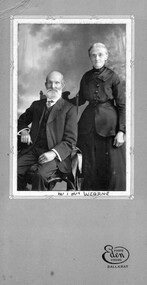
... Scotland in 1846, was a daughter of Henry McGie, a sawmiller, who pioneered the use of steam-driven timber-milling equipment in his sawmills in Victoria. John Wearne Ann Wearne nee McGie "To dear Mrs -?- (name crossed out) from J and A Wearne with best wishes". Sepia photograph of an older bearded gentleman wearing suit and tie seated with left arm resting on lap, right arm resting on chair arm, and woman wearing glasses and long two piece, long sleeved outfit standing at left of man, her right arm resting on back of chair and left arm hanging by her side. ...John Wearne migrated to Victoria from Cornwall in 1853. He was living in the Lintons/Smythesdale district by 1858, where he had mining interests. He married Ann McGie in 1865, after his first wife Selina Harris (married 1858) died in 1860. John and Ann Wearne had ten children, all born at Linton. Ann McGie, born in Scotland in 1846, was a daughter of Henry McGie, a sawmiller, who pioneered the use of steam-driven timber-milling equipment in his sawmills in Victoria.Sepia photograph of an older bearded gentleman wearing suit and tie seated with left arm resting on lap, right arm resting on chair arm, and woman wearing glasses and long two piece, long sleeved outfit standing at left of man, her right arm resting on back of chair and left arm hanging by her side."To dear Mrs -?- (name crossed out) from J and A Wearne with best wishes".john wearne, ann wearne nee mcgie -
 Warrnambool and District Historical Society Inc.
Clothing - Woman's kilt, Fletcher Jones and Staff, Warrnambool, 1980s
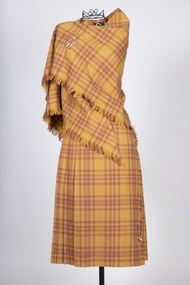
... Scottish Australian Heritage Council. He chose the colours of the Outback as the basis of his tartan. The tartan is design registered in Australia (No. 97439). (Source: District Tartans, P. Smith and G Teall, 1992). This outfit...Scottish Australian Heritage Council. He chose the colours of the Outback as the basis of his tartan. The tartan is design registered in Australia (No. 97439). (Source: District Tartans, P. Smith and G Teall, 1992). This outfit ...This is a woman's kilt (skirt, shawl and pin). Two of the objects were made by the Fletcher Jones clothing company. The Tartan is the Australian tartan which was designed by John Reid, a Melbourne architect, when he entered a competition run by the Scottish Australian Heritage Council. He chose the colours of the Outback as the basis of his tartan. The tartan is design registered in Australia (No. 97439). (Source: District Tartans, P. Smith and G Teall, 1992). This outfit was possibly made around 1990. David Fletcher Jones who served in World War One had a itinerant drapery business in the Western District before opening a tailoring business in Warrnambool in 1924.He began to specialise in men's clothing and in 1946 opened a shop in Melbourne. In 1948 he opened a clothing factory in Warrnambool and formed a new company Fletcher Jones and Staff. The company expanded to all states of Australia and included the manufacture of both men's and women's clothing making it one of the best known clothing companies in Australia. The company dissolved in 2011 This is a fine example of a Fletcher Jones clothing product and comes from a firm which was a dominant industry in Warrnambool and known Australia wide. It has further cultural significance being in The Australian Tartan..1 An orange/tan checked woollen kilt with a pleated skirt and straight panel at the front with a side fringe and a metal buckle It has an adjustable waist with buttons and metal clips. .2 A triangular shaped shawl in the same material as .1 .3 A metal pin or brooch in the shape of a sword and a circular piece with a swan image and a motto ENDURE FORT..1 Fletcher Jones AUSTRALIA'S FINEST CLOTHING PURE NEW WOOL .2 FLETCHER JONES AUTRALIA'S FINEST CLOTHING MADE IN AUSTRALIA .3 ENDURE FORT fletcher jones clothing company, warrnambool industries, australian tartan, tartan, australian tartan kilt, fletcher jones kilt, fletcher jones
