
Showing 9 items matching "sea chest"
-
 Benalla Migrant Camp Inc.
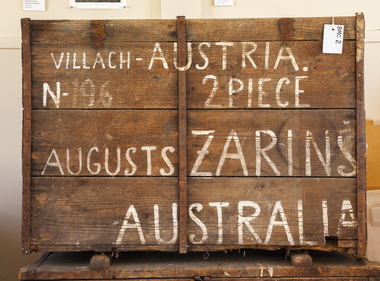
Functional object - Wooden Sea Chest, Zarins Sea Chest, 1940-50s
... Wooden Sea Chest...Zarins Sea Chest......sea chest...Sea chests held all the worldy belongings of migrant families, when they migrated by ship. ...Sea chests held all the worldy belongings of migrant families, when they migrated by ship. ...Sea chests held all the worldy belongings of migrant families, when they migrated by ship. Families were eligible for up to two chests depending on the size of the family. From the markings, it appears that there was a second chest, but this is the only chest from this family in our collection. This chest would have been purchased or built by the Zarins family and loaded at the harbour from which the migrant ship left - in this instance that location is unknown. A basic online search reveals that Villach-Austria refers to the DP camp (displaced persons' camp) that the Zarins family originated from. Maybe the chest had been picked up from there, or there were a group of camp residents coming to Australia, we can only guess why this is written on the chest at all. Heavy wooden chest with metal handles on both sides and lid is missing. Metal bands with nails fixed to front and back and sides.Villach-Austria, N-196, 2 piece, AUGUSTS ZARINS, Australia (painted on side of chest in white paint, by hand)wood, wooden, chest, sea chest, zarins -
 Whitehorse Historical Society Inc.
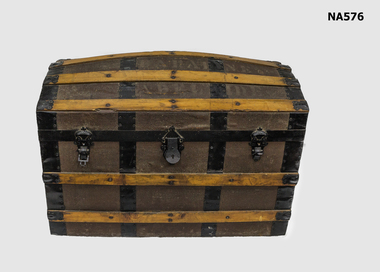
Functional object - Sea Chest
... Sea Chest...Sea chest - raised curved lid, wooden slats 7cm apart. ...Functional object Sea Chest ...Used by Mrs Duncan's Grandfather when he was a carpenter on the Clipper Ships that sailed between England and Australia in the 1870sSea chest - raised curved lid, wooden slats 7cm apart. Metal struts across lid and down sides. One metal lock, 2 catch locks. Handle each end.personal effects, travel goods -
 Port Melbourne Historical & Preservation Society
Photograph - PMHPS visit to Polly Woodside Maritime Museum, Ann Smallpage, 24 Mar 2003
... This image shows view of wooden sea chest ...This image shows view of wooden sea chest Photograph PMHPS visit to Polly Woodside Maritime Museum Ann Smallpage ...Group of 33 colour photographs taken at the Polly Woodside Maritime Museum on the occasion of an official visit by the PMH&PS which took place in lieu of the March 2003 meeting of the Society.. This image shows view of wooden sea chest polly woodside, transport - shipping, pmhps, port melbourne historical & preservation society, arts and entertainment - heritage tours -
Port Melbourne Historical & Preservation Society
Photograph - PMHPS visit to Polly Woodside Maritime Museum, Ann Smallpage, 24 Mar 2003
... This image shows view of wooden sea chest ...This image shows view of wooden sea chest Photograph PMHPS visit to Polly Woodside Maritime Museum Ann Smallpage ...Group of 33 colour photographs taken at the Polly Woodside Maritime Museum on the occasion of an official visit by the PMH&PS which took place in lieu of the March 2003 meeting of the Society.. This image shows view of wooden sea chest polly woodside, transport - shipping, pmhps, port melbourne historical & preservation society, arts and entertainment - heritage tours -
 Bendigo Military Museum
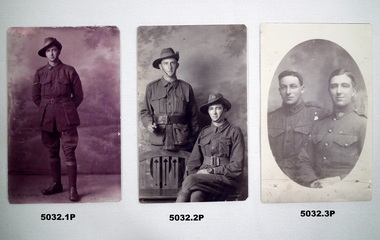
Photograph - PHOTOGRAPHS 38th BN, Post 1920
... .1) William Edgar Stanbury No 997 enlisted on 26.2.1916 age 21 years in C Coy 38th Bn AIF, embarked for England 20.6.1916, hospital at sea with Measles, embarked for France 22.11.1916, WIA GSW to hand 8.6.1917, rejoin unit 5.8.1917, awarded “MM” 4.10.1917, made L/Cpl 8.11.1917, WIA 2nd occasion 31.8 1918 wounds to leg & chest, embark for Australia 25.1.1919, discharged from the AIF 30.4.1919. ....1) William Edgar Stanbury No 997 enlisted on 26.2.1916 age 21 years in C Coy 38th Bn AIF, embarked for England 20.6.1916, hospital at sea with Measles, embarked for France 22.11.1916, WIA GSW to hand 8.6.1917, rejoin unit 5.8.1917, awarded “MM” 4.10.1917, made L/Cpl 8.11.1917, WIA 2nd occasion 31.8 1918 wounds to leg & chest, embark for Australia 25.1.1919, discharged from the AIF 30.4.1919. ....1) William Edgar Stanbury No 997 enlisted on 26.2.1916 age 21 years in C Coy 38th Bn AIF, embarked for England 20.6.1916, hospital at sea with Measles, embarked for France 22.11.1916, WIA GSW to hand 8.6.1917, rejoin unit 5.8.1917, awarded “MM” 4.10.1917, made L/Cpl 8.11.1917, WIA 2nd occasion 31.8 1918 wounds to leg & chest, embark for Australia 25.1.1919, discharged from the AIF 30.4.1919. “MM” Military Medal East of Ypres. Being held up by 2 enemy machine gunners and on his own initiative worked forward sniping the gunners enabling others to advance and capture the garrison of 2 Officers and 20 OR’s. Throughout the day exhibited great coolness and disregard of self and by his skilful sniping enabled his Platoon to advance against other enemy strongpoints. .2) Stanbury seated, Leslie W Clark standing (Possibly 2087 Leslie William Clark) .3) Stanbury right Photos B & W, soldiers in uniform, studio background. .1) Edgar Stanbury standing, L/Cpl stripe on arm, “MM” ribbon on jacket. .2) Leslie Clark standing, Edgar Stanbury sitting. .3) Unknown on the left, Edgar Stanbury on the right, “MM” ribbon on jacket.photographs, 38th bn, “mm”, c coy -
 Bendigo Military Museum
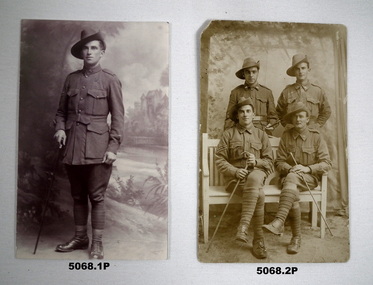
Photograph - PHOTOGRAPHS 38th BN, 1) post 2008, .2) 1916
... Enlisted 16.2.1916 in C Coy 38th Bn age 18 years 5 months, embark for England 20.6.1916, hospital at sea with Tonsilitis, embark for France 22.11.1916, hospital 23.11.16 with Mumps, rejoin unit 4.1.1917, WIA 7/9.6.1917 GSW Chest, rejoin unit 27.10.1917, made L/Cpl 17.8.1918, WIA 2nd occasion 24.8.1918 GSW Right Thigh, RTA 2.3.1919, discharged from the AIF 3.8.1919....Enlisted 16.2.1916 in C Coy 38th Bn age 18 years 5 months, embark for England 20.6.1916, hospital at sea with Tonsilitis, embark for France 22.11.1916, hospital 23.11.16 with Mumps, rejoin unit 4.1.1917, WIA 7/9.6.1917 GSW Chest, rejoin unit 27.10.1917, made L/Cpl 17.8.1918, WIA 2nd occasion 24.8.1918 GSW Right Thigh, RTA 2.3.1919, discharged from the AIF 3.8.1919. ....1) Norman Victor Harbourd No 908. Norman had pre war service. Enlisted 16.2.1916 in C Coy 38th Bn age 21 years, embarked for England 20.6.1916, hospital with Chill at sea, hospital 24.8.1916 with Measles then Influenza, embark for France 22.11.1916, made Cpl 14.12.1916, hospital 27.1.1917 with Gastro Enteritis, rejoin unit 4.2.1917, WIA 25.2.1917 GSW Face & Right Thigh, medically downgraded, RTA with Defective Vision, discharged from the AIF 9.2.1919 Medically unfit. .2) Sitting on left is Norman, rear right is Lachlan Wells Harbourd, the others unknown at this point. Lachlan Wells Harbourd No 909. Lachlan had pre War service. Enlisted 16.2.1916 in C Coy 38th Bn age 18 years 5 months, embark for England 20.6.1916, hospital at sea with Tonsilitis, embark for France 22.11.1916, hospital 23.11.16 with Mumps, rejoin unit 4.1.1917, WIA 7/9.6.1917 GSW Chest, rejoin unit 27.10.1917, made L/Cpl 17.8.1918, WIA 2nd occasion 24.8.1918 GSW Right Thigh, RTA 2.3.1919, discharged from the AIF 3.8.1919.Photos,1 sepia, 1 B & W, soldiers in uniform in studio background. .1) Soldier standing with Cpl stripes on arm holding a crop. .2) Four soldiers, two standing 2 sitting one with Cpl stripes, both sitting have crops..2) on rear, “With best love from your loving Bro’s Norman, Lachlan”photographs, 38th bn, c coy -
 Bendigo Military Museum
Photograph - PHOTOGRAPH 38th BN, C. 1999
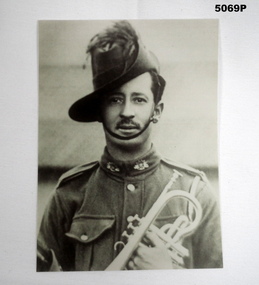
... Enlisted in the AIF 15.3.1916 No 14 in HQ 38th BN age 33 years 3 months, he was a Stretcher Bearer/Bandsman, embark for England 20.6.1916, hospital at sea with Influenza, embark for France 22.11.1916, WIA 8.6.1917 Gas poisoning eyes, throat, chest, hospital 20.6.1918 with Influenza, medically down graded, RTA 11.12.1918 with Defective Vision, discharged from the AIF 30.3.1919 medically unfit....Enlisted in the AIF 15.3.1916 No 14 in HQ 38th BN age 33 years 3 months, he was a Stretcher Bearer/Bandsman, embark for England 20.6.1916, hospital at sea with Influenza, embark for France 22.11.1916, WIA 8.6.1917 Gas poisoning eyes, throat, chest, hospital 20.6.1918 with Influenza, medically down graded, RTA 11.12.1918 with Defective Vision, discharged from the AIF 30.3.1919 medically unfit. ...Edward Thomas Code. Edward had 8 years pre war service in the 8th Bn and 18 months in the Naval Reserve. Enlisted in the AIF 15.3.1916 No 14 in HQ 38th BN age 33 years 3 months, he was a Stretcher Bearer/Bandsman, embark for England 20.6.1916, hospital at sea with Influenza, embark for France 22.11.1916, WIA 8.6.1917 Gas poisoning eyes, throat, chest, hospital 20.6.1918 with Influenza, medically down graded, RTA 11.12.1918 with Defective Vision, discharged from the AIF 30.3.1919 medically unfit.Photo B & W rectangular shape, soldier in uniform holding a musical instrument and feathers in slouch hat, studio back ground.photographs, 38th bn, -
 Bendigo Military Museum
Uniform - COAT, RAAF, 1943
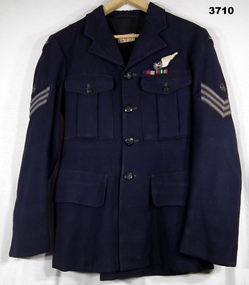
... sea with No 2 Sqd RAAF on 21.12.1944. He embarked for Balikpapan on 12.6.1945 with 2 Sqd Mitchell Bombers. He flew 19 Operational sorties which included 5 strikes and attacks. He was discharged on 22.1.1946 with the rank of WO11. Uniiform RAAF WW2 RAAF Staff Sgt, service jacket, blue. Chest ...Uniform issued to Arthur Thomas MANLY No 431130 RAAF. Arthur enlisted on 21.5.1943 age 18 years. He trained at various places, some including Narrandera, East and West Sale and Rathmines. On 8.6.1944 he was posted as an Air Gunner and on 8.12.1944 he reached the rank of Flt Sgt. He flew his first Operational flight at sea with No 2 Sqd RAAF on 21.12.1944. He embarked for Balikpapan on 12.6.1945 with 2 Sqd Mitchell Bombers. He flew 19 Operational sorties which included 5 strikes and attacks. He was discharged on 22.1.1946 with the rank of WO11.RAAF Staff Sgt, service jacket, blue. Chest (L) has 2 x WWII ribbons & Air Gunner's Badge buttons are darkened brass. Light blue cloth eagles sewn on each shoulder. It has 4 pockets & the waist belt is stored on rear of jacket in loops. Trousers not included.uniiform, raaf, ww2 -
 Friends of Westgarthtown
Functional object - Trunk/ Koffer, c. 1840s
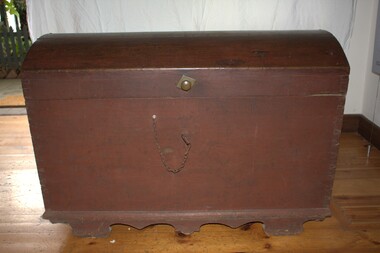
... This German-made sea chest, dating from the late 1840s, holds exceptional historical, cultural, and interpretive significance as an original migration object belonging to Christian and Sophia Ziebell during their maiden voyage to Australia. ...The chest was constructed to allowable dimensions for storage in the ship's hold. The sturdy watertight construction afforded protection for the chests contents. It can be imagined that these would be household utensils, items of clothing and the most treasured ornaments as space permitted. It is likely that the contents included some building tools and as well, implements which Christian Ziebell used in his trade as a butcher in Bruel, thereby enabling him to undertake profitable work on his arrival in Australia.This object is of primary significance. The Koffer was constructed to allowable dimensions for storage in the ship’s hold. The sturdy watertight construction afforded protection for the Koffer’s contents on the voyage aboard the Privislaw from Hamburg, Germany to Hobsons Bay, Australia in 1850. The Koffer held the precious necessities for life for Christian Ziebell's family at their new destination. It is likely that the contents included some building tools as well, implements that Christian used in his trade as a butcher in Bruel, thereby enabling him to undertake profitable work on arrival in Australia. The wooden Koffer was airtight, so if lost overboard it would be retrievable. Some were fixed to the ship’s deck. After they settled at Westgarthtown the Koffer continued to contain the precious documents through each generation. Only the current owners saw the contents in each generation, and the children always regarded it as a “treasure chest”, which was always locked and out of bounds for them. This German-made sea chest, dating from the late 1840s, holds exceptional historical, cultural, and interpretive significance as an original migration object belonging to Christian and Sophia Ziebell during their maiden voyage to Australia. Serving as the family’s personal storage trunk aboard the Pribislaw in 1849, the chest would have functioned as a container for clothing, tools, and essential belongings. Later it served as storage for family archives and Lutheran church committee papers. Constructed in the robust mid-19th-century German style, the chest likely features oak timbers, dovetail joinery, and iron fittings typical of sea-going koffers of the period. Its painted decoration, including the name “C. Ziebell” in large black charcoal script, provides strong, direct provenance and reflects both ownership and pride in family identity. Such personalised embellishment was common among German migrants who decorated their chests during periods of spare time aboard the ship. As one of the rare surviving objects directly associated with the Ziebell family’s migration story, this chest embodies themes of aspiration, hardship, cultural continuity, and settlement. It is a tangible link between the family’s Mecklenburg origins and their new life at Westgarthtown, offering powerful interpretive value for understanding early German-Wendish migration and daily life at sea. Built to specifications for sea voyaging it is also a reminder of the planning required prior to considered migration. Its survival enriches the museum’s capacity to convey the lived experience of Christian and Sophia Ziebell and the foundational story of the community they helped to establish. Large wooden trunk/koffer. Base is rectangular, and lid is rectancular to fit the base but curves between the front and back. Morticed corners; protruding base with beveled edge. Supported by profiled runners with four built-in feet. Handle for carrying on each end, and locking mechanism on front.'C. Ziebell' written in large font on back of chestpersonal effects, travel goods, pribislaw, johann christian ziebell, german migration, luggage
