
Showing 14 items matching "seaman's certificate of discharge"
-
 Flagstaff Hill Maritime Museum and Village
Certificate - Certificate of Discharge, 1845 - 1852
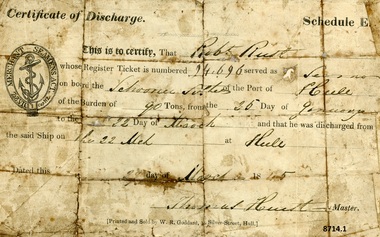
... ...Seaman's Certificate of Discharge...He became a merchant seaman and all of his "Certificates of Discharge" (except the first one) show him working out of the London docks. ...This is a set of twelve "Certificates of Discharge", two handwritten character descriptions and two "Certificates of Character" issued to Able Seaman Bob Rust primarily between the years 1845 and 1852. ...Certificate of Discharge. Schedule E, 7 & 8 Victoria, c.112. This is to certify, that Robert Rust/ whose Register Ticket is numbered 24696 served as Able Seaman/ on Board the Caleb Angus of the Port of London / of the Burden of 303 Tons, from the 14th day of July to the 30th / day of Nov 1845 and that he was discharged from the said ship on 30th /Nov 1845 at West India Docks London Dated this 3 day of December 1845" Mr Whittle MASTER. ...He became a merchant seaman and all of his "Certificates of Discharge" (except the first one) show him working out of the London docks. ...Bob Rust was born in Poplar, London in 1823. He became a merchant seaman and all of his "Certificates of Discharge" (except the first one) show him working out of the London docks. The certificates document his career as an "Able Seaman" between the years 1845 to 1852. He worked on the following ships - Jan 25th - March 22nd, 1845 - schooner "Sisters" out of Hull. 14th July - 30th Nov 1845 - "Caleb Angus" - Port of London to West India Dock, London. 12th Dec 1845 - 14th June 1846 - "Caleb Angus" - Port of London to West India Dock, London. April - 16th Oct 1847 - barque "James Turcan" - discharged at Antwerp. It was noted by Mr Mills (Master) "his conduct was to my entire satisfaction. He is a sober, steady man" 25th Oct - 18th Dec 1847 - Brig "Eclipse" - Port of London. Dec 1847 - Nov 1848 - "Cecrops" - London to Cardiff to Cuba and discharged at West India Dock, London. 2nd Dec 1848 - 9th Feb 1850 (15 months) - "Enterprise" - discharged London. Nb - this was not the "Enterprise" used by John Pascoe Fawkner to enter the Yarra in 1835 or the "Enterprise" that sank in Lady Bay, Warrnambool in 1850 and it was not the "Enterprise" belonging to the British Navy which was used to search for Sir John Franklin's lost expedition and later made two Arctic voyages. It is not noted where Bob Rust sailed to on this voyage, but his Master noted on his certificate that "the bearer is an excellent seaman and a good sail maker". 3rd April - 20th Oct 1850 - brig "Thames" - London to London via Trieste. 30th Oct 1850 - 10th May 1851 - "Elizabeth". 9th June - 10th Nov 1851 - "Lady Rowena" - to Alexandria. 23rd Nov 1851 - 17th May 1852 - "Thames" - Mediterranean voyage to Trieste. Bob Rust was an early settler in Warrnambool. He came to Warrnambool, Australia sometime between May 1852 and 1856 where he was recorded in the Electoral Roll, as a labourer, living in Henna Street. According to family history, he "jumped ship" at Port Fairy (then Belfast) as there are no records of him officially arriving in Australia. His picture and details are recorded in "The Pioneers' Register, Warrnambool Township and Shire 1839-1900 Volume Two". He married Sarah Ann Twaits in 1865 and they had seven children. His wife died in 1876 following the birth of their last child. He doesn't appear to have ever worked as a seafarer once he arrived in Warrnambool but is only recorded as working as a labourer and chimney sweep and (in the 1880's) operating as a "General Storekeeper" and "Produce Merchant" (frequently advertising in the Warrnambool Standard for items such as potatoes, oats and dairy produce from his Henna Street premises). He continued to live in Henna Street until his death on 15th January 1906 aged 82 years. English maritime discharge certificates evolved from simple proof of release in the 1700's to become official service records in the mid 1800's. They were issued at the end of a voyage to confirm a sailor had been released from duty and paid. The Merchant Shipping Act of 1835 introduced the formal registration of British seamen, to allow the Government (Board of Trade) to identify individual seamen for the Royal Naval Reserve. Seafarers who registered were issued with tickets which contained some personal details including name, date and place of birth. As the registration system evolved over time, each merchant seafarer was allocated a unique number which would be retained during their time of service at sea. Bob Rust's number was 27914. It also documented the name of the ship (for each voyage), its tonnage, master and date and place of discharge. Early certificates had separate notes re the seaman's conduct or character but after the early 1850's, these became part of the discharge certificate. This collection of "Certificates of Discharge" include those from the late 1840's (which were smaller in size), several handwritten character references as well as some examples of the newer forms of the early 1850's.Theses certificates are significant examples of the legal paperwork generated by the British government in the day-to-day regulation of working seamen in the late 19th century. They are also significant as they document the career of a working seaman at that time.This is a set of twelve "Certificates of Discharge", two handwritten character descriptions and two "Certificates of Character" issued to Able Seaman Bob Rust primarily between the years 1845 and 1852. They have been issued by the Masters of the ships Bob Rust had sailed on, at the completion of each voyage. They differ slightly in size and layout but most follow a similar format in documenting the name of the seaman (Bob Rust), his ticket number (24696), the name of the ship and its tonnage, the port of departure and discharge (e.g. West India Docks London) and the date of the voyage. Some later certificates also describe the destination of the voyage (e.g. Mediterranean). Two of the documents are handwritten notes by the master of the ship certifying as to the conduct of the seaman and two later documents (from 1851 and 1852) are "Certificates of Character" - completed and signed by the Master on the termination of the voyage. Example of Certificate from 1845 - 1850 - "Certificate of Discharge. Schedule E, 7 & 8 Victoria, c.112. This is to certify, that Robert Rust/ whose Register Ticket is numbered 24696 served as Able Seaman/ on Board the Caleb Angus of the Port of London / of the Burden of 303 Tons, from the 14th day of July to the 30th / day of Nov 1845 and that he was discharged from the said ship on 30th /Nov 1845 at West India Docks London Dated this 3 day of December 1845" Mr Whittle MASTER. Example of handwritten character note - "This is to certify that the/ bearer Robert Rust sailor in the barque/ James Turcan, under my command as able / seaman six months during which time / his conduct was to my entire satisfaction / he is a sober steady man. W B. Mills Antwerp 20th October 1847"flagstaff hill maritime museum and village, shipwreck coast, warrnambool, certificate of discharge, certificate of character, robert rust, bob rust, seaman's certificate of discharge, sisters, caleb angus, james turcan, eclipse, cecrops, enterprise, brig thames, elizabeth, lady rowena, warrnambool pioneer, sarah ann twaits -
 Flagstaff Hill Maritime Museum and Village
Equipment - Ship's Wheel, 1922
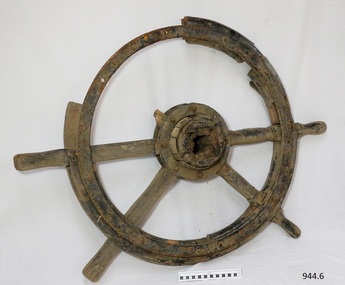
... In 1940, Able Seaman Allan H Lucas served on the Reginald M between September and December, being engaged and discharged from Port Adelaide. The ship’s Master, W S Murch, signed his Certificate of Discharge. ...In 1940, Able Seaman Allan H Lucas served on the Reginald M between September and December, being engaged and discharged from Port Adelaide. The ship’s Master, W S Murch, signed his Certificate of Discharge. ...This ship's wheel was hand-made from wood and metal using a recycled cart wheel. It originally belonged to the "Reginald M", a coastal trading ketch. ‘REGINALD M’ 1922 to 1975- The vessel “Reginald M” was a two-masted coastal ketch, owned and built by Mr Jack (John) Murch of Birkenhead, Port of Adelaide, South Australia. Its construction took approximately 6 months, and it launched at Largs Bay in 1922. The Reginald M’s purpose was to serve the coastal trade of South Australia, to carry cargo cheaply and efficiently. Some have said that the keel was, in fact, hewn from two telegraph poles! Its builder frequented all the salvage yards for materials and fittings. Reginald M had a very shallow draft and a flat bottom that enabled it to come close to shore and to sit high and dry at low tide or to be beached on sand. The flat bottom was also to make the ship able to skim over reefs. Wagons could load and unload direct from their sides. Its cargo included Guano, Barley, Wool, Horses, Cattle, Timber, Explosives, Potatoes, Shell Gritt and Gypsum. On April 9th 1931Reginald M weathered a large storm in St Vincent Gulf, SA. The vessel suffered great damage; the mast snapped, and the crew laboured for four hours to free it by chopping off the mast and rigging. The crew patched it up and slowly returned to Port Adelaide with only a portion of the insured cargo being damaged. The crew members at the time were owner Mr John H Murch of Wells Street, Largs Bay; Skipper Mr R Murch, John’s brother; Murray, son of Captain Murch; and Seaman John Smith. Reg Webb purchased Carribie Station, at Marion in the Warooka District, south of Adelaide, in 1921. He cleared the land and farmed sheep and grain. In 1923, he shipped his own wool and grain from Marion Bay, having first carted 300 bags of the barley grain, 12 bags at a time, along the unmade track to the jetty. A photograph donated to Flagstaff Hill, dating about 1929 - 1942, shows two men on the Reginald M, holding between them their fishing catch of a large hammer shark. The photograph is stamped “GRENFELL STUDIO PORT LINCOLN PRINT” and titled “hammer shark caught on Reginald Emm”. The donor’s family lived on the Your Peninsula and dispatched their grain from a chute at Gleeson’s Landing to the awaiting transport vessel. Reg knew the Murch Brothers from Port Adelaide. The brothers had been using their ketch, Reginald M, to ship Guano from the Islands, led by Captain Richard Murch. Reg approached them in 1934 about shipping grain from Marion Bay. The brothers visited the bay and thought it was an ideal place. They showed Reg where to stack his grain, and they measured up the cliffs. When Reg was ready, they brought down and installed a ninety-foot wooden chute. The bags of grain were individually pushed down the chute, landing in a waiting small boat, then rowed to Reginald M with 14 bags at a time. After 10 hours, Reginald M would have a load of 1300 bags of grain to ship to waiting ports. At one time, a wild storm destroyed the chute, so they built a stronger replacement chute. Reginald M engaged in the shipping of grain from there until 1938. In 1940, Able Seaman Allan H Lucas served on the Reginald M between September and December, being engaged and discharged from Port Adelaide. The ship’s Master, W S Murch, signed his Certificate of Discharge. It seems that at the Reginald M was used, at one time, as a Customs vessel, as one photograph in Flagstaff Hill’s collection shows “H.M.C. No. 3, Pt Adelaide” on the bow. In 1969, the last freight left Marion Bay on the ketch Reginald M carrying grain, wool, and explosives. In late 1970, the Mt. Lyell Mining and Railway Company bought the vessel to use as a barge to carry explosives. In 1972, the Navy League of Strahan, Tasmania, purchased it for use by the Strahan Sea Cadet Unit to use at Macquarie Harbour and renamed it T.S. Macquarie. However, this plan for the use of Reginald M did not happen. In 1974, Mr Andrew Rennie, of East Brighton, Melbourne, bought it for a similar purpose, paying $5,000 and donating a ‘Cadet of the Year’ trophy to the Sea Cadets. He sailed it from Strahan to Melbourne, planning to use it for pleasure sailing. Also, in 1975, Reginald M was bought by the Melbourne Ferry Company at auction. Later in 1975, Flagstaff Hill Maritime Museum bought the Reginald M for $20,000. It became a popular exhibit in the Village’s lake. In 2006, using funds from a $4,000 government grant, the restoration of the vessel continued. Flagstaff Hill Maritime Village’s Collection holds other artefacts associated with Reginald M. They include - Photographs of the Reginald M, including one photograph of it in Outer Harbour, S.A., dated 1947, with Skipper- R.F. Dale and Owner- John Murch. Another shows it docked at Port Adelaide, with the lettering H.M.C. No. 3 Pt ADEL (standing for His /Her Majesty’s Customs). There is a black and white photo of it at a wharf and another showing a person on board. - a lifebuoy, made of cork, with the inscription of “Pt Adelaide” on it. - Helm section, removed and replaced during restoration. - a bullet found in pieces of timber when Reginald M was restored in 1979 Reginald M was a much-loved exhibit at the Maritime Village, where many visitors enjoyed boarding and exploring a real ship with a long history. Sadly, the Reginald M was decommissioned in late 2016, due to the continuing prohibitive cost of maintenance and the risk to public safety. Components from the Reginald M are held in Flagstaff Hill's collection as a reminder of the Reginald M’s history. This ship's wheel is significant because of its association with the REGINALD M. REGNIALD M was a coastal trading ketch from South Australia built in 1922. It is one of very few sailing coastal trading vessels still extant, and its flat bottom, single chine shape illustrates a very simple but robust method of construction, compared to other round bilged examples of trading vessels. She is now listed on the Australian Register of Historic Vessels (ARHV Number: HV000562.)Ship’s wheel, also called a Helm, eight spoke design. Centre of wheel is handmade of wood and has iron rings around each side. The spokes are fitted into this wooden hub. The outer wheel has an iron ring on one side and sections of a wooden ring on the other. There are both original and modern bolt and screw fastenings. The wheel has remnants of black paint. This ship’s wheel was originally fitted to the ketch REGINALD M and removed during its restoration. flagstaff hill, warrnambool, shipwrecked-coast, flagstaff-hill, flagstaff-hill-maritime-museum, maritime-museum, shipwreck-coast, flagstaff-hill-maritime-village, ship's wheel, hand made ship's wheel, coastal trader, reginald m, ketch, john murch, ch murch, reg webb, carribie station, mt lyell copper company, queenstown navy league, andrew rennie, melbourne ferry company, r.f. dale -
 Flagstaff Hill Maritime Museum and Village
Certificate - Certificates of Discharge, Commonwealth Governments Shipping Offices, 1895 - 1919
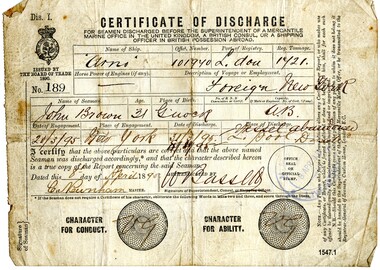
... Under the Merchant Shipping Act 1854 each seaman discharged was also to be issued with a certificate of discharge (this series) giving particulars of the ship, period of service and the seamans capacity, ability and conduct. ...This is a set of twenty three "Certificates of Discharge" issued to seaman John F. Brown primarily between the years 1895 and 1908 (although the last one is dated 1919). ..."CERTIFICATE OF DISCHARGE" "FOR SEAMEN DISCHARGED BEFORE THE SUPERINTENDENT OF A MERCANTILE / MARINE OFFICE IN THE UNITED KINGDOM, A BRITISH CONSUL, OR A SHIPPING/OFFICER IN BRITISH POSSESSION ABROAD" Headings filled out include - "Name of Ship", "Official number", "Reg. Tonnage", "Horse power of Engine (if any)", "Description of Voyage or Employment", "Name of Seaman...Under the Merchant Shipping Act 1854 each seaman discharged was also to be issued with a certificate of discharge (this series) giving particulars of the ship, period of service and the seamans capacity, ability and conduct. ...The following information is taken from the PROV (Public Records Office of Victoria) website - "In Victoria regulation of the engagement and discharge of seamen was initially subject to New South Wales legislation. An Act to amend and consolidate the Laws relating to Seamen in the Merchant Service of the Colony of New South Wales, and for keeping a Register of Seamen belonging to Ships registered in the said Colony (13 Vic., No.28) of 1849 introduced requirements for ships masters to enter into written agreements with seamen engaged by them as crew, specifying wages and provisions, the capacity in which they would serve and the nature of the voyage. It also required masters to issue to seamen certificates of discharge upon their discharge or upon payment of their wages. The 1849 Act applied only to ships registered in the Colony. In 1854 the Imperial Merchant Shipping Act was passed, which had application to all British ships except those registered in the Colony. Consolidation of the separate laws occured with the passing of the Seamen Statute 1865 (28 Vic.,No.245) which adopted Part III of the Merchant Shipping Act 1854 (17 & 18 Vic, C 104) (see Parliamentary Debates, Session 1, 22 February 1865). The Imperial Act, like the New South Wales Act before it, required the master or owner of every British ship, over a certain tonnage, to enter a written agreement for the engagement and discharge of seamen. The Articles of Agreement (VPRS 566) were to be made at the start of a particular voyage, although running agreements were able to be made for a defined period in which short and frequent voyages would be made. At the end of the voyage the discharge and release of the crew was recorded. The date, place and reason for leaving the ship, and the balance of wages paid upon discharge, were recorded in the articles of agreement. Under the Merchant Shipping Act 1854 each seaman discharged was also to be issued with a certificate of discharge (this series) giving particulars of the ship, period of service and the seamans capacity, ability and conduct. No seaman could be engaged to work on a ship unless he delivered to the person engaging him a discharge from his last ship or a permit to sign articles. In the articles of agreement and in the Release Books (VPRS 945) the crew were required to sign their release of the ship, master or owner from any claims to wages or otherwise in respect of the voyage. In the release books the master also signed a release of the crew from all claims. It appears that in Victoria licensed shipping agents were initially able to facilitate the engagement and discharge of seamen. From 1 April 1859, however, the function was to be performed entirely in the Government Shipping Office (Government Gazette, 29 March 1859). In 1869, the names of Shipping Offices were changed to Mercantile Marine Offices and Shipping Masters to Superintendents of Mercantile Marine Offices. The role of the Shipping Office/Mercantile Marine Office was to facilitate and oversee the engagement and discharge of seamen and apprentices to the sea service. The facilities provided were subject to fees payable by ships masters. The Offices were located within the Department of Trade and Customs (VA 606) until 1901 and then within the Chief Secretarys Department (VA 475) to 1922. Responsibility for attesting master and seamen engagements and discharges transferred to the Commonwealth under Parts II and III of the Commonwealth Navigation Act 1912, which became effective on 1 March 1922 when the Navigation (Master and Seamen) Regulations were passed. Seamens Discharge Certificates 1882 to 1922 This series comprises counterfoils (or stubs) of Certificates of Discharge issued to seamen upon their discharge or upon payment of their wages between 1882 and 1922. The Certificates were signed by the Master of the ship and authorised by the Mercantile Marine Office. The counterfoils record details about the ships, the birthplaces and ages of the seamen, the dates of engagement and discharge, and the capacity, conduct and ability of the seamen." This particular set of Certificates of Discharge belonged to a seaman called John F. Brown. Little is known about him but information taken from the cerificates tell us that John F. Brown was born in Greenock, Scotland in about 1868 and that his rank was "Able Bodied Seaman". All of his cerificates describe his conduct and ability as "V. G. (Very Good). During the period from April 1895 to August 1908, he worked on about twenty two different ships - sailing on several Liverpool to New York voyages in 1895 and 1896. In September 1896 he began working on Australian coastal steamers - travelling up and down the coast of Australia (between the ports of Melbourne, Sydney, Newcastle, Adelaide and Brisbane) until August 1908. There is an eleven year gap in his records and his final certificate was issued in September 1919. Some of the ships he worked on include the "Arno", "Melbourne", "Burrumbeet", "Kalgoorlie", "New Guinea", "Buninyong", "Pilbarra", "Oakworth", "Cintra", "Lady Musgrave", "Dawn", "Moorabool", "Colac", "Ramazon", 'Brisbane", "City of Lincoln", "Peregrine" "Mareeba" and "Wear".Theses certificates are significant examples of the legal paperwork generated by the British and Australian governments in the day to day regulation of working seamen in the late 19th and early 20th centuries. They are also significant as they document the career of a working seaman at that time.This is a set of twenty three "Certificates of Discharge" issued to seaman John F. Brown primarily between the years 1895 and 1908 (although the last one is dated 1919). They have been issued by the Shipping Masters at U.K. Mercantile Marine Office (abroad), the Port of Melbourne Victoria, the Port of Sydney N.S.W., the Port of Newcastle N.S.W. and the Port of Brisbane. They are all of a similar size and layout with slight differences in their crests (depending on the port of issue) and the fonts used over the preceding years. They give a good overview into the career of John F. Brown as they list his place and date of birth, his voyages (places of engagement and discharge and the dates of the voyages), the ships he served on (with their tonnage, horsepower, official number and place of registry) plus his ranking, conduct and ability. All certificates are signed by the Master and authenticated by the Shipping Officer. Eight of the certificates have a purple circular stamp on the back with "S. F. 19 SEPT 1908 GLASGOW""CERTIFICATE OF DISCHARGE" "FOR SEAMEN DISCHARGED BEFORE THE SUPERINTENDENT OF A MERCANTILE / MARINE OFFICE IN THE UNITED KINGDOM, A BRITISH CONSUL, OR A SHIPPING/OFFICER IN BRITISH POSSESSION ABROAD" Headings filled out include - "Name of Ship", "Official number", "Reg. Tonnage", "Horse power of Engine (if any)", "Description of Voyage or Employment", "Name of Seaman", "Age", "Place of Birth", "No. of R.N.R. Commission or Certificate", "Capacity. If mate or Engineer. No of certificate (if any)", "Date of Engagement", "Place of Engagement", Date of Discharge", "Place of Discharge", "I certify that the above particulars are correct and that the abovenamed Seaman was discharged accordingly* and that the character described herein is a true copy of the report concerning the said seaman." "Dated this .... day of ... " , "Authenticated by ...." "Character for Conduct" , "Character for Ability".flagstaff hill, warrnambool, shipwrecked-coast, flagstaff-hill, flagstaff-hill-maritime-museum, maritime-museum, shipwreck-coast, flagstaff-hill-maritime-village, certificate of discharge for j.f.brown, certificate of discharge, certificate, discharge, discharge for j.f.brown, john f. brown, arno, s.s. melbourne, s.s. burrumbeet, s.s. kalgooli, s.s. new guinea, s.s. buninyong, s.s. pilbarra, s.s. oakworth, s.s. lady musgrave, s.s. dawn, s.s. moorabool, s.s. colac, s.s. city of lincoln, s.s. mareeba, s.s. wear, s.s. ramazon, s.s. peregrine -
 Flagstaff Hill Maritime Museum and Village
Memorabilia - Bullet & Timber, Early 20th century
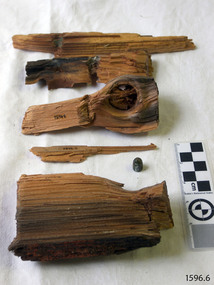
... In 1940, Able Seaman Allan H Lucas served on the Reginald M between September and December, being engaged and discharged from Port Adelaide. The ship’s Master, W S Murch, signed his Certificate of Discharge. ...In 1940, Able Seaman Allan H Lucas served on the Reginald M between September and December, being engaged and discharged from Port Adelaide. The ship’s Master, W S Murch, signed his Certificate of Discharge. ...The Reginald M was an early purchase of Flagstaff Hill Maritime Museum and Village, soon after it opened in 1975. It was restored and then used as an exhibit in the maritime Village. The reason for the bullet being within the pieces of timber is unknown. The Reginald M's history does not suggest a time when weapons were used. However, the vessel's construction included used materials from different sources; perhaps the bullet was within these materials, which later became part of the Reginald M. ‘REGINALD M’ 1922 to 1975- The vessel “Reginald M” was a two-masted coastal ketch, owned and built by Mr Jack (John) Murch of Birkenhead, Port of Adelaide, South Australia. Its construction took approximately 6 months, and it launched at Largs Bay in 1922. The Reginald M’s purpose was to serve the coastal trade of South Australia, to carry cargo cheaply and efficiently. Some have said that the keel was, in fact, hewn from two telegraph poles! Its builder frequented all the salvage yards for materials and fittings. Reginald M had a very shallow draft and a flat bottom that enabled it to come close to shore and to sit high and dry at low tide or to be beached on sand. The flat bottom was also to make the ship able to skim over reefs. Wagons could load and unload directly from their sides. Its cargo included Guano, Barley, Wool, Horses, Cattle, Timber, Explosives, Potatoes, Shell Grit, and Gypsum. On April 9th 1931, Reginald M weathered a large storm in St Vincent Gulf, SA. The vessel suffered great damage; the mast snapped, and the crew laboured for four hours to free it by chopping off the mast and rigging. The crew patched it up and slowly returned to Port Adelaide with only a portion of the insured cargo being damaged. The crew members at the time were the owner, Mr John H Murch of Wells Street, Largs Bay; Skipper Mr R Murch, John’s brother; Murray, son of Captain Murch; and Seaman John Smith. Reg Webb purchased Carribie Station, at Marion in the Warooka District, south of Adelaide, in 1921. He cleared the land and farmed sheep and grain. In 1923, he shipped his own wool and grain from Marion Bay, having first carted 300 bags of the barley grain, 12 bags at a time, along the unmade track to the jetty. A photograph donated to Flagstaff Hill, dating about 1929 - 1942, shows two men on the Reginald M, holding between them their fishing catch of a large hammer shark. The photograph is stamped “GRENFELL STUDIO PORT LINCOLN PRINT” and titled “hammer shark caught on Reginald Emm”. The donor’s family lived on the Your Peninsula and dispatched their grain from a chute at Gleeson’s Landing to the awaiting transport vessel. Reg knew the Murch Brothers from Port Adelaide. The brothers had been using their ketch, Reginald M, to ship Guano from the Islands, led by Captain Richard Murch. Reg approached them in 1934 about shipping grain from Marion Bay. The brothers visited the bay and thought it was an ideal place. They showed Reg where to stack his grain, and they measured up the cliffs. When Reg was ready, they brought down and installed a ninety-foot wooden chute. The bags of grain were individually pushed down the chute, landing in a waiting small boat, then rowed to Reginald M with 14 bags at a time. After 10 hours, Reginald M would have a load of 1300 bags of grain to ship to waiting ports. At one time, a wild storm destroyed the chute, so they built a stronger replacement chute. Reginald M engaged in the shipping of grain from there until 1938. In 1940, Able Seaman Allan H Lucas served on the Reginald M between September and December, being engaged and discharged from Port Adelaide. The ship’s Master, W S Murch, signed his Certificate of Discharge. It seems that at the Reginald M was used, at one time, as a Customs vessel, as one photograph in Flagstaff Hill’s collection shows “H.M.C. No. 3, Pt Adelaide” on the bow. In 1969, the last freight left Marion Bay on the ketch Reginald M carrying grain, wool, and explosives. In late 1970, the Mt. Lyell Mining and Railway Company bought the vessel to use as a barge to carry explosives. In 1972, the Navy League of Strahan, Tasmania, purchased it for use by the Strahan Sea Cadet Unit to use at Macquarie Harbour and renamed it T.S. Macquarie. However, this plan for the use of Reginald M did not happen. In 1974, Mr Andrew Rennie, of East Brighton, Melbourne, bought it for a similar purpose, paying $5,000 and donating a ‘Cadet of the Year’ trophy to the Sea Cadets. He sailed it from Strahan to Melbourne, planning to use it for pleasure sailing. Also, in 1975, Reginald M was bought by the Melbourne Ferry Company at auction. Later in 1975, Flagstaff Hill Maritime Museum bought the Reginald M for $20,000. It became a popular exhibit in the Village’s lake. In 2006, using funds from a $4,000 government grant, the restoration of the vessel continued. Flagstaff Hill Maritime Village’s Collection holds other artefacts associated with Reginald M. They include - Photographs of the Reginald M, including one photograph of it in Outer Harbour, S.A., dated 1947, with Skipper- R.F. Dale and Owner- John Murch. Another shows it docked at Port Adelaide, with the lettering H.M.C. No. 3 Pt ADEL (standing for His /Her Majesty’s Customs). There is a black and white photo of it at a wharf and another showing a person on board. - a lifebuoy, made of cork, with the inscription of “Pt Adelaide” on it. - Helm section, removed and replaced during restoration. - a bullet found in pieces of timber when Reginald M was restored in 1979 Reginald M was a much-loved exhibit at the Maritime Village, where many visitors enjoyed boarding and exploring a real ship with a long history. Sadly, the Reginald M was decommissioned in late 2016, due to the continuing prohibitive cost of maintenance and the risk to public safety. Components from the Reginald M are held in Flagstaff Hill's collection as a reminder of the Reginald M’s history. The timber is an example of the materials used to build the Reginald M in 1922. The ship was built from recycled items where possible. The bullet represents a time in the history of the vessel that is currently unknown.Wood from the vessel, Reginald M, and a bullet found within its timbers on June 22nd, 1979, during its restoration. flagstaff hill, flagstaff hill maritime museum and village, warrnambool, maritime museum, maritime village, great ocean road, shipwreck coast, reginald m, ketch, coastal trader, timber, wood, bullet, murch, john murch, 1922 -
 Flagstaff Hill Maritime Museum and Village
Photograph, 1945
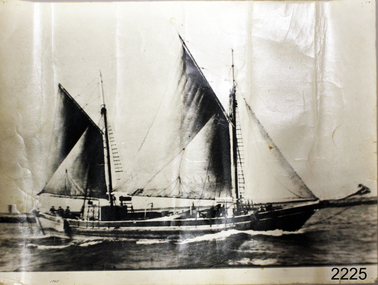
... In 1940, Able Seaman Allan H Lucas served on the Reginald M between September and December, being engaged and discharged from Port Adelaide. The ship’s Master, W S Murch, signed his Certificate of Discharge. ...In 1940, Able Seaman Allan H Lucas served on the Reginald M between September and December, being engaged and discharged from Port Adelaide. The ship’s Master, W S Murch, signed his Certificate of Discharge. ...The donor was a seamen at Port Adelaide, where this photogrpah of the ketch, Reginald M, was taken in 1945. ‘REGINALD M’ 1922 to 1975- The vessel “Reginald M” was a two-masted coastal ketch, owned and built by Mr Jack (John) Murch of Birkenhead, Port of Adelaide, South Australia. Its construction took approximately 6 months, and it launched at Largs Bay in 1922. The Reginald M’s purpose was to serve the coastal trade of South Australia, to carry cargo cheaply and efficiently. Some have said that the keel was, in fact, hewn from two telegraph poles! Its builder frequented all the salvage yards for materials and fittings. Reginald M had a very shallow draft and a flat bottom that enabled it to come close to shore and to sit high and dry at low tide or to be beached on sand. The flat bottom was also to make the ship able to skim over reefs. Wagons could load and unload directly from their sides. Its cargo included Guano, Barley, Wool, Horses, Cattle, Timber, Explosives, Potatoes, Shell Gritt, and Gypsum. On April 9th 1931, Reginald M weathered a large storm in St Vincent Gulf, SA. The vessel suffered great damage; the mast snapped, and the crew laboured for four hours to free it by chopping off the mast and rigging. The crew patched it up and slowly returned to Port Adelaide with only a portion of the insured cargo being damaged. The crew members at the time were the owner, Mr John H Murch of Wells Street, Largs Bay; Skipper Mr R Murch, John’s brother; Murray, son of Captain Murch; and Seaman John Smith. Reg Webb purchased Carribie Station, at Marion in the Warooka District, south of Adelaide, in 1921. He cleared the land and farmed sheep and grain. In 1923, he shipped his own wool and grain from Marion Bay, having first carted 300 bags of the barley grain, 12 bags at a time, along the unmade track to the jetty. A photograph donated to Flagstaff Hill, dating about 1929 - 1942, shows two men on the Reginald M, holding between them their fishing catch of a large hammer shark. The photograph is stamped “GRENFELL STUDIO PORT LINCOLN PRINT” and titled “hammer shark caught on Reginald Emm”. The donor’s family lived on the Your Peninsula and dispatched their grain from a chute at Gleeson’s Landing to the awaiting transport vessel. Reg knew the Murch Brothers from Port Adelaide. The brothers had been using their ketch, Reginald M, to ship Guano from the Islands, led by Captain Richard Murch. Reg approached them in 1934 about shipping grain from Marion Bay. The brothers visited the bay and thought it was an ideal place. They showed Reg where to stack his grain, and they measured up the cliffs. When Reg was ready, they brought down and installed a ninety-foot wooden chute. The bags of grain were individually pushed down the chute, landing in a waiting small boat, then rowed to Reginald M with 14 bags at a time. After 10 hours, Reginald M would have a load of 1300 bags of grain to ship to waiting ports. At one time, a wild storm destroyed the chute, so they built a stronger replacement chute. Reginald M engaged in the shipping of grain from there until 1938. In 1940, Able Seaman Allan H Lucas served on the Reginald M between September and December, being engaged and discharged from Port Adelaide. The ship’s Master, W S Murch, signed his Certificate of Discharge. It seems that at the Reginald M was used, at one time, as a Customs vessel, as one photograph in Flagstaff Hill’s collection shows “H.M.C. No. 3, Pt Adelaide” on the bow. In 1969, the last freight left Marion Bay on the ketch Reginald M carrying grain, wool, and explosives. In late 1970, the Mt. Lyell Mining and Railway Company bought the vessel to use as a barge to carry explosives. In 1972, the Navy League of Strahan, Tasmania, purchased it for use by the Strahan Sea Cadet Unit to use at Macquarie Harbour and renamed it T.S. Macquarie. However, this plan for the use of Reginald M did not happen. In 1974, Mr Andrew Rennie, of East Brighton, Melbourne, bought it for a similar purpose, paying $5,000 and donating a ‘Cadet of the Year’ trophy to the Sea Cadets. He sailed it from Strahan to Melbourne, planning to use it for pleasure sailing. Also, in 1975, Reginald M was bought by the Melbourne Ferry Company at auction. Later in 1975, Flagstaff Hill Maritime Museum bought the Reginald M for $20,000. It became a popular exhibit in the Village’s lake. In 2006, using funds from a $4,000 government grant, the restoration of the vessel continued. Flagstaff Hill Maritime Village’s Collection holds other artefacts associated with Reginald M. They include - Photographs of the Reginald M, including one photograph of it in Outer Harbour, S.A., dated 1947, with Skipper- R.F. Dale and Owner- John Murch. Another shows it docked at Port Adelaide, with the lettering H.M.C. No. 3 Pt ADEL (standing for His /Her Majesty’s Customs). There is a black and white photo of it at a wharf and another showing a person on board. - a lifebuoy, made of cork, with the inscription of “Pt Adelaide” on it. - Helm section, removed and replaced during restoration. - a bullet found in pieces of timber when Reginald M was restored in 1979 Reginald M was a much-loved exhibit at the Maritime Village, where many visitors enjoyed boarding and exploring a real ship with a long history. Sadly, the Reginald M was decommissioned in late 2016, due to the continuing prohibitive cost of maintenance and the risk to public safety. Components from the Reginald M are held in Flagstaff Hill's collection as a reminder of the Reginald M’s history. The photograph represents a time when the Reginald M was in use at the Port of Adelaide. It shows the configuration of the sails at that time. The vessel was active as a coastal trader from Adelaide and along the south east coast of Australia.Photograph: sepia, rectangular image of the two-masted ketch, Reginald M, in Port River, Adelaide, South Australia. A figure is on the bowsprit, and other figures are on the masts and on deck. Photographed at Port River, Adelaide.flagstaff hill, flagstaff hill maritime museum and village, warrnambool, maritime museum, maritime village, great ocean road, shipwreck coast, ships, port river sa, adelaide, reginald m, 2-masted, sailing ship, ketch, port adelaide, 1945 -
 Flagstaff Hill Maritime Museum and Village
Photograph
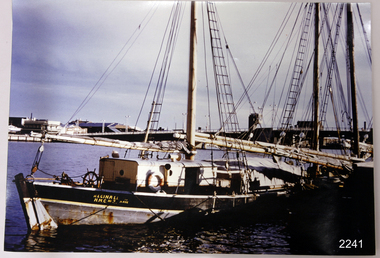
... In 1940 Able Seaman Allan H Lucas served on Reginald M between September and December, being engaged and discharged from Port of Adelaide. His Certificate...In 1940 Able Seaman Allan H Lucas served on Reginald M between September and December, being engaged and discharged from Port of Adelaide. His Certificate ...This coloured photograph of the ketch Reginald M was taken when she was docked at Port Adelaide. The side of the vessel shows the letters "REGINALD M / H.M.C. No. 2 Pt ADEL" - (abbreviation H.M.C. meaning His/Her Majesty's Customs. HISTORY The Reginald M, a two-masted coastal ketch, was owned and built by Mr. Jack (John) Murch of Birkenhead, Port of Adelaide, South Australia to serve the coastal ports of South Australia. Its construction took approximately 6 months and it was launched at Largs Bay in 1922. Its purpose was to carry cargo cheaply and efficiently, and tradition has it that the keel was in fact hewn from two telegraph poles! Its builder frequented all the salvage yards for materials and fittings. The Reginald M had a very shallow draft and a flat bottom that enabled it to sit high and dry at low tide. The flat bottom was also to make the ship able to skim over reefs. Wagons were able to load and unload direct from her side. Her cargo included Guano, Barley, Wool, Horses, Cattle, Timber, Explosives, Potatoes, Shell Grit and Gypsum. In 1931 she weathered a large storm in St Vincents Gulf, SA. Her crew at the time were Owner Mr John H Murch, Wells St, Largs Bay, Skipper, John’s brother Mr R Murch, Murray, son of Mr R Murch and Seaman John Smith Reg Webb purchased Carribie Station, at Marion in the Warooka District, south of Adelaide, in 1921. He cleared the land and farmed sheep and grain. In 1923 he shipped his own wool and grain from Marion Bay, having first carted 300 bags of the barley grain, 12 bags at a time, along the unmade track to the jetty. A photograph dating about 1929 -1942 shows 2 men on the Reginald M, having just landed their fishing catch of a hammer shark. The photograph is stamped “GRENFELL STUDIO PORT LINCLON PRINT” and titled “hammer shark caught on Reginall Emm”. Reg Webb knew the Murch Brothers from Port Adelaide. The brothers had been using their ketch REGINALD M to ship Guano from the Islands, led by Captain Richard Murch. Reg approached them in 1934 about shipping grain from Marion Bay. The brothers visited the bay and thought it was an ideal place. They showed Reg where to stack his grain and they measured up the cliffs. When Reg was ready, they brought down and installed a ninety foot wooden chute. The bags of grain were then individually sent down the chute, landing in a waiting small boat then rowed to REGINALD M, 14 bags at a time. After 10 hours REGINALD M would be fully loaded with 1300 bags of grain and shipped to waiting ports. At one time a wild storm destroyed the chute but it was rebuilt and strengthened. REGINALD M was involved in shipping the grain from there until 1938. In 1940 Able Seaman Allan H Lucas served on Reginald M between September and December, being engaged and discharged from Port of Adelaide. His Certificate of Discharge was signed by ship’s Master W S Murch. It seems that at some stage Reginald M was used as a Customs vessel because a photograph in Flagstaff Hill’s collection shows the text “H.M.C. No. 3, Pt Adelaide” on the bow, the abbreviations standing for “His/Her Majesty’s Customs”. In 1969 the last freight left Marion Bay on the ketch REGINALD M carrying grain, wool and explosives. In late 1970 she was sold to the Mt. Lyell Copper Company, based in Queenstown, Tasmania, to carry explosives. In 1972 the Navy League of Strahan, Tasmania, purchased her for use by the Strahan Sea Cadet Unit and renamed her T.S. Macquarie. In 1974 Mr. Andrew Rennie, of East Brighton, Melbourne, bought her, paying $5,000 and donating a ‘Cadet of the Year” trophy to the Sea Cadets. He sailed her from Strahan to Melbourne, planning to use her for pleasure sailing. In 1975 Reginald M was sold to Melbourne Ferry Company at auction. In 1975 the Reginald M was bought by Flagstaff Maritime Museum for $20,000. She has been restored and is now one of the exhibits, tied up at the dock. Flagstaff Hill Maritime Village’s Collection holds several other artefacts associated with Reginald M. They include - Photographs of the Reginald M, including one photograph of her in Outer Harbour, S.A. dated 1947, with Skipper- R.F. Dale and Owner- John Murch. Another shows her docked at Port Adelaide, with the lettering H.M.C. No. 3 Pt ADEL (standing for His/Her Majesty’s Customs). There is a black and white photo of her at a wharf and another showing a person on board. - a lifebuoy, with Pt Adelaide on it. - a bullet found in pieces of timber when Reginald M was restored in 1979 (References: Flagstaff Hill Fact Sheet “Reginald M”, the book “The Reg Webb Story” compiled by the Warooka & District Museum. Reg Webb’s daughter Lily Ramsay (nee Webb) and her husband Howard, Lizzie Rennie (daughter of owner Andrew Rennie), brochure “Discover the Yorke Peninsula South Australia”, Ketch in Peril; Adelaide Chronicle 9 April 1931, K Gordon & Mary Filmer of Warooka; South Australian Maritime Museum) Thiis photograph is significant because of its connection to the history of the vessel REGINALD M is a coastal trading ketch from South Australia built in 1922. It is one of very few sailing coastal trading vessels still extant, and its flat bottom, single chine shape illustrates a very simple but robust method of construction, compared to other round bilged examples of trading vessels. She is now listed on the Australian Register of Historic Vessels (ARHV Number: HV000562.)Photograph of Reginald M at Port Adelaide. The side of the vessel shows the letters "REGINALD M / H.M.C. No. 2 Pt ADEL" - (abbreviation H.M.C. meaning His/Her Majesty's Customs. Painted on the side of the vessel "REGINALD M / H.M.C. No. 2 Pt ADEL" - flagstaff hill, warrnambool, shipwrecked-coast, flagstaff-hill, flagstaff-hill-maritime-museum, maritime-museum, shipwreck-coast, flagstaff-hill-maritime-village, reginald m, coastal trading ketch, trading vessel, john murch ship builder, port adelaide vessel reginald m, andrew rennie, macquarie training vessel, mt lyell copper company, queenstown navy league, ch murch, reg webb, carribie station, melbourne ferry company, grenfell studio port lincoln, vessel reginald m -
 Mission to Seafarers Victoria
Certificate - Certificate of discharge, photocopy, Ministry of War Transport: continuous certificate of discharge: George Winfield Duncan, 1943
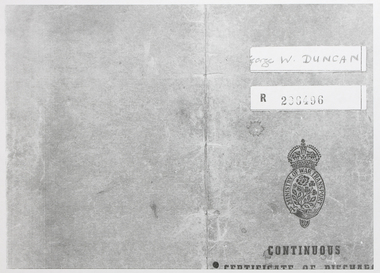
... stamped on front cover oval ribbon insignia surrounding roses and surmounted by crown with lettering : Ministry of War Transport Printed at lwr edge: Continuous / certificate of discharge. Inside left cover: seaman photo, name reg number and official stamp with date Inside right page: notes and information....The memorabilia relates to his career at sea and in particular the role of an engineer, including a handwritten manual of notes and references relating to the mechanical and engineering aspects and areas of responsibility for maintenance. war transport ww2 merchant navy merchant seamen george winfield duncan (1922-2017) g.w. duncan stamped on front cover oval ribbon insignia surrounding roses and surmounted by crown with lettering : Ministry of War Transport Printed at lwr edge: Continuous / certificate of discharge. Inside left cover: seaman photo, name reg number and official stamp with date Inside right page: notes and information. small grey blue printed single fold seaman's photo identity card with printed guidelines and conditions of association / membership. ...This card together with a log book was a vital record of service for any seaman serving on a Merchant vessel that had been commandeered for War transport work and needed to be validated to ensure eligibility to be taken on as qualified member of the crew. G.W. Duncan appears to have specialised in engine room and mechanical maintenance. He appears to have served aboard a number of vessels including merchant vessels commissioned into wartime service in WW2.Mariner Duncan had a particular regard for the Mission to Seafarers. This plate for display on a commissioned new table at the MTSV chapel acknowledges his bequest and the material donated. Collectively the G W Duncan material includes: photographs, professional data memorabilia and written and commercially printed resources. The memorabilia relates to his career at sea and in particular the role of an engineer, including a handwritten manual of notes and references relating to the mechanical and engineering aspects and areas of responsibility for maintenance. small grey blue printed single fold seaman's photo identity card with printed guidelines and conditions of association / membership.stamped on front cover oval ribbon insignia surrounding roses and surmounted by crown with lettering : Ministry of War Transport Printed at lwr edge: Continuous / certificate of discharge. Inside left cover: seaman photo, name reg number and official stamp with date Inside right page: notes and information.war transport, ww2, merchant navy, merchant seamen, george winfield duncan (1922-2017), g.w. duncan -
 Mission to Seafarers Victoria
Certificate, Certificate of Discharge
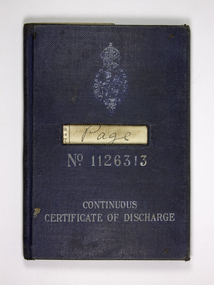
... Extremely accurate record of Charles Page's merchant navy career, travels and work performance. charles page seaman Legal document - Sturdy small hardcover booklet/log, containing a number of pages with blank spaces for ship's officers to record details regarding voyages, ships, rating and behaviour of mate. Many yellowed pages with top right corner of each page neatly removed by hand. Fold over flap on hard cover to prevent damage of inside pages. Certificate of Discharge ...Extremely accurate record of Charles Page's merchant navy career, travels and work performance.Legal document - Sturdy small hardcover booklet/log, containing a number of pages with blank spaces for ship's officers to record details regarding voyages, ships, rating and behaviour of mate. Many yellowed pages with top right corner of each page neatly removed by hand. Fold over flap on hard cover to prevent damage of inside pages. charles page, seaman -
 Flagstaff Hill Maritime Museum and Village
Domestic object - Wood Stove, circa 1880-1920
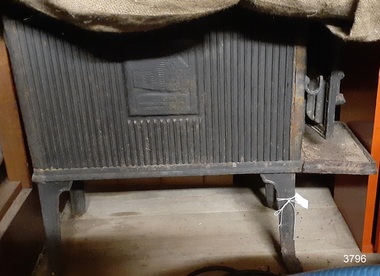
... In 1940 Able Seaman Allan H Lucas served on Reginald M between September and December, being engaged and discharged from Port of Adelaide. The ship’s Master, W S Murch, signed his Certificate of Discharge. ...In 1940 Able Seaman Allan H Lucas served on Reginald M between September and December, being engaged and discharged from Port of Adelaide. The ship’s Master, W S Murch, signed his Certificate of Discharge. ...Stoves of this design are used for heating domestic places and were available in many designs and shapes. They commonly used wood as fuel. They were used for both heating and cooking. This stove was part of the original furnishings of the 1922 vessel 'Reginald M', a South Australian coastal trader. The two-masted coastal ketch was built from material and fittings obtained from salvage yards by Mr Jack (John) Murch of Birkenhead, Port of Adelaide, South Australia. Its construction took approximately six months. It was launched at Largs Bay in 1922. ‘REGINALD M’ 1922 to 1975- The vessel “Reginald M” was a two-masted coastal ketch, owned and built by Mr. Jack (John) Murch of Birkenhead, Port of Adelaide, South Australia. Its construction took approximately 6 months, and it launched at Largs Bay in 1922. The Reginald M’s purpose was to serve the coastal trade of South Australia, to carry cargo cheaply and efficiently. Some have said that the keel was in fact hewn from two telegraph poles! Its builder frequented all the salvage yards for materials and fittings. Reginald M had a very shallow draft and a flat bottom that enabled it to come close to shore and to sit high and dry at low tide or to be beached on sand. The flat bottom was also to make the ship able to skim over reefs. Wagons could load and unload direct from its side. Her cargo included Guano, Barley, Wool, Horses, Cattle, Timber, Explosives, Potatoes, Shell Gritt and Gypsum. On April 9th 1931Reginald M weathered a large storm in St Vincent Gulf, SA. The vessel suffered great damage; mast snapped and the crew laboured for four hours to free it by chopping off the past and rigging. The crew patched iit up and slowly returned to Port Adelaide with only a portion of the insured cargo being damaged. Her crew members at the time were owner Mr John H Murch of Wells Street Largs Bay, Skipper Mr R Murch – John’s brother, Murray – son of Captain Murch and Seaman John Smith. Reg Webb purchased Carribie Station, at Marion in the Warooka District, south of Adelaide, in 1921. He cleared the land and farmed sheep and grain. In 1923 he shipped his own wool and grain from Marion Bay, having first carted 300 bags of the barley grain, 12 bags at a time, along the unmade track to the jetty. A photograph donated to Flagstaff Hill, dating about 1929 - 1942, shows two men on the Reginald M, holding between them their fishing catch of a large hammer shark. The photograph is stamped “GRENFELL STUDIO PORT LINCOLN PRINT” and titled “hammer shark caught on Reginald Emm”. The donor’s family lived on the Your Peninsular and despatched their grain from a chute at Gleeson’s Landing to the awaiting transport vessel. Reg knew the Murch Brothers from Port Adelaide. The brothers had been using their ketch Reginald M to ship Guano from the Islands, led by Captain Richard Murch. Reg approached them in 1934 about shipping grain from Marion Bay. The brothers visited the bay and thought it was an ideal place. They showed Reg where to stack his grain, and they measured up the cliffs. When Reg was ready, they brought down and installed a ninety-foot wooden chute. The bags of grain individually pushed down the chute, landing in a waiting small boat then rowed to Reginald M, 14 bags at a time. After 10 hours Reginald M would have a load of 1300 bags of grain to ship to waiting ports. At one time a wild storm destroyed the chute, so they built a stronger replacement chute. Reginald M engaged in the shipping of grain from there until 1938. In 1940 Able Seaman Allan H Lucas served on Reginald M between September and December, being engaged and discharged from Port of Adelaide. The ship’s Master, W S Murch, signed his Certificate of Discharge. It seems that at the Reginald M was used at one time as a Customs vessel, as one photograph in Flagstaff Hill’s collection shows “H.M.C. No. 3, Pt Adelaide” on the bow. In 1969 the last freight left Marion Bay on the ketch Reginald M carrying grain, wool, and explosives. In late 1970 the Mt. Lyell Mining and Railway Company bought the vessel to use as a barge to carry explosives. In 1972 the Navy League of Strahan, Tasmania, purchased it for use by the Strahan Sea Cadet Unit to use at Macquarie Harbour and renamed iit T.S. Macquarie. However, this plan for use of Reginald M did not happen. In 1974 Mr. Andrew Rennie, of East Brighton, Melbourne, bought it for a similar purpose, paying $5,000 and donating a ‘Cadet of the Year” trophy to the Sea Cadets. He sailed it from Strahan to Melbourne, planning to use it for pleasure sailing. Also, in 1975 Reginald M was bought by the Melbourne Ferry Company auction. Later in 1975 Flagstaff Hill Maritime Museum bought the Reginald M for $20,000. It became a popular exhibit in the Village’s lake. In 2006, using funds from a $4,000 government grant, restoration continued the vessel. Flagstaff Hill Maritime Village’s Collection holds other artefacts associated with Reginald M. They include - Photographs of the Reginald M, including one photograph of iit in Outer Harbour, S.A. dated 1947, with Skipper- R.F. Dale and Owner- John Murch. Another shows it docked at Port Adelaide, with the lettering H.M.C. No. 3 Pt ADEL (standing for His/Her Majesty’s Customs). There is a black and white photo of it at a wharf and another showing a person on board. - a lifebuoy, made of cork, with the inscription of “Pt Adelaide” on it. - Helm section, removed and replaced during restoration. - a bullet found in pieces of timber when Reginald M was restored in 1979 Reginald M was a much-loved exhibit at the Maritime Village, where many visitors enjoyed boarding and exploring a real ship with a long history. Sadly, in late 2016, the Reginald M was decommissioned due to the continuing prohibitive cost of maintenance and the risk to public safety. Components from the Reginald M are preserved as part of Flagstaff Hill's collection. The stove is significant as it represents the heating and cooking appliances used in the late 19th and early 20th centuries, both on board vessels as well as for domestic purposes. The stove has additional significance for its association with the vessel "Reginald M", a coastal trading ketch from South Australia built in 1922 at Largs Bay. It is one of the very few sailing coastal trading vessels built in Australia, with its flat bottom, single chine shape designed for navigating shallow water. Stove: a cast-iron, rectangular, four-legged stove with a hinged front door. This stove was part of the original furnishings of the vessel 'Reginald M', built in Adelaide in 1922. Inscription on the side. Image of a log cabin with an illegible inscription below it.flagstaff hil, warrnambool, flagstaff hill maritime museum, maritime museum, shipwreck coast, flagstaff hill maritime village, coastal trader, trading vessel, vessel reginald m, ketch, john murch ship builder, reg webb, carribie station, mt lyell copper company, queenstown navy league, andrew rennie, melbourne ferry company, r.f. dale, port adelaide vessel reginald m, macquarie training vessel, grenfell studio port lincoln, stove, domestic heating, domestic cooking, heater, cooking unit, wood fired stove, wood stove, wood-burning stove -
 Flagstaff Hill Maritime Museum and Village
Machine - Steering Gear, Carron Ironworks foundry, before 1922
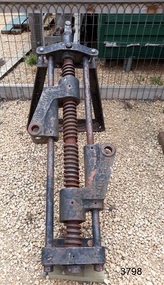
... In 1940 Able Seaman Allan H Lucas served on Reginald M between September and December, being engaged and discharged from Port of Adelaide. His Certificate...In 1940 Able Seaman Allan H Lucas served on Reginald M between September and December, being engaged and discharged from Port of Adelaide. His Certificate ...The ship's steering gear was used for steering and navigation of a vessel - it was a very important part of the ship's equipment. This steering gear was part of the original vessel 'Reginald M', which became part of the exhibitions at Flagstaff Hill Maritime Village. The steering gear was manufactured by the Carron Company. ABOUT THE CARRON COMPANY The Carron Company established its ironworks on the banks of the River Carron in Stirlingshire, Scotland, in 1759, and became an incorporated company in 1773. One of the notable items produced by the company was the Carronade, a short-barrelled naval cannon, being produced until the 1850s. The company was the largest ironworks in Europe during the 19th century. It supplied ammunition and armaments, steamboat engines, pig iron, cast iron goods such as balustrades fire grates and bath tugs, pillar boxes and telephone boxes, and even cast iron rings for underground tunnels. In 1982 it became insolvent and was taken over by the Franke Corporation, using the brand Carron Phoenix. ABOUT THE 'REGINALD M' The Reginald M’s purpose was to serve the coastal trade of South Australia, to carry cargo cheaply and efficiently. It is believed that the keel was in fact hewn from two telegraph poles! Its builder frequented all the salvage yards for materials and fittings. The vessel “Reginald M” was a two-masted coastal ketch, owned and built by Mr. Jack (John) Murch of Birkenhead, Port of Adelaide, South Australia. Its construction took approximately 6 months and it was launched at Largs Bay in 1922. Reginald M had a very shallow draft and a flat bottom that enabled it to come close to shore and to sit high and dry at low tide or to be beached on sand. The flat bottom was also to make the ship able to skim over reefs. Wagons could load and unload direct from her side. Her cargo included Guano, Barley, Wool, Horses, Cattle, Timber, Explosives, Potatoes, Shell Grit and Gypsum. On April 9th 1931Reginald M weathered a large storm in St Vincent Gulf, SA. The vessel suffered much damage; mast snapped and the crew laboured for four hours to free her by chopping off the past and rigging. The crew patched her up and slowly returned to Port Adelaide with only a portion of the insured cargo being damaged. Her crew members at the time were owner Mr John H Murch of Wells Street Largs Bay, Skipper Mr R Murch – John’s brother, Murray – son of Captain Murch and Seaman John Smith. Reg Webb purchased Carribie Station, at Marion in the Warooka District, south of Adelaide, in 1921. He cleared the land and farmed sheep and grain. In 1923 he shipped his own wool and grain from Marion Bay, having first carted 300 bags of the barley grain, 12 bags at a time, along the unmade track to the jetty. A photograph donated to Flagstaff Hill, dating about 1929 - 1942, shows two men on the Reginald M, holding between them their fishing catch of a large hammer shark. The photograph is stamped “GRENFELL STUDIO PORT LINCOLN PRINT” and titled “hammer shark caught on Reginald Emm”. The donor’s family lived on the Your Peninsular and despatched their grain from a chute at Gleeson’s Landing to the awaiting transport vessel. Reg knew the Murch Brothers from Port Adelaide. The brothers had been using their ketch REGINALD M to ship Guano from the Islands, led by Captain Richard Murch. Reg approached them in 1934 about shipping grain from Marion Bay. The brothers visited the bay and thought it was an ideal place. They showed Reg where to stack his grain and they measured up the cliffs. When Reg was ready, they brought down and installed a ninety foot wooden chute. The bags of grain were then individually sent down the chute, landing in a waiting small boat then rowed to REGINALD M, 14 bags at a time. After 10 hours REGINALD M would be fully loaded with 1300 bags of grain and shipped to waiting ports. At one time a wild storm destroyed the chute but it was rebuilt and strengthened. REGINALD M was involved in shipping the grain from there until 1938. In 1940 Able Seaman Allan H Lucas served on Reginald M between September and December, being engaged and discharged from Port of Adelaide. His Certificate of Discharge was signed by ship’s Master W S Murch. It seems that at some stage Reginald M was used as a Customs vessel, as one photograph in Flagstaff Hill’s collection shows “H.M.C. No. 3, Pt Adelaide” on the bow. In 1969 the last freight left Marion Bay on the ketch REGINALD M carrying grain, wool and explosives. In late 1970 she was sold to the Mt. Lyell Mining and Railway Company and was used by them as a barge to carry explosives. In 1972 the Navy League of Strahan, Tasmania, purchased her for use by the Strahan Sea Cadet Unit to use at Macquarie Harbour and renamed her T.S. Macquarie. However this plan for use of Reginald M did not come to pass. In 1974 Mr. Andrew Rennie, of East Brighton, Melbourne, bought her for a similar purpose. , paying $5,000 and donating a ‘Cadet of the Year” trophy to the Sea Cadets. He sailed her from Strahan to Melbourne, planning to use her for pleasure sailing. Also in 1975 Reginald M was sold to Melbourne Ferry Company at auction. Later in 1975 the Reginald M was bought by Flagstaff Maritime Museum for $20,000 . She has been restored and is now one of the exhibits in the Village lagoon or lake. It was restored in 2006 using funds from a $4,000 government grant. Flagstaff Hill Maritime Village’s Collection holds several other artefacts associated with Reginald M. They include photographs of the Reginald M, including one photograph of her in Outer Harbour, S.A. dated 1947, with Skipper- R.F. Dale and Owner- John Murch. Another shows her docked at Port Adelaide, with the lettering H.M.C. No. 3 Pt ADEL (standing for His/Her Majesty’s Customs). There is a black and white photo of her at a wharf and another showing a person on board.The steering gear is significant through its association with the Carron Company, the largest ironworks in Europe in the 19th century, and the manufacture of the short barrel, lightweight naval gun - the Carronade. The steering gear is significant for its association with the vessel REGINALD M is a coastal trading ketch from South Australia built in 1922. It is one of very few sailing coastal trading vessels still extant, and its flat bottom, single chine shape illustrates a very simple but robust method of construction, compared to other round bilged examples of trading vessels. She is now listed on the Australian Register of Historic Vessels (ARHV Number: HV000562.) Ship's steering gear that was part of the original vessel 'Reginald M', which was constructed in 1922. Inscription on both sides. Made by the Carron Company, UK."CARRON COMPANY"flagstaff hil, warrnambool, shipwrecked coast, flagstaff hill maritime museum, maritime museum, shipwreck coast, flagstaff hill maritime village, coastal trader, trading vessel, vessel reginald m, ketch, john murch ship builder, reg webb, carribie station, mt lyell copper company, queenstown navy league, andrew rennie, melbourne ferry company, r.f. dale, port adelaide vessel reginald m, macquarie training vessel, grenfell studio port lincoln, ship steering gear, metal steering gear, ship's gear, ship's navigation, carron company -
 Bendigo Historical Society Inc.
Medal - Lyons Collection: Three World War 1 medals
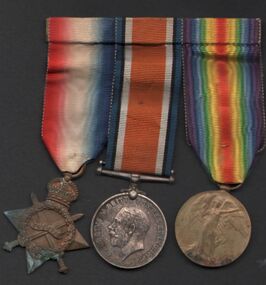
... Seaman. Address Swigg Street, Birkenhead, SA. NoK Mrs A Gillies of same address. Embarked from Adelaide SA on board RMS Malwa on 2.12.1915. RTA 15.11.1919. In London submitted a Statutory Declaration to correct his name to William Terence O'Connor. Dated 9.9.1919. Made a claim 13.12.1938 for a lost discharge certificate...Seaman. Address Swigg Street, Birkenhead, SA. NoK Mrs A Gillies of same address. Embarked from Adelaide SA on board RMS Malwa on 2.12.1915. RTA 15.11.1919. In London submitted a Statutory Declaration to correct his name to William Terence O'Connor. Dated 9.9.1919. Made a claim 13.12.1938 for a lost discharge certificate ...William O'Connor. Regimental Number 3648. Enlisted 9 August 1915 in Adelaide. Aged 18 years. Born Liverpool. Occupation: Seaman. Address Swigg Street, Birkenhead, SA. NoK Mrs A Gillies of same address. Embarked from Adelaide SA on board RMS Malwa on 2.12.1915. RTA 15.11.1919. In London submitted a Statutory Declaration to correct his name to William Terence O'Connor. Dated 9.9.1919. Made a claim 13.12.1938 for a lost discharge certificate (Lost in a shipwreck July 1921 Beachport South Australia). Died 9.6.1963. Buried Springvale Cemetery. World War 1 medal set - 1914 -15 Star, British War Medal and Victory Medal belonging to seaman William Terence O'Connor. William T O'Connorworld war 1 medals -
 Port Melbourne Historical & Preservation Society
Certificate - George Hossack, Certificate of Discharge, 1935
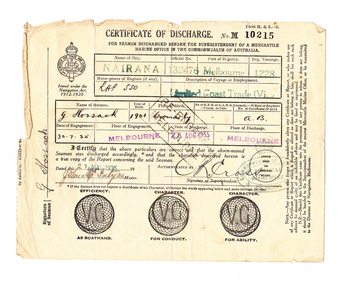
... Certificates of Discharge for Geo (George) Hossack from "HMS Nairana". Two periods of service as seaman boathand. .01 - 30/7/35 to 26/8/35 .02 - 23/9/35 to 15/12/35...maritime transport - shipping don hossack george hossack Certificates of Discharge for Geo (George) Hossack from "HMS Nairana". Two periods of service as seaman boathand. .01 - 30/7/35 to 26/8/35 .02 - 23/9/35 to 15/12/35 Certificate of Discharge Certificate George Hossack ...Certificates of Discharge for Geo (George) Hossack from "HMS Nairana". Two periods of service as seaman boathand. .01 - 30/7/35 to 26/8/35 .02 - 23/9/35 to 15/12/35maritime, transport - shipping, don hossack, george hossack -
 Ringwood RSL Sub-Branch
Documents - Discharge papers, Merchant Navy
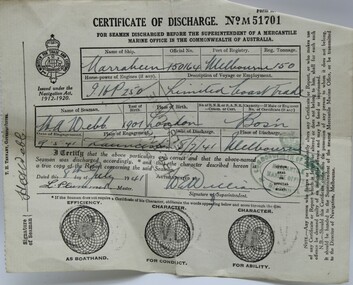
... Seaman Henry A Webb indicating rank AB to Bosun. Vessels Tarcoola and Narrabeen. Merchant Navy certificates of discharge ranging from August 1925 to May 1941 Merchant Navy Documents - Discharge papers ...Original documernts.Merchant Navy certificates of discharge ranging from August 1925 to May 1941Seaman Henry A Webb indicating rank AB to Bosun. Vessels Tarcoola and Narrabeen. -
 Ringwood RSL Sub-Branch
Book - Document Certificate of Discharge, Board of Trade No, 963114
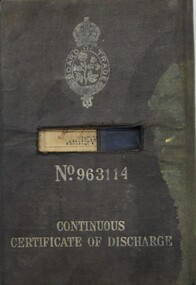
... Issued to Harry Webb - merchant seaman born 1901 in London - last entry 1921.12pages plus loose sheets. Continuous Certificate of Discharge...Issued to Harry Webb - merchant seaman born 1901 in London - last entry 1921.12pages plus loose sheets. Continuous Certificate of Discharge Board of Trade No, 963114 Book Document Certificate of Discharge ...Issued to Harry Webb - merchant seaman born 1901 in London - last entry 1921.12pages plus loose sheets. Continuous Certificate of Discharge
