
Showing 13 items matching "settlers under sail"
-
 Sunshine and District Historical Society Incorporated
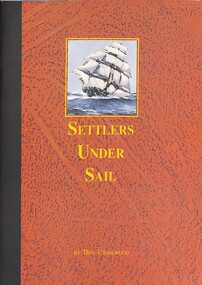
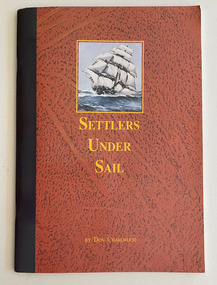
Book - Settlers Under Sail, A Victoria Press Publication, 1991
... Settlers Under Sail...Settlers Under Sail...Settlers Under Sail...Includes a reconstruction of the wreck of The Loch Ard. sailing ships immigration shipwrecks This is an historical account of sailing ship immigration to Australia in the 1800's Settlers Under Sail Soft covered book with 49 pages Settlers Under Sail Book Settlers Under Sail A Victoria Press Publication Don Charlwood ...This is an historical account of sailing ship immigration to Australia in the 1800'sSoft covered book with 49 pagesnon-fictionThis is an historical account of sailing ship immigration to Australia in the 1800'ssailing ships, immigration, shipwrecks -
 Bendigo Historical Society Inc.
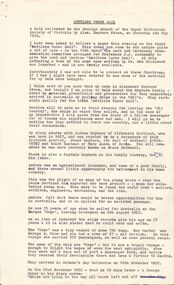
Document - SETTLERS UNDER SAIL, 15/03/1918
... SETTLERS UNDER SAIL......Settlers Under Sail...DOCUMENT Names of bendigo pioneers bendigo historical society Settlers Under Sail Alexander Hepburn Stone Loch Ard Centenary Commemoration Committee Professor J. ...Typed notes mentioning the history of the Hepburn Family and Margaret Cotton McLachlan coming by sailing ship to Australia to marry her fiance who was a miner in Sandhurst and extracts from the diary of William Thompson.document, names of bendigo pioneers, bendigo historical society, settlers under sail, alexander hepburn stone, loch ard centenary commemoration committee, professor j. j. auchmuty, mr don charlwood, andrew hepburn, james hepburn, mary queen of scots, black bothwell, captain hepburn, the 'hope', george b crow, george baker, the 'marlbro', archives department of the latrobe library, mr loman, the 'david clarke', captain hepburn of the royal scots, sir john hepburn, mr howard hepburn, victoria reef lease no 60, ebenezer neill, becker, stirton, margaret cotton mclachlan, ina hepburn, the 'donald mckay', black ball line, james baines and company of liverpool, onedin line, passenger contract ticket, james mclauchlan, christian ferguson, robert miller, william thompson, mr stanwin, the 'shomberg', itchell and son, the 'dunbar', margaret stirton, canon horace stirton, dr james nish, p pentreath, jane pentreath, st andrew's presbyterian church sandhurst, james hepburn, corporate high school, bendigo high school, iron bark school of john rae, rae's hill school, mr john rae, rae anderson, bendigo branch of the royal historical society of victoria, victoria reef mine, 'gourdie farm', mr howard hepburn, john fortey, margaret cotton hepburn -
 Port Melbourne Historical & Preservation Society
Book, "Settlers under sail", 1978
... "Settlers under sail"..."Settlers Under Sail" A History of early sail and the sinking of the Loch Ard, by Don Charwood...transport - shipping don charlwood "Settlers Under Sail" A History of early sail and the sinking of the Loch Ard, by Don Charwood "Settlers under sail" Book ..."Settlers Under Sail" A History of early sail and the sinking of the Loch Ard, by Don Charwoodtransport - shipping, don charlwood -
 Bendigo Historical Society Inc.
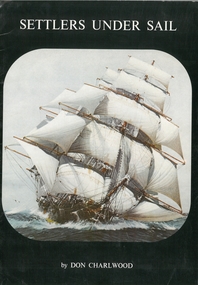
Book - SETTLERS UNDER SAIL
... SETTLERS UNDER SAIL...Settlers under sail by Don Charlwood, soft cover 78 pages with black and white photographs published by The Premiers Department Melbourne Victoria printed by F.D. ...Commemorating the era of immigration to Victoria by sail. Book SETTLERS UNDER SAIL ...Settlers under sail by Don Charlwood, soft cover 78 pages with black and white photographs published by The Premiers Department Melbourne Victoria printed by F.D. Atkinson Government Printer. Commemorating the era of immigration to Victoria by sail.victoria, history, shipping -
 Ringwood RSL Sub-Branch
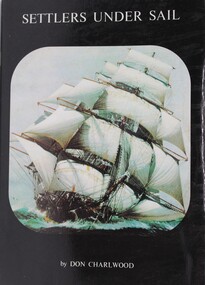
Book - Settlers under sail, Don Charlwood
... Settlers under sail...Don Charlwood Book Settlers under sail ... -
 City of Moorabbin Historical Society (Operating the Box Cottage Museum)
Book, Charlwood, D. E. (Donald Ernest), 1915-2012, Settlers under sail, 1978 © 1991
... Settlers under sail...(some col.), facsim., 1 map, ports Settlers under sail Book Charlwood, D. E. (Donald Ernest), 1915-2012 Victorian Press Publication ..."Settlers Under Sail is Don Charlwood's account of the days of the sailing ship and a fascinating reconstruction of the wreck of the LOCH ARD. -- back cover49 p. : ill. (some col.), facsim., 1 map, portsnon-fiction"Settlers Under Sail is Don Charlwood's account of the days of the sailing ship and a fascinating reconstruction of the wreck of the LOCH ARD. -- back covershipwrecks, cape otway, sailing ships, ocean travel, emigration, immigration -
 Eltham District Historical Society Inc
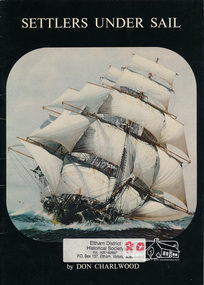
Book, Charlwood, D. E. (Donald Ernest), 1915-2012, Settlers under sail / by Don Charlwood ; with pictorial research, layout, and design by Donald Walker and Robert L. Suggett, 1980
... Settlers under sail / by Don Charlwood ; with pictorial research, layout, and design by Donald Walker and Robert L. .... : ill. (1 col.), map, ports. ; 30 cm. Settlers under sail / by Don Charlwood ; with pictorial research, layout, and design by Donald Walker and Robert L. ...Paperback; 28 p. : ill. (1 col.), map, ports. ; 30 cm.ISBN 0724116842 or 0724182314lorch ard (ship), ship voyage, ship wrecks -
 Peterborough History Group
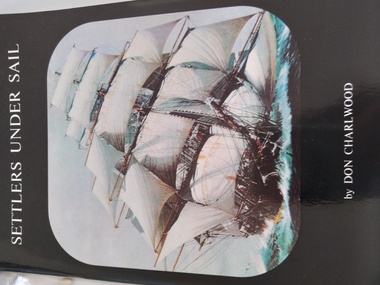
Book, Don Charlwood, Settlers Under Sail, 1999, Third edition
... Settlers Under Sail...Significant as information compiled by a respected maritime historian and includes information about local shipwreck. bully forbes the schomberg peterborough shipwrecks great ocean road the shipwreck coast don charlwood great circle route sailing ships Signed by the author Settlers Under Sail Book Don Charlwood ...Describes The Great Circle Route and includes information about Bully Forbes, Captain of the Schomberg.Significant as information compiled by a respected maritime historian and includes information about local shipwreck.Signed by the authorbully forbes, the schomberg, peterborough, shipwrecks, great ocean road, the shipwreck coast, don charlwood, great circle route, sailing ships -
 Whitehorse Historical Society Inc.
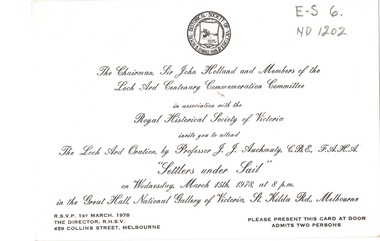
Document - Invitation, Loch Ard Oration, 1/03/1978
... Invitation to the Loch Ard Oration by Professor J.J.Auchmuty, 'Settlers under sail', 15/03/1978....Loch Ard Centenary Commemoration Committee Invitation to the Loch Ard Oration by Professor J.J.Auchmuty, 'Settlers under sail', 15/03/1978. Loch Ard Oration Document Invitation ...Invitation to the Loch Ard Oration by Professor J.J.Auchmuty, 'Settlers under sail', 15/03/1978.invitations, holland, john, royal historical society of victoria, auchmuty, j. j., loch ard centenary commemoration committee -
Kew Historical Society Inc
Archive (Sub-series) - Subject File, CHARLWOOD, Arthur, 1981
... A copy of Don Charlwood’s ‘Settlers Under Sail’ is in the file....A copy of Don Charlwood’s ‘Settlers Under Sail’ is in the file. CHARLWOOD, Arthur Archive Subject File ...Various partiesReference, Research, InformationSecondary Values (KHS Imposed Order)Subject file containing information about the Charlwood family who arrived in Kew on the ‘Success’ in 1850. In 1888, the family built four two-storey houses at 25-31 Gellibrand Street. The file contains a nine-page biographical account of Arthur Charlwood’s origin in England, his migration to Victoria and his life and businesses in Melbourne. The photocopied account was written by Don Charlwood and donated to the Society in 1981 by Mrs Sewell. A copy of Don Charlwood’s ‘Settlers Under Sail’ is in the file.arthur charlwoodarthur charlwood -
 Flagstaff Hill Maritime Museum and Village
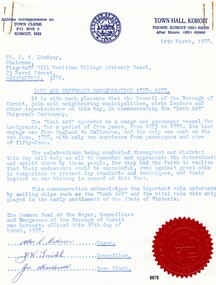
Letter - Loch Ard Centenary Letter, Koroit Council, March 1978
... A booklet called "Settlers Under Sail" by Don Charlwood was commissioned to be made available to all school children. ...A booklet called "Settlers Under Sail" by Don Charlwood was commissioned to be made available to all school children. ...The Loch Ard was an iron hulled clipper, built in Scotland in 1873 and wrecked on the southwest coast of Victoria in 1878 at what is now known as Loch Ard Gorge, near Port Campbell. Fifty two crew and passengers died and only Tom Pierce and Eva Carmichael survived. The Loch Ard was the last sailing ship to lose emigrants' lives when negotiating the entrance to Bass Strait. One of the most unlikely pieces of cargo to have survived the shipwreck was a Minton porcelain peacock - one of only nine in the world. The peacock was destined for the Melbourne International Exhibition in 1880. It had been well packed, which gave it adequate protection during the violent storm. Today, the Minton peacock can be seen at the Flagstaff Hill Maritime Museum in Warrnambool. From Australia's most dramatic shipwreck it has now become Australia's most valuable shipwreck artefact and is one of very few 'objects' on the Victorian State Heritage Register. The Victorian History Advisory Council decided 1978 was an appropriate year to mark, not only the centenary of the sinking of the Loch Ard in 1878, but also commemorate the large part played by sailing ships in immigration, and through this, the development of Australia. The Victorian Government authorised the commemoration and a "Loch Ard Centenary Committee" was formed. It was established to create public interest and awareness for the 100th anniversary of the tragic Loch Ard shipwreck. Activities and events included student essays, exhibitions, videos, publications, competitions and historical information. A booklet called "Settlers Under Sail" by Don Charlwood was commissioned to be made available to all school children. The anchor of the Loch Ard was raised from the wreck and displayed at Port Campbell, a memorial plaque (erected by The National Park) was unveiled at Loch Ard Gorge, a special "Loch Ard Shipwreck Centennial Port Campbell" postmark was issued by the Post Office and a model ship competition was held. Flagstaff Hill Maritime Museum and Village, together with other local towns and shires along the south-west coast participated in many of these commemorative activities. This letter is a significant reminder (and recognition) of the importance the Loch Ard (and other immigrant ships) played in the settling of Victoria and the dangers faced by the settlers who came to Australia in these ships. Flagstaff Hill’s collection of artefacts from LOCH ARD is significant for being one of the largest collections of artefacts from this shipwreck in Victoria. It is significant for its association with the shipwreck, which is on the Victorian Heritage Register (VHR S417). The collection is significant because of the relationship between the objects, as together they have a high potential to interpret the story of the LOCH ARD. The LOCH ARD collection is archaeologically significant as the remains of a large international passenger and cargo ship. The LOCH ARD collection is historically significant for representing aspects of Victoria’s shipping history and its potential to interpret sub-theme 1.5 of Victoria’s Framework of Historical Themes (living with natural processes). The collection is also historically significant for its association with the LOCH ARD, which was one of the worst and best-known shipwrecks in Victoria’s history.Single page letter typed in blue ink, on behalf of Koroit Council, written on 14th March 1978 and addressed to the Chairman, Flagstaff Hill Maritime Village Advisory Board, in recognition of the "Loch Ard Centenary Commemoration 1878 - 1978". It has the "Borough of Koroit" stamp at the top of the page and a red "Borough of Koroit" seal on the bottom right-hand corner of the page. It is signed by the Mayor (Allan R. Waterson), a councillor (J. W. Smith) and the Town Clerk (Jim Macdonald). The letter is in a plain buff manilla folder labelled in blue type.Top left corner - "Address correspondence to:/TOWN CLERK / P.O. BOX 5/KOROIT, 3282" Top Centre - blue circular ink stamp of "BOROUGH OF KOROIT 1870" with coat of arms in the center Top right - "TOWN HALL,KOROIT/ PHONE KOROIT (055) 658230/After Hours (055) 658490" The letter is addressed to - "CR. J. S. Lindsay, /Chairman,/ Flagstaff Hill Maritime Village Advisory Board,/ WARRNAMBOOL. 3280" "LOCH ARD CENTENARY COMMEMORATION 1878 - 1978" (underlined) The letter begins - "It is with much pleasure that the Council of the Borough of Koroit, join with neighbouring municipalities, civic leaders and other organisations on this day, in commemorating the "Loch Ard" Shipwreck centenary. The "Loch Ard" operated as a cargo and passenger vessel for immigrants, for a period of five years, from 1873 to 1878. Its last voyage was from England to Melbourne, and the ship was sunk on the 1st June 1878, with only two survivors from passengers and crew of fifty-four. The celebrations being conducted throughout our district this day will help us all to remember and appreciate the determination and spirit shown by these people, for they had the faith to realise that their endeavours would be successful, even against great odds in comparison to present day standards and techniques, and their imprint on our history is record of this fact. This commemoration acknowledges the important role undertaken by sailing ships such as the "Loch Ard" and the vital role this ship played in the early settlement of the State of Victoria." The letter ends with -" the Common Seal of the Mayor, Councillors and Burgesses of the Borough of Koroit was hereunto affixed this 18th day of March, 1978." The letter is signed "Allan J. Waterson Mayor/J. W. Smith Councillor/ Jim Macdonald Town Clerk and a large red seal of the Borough of Koroit (with their coat of arms) is in the bottom right-hand corner. Front of manilla folder - "BOROUGH OF KOROIT / LOCH ARD CENTENARY COMMEMORATION/ 1878 - 1978" "4050" written in black ink top right-hand corner next to a scribbled out numberflagstaff hill maritime museum and village, warrnambool, great ocean road, shipwreck coast, loch ard, port cambell, shipwreck, commemorative committee, loch ard centenary, koroit council, commemorative letter, loch ard commemorative committee -
 Flagstaff Hill Maritime Museum and Village
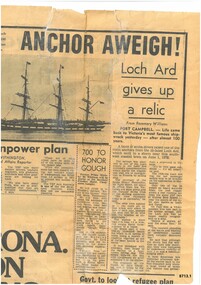
Newspaper - Newspaper Article, March 1978
... A booklet called "Settlers Under Sail" by Don Charlwood was commissioned to be made available to all school children, a memorial plaque (erected by The National Park) was unveiled at Loch Ard Gorge, a special "Loch Ard Shipwreck Centennial Port Campbell" postmark was issued by the Post Office and a model ship competition was held. ...A booklet called "Settlers Under Sail" by Don Charlwood was commissioned to be made available to all school children, a memorial plaque (erected by The National Park) was unveiled at Loch Ard Gorge, a special "Loch Ard Shipwreck Centennial Port Campbell" postmark was issued by the Post Office and a model ship competition was held. ...The Loch Ard was the last sailing ship to lose emigrants' lives when negotiating the entrance to Bass Strait. The ship Loch Ard was built on the River Clyde in Scotland in 1873 for the prestigious Loch Line of colonial clipper ships, designed for the Australian run. It sailed from England on 1 March 1878 carrying 37 crew, 17 passengers and a diverse general cargo ranging from luxury items to bulk railway iron. On 1 June 1878, emerging from fog and hearing too late the sound of breakers against the tall limestone cliffs, the vessel struck the southern foot of Mutton Bird Island and sank in 23 metres of water. Of the fifty-four people on board only two survived, one young male crewman, Tom Pearce, and one young female passenger, Eva Carmichael. This newspaper advertisement was donated by the family of George Shields - a member of the Shields family who had had a long association with the wreck of the Loch Ard and Eva Carmichael. In 1878, following the wreck of the Loch Ard and the subsequent rescue of Eva Carmichael, Eva was taken to Glenample station (near Princetown) to recuperate. It was during this period that Eva became great friends with Jane Shields (an Aunt of George Shields) - a friendship that continued throughout their lives. At that time, Jane was a young woman living in Princetown with her parents and siblings. Many of the Shields family continued to have a great interest in the Loch Ard and several generations of the family are buried in the Loch Ard cemetery. One of the most unlikely pieces of cargo to have survived the shipwreck was a Minton porcelain peacock - one of only nine in the world. The peacock was destined for the Melbourne International Exhibition in 1880. It had been well packed, which gave it adequate protection during the violent storm. Today, the Minton peacock can be seen at the Flagstaff Hill Maritime Museum in Warrnambool. From Australia's most dramatic shipwreck it has now become Australia's most valuable shipwreck artefact and is one of very few 'objects' on the Victorian State Heritage Register. The Victorian History Advisory Council decided 1978 was an appropriate year to mark, not only the centenary of the sinking of the Loch Ard in 1878, but also commemorate the large part played by sailing ships in immigration, and through this, the development of Australia. The Victorian Government authorised the commemoration and a "Loch Ard Centenary Committee" was formed. It was established to create public interest and awareness for the 100th anniversary of the tragic Loch Ard shipwreck. Activities and events included student essays, exhibitions, videos, publications, competitions and historical information. A booklet called "Settlers Under Sail" by Don Charlwood was commissioned to be made available to all school children, a memorial plaque (erected by The National Park) was unveiled at Loch Ard Gorge, a special "Loch Ard Shipwreck Centennial Port Campbell" postmark was issued by the Post Office and a model ship competition was held. Flagstaff Hill Maritime Museum and Village, together with other local towns and shires along the south-west coast participated in many of these commemorative activities. The Chair of the Loch Ard Century Committee (Sir John Holland) approached the "Scuba Divers Federation of Victoria" to "seek and recover a significant relic from the Loch Ard" with the idea of having it available for public display at Port Campbell. The SDFV enlisted the help of the VSAG (Victorian Sub Aqua Group) with a contingent of nineteen divers participating in the salvage which took place over the weekend of 11th and 12th March 1978. The anchor was placed in the custody of the expert conservators at Flagstaff Hill Maritime Museum and Village to be cleaned, and eighteen months later was returned to Port Campbell. This newspaper article was one of many reports and descriptions of events that took place during the Centennial Commemoration of the sinking of the Loch Ard. This newspaper article is a significant reminder (and recognition) of the importance the Loch Ard (and other immigrant ships) played in the settling of Victoria and the dangers faced by the settlers who came to Australia in these ships. Flagstaff Hill’s collection of artefacts from LOCH ARD is significant for being one of the largest collections of artefacts from this shipwreck in Victoria. It is significant for its association with the shipwreck, which is on the Victorian Heritage Register (VHR S417). The collection is significant because of the relationship between the objects, as together they have a high potential to interpret the story of the LOCH ARD. The LOCH ARD collection is archaeologically significant as the remains of a large international passenger and cargo ship. The LOCH ARD collection is historically significant for representing aspects of Victoria’s shipping history and its potential to interpret sub-theme 1.5 of Victoria’s Framework of Historical Themes (living with natural processes). The collection is also historically significant for its association with the LOCH ARD, which was one of the worst and best-known shipwrecks in Victoria’s history.A newspaper cutting taken from a Victorian newspaper (possibly the Herald) printed in March 1978, describing the salvaging of the anchor from the wreck of the Loch Ard near Port Campbell. The cutting has two tears (that have sticky tape on them) and the paper is yellowed with age. The article (written by Rosemary Williams) has an old black and white photograph of the Loch Ard, two large print headings and two colomns of text. The article has been cut out of a larger page and also contains parts of other articles and an advertisement."ANCHOR AWEIGH!" "Loch Ard /gives up/ a relic" Plus two colomns of text describing the raising of the anchor by a team of divers.flagstaff hill maritime museum and village, warrnambool, great ocean road, shipwreck coast, loch ard, loch ard centennial, loch ard anchor, port campbell, loch ard salvage, scuba divers, scuba divers federation of victoria, victorian sub aqua group -
 City of Melbourne Libraries
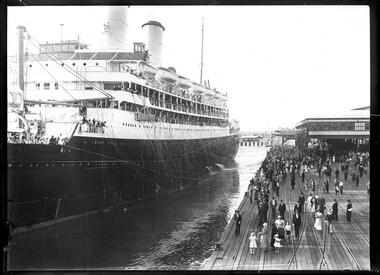
Photograph, Bull, Hugh Jones, 1897-1993, RMS Orford departing from Station Pier, Port Melbourne
... Settlers Scheme and the Dreadnought Boys Co program to promote and assist the migration of British youths willing to become farm workers in Australia 1911-1939 were noted too. On the 19th March 1932, RMS Orford featured in the “Parade of Ships” celebrating the official opening of the Sydney Harbour Bridge. Only country people were allowed to book a ticket as a guest on board. The Post Office issued commemorative postage stamps showing the Orford sailing under the bridge. In March 1934, the Orford sailed...Settlers Scheme and the Dreadnought Boys Co program to promote and assist the migration of British youths willing to become farm workers in Australia 1911-1939 were noted too. On the 19th March 1932, RMS Orford featured in the “Parade of Ships” celebrating the official opening of the Sydney Harbour Bridge. Only country people were allowed to book a ticket as a guest on board. The Post Office issued commemorative postage stamps showing the Orford sailing under the bridge. In March 1934, the Orford sailed ...Published: 21 March 1934 The Age p11 Published title: CROWDED TOURIST SHIP WILL CARRY TEST AND DAVIS CUP TEAMS. Published caption: Carrying an exceptionally large number of tourists, business men and prominent sporting personalities, R.M.S. Orford sailed for London yesterday. Over two hundred passengers embarked at Melbourne, and on leaving the Australian coast there will be two thousand persons on board. The Australian Test team will join the vessel at Fremantle and the remaining two Davis Cup representatives will embark at Adelaide. A picture of the Orford taken just as she moved out from Station Pier, Port Melbourne, under her own steam. Trove article identifier: http://nla.gov.au/nla.news-article203826897 Description: Passenger ship about to depart Station Pier, Port Melbourne. Research by project volunteer, Fiona Collyer: The RMS Orford was built by Vickers-Armstrong Shipyard Barrow-in-Furness, Cumbria, England and launched in 1927 by Lady Ryrie, the wife of Sir Granville Ryrie, the Australian Ambassador to the UK. The Orford was owned by the Orient Steam Navigation Ltd and was designed for the mail and passenger service between England and Australia. She was 20,000 tons, 658 ft long, 75 ft across and 80 ft high from water-line to deck. She had eight decks, a swimming pool and cost more than £1,000,000. She could travel at 20 knots – 480 miles a day, a 5 week voyage between Australia and England. There were enough lifeboats to accommodate every person on board. Promoted as a ship of comfort, luxury, speed and grace with spacious, beautifully decorated lounges, smoking-rooms and writing rooms, the SMH 23/11/1928 review said “sitting-rooms where the furniture recreates the air of quiet, exquisite, safe luxury; suites where you may retire from other people, and on a sea voyage other people, even the most charming other people, often begin to resemble one’s worst enemies towards the end of several weeks sea voyaging together”. “Travel like a human being. This is what the great liners give you today. The Orford dining room is enormous (it seated 350 people) the walls sweep up to a white, cool roof supported on decorative pillars. Panels of grey scagliola and carved designs remove the bleak, comfortless air which used to cling to dining-rooms of ships. Everything about them was so wretchedly temporary that you could not enter them without wishing that you stayed at home. They gave you the creeps and indigestion. This room is gay, bright, sunlit, like a luxurious café overlooking the sea.” “You really feel in here that you are a human being and not a piece of cargo endowed with sensation.” The Orford had the punkah louvre system of ventilation which forced draughts through every part of the ship, ensuring “No Ship Smells!!” and avoiding - “… a mayonnaise of all the unpleasant odours generated under heaven. From the hot oil of the engines, from those overheated, bottomless pits below the water-line, from new paint and food, from people perspiring at work, from rope and tar and grease and fruit and wet clothes and tobacco, rises a deplorable incense that lingers unsettlingly in the nostril long after one has left the ship. Those dreadful odours will never rise to torture the senses of passengers who feel that all is over with them.” The modern electric kitchen had a roll making machine capable of producing 2000 rolls for the table an hour and a bread and butter machine which cut the bread into slices and spread the butter in one operation. (The Week – Brisbane 30/11/1928) On 13/10/1928, the Orford made its first voyage to Australia with 520 first class and 1100 3rd class passengers. The name of the passengers embarking and disembarking and their reason for visiting were published in newspapers and the number of migrants for the New Settlers Scheme and the Dreadnought Boys Co program to promote and assist the migration of British youths willing to become farm workers in Australia 1911-1939 were noted too. On the 19th March 1932, RMS Orford featured in the “Parade of Ships” celebrating the official opening of the Sydney Harbour Bridge. Only country people were allowed to book a ticket as a guest on board. The Post Office issued commemorative postage stamps showing the Orford sailing under the bridge. In March 1934, the Orford sailed from Australia to London, via Colombo, Aden, Port Said, Naples, Villefranche, Toulon, Parma, Gibraltar and Channel Port. Amongst the 2000 passengers on board was the Davis Cup Tennis team, tennis champions Joan Hartigan and Nell Hopman, the Australian Test cricket team and British champion swimmer Joyce Cooper. Every day tennis player Harry Hopman and an Australian Press Association reporter radioed through reports on their activities, which included – - Test cricket batsman Len Darling having spend 4 days in his cabin after straining his groin when he slipped over while playing ball tennis in his slippers. - Batsman Bill Brown dancing the fox-trot, displaying footwork similar to the grace he showed at the wicket. - Alluding to the seasickness of Don Bradman and Stan McCabe and how they were making up for meals lost on the Great (very choppy) Australian Bight. - Miss Joan Hartigan discarding her bright blue shorts for brighter blue bathers and being first into the pool. - Bowler Bill O’Reilly being tripped by a passenger on the deck and spending the voyage with bandaged wrists with daily updates of his progress in the press. - Wicketkeeper Ben Barnett’s conjuring tricks and constant whirring movie camera. - Results of the quoits, ball tennis and bridge tournaments. A fancy dress ball was held one night and the cricketers dressed as sheiks and sang “The Riff Song” from the pre-code 1929 operetta film “The Desert Song” starring John Bates as the Red Shadow and Myrna Lay as a native dancing girl. Alan Kippax’s beard blew overboard! Joan Hartigan dressed as Burlington Bertie from the music hall song and Nell Hopman a doll in a box wearing a crinkled paper dress. On arrival at Southampton, while they waited for the gangway to be lowered, Bradman entertained the team at the piano playing popular tunes while the cricketers sang. . In 1935, RMS Orford’s third class accommodation was converted to tourist class. Her passenger capacity was now 468 First Class, 515 tourist class and 440 crew. First saloon from Sydney fares cost for single £76, £82, £88 and Third Class fares were £21, £23, £25. Less than a penny a mile. . In 1936, the Orford embarked the exiled Emperor of Ethiopia, Haile Selassie at Gibraltar on his way to the UK. In 1939, she was requisitioned for Australian government service and on 7/1/1940 she conveyed the first Australian troops to Egypt and was then used to carry French troops from Tamatave, Madagascar to Marseilles. On 1/6/1940 RMS Orford was bombed and set on fire at Marseilles by German aircraft. 14 crew were killed, 25 wounded. In 1947, the wreck was re-floated and broken up at Savona. . . References: R.M.S. ORFORD. (1928, November 23). The Sydney Morning Herald (NSW : 1842 - 1954), p. 14. Retrieved September 15, 2023, from http://nla.gov.au/nla.news-article16511535 ARRIVAL OF THE ORFORD (1928, November 30). The Week (Brisbane, Qld. : 1876 - 1934), p. 21. Retrieved September 15, 2023, from http://nla.gov.au/nla.news-article181126802 CROWDED TOURIST SHIP WILL CARRY TEST AND DAVIS CUP TEAMS. (1934, March 21). The Age (Melbourne, Vic. : 1854 - 1954), p. 11. Retrieved October 5, 2023, from http://nla.gov.au/nla.news-article203826897 Photographer notations on slide: "B19".tennis, ships
