
Showing 83 items matching "seven network"
-
 Disability Sport & Recreation Victoria
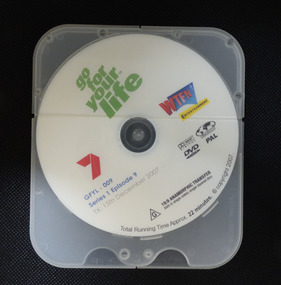
DVD, Seven Network et al, Go For Your Life, 15/12/2009
... ...Seven Network...Go For Your Life was a lifestyle program broadcast by the Seven Network, which focused on health and active living. ...Seven Network...Go For Your Life was a lifestyle program broadcast by the Seven Network, which focused on health and active living. ...Go For Your Life was a lifestyle program broadcast by the Seven Network, which focused on health and active living. In a segment presented by former Collingwood Football Club captain Tony Shaw (which lasts from 00:05:53 to 00:11:03), there is a focus on wheelchair basketball and handcycling.DVD in casego for your life - GFYL - 009 - Series 1 Episode 9 - TX: 15th December 2009 WTFN Entertainment Total Running Time: Approx 22 minutesgo for your life, seven network, wheelchair basketball, handcycling, tony shaw -
 Robin Boyd Foundation
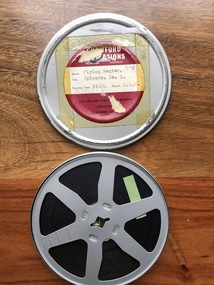
Film, Robin Boyd, The Flying Dogtor, Episode 1, 1962
... They were produced by Crawford Productions and broadcast on Australian Television Network, which later became the Seven Network. Hector Crawford and Robin Boyd were friends....They were produced by Crawford Productions and broadcast on Australian Television Network, which later became the Seven Network. Hector Crawford and Robin Boyd were friends. ...The Flying Dogtor is a black and white cartoon series, consisting of line drawings, devised and written by Robin Boyd. He also created the initial drawings for all the characters. The Flying Dogtor series, consisting of 52 episodes, was devised and written by Robin Boyd between 1962-1964 (items D194-D241). They were produced by Crawford Productions and broadcast on Australian Television Network, which later became the Seven Network. Hector Crawford and Robin Boyd were friends.16mm black and white film with sound. Inside a circular metal canister with lid. Duration-5:31 Minutes the flying dogtor, hector crawford, crawfords, robin boyd -
 Robin Boyd Foundation
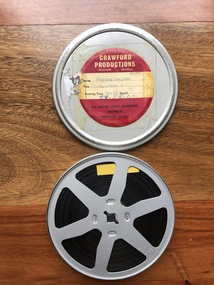
Film, Robin Boyd, The Flying Dogtor, Episode 2, 1962
... They were produced by Crawford Productions and broadcast on Australian Television Network, which later became the Seven Network. Hector Crawford and Robin Boyd were friends....They were produced by Crawford Productions and broadcast on Australian Television Network, which later became the Seven Network. Hector Crawford and Robin Boyd were friends. ...The Flying Dogtor is a black and white cartoon series, consisting of line drawings, devised and written by Robin Boyd. He also created the initial drawings for all the characters. The Flying Dogtor series, consisting of 52 episodes, was devised and written by Robin Boyd between 1962-1964 (items D194-D241). They were produced by Crawford Productions and broadcast on Australian Television Network, which later became the Seven Network. Hector Crawford and Robin Boyd were friends.16mm black and white film with sound. Inside a circular metal canister with lid. Duration-5:12 Minutes the flying dogtor, hector crawford, crawfords, robin boyd, ohm2022, ohm2022_5 -
 Robin Boyd Foundation
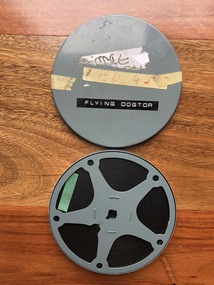
Film, Robin Boyd, The Flying Dogtor, Episode 1, 1963
... They were produced by Crawford Productions and broadcast on Australian Television Network, which later became the Seven Network. Hector Crawford and Robin Boyd were friends. ...They were produced by Crawford Productions and broadcast on Australian Television Network, which later became the Seven Network. Hector Crawford and Robin Boyd were friends. ...The Flying Dogtor is a black and white cartoon series, consisting of line drawings, devised and written by Robin Boyd. He also created the initial drawings for all the characters. The Flying Dogtor series, consisting of 52 episodes, was devised and written by Robin Boyd between 1962-1964 (items D194-D241). They were produced by Crawford Productions and broadcast on Australian Television Network, which later became the Seven Network. Hector Crawford and Robin Boyd were friends. 16mm black and white film with sound. Inside a circular metal canister with lid. Duration-5:31 Minutes the flying dogtor, hector crawford, crawfords, robin boyd -
 Bendigo Military Museum
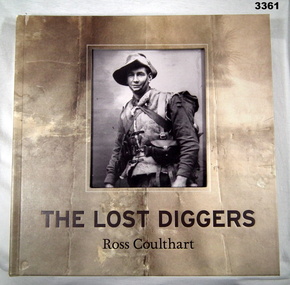
Book - PHOTOGRAPHS, WW1, Ross Coulthart, The Lost Diggers, c.2011
... From acknowledgements: This book was conceived out of the extraordinary public response we had on the Seven TV Network's Sunday Night public affairs program to several stories presenting The Lost Diggers images. ...From acknowledgements: This book was conceived out of the extraordinary public response we had on the Seven TV Network's Sunday Night public affairs program to several stories presenting The Lost Diggers images. ...The Lost Diggers. (Photos from WWI). From acknowledgements: This book was conceived out of the extraordinary public response we had on the Seven TV Network's Sunday Night public affairs program to several stories presenting The Lost Diggers images. From preface: Swarthy Anzacs, village of Vignacourt, photographs taken by local photographers Louis & Antoinette Thuillier.Hard cardboard cover, buckram texture, with sepia coloured faded photo background. Cut out panel on front, see through to black & white 1/2 portrait photo of uniformed soldier. Dark brown print front & spine, some white on back. Brown ribbon page marker. Front & back end papers & flyleaf, black & white photos. 399 pages, cut glossy white. Illustrated black & white, colour & sepia photos.book, photographs, lost diggers -
 Federation University Historical Collection
Ephemera - Stickers, University of Ballarat Stickers
... The name Federation University Australia was chosen to convey the scope and capacity of an expanded regional university with a federated network of campuses. sticker university of ballarat flag logo Seven University of Ballarat Stickers. ...Federation University Australia was established on 1 January 2014. Formerly known as the University of Ballarat, its enabling legislation was the University of Ballarat Amendment (Federation University Australia) Act 2013. Although formally created as a University in 1994, the University of Ballarat has a lineage back to 1870 with the establishment of the School of Mines Ballarat, making it the third institution of higher learning to be established in Australia and the first to be established in regional Australia. On 1 January 1994, Ballarat University College became the University of Ballarat and in 1998 the University merged with three TAFE Institutes to become a dual sector institution with multiple campuses. On 1 January 2014, the University of Ballarat amalgamated with the Monash University Gippsland Campus to form Federation University Australia. The Gippsland Campus also had a long lineage dating back to 1928 with the establishment of the Yallourn Technical School which became a predecessor institution to the Gippsland College of Advanced Education formed in 1968. In 1990, it was renamed the Monash University College and in 1993 became the Gippsland Campus of Monash University. In 2016, Federation University Australia announced plans to take possession, over a two-year period, of Monash’s Berwick Campus in the south-east corridor of Melbourne. Federation University Australia, or FedUni, is headquartered in Ballarat and offers programs in Higher Education and Vocational Education and Training to regional Victoria and beyond. The University’s commitment to educational and social equity, teaching excellence, research distinction, environmental sustainability and regional capacity building has enabled it to develop in a way that draws on its proud heritage to inform its future. Its regional character sets a framework for the University’s priorities but does not constrain it from serving wider community interests, nationally and internationally. The name Federation University Australia was chosen to convey the scope and capacity of an expanded regional university with a federated network of campuses.Seven University of Ballarat Stickers.sticker, university of ballarat, flag, logo -
 Flagstaff Hill Maritime Museum and Village
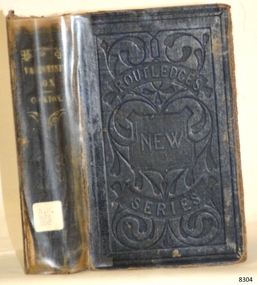
Book - Fictional Novel, Henry Cockton, The Life and Adventures of Valentine Fox, 1854
... Seven Stars, and died of consumption in 1853 at the age of 45, leaving his family destitute. The publisher, George Routledge (1812–1888), was one of the most influential pioneers of mass-market, affordable publishing in the Victorian era. Born in Cumberland, he established his publishing business in London in 1843. Routledge revolutionised the book trade by launching the famous "Railway Library" in 1848. Recognising that Britain's booming rail network...Seven Stars, and died of consumption in 1853 at the age of 45, leaving his family destitute. The publisher, George Routledge (1812–1888), was one of the most influential pioneers of mass-market, affordable publishing in the Victorian era. Born in Cumberland, he established his publishing business in London in 1843. Routledge revolutionised the book trade by launching the famous "Railway Library" in 1848. Recognising that Britain's booming rail network ...The Life and Adventures of Valentine Vox, the Ventriloquist was first published in monthly parts between 1839 and 1840, and is a satirical, lighthearted Victorian novel. The story follows a young man named Valentine Vox who discovers he has an extraordinary talent for ventriloquism. Instead of using his gift for simple entertainment, he acts as a chaotic prankster, throwing his voice in public places to stir up trouble, expose hypocrisy, and drive unsuspecting citizens to near-madness. He makes everyday items appear to speak, creates invisible crowds, and wreaks havoc in taverns, political meetings, and crowded streets. Beneath the slapstick comedy, the novel serves a serious social purpose. Valentine’s antics eventually lead him to expose the horrific conditions and corrupt practices of private lunatic asylums in Victorian England, where sane people were sometimes locked away by greedy relatives. The book actually contributed to real-world public outcry and subsequent legal reforms surrounding mental health facilities.Valentine Vox Author: Henry Cockton Publisher: George Routledge & Co Date: 1854 Further Information: The Life and Adventures of Valentine Fox. The Ventriloquist fictionThe Life and Adventures of Valentine Vox, the Ventriloquist was first published in monthly parts between 1839 and 1840, and is a satirical, lighthearted Victorian novel. The story follows a young man named Valentine Vox who discovers he has an extraordinary talent for ventriloquism. Instead of using his gift for simple entertainment, he acts as a chaotic prankster, throwing his voice in public places to stir up trouble, expose hypocrisy, and drive unsuspecting citizens to near-madness. He makes everyday items appear to speak, creates invisible crowds, and wreaks havoc in taverns, political meetings, and crowded streets. Beneath the slapstick comedy, the novel serves a serious social purpose. Valentine’s antics eventually lead him to expose the horrific conditions and corrupt practices of private lunatic asylums in Victorian England, where sane people were sometimes locked away by greedy relatives. The book actually contributed to real-world public outcry and subsequent legal reforms surrounding mental health facilities.flagstaff hill, warrnambool, shipwrecked coast, flagstaff hill maritime museum, maritime museum, shipwreck coast, flagstaff hill maritime village, great ocean road, book, pattison collection, warrnambool library, warrnambool mechanics’ institute, ralph eric pattison, corangamite regional library service, warrnambool city librarian, mechanics’ institute library, victorian library board, warrnambool books and records, warrnambool children’s library, valentine vox, henry cockton -
 Eltham District Historical Society Inc
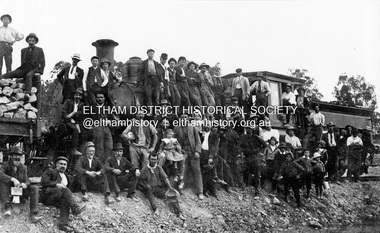
Photograph, First steam train to Hurstbridge
... seven boys also gather for the photo. The line opened on 2 January 1912 and was officially opened in June. The photo commemorates the culmination of many years of community and political agitation for the extension of the railway line. 100 years later the Hurstbridge railway line remains a vital part of Melbourne's public transport network. ...A large group of men of varying ages stand on or beside the first steam train to Hurstbridge. Two hold children on their laps. A small group of seven boys also gather for the photo. The line opened on 2 January 1912 and was officially opened in June.The photo commemorates the culmination of many years of community and political agitation for the extension of the railway line. 100 years later the Hurstbridge railway line remains a vital part of Melbourne's public transport network. This photo forms part of a collection of photographs gathered by the Shire of Eltham for their centenary project book, "Pioneers and Painters: 100 years of the Shire of Eltham" by Alan Marshall (1971). The collection of over 500 images is held in partnership between Eltham District Historical Society and Yarra Plenty Regional Library (Eltham Library) and is now formally known as 'The Shire of Eltham Pioneers Photograph Collection.' It is significant in being the first community sourced collection representing the places and people of the Shire's first one hundred years.Digital image Also black and white copy of original mounted photo (broken) printed on glossy photographic paper 30.5 x 40.5 cm; image size approx. 18.5 x 28 cm (One of 36 photos (5 with duplicate prints) from Kevin Patterson of Nillumbik Historical Society, no captions, subjects largely unknown but mostly of Diamond Creek area and people.)sepp, shire of eltham pioneers photograph collection, hurstbridge, steam train, railroads, group, hurstbridge railway line, steam engine, diamond creek, wattle glen, railway line -
 Monbulk RSL Sub Branch
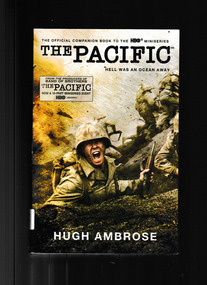
Book, The Text Publishing Company, The Pacific, 2010
... World War 1939-1945 - Campaigns - Pacific area World war 1939 – 1945 – Personal narratives – United States Historian Hugh Ambrose deepens the experience of the HBO miniseries The Pacific, produced by Steven Spielberg and Tom Hanks and broadcast on the Seven Network. These are the true stories of the men who put their lives on the line for their country, who were dispatched to the other side of the world to fight an enemy who preferred suicide to surrender; men who suffered hardship and humiliation in POW camps; men who witnessed casualties among soldier and civilian alike; and men whose medals came at a shocking price. ...Historian Hugh Ambrose deepens the experience of the HBO miniseries The Pacific, produced by Steven Spielberg and Tom Hanks and broadcast on the Seven Network. These are the true stories of the men who put their lives on the line for their country, who were dispatched to the other side of the world to fight an enemy who preferred suicide to surrender; men who suffered hardship and humiliation in POW camps; men who witnessed casualties among soldier and civilian alike; and men whose medals came at a shocking price. Covering nearly four years of combat, with unprecedented access to military records, letters, journals, memoirs, photographs and interviews, this volume offers a unique historical perspective on the war against Japan-and ultimately the triumphant yet uneasy return home.Ill, map, p.449.non-fictionHistorian Hugh Ambrose deepens the experience of the HBO miniseries The Pacific, produced by Steven Spielberg and Tom Hanks and broadcast on the Seven Network. These are the true stories of the men who put their lives on the line for their country, who were dispatched to the other side of the world to fight an enemy who preferred suicide to surrender; men who suffered hardship and humiliation in POW camps; men who witnessed casualties among soldier and civilian alike; and men whose medals came at a shocking price. Covering nearly four years of combat, with unprecedented access to military records, letters, journals, memoirs, photographs and interviews, this volume offers a unique historical perspective on the war against Japan-and ultimately the triumphant yet uneasy return home. world war 1939-1945 - campaigns - pacific area, world war 1939 – 1945 – personal narratives – united states -
 National Wool Museum
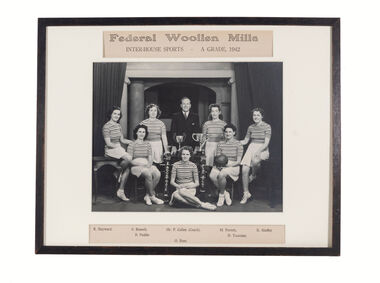
Photograph, Federal Woollen Mills, Interhouse Sports, A Grade 1942, 1942
... Local Geelong business, such as the surrounding woollen mills, business firms and church clubs would form teams of seven women to compete in a variety of sports such as bowls, basketball, hockey, cricket and soccer. Events such as these were organised to encourage women to participate in competitive sports and network with other women in the workforce....Local Geelong business, such as the surrounding woollen mills, business firms and church clubs would form teams of seven women to compete in a variety of sports such as bowls, basketball, hockey, cricket and soccer. Events such as these were organised to encourage women to participate in competitive sports and network with other women in the workforce. woollen mills - history woollen mills textile mills - staff sporting teams classweave industries pty ltd federal woollen mills ltd sport woollen mills - history woollen mills textile mills - staff sporting teams Federal Woollen Mills, Interhouse Sports, A Grade 1942 The Lockwood Studios/ Geelong Framed photograph Federal Woollen Mills, Interhouse Sports, A Grade 1942 Photograph Photograph ...Between the 1920’s and 1950’s the YWCA, Blue Triangle and local committee of representatives organised an Inter House Athletics Day for Girls in Geelong and Melbourne. Local Geelong business, such as the surrounding woollen mills, business firms and church clubs would form teams of seven women to compete in a variety of sports such as bowls, basketball, hockey, cricket and soccer. Events such as these were organised to encourage women to participate in competitive sports and network with other women in the workforce.Framed photographFederal Woollen Mills, Interhouse Sports, A Grade 1942 The Lockwood Studios/ Geelongwoollen mills - history woollen mills textile mills - staff sporting teams, classweave industries pty ltd federal woollen mills ltd, sport, woollen mills - history, woollen mills, textile mills - staff, sporting teams -
 National Wool Museum
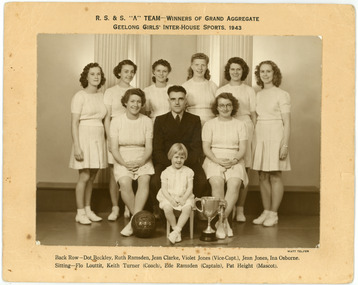
Photograph, R.S.S. "A" Team - Winners of Grand Aggregate, Geelong Girls' Interhouse Sports, 1943, 1943
... Local Geelong business, such as the surrounding woollen mills, business firms and church clubs would form teams of seven women to compete in a variety of sports such as bowls, basketball, hockey, cricket and soccer. Events such as these were organised to encourage women to participate in competitive sports and network with other women in the workforce. textile mills - sporting teams textile mills returned soldiers and sailors mill sport textile mills - sporting teams textile mills Top edge - R.S.S. ...Photograph depicts the R.S.S. "A" Team - Winners of Grand Aggregate, Geelong Girls' Interhouse Sports, 1943. Those photographed are: Dot Beckley, Ruth Ramsden, Jean Clarke, Violet Jones (Vice Capt), Jean Jones, Ina Osborne, Flo Louttit, Keith Turner (Coach), Ede Ramsden, (Captain), Pat Height (Mascot). Between the 1920’s and 1950’s the YWCA, Blue Triangle and local committee of representatives organised an Inter House Athletics Day for Girls in Geelong and Melbourne. Local Geelong business, such as the surrounding woollen mills, business firms and church clubs would form teams of seven women to compete in a variety of sports such as bowls, basketball, hockey, cricket and soccer. Events such as these were organised to encourage women to participate in competitive sports and network with other women in the workforce.Photograph depicts the R.S.S. "A" Team - Winners of Grand Aggregate, Geelong Girls' Interhouse Sports, 1943.Top edge - R.S.S. "A" Team - Winners of Grand Aggregate, Geelong Girls' Interhouse Sports, 1943. Bottom edge - Back row - Dot Beckley, Ruth Ramsden, Jean Clarke, Violet Jones (Vice Capt), Jean Jones, Ina Osborne / Sitting - Flo Louttit, Keith Turner (Coach), Ede Ramsden, (Captain), Pat Height (Mascot)textile mills - sporting teams textile mills, returned soldiers and sailors mill, sport, textile mills - sporting teams, textile mills -
 National Wool Museum
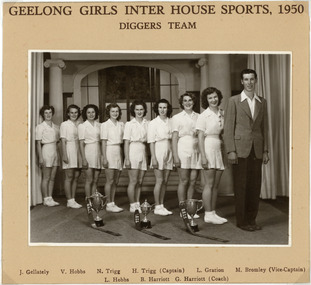
Photograph, Geelong Girls Inter House Sports, 1950: Diggers Team, 1950
... Local Geelong business, such as the surrounding woollen mills, business firms and church clubs would form teams of seven women to compete in a variety of sports such as bowls, basketball, hockey, cricket and soccer. Events such as these were organised to encourage women to participate in competitive sports and network with other women in the workforce....Local Geelong business, such as the surrounding woollen mills, business firms and church clubs would form teams of seven women to compete in a variety of sports such as bowls, basketball, hockey, cricket and soccer. Events such as these were organised to encourage women to participate in competitive sports and network with other women in the workforce. textile mills - sporting teams sport GEELONG GIRLS INTER HOUSE SPORTS, 1950 / DIGGERS TEAM / J. ...Photograph of the Diggers team who participated in the Geelong Girls Interhouse Sports, 1950. The Diggers team was possibly drawn from those who worked at the RSS Mill. Members of the team are J. Gellately, V. Hobbs, N. Trigg, H. Trigg (Captain), L. Gration, M. Bromley (Vice-Captain), L. Hobbs, B. Harriott, G. Harriott (coach). Between the 1920’s and 1950’s the YWCA, Blue Triangle and local committee of representatives organised an Inter House Athletics Day for Girls in Geelong and Melbourne. Local Geelong business, such as the surrounding woollen mills, business firms and church clubs would form teams of seven women to compete in a variety of sports such as bowls, basketball, hockey, cricket and soccer. Events such as these were organised to encourage women to participate in competitive sports and network with other women in the workforce.GEELONG GIRLS INTER HOUSE SPORTS, 1950 / DIGGERS TEAM / J. Gellately V. Hobbs N. Trigg H. Trigg (Captain) L. Gration M. Bromley (Vice-Captain) / L. Hobbs B. Harriott G. Harriott (Coach)textile mills - sporting teams, sport -
 National Wool Museum
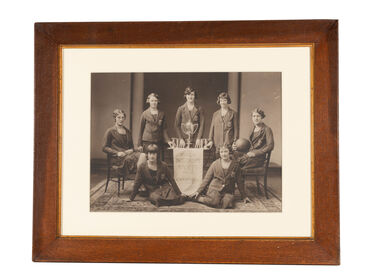
Photograph, Girls Interhouse Sports Champions 1931, 1931
... Local Geelong business, such as the surrounding woollen mills, business firms and church clubs would form teams of seven women to compete in a variety of sports such as bowls, basketball, hockey, cricket and soccer. Events such as these were organised to encourage women to participate in competitive sports and network with other women in the workforce....Local Geelong business, such as the surrounding woollen mills, business firms and church clubs would form teams of seven women to compete in a variety of sports such as bowls, basketball, hockey, cricket and soccer. Events such as these were organised to encourage women to participate in competitive sports and network with other women in the workforce. textile mills sporting teams sport textile mills - sporting teams Back Row L-R: M. ...Photograph of Girls Interhouse Sports Champions in 1931. Between the 1920’s and 1950’s the YWCA, Blue Triangle and local committee of representatives organised an Inter House Athletics Day for Girls in Geelong and Melbourne. Local Geelong business, such as the surrounding woollen mills, business firms and church clubs would form teams of seven women to compete in a variety of sports such as bowls, basketball, hockey, cricket and soccer. Events such as these were organised to encourage women to participate in competitive sports and network with other women in the workforce.Framed photograph of the Girls Interhouse Sports Champions 1931.Back Row L-R: M. Paley, Kath Whelan, Olive Dodds, Fairbrother and Mabel Chapman Front Row L-R Kathy and Mooney Nhiel.textile mills sporting teams, sport, textile mills - sporting teams -
 National Wool Museum
Photograph
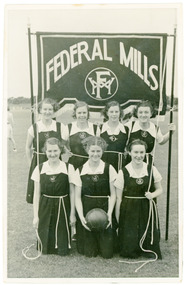
... Local Geelong business, such as the surrounding woollen mills, business firms and church clubs would form teams of seven women to compete in a variety of sports such as bowls, basketball, hockey, cricket and soccer. Events such as these were organised to encourage women to participate in competitive sports and network with other women in the workforce....Local Geelong business, such as the surrounding woollen mills, business firms and church clubs would form teams of seven women to compete in a variety of sports such as bowls, basketball, hockey, cricket and soccer. Events such as these were organised to encourage women to participate in competitive sports and network with other women in the workforce. textile mills sporting teams textile mills staff federal woollen mills ltd sport textile mills - sporting teams textile mills - staff FEDERAL MILLS / FWM Photograph Photograph ...Photo depicts the Federal Mills basketball team. Back: Gladys Rand, Mavis Anderson, Nellie Bawden, Lyla Dorling. Front: Jean Mawson, Eva Fagen, Jean Devlin. Mrs Alsop was a mill worker from early 1930s till early 1970s. She worked at Federal and Foster Mills in Geelong District and Yarra Falls, Melbourne. Between the 1920’s and 1950’s the YWCA, Blue Triangle and local committee of representatives organised an Inter House Athletics Day for Girls in Geelong and Melbourne. Local Geelong business, such as the surrounding woollen mills, business firms and church clubs would form teams of seven women to compete in a variety of sports such as bowls, basketball, hockey, cricket and soccer. Events such as these were organised to encourage women to participate in competitive sports and network with other women in the workforce.FEDERAL MILLS / FWMtextile mills sporting teams, textile mills staff, federal woollen mills ltd, sport, textile mills - sporting teams, textile mills - staff -
 National Wool Museum
Photograph, c1943
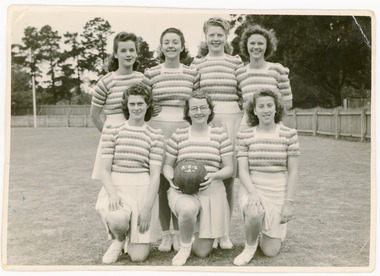
... Local Geelong business, such as the surrounding woollen mills, business firms and church clubs would form teams of seven women to compete in a variety of sports such as bowls, basketball, hockey, cricket and soccer. Events such as these were organised to encourage women to participate in competitive sports and network with other women in the workforce. textile mills staff textile mills sporting teams textile mills returned soldiers and sailors mill sport photographs textile mills - staff textile mills - sporting teams Depicts seven members of an R.S. ...Depicts seven members of an R.S.&S. Mill 'A' basketball team. Those pictured are: Dorothy Beckley, Ruth Ramsden, Violet Jones, Jean Clark, Jean Jones, Edie Ramsden, Pat Rogan.Between the 1920’s and 1950’s the YWCA, Blue Triangle and local committee of representatives organised an Inter House Athletics Day for Girls in Geelong and Melbourne. Local Geelong business, such as the surrounding woollen mills, business firms and church clubs would form teams of seven women to compete in a variety of sports such as bowls, basketball, hockey, cricket and soccer. Events such as these were organised to encourage women to participate in competitive sports and network with other women in the workforce.Depicts seven members of an R.S.&S. Mill 'A' basketball team.textile mills staff, textile mills sporting teams, textile mills, returned soldiers and sailors mill, sport, photographs, textile mills - staff, textile mills - sporting teams -
 National Wool Museum
Archive - Soroptimist Project Quilt 2000 Brochure, Soroptimist International, 2000
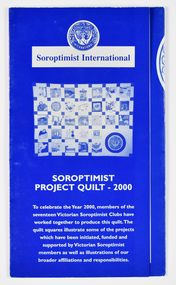
... network of around 72,000 club members in 121 countries. Advocating for human rights and gender equality, at the heart of Soroptimist International’s advocacy is its work across seven UN Centres, where UN representatives ensure that the voices of women and girls are heard. ...network of around 72,000 club members in 121 countries. Advocating for human rights and gender equality, at the heart of Soroptimist International’s advocacy is its work across seven UN Centres, where UN representatives ensure that the voices of women and girls are heard. ...Brochure to accompany the Soroptimist Quilt Project 2000. The quilt was made by members of seventeen Soroptimist International clubs across Victoria to celebrate the Year 2000. The quilt squares illustrate some of the projects initiated, funded and supported by Victorian Soroptimists as well as illustrations of broader affiliations and responsibilities, including to the UN. Examples include the S.I.A.M. (Soroptimist International Aids Mediation) project by SI Berwick in Northern Thai villages which established industries and health programs for women and girls as viable alternatives to the sex industry. Revegetation of woodlands, wetlands and cleared land by SI Deakin. Donation of toiletries to women's shelters, police lock ups and church emergency centres in the western suburbs of Melbourne by SI Cut Paw Paw. Founded in 1921, Soroptimist International is a global volunteer movement with a network of around 72,000 club members in 121 countries. Advocating for human rights and gender equality, at the heart of Soroptimist International’s advocacy is its work across seven UN Centres, where UN representatives ensure that the voices of women and girls are heard. Memberships work on grassroots projects that help women and girls achieve their individual and collective potential, realise aspirations and have an equal voice in communities worldwide. It has a flourishing Club in Geelong. The quilt has been displayed in Soroptimist Headquarters Victoria at 383 Toorak Road, South Yarra (Soroptimist House) since touring the State of Victoria in 2000. Soroptimist House has been sold with the funds raised to go to furthering the objects of Soroptimism.A3 sized folded brochure printed in blue and white depicting images and text relating to squares of the Soroptimist Project Quilt 2000.front: [printed] SOROPTIMIST / INTERNATIONAL / Soroptimist International / SOROPTIMIST / PROJECT QUILT - 2000 / To celebrate the Year 2000, members of the / seventeen Victorian Soroptimist Clubs have / worked together to produce this quilt. The / quilt squares illustrate some of the projects / which have been initiated, funded and / supported by Victorian Soroptimist / members as well as illustrations of our / broader affiliations and responsibilities.quilt, women, soroptimist, victoria, community, clubs, human rights, gender equality, united nations -
 National Wool Museum
Textile - Soroptimist Project Quilt, Soroptimist International, 2000
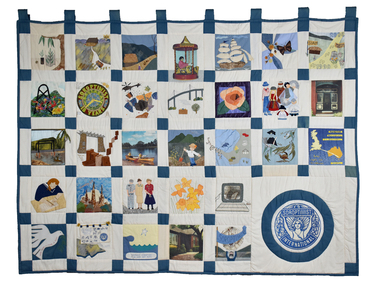
... network of around 72,000 club members in 121 countries. Advocating for human rights and gender equality, at the heart of Soroptimist International’s advocacy is its work across seven UN Centres, where UN representatives ensure that the voices of women and girls are heard. ...network of around 72,000 club members in 121 countries. Advocating for human rights and gender equality, at the heart of Soroptimist International’s advocacy is its work across seven UN Centres, where UN representatives ensure that the voices of women and girls are heard. ...The quilt was made by members of seventeen Soroptimist International clubs across Victoria to celebrate the Year 2000. The quilt squares illustrate some of the projects initiated, funded and supported by Victorian Soroptimists as well as illustrations of broader affiliations and responsibilities, including to the UN. Examples include the S.I.A.M. (Soroptimist International Aids Mediation) project by SI Berwick in Northern Thai villages which established industries and health programs for women and girls as viable alternatives to the sex industry. Revegetation of woodlands, wetlands and cleared land by SI Deakin. Donation of toiletries to women's shelters, police lock ups and church emergency centres in the western suburbs of Melbourne by SI Cut Paw Paw. Founded in 1921, Soroptimist International is a global volunteer movement with a network of around 72,000 club members in 121 countries. Advocating for human rights and gender equality, at the heart of Soroptimist International’s advocacy is its work across seven UN Centres, where UN representatives ensure that the voices of women and girls are heard. Memberships work on grassroots projects that help women and girls achieve their individual and collective potential, realise aspirations and have an equal voice in communities worldwide. It has a flourishing Club in Geelong. The quilt was displayed from 2001 until 2023 in Soroptimist Headquarters Victoria at 383 Toorak Road, South Yarra (Soroptimist House) since touring the State of Victoria in 2000. Soroptimist House has been sold with the funds raised to go to furthering the objectives of Soroptimism.Cream patchwork quilt with 31 squares depicting various scenes and motifs. The Soroptimist logo features in the bottom right corner.quilt, women, soroptimist, victoria, community, clubs, human rights, gender equality, united nations -
 Robin Boyd Foundation
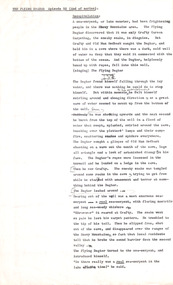
Document - Script, Robin Boyd, The Flying Dogtor. Episode 52 End of Series, 1963
... The Flying Dogtor" series was broadcast on Australian Television Network (later becoming the Seven Network) between February and April 1964 (see item D254 for schedule). ...This is the last episode of 'The Flying Dogtor'. The Dogtor found himself falling through the icy water, and there was nothing he could do to stop himself. But suddenly, he was shooting upwards and burst through the top of the well. A real sea serpent came to the Dogtor's rescue. Sir Thomas Persian, the Minister of Fishery, was so delighted when he learned that the mystery of the lake was solved, that he held a big parade through the streets of Canberra in honour of The Flying Dogtor.The Flying Dogtor" series was broadcast on Australian Television Network (later becoming the Seven Network) between February and April 1964 (see item D254 for schedule).Typewritten, carbon copy, foolscap, 2 pagesHandwritten pencil edits and additions.the flying dogtor, robin boyd, crawford productions, manuscript, ohm2022, ohm2022_4 -
 Robin Boyd Foundation
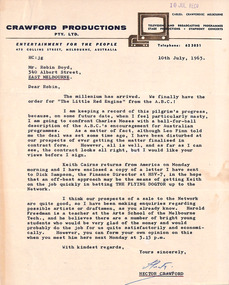
Letter, Hector Crawford, Letter from Hector Crawford to Robin Boyd, 10.07.1963
... The Flying Dogtor" series was broadcast on Australian Television Network (later becoming the Seven Network) between February and April 1964 (see item D254 for schedule). ...Letter from Hector Crawford, Managing Director of Crawford Productions, regarding the prospect of selling ‘The Flying Dogtor’ to HSV 7.The Flying Dogtor" series was broadcast on Australian Television Network (later becoming the Seven Network) between February and April 1964 (see item D254 for schedule).Typewritten, quarto, 2 pagesthe flying dogtor, robin boyd, crawford productions -
 Robin Boyd Foundation
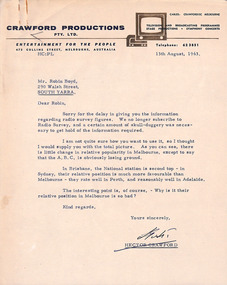
Letter, Hector Crawford, Letter from Hector Crawford to Robin Boyd, 13.08.1963
... The Flying Dogtor" series was broadcast on Australian Television Network (later becoming the Seven Network) between February and April 1964 (see item D254 for schedule). radio survey data radio ratings The Flying Dogtor Robin Boyd Crawford Productions Typewritten, quarto, one page letter. ...Letter from Hector Crawford, Managing Director of Crawford Productions, and attached document provides information regarding 1963 radio survey figures (ratings) gauging relative popularity of stations in Australian cities.The Flying Dogtor" series was broadcast on Australian Television Network (later becoming the Seven Network) between February and April 1964 (see item D254 for schedule).Typewritten, quarto, one page letter. Attached document is 7 foolscap, typed pages.radio survey data, radio ratings, the flying dogtor, robin boyd, crawford productions -
 Robin Boyd Foundation
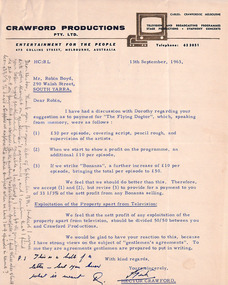
Letter, Hector Crawford, Letter from Hector Crawford to Robin Boyd, 13.09.1963
... The Flying Dogtor" series was broadcast on Australian Television Network (later becoming the Seven Network) between February and April 1964 (see item D254 for schedule). ...Letter from Hector Crawford, Managing Director of Crawford Productions, regarding Robin Boyd's fees for 'The Flying Dogtor', and reply by Robin Boyd (20 September 1963).The Flying Dogtor" series was broadcast on Australian Television Network (later becoming the Seven Network) between February and April 1964 (see item D254 for schedule).Typewritten, quarto, one page.Crawford has added a PS in pen. Robin Boyd has drafted a handwritten reply on the side in pencil. Typewritten carbon copy (foolscap) reply attached.the flying dogtor, robin boyd, crawford productions -
 Robin Boyd Foundation
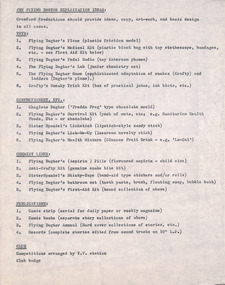
Document, The Flying Dogtor Exploitation Ideas
... The Flying Dogtor" series was broadcast on Australian Television Network (later becoming the Seven Network) between February and April 1964 (see item D254 for schedule). ...Exploitation ideas' document is a list of possible merchandising ideas for The Flying Dogtor series.The Flying Dogtor" series was broadcast on Australian Television Network (later becoming the Seven Network) between February and April 1964 (see item D254 for schedule).Typewritten, quarto, one pagethe flying dogtor, robin boyd, crawford productions -
 Robin Boyd Foundation
Document, Crawford Productions, Production schedule breakdown, 1963
... The Flying Dogtor" series was broadcast on Australian Television Network (later becoming the Seven Network) between February and April 1964. ...The Flying Dogtor production schedule for all 52 episodes including when each episode is broadcast, between February and April 1964.The Flying Dogtor" series was broadcast on Australian Television Network (later becoming the Seven Network) between February and April 1964.Typewritten carbon copy cutoff page, plus double page foolscap handwritten tabular schedule.the flying dogtor, robin boyd, crawford productions -
 Robin Boyd Foundation
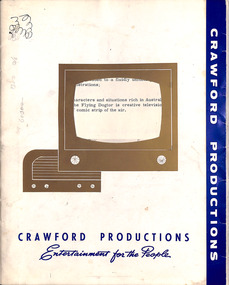
Booklet, The Flying Dogtor Booklet, 1963
... The Flying Dogtor" series was broadcast on Australian Television Network (later becoming the Seven Network) between February and April 1964 (see item D254 for schedule). ...This is an illustrated booklet which presents a concept proposal for 'The Flying Dogtor' television programme - described as a new kind of comic strip for television, with animal characters from the Australian bush. The hero is the great Dogtor Dane and the crafty villain is Carson Carpetbag. Two child psychologists were consulted. At the back of the booklet, sketches were inserted (item D256).The Flying Dogtor" series was broadcast on Australian Television Network (later becoming the Seven Network) between February and April 1964 (see item D254 for schedule).Typewritten, illustrated, printed and bound in a cardboard folder with a TV shaped cut out. 9 pages.Doodles on front cover.the flying dogtor, robin boyd, crawford productions -
 Robin Boyd Foundation
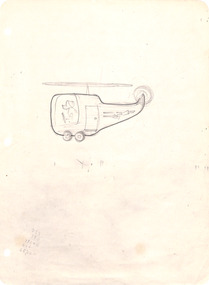
Document - Illustrations, The Flying Dogtor Illustrations, 1963
... The Flying Dogtor" series was broadcast on Australian Television Network (later becoming the Seven Network) between February and April 1964 (see item D254 for schedule). ...See D255. Sketches inserted at the back of an illustrated book on The Flying Dogtor' proposal.The Flying Dogtor" series was broadcast on Australian Television Network (later becoming the Seven Network) between February and April 1964 (see item D254 for schedule).Original pencil hand drawnthe flying dogtor, robin boyd, crawford productions, ohm2022, ohm2022_4 -
 Robin Boyd Foundation
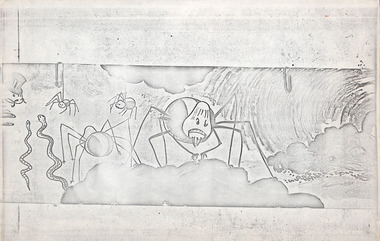
Document - Illustrations, The Flying Dogtor Illustrations, 1963
... The Flying Dogtor" series was broadcast on Australian Television Network (later becoming the Seven Network) between February and April 1964 (see item D254 for schedule). ...These are possibly the telescript illustrations used in 'The Flying Dogtor' television programme.The Flying Dogtor" series was broadcast on Australian Television Network (later becoming the Seven Network) between February and April 1964 (see item D254 for schedule).Photocopy of original pencil hand drawnthe flying dogtor, robin boyd, crawford productions -
 Robin Boyd Foundation
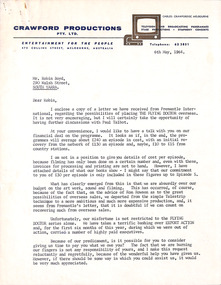
Letter, Hector Crawford, Hector Crawford (Crawford Productions) to Robin Boyd, 06.05.1964
... The Flying Dogtor" series was broadcast on Australian Television Network (later becoming the Seven Network) between February and April 1964 (see item D254 for schedule). ...Letter regarding ‘The Flying Dogtor’ production cost increases and delayed payments to Robin Boyd. Attached is a letter (4 May 1964) from Fremantle International about overseas distribution and an episode cost schedule. The Flying Dogtor" series was broadcast on Australian Television Network (later becoming the Seven Network) between February and April 1964 (see item D254 for schedule).Typewritten, quarto, 2 page letter, with 2 page quarto attachment and foolscap typed page.the flying dogtor, robin boyd, crawford productions -
 Robin Boyd Foundation
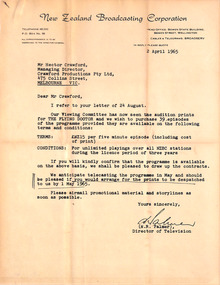
Letter, Correspondence between New Zealand Broadcasting Corporation and Hector Crawford, Apr-65
... The Flying Dogtor" series was broadcast on Australian Television Network (later becoming the Seven Network) between February and April 1964 (see item D254 for schedule). ...Letter of confirmation, from New Zealand Broadcasting Corporation, of purchase of 39 episodes of ‘The Flying Dogtor’ and increasing purchase to 52 episodes.The Flying Dogtor" series was broadcast on Australian Television Network (later becoming the Seven Network) between February and April 1964 (see item D254 for schedule).Typewritten, quarto, 2 pages + "with compliments" note cardthe flying dogtor, crawfords, new zealand broadcasting corporation -
 Robin Boyd Foundation
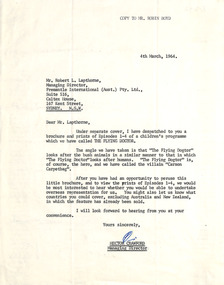
Letter, Hector Crawford to Robert Lapthorne, 04.03.1964
... The Flying Dogtor series was broadcast on Australian Television Network (later becoming the Seven Network) between February and April 1964. ...This letter is about overseas representation for The Flying Dogtor. It describes the program as follows: The Flying Dogtor looks after bush animals in the similar manner as The Flying Doctor looks after humans. The Flying Dogtor is the hero and Carson Carpetbag is the villain.The Flying Dogtor series was broadcast on Australian Television Network (later becoming the Seven Network) between February and April 1964.Typewritten, one page -
 Robin Boyd Foundation
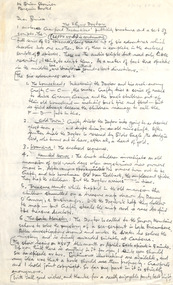
Letter, Robin Boyd, Robin Boyd to Brian Stonier, Penguin Books, 03.03.1964
... The Flying Dogtor" series was broadcast on Australian Television Network (later becoming the Seven Network) between February and April 1964. ...This letter accompanies a Crawford Productions publicity brochure and a set of scripts for The Flying Dogtor. A synopsis of the six adventures is included. The programs are each five minutes and will be aired starting March or April 1964. Boyd is suggesting that Penguin might be interested in publishing the scripts, accompanied by many illustrations.The Flying Dogtor" series was broadcast on Australian Television Network (later becoming the Seven Network) between February and April 1964.2 pages: 1st page handwritten, 2nd page typewritten (duplication of letter)the flying dogtor, robin boyd, brian stonier, penguin books
