
Showing 40 items matching "shoe trade"
-
 Bendigo Historical Society Inc.
Document - The Tanners and Curriers' Journal and Shoe Trade Review, 1/5/1884
... The Tanners and Curriers' Journal and Shoe Trade Review...The Tanners and Curriers' Journal and Shoe Trade Review London May 1st 1884, Cover and two other pages of the document; wanted Ads; latest trade news. 32 pages...The business continued trading under the name J H Abbott & Co. history bendigo abbott collection The Tanners and Curriers' Journal and Shoe Trade Review London May 1st 1884, Cover and two other pages of the document; wanted Ads; latest trade news. 32 pages Document The Tanners and Curriers' Journal and Shoe Trade Review ...Joseph Henry Abbott founded the business in 1853 with a store that supplied everyday essential items to those seeking their fortune on the goldfields. The timing and choice of store ensured that he would become a prominent part of the Bendigo business scene. Abbott's next venture was to establish the New Times Boot Market & Factory in Pall Mall, Sandhurst. In 1867, his wife took over running the shop which was located next to the Bendigo Arcade near Williamson Street. In 1876, the leather business of T Baulderstone was purchased, and operations were further expanded later by the acquisition of the Edinburgh Tannery at Sheepwash Creek, and The Edinburgh Leather & Grindery warehouse in Bull Street, Sandhurst. In 1889, Joseph Abbott passed all interests in the business to his son, who shared the same name, in partnership with an adopted son, Richard Hartley Smith Abbott. The business continued trading under the name J H Abbott & Co.The Tanners and Curriers' Journal and Shoe Trade Review London May 1st 1884, Cover and two other pages of the document; wanted Ads; latest trade news. 32 pageshistory, bendigo, abbott collection -
 NMIT (Northern Melbourne Institute of TAFE)
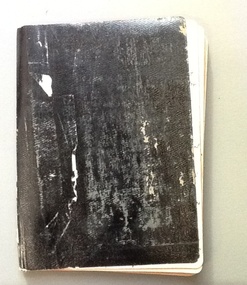
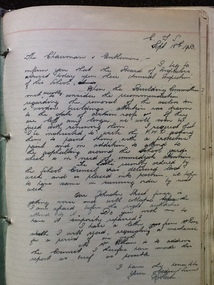
Minutes - CTS, Minutes of Boot and Shoe Advisory Committee, Collingwood Technical School. 1924-1930, 1924-1930
... ...Shoe trade...Minutes of the Boot and Shoe Advisory Committee containing information about the Boot and Trade section of Collingwood Technical School from 1924-1930. ...Collingwood Technical School CTS Boot trade Shoe trade Boot and Shoe Advisory Committee NMIT All entries are handwritten. ...Minutes of the Boot and Shoe Advisory Committee containing information about the Boot and Trade section of Collingwood Technical School from 1924-1930. Includes information regarding early applicants to teach in this area.Early minutes relating to Collingwood Technical School.Black covered exercise book containing handwritten minutes.All entries are handwritten.collingwood technical school, cts, boot trade, shoe trade, boot and shoe advisory committee, nmit, -
 NMIT (Northern Melbourne Institute of TAFE)
Minutes - CTS, Minutes of Boot and Shoe Advisory Committee, Collingwood Technical School. 1930-1953, 1930-1953
... ...Shoe trade...Collingwood Technical School CTS Boot trade Shoe trade Boot and Shoe Advisory Committee NMIT On spine of folder: "Boot + / Shoe / Adv.Comm / Minutes" Hard cover ring binder covered in grey fabric. ...This Advisory Committee deals with all aspects of training students and apprentices to work in the Boot Trade.Minutes dealing with all aspects of the boot and shoe industry.Hard cover ring binder covered in grey fabric. Includes both hand written and typed minutes.On spine of folder: "Boot + / Shoe / Adv.Comm / Minutes"collingwood technical school, cts, boot trade, shoe trade, boot and shoe advisory committee, nmit, -
NMIT (Northern Melbourne Institute of TAFE)
Folder: Of documents, forms and articles used for researching the history of CTS
... Folder of articles, documents and forms on the history of CTS including: Educational reform from the end of the 19th century; Appointment of M Richmond; Classes started; Enrolments – Student Numbers; Finance Support; First Council meeting; Buildings; Sports; Notes of speech at Laying of foundation stone of boot and shoe trade school on 21st February 1945 by the Hon. ...Collingwood Technical School History Paul Scofield NMIT Folder of articles, documents and forms on the history of CTS including: Educational reform from the end of the 19th century; Appointment of M Richmond; Classes started; Enrolments – Student Numbers; Finance Support; First Council meeting; Buildings; Sports; Notes of speech at Laying of foundation stone of boot and shoe trade school on 21st February 1945 by the Hon. ...Folder of articles, documents and forms on the history of CTS including: Educational reform from the end of the 19th century; Appointment of M Richmond; Classes started; Enrolments – Student Numbers; Finance Support; First Council meeting; Buildings; Sports; Notes of speech at Laying of foundation stone of boot and shoe trade school on 21st February 1945 by the Hon. T. T. Hollway, MLA, Minister of Education; Extra-curricular activities; Discipline; Certificates and Exams; Ethnic intake era 1950s, 60s, 70s; TAFE student statistics; Split with TAFE 1980s;collingwood technical school, history, paul scofield, nmit -
NMIT (Northern Melbourne Institute of TAFE)
Folder: Bound folder of newspaper cuttings 1960-1979, and Invitations to ceremonies and exhibitions 1935 to 1979
... Invitation card to the laying of foundation stone of the Boot and Shoe Trade School of Collingwood Technical School on 21st February 1945. ...Invitation card to the laying of foundation stone of the Boot and Shoe Trade School of Collingwood Technical School on 21st February 1945. ...Large bound folder consisting of various items pasted into it. Includes: Invitation to the Exhibition of Prahran Technical School students work on 11 November 1930. Invitation card to the laying of foundation stone of the Boot and Shoe Trade School of Collingwood Technical School on 21st February 1945. Invitation card to the Collingwood Technical School Annual exhibition of students’ hobbies on 23rd May, 1935. Newspaper cuttings dating from 14 January 1960 to 26 July 1978 related to technical education and plans for Otter Street Collingwood building . Flyer for the Collingwood Technical School Golden Jubilee of on 20 July 1962. Program for Collingwood Technical College Annual Award Night 9 December 1970. Collingwood Technical School 1971 handbook. Program for Collingwood Technical College Apprentice Award Night 22 July 1971. Invitation card and program for Official Opening of Alex & Doris Cowmeadow Wings of Camp Westlake 14 November 1971 Collingwood Technical College. Invitation and program for Collingwood Technical College Annual Award night 8 December 1971 collingwood technical school, collingwood technical college, camp westlake, newspaper clippings, nmit -
 Sunshine and District Historical Society Incorporated
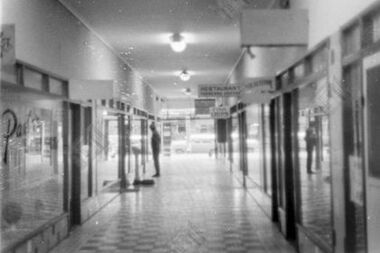
Photograph - 323 Main Rd East - St. Albans Arcade Photograph
... . – Dealer - Arcade Hairdresser - Arcade Trading Co – Shoes This reflects the post‑war migrant boom, when St Albans was rapidly expanding and small shopfronts were essential community hubs. .... – Dealer - Arcade Hairdresser - Arcade Trading Co – Shoes This reflects the post‑war migrant boom, when St Albans was rapidly expanding and small shopfronts were essential community hubs. ...The St. Albans Arcade was one of first buildings in St. Albans that had various shops under one roof. The earliest listing of the Arcade appears in 1960, showing a lively mix of small migrant‑run businesses typical of early St Albans: - Arcade Fruit Supplies - Mrs Irena Leczycki – Delicatessen - St Albans Fish Shop - Kenroniee Café - Violet Gift & Hardware - Arcade Butcher - Brotherhood of St Laurence – Dealer - Kanizsay, A. – Dealer - Arcade Hairdresser - Arcade Trading Co – Shoes This reflects the post‑war migrant boom, when St Albans was rapidly expanding and small shopfronts were essential community hubs. In 1970, the Arcade included: - T.A.B. of Victoria - Hampshire Real Estate Agency - Wittner’s Pty Ltd – Boot Retailer - Marta’s Beauty Saloon - Georgiou, P. – Hairdresser This marks the Arcade’s shift from purely retail to professional services, reflecting St Albans’ growing population and commercial maturity.5666 - Main Rd East 323 - St. Albans Arcade 1970's Photo 01.jpgmain road east, st. albans, st. albans arcade -
 Flagstaff Hill Maritime Museum and Village
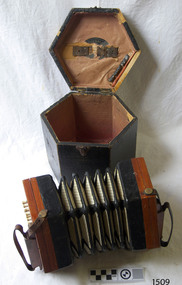
Instrument - Concertina, Lachenal and Co, 1879-1933
... trade mark 15222...english-style reed...richard ballinger...Louis Lachenal...concertina manufacturer...reed-shoe...A Trade Mark application was made by Richard Ballinger on behalf of Lachenal & Co. on 31st August 1878 and the Number 19,555 was published in the Trade Mark Journal January 8, 1879. The symbol was an English-style reed-shoe with the words 'Trade Mark' and 'English Make'. ...Label within oval cut-out "LACHENAL & Co / PATENT CONCERTINA / MANUFACTURERS / LONDON", Label inside lid " - CHENAL -", Impressed into wood STEEL REEDS", "ENGLAND", "TRADE MARK ENGLISH MAKE [reed-shoe symbol]" , (originally marked with Number "98030" )...A Trade Mark application was made by Richard Ballinger on behalf of Lachenal & Co. on 31st August 1878 and the Number 19,555 was published in the Trade Mark Journal January 8, 1879. The symbol was an English-style reed-shoe with the words 'Trade Mark' and 'English Make'. ...Louis Lachenal manufactured concertinas for C Wheatstone & Co. from around 1848-1858 in a combined home and manufactory in Cheswick, England. He then establish up his own business 'Lachenal's' at 8 Little James Street in London. In 1863 the firm began advertising both 'Anglo and English concertinas, which were more expensive. Lachenal passed away in 1861, so his wife Elizabeth took over the business. The firm was sold to a group of five businessmen in about 1873 and in 1874 the firm became ‘Lachenal & Co.’ A Trade Mark application was made by Richard Ballinger on behalf of Lachenal & Co. on 31st August 1878 and the Number 19,555 was published in the Trade Mark Journal January 8, 1879. The symbol was an English-style reed-shoe with the words 'Trade Mark' and 'English Make'. It was stamped on the right-hand rail (handle) of the Lachenal Anglos, to distinguish them from the German-made ones. It seems that the company ceased business in 1933.This concertina, made in the late 19th to early 20th century, represents the portable musical entertainment of the early settlers in the colony of Australia. Concertina, six sided, 21 buttons, with fitted case. Wooden ends have carved cut-outs and leather straps attached to brass buttons. Five-fold bellows have light coloured sides with reinforced edges and corners. Constructed with steel reeds and bone key-buttons. Wooden, black fabric-covered hexagonal case with triangular metal catch, two brass hinges, leather handle and faded red lining. Inscriptions on label inside lid and on wooden ends of bellows. Lachenal, Anglo design, made by Lachenal & Co. of London. Label within oval cut-out "LACHENAL & Co / PATENT CONCERTINA / MANUFACTURERS / LONDON", Label inside lid " - CHENAL -", Impressed into wood STEEL REEDS", "ENGLAND", "TRADE MARK ENGLISH MAKE [reed-shoe symbol]" , (originally marked with Number "98030" )flagstaff hill, warrnambool, shipwrecked-coast, flagstaff-hill, flagstaff-hill-maritime-museum, maritime-museum, shipwreck-coast, flagstaff-hill-maritime-village, concertina, squeeze box, musical instrument, london, english make, trade mark 15222, english-style reed, richard ballinger, louis lachenal, concertina manufacturer, reed-shoe, lachenal anglo, lachenal & co, lachenal -
 Federation University Historical Collection
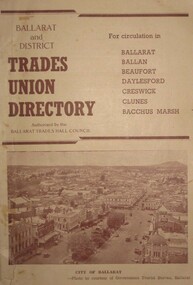
Booklet, Challenge Press Print Geelong, Ballarat and District Trades Union Directory, c1948, c1948
... trade unions trades and labor council trades union Brown soft covered book of 96 pages. Numerous advertisements and illustrations. It includes a listing of unions affiliated with the Trades and Labour Council, Ballarat and extracts and amendments to the Workers' Compensation Act.The book also includes many advertisements including E. Lucas and Co.; Myer Woollen Mills; Day-tex Fabrics (Daylesford); Ballarat Star Dairies; Rowlands Aerated Waters; Menzies Knitwear; Haymes Paints; Paddle Shoes ...The Trades Union Directory was for circulation in Ballarat, Ballan, Beaufort, Daylesford, Creswick, Clunes and Bacchus MarshBrown soft covered book of 96 pages. Numerous advertisements and illustrations. It includes a listing of unions affiliated with the Trades and Labour Council, Ballarat and extracts and amendments to the Workers' Compensation Act.The book also includes many advertisements including E. Lucas and Co.; Myer Woollen Mills; Day-tex Fabrics (Daylesford); Ballarat Star Dairies; Rowlands Aerated Waters; Menzies Knitwear; Haymes Paints; Paddle Shoes; and Ronaldson - Tippett. Includes information on Social Services including old-age pensions and invalid pensions; Extracts and Amendments to the Workers' Compensation Act.union, pension, labor council, trade unions, trades and labor council, trades union -
 Flagstaff Hill Maritime Museum and Village
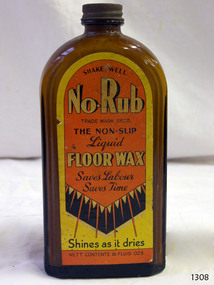
Container - Bottle, J R Alexander & Sons Ltd, c. 1936
... Flagstaff Hill Flagstaff Hill Maritime Museum and Village Warrnambool Maritime Museum Maritime Village Great Ocean Road Shipwreck Coast glass technology bottle glass bottle brown glass cleaning product floor cleaner floor polish domestic cleaner No-Rub floor wax non-slip flat bottle bottle contents liquid wax J R Alexander & Sons household cleaning cleaning products Zippy Starch Zippy Window Cleaner liquid floor wax No Rub floor wax supreme shoe polish rectangular bottle Printed on the label: "SHAKE WELL" "No-Rub" TRADE MARK REGD." ...This bottle labelled No Rub liquid wax proclaims the wonders of No-Rub, no-slip, and shines as it dries. The bottle still contains some of the liquid floor wax, made by J R Alexander & Sons Limited. The company was registered as a limited company from 1924 to 1975. However, the firm's advertisement and referrals from satisfied Melbourne customers, printed in The Argus, Melbourne, on Mach 19th, 1954, states that it made the first shoe polish, Supreme, in Australia as long ago as 1900. The firm made a range of household cleaning products such as floor wax, shoe polish and fabric starch. The J R Alexander & Sons Ltd. No-Rub liquid wax was advertised in various states of Australia from around 1936 until the 1950s. Later advertisements show sketches of the wax containers, which were round bottles or metal cans. The bottle in our collection is likely to be made around the 1960s.Bottle; brown glass with metal cap and yellow, orange and black label on the front. Flat rectangular-shaped bottle with a short neck and rounded shoulders The bottle has a black metal screw top lid and contents inside. There are inscriptions on the label. The bottle contains No Rub Floor Wax. Made by J R Alexander and Sons, of Adelaide, Melbourne, Sydney and BrisbanePrinted on the label: "SHAKE WELL" "No-Rub" TRADE MARK REGD." "THE NON-SLIP / Liquid / FLOOR WAX / Saves Labour / Saves Time" "Shines as it dries" "NETT CONTENTS 15 FLUID OZS"flagstaff hill, flagstaff hill maritime museum and village, warrnambool, maritime museum, maritime village, great ocean road, shipwreck coast, glass technology, bottle, glass bottle, brown glass, cleaning product, floor cleaner, floor polish, domestic cleaner, no-rub, floor wax, non-slip, flat bottle, bottle contents, liquid wax, j r alexander & sons, household cleaning, cleaning products, zippy starch, zippy window cleaner, liquid floor wax, no rub floor wax, supreme shoe polish, rectangular bottle -
 Flagstaff Hill Maritime Museum and Village
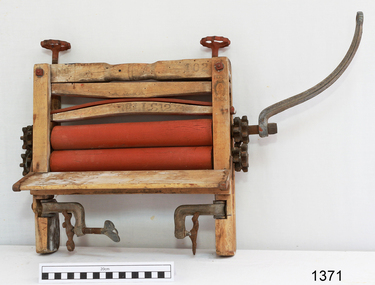
Wringer
... Adjustable pressure clamps on top. Trade Mark of Horse Shoe with "AWCo" inside it . Instructions stamped on wooden slope "THIS WRINGER HAS WARRANTED RUBBER / ROLLS / VULCANISED TO THE SHAFTS / PUT - - - THE BEARINGS / BEFORE USING LARD LOOSEN TOP SCREWS / WHEN THE WRINGER IS NOT IN USE" and "HORSE-SHOE COMBINATION TUB CLAMPS / WILL HOLD WRINGER - - - TO GALVANISED IRON, FIBRE OR WOOD TUBS" . ...Adjustable pressure clamps on top. Trade Mark of Horse Shoe with "AWCo" inside it . Instructions stamped on wooden slope "THIS WRINGER HAS WARRANTED RUBBER / ROLLS / VULCANISED TO THE SHAFTS / PUT - - - THE BEARINGS / BEFORE USING LARD LOOSEN TOP SCREWS / WHEN THE WRINGER IS NOT IN USE" and "HORSE-SHOE COMBINATION TUB CLAMPS / WILL HOLD WRINGER - - - TO GALVANISED IRON, FIBRE OR WOOD TUBS" . ...Washing wringer (or mangle) marked "EXTRA HIGH GRADE WARRANTED" and "102" and " - - -ROLLS 12 - - -" Has orange coloured rollers. Clamps on swivel to clamp onto trough. Adjustable pressure clamps on top. Trade Mark of Horse Shoe with "AWCo" inside it . Instructions stamped on wooden slope "THIS WRINGER HAS WARRANTED RUBBER / ROLLS / VULCANISED TO THE SHAFTS / PUT - - - THE BEARINGS / BEFORE USING LARD LOOSEN TOP SCREWS / WHEN THE WRINGER IS NOT IN USE" and "HORSE-SHOE COMBINATION TUB CLAMPS / WILL HOLD WRINGER - - - TO GALVANISED IRON, FIBRE OR WOOD TUBS" . flagstaff hill, warrnambool, shipwrecked-coast, flagstaff-hill, flagstaff-hill-maritime-museum, maritime-museum, shipwreck-coast, flagstaff-hill-maritime-village, wringer, mangle, laundry, domestic, cleaning, washing wringer, clothes wringer -
 Flagstaff Hill Maritime Museum and Village
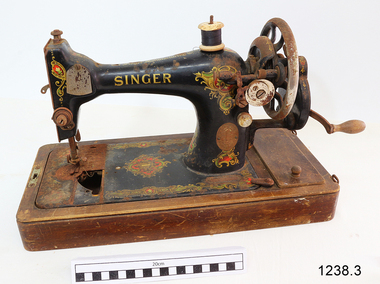
Domestic object - Sewing Machine & case, Singer Sewing Machine Company, 1920
... Trade Mark. Decorative silver swivel cover plate over machine's workings at back of machine. Has small green instructions booklet called "Instructions For Using Singer Machines No 127 and 128." Also wooden base has compartment space for various alternative machine "shoes...Trade Mark. Decorative silver swivel cover plate over machine's workings at back of machine. Has small green instructions booklet called "Instructions For Using Singer Machines No 127 and 128." Also wooden base has compartment space for various alternative machine "shoes ...Sewing machine, hand operated, black with decorative painted patterning in green, red and gold in wood case. On top in Old English print "The Singer Manufacturing Co". Gold discs on front and back with the Singer Trade Mark. Decorative silver swivel cover plate over machine's workings at back of machine. Has small green instructions booklet called "Instructions For Using Singer Machines No 127 and 128." Also wooden base has compartment space for various alternative machine "shoes". Dated 1920 "THE SINGER MACHINE CO. TRADE MARK" plaque on front and back of machine. "The Singer Manufacturing Co." in gold lettering across top of machine. "SINGER" in gold lettering across the front.flagstaff hill, warrnambool, shipwrecked-coast, flagstaff-hill, flagstaff-hill-maritime-museum, maritime-museum, shipwreck-coast, flagstaff-hill-maritime-village, sewing machine, the singer manufacturing co -
 City of Moorabbin Historical Society (Operating the Box Cottage Museum)
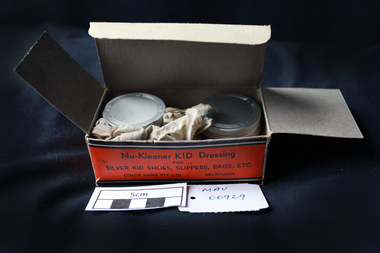
Manufactured Object, shoe polish gold kid, 20thC
... 'top of box ' NU-KLEENER / SHOE DRESSING / GOLD KID / Cant B Beat ( drum soldier trade mark )' side THIS DRESSING IS SCIENTIFICALLY PREPARED BY EXPERTS TO ENSURE NOT ONLY A PERFECT FINISH, BUT ALSO AS A PRESERVATIVE OF THE ARTICLE TREATED,'/ Colour Shine Pty Ltd Melbourne. ...Shoe polish is not a cleaning product, and therefore the footwear should be both clean and dry before application. shoes boots clothing boot preservation leather kid-leather personal effects handbags moorabbin colour shine pty ltd / curton co. pty. ltd 'top of box ' NU-KLEENER / SHOE DRESSING / GOLD KID / Cant B Beat ( drum soldier trade mark )' side THIS DRESSING IS SCIENTIFICALLY PREPARED BY EXPERTS TO ENSURE NOT ONLY A PERFECT FINISH, BUT ALSO AS A PRESERVATIVE OF THE ARTICLE TREATED,'/ Colour Shine Pty Ltd Melbourne. ...Shoe polish is a waxy paste, cream, or liquid used to polish, shine, and waterproof leather shoes or boots to extend the footwear's life, and restore, maintain and improve their appearance. Shoe polish is not a cleaning product, and therefore the footwear should be both clean and dry before application. A cardboard box containing 1 jar of creme polish and 1 jar of gold powder with 2 cloths to be used for preserving 'silver kid shoes, slippers, bags etc.''top of box ' NU-KLEENER / SHOE DRESSING / GOLD KID / Cant B Beat ( drum soldier trade mark )' side THIS DRESSING IS SCIENTIFICALLY PREPARED BY EXPERTS TO ENSURE NOT ONLY A PERFECT FINISH, BUT ALSO AS A PRESERVATIVE OF THE ARTICLE TREATED,'/ Colour Shine Pty Ltd Melbourne. Instructions for use on either end of box . Inside lid a stamp 'Curton Co. Pty Ltd. Melbourne' Jar 1 'NU-KLEENER GOLD KID CREME' Jar 2 'NU-KLEENER GOLD KID POWDER'shoes, boots, clothing, boot preservation, leather, kid-leather, personal effects, handbags, moorabbin, colour shine pty ltd / curton co. pty. ltd -
 City of Moorabbin Historical Society (Operating the Box Cottage Museum)
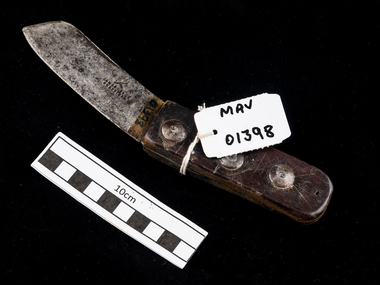
Tools, Knife, curved, Sheffield c1900, 20thC
... shoe and butchers’ knife manufacturer, who was listed in Whitecroft UK in 1822 . By 1825, he was based in Hollis Croft. John apparently died in about 1837. He had two sons – George (1808-1879) and James (1811-1881) who took over the business. George moved to Indianna, USA and in 1868 James continued to manufacture 'Cooks’ and palette knives and steels" Oxley’s trade...shoe and butchers’ knife manufacturer, who was listed in Whitecroft UK in 1822 . By 1825, he was based in Hollis Croft. John apparently died in about 1837. He had two sons – George (1808-1879) and James (1811-1881) who took over the business. George moved to Indianna, USA and in 1868 James continued to manufacture 'Cooks’ and palette knives and steels" Oxley’s trade ...John Oxley was a shoe and butchers’ knife manufacturer, who was listed in Whitecroft UK in 1822 . By 1825, he was based in Hollis Croft. John apparently died in about 1837. He had two sons – George (1808-1879) and James (1811-1881) who took over the business. George moved to Indianna, USA and in 1868 James continued to manufacture 'Cooks’ and palette knives and steels" Oxley’s trade mark was a butcher’s knife crossed with a sharpening steel (and the letters ‘JO’). The firm stayed in the family until 1960. Early settlers were self reliant and repaired their own equipment for kitchen,dairy, farm, horses, carts using various tools . This strong steel knife is typical of the type used by early settlers in Moorabbin Shire c1900Heavy duty curved steel knife with a wide blade encased in 2 thick leather straps secured with steel rivets Blade ; James Oxley with Trade Mark - a butcher’s knife crossed with a sharpening steel (and the letters ‘JO’). scratched into leather handle ; J EVANSknives, sheffield steel, oxley james ltd. , leatherworkers, saddles, horses, bootmakers, shoes, boots, builders, carpenters, early settlers, market gardeners, blacksmiths, tools, building equipment, hammers, moorabbin shire, bentleigh, mckinnon, highett, cheltenham,mcewan james pty ltd, melbourne, bunnings pty ltd, -
 Glenelg Shire Council Cultural Collection
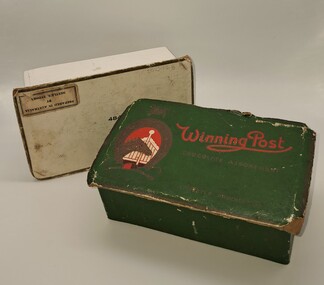
Functional object - Chocolate Box - Winning Post
... Trade Mark / Chocolate Assortment / A Nestle Production - top of box 484 / MSC (very feint stamp) / Prepared in Australia by Nestle's Sydney. The inside of the box still has the inner tissue paper. Chocolate Box. Main colour is a racing green. Red lettering spells out - Sinning Post' There is an image of a horse's head with the mane flowing back as if running. It is running pas the winning post. The horse is brown and is framed in a horse shoe ...Chocolate Box. Main colour is a racing green. Red lettering spells out - Sinning Post' There is an image of a horse's head with the mane flowing back as if running. It is running pas the winning post. The horse is brown and is framed in a horse shoe. Under the image is a depiction of jockey's equipment - whips and hat.Trade Mark / Winning Post / Regd. Trade Mark / Chocolate Assortment / A Nestle Production - top of box 484 / MSC (very feint stamp) / Prepared in Australia by Nestle's Sydney. The inside of the box still has the inner tissue paper.chcolate, confectionary, leisure, winning post, horse -
 Eltham District Historical Society Inc
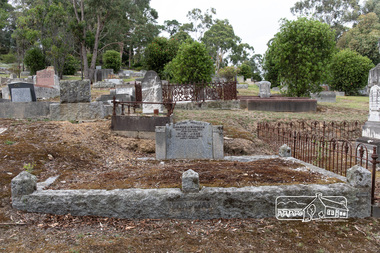
Photograph, Peter Pidgeon, Grave of George and Mary Knapman. Eltham Cemetery, Victoria, 5 April 2021
... George ‘Snowy’ Knapman was a blacksmith by trade. He owned and operated a shoeing forge and wheelwright workshop, known as Snowy Knapman’s Forge, in Main Road Eltham, next door to the Eltham Court House. ...George ‘Snowy’ Knapman was a blacksmith by trade. He owned and operated a shoeing forge and wheelwright workshop, known as Snowy Knapman’s Forge, in Main Road Eltham, next door to the Eltham Court House. ...George Knapman was born c.1851 in Ashburton, Devon, England, the son of George Knapman and Elizabeth Grant nee Wyatt. George, his mother and three sisters arrived in the Port of Melbourne, 28 Jul 1857 aboard the ship, Mindoro from Plymouth, his father having preceded them some eighteen months earlier. George married Mary Jane Williams in 1877 and they settled in Eltham where they had five children; Percival George (1878), Florence Maud (1880), Laura Blanche (1882), Alfred Edgar (1886) and Gladys Victoria (1897). In 1879 George was elected a vestryman for St Margaret’s Church, a position he would be re-elected to for many years. Both he and Mary were active members of the church and social activities. In 1884 George was also engaged in collecting funds for the renovation of the St Helena church George was also a member of the Eltham Cricket Club. In May 1884 following completion of the cricket season, several players banded together to form a group holding fortnightly meetings for the purpose of giving readings, recitations, etc to relieve the dullness of the long winter evenings. Charles Wingrove was elected President, Rev. J.B. Gason Treasurer and George along with Messrs Evans, Bourke, D. McColl, C. Jarrold, George Hill and William Brown, members of the Committee. In 1885, George advertised two horses had strayed from his premises (reward £2) and in 1891 he had a cultivator for sale (price £7/10/-). In 1902 he was treasurer of the Eltham Rifle Club. His children attended Eltham Primary School. In 1904 he was a member of the school's Board of Advice and addressed children at an Arbor Day planting activity. In 1907 he was elected president of the Eltham Progressive League, calling for public toilets to be erected at a local picnic spot. George along with William John Taylor and Isaac Hill was also appointed a Trustee of the Eltham Rechabite Hall in Henry Street on behalf of the Hope of Eltham Tent No. 195 Victoria District Independent Order of Rechabites from December 1901 until its sale to the community in December 1921 for use as a public hall. George ‘Snowy’ Knapman was a blacksmith by trade. He owned and operated a shoeing forge and wheelwright workshop, known as Snowy Knapman’s Forge, in Main Road Eltham, next door to the Eltham Court House. The location was well chosen. Mail coaches from Melbourne passed through Eltham enroute to Christmas Hills and Yarra Glen, with another heading to Kingstown (now Panton Hill). It was common practice for horses to be changed at Eltham. Two photos taken June 4, 1907, captioned ‘Election Day Eltham’, show a large crowd of men assembled in Main Road outside Knapman's premises. They are waiting to vote at the Court House. There are no women in the crowd; they were not empowered to vote. George's brothers William and John were also blacksmiths at Heidelberg, continuing the business established by their father George, who had died in 1900. After William died in 1909, George moved to Heidelberg to take over from him. George died at his residence, ‘Devon’, Yarra Street, Heidelberg on March 16, 1923, and is buried in Eltham Cemetery with his wife Mary who died July 16, 1935, at Kew. Their former house at Eltham was located near where the WW1 Monument was erected in 1919, after they had moved to Heidelberg, at the corner of Bridge Street and Main Road and occupied by Mr. R. Trevena at the time of Mary’s death. Mary was sister to E.J. Williams, W. Williams and Mrs Fawkner, all residents of Eltham. In Loving Memory of George Knapman Died 15th March 1923 Also his wife Mary Jane Died 16th July 1935 Sadly Missed Born Digitaleltham cemetery, gravestones, george knapman, mary jane knapman (nee williams) -
 Kiewa Valley Historical Society
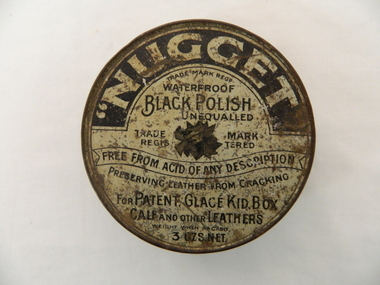
Tin Container Boot Polish
... Consumer awareness and demand for a better product information statement was at its infant stage and the fore front of modern consumer legislation. cleaning polish boots and shoes early consumer warranty Outside tin trade marked "nugget waterproof black polish (unequalled) free from acid or any description preserving leather from cracking. for patent, glace kid, box calf and other leathers" manufactured in Williamstown Australia Rusted round tin container, originally contained shoe or boot polish manufactured by Nugget. ...This product first manufactured in 1908 however this item was manufactured circa 1920-1930 and marketed as waterproof and free from acid of any description.The requirement of users to be acid free was a historical first for this type of product. Consumer awareness and demand for a better product information statement was at its infant stage and the fore front of modern consumer legislation.Rusted round tin container, originally contained shoe or boot polish manufactured by Nugget.Outside tin trade marked "nugget waterproof black polish (unequalled) free from acid or any description preserving leather from cracking. for patent, glace kid, box calf and other leathers" manufactured in Williamstown Australiacleaning polish, boots and shoes, early consumer warranty -
 Bendigo Historical Society Inc.
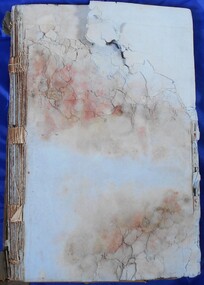
Administrative record - Account Book, 1859
... trade in Mundy Street, Bendigo before selling the business in 1865 after 11 years. Upon the discovery of gold in Western Australia, John travelled there and back three times before dying in Bendigo in 1902. He lived in Violet st., and left a wife, Elizabeth Hannah, and daughter, Mrs E Morris. Early business in Sandhurst in 1850s. Bendigo businesses Blacksmith Horse shoer ...John Mitchell was born c. 1830 in Cornwall and travelled to Victoria with his father in 1853. Arriving in Bendigo they both worked as blacksmiths before his father returned to Cornwall. John plied his trade in Mundy Street, Bendigo before selling the business in 1865 after 11 years. Upon the discovery of gold in Western Australia, John travelled there and back three times before dying in Bendigo in 1902. He lived in Violet st., and left a wife, Elizabeth Hannah, and daughter, Mrs E Morris. Early business in Sandhurst in 1850s.An account book used by the John Mitchell to record the purchases and services made with his business. Records date from 1859 - 1868. The book has lost its front cover, but the back cover is still attached. The book is made up of several sections stitched together and bound with three pieces of cotton cloth. The pages are light blue with ruled columns. There are alphabetical tabs at the front of the book with lists of names. Individual customers are allocated a double page entry. Pages numbers are written at the top of pages. The book is in very poor condition having obvious signs of water and insect damage with visible patches of mold. The writing in the first quarter of the book is barely legible, remaining pages can be read.bendigo businesses, blacksmith, horse shoer, wheelwright -
 Royal Australian and New Zealand College of Obstetricians & Gynaecologists (RANZCOG)
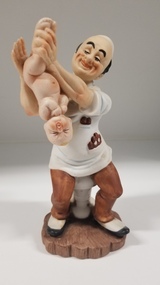
Sculpture - Porcelain figurine of an obstetrician holding a baby
... shoes. There is a glove protruding from the pocket of the gown at the left hip. The doctor is holding a baby by its ankles in his left hand, and is holding his right hand against the baby's bottom. The baby is crying. The figure is seated on the edge of a stool, and standing on a brown coloured base. There is a copyright symbol (a c inside a circle) printed on the underside of the base of the statue, along with the text 'geo.z.Lefton/THE O.B.' Sticker attached to underside of base reads 'Lefton/TRADE...shoes. There is a glove protruding from the pocket of the gown at the left hip. The doctor is holding a baby by its ankles in his left hand, and is holding his right hand against the baby's bottom. The baby is crying. The figure is seated on the edge of a stool, and standing on a brown coloured base. There is a copyright symbol (a c inside a circle) printed on the underside of the base of the statue, along with the text 'geo.z.Lefton/THE O.B.' Sticker attached to underside of base reads 'Lefton/TRADE ...George Zoltan Lefton, a Hungarian immigrant who came to the United States in 1939, was the driving force behind Lefton China. Although he began his career in clothing and sportswear, his porcelain collecting interest led to the formation of the Lefton Company in 1940. Headquartered in Chicago, the company was a wholesale and marketer of ceramic goods. After the bombing of Pearl Harbor on December 7, 1941, Lefton helped his friend Nunome, a Japanese American, board up his business to avoid looting. When the war ended, Nunome introduced Lefton to Japanese ceramic manufacturers during the Japanese occupation. Lefton was one of the first American businessmen to work with these manufacturers. (WorthPoint)Porcelain figurine of a doctor holding a baby. The doctor has black hair, is of male appearance, and is dressed in surgical attire, consisting of a short sleeved white surgical gown and cap, brown trousers and black and white shoes. There is a glove protruding from the pocket of the gown at the left hip. The doctor is holding a baby by its ankles in his left hand, and is holding his right hand against the baby's bottom. The baby is crying. The figure is seated on the edge of a stool, and standing on a brown coloured base. There is a copyright symbol (a c inside a circle) printed on the underside of the base of the statue, along with the text 'geo.z.Lefton/THE O.B.' Sticker attached to underside of base reads 'Lefton/TRADE MARK/EXCLUSIVES/JAPAN'.obstetrics -
 NMIT (Northern Melbourne Institute of TAFE)
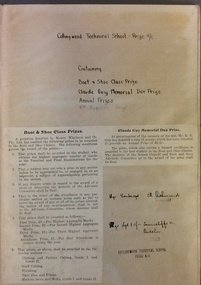
Account Book - CTS, Prize Account. Collingwood Technical School, 1927-1929
... trade. There was a monetary reward. The money for the award was usually the interest on investments donated for this purpose. The names o recipients of the prizes for 1927-1929 are recorded with the amount won. This is a record of those award winners attending CTS at the time. Collingwood Technical School Prizes Boot and Shoe ...Awards were made to the outstanding apprentice in each trade, or section of trade. There was a monetary reward. The money for the award was usually the interest on investments donated for this purpose.The names o recipients of the prizes for 1927-1929 are recorded with the amount won. This is a record of those award winners attending CTS at the time.Black cardboard cover with red tape spine. Internal pages ruled for accounts.Inside cover: "Collingwood Technical School - Prize a/c. / Containing / boot and shoe class prize / Claude Guy Memorial Dux Prize / Annual prizes / Wm Reynolds Prize." Pasted on same page are explanations of prizes.collingwood technical school, prizes, boot and shoe class prize, claude guy memorial dux prize, annual prizes, wm reynolds prize, apprentices, awards, nmit, -
 Bendigo Historical Society Inc.
Document - GUINEY COLLECTION: INVOICE J.H. ABBOTT & CO, MARKET SQUARE BENDIGO
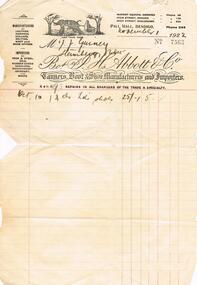
... On top of invoice, image of elephant with harness pulling a shoe, which is attached firmly to a tree trunk. ( indicating strength of product ?) Underneath 'registered trade mark' Abbott's stores listed as being in 'Market Square, Bendigo, High Street, Echuca, High Street, Eaglehawk'....On top of invoice, image of elephant with harness pulling a shoe, which is attached firmly to a tree trunk. ( indicating strength of product ?) Underneath 'registered trade mark' Abbott's stores listed as being in 'Market Square, Bendigo, High Street, Echuca, High Street, Eaglehawk'. ...Buff coloured invoice issued by J.H. Abbott & Co., tanners, boot and shoe manufacturers and importers, Market Square, Bendigo to Mr. J.J. Guiney. Invoice dated November 1922, for 1 pair ladies shoes, 25/-. On top of invoice, image of elephant with harness pulling a shoe, which is attached firmly to a tree trunk. ( indicating strength of product ?) Underneath 'registered trade mark' Abbott's stores listed as being in 'Market Square, Bendigo, High Street, Echuca, High Street, Eaglehawk'.bendigo, business, j.h. abbott & co -
 Bendigo Historical Society Inc.
Photograph - HARRY BIGGS COLLECTION: BENDIGO ARCADE / BENNETTS WALK, c1940's
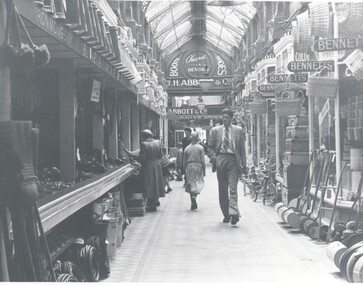
... Trade signs are Abbott & Co., Boots Shoes, Cheapest in Bendigo. ...Shoes. Abbott & Co. Photograph. Harry Biggs Collection. Very detailed photo of Bendigo Arcade / Bennetts Arcade c1940's. Many products are displayed in front of the shops - brooms, hoses, bins, lawn mowers, cases, baskets, brushes etc. Trade ...Photograph. Harry Biggs Collection. Very detailed photo of Bendigo Arcade / Bennetts Arcade c1940's. Many products are displayed in front of the shops - brooms, hoses, bins, lawn mowers, cases, baskets, brushes etc. Trade signs are Abbott & Co., Boots Shoes, Cheapest in Bendigo. Bennetts, ironmongery. On the left is a woman in a long winter coat shopping. There are three people walking through the Arcade. The roof is very ornate & the top is clear so it is well lit with the light coming through. See Research field and 2400.104.1.pdf (attached) for further information.place, building, commercial, harry biggs collection. bendigo arcade. bennetts arcade. boots shoes. abbott & co. -
Coal Creek Community Park & Museum
Music Sheets
... / Head Over Heels in Love 118 - Harbour Lights / There's Yoo-hoo in Your Eyes 146 - Its The Natural Thing to Do / The Moon Got In My Eyes 150 - The Little Boy Santa Forgot / Have You Ever Been In Heaven 152 - Where an Old Spanish Town Used To Be / Once In A While 154 - You're a Sweetheart / My Fine Feathered Friend 157 - Sweet Someone / Broadway's Gone Hawaii 158 - Always and Always / A Gypsy Told Me 160 - Got A Pair Of New Shoes / A Serenade to the Stars 161 - Down Where the Trade Winds Blow / Hawaii Calls 163 - More Than Ever / Let's Give love Another Chance 165 - A Foggy Day / Rosalie 166 - Who Are We To Say / Shadows on the Moon 169 - Melody Farm / The One I Love 170 - Moonshine Over Kentucky / An Old Straw Hat 175 - On The Sentimental Side / My Heart is Taking Lessons.../ Head Over Heels in Love 118 - Harbour Lights / There's Yoo-hoo in Your Eyes 146 - Its The Natural Thing to Do / The Moon Got In My Eyes 150 - The Little Boy Santa Forgot / Have You Ever Been In Heaven 152 - Where an Old Spanish Town Used To Be / Once In A While 154 - You're a Sweetheart / My Fine Feathered Friend 157 - Sweet Someone / Broadway's Gone Hawaii 158 - Always and Always / A Gypsy Told Me 160 - Got A Pair Of New Shoes / A Serenade to the Stars 161 - Down Where the Trade Winds Blow / Hawaii Calls 163 - More Than Ever / Let's Give love Another Chance 165 - A Foggy Day / Rosalie 166 - Who Are We To Say / Shadows on the Moon 169 - Melody Farm / The One I Love 170 - Moonshine Over Kentucky / An Old Straw Hat 175 - On The Sentimental Side / My Heart is Taking Lessons Music Sheets ...A selection of 36 music sheets. Numbers against each song title has been written by the original owner. 1 - Ginger Headed Feller 2 - Dreamy Hawaiian Moon 3 - Small Fry 4 - A Little Kiss At Twilight 7 - Musical Comedy Favourites Pt 1 & 2 9 - Moonlight in Waikiki 12 - You're Pretty as a Picture / My Own 19 - Sweethearts and Wooden Shoes (2 Copies) 20 - One Day When We Were Young 24 - Who Do You Think You Saw Last Night? / You're Lovely Madam 25 - Thanks For Everything / I Found My Yellow Basket 27 - Josephine / I'm Singing a Song for the Old Folks 30 - Romany / The Park Parade 31 - A Song of Old Hawaii / So little Time 83 - A Pretty Girl is like a Melody / You 101 - One Never Knows, Does One / Goodnight My love 103 - Someone to Care For Me / Rainbow on the Rive 105 - Miracles Sometimes Happen / I Want the Whole World to Love You 112 - The Coronation Waltz 116 - Looking Around Corners For You / There's That Look in Your Eyes Again 117 - May I Have The Next Romance With You? / Head Over Heels in Love 118 - Harbour Lights / There's Yoo-hoo in Your Eyes 146 - Its The Natural Thing to Do / The Moon Got In My Eyes 150 - The Little Boy Santa Forgot / Have You Ever Been In Heaven 152 - Where an Old Spanish Town Used To Be / Once In A While 154 - You're a Sweetheart / My Fine Feathered Friend 157 - Sweet Someone / Broadway's Gone Hawaii 158 - Always and Always / A Gypsy Told Me 160 - Got A Pair Of New Shoes / A Serenade to the Stars 161 - Down Where the Trade Winds Blow / Hawaii Calls 163 - More Than Ever / Let's Give love Another Chance 165 - A Foggy Day / Rosalie 166 - Who Are We To Say / Shadows on the Moon 169 - Melody Farm / The One I Love 170 - Moonshine Over Kentucky / An Old Straw Hat 175 - On The Sentimental Side / My Heart is Taking Lessonspencil and blue ink numbering system. -
 Eltham District Historical Society Inc
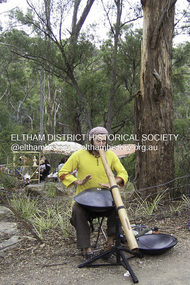
Photograph - Digital Photograph, Marguerite Marshall, Jesse Tree playing the Didgeridoo and Swiss Hang Drum at St Andrews Market, 29 March 2008
... A young woman visited Morocco and when friends admired the shoes she bought, she decided to import them and sell them at the market. Oxfam sells Fair Trade toys and clothes and displays a petition to Make Poverty History. ...A young woman visited Morocco and when friends admired the shoes she bought, she decided to import them and sell them at the market. Oxfam sells Fair Trade toys and clothes and displays a petition to Make Poverty History. ...Published: Nillumbik Now and Then / Marguerite Marshall 2008; photographs Alan King with Marguerite Marshall.; p175 It’s Saturday morning and thousands of people are visiting St Andrews Market at the corner of Heidelberg-Kinglake Road and Proctor Street. It’s hard to find a park. Cars are banked up along the narrow road and crammed in a nearby parking area. Yet, at the market, people look relaxed and happy amongst the yellow box gums on the site where the Wurundjeri people used to gather. Stone artefacts unearthed there by Koorie researcher, Isabel Ellender, indicate the site was once a Wurundjeri meeting place, according to Aboriginal Affairs Victoria. Acoustic sounds mingle with quiet conversations. A guitarist blows a mouth organ while his bare toes tickle chimes. A tiny busker, perhaps five years old, plays a violin while sounds of a harp emerge from the hall. One stallholder, selling delicious-looking pastries, chats to another in Spanish, then to me in broad Australian. ‘I was born in Fitzroy but my mother came from Mexico and my dad from Serbia,’ she smiles. A New Zealander fell in love with Mongolia and now imports their hand-made embroidered clothes and Yurts (tents) and runs adventure tours. A young woman visited Morocco and when friends admired the shoes she bought, she decided to import them and sell them at the market. Oxfam sells Fair Trade toys and clothes and displays a petition to Make Poverty History. Other stalls sell Himalayan salt, jewellery made from seeds from northern Australia, glass paper-weights from China as well as locally grown vegetables, flowers and organic freshly baked bread. A woman sits in a state of bliss under the hands of a masseur. Another offers Reiki or spiritual healing. A juggler tosses devil sticks – ‘not really about the devil,’ he smiles. This skill was practised thousands of years ago in Egypt and South America he says. At the Chai Tent people lounge on cushions in leisurely conversation. The idea for the market was first mooted among friends over a meal at the home of famous jazz and gospel singer Judy Jacques.2 Jacques remembers a discussion with several local artists including Marlene Pugh, Eric Beach, Les Kossatz, Ray Newell and Peter Wallace. ‘We decided we wanted a meeting place, where all the different factions of locals could meet on common ground, sell their goodies and get to know one another,’ Jacques recalls. They chose the site opposite another meeting place, St Andrews Pub. A week later Jacques rode her horse around the district and encouraged her neighbours to come along to the site to buy or sell. On February 23, 1973, about 20 stallholders arrived with tables. They traded ‘second-hand clothes, vegetables, meat, cheese, eggs, chickens, goats, scones, tea, garden pots and peacock feathers’. Now around 2000 people visit each Saturday. People usually linger until dusk. The market – with around 150 stalls of wares from a wide variety of cultures – stands alongside Montsalvat as the most popular tourist attraction in Nillumbik. By the 1990s St Andrews Market was in danger of being loved to death, as the site was becoming seriously degraded. The market was spreading in all directions and the degradation with it. A local council arborist’s report in 1994 noted exposed tree roots from erosion and compaction. The Department of Sustainability and Environment threatened to close the market if the degradation was not rectified. After many months of research, discussions and lobbying by a few residents, the council formed a Committee of Management, with an Advisory Committee, and introduced an Environment Levy. The State Government, the council and the market, funded terracing of the site to stop erosion, and retain moisture and nutrients. Vehicles were excluded from some sensitive areas and other crucial zones reserved for re-vegetation. Volunteers planted more than 3000 locally grown indigenous species. The old Yellow Box trees fully recovered and are expected to give shade for many years to come.This collection of almost 130 photos about places and people within the Shire of Nillumbik, an urban and rural municipality in Melbourne's north, contributes to an understanding of the history of the Shire. Published in 2008 immediately prior to the Black Saturday bushfires of February 7, 2009, it documents sites that were impacted, and in some cases destroyed by the fires. It includes photographs taken especially for the publication, creating a unique time capsule representing the Shire in the early 21st century. It remains the most recent comprehenesive publication devoted to the Shire's history connecting local residents to the past. nillumbik now and then (marshall-king) collection, didgeridoo, jesse tree, st andrews market, swiss hang drum -
 Kiewa Valley Historical Society
Pin Badge - Boy Scout
... shoe shaped reading BS. Box-Used for storage of pin: Cardboard box with a higed lid. Covered with a buff coloured, wookgrain printed paper. Inside lid: Cream Ladle/ E.P.N.S. / Made in APEX Reg. Australia Trade...shoe shaped reading BS. Box-Used for storage of pin: Cardboard box with a higed lid. Covered with a buff coloured, wookgrain printed paper. Inside lid: Cream Ladle/ E.P.N.S. / Made in APEX Reg. Australia Trade ...Metal lapel pin - brass?. Head: Fleur-de-lise shape at top with two black stars. Black horse-shoe shaped reading BS. Box-Used for storage of pin: Cardboard box with a higed lid. Covered with a buff coloured, wookgrain printed paper. Inside lid: Cream Ladle/ E.P.N.S. / Made in APEX Reg. Australia Trade Mark Inside box is a cardboard insert with a slot cut out for resting an object.Pin Face: 'Boy Scouts'-embossed over black enamel.Rear: 'Stokes'scouts, badge, mt beauty, boys club -
 Anglesea and District Historical Society
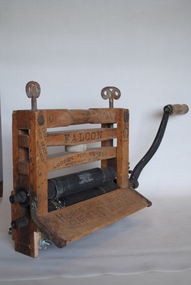
Wringer, The American Wringer Co, 1888 onwards
... Sides: EXTRA / HIGH GRADE / WARRANTED / TRADE / MARK . . . Flap: HORSE SHOE BRAND / CLOTHES WRINGER / WARRANTED 3 YEARS FOR FAMILY USE Underside of Flap: THIS WRINGER HAS WARRANTED RUBBER / ROLLS / VULCANIZED TO THE SHAFTS / PUT A LITTLE OIL OR LARD ON THE BEARINGS / BEFORE USING AND LOOSEN TOP SCREWS / WHEN THE WRINGER IS NOT IN USE...Sides: EXTRA / HIGH GRADE / WARRANTED / TRADE / MARK . . . Flap: HORSE SHOE BRAND / CLOTHES WRINGER / WARRANTED 3 YEARS FOR FAMILY USE Underside of Flap: THIS WRINGER HAS WARRANTED RUBBER / ROLLS / VULCANIZED TO THE SHAFTS / PUT A LITTLE OIL OR LARD ON THE BEARINGS / BEFORE USING AND LOOSEN TOP SCREWS / WHEN THE WRINGER IS NOT IN USE Hand operated wringer; timber frame with metal fittings; timber handle; 2 top screws; scattered nail holes Wringer The American Wringer Co ...Hand operated wringer; timber frame with metal fittings; timber handle; 2 top screws; scattered nail holesCentre: FALCON / LOOSEN TOP SCREWS / WHEN NOT IN USE / IMPROVED PAT'D . . . Sides: EXTRA / HIGH GRADE / WARRANTED / TRADE / MARK . . . Flap: HORSE SHOE BRAND / CLOTHES WRINGER / WARRANTED 3 YEARS FOR FAMILY USE Underside of Flap: THIS WRINGER HAS WARRANTED RUBBER / ROLLS / VULCANIZED TO THE SHAFTS / PUT A LITTLE OIL OR LARD ON THE BEARINGS / BEFORE USING AND LOOSEN TOP SCREWS / WHEN THE WRINGER IS NOT IN USEwringer, mangle, laundry -
 Yarrawonga and Mulwala Pioneer Museum
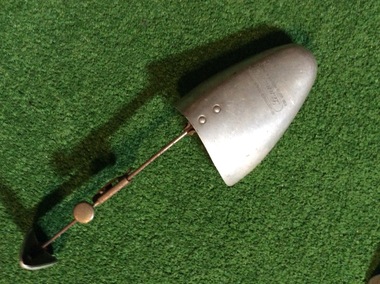
Shoe Trees
... 1.Registered trade mark Lenards for good boots and shoes 9 1/2 x 10m 2. Saxone deluxe shoe tree 9 1/2 x 11...1.Registered trade mark Lenards for good boots and shoes 9 1/2 x 10m 2. Saxone deluxe shoe tree 9 1/2 x 11 2 shoe trees - not a pair. ...2 shoe trees - not a pair. Aluminium shape which slides into toe of shoe Metal stem attached which has holes for length adjustment1.Registered trade mark Lenards for good boots and shoes 9 1/2 x 10m 2. Saxone deluxe shoe tree 9 1/2 x 11 -
 Brighton Historical Society
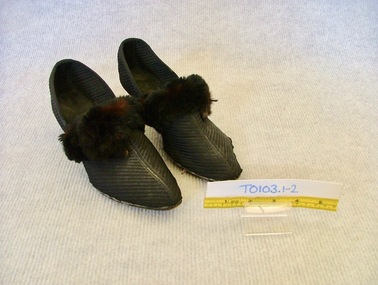
Shoes, c1890s
... The shoes were made by Kendal Milne & Co, a large department store on Deansgate, Manchester. It has traded under various names and owners since it opened in 1832; it traded as Kendal Milne & Co from 1862-1919, and continued to be known by this name for many years after. ...The shoes were made by Kendal Milne & Co, a large department store on Deansgate, Manchester. It has traded under various names and owners since it opened in 1832; it traded as Kendal Milne & Co from 1862-1919, and continued to be known by this name for many years after. ...This item is part of the Di Reidie collection. Diane Reidie was a much loved volunteer and President of Brighton Historical Society from 1999 until 2016. Originally from New Zealand, Di and her family lived in Male Street, Brighton for many years. A vibrant and energetic person with a zest for life and a gift for bringing people together, Di was a friend to many in the Bayside community and active in local community organisations. Her tireless work as President of BHS saw her named Bayside Citizen of the Year in 2008. As a seller and collector of vintage clothing, she was passionate about fashion history; one of her many enduring contributions to BHS was her extensive work in preserving, developing and promoting the Society's costume collection. In 2018-19, Di donated more than one hundred items from her personal vintage clothing collection to the Society. The collection, which includes clothing, hats, handbags and shoes from local and international designers, is representative of Di's wide-ranging interests, colourful personality, creativity, humour and love of fashion and travel. Di purchased these 1890s shoes around 1990 and recalled wearing them to approximately three events before she donated them to BHS in 2019. Di enjoyed the novelty and conversation they would inspire due to their unusual appearance by modern standards. The shoes are indicative of Di's playful approach to clothing and life. The decorative preserved mink pelt with head featured on the vamps of these shoes is typical of Victorian era interest in and prevalent use of preserved animals for decorative purposes in clothing, millinery and household adornment. This fashion reflected social positioning of oneself as being affluent, educated and worldly. Following the death of Queen Victoria's husband Prince Albert in 1861, the Queen's approach to mourning his death influenced social conventions for the public, with the wearing of black becoming a significant aspect of Victorian fashions. The shoes were made by Kendal Milne & Co, a large department store on Deansgate, Manchester. It has traded under various names and owners since it opened in 1832; it traded as Kendal Milne & Co from 1862-1919, and continued to be known by this name for many years after. The store is currently owned by the House of Fraser department store chain and is known as House of Fraser Manchester.Black silk linear quilted uppers of single piece construction with feature centre front vamp seam. Horsehair wadding can be seen along the side of the forefoot where the upper is coming away from the leather soles. Approx 4.5 cm plain black silk covered heel with leather top piece missing from right shoe. Both shoes feature the head of a small preserved mink with glass eyes. The toppling of the vamp features a decorative strip of mink fur. Inside of both shoes is a gold printed manufacturers label on the black silk insole.Manufacturers label - Made expressly for Kendall Milne and Co, Manchester.victoriana, mink pelt, taxidermy, 1890s, fur, di reidie, vintage clothing -
 Lakes Entrance Historical Society
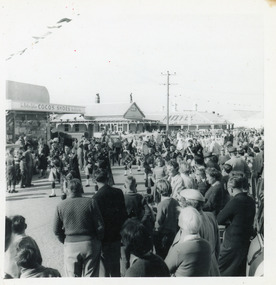
Photograph - Coco's Shoe Shop and Victoria House Motel. c1961, Fish, Marie, Governor General Lord and Lady Dunrossil visit to Lakes Entrance Victoria
... Township Celebrations Retail Trade Motels Black and white photograph of the crowd on Esplanade, watching the street procession during the visit of the Governor General Lord and Lady Dunrossil. In the background Coco's Shoe ...Black and white photograph of the crowd on Esplanade, watching the street procession during the visit of the Governor General Lord and Lady Dunrossil. In the background Coco's Shoe Shop and Victoria House Motel. Lakes Entrance Victoriatownship, celebrations, retail trade, motels -
 National Wool Museum
Shoe, sheep
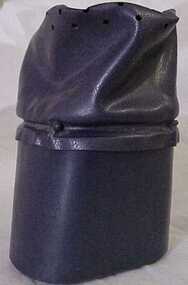
... PAT APPD / No. 21990/56 / NYLEX / TRADE MARK / SHEEP SHOE...Sheep footrot Sheep shoe Sheep - footrot PAT APPD / No. 21990/56 / NYLEX / TRADE MARK / SHEEP SHOE Shoe, sheep ...Plastic sheep shoes, designed to prevent foot rot in sheep.PAT APPD / No. 21990/56 / NYLEX / TRADE MARK / SHEEP SHOEsheep footrot, sheep shoe, sheep - footrot -
 Wodonga & District Historical Society Inc
Sign - Water Tower Shoe Repairs, "Cobbler's Inn", Wodonga
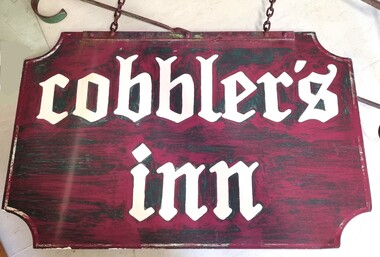
... Shoe Repairs, at the base of the Wodonga water tower in 1961. Gwen added a florist shop which operated for some years In 1979 Ron Turton took over the Cobbler’s Inn in partnership with his brother-in-law Len Freyer. Len entered the trade...Shoe Repairs, at the base of the Wodonga water tower in 1961. Gwen added a florist shop which operated for some years In 1979 Ron Turton took over the Cobbler’s Inn in partnership with his brother-in-law Len Freyer. Len entered the trade ...Wodonga Water Tower was officially opened on 4th December 1924 to store water for the town of Wodonga. Due to increased consumption demands and the construction of a large reservoir, the Water Tower was decommissioned in 1959. It stood unused until the lower section was modified and put to use as Water Tower Shoe Repairs, better known as “Cobbler’s Inn” in 1961. Albert (Bert) Green and his wife Gwen opened a shoe repair business, Water Tower Shoe Repairs, at the base of the Wodonga water tower in 1961. Gwen added a florist shop which operated for some years In 1979 Ron Turton took over the Cobbler’s Inn in partnership with his brother-in-law Len Freyer. Len entered the trade as an apprentice with Quinn's Bootmakers of Wodonga at the age of 14 and later worked with Mr. Green. Ron’s son, Justin also joined the business and took over from his father in 2018. The Cobbler’s Inn was closed in 2024.This item is significant because it was displayed outside a well-known and unique Wodonga Business for approximately 60 years.A collection of images which tell some of the story of the Cobbler's Inn in Wodonga. 1. Cobbler's Inn Sign 2. Albert Green, the first Cobbler's Inn Cobbler 3. Cobbler's Inn at base of Wodonga Water Tower 4. Cobbler's Inn sign & doorway Wodonga 5. Justin and Ron Turton. Ron and his partner Len Freyer, took over from Albert Green. Justin worked with him and later took over the business. 6. Justin & Ron Turton with original sewing machine 7. Inside the Cobbler's Inn 8. Empty shop space inside Wodonga Water Tower March 2025Cobbler's Inncobbler's inn wodonga, wodonga water tower, water tower shoe repairs
