
Showing 48 items matching "shopping bags"
-
 Greensborough Historical Society
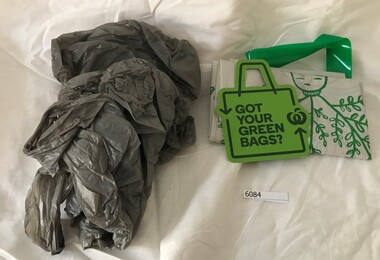
Shopping bags, Woolworths, Single and multiple use shopping bags, 2018_
... Shopping bags...Single and multiple use shopping bags...shopping bags...In 2018, most Victorian supermarkets ceased using single use shopping bags and made more substantial multi-use bags available for purchase by customers. ...Single use grey plastic supermarket shopping bags (2); reusable green and white supermarket shopping bag, with cardboard tag printed in green. ...Single and multiple use shopping bags Shopping bags Woolworths ...In 2018, most Victorian supermarkets ceased using single use shopping bags and made more substantial multi-use bags available for purchase by customers. Word document with history of the use of plastic bags (from Wikipedia) and comment on cessation of plastic bags in Greensborough.Single use grey plastic supermarket shopping bags (2); reusable green and white supermarket shopping bag, with cardboard tag printed in green. Word document with history of the use of plastic bags.Green and white bag has Bar code, Woolworths logo and slogan " The fresh food people". Tag reads " Got your green bags?" with explanation on obverse.shopping bags -
 Whitehorse Historical Society Inc.
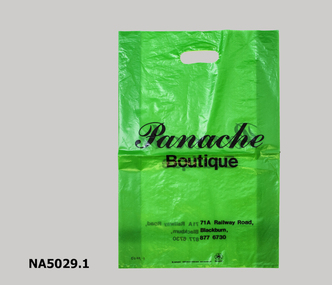
Functional object - Shopping Bags
... Shopping Bags...Plastic shopping bags used by four business in the Blackburn Shopping Centre. ...Plastic shopping bags used by four business in the Blackburn Shopping Centre. ...Plastic shopping bags used by four business in the Blackburn Shopping Centre. All have advertisement for the different shops printed on them including telephone number.These begs were used to carry purchases and advertise the business.1 Green plastic carry bag from Panache Boutique, Blackburn .2 Black and gold stripped carry bag from Victor's Men's Fashion shop, Blackburn .3 White, red and blue plastic carry bag from Anstees, Blackburn .4 White carry bag with green writing from Love Fortyvictor's fashion for men, anstees supa valu, love forty sporting apparel, blackburn shopping strip, shopping, panache boutique -
 Sunshine and District Historical Society Incorporated
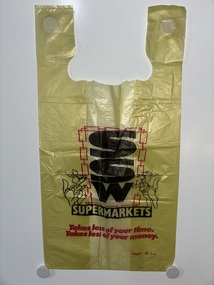
Ephemera - SSW Supermarket Shopping Bags, C1950's - 1960's
... SSW Supermarket Shopping Bags...Flour bag and plastic bag donated to Sunshine & District Historical Society for it's collection SSW Supermarket Bag 2162.01 - Plastic Bag a pale yellow in color with red printed text 2 images of kangaroos with bold black text and store logo|2162.02 - Flour bag a paper bag has the store logo with red and black text SSW Supermarket Ephemera SSW Supermarket Shopping Bags ...Flour bag and plastic bag donated to Sunshine & District Historical Society for it's collectionSSW Supermarket2162.01 - Plastic Bag a pale yellow in color with red printed text 2 images of kangaroos with bold black text and store logo|2162.02 - Flour bag a paper bag has the store logo with red and black textssw supermarket, bag -
![Sculpture, GUNN, Mandy arr. Australia 1966, [W]RAPT, 2012-2013](/media/collectors/510b3f7f023fd725b4cd52a0/items/5faa11d96d17f126301ddb2f/item-media/5faa11ea6d17f126301ddbec/item-fit-380x285.jpg?cb=6) Latrobe Regional Gallery
Latrobe Regional GallerySculpture, GUNN, Mandy arr. Australia 1966, [W]RAPT, 2012-2013
... Recycled paper shopping bags and wrappings on cardboard construction...Recycled paper shopping bags and wrappings on cardboard construction [W]RAPT Sculpture GUNN, Mandy arr. ...Recycled paper shopping bags and wrappings on cardboard construction -
 Flagstaff Hill Maritime Museum and Village
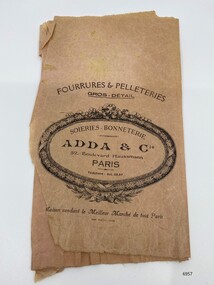
Container - Brown paper shopping bag from Adda & Co. Paris, c. early 20th century
... Adda & Co operated a business at 52 Boulevard Haussmann, Paris.The store sold crocheted silks, furs and hides. History of shopping bags: Before the late 1800s, shopping bags didn’t exist. ...Adda & Co operated a business at 52 Boulevard Haussmann, Paris.The store sold crocheted silks, furs and hides. History of shopping bags: Before the late 1800s, shopping bags didn’t exist. ...Adda & Co operated a business at 52 Boulevard Haussmann, Paris.The store sold crocheted silks, furs and hides. History of shopping bags: Before the late 1800s, shopping bags didn’t exist. Shoppers would either carry their goods home in baskets, or have the merchant deliver them to people's homes, until 1852 when Francis Wolle, a schoolteacher in Pennsylvania, invented a machine to produce paper shopping bags. This invention would allow customers to carry items home in disposable paper bags. Soon after, owners of department stores and retailers began to realise that paper shopping bags could be used to help market their brands, and as such custom shopping bags with printed logos became common place. Carrying a shopping bag from certain shops became a type of status symbol for consumers, providing evidence that one was well-off, had good taste, or both.The paper shopping bag is a rare survival of ephemera related to a retail store called Adda &Co that operated at 52 Boulevard Haussmann, Paris. The arrival of waves of more than ten million migrants by boat is one of the major themes in Australia’s history. The paper shopping bag is representative of personal items purchased for migrant journeys as markers of domesticity, warmth and making oneself at home in a new land that speaks of the transnational lives embedded in threads of migration.A brown paper shopping bag with a printed logo and store information in black inkparis, department store, shopping, adda & co, flagstaff hill, maritime museum -
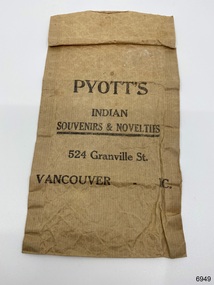 Flagstaff Hill Maritime Museum and Village
Container - Pyott's Paper Shopping Bag, c. early 20th-century
... Vancouver B.C'. History of shopping bags: Before the late 1800s, shopping bags didn’t exist. ...Vancouver B.C'. History of shopping bags: Before the late 1800s, shopping bags didn’t exist. ...Pyott's Ltd., was an merchant and novelty shop in Vancouver, Canada during the early-20th century. An advertisement for the shop was published on February 9, 1922 in the Ubyssey News (issued Weekly by the Publications Board of the University of British Columbia. It reads: 'We carry one of the largest lines of Indian Burnt Leather Goods, Moccasins and Baskets in the city; also Beads, Purses and Hand Bags; View Books, Post Cards and Novelties of all kinds. Your inspection invited, 524 Granville St. Vancouver B.C'. History of shopping bags: Before the late 1800s, shopping bags didn’t exist. Shoppers would either carry their goods home in baskets, or have the merchant deliver them to people's homes, until 1852 when Francis Wolle, a schoolteacher in Pennsylvania, invented a machine to produce paper shopping bags. This invention would allow customers to carry items home in disposable paper bags. Soon after, owners of department stores and retailers began to realise that paper shopping bags could be used to help market their brands, and as such custom shopping bags with printed logos became common place. Carrying a shopping bag from certain shops became a type of status symbol for consumers, providing evidence that one was well-off, had good taste, or both. The paper shopping bag is a rare survival of ephemera related to a retail store that existed in Vancouver, Canada during the early-20th century. The arrival of waves of more than ten million migrants by boat is one of the major themes in Australia’s history. The paper shopping bag is representative of personal items purchased for migrant journeys as markers of domesticity, warmth and making oneself at home in a new land that speaks of the transnational lives embedded in threads of migration. A brown paper shopping bag with a printed logo and store information in black inkPyott's, Indian Souvenirs & Novelies. 524 Granville St, Vancouver- B.C. On the reverse side in handwriting: 'Red + dark red beadsshopping bag, marketing, ephemera, pyott's, vancouver, canada, migration, flagstaff hill, merchant -
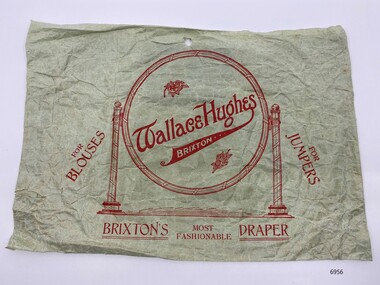 Flagstaff Hill Maritime Museum and Village
Container - Wallace Hughes Paper Shopping Bag, c. mid-20th century
... Brixton was once home to several large department stores, none survive today. History of shopping bags: Before the late 1800s, shopping bags didn’t exist. ...Brixton was once home to several large department stores, none survive today. History of shopping bags: Before the late 1800s, shopping bags didn’t exist. ...The paper shopping bag was most likely used for carrying garments, silk or woollen fabrics home from the Wallace Hughes department store. This substantial drapery operated from the late 19th-century-to the mid-20th century, and had 30 departments and stood at 464 - 470 Brixton Road, south London, U.K. The building was destroyed during the second World War and rebuilt in the 1950s. Brixton was once home to several large department stores, none survive today. History of shopping bags: Before the late 1800s, shopping bags didn’t exist. Shoppers would either carry their goods home in baskets, or have the merchant deliver them to people's homes, until 1852 when Francis Wolle, a schoolteacher in Pennsylvania, invented a machine to produce paper shopping bags. This invention would allow customers to carry items home in disposable paper bags. Soon after, owners of department stores and retailers began to realise that paper shopping bags could be used to help market their brands, and as such custom shopping bags with printed logos became common place. Carrying a shopping bag from certain shops became a type of status symbol for consumers, providing evidence that one was well-off, had good taste, or both.The paper shopping bag is a rare survival of ephemera related to a department store owned by Wallace Hughes in Brixton, South London, Britain that operated during the early-20th century, The arrival of waves of more than ten million migrants by boat is one of the major themes in Australia’s history. The paper shopping bag is representative of personal items purchased for migrant journeys as markers of domesticity, warmth and making oneself at home in a new land that speaks of the transnational lives embedded in threads of migration.The green coloured paper shopping bag with a printed logo and store information in red ink.Wallace Hughes, Brixton; For jumpers; For blouses; brixton's most fashionable draperwallace hughes, shopping bag, draper, migration, brixton, flagstaff hill -
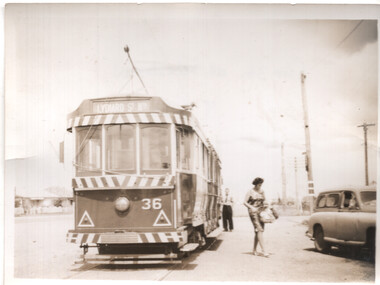 Ballarat Tramway Museum
Photograph - SECV Ballarat 36 at Sebastopol, Graeme Cleak, 9-3-1962
... Photo shows SECV Ballarat No. 36 at the Sebastopol terminus with a lady carrying shopping bags walking from the tram and the motorman standing at the far end of the tram. ...Photo shows SECV Ballarat No. 36 at the Sebastopol terminus with a lady carrying shopping bags walking from the tram and the motorman standing at the far end of the tram. ...Photo shows SECV Ballarat No. 36 at the Sebastopol terminus with a lady carrying shopping bags walking from the tram and the motorman standing at the far end of the tram. Photo by Graeme Cleak 9-3-1962Yields information about Ballarat tram services and tram 36 in 1962.Black and white photograph with notes on the rear.In ink on the rear "Car 36 at Sebastopol, 9.3.62, Photo by Graeme Cleak"tramways, tramcars, tram 36, sebastopol -
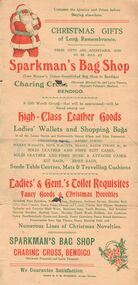 Bendigo Historical Society Inc.
Memorabilia - SPARKMAN'S BAG SHOP CHRISTMAS GIFT BROCHURE
... Ladies Wallets and Shopping Bags etc., Table Centres, Mats & Travelling Cushions. ...Ladies Wallets and Shopping Bags etc., Table Centres, Mats & Travelling Cushions. ...BHS CollectionSparkman's Bag Shop Christmas Gift Brochure: Cream paper with red and green print with a Santa Clause left hand corner. Printed on the brochure is * Compare the Quality and Prices before Buying elsewhere. Christmas Gifts of Long Remembrance. Sparkans's Bag Shop (Late Harper's Oldest Established Bag Shop in Bendigo) Charing Cross (Between Mitchell St and Lyric Theatre, Opposite Cabmen's Shelter), Bendigo. High = Class Leather Goods. Ladies Wallets and Shopping Bags etc., Table Centres, Mats & Travelling Cushions. Ladies & Gent's Toilet Requisites, Fancy Goods & Christmas Novelties. We Guarantee Satisfaction. Paper torn in two places. Box 625.Printed by F.H. Sparkman, Arcade, Bendigobusiness, retail, advertising -
 Bendigo Historical Society Inc.
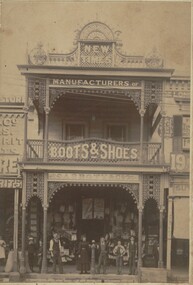
Photograph - ABBOTT & CO BOOT AND SHOE MANUFACTURERS, c.1900
... Hitching post? In front of shop. Bags of grain, two males, 1 femal figures, four adolescents in front of building. ...Hitching post? In front of shop. Bags of grain, two males, 1 femal figures, four adolescents in front of building. ...Sepia toned photograph of two story building. Cast iron supports to verandah and balcony. Ornate cast iron trim. New Times sign on parapet. Various sale signs on windows and front doors. Hitching post? In front of shop. Bags of grain, two males, 1 femal figures, four adolescents in front of building. Brick gutter. Wooden case on right. 'Abbott's & Co. Pall Mall Bendigo Boot and Shoe Store' . Check directories for dates of occupation. James Lerk 17/12/1999. History of object: The very flamboyant front for Abbott & Co Boot and Shoe Manufacturers. Abbotts conducted a tannery at Sheepwash - a wonderful example of an industry 'adding'. Photos. C1900. James Lerk caption.buildings, commercial, abbotts boot & shoe manufacturers -
 Vision Australia
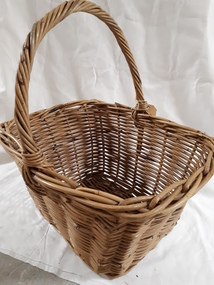
Functional object - Object, Cane basket with handle
... Cane baskets were the original green alternative to plastic shopping bags. Note that the handle is deliberately askew, for easier carrying against the hip....Cane baskets were the original green alternative to plastic shopping bags. Note that the handle is deliberately askew, for easier carrying against the hip. ...Basket weaving and brush making was a source of income for those who worked in the workshops at RVIB and other institutions in New South Wales and Queensland. A diverse range products could be produced with cane, such as cane chairs, cots, washing baskets and trolleys, and the Institution sought to highlight these in the annual report. Over time the demand for, and supply of, cane changed - particularly during World War 2 when Asian sources were under attack or destroyed. At home, other materials such as plastics as well as the ability to import cheaper pre-produced products further reduced the demand for workshop pieces. Generic style basket that would have been used for shopping or any household task requiring movement of multiple items. Cane baskets were the original green alternative to plastic shopping bags. Note that the handle is deliberately askew, for easier carrying against the hip.1 cane basket with askew handleemployment, royal victorian institute for the blind -
 Healesville Sanctuary Heritage Centre
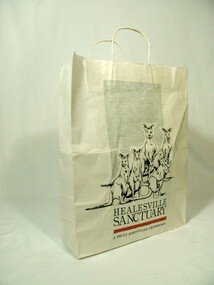
paper bag, 1980's
... This carry bag was used in the 1980's to carry items bought at the Healesville Sanctuary Shop. Many bags have been used since the inception of the shop and this is one of many used over the years. ...This carry bag was used in the 1980's to carry items bought at the Healesville Sanctuary Shop. Many bags have been used since the inception of the shop and this is one of many used over the years. ...This carry bag was used in the 1980's to carry items bought at the Healesville Sanctuary Shop. Many bags have been used since the inception of the shop and this is one of many used over the years. It is interesting to note that paper was used widely throughout the early years and in latter years as the Sanctuary became more dedicated to preservation of the environment, more environmentally-friendly materials have been used.This is a white paper carry bag. The illustration in black and white is of a family group of grey kangaroos; 5 adults and joey. A light green basket-weave pattern forms the background. It has rafia handles and is inscribed with the name of the Healesville Sanctuary underscored in red.Inscription on the lower edge of the paper bag reads "HEALESVILLE / SANCTUARY / A TRULY AUSTRALIAN EXPERIENCE". On the underside of the bag it reads "For Re-order B.S.B. (03) 801 9255"paper-bag, shop, healesville-sanctuary, grey-kangaroo, kangaroo, 1980's -
 City of Melbourne Libraries
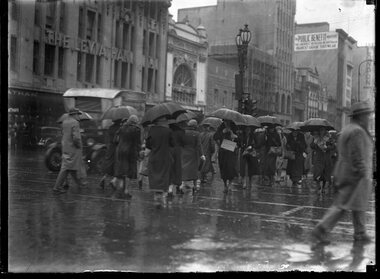
Photograph, Bull, Hugh Jones, 1897-1993, Christmas shopping in the wind and rain, Bourke Street, Melbourne
... Published caption: Battling against the rain and wind, Christmas shoppers had an unpleasant time in Melbourne yesterday as they made their way from shop to shop; but still, they made their purchases, and with parcels and shopping bags clutched close, and with umbrellas held against the wind, they made their way to trains and trams for the homeward journey. ...Published caption: Battling against the rain and wind, Christmas shoppers had an unpleasant time in Melbourne yesterday as they made their way from shop to shop; but still, they made their purchases, and with parcels and shopping bags clutched close, and with umbrellas held against the wind, they made their way to trains and trams for the homeward journey. ...Published: (1933, December 15). The Age (Melbourne, Vic. : 1854 - 1954), p. 13. Published title: SHOPPING CONTINUED AMID RAIN AND STORM IN THE CITY. Published caption: Battling against the rain and wind, Christmas shoppers had an unpleasant time in Melbourne yesterday as they made their way from shop to shop; but still, they made their purchases, and with parcels and shopping bags clutched close, and with umbrellas held against the wind, they made their way to trains and trams for the homeward journey. A picture in Bourke-street yesterday. Trove article identifier: http://nla.gov.au/nla.news-article203353770 Description: Crowd of men and women in winter clothing, in the rain, carrying umbrellas, crossing at the intersection of Bourke and Swanston streets. “Xmas shopping in wind and rain. When we first saw the rain, umbrellas, long coats and fox stoles, we naturally assumed this photo was taken in mid-winter. Some months later, we noticed the photographer’s pencil “scritchings” at the slide’s edge, and the truth was revealed: mid-December Melbourne in Bourke Street!" Featured in "Newsworthy: Melbourne in photographs 1933-1936" exhibition at East Melbourne Library, October to December 2023. Exhibition caption by project team. Research by project volunteers: Visible buildings include Leviathan Men's Clothing Store in Beaux Arts style, Melba Theatre and London Stores, together with signage for Public Benefit Footwear (later to become PBs). Leviathan was an Australian clothing brand established 1865, producing garments for sailing and watersports. Melba Theatre, opened in 1911, was a long narrow theatre of only 17 seats across. Adjacent to the Melba Theatre are a Woolworths and a Coles. The Public Bootery, a shoe shop established 1908, moved to this site 1924. Double headed decorative street lights (now called "Collins Street lights") were installed in 1929, inspired by the street lighting style of San Francisco. References: SHOPPING CONTINUED AMID RAIN AND STORM IN THE CITY. (1933, December 15). The Age (Melbourne, Vic. : 1854 - 1954), p. 13. Retrieved October 14, 2024, from http://nla.gov.au/nla.news-article203353770 Photographer notations on slide: "Xmas shopping in wind and rain Age B9". -
 Sunshine and District Historical Society Incorporated
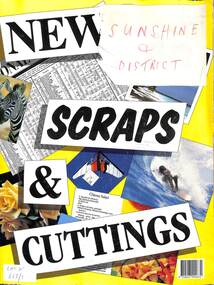
Album - Sunshine Advocate and Brimbank Messenger Newspaper Cuttings 1998 - 2010 Scrapbook, 1998-2001
... Albans Hume & Hovell cairn in the move Iramoo Committee Shopping bags ban Harvester City, the making of Multicultural Sunshine book grant Susan Jennison Melchior Bajada Ray Carlton book donation to Sunshine Library Hampshire Road connection the Market Place with the Plaza Girls should be girls...Albans Hume & Hovell cairn in the move Iramoo Committee Shopping bags ban Harvester City, the making of Multicultural Sunshine book grant Susan Jennison Melchior Bajada Ray Carlton book donation to Sunshine Library Hampshire Road connection the Market Place with the Plaza Girls should be girls Sunshine Advocate Brimbank Messenger Newspaper Sunshine & District Three scrapbooks containing numerous paper cuttings from Sunshine Advocate and Brimbank Messenger 1998 - 2010 compiled by Tom Rigg for the Sunshine & District Historical Society Inc. ...663.01 People in official positions 1908 H.V. McKay Factory Gates Part layout in vicinity of Sunshine Railway Station map 1910 Sunshine Station Signal Box Harvester Museum H.V. McKay H.V. McKay Bulk Store Sunshine's colorful history Family of Nathaniel & Mary McKay family tree Sunshine Smithy Braybrook residents 1903 & 1906 Sands & McDougal listing Nat & Joyce Wright Sunshine Market Place Sunshine new police station Sunshine new post office S&DHS newspaper articles Black Powder Mill Deer Park St. John's Anglican Church Robert Eric Parsons Rubbish dumping issue Bob & Cyril Parsons Deer Park Bypass Sunshine Leisure Centre Sunshine Station Interchange Dorothy Price Sunshine Hospital expansion Albert & Amy Russell Wally O'Brien Hospital pedestrian crossing Our Lady's Primary School reunion Mytle Baylis Darling Albion Flour Mill Pokie machines Harricks Cottage Jack Tighe Cr Brooke Gujinovic New Brimbank Mayor Jack Collins Isabella Williams Reserve Cairnlea development Albert Holden Old Sunshine Police Station Sun Crescent Big bins Phyllis Vance Sunshine Pipe Band Dick & Elsie Whiting Historic house demolition Boom gate delay Brian & Doreen Duffy Beth Argyle Sunshine Railway Disaster Les Hunter Sunshine Pool closure protest Clare Brennan Mickey Vautier Jack Sheridan Balam Balam Reserve Gwen Goedecke Derrimut Hotel & licensee Wal Elms Jimmy Gaylor John & Leone Hawking Centrelink move Joan Carstairs Hampshire Road roadworks Lloyd McCallum postman retires Mavis Kittelty & Sunshine Croquet Club closes Frank O'Connor Beth Argyle, Don Deeble, Shirley Wallace & Jack Sheridan Sunshine Anglican Church & Father Stuart Soley Ian Baker Morris Street proposed flat development protest Brimbank's rich cultural history Church of Christ Doreen Foster & Albion Tennis Club Francis & Lillian Allen Sunshine Wesleyan Methodist Church 3LO-3AR radio transmitter George & Gloria Hales H.V. McKay Medal Trade Wing Lorna Cameron Noala Flynn St. Ablans Baptist Church & Ralph Phillips Apostolic Christian Church Keilor Christian City Church Sunshine City Band Maidstone Our Ladys of Perpetual Church Waterways Ron & Margaret Craker 663.02 Black Powder Mill St. Albans Greek Orthodox Church of St. Paraskeve Western Ring Road traffic Joseph & Frances Testa Sydenham Kingdom Hall of Jehovah's Witnesses Sydenham The Assemblies of God Michael & Rosalia Skok Werribee's State Rose Gardens Tom & Maria Diele Tom Rigg and the origin of the district's street names Sunshine & St. Albans Baptist Church ICI Estate protest Sunshine Salvation Army Church Macedonian Orthodox Church Anita-Marie Neumann Albanvale path of recognition Sunshine Pool action group Minnie Gorsuch State Election 2000 Jean Folry & Ilma Weir Brimbank Uniting Church Harvester Town book launch - Olwen Ford Brooke Jujinovic Keilor Cemetery gravestones John Howard ignores Braybrook Norman & Joan Wales Clare Brennan Drive named after Clare Brennan Fosseys Sunshine closure Commonwealth Bank (CBA) Glengala Road closure James Frederick McKay A history of Sunshine H.V. McKay's Russell Street gates Barry McMahon Sunshine Swimming Pool Aquatic centre sale Keith Buckley Migrants' move to brave new world Vasilos & Eugenia Karaoglandis William Hyett Darryl Myers Kathleen Inkster Sunshine RSL Kevin Keegan, Kevin Bryar & Fred Russell Barney & Renee Cater Mona Malouf George Carter Sunshine Pottery memorabilia & reunion Des Johnson Duke Street Aborigine artifacts Albert Drayton Two pools planned Sunshine Pool repairs approved Olympic Torch journey through Brimbank Maurice & Kathleen Sanders Paul & Suzanna Vicek Deer Park By Pass Road Bert & Noreen Craddock St. Albans Legless Lizards under fire Sunshine rare orchid scare St. Albans Road black spot Viet name for Burke Street Russell Street gates unveiling ceremony Don & Val Byrnes Emily Hall Sunshine Swim centre Water action plans Melton Highway sugar gum tree removal by Vicroads Sunshine Police Station Olympic Rings Brick Emmaus Catholic School Sydenham opening Black Powder Mill Stevens Farmhouse fire Yvonne Flack Frank Gathercole Commonwealth Bank closure Marion Martin Deer Park State School Tom & Flo Beagley Call for railway land buffer Clarrie Salvador Braybrook Hotel Sunshine Harvester Smithy 2000, A year to remember Bus Re-route hits traders Sunshine Swimming Pool end of life Pam Chapman Prune Goldrick - When the Whistle Blew Wally O'Brien recalls Deer Park during his childhood Western Highway / Ballarat Road traffic Tom Rigg confusing St. Albans bus signs Rubbish in Deer Park Phyllis Frost Basil Morcos Allan "Titch" Williams George Thoms Clarrie Salvator Tom Dile Igor Balabin John McArdie Sam & Rita Attard Jack & Dorothy Roberts Joe De Gabriele Beth Argyle John Refshauge surgeon Bill Fogarity Brimbank Heritage Listing in peril Museum of Victoria virtually tour of H.V. McKay Harvester Factory Jock McLeod John & Lorna Stainer Rita Shimmin Smithy Nettlefolds - Len Duxon, Betty Scott, Frank Richards, Thelma Burnett, Reg Ratcliffe & Frank Farrugia Emma Broadhead Bill Bunting Gwen Goedecke Ron Dorre Sunshine Hospital Redevelopment Braybrook Squash Centre Megan Blair Harvester Town book launch Tom Rigg rail safety activist Lloyd & Gislaine Simpson Sunshine's past revealed Legless Lizards site Jones Creek Wetlands St. Albans time capsule Cairnlea suburb name causing a stir Agnes Clark Norman de Pomeroy Ern & Dot Nicholls Anton & Maria Gerber Peter & Margaret McManus H.V. McKay Offices heritage listing Cr. Chris Evans out Two historical walks in Sunshine Brink Back the H.V. McKay Smithy opening invite Council destroys old files Harricks Cottage Special Exhibition Models of Sunshine made farm implements exhibition invite 663.03 Wally O'Brien Cr. Chris Evans Sunshine pool debate Black Powder Mill Sydenham / Hillside Primary School name changes Say goodbye to Sydenham, Watergardens Spalding Reunion Harry Unger Gwen Goedecke Frances Fitzgerald Preserving Brimbank's significant landmarks Bernard Reilly kindergarten train Albert Holden St. Peters Channel Catholic Church Terry Muscat Smithy Norman & Geoff Pomeroy Sunshine disaster recalled Sydenham Railway Station Sunshine Baseball Club Albert Evans Sunshine Pool anger Albion car crash Jackson School to lose portables Black Powder Mill John Kontek Harvester basic wage case Sushine Harvester & Offices complex Deer Park Primary School Sunshine underpass / subway shame Albion Railway Station Rolando & Lilia Antonio Furlong Road tragedy Anita Ciancio & baby Montana kidnapping Harricks Cottage Fence to keep out snakes Shire of Braybrook Financial & Rate records donated to S&DHS Bikini protest in Council Chambers Talintyre Reserve name change from Tallintyre Reserve Peter Somerville and the Blackbird Keith Miller Gerald Griggs St. Albans Hume & Hovell cairn in the move Iramoo Committee Shopping bags ban Harvester City, the making of Multicultural Sunshine book grant Susan Jennison Melchior Bajada Ray Carlton book donation to Sunshine Library Hampshire Road connection the Market Place with the Plaza Girls should be girlsSunshine & Districtsunshine advocate, brimbank messenger, newspaper -
 Ringwood and District Historical Society
Sweet Bags, Bundle kite shaped brown paper bags for ice cream cones and sweets. Ringwood c 1940, c. 1940
... Used to put around ice cream cones for handling, or to put sweets in when buying from shops. Bundle of kite shaped brown paper bags held together by a string tie at the top. ...Used to put around ice cream cones for handling, or to put sweets in when buying from shops.Bundle of kite shaped brown paper bags held together by a string tie at the top. -
 Flagstaff Hill Maritime Museum and Village
Accessory - Bag, Daisy Welsh, 1928
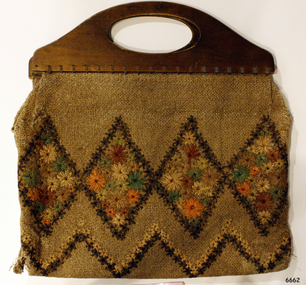
... shopping bag is part of a set of two items. The items were designed, hand sewn and embroidered with raffia by my mother Daisy Elvena (nee Dale) Welsh. Daisy Elvena Dale (born 27 October 1899) daughter of Ellis and Ann (nee Lees) Dale, of Latrigg, Wangoom, Warrnambool, married Raymond Welsh in 1922. A few years later – approximately 1928- Daisy made these two articles, which she used, particularly during the Depression years. The important factor concerning these bags...Embroidered shopping Bag, part of a set, the other part being a wallet (purse). Wooden handles and fabric is decorated with embroidered raffia flowers. The bags...bags was part of the clothing brought from England to Australia, an example of emigrant luggage. It also represents a traditional home industry of 'clothiers'. This item is associated with the families of Chamberlain, Dale and Lees. These families are listed in the "Pioneers' Register" for Warrnambool Township and Shire, 1835-1900, published by A.I.G.S. Warrnambool Branch. flagstaff hill warrnambool shipwrecked coast flagstaff hill maritime museum maritime museum shipwreck coast flagstaff hill maritime village great ocean road chamberlain dale lees stone betty stone warrnambool pioneers clithier william dale daisy welsh wangoom hopsack saddleworth yorkshire shopping bag handbag homespun handmade Embroidered shopping Bag, part of a set, the other part being a wallet (purse). ...In the words of the Donor, Betty Stone, "This shopping bag is part of a set of two items. The items were designed, hand sewn and embroidered with raffia by my mother Daisy Elvena (nee Dale) Welsh. Daisy Elvena Dale (born 27 October 1899) daughter of Ellis and Ann (nee Lees) Dale, of Latrigg, Wangoom, Warrnambool, married Raymond Welsh in 1922. A few years later – approximately 1928- Daisy made these two articles, which she used, particularly during the Depression years. The important factor concerning these bags is that they were made with hand-woven cloth cut from a pair of trousers that her grandfather, William Dale brought with him when he left the family farm Back o-the Low situated in Saddleworth, Yorkshire, England. He arrived in Australia in 1852 and seven years later was operating a quarry on land purchased in Wangoom, Warrnambool known as The Dale Bluestone Quarries. Dale forebears in Yorkshire were first recorded as "clothiers" ( ie weavers of cloth) in the Saddleworth parish records dated 1764; following generations also continued the tradition of producing hand-woven cloth as a home industry. The cloth, from which these two bags were made, is evidence of a tradition begun by the Dale family in Saddleworth, Yorkshire more than two hundred and fifty years ago. My mother, Daisy Elvena (nee Dale) Welsh (granddaughter of William Dale) always referred to the cloth, which is at least 160 years old, as a homespun hopsack. (Note: For additional information please refer to Betty Stone’s book “Pioneers and Places - A History of three Warrnambool Pioneering Families” ie. Chamberlain, Dale and Lees Families)The homespun hopsack fabric for the set of bags was part of the clothing brought from England to Australia, an example of emigrant luggage. It also represents a traditional home industry of 'clothiers'. This item is associated with the families of Chamberlain, Dale and Lees. These families are listed in the "Pioneers' Register" for Warrnambool Township and Shire, 1835-1900, published by A.I.G.S. Warrnambool Branch.Embroidered shopping Bag, part of a set, the other part being a wallet (purse). Wooden handles and fabric is decorated with embroidered raffia flowers. The bags were made by Daisy Welsh (nee Dale) c. 1928 from homespun "hopsack' fabric of William Dale's trousers, brought to Australia in 1852. Part of the 'Chamberlain Dale Lees Collection' flagstaff hill, warrnambool, shipwrecked coast, flagstaff hill maritime museum, maritime museum, shipwreck coast, flagstaff hill maritime village, great ocean road, chamberlain, dale, lees, stone, betty stone, warrnambool pioneers, clithier, william dale, daisy welsh, wangoom, hopsack, saddleworth, yorkshire, shopping bag, handbag, homespun, handmade -
 Flagstaff Hill Maritime Museum and Village
Accessory - Wallet, Daisy Welsh, 1920s
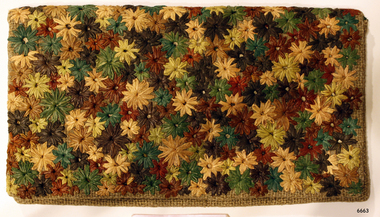
... Embroidered wallet (purse), rectangular, part of a set, the other part being a shopping bag Decorated with embroidered raffia flowers. The bags were made by Daisy Welsh (nee Dale) c. 1928 from homespun "hopsack' fabric of William Dale's trousers, brought to Australia in 1852. ...Warrnambool Branch. flagstaff hill warrnambool shipwrecked coast flagstaff hill maritime museum maritime museum shipwreck coast flagstaff hill maritime village great ocean road chamberlain dale lees stone betty stone warrnambool pioneers clithier william dale daisy welsh wangoom hopsack saddleworth yorkshire wallet purse hand woven handmade Embroidered wallet (purse), rectangular, part of a set, the other part being a shopping bag Decorated with embroidered raffia flowers. The bags were made by Daisy Welsh (nee Dale) c. 1928 from homespun "hopsack' fabric of William Dale's trousers, brought to Australia in 1852. ...In the words of the Donor, Betty Stone, "The wallet is one of a set of two items. They were designed, hand-sewn sewn and embroidered with raffia by my mother Daisy Elvena (nee Dale) Welsh. Daisy Elvena Dale (born 27 October 1899) daughter of Ellis and Ann (nee Lees) Dale, of Latrigg, Wangoom, Warrnambool, married Raymond Welsh in 1922. A few years later – approximately 1928- Daisy made these two articles, which she used, particularly during the Depression years. The important factor concerning these bags is that they were made with hand-woven cloth cut from a pair of trousers which her grandfather, William Dale brought with him when he left the family farm Back o-'the Low situated in Saddleworth, Yorkshire, England. He arrived in Australia in 1852 and seven years later was operating a quarry on land purchased in Wangoom, Warrnambool known as The Dale Bluestone Quarries. Dale forebears in Yorkshire were first recorded as "clothiers" ( ie weavers of cloth) in the Saddleworth parish records dated 1764; following generations also continued the tradition of producing hand woven cloth as a home industry. The cloth, from which these two bags were made, is evidence of a tradition begun by the Dale family in Saddleworth, Yorkshire more than two hundred and fifty years ago. My mother, Daisy Elvena (nee Dale) Welsh (granddaughter of William Dale) always referred to the cloth, which is at least 160 years old, as a homespun hopsack.The homespun hopsack fabric for the set of bags was part of the clothing brought from England to Australia, an example of emigrant luggage. It also represents a traditional home industry of 'clothiers'. This item is associated with the families of Chamberlain, Dale and Lees. These families are listed in the "Pioneers' Register" for Warrnambool Township and Shire, 1835-1900, published by A.I.G.S. Warrnambool Branch.Embroidered wallet (purse), rectangular, part of a set, the other part being a shopping bag Decorated with embroidered raffia flowers. The bags were made by Daisy Welsh (nee Dale) c. 1928 from homespun "hopsack' fabric of William Dale's trousers, brought to Australia in 1852. Part of the 'Chamberlain Dale Lees Collection' flagstaff hill, warrnambool, shipwrecked coast, flagstaff hill maritime museum, maritime museum, shipwreck coast, flagstaff hill maritime village, great ocean road, chamberlain, dale, lees, stone, betty stone, warrnambool pioneers, clithier, william dale, daisy welsh, wangoom, hopsack, saddleworth, yorkshire, wallet, purse, hand woven, handmade -
Warrnambool and District Historical Society Inc.
Functional object - School lunch bag, B & P Hoy Wholesalers Warrnambool, 1960s
... The bags were distributed by B & P Hoy, wholesalers who had a retail shop at 48 Kepler Street and a warehouse and office at 1074 Raglan Parade. ...The bags were distributed by B & P Hoy, wholesalers who had a retail shop at 48 Kepler Street and a warehouse and office at 1074 Raglan Parade. ...This bag has been produced for school children to order their lunches from a school canteen. The bags were distributed by B & P Hoy, wholesalers who had a retail shop at 48 Kepler Street and a warehouse and office at 1074 Raglan Parade. (Approximate dates 1960s to 1980s)This item is of interest as an example of local school lunch bags in the 1960s.A white paper bag with blue and red printing and sketches of five children, a dog, a skate board, an old time school master and the Australian flag. The bag opening has serrated edging.B & P HOY WHOLESALERS "THE MONEY SAVERS" 1074 RAGLAN PARADE WARRNAMBOOLschool canteens, b & p hoy warrnambool, school lunch bags -
 Eltham District Historical Society Inc
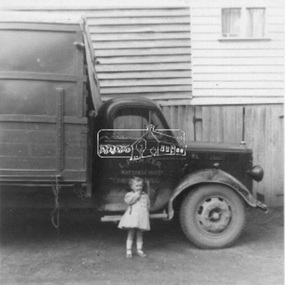
Photograph, Len Parker's Bedford truck at the Tosch home in Panton Hill, c.1952
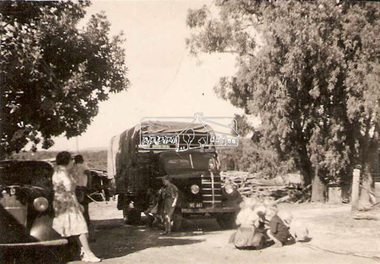
... bags to keep the wind out! Len had paid 75 pounds for it, kept it for ten years and sold it for the same price! Len’s blue 1949 Bedford was brought new in 1950 for 900 pounds with only a tray back on it. Straight away Len had a wooden frame covered with canvas added, with a roll up front and back. In later years, more solid sides replaced the canvas. Benches were added to hold the boxes of fruit and vegetables, with room to move in the middle, a fruit shop...bags to keep the wind out! Len had paid 75 pounds for it, kept it for ten years and sold it for the same price! Len’s blue 1949 Bedford was brought new in 1950 for 900 pounds with only a tray back on it. Straight away Len had a wooden frame covered with canvas added, with a roll up front and back. In later years, more solid sides replaced the canvas. Benches were added to hold the boxes of fruit and vegetables, with room to move in the middle, a fruit shop ...Len Parker's Bedford truck is featured in one of the public art mosaics in Were Street, Montmorency. Mr Parker by Grace de Visser (EDHS Newsletter No. 249, December 2019) Len Parker was a regular sight around the district for almost 40 years, selling fruit and veggies from the back of his truck to his regular customers between 1939 and 1978, first in a 1927 Chevy then a 1949 Bedford truck. Len’s connection to the Eltham district started long before he was born. His father Fred first came through the district in the early 1900s. With horse and cart buying and selling what was available at the markets using his mothers’ home in North Melbourne as his base. Fred settled and developed a market garden in the rich soil along the creek at Watsons Creek, Christmas Hills in 1903. Ada Watson was almost five years old and one of eight siblings aged two to sixteen, when her Grandfather and Father both named Christopher Watson brought the Eltham Hotel and they moved from Richmond. Ada’s mother was formerly Emily Silk whose parents Martha and John Silk had been farming in Eltham around 1858 and much later a dairy farmer in Fitzroy. In 1917 at St Margaret’s Church Eltham, Fred aged 44 married Ada aged 35 who was still living and working at the Eltham Hotel. Six years later Ada died from cancer leaving Fred with two small children, Rose five and Len three. Len as a young boy, like his father before him worked the land with horses, growing vegetables, mainly potatoes, cabbages, pumpkins, beans, and tomatoes, selling the excess at the market. Len took over from his ageing father Fred, who had established similar rounds selling door to door with a horse and cart. Len preferred mechanical horsepower to the real kind! In 1939 at the age of eighteen Len brought an old 1927 Chevy Truck. He was taught how to drive it and two weeks later got his driver’s Licence. The Chevy truck had an old wagon on the back with no doors, only hessian bags to keep the wind out! Len had paid 75 pounds for it, kept it for ten years and sold it for the same price! Len’s blue 1949 Bedford was brought new in 1950 for 900 pounds with only a tray back on it. Straight away Len had a wooden frame covered with canvas added, with a roll up front and back. In later years, more solid sides replaced the canvas. Benches were added to hold the boxes of fruit and vegetables, with room to move in the middle, a fruit shop on wheels. Len had large scales attached to a box for weighing the fruit and veggies and many a district baby was also weighed on them. Len would stop at customer’s homes, take their orders and with his big cane basket on his arm deliver their order to their door. On his rounds he always wore a big soft back leather apron and a black or navy beret. If it was cold, he wore a ‘bluey’ jacket on his tall slender frame. Len would go to the markets early Thursday morning, only buying what was not grown at home or brought from his brother in law’s orchard. On his way home Len would start his ‘rounds’ in Lower Plenty and then Montmorency and parts of Eltham. Friday’s regulars were in Research, Kangaroo Ground and Panton Hill. Saturdays were Panton Hill and Christmas Hills. When Len retired in 1978, due to changing social times, women were working more and supermarkets starting to take over; his ageing truck was retired too. In 1999 his son Jim had the Bedford restored, Len was very happy to see ‘Beddy’ all shiny and new once again with just a tray back, like when it was new. Jim still drives the ‘Beddy’ to Heritage Truck shows twenty years on. Len married, had five children and lived most of his life, (except during World War 2 when he served in New Guinea), at Watsons Creek, Christmas Hills dying there in 2006 and is buried at the Kangaroo Ground cemetery with his wife of 64 years, Stella nee Tosch 1917 - 2007. Grace de Visser, the author of this article, is the daughter of Len Parker and a descendant of the two former owners of the Eltham Hotel, both named Christopher Watson. bedford truck, len parker, panton hill, tosch property -
 Eltham District Historical Society Inc
Photograph, Len Parker's Bedford truck, c.1962
... bags to keep the wind out! Len had paid 75 pounds for it, kept it for ten years and sold it for the same price! Len’s blue 1949 Bedford was brought new in 1950 for 900 pounds with only a tray back on it. Straight away Len had a wooden frame covered with canvas added, with a roll up front and back. In later years, more solid sides replaced the canvas. Benches were added to hold the boxes of fruit and vegetables, with room to move in the middle, a fruit shop...bags to keep the wind out! Len had paid 75 pounds for it, kept it for ten years and sold it for the same price! Len’s blue 1949 Bedford was brought new in 1950 for 900 pounds with only a tray back on it. Straight away Len had a wooden frame covered with canvas added, with a roll up front and back. In later years, more solid sides replaced the canvas. Benches were added to hold the boxes of fruit and vegetables, with room to move in the middle, a fruit shop ...Len Parker's Bedford truck is featured in one of the public art mosaics in Were Street, Montmorency. The little girl is Grace de Visser's sister. Mr Parker by Grace de Visser (EDHS Newsletter No. 249, December 2019) Len Parker was a regular sight around the district for almost 40 years, selling fruit and veggies from the back of his truck to his regular customers between 1939 and 1978, first in a 1927 Chevy then a 1949 Bedford truck. Len’s connection to the Eltham district started long before he was born. His father Fred first came through the district in the early 1900s. With horse and cart buying and selling what was available at the markets using his mothers’ home in North Melbourne as his base. Fred settled and developed a market garden in the rich soil along the creek at Watsons Creek, Christmas Hills in 1903. Ada Watson was almost five years old and one of eight siblings aged two to sixteen, when her Grandfather and Father both named Christopher Watson brought the Eltham Hotel and they moved from Richmond. Ada’s mother was formerly Emily Silk whose parents Martha and John Silk had been farming in Eltham around 1858 and much later a dairy farmer in Fitzroy. In 1917 at St Margaret’s Church Eltham, Fred aged 44 married Ada aged 35 who was still living and working at the Eltham Hotel. Six years later Ada died from cancer leaving Fred with two small children, Rose five and Len three. Len as a young boy, like his father before him worked the land with horses, growing vegetables, mainly potatoes, cabbages, pumpkins, beans, and tomatoes, selling the excess at the market. Len took over from his ageing father Fred, who had established similar rounds selling door to door with a horse and cart. Len preferred mechanical horsepower to the real kind! In 1939 at the age of eighteen Len brought an old 1927 Chevy Truck. He was taught how to drive it and two weeks later got his driver’s Licence. The Chevy truck had an old wagon on the back with no doors, only hessian bags to keep the wind out! Len had paid 75 pounds for it, kept it for ten years and sold it for the same price! Len’s blue 1949 Bedford was brought new in 1950 for 900 pounds with only a tray back on it. Straight away Len had a wooden frame covered with canvas added, with a roll up front and back. In later years, more solid sides replaced the canvas. Benches were added to hold the boxes of fruit and vegetables, with room to move in the middle, a fruit shop on wheels. Len had large scales attached to a box for weighing the fruit and veggies and many a district baby was also weighed on them. Len would stop at customer’s homes, take their orders and with his big cane basket on his arm deliver their order to their door. On his rounds he always wore a big soft back leather apron and a black or navy beret. If it was cold, he wore a ‘bluey’ jacket on his tall slender frame. Len would go to the markets early Thursday morning, only buying what was not grown at home or brought from his brother in law’s orchard. On his way home Len would start his ‘rounds’ in Lower Plenty and then Montmorency and parts of Eltham. Friday’s regulars were in Research, Kangaroo Ground and Panton Hill. Saturdays were Panton Hill and Christmas Hills. When Len retired in 1978, due to changing social times, women were working more and supermarkets starting to take over; his ageing truck was retired too. In 1999 his son Jim had the Bedford restored, Len was very happy to see ‘Beddy’ all shiny and new once again with just a tray back, like when it was new. Jim still drives the ‘Beddy’ to Heritage Truck shows twenty years on. Len married, had five children and lived most of his life, (except during World War 2 when he served in New Guinea), at Watsons Creek, Christmas Hills dying there in 2006 and is buried at the Kangaroo Ground cemetery with his wife of 64 years, Stella nee Tosch 1917 - 2007. Grace de Visser, the author of this article, is the daughter of Len Parker and a descendant of the two former owners of the Eltham Hotel, both named Christopher Watson. bedford truck, len parker -
 Eltham District Historical Society Inc
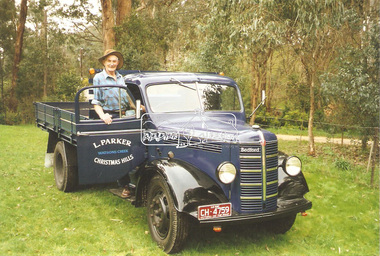
Photograph, Len Parker with his restored Bedford truck, 1999
... bags to keep the wind out! Len had paid 75 pounds for it, kept it for ten years and sold it for the same price! Len’s blue 1949 Bedford was brought new in 1950 for 900 pounds with only a tray back on it. Straight away Len had a wooden frame covered with canvas added, with a roll up front and back. In later years, more solid sides replaced the canvas. Benches were added to hold the boxes of fruit and vegetables, with room to move in the middle, a fruit shop...bags to keep the wind out! Len had paid 75 pounds for it, kept it for ten years and sold it for the same price! Len’s blue 1949 Bedford was brought new in 1950 for 900 pounds with only a tray back on it. Straight away Len had a wooden frame covered with canvas added, with a roll up front and back. In later years, more solid sides replaced the canvas. Benches were added to hold the boxes of fruit and vegetables, with room to move in the middle, a fruit shop ...Len's Bedford truk is featured in one of the Montmorency Were Street shopping precinct mosaics. Mr Parker by Grace de Visser (EDHS Newsletter No. 249, December 2019) Len Parker was a regular sight around the district for almost 40 years, selling fruit and veggies from the back of his truck to his regular customers between 1939 and 1978, first in a 1927 Chevy then a 1949 Bedford truck. Len’s connection to the Eltham district started long before he was born. His father Fred first came through the district in the early 1900s. With horse and cart buying and selling what was available at the markets using his mothers’ home in North Melbourne as his base. Fred settled and developed a market garden in the rich soil along the creek at Watsons Creek, Christmas Hills in 1903. Ada Watson was almost five years old and one of eight siblings aged two to sixteen, when her Grandfather and Father both named Christopher Watson brought the Eltham Hotel and they moved from Richmond. Ada’s mother was formerly Emily Silk whose parents Martha and John Silk had been farming in Eltham around 1858 and much later a dairy farmer in Fitzroy. In 1917 at St Margaret’s Church Eltham, Fred aged 44 married Ada aged 35 who was still living and working at the Eltham Hotel. Six years later Ada died from cancer leaving Fred with two small children, Rose five and Len three. Len as a young boy, like his father before him worked the land with horses, growing vegetables, mainly potatoes, cabbages, pumpkins, beans, and tomatoes, selling the excess at the market. Len took over from his ageing father Fred, who had established similar rounds selling door to door with a horse and cart. Len preferred mechanical horsepower to the real kind! In 1939 at the age of eighteen Len brought an old 1927 Chevy Truck. He was taught how to drive it and two weeks later got his driver’s Licence. The Chevy truck had an old wagon on the back with no doors, only hessian bags to keep the wind out! Len had paid 75 pounds for it, kept it for ten years and sold it for the same price! Len’s blue 1949 Bedford was brought new in 1950 for 900 pounds with only a tray back on it. Straight away Len had a wooden frame covered with canvas added, with a roll up front and back. In later years, more solid sides replaced the canvas. Benches were added to hold the boxes of fruit and vegetables, with room to move in the middle, a fruit shop on wheels. Len had large scales attached to a box for weighing the fruit and veggies and many a district baby was also weighed on them. Len would stop at customer’s homes, take their orders and with his big cane basket on his arm deliver their order to their door. On his rounds he always wore a big soft back leather apron and a black or navy beret. If it was cold, he wore a ‘bluey’ jacket on his tall slender frame. Len would go to the markets early Thursday morning, only buying what was not grown at home or brought from his brother in law’s orchard. On his way home Len would start his ‘rounds’ in Lower Plenty and then Montmorency and parts of Eltham. Friday’s regulars were in Research, Kangaroo Ground and Panton Hill. Saturdays were Panton Hill and Christmas Hills. When Len retired in 1978, due to changing social times, women were working more and supermarkets starting to take over; his ageing truck was retired too. In 1999 his son Jim had the Bedford restored, Len was very happy to see ‘Beddy’ all shiny and new once again with just a tray back, like when it was new. Jim still drives the ‘Beddy’ to Heritage Truck shows twenty years on. Len married, had five children and lived most of his life, (except during World War 2 when he served in New Guinea), at Watsons Creek, Christmas Hills dying there in 2006 and is buried at the Kangaroo Ground cemetery with his wife of 64 years, Stella nee Tosch 1917 - 2007. Grace de Visser, the author of this article, is the daughter of Len Parker and a descendant of the two former owners of the Eltham Hotel, both named Christopher Watson. bedford truck, len parker -
 Eltham District Historical Society Inc
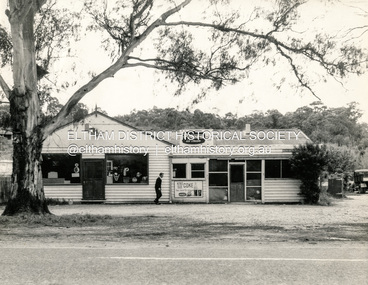
Photograph, George W. Bell, Eltham South Milk Bar, opposite Eltham Lower Park, c.1960
... Locals who were children of the late 1950s on recall buying bags of lollies and drinks such as Blue Heaven Spider (ice cream float) and crackers for cracker night. At one point the shop...Locals who were children of the late 1950s on recall buying bags of lollies and drinks such as Blue Heaven Spider (ice cream float) and crackers for cracker night. At one point the shop ...Site of original tea rooms opposite what was then Eltham Park, now Eltham Lower Park on Main Road, present-day 573 Main Road since early 1970s, immediately prior to which it was 271 Main Road. It is believed a Mrs M Willoughby operated the tea rooms around October 1919. Arthur James McDonald became proprietor of the Eltham Park Tea Rooms some time between 1942 and 1945. In the 1942 Electoral Roll he was recorded living in Moonee Ponds as an aircraft fitter and was then recorded as a tea-room proprietor at Main Road, Eltham in the 1946 Electoral Roll. By 1949 he had moved to Leongatha where he was a café proprietor. A picture of the 1934 floods (EDHS_00103) shows the tea rooms surrounded by waist height flood waters. This building was a different structure. It is not known whether the building was demolished and rebuilt because of this flood event or sometime later to the building seen in this photograph, however it appears to be of a mid-1950s style. During the 1950s it was a milk bar as seen in this photograph and served Devonshire teas in the late 1950s, open only on weekends to service the park and miniature railway opposite. Locals who were children of the late 1950s on recall buying bags of lollies and drinks such as Blue Heaven Spider (ice cream float) and crackers for cracker night. At one point the shop also had pinball machines. It is believed the section of the building to the right was a residence. By the time the Shire of Eltham celebrated its centenary in 1971, the Eltham South Milk Bar was under new management. During the 1980s the shop was operated by Ansell and Muir and they offered takeaway fast food, such as spring rolls and especially hot chicken and chips. Locals also fondly recall their chicken schnitzel with lemon juice. It is remembered as one of the best takeaway food shops, fresh food and fast service with great parking. The residence section to the right was developed as an art, pottery and crafts gallery, Bimbadeen, run by Don Brown, then a local artist. It was taken over in the late 1980s as River Clay run by Leo Haanappel and Coeny Dommers. Unfortunately, the store stood within the 1934 flood zone and the property was unable to be redeveloped. The former Shire of Eltham acquired the land, and the building was subsequently demolished. In December 1993 company registration for Ansell and Muir Prestige Catering was cancelled and the business dissolved. The location is now the site of the current Fleur de Feliss flower stall tent. 17 December 1993 company registration cancelled for Ansell and Muir Prestige Catering Pty. Ltd. [CORPORATIONS LAW Subsection 574(1) (1994, January 12). Commonwealth of Australia Gazette. Periodic (National : 1977 - 2011), p. 20. Retrieved May 24, 2026, from http://nla.gov.au/nla.news-article238039370]Black and white photograph of Eltham South Store later Ansell & Muir c.1960573 main road eltham, 1960, a.j. mcdonald, ansell, ansell and muir, arthur james mcdonald, bimbadeen gallery, eltham, eltham park tea rooms, eltham south, george w. bell collection, main road eltham, milk bar, muir, riverclay craft gallery, shops, take away food -
 Bendigo Historical Society Inc.
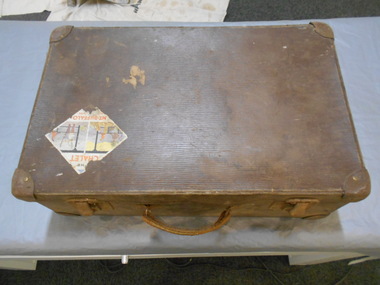
Functional object - Suitcase Made in Bendigo
... HARPER NEW BAG SHOP Leather Goods & Ladies' Hand Bags Travelling Bags & Trunks Saddler & Harness Maker Charing Cross BENDIGO The other is light blue with black writing, QUALITY Guaranteed M.B. ...HARPER NEW BAG SHOP Leather Goods & Ladies' Hand Bags Travelling Bags & Trunks Saddler & Harness Maker Charing Cross BENDIGO The other is light blue with black writing, QUALITY Guaranteed M.B. ...G. Harper was a saddler and harness maker located at Bath Corner, Charring Cross. He advertised in The Bendigo Advertiser in 1892A brown suitcase with two metal clasps which could be locked. There are two travel stickers, ones a Victorian railways luggage Melbourne Albury which is partly missing, the other is The CHALET MT BUFFALO Nation Park. On the inside of the lid there are two labels one is black with gold letters G. HARPER NEW BAG SHOP Leather Goods & Ladies' Hand Bags Travelling Bags & Trunks Saddler & Harness Maker Charing Cross BENDIGO The other is light blue with black writing, QUALITY Guaranteed M.B. Fibre CASE.182 underlined made in bendigo, suitcase, g. harper saddler and harness maker -
 Warrnambool and District Historical Society Inc.
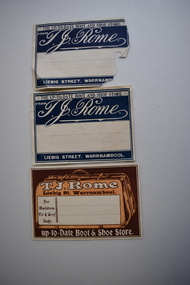
4x Labels, Rome, Early 20th Century
... shop at 115 Liebig Street in 1907. He retired in 1962. Tommy Rome was also important as the person who recorded songs and skits on an Edison phonograph at the Warrnambool Industrial and Art Exhibition in 1897. These recordings survive today as the earliest surviving sound recordings in Australia. These are labels from a well known business in Warrnambool and so are of some significance. t.j.rome boots and shoes warrnambool .1 T.J.Rome Liebig St. Warrnambool For Gladstone, Kit & Brief Bags ...Thomas (Tommy) Rome was a prominent Warrnambool citizen who came to Warrnambool in 1888 and established his footwear shop at 115 Liebig Street in 1907. He retired in 1962. Tommy Rome was also important as the person who recorded songs and skits on an Edison phonograph at the Warrnambool Industrial and Art Exhibition in 1897. These recordings survive today as the earliest surviving sound recordings in Australia.These are labels from a well known business in Warrnambool and so are of some significance..1Rectangular paper label with brown and yellow background, white and brown text and a space for writing. The reverse is adhesive. .2 Rectangular paper white label with dark blue sections, a space for writing and dark blue and white text. The reverse is adhesive. It is damaged. .3 Identical to .2 .4 Identical to .2 ..1 T.J.Rome Liebig St. Warrnambool For Gladstone, Kit & Brief Bags. up=to=date Boot & Shoe Store. .2, .3, .4 THE UP-TO-DATE BOOT AND SHOE STORE FROM, T.J. Rome LIEBIG STREET,WARRNAMBOOL .t.j.rome, boots and shoes, warrnambool -
 Warrnambool and District Historical Society Inc.
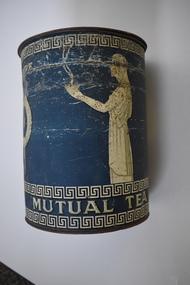
Tea Tin, Mutual Store Ltd, Mid 20th century
... shops etc. Bulk tea can still be bought but the main tea sales are now in the form of tea-bags. ...shops etc. Bulk tea can still be bought but the main tea sales are now in the form of tea-bags. ...This tin contained bulk tea which came from the Melbourne Mutual Store. Established in 1872 as a profit-sharing co-operative of shareholders and staff, Mutual Store Ltd was situated at the corner of Flinders and Degraves Street, Melbourne. Fire destroyed the building in 1891 and the new building erected is an important heritage building today. In 1961 Peter Kaye Consolidated Ltd bought the business and it then traded as Mutual Store Holdings Ltd. In 1964 Cleckheaton (from England) took over the business and closed the store in 1965. Tea tins such as this one would have been distributed by the Mutual Store to smaller businesses such as cafes or repackaged for sale at grocery shops etc. Bulk tea can still be bought but the main tea sales are now in the form of tea-bags. This tin is retained as a memento of the days in the 19th and early to mid 20th centuries when tea was sold only in bulk and provided in tins such as this by the importers to small grocery shops and the like. This is a tea tin, cylindrical in shape. It has a tight-fitting lid with a metal clip. There is blue and cream painting around the sides of the tin with images of Greek figures and a wreath with a ribbon. The tin is much scratched and rusted. There is cream printing on the tin.‘Mutual Tea’ ‘Mutual Store Ltd Flinders Street Melbourne Aust. ‘ ‘5 lbs nett’ mutual store, melbourne, warrnambool -
 Sunshine and District Historical Society Incorporated
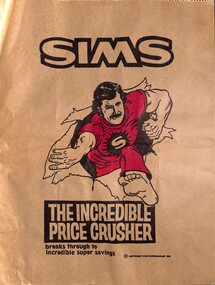
Ephemera - Joseph "Joe" Wlodarczyk Collection - Supermarket Paper Grocery Bags
... Collected by Joseph Wlodarczyk All these bags came from the major supermakets that were located in the Sunshine Shopping Centre SIMS and later SSW were located in Sun Crescent Payless, Safeway and Coles were located in Hampshire Road North of the railway line...Collected by Joseph Wlodarczyk All these bags came from the major supermakets that were located in the Sunshine Shopping Centre SIMS and later SSW were located in Sun Crescent Payless, Safeway and Coles were located in Hampshire Road North of the railway line Supermarket Bag Sims, Payless, Safeway, Coles New World, SSW Collection of Brown Grocery Paper Bags Ephemera Joseph "Joe" Wlodarczyk Collection - Supermarket Paper Grocery Bags ...Collected by Joseph Wlodarczyk All these bags came from the major supermakets that were located in the Sunshine Shopping Centre SIMS and later SSW were located in Sun Crescent Payless, Safeway and Coles were located in Hampshire Road North of the railway lineCollection of Brown Grocery Paper BagsSims, Payless, Safeway, Coles New World, SSWsupermarket, bag -
 Sunshine and District Historical Society Incorporated
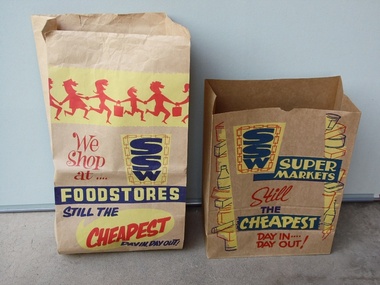
Memorabilia - SSW Supermarket Brown Paper Grocery Bag
... It is likely that many of the younger generation have no idea of how the paper grocery bags looked like, or that they were once used instead of plastic bags. brown paper grocery bag ssw supermarket food grocery purchases groceries. Large Bag: We Shop at .... ...These type of brown paper grocery bags were commonly supplied by SSW Supermarkets, and also by other Supermarkets. The customers generally packed their own grocery purchases into the bags, while the checkout people were engaged in the time consuming process of accurately entering by hand, the price of each item into the cash registers. One local SSW Supermarket was situated on Sun Crescent in Sunshine. The introduction of stronger plastic film grocery bags and barcode scanning saved time, and the checkout person took over the role of packing the grocery purchases. In recent times customers who use the self check out terminals have again assumed the role of packing their own groceries. The environment polluting plastic bags however still remain, unless the customers bring their own 'green' bags.These two brown paper grocery bags provide a historical reminder of how grocery purchases were taken home from Supermarkets in the not too distant past. It is likely that many of the younger generation have no idea of how the paper grocery bags looked like, or that they were once used instead of plastic bags.Two brown paper bags which were available for free in SSW Supermarkets, so that customers could pack their grocery purchases to be able to take them home. The bags have SSW advertising printed on them in red, yellow, and navy blue inks.Large Bag: We Shop at .... SSW FOODSTORES STILL THE CHEAPEST DAY IN, DAY OUT! Smaller Bag: SSW SUPERMARKETS Still THE CHEAPEST DAY IN .... DAY OUT!brown paper grocery bag, ssw supermarket, food, grocery purchases, groceries. -
 Embroiderers Guild, Victoria
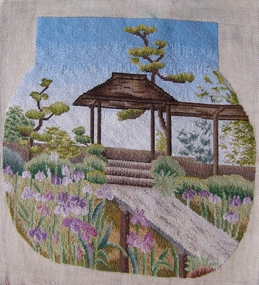
Textile - Petit Point Royal School of Needlework Bag Front Panel, Royal School of Needlework London, Early 20th century
... shop. Embroidery Canvas work Petit point 1900-20 England Bags Fine canvas (20 threads to 2 cms) with oriental design in petit point using multi coloured filloselle silk. ...This example was purchased at the sale of old stock in the Royal School of Needlework shop.Fine canvas (20 threads to 2 cms) with oriental design in petit point using multi coloured filloselle silk. These canvas bags were made and sold for embroidering at the Royal School of Needlework, London.embroidery, canvas work, petit point, 1900-20, england, bags -
 Embroiderers Guild, Victoria
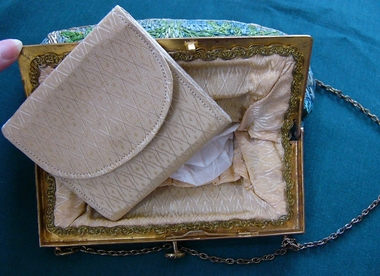
Accessory - Evening Bag, 1920
... Came from an opportunity shop. Embroidery Bags 1920-40 France Canvas work Canvas embroidery on fine cotton evenweave. ...Came from an opportunity shop.Canvas embroidery on fine cotton evenweave. Raffia threads are used in green for the background and one large spray of flowers in pink form the central motif. A decorative metal frame used and a cream figures dilk material for the lining and small mirror cover.embroidery, bags, 1920-40, france, canvas work -
 Embroiderers Guild, Victoria
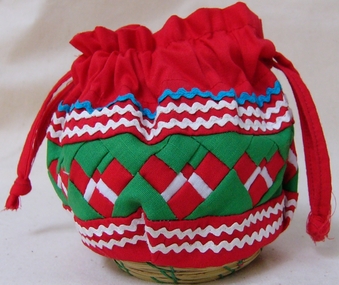
Accessory - Bag, Prior to 1987
... Purchased in a shop at the Department of the Interior, Washington, USA by Edna Wark. Patchwork Seminole Bags North America 1960-80 Bag of bright red, green and white cotton fabric and with white and blue fine ric-rac braid. ...Purchased in a shop at the Department of the Interior, Washington, USA by Edna Wark.Bag of bright red, green and white cotton fabric and with white and blue fine ric-rac braid. The patchwork top is attached to a basketry base made of grass and fibre. Machinepieces and constructed Grass hand stitchedpatchwork, seminole, bags, north america, 1960-80
