
Showing 3 items matching "short field landings"
-
 Moorabbin Air Museum
Book - Pilot training, Make Better Landings
... landing...Glide / flapless & other abnormal landings...Crosswind landings...Short field...Pilot training Engine assisted approach & landing Glide / flapless & other abnormal landings Crosswind landings Short field landings Tailwheel techniques Landing turboprop aircraft Landing jet aircraft Landing on contaminated surfaces Overview of approach & landing techniques, circa 1990 Make Better Landings Book Pilot training ...Overview of approach & landing techniques, circa 1990non-fictionOverview of approach & landing techniques, circa 1990engine assisted approach & landing, glide / flapless & other abnormal landings, crosswind landings, short field landings, tailwheel techniques, landing turboprop aircraft, landing jet aircraft, landing on contaminated surfaces -
 Bendigo Military Museum
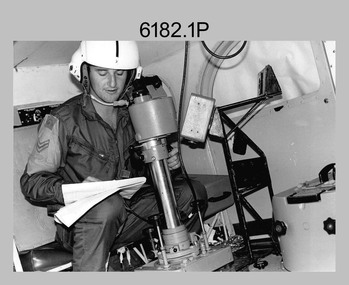
Photograph - Royal Australian Survey Corps Aerial Surveys, c1980
... The Australian Army’s Pilatus Porter (short take-off and landing turbo propeller) was also equipped with a Wild RC10 aerial mapping camera for identification photography. The Pilatus Porter was also used on RA Svy’s map field checking operations. ...The Australian Army’s Pilatus Porter (short take-off and landing turbo propeller) was also equipped with a Wild RC10 aerial mapping camera for identification photography. The Pilatus Porter was also used on RA Svy’s map field checking operations. ...This is a set of nine photographs of technicians from the Royal Australian Survey Corps operating aerial surveys equipment c1980s. In photo .1P, CPL Steve Gloster was operating a RC10 air survey camera mounted in an Australian Army Pilatus Porter aircraft. The Wild RC10 super wide-angle air survey cameras were first introduced in 1971, were equipped with virtual distortion free lenses for supplementary, spot and special photography. In photo .2P, Roger Rees was operating Air Profile Recorder (APR) equipment. it was possibly taken during OP NERVOSE 84, sometime between June – August 1984 when based in Ngukurr, Northern Territory. The APR was operated at this time in unison with an RC10 camera. In 1963 the Royal Australian Survey Corps introduced the radar airborne profile recorder (Canadian Applied Research Ltd, Mark V, Airborne Profiler Recorder) was introduced for 1:100,000 mapping to replace terrain heighting by aneroid barometry. Later in 1974-1975, the Australian developed WREMAPS II airborne laser terrain profile recorder was introduced. In photo .3P, Neil Jones appears at the door of Airsearch Beechcraft Queen Air aircraft, Registration / Serial VH-MWX. This aircraft was typically used by RA Svy on air survey operations flying mission with Aerodist, APR and RC10 camera equipment. The Australian Army’s Pilatus Porter (short take-off and landing turbo propeller) was also equipped with a Wild RC10 aerial mapping camera for identification photography. The Pilatus Porter was also used on RA Svy’s map field checking operations. Photo .9P was taken at a survey station at an unknown location. In this photo an Australian Army Kiowa Light Observation Helicopter (LOH) is supporting a field survey party undertaking Magnavox AN/PRR-14 portable Doppler satellite observations. The satellite receiver’s antenna is plumbed over the survey ground mark surrounded by white plastic panels. The panels were used to identify the survey station on aerial photography. Introduced in 1974–1975, the Magnavox AN/PRR-14 portable Doppler satellite (US Navy Navigation Satellite System – TRANSIT) receivers and computing system provided independent three-dimensional point positions anywhere in the world, anytime, in any weather accurate to about 1.5metres with precise satellite ephemerides. The Bell OH-58 Kiowa LOH was a family of military helicopters used for observation, utility, and direct fire support. It was identified by RA Svy in the mid-1970s that considerable time was lost in replacing unserviceable remote equipment by road. Therefore Aerodist operations (pre-dating satellite receiver operations) were fully supported by Army’s Kiowa LOH aircraft. This is a set of nine photographs of technicians from the Royal Australian Survey Corps operating aerial surveys equipment c1980s. .1P to .3P, .5P to .9P - Colour and black and white photos on photographic paper and scanned at 300 dpi. .4P - Colour photo on 35mm slide film and scanned at 96 dpi. .1) & .2) - Photo, black & white, c1980s, CPL Steve Gloster operating an RC10 air camera. .3) - Photo, colour, 1984, Roger Rees operating Air Profile Recorder (APR) equipment. .4) - Photo, colour, c1980s, Neil Jones at the door of an Airsearch Beechcraft Queen Air aircraft, typically used by RA Svy on air survey operations. .5) - Photo, colour, c1980s. A Beechcraft King Air aircraft, also used by RA Svy on air survey operations. .6) - Photo, colour, c1980s. An Australian Army Pilatus Porter, used by RA Svy on air survey and map field checking operations. SGT Peter Mustart is possibly in the foreground. .7) to .8) - Photo, colour, c1980s. An Australian Army Pilatus Porter and unidentified personnel, used by RA Svy on air survey and map field checking operations. .9) - Photo, colour, c1980s. An Australian Army Kiowa helicopter supporting a field survey party undertaking Magnavox AN/PRR-14 portable Doppler satellite observations. There are biro marks on photos .4P to .9Proyal australian survey corps, rasvy, army survey regiment, asr, fortuna, aerial surveys -
 Returned Nurses RSL Sub-branch
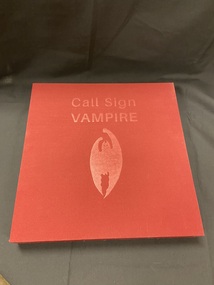
Book - Hardcover book, Rod Searle et al, Call sign Vampire, 2021
... short, / the craft so long to learn." / Hippocrated / With the warmest of wishes, / Gregory & Debbie. / 2023' [Handwritten in black ink on the second page] Hardcover, cloth bound, burgundy book with a white dust jacket. The dust jacket shows an image of six people ducking from the force of the wind coming from the helicopter that is landing behind them, there is blue cloudy sky above. Across the sky is printed the title. The book is housed in a burgundy clth covered slipcase. Call sign Vampire Book Hardcover book Rod Searle Denise Bell Paul Danaher Gregory Anderson 1st (Aust) Field ...This inside story of an Australian Field Hospital during the Vietnam War is told through a compilation of operational facts interspersed with the personal experiences of those who served and the patients who passed through the hospital doors, into their care.Call Sign VAMPIRE provides a window into the frenetic world of a military hospital in a war zone through evocative, sometimes confronting imagery. In this environment time was of the essence and life often hung in the balance.The wounded, "... they were scared, frightened, shocked and they weren't coping. Generally, when the chopper landed, they weren't coping. No. They were in shock, incoherent and it was no good asking them what had happened, or where they'd been, because twenty minutes before they were in contact with the enemy ..." Ron NolanAt the 1st Australian Field Hospital the battle for life and limb was often challenging and intense. Medical services provided by the hospital were of such a high standard that the survival rate, for soldiers arriving at the hospital alive, was 99%.This success rate still stands today as a truly remarkable achievement!The hospital comprised triage, operating theatres, pathology, pharmacy, X-ray, physiotherapy, psychiatry, outpatients, RAP, a six-bed intensive care ward and 50 bed medical and 50 bed surgical ward. It was also supported by a Q-store, an orderly room, messes and accommodation. Units attached to the hospital were the 33rd Dental Unit, 1st Field Medical and Dental Stores, 1st Field Hygiene Company, Chaplains and Australian Red Cross representatives.Our book is a celebration of the dedication, temerity and care of a unique group of Australians, thrown together to get on with the job of treating the injured and wounded. A consequence of Australia's involvement in the Vietnam War.Our hope is that the readers of Call Sign VAMPIRE gain an insight into what it meant to go to a war that polarised public opinion, and impacted the physical and mental well being of so many young soldiers and personnel dealing with the consequential casualties and despair. We also hope that you come to understand why as young Australians we are so proud to have been part of a unit that as Roger Nation remembers, "... welded together to form a team of world class standard" and why our camaraderie has continued to this day. - from Trove record.Hardcover, cloth bound, burgundy book with a white dust jacket. The dust jacket shows an image of six people ducking from the force of the wind coming from the helicopter that is landing behind them, there is blue cloudy sky above. Across the sky is printed the title. The book is housed in a burgundy clth covered slipcase.non-fictionThis inside story of an Australian Field Hospital during the Vietnam War is told through a compilation of operational facts interspersed with the personal experiences of those who served and the patients who passed through the hospital doors, into their care.Call Sign VAMPIRE provides a window into the frenetic world of a military hospital in a war zone through evocative, sometimes confronting imagery. In this environment time was of the essence and life often hung in the balance.The wounded, "... they were scared, frightened, shocked and they weren't coping. Generally, when the chopper landed, they weren't coping. No. They were in shock, incoherent and it was no good asking them what had happened, or where they'd been, because twenty minutes before they were in contact with the enemy ..." Ron NolanAt the 1st Australian Field Hospital the battle for life and limb was often challenging and intense. Medical services provided by the hospital were of such a high standard that the survival rate, for soldiers arriving at the hospital alive, was 99%.This success rate still stands today as a truly remarkable achievement!The hospital comprised triage, operating theatres, pathology, pharmacy, X-ray, physiotherapy, psychiatry, outpatients, RAP, a six-bed intensive care ward and 50 bed medical and 50 bed surgical ward. It was also supported by a Q-store, an orderly room, messes and accommodation. Units attached to the hospital were the 33rd Dental Unit, 1st Field Medical and Dental Stores, 1st Field Hygiene Company, Chaplains and Australian Red Cross representatives.Our book is a celebration of the dedication, temerity and care of a unique group of Australians, thrown together to get on with the job of treating the injured and wounded. A consequence of Australia's involvement in the Vietnam War.Our hope is that the readers of Call Sign VAMPIRE gain an insight into what it meant to go to a war that polarised public opinion, and impacted the physical and mental well being of so many young soldiers and personnel dealing with the consequential casualties and despair. We also hope that you come to understand why as young Australians we are so proud to have been part of a unit that as Roger Nation remembers, "... welded together to form a team of world class standard" and why our camaraderie has continued to this day. - from Trove record. 1st australian field hospital, vietnam war
