
Showing 110 items matching "signals training"
-
 National Vietnam Veterans Museum (NVVM)
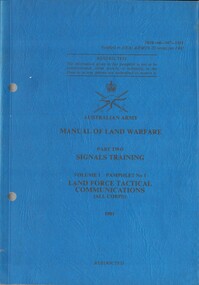
Manual, Australian Army, Australian Army: Manual of Land Warfare, Part Two: Signals Training. Volume 1 Pamphlet No. 1, Land Force Tactical Communications (All Corps) 1981, 1981
... Australian Army: Manual of Land Warfare, Part Two: Signals Training. Volume 1 Pamphlet No. 1, Land Force Tactical Communications (All Corps) 1981......Signals Training...Australia - Armed Forces - Service manuals Land Warfare Signals Training Land Force Tatical Communications A blue coloured cardboard cover with black information on the front cover. ...A blue coloured cardboard cover with black information on the front cover. Top right hand corner reads 7610-66-107-1151. Under the Australian Army insignia are the details of the manual. There are two punch holes down the left hand side and the manual is covered in a plastic cover. australia - armed forces - service manuals, land warfare, signals training, land force tatical communications -
 4th/19th Prince of Wales's Light Horse Regiment Unit History Room
Pamphlet, Royal Australian Armoured Corps Advanced Signal Training 1981, 1981
... Royal Australian Armoured Corps Advanced Signal Training 1981...signals training...Soft covered loose leaf book, the RAAC extract from the Manual of Land Warfare Part Two, Signal Training Volume 2 detailing communications techniques and radio telephone procedures...Royal Australian Armoured Corps Advanced Signal Training. RAAC extract from the Manual of Land Warfare Part Two, Signal Training Volume 2 Communications Techniques Pam No 3 Telephone Procedures (All Corps) 1980...Used by the Regiment signals training royal australian armoured corps handbook Royal Australian Armoured Corps Advanced Signal Training. ...Used by the RegimentSoft covered loose leaf book, the RAAC extract from the Manual of Land Warfare Part Two, Signal Training Volume 2 detailing communications techniques and radio telephone proceduresRoyal Australian Armoured Corps Advanced Signal Training. RAAC extract from the Manual of Land Warfare Part Two, Signal Training Volume 2 Communications Techniques Pam No 3 Telephone Procedures (All Corps) 1980signals training, royal australian armoured corps, handbook -
4th/19th Prince of Wales's Light Horse Regiment Unit History Room
Book, Modern Printing Pty Ltd, Signals Training Vol II Part II 1937 - Supplement, 1936
... Signals Training Vol II Part II 1937 - Supplement...Signals short wave skip distances A hard covered book dealing with skip distances of short wave signals, with graphs. Signals Training Vol II Part II 1937 - Supplement Book Modern Printing Pty Ltd ...A hard covered book dealing with skip distances of short wave signals, with graphs.signals, short wave, skip distances -
4th/19th Prince of Wales's Light Horse Regiment Unit History Room
Manual - Folder, loose leaf, Royal Australian Armoured Corps Signal Training 1985, 1985
... Royal Australian Armoured Corps Signal Training 1985...The RAAC extract from Manual of Land Warfare Part 2 Signal Training Volume 2, detailing procedure to be used for radiotelephone communications throughout the Army. ...RAAC Signal Training 1985. RAAC Extract from Manual of Land Warfare Part 2. ...Royal Australian Armoured Corps Signal Training 1985 Manual Folder, loose leaf ...Used by the RegimentSoft covered loose leaf book. The RAAC extract from Manual of Land Warfare Part 2 Signal Training Volume 2, detailing procedure to be used for radiotelephone communications throughout the Army. Includes Amendment list No 1.RAAC Signal Training 1985. RAAC Extract from Manual of Land Warfare Part 2. Signal Training Volume 2, Pamphlet No 3. Radio Telephone Procedure (All Corps) 1983hand book, radio training, royal australian armoured corps -
 Geelong RSL Sub Branch
Book, Signal Training (All Arms) 1938, Early 20th Century
... Signal Training (All Arms) 1938...Training...Signals...Signal Training (All Arms) 1938 for the use of training Military Personal....Signal Training (All Arms) 1938 for the use of training Military Personal. ...Signal Training (All Arms) 1938 for the use of training Military Personal.Used for training Military Personnel in Signals.Oblong shape book, red cardboard and cloth cover.Inside front cover written in pencil in name Booth. Printed by Brown, Prior, Anderson Pty Ltd Melbourne. C.1.training, signals, all arms, military. -
 The Beechworth Burke Museum
Photograph, 1944
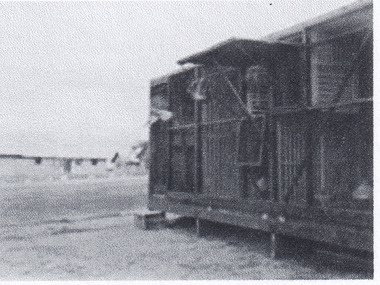
... Taken in 1944 in Bonegilla, Victoria, this photograph depicts soldiers of the 1st Australian Corps Signals training battalion releasing carrier pigeons from a portable loft for their daily exercise....Obverse: Negative Number: 066265/ thumbnail/ image 066265/ purchased from Australian War Memorial/ Bonegilla Victoria 1944*05-03 Carrier pigeons being released for their/ daily exercise from a portable loft of the 1st Signals training Battlion/ Reverse: 7993/...Taken in 1944 in Bonegilla, Victoria, this photograph depicts soldiers of the 1st Australian Corps Signals training battalion releasing carrier pigeons from a portable loft for their daily exercise. ...Taken in 1944 in Bonegilla, Victoria, this photograph depicts soldiers of the 1st Australian Corps Signals training battalion releasing carrier pigeons from a portable loft for their daily exercise.The 1st Australian Corps Signals was a branch of the Australian Imperial Airforce that was active during World War Two. One of the tasked carried out by 1st Australian Corps Signals was to send messages through the use of carrier pigeons. Carrier pigeons were most commonly used by the Allied Forces to send messages from the front line trenches or advancing units.Black and white square reproduced photograph on rectangular archival paperObverse: Negative Number: 066265/ thumbnail/ image 066265/ purchased from Australian War Memorial/ Bonegilla Victoria 1944*05-03 Carrier pigeons being released for their/ daily exercise from a portable loft of the 1st Signals training Battlion/ Reverse: 7993/military album, beechworth, burke museum, military, world war 2, ww2, australian army, bonegilla, pigeons -
4th/19th Prince of Wales's Light Horse Regiment Unit History Room
Booklet, Signal Training (All Arms) Pam No 7 Radiotelephone Procedure 1969 Amendment List No 3, 15/3/1978
... Signal Training (All Arms) Pam No 7 Radiotelephone Procedure 1969 Amendment List No 3...Amendment List No 3 to Signal Training Pam 7 1969...Used by the Regiment training manuals radiotelephone procedures DSN 0652-03-029-1400 Amendment List No 3 to Signal Training Pam 7 1969 Signal Training (All Arms) Pam No 7 Radiotelephone Procedure 1969 Amendment List No 3 Booklet Booklet ...Used by the RegimentAmendment List No 3 to Signal Training Pam 7 1969DSN 0652-03-029-1400training manuals, radiotelephone procedures -
 The Beechworth Burke Museum
Photograph, 1944
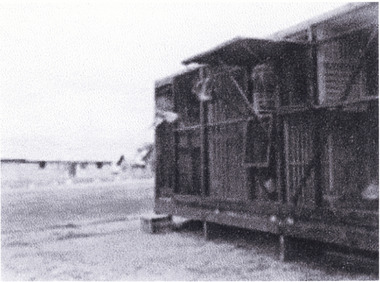
... Taken in 1944 in Bonegilla, Victoria, this photograph depicts soldiers of the 1st Australian Corps Signals training battalion releasing carrier pigeons from a portable loft for their daily exercise....Obverse: Bonegilla Victoria 1944 - 05 - 03 Carrier pigeons being released for their daily exercise/ from a portable loft of the 1st Signals training Battlion/ copied from the Australian War Memorial No 066265 Order No 2319835 Copyright/ permission for the collection of/ Robert O'Hara Burke Memorial Museum Beechworth/ Reverse: 7993.1...Taken in 1944 in Bonegilla, Victoria, this photograph depicts soldiers of the 1st Australian Corps Signals training battalion releasing carrier pigeons from a portable loft for their daily exercise. ...Taken in 1944 in Bonegilla, Victoria, this photograph depicts soldiers of the 1st Australian Corps Signals training battalion releasing carrier pigeons from a portable loft for their daily exercise.The 1st Australian Corps Signals was a branch of the Australian Imperial Airforce that was active during World War Two. One of the tasked carried out by 1st Australian Corps Signals was to send messages through the use of carrier pigeons. Carrier pigeons were most commonly used by the Allied Forces to send messages from the front line trenches or advancing units.Black and white square reproduced photograph on rectangular archival paperObverse: Bonegilla Victoria 1944 - 05 - 03 Carrier pigeons being released for their daily exercise/ from a portable loft of the 1st Signals training Battlion/ copied from the Australian War Memorial No 066265 Order No 2319835 Copyright/ permission for the collection of/ Robert O'Hara Burke Memorial Museum Beechworth/ Reverse: 7993.1military album, beechworth, burke museum, military, world war 2, ww2, australian army, bonegilla, pigeons -
4th/19th Prince of Wales's Light Horse Regiment Unit History Room
Pamphlet, Department of Supply Central Drawing Office, Signal Training (All Arms) Pam No 7 Voice Procedure 1963, 1963
... Signal Training (All Arms) Pam No 7 Voice Procedure 1963...Signal Training (All Arms) Pamphlet No 7 Voice Procedure 1963 Supersedes Signal Training Pamphlet No 7 Voice Procedure 1955. ...Used by the Regiment radio training voice procedure Signal Training (All Arms) Pamphlet No 7 Voice Procedure 1963 Supersedes Signal Training Pamphlet No 7 Voice Procedure 1955. ...Used by the RegimentSoft covered book detailing the voice procedures to be used throughout the AMF incorporating new procedures to cater for modern equipments.Signal Training (All Arms) Pamphlet No 7 Voice Procedure 1963 Supersedes Signal Training Pamphlet No 7 Voice Procedure 1955. WO Code 8943radio training, voice procedure -
 Lara RSL Sub Branch
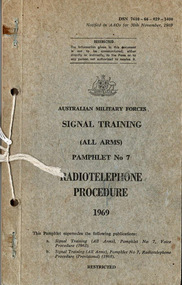
Book, Australian Military forces Signal Training & Radiotelephone Procedure. 1969
... Australian Military forces Signal Training & Radiotelephone Procedure. 1969...Australian Military forces Signal Training & Radiotelephone Procedure.1969...Australian Military forces Signal Training & Radiotelephone Procedure. 1969 Book Book ...Rectangular shaped book.Australian Military forces Signal Training & Radiotelephone Procedure.1969 -
 The Beechworth Burke Museum
Photograph, 03/05/1944
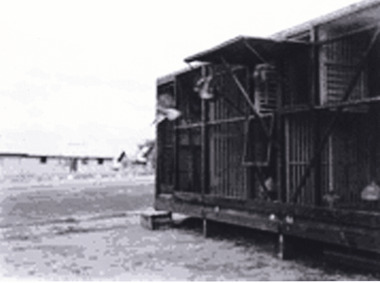
... Johnston, this photograph depicts soldiers of the 1st Australian Corps Signals training battalion releasing carrier pigeons from a portable loft for their daily exercise....Obverse: Bonegilla Victoria 1944-05-03/ Carrier Pigeons being released for their daily exercise/ from a portable loft of the 1st Signals training Battalion/ Photograph made 3 May 1944, by E.C. ...Johnston, this photograph depicts soldiers of the 1st Australian Corps Signals training battalion releasing carrier pigeons from a portable loft for their daily exercise. ...Taken in 1944 in Bonegilla, Victoria by Captain E.C. Johnston, this photograph depicts soldiers of the 1st Australian Corps Signals training battalion releasing carrier pigeons from a portable loft for their daily exercise.The 1st Australian Corps Signals was a branch of the Australian Imperial Airforce that was active during World War Two. One of the tasked carried out by 1st Australian Corps Signals was to send messages through the use of carrier pigeons. Carrier pigeons were most commonly used by the Allied Forces to send messages from the front line trenches or advancing units. Edgar Charles Johnston (1896-1988) was an aviator and public servant. In WW1 he served with the Australian Imperial Force, and later joined the Royal Flying Corps. For his service in the Royal Flying Corps he was awarded the Distinguished Flying Cross, which assisted him in becoming the assistant director-general in 1939 of the Commonwealth Department of Aviation. During World War II he was heavily engaged in the department’s activities in support of the war effort.Black and white square reproduced photograph on rectangular archival paperObverse: Bonegilla Victoria 1944-05-03/ Carrier Pigeons being released for their daily exercise/ from a portable loft of the 1st Signals training Battalion/ Photograph made 3 May 1944, by E.C. Johnston/ copied from CD Image supplied from/ Australian War Memorial collection/ Copyright/ Use of this image for the/ Robert O'Hara Burke Memorial Museum, Beechworth/ enhanced to remove moir effect/ Reverse: 7993.2/military album, beechworth, burke museum, military, world war 2, ww2, australian army, bonegilla, pigeons, edgar charles johnston -
 Lara RSL Sub Branch
Pamphlet, Signal training pamphlet
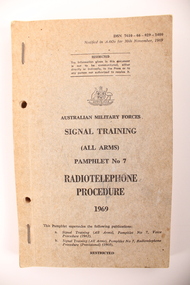
... Signal training pamphlet......signal training...Signal training (all arms), pamphlet no 7, voice procedure 1963 B. ...Signal training (all arms), pamphlet no 7, voice procedure 1963 B. ...A brown cardboard pamphlet. Used by all arms, the pamphlet provides the radiotelephone procedures. DSN 7610-66-029-1400 Australian Military Forces Signal Training (All arms) pamphlet no 7: radiotelephone procedure 1969 Restricted The information given in this document is not to be communicated, either directly or indirectly, to the Press or to any person not authorised. Australian Military Forces Signal training All arms Pamphlet no 7 Radiotelephone procedure 1969 This pamphlet supersedes the following publications: A. Signal training (all arms), pamphlet no 7, voice procedure 1963 B. Signal training (all arms), pamphlet no 7, radiotelephone procedure (provisional) (1968) pamphlet, instructions, training, signal training, radiotelephone, 1969, restricted, australian military forces -
4th/19th Prince of Wales's Light Horse Regiment Unit History Room
Pamphlet, Royal Armoured Corps Training - Notes for Royal Armoured Corp Signal Instructors, 1966
... Royal Armoured Corps Training - Notes for Royal Armoured Corp Signal Instructors......signals training...Training material for Regiment book signals training Army Code No 70303 Soft covered, stapled book covering currents, circuits, radio waves, security, various radios and harness installations used by armoured units. ...Training material for RegimentSoft covered, stapled book covering currents, circuits, radio waves, security, various radios and harness installations used by armoured units. Army Code No 70303book, signals training -
 4th/19th Prince of Wales's Light Horse Regiment Unit History Room
Book, Signal Training (All Arms) 1938, at 1938
... Signal Training (All Arms) 1938......signals training...manual signals training 26 Manuals 1875 Hard covered book detailing Phonetic Alphabet, Morse and Semaphore Codes, Visual Instruments, Field Cables, Wireless Sets etc Signal Training (All Arms) 1938 Book Book Brown, Prior, Anderson Pty Ltd ...Hard covered book detailing Phonetic Alphabet, Morse and Semaphore Codes, Visual Instruments, Field Cables, Wireless Sets etc26 Manuals 1875manual, signals training -
 National Vietnam Veterans Museum (NVVM)
Booklet, Australian Army, Australian Army: Signal Training (All Arms) Pamphlet No. 6: Communications Security, 1971 (Copy 2), 1971
... Australian Army: Signal Training (All Arms) Pamphlet No. 6: Communications Security, 1971 (Copy 2)...Signals...Signal Training...Australia - Armed Forces - Service manuals Signals Signal Training A blue coloured cover with all information in black ink. ...A blue coloured cover with all information in black ink. Top right corner reads DSN 7610--66-039-4906. Above Australian there is a kangaroo above two crossed swords and a crown above them. Down the left hand side a two punch holes. There is a dark rectangular near the top left hand side of the booklet which looks like an adhesive mark.australia - armed forces - service manuals, signals, signal training -
 National Vietnam Veterans Museum (NVVM)
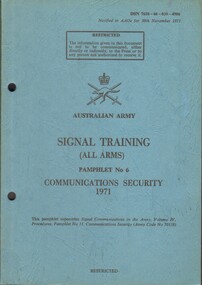
Booklet, Australian Army, Australian Army: Signal Training (All Arms) Pamphlet No. 6: Communications Security, 1971 (Copy 3), 1971
... Australian Army: Signal Training (All Arms) Pamphlet No. 6: Communications Security, 1971 (Copy 3)...Signals...Signal Training...Australia - Armed Forces - Service manuals Signals Signal Training A blue coloured cover with all information in black ink. ...A blue coloured cover with all information in black ink. Top right corner reads DSN 7610--66-039-4906. Above Australian there is a kangaroo above two crossed swords and a crown above them. Down the left hand side a two punch holesaustralia - armed forces - service manuals, signals, signal training -
 National Vietnam Veterans Museum (NVVM)
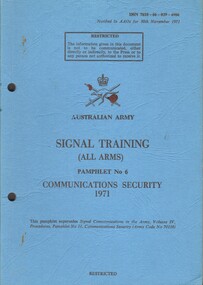
Booklet, Australian Army, Australian Army: Signal Training (All Arms) Pamphlet No. 6: Communications Security, 1971 (Copy 1), 1971
... Australian Army: Signal Training (All Arms) Pamphlet No. 6: Communications Security, 1971 (Copy 1)...Signals...Signal Training...Australia - Armed Forces - Service manuals Signals Signal Training A blue coloured cover with all information in black ink. ...A blue coloured cover with all information in black ink. Top right corner reads DSN 7610--66-039-4906. Above Australian there is a kangaroo above two crossed swords and a crown above them. Down the left hand side a two punch holesaustralia - armed forces - service manuals, signals, signal training -
 Bendigo Military Museum
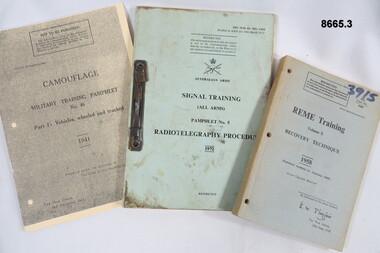
Manual - TRAINING MANUALS VARIOUS, Australian Armed Forces, 1941, 1958, 1972
... REME Training Volume X Recovery Technique 1958. 2. SIGNAL TRAINING - RADIOTELEGRAPHY PROCEDURE 1972. 3. ...REME Training Volume X Recovery Technique 1958. 2. SIGNAL TRAINING - RADIOTELEGRAPHY PROCEDURE 1972. 3. ...Three training manuals primarily for the guidance and instructions of officers and senior NCO's. 1. REME Training Volume X Recovery Technique 1958. 2. SIGNAL TRAINING - RADIOTELEGRAPHY PROCEDURE 1972. 3. CAMOUFLAGE Part 4: Vehicles, wheeled and tracked 1941. (Photocopy pages)1. On front cover, “3915”passchendaele barracks trust, pbt 48 100 101, manuals, training -
 Ballarat Tramway Museum
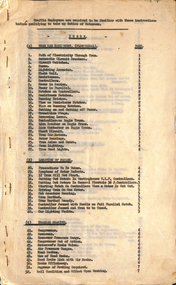
Document - Instruction, State Electricity Commission of Victoria (SECV), "Traffic Employees are required to be familiar with these instructions before qualifying to take up duties of Motormen.", c1940
... ... Training... Signals...Trams tramways SEC Instructions Traffic Staff Motormen Bendigo Training Signals Instructions - 19 sheets (last sheet missing), stapled multiple times on the left hand edge, providing detailed instructions and guidance to trainee motormen. ...Demonstrates training of tram drivers in Bendigo. Similar documents would have been used for Ballarat and Geelong.Instructions - 19 sheets (last sheet missing), stapled multiple times on the left hand edge, providing detailed instructions and guidance to trainee motormen. Has reference to T1F controllers, K36J controllers and instructions for Safety Cars (Birney). Has diagrams for electrical paths. Has a table of contents, covers electrical, faults, braking, failures of braking, emergency braking, dead man controls, signal instructions for Bendigo and General Instructions. C1940. See also Reg Item 3486 for another version. trams, tramways, sec, instructions, traffic staff, motormen, bendigo, training, signals -
 4th/19th Prince of Wales's Light Horse Regiment Unit History Room
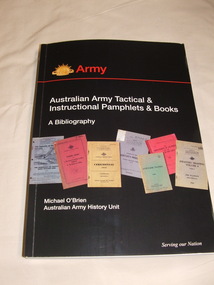
Book, Army History Unit, Australian Army Tactical & Instructional Pamphlets & Books - A Bibliography, 2017
... The bibliography demonstrates the range of subject areas that Army has addressed over its history, including such esoteric issues as censorship, the evolution of Signals training, accreditation of war correspondents & the management of enemy POW and repatriation of Australians taken POW....The bibliography demonstrates the range of subject areas that Army has addressed over its history, including such esoteric issues as censorship, the evolution of Signals training, accreditation of war correspondents & the management of enemy POW and repatriation of Australians taken POW. ...This second edition charts the evolution of doctrine development in the Australian Army by detailing a list of instructional and tactical literature of the Army and its precursor pre-Federation Australian colonies. The bibliography demonstrates the range of subject areas that Army has addressed over its history, including such esoteric issues as censorship, the evolution of Signals training, accreditation of war correspondents & the management of enemy POW and repatriation of Australians taken POW.ISBN 978-0-9946046-8-2bibliography, tactical & instructional pamphlets & books, military education -
 Bendigo Military Museum
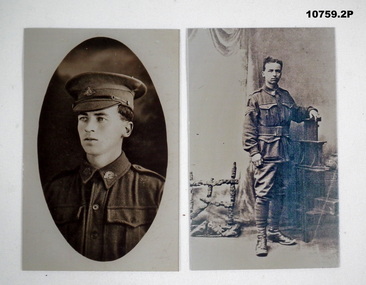
Photograph - SEPIA PHOTOGRAPHS, WW1
... Re enlisted in WW2 No V85463 on 26.6.1940, discharged 10.10.1945 with the rank of Sgt in 2nd Signals Training Bn. Staley collection, refer Cat No 10758.2P...Re enlisted in WW2 No V85463 on 26.6.1940, discharged 10.10.1945 with the rank of Sgt in 2nd Signals Training Bn. Staley collection, refer Cat No 10758.2P Photographs Tmstaleycollection .1) Photo sepia tone, portrait of a Soldier with Peak cap set in an oval shape. .2) Phot sepia tone,, studio setting of a Soldier standing, has Corporal Stripes on his arm, no hat on. ...Photos re Thomas Staley No 945 (born England, enlisted Melbourne) on 13.7.1915 in C Coy 29th Bn age 23 years, embark for Eygpt 10.11.1915, embark for France 16.6.1916, appointed Cpl 30.5.1917, Sgt 4.11.1917 in Anti Gas Personnel, discharged from the AIF on 25.7.1919. Re enlisted in WW2 No V85463 on 26.6.1940, discharged 10.10.1945 with the rank of Sgt in 2nd Signals Training Bn. Staley collection, refer Cat No 10758.2P.1) Photo sepia tone, portrait of a Soldier with Peak cap set in an oval shape. .2) Phot sepia tone,, studio setting of a Soldier standing, has Corporal Stripes on his arm, no hat on.photographs, tmstaleycollection -
 Melbourne Tram Museum
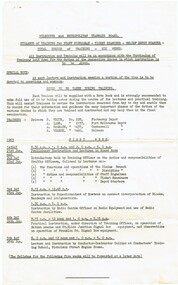
Document - Memorandum, Melbourne & Metropolitan Tramways Board (MMTB), "Syllabus of Training for Staff Signalman - Ticket Examiner - Relief Depot Staff", Jan. 1963
... Training... Inspectors... Signals...Gives details of the various training locations, signal boxes, radio centre, tickets, rosters. ...Gives details of the various training locations, signal boxes, radio centre, tickets, rosters. ...Set of three stencil cut duplicated foolscap documents setting out the "Syllabus of Training for Staff Signalman - Ticket Examiner - Relief Depot Staff", training schedule for Drivers seeking promotion to Officers. P. White of Footscray A Lane of Port Melbourne A McGrath of Camberwell R. Wearne of Malvern Training commenced 21 Jan 1963. Gives details of the various training locations, signal boxes, radio centre, tickets, rosters. Training took 6 weeks.trams, tramways, mmtb, training, inspectors, signals, tickets -
 Nhill Aviation Heritage Centre
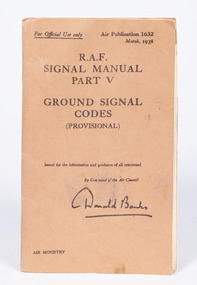
Booklet - R.A.F Signal Manual Part V, Ground Signal Codes (Provisional)
... Signal codes used by Royal Air Force. This booklet was authorised by Sir Donald Banks, Secretary of the British Air Ministry . He was responsible for setting up the Empire Air Training Scheme . ...Signal codes used by Royal Air Force. This booklet was authorised by Sir Donald Banks, Secretary of the British Air Ministry . He was responsible for setting up the Empire Air Training Scheme . ...Signal codes used by Royal Air Force. This booklet was authorised by Sir Donald Banks, Secretary of the British Air Ministry . He was responsible for setting up the Empire Air Training Scheme . He travelled to Australia and New Zealand to discuss the manufacture of aircraft in those countries such as Wirraways and Beaufighters.Orange cardboard cover with 40 buff coloured pages.For official use only. Air Publication 1632, March 1938. Issued for the information and guidance of all concerned. By command of the Air Council (signed) Donald Banks. Air Ministry -
 Lara RSL Sub Branch
Photograph, Set 4 photographs. and others for Torquay Light Horse camp, 1940
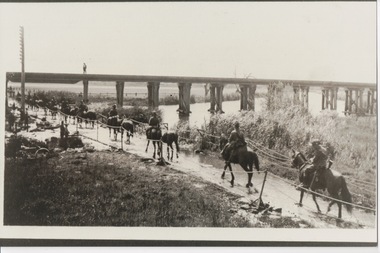
... Training Camp, WW2 Plaque at Pt. Danger Note----- (See images to view plaque) The plaque identifies a significant event in Torquay’s history and the sentiments of ‘change’ for the Light Horse Brigade – from horses to machines. In 1940 the four Light Horse Regiments (4th, 8th, 13th and 20th), some 5000 Light Horse and 2000 horses camped and trained at Torquay. Three other regiments, formerly mounted on horses, were also at Torquay ‘mounted’ on privately owned trucks and cars. Division troops included Artillery, Engineers, Signals...Training Camp, WW2 Plaque at Pt. Danger Note----- (See images to view plaque) The plaque identifies a significant event in Torquay’s history and the sentiments of ‘change’ for the Light Horse Brigade – from horses to machines. In 1940 the four Light Horse Regiments (4th, 8th, 13th and 20th), some 5000 Light Horse and 2000 horses camped and trained at Torquay. Three other regiments, formerly mounted on horses, were also at Torquay ‘mounted’ on privately owned trucks and cars. Division troops included Artillery, Engineers, Signals ...These images capture for all time Light Horsemen travelling through Geelong on their way to camp at Torquay for the last Group meeting in Australia . information following - details obtained from .........https://torquayhistory.com/light-horse-brigade/ On Australia Day, 1997, Sir John Young unveiled this plaque on Point Danger, Torquay. Torquay history, Light Horse Training Camp, WW2 Plaque at Pt. Danger Note----- (See images to view plaque) The plaque identifies a significant event in Torquay’s history and the sentiments of ‘change’ for the Light Horse Brigade – from horses to machines. In 1940 the four Light Horse Regiments (4th, 8th, 13th and 20th), some 5000 Light Horse and 2000 horses camped and trained at Torquay. Three other regiments, formerly mounted on horses, were also at Torquay ‘mounted’ on privately owned trucks and cars. Division troops included Artillery, Engineers, Signals, Field Ambulance and other branches of the Army necessary to enable a Division to function. It wasn’t just the sheer numbers of men coming to this little town that made the event significant, it was also the fact that the men of the Light Horse were dramatic, almost glamorous figures and it is easy to see their exploits as some splendid adventure. Horses have played a special role in the story of Australia. They were the only means of transport across this huge country, so it was necessary for everyone to have the ability to ride a horse. When war broke out in 1899 between Britain and the Boers of South Africa (“Boer” was Dutch for “farmer”) Australia sent troops to fight. At first Britain was wary of using untried, unprofessional colonial cavalrymen but soon saw that the slouch-hatted Australian “bushmen” were a match for the fast-moving and unconventional mounted commandos of the Boers. The Australians proved themselves to be expert rough-riding horsemen and good shots. Bush life had hardened them to go for long periods with little food and water. They also showed remarkable ability to find their way in a strange country and use its features for cover, in both attack and defence. By 1914, when Australia joined the war against Germany, there were 23 Light Horse regiments of militia volunteers. Many men from these units joined the Light Horse regiments of the Australian Imperial Force (AIF). Men were given remounts (if not using their own horses) – army horses bought by Commonwealth purchasing officers from graziers and breeders. These were called “walers” because they were a New South Wales stockhorse type – strong, great-hearted animals with the strains of the thoroughbred and semi-draught to give them speed, strength and stamina. On 1st November, 1914, Australia’s First Infantry Division and the first four Light Horse regiments sailed for England in a fleet of transport ships. The first of the Light Horse arrived at Gallipoli in May without their horses. Back with their horses after Gallipoli, they were formidable combatants across the Sinai and Palestine. Some British commanders observed that the light horseman moved with a “lazy, slouching gait, like that of a sleepy tiger” but described how the promise of battle “changes that careless gait, into a live athletic swing that takes him over the ground much quicker than other troops”. They had Light Horse, Torquay, training campdeveloped a reputation as formidable infantrymen. The Turks called them “the White Ghurkas” – a reference to their deadly skill with the bayonet. The Arabs called them “The Kings of the Feathers”. The plume had originally been a battle honour of the Queensland Mounted Infantry for their work in the shearer’s strike of 1891. During WW1 it was adopted by almost all the Light Horse Regiments. It was the proud badge of the light horseman. The most famous of their battles was the attack on Beersheba- the charge of the 4th Light Horse Brigade. Mounted infantrymen and their superb walers had carried out one of the most successful cavalry charges in history – against what seemed impossible odds. They surprised the Turks by charging cavalry-style, when they would normally have ridden close to an objective then dismounted to fight. The fall of Beersheba swung the battle tide against the Turks in Palestine; and changed the history of the Middle East. While 19 men from the Surf Coast Shire served with the 4th Light Horse over the course of WW1, only four were involved in the charge of Beersheba- John GAYLARD, Philip QUINN.(Winchelsea); Wallace FINDLAY (Anglesea); Harry TRIGG (Bambra). After the war, Light Horse units played a key role in the Australian Government’s compulsory military training programme. The Citizen Military Forces (C.M.F.) thrived on the glamour of the wartime Light Horse tradition, ignoring the possibility that motor vehicles would soon replace the horses. When training was no longer compulsory, the C.M.F. regiments declined and horses became more of a luxury during the 1930s depression years of poverty and unemployment. Some regiments were motorised. Then, in 1939, Australia joined Britain in another world war. Training was increased for the militia at both home bases and regional training camps. The camp at Torquay in 1940, commanded by Major General Rankin, was at Divisional strength. By the end of the camp some felt that the Division was ready for active service. Gradually, over the next four years, the Australian Light Horse units were mounted on wheels and tracks and the horses were retired. Six men enlisted at the Torquay camp and another 57 men and women enlisted at Torquay for service in WW2. Those who served in the Militia provided valuable Officers and NCOs and men for the armed services during the war. Each infantry division of the 2nd AIF had a Light Horse regiment attached to it. But the day of the Australian mounted soldier hadn’t quite passed. During World War II, Australia’s 6th Cavalry Regiment formed a mounted unit they called “The Kelly Gang” which did valuable scouting work. In New Guinea, a mounted Light Horse Troop did patrol duty and helped carry supplies. Some fully equipped walers were flown into Borneo for reconnaissance in rugged mountain country. But by the end of the war, in 1945, the horse had disappeared from the Australian Army. References: Australian Light Horse Association www.lighthorse.org.au National Australia Archives Australian War Memorial Surf Coast Shire WW1 memorials www.togethertheyserved.com The Light horse- a Cavalry under Canvas Light Horse, Training Camp, Torquay, WW2 Late in 1939 it was decided to set up a Lighthorse training camp in Torquay to train both men and horses for the battles of the Second World War. Horses, men and equipment came on special trains from all over Victoria and NSW, and as you would expect horseman came from areas such as Omeo and Sale, the Wimmera and the Western District. They arrived at the Geelong racecourse for watering in the Barwon River and then were ridden across the ford at the breakwater and began their 11 mile trek to Torquay. Light Horse, Training Camp, Torquay, WW2 Tent city By the end of January 1940 the camp at Torquay accommodated some 5000 men and 2500 horses of the Second Cavalry Division. The rows of horses, tents and huts near Blackgate Road were quite a sight. While the cavalrymen engaged in exercises on the land and on the beaches, many of the troops took over the Torquay School for special training of men and officers. Mr Bob Pettit local farmer and Councillor for the Barrabool Shire, wrote about the Light horse in the Surf Coast Community News in 1985 saying “They used to travel about the district riding four abreast in one long convoy. To my annoyance they went through my property and shut all the gates behind them. I had certain gates open to let stock in to the water holes and it would take me three -quarters of an hour to follow the horsemen up and put all the gates right again” he continued “the men from the Light Horse were here when the fire went through in March 1940. He recalled an incident when early one morning, as some one blew the bugle, a soldier putting a white sheet on the line frightened the horses. They panicked and ran off in all directions. Six went over the cliff near Bird Rock, five were never found, and the rest were gathered up after nearly a fortnight in the bush around Addiscott and Anglesea" Light Horse, Training Camp, Torquay, WW2, Geelong Parade Geelong parade The training camp culminated in a parade through the streets of Geelong on March 12th 1940. The salute was given at the Town Hall and the troops continued on a route to the You Yang’s for a training exercise. Note-----(see media section for photograph) The Camp was abandoned in mid 1940 as it was deemed unsuitable for training during winter and the cost of a permanent camp could not be justified if it could not be used all year. Historic.......Rare,,,Interpretive.Sepia photographs.set of four ....post card size ....Horses &LighthorsemenNo 1, Lighthorsemen Regiment Geelong 1940......No 2 Light Horse at Breakwater Geelong 1938 to 1940....No 3 Light Horse at Breakwater Geelong 1938 to 1940.....No 4 Light Horse crossing Breakwater camped at Geelong Showgrounds. These markings are on reverse of photographs.light horsemengeelong 1940., world war 2 -
 Flagstaff Hill Maritime Museum and Village
Book, The Old Bus
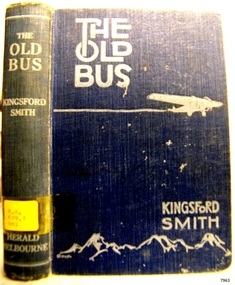
... He served in 4th Signal Troop, 2nd Division Signal Company at Gallipoli Peninsular as a ‘sapper’ or combat engineer and later in Egypt and in France as a dispatch rider. In 1916 Kingsford Smith was transferred to the Australian Flying Corps as a sergeant. He was discharged after training...He served in 4th Signal Troop, 2nd Division Signal Company at Gallipoli Peninsular as a ‘sapper’ or combat engineer and later in Egypt and in France as a dispatch rider. In 1916 Kingsford Smith was transferred to the Australian Flying Corps as a sergeant. He was discharged after training ...Sir Charles Edward Kingsford Smith is a famous Australian, well known in civil aviation history for his courageous endeavours in flight. He broken many flight records for long distance and time travelled and he was also a war hero in World War 1. He has been referred to as being “known to millions of Australians as “Smithy” … he was one of Australia’s true twentieth-century legends”. In honour of his place amongst the world’s famous pioneers his image is featured on Australia’s $20 note, Sydney airport is named after him, there is a memorial to Kingsford Smith, Taylor and Ulm at the Anderson Park, also in Sydney and his plane “Southern Cross” is on view at Brisbane Airport. Kingsford Smith wrote ‘The Old Bus’ (1932) and he and Ulm were co-authors of ‘Story of 'Southern Cross' Trans-Pacific Flight’ (1928). His also wrote a book about his own life ‘My Flying Life’ which was published after his death in 1937. and the story of his life was filmed in Australia in 1946. A BRIEF HISTORY OF SIR CHARLES EDWARD KINGSFORD SMITH (1897 – 1935) … Kingsford Smith was born 9th February 1897 in Brisbane, Queensland, Australia. His parents were William Charles Smith and Catherine Mary, nee Kingsford. His mother’s maiden name of “Kingsford” was added to the family name when they spent time in Canada from around 1903 to 1907, after which they returned to Sydney, Australia. In 1915 Kingsford Smith enlisted in Australian Imperial Force. He served in 4th Signal Troop, 2nd Division Signal Company at Gallipoli Peninsular as a ‘sapper’ or combat engineer and later in Egypt and in France as a dispatch rider. In 1916 Kingsford Smith was transferred to the Australian Flying Corps as a sergeant. He was discharged after training in England and commissioned as a second lieutenant in the Royal Flying Corps. He was appointed fling officer and soon joined the 23rd Squadron in France. He brought down four machines in his first month there and also did invaluable work attacking enemy targets. He was wounded and shot down and later awarded the Military Cross ‘for conspicuous gallantry and devotion to duty’. He was promoted to lieutenant in 1918 and served as a Flying Instructor with the R.F.C. Kingsford Smith was not allowed to participate in the 1919 England to Australia air race because of assumed lack of navigational experience. He and his pilot friend Cyril Maddocks formed a business and flew joy-flights in both England and America. In America he did some stunt flying with a Flying Circus. Kingsford Smith returned to Australia in 1921 and found employment as a pilot. He soon realised the value of air transport in such a vast country. He formed a partnership with pilot Keith Anderson in 1924 and they purchased two Bristol Tourer biplanes. Their business broadened to include Charles Ulm and became the Interstate Flying services in Sydney. Together they performed important ‘demonstration’ flights including a flight around Australia in 10 days and 5 hours using very limited navigational equipment. Kingsford Smith immediately started to search for support to do a trans-Pacific flight. This support came from the New South Wales government, Sidney Myer and G. Allan Hancock, an American oil magnate. On 31st May 1928 Kingsford Smith, Charles Ulm and two American crewmen, Harry Lyan and Jim Warner, took off from Oakland, California and flew to Brisbane via Hawaii and Suva. This historic flight took 83 hours and 38 minutes. Their Fokker plane had three engines and was named the “Southern Cross”. This amazing achievement resulted in huge financial subscriptions. Kingsford Smith was awarded the Air Force Cross and appointed as honorary squadron leader, Royal Australian Air Force. Kingsford Smith flew his Southern Cross plane from Point Cook in Victoria to Perth nonstop. Then in September – October 1928, with Charles Ulm and an Australian crew, he piloted the Southern Cross from Sidney to Christchurch New Zealand. This flight showed that was possible for regular passenger and mail services across the Tasman Sea. Kingsford Smith flew his plane to England to an order for four aircraft, planning to use them for an inter-capital air service in Australia. Sadly on 1st April 1929 he was forced to land, having lost radio contact with the ground and having run into bad weather over north – west Australia. Keith Anderson and Robert Hitchcock both perished before the search party reached them. Once official enquiries were completed the flight to England continued in June and was completed in record time of 12 days and 18 hours. In January 1930 Kingsford Smith piloted the “Southern Cloud”, one of the new Avro Ten planes, on the first flight of his airline, the Australian National Airways, from Sydney to Melbourne. The “Southern Cross” was overhauled in Holland by the Fokker Aircraft Co. and in June 1930 Kingsford Smith achieved an east-west crossing of the Atlantic from Ireland to Newfoundland in 31.5 hours. Kingsford Smith returned to England and took delivery of an Avro Avian biplane that he named the “Southern Cross Junior” and flew solo from England to Darwin, Australia. This record breaking flight took less than 10 days. He beat four other planes that had left England before him and he was 5.5 days faster than Hinkler. Sadly Kingsford Smith’s “Southern Cloud” was lost during a flight from Sydney to Melbourne in 1931 with no surviving crew or passengers; in 1958 the wreckage was discovered in the Snowy Mountains. Later that year Kingsford Smith flew his “Southern Cloud” from Australia to Timor, collecting mail from a damaged Imperial Airways plane in Timor. Other flights followed. Kingsford Smith was knighted in 1932 for his services in Aviation. He returned to selling joy flights then established the Kingsford Smith Air Service, a flying training school in Sydney. In 1933 Kingsford Smith flew the amazing record flight in “Miss Southern Cross” – a Percival Gull - from London to Wyndham in Western Australia in just over ten days. The Australian Commonwealth then gave Kingsford Smith a large grant and he was also appointed as aviation consultant to Vacuum Oil Co. Another flying record was made when Kingsford Smith and Sir P.G. Taylor flow “Lady Southern Cross” from Brisbane to San Francisco in order to sell her there; the west-east-trans-Pacific flight made aviation history. They returned to Australia to make an attempt at the trans-Tasman flight but their attempt failed due to engine failure; they managed to get back to Sydney safely, minus most of their cargo. Kingsford Smith had his unsold “Lady Southern Cross” shipped back to England, from where he and J. T. Pethybridge in the “Lady Southern Cross” attempted another record breaking flight from England The Old Bus Author: Charles Kingsford Smith Publisher: Distibuted by Herald Feature Service Date; 1932Label on spine cover with typed text RA 629.1309 KIN flagstaff hill, warrnambool, shipwrecked coast, flagstaff hill maritime museum, maritime museum, shipwreck coast, flagstaff hill maritime village, great ocean road, the old bus, charles kingsford smith -
 Greensborough Historical Society
Newspaper - Newspaper Clipping, Diamond Valley Leader, Defence forces signal training improvement, 31/10/2012
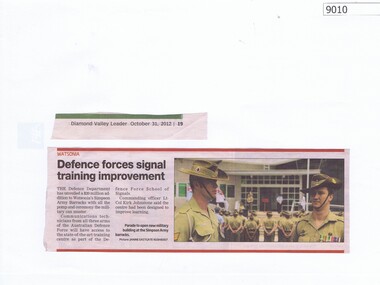
... Defence forces signal training improvement...A new Defence Force School of Signals was opened at Simpson Army Barracks in 2012. simpson army barracks Defence Force School of Signals Newspaper clipping with text and colour photo Defence forces signal training improvement Newspaper Newspaper Clipping Diamond Valley Leader ...A new Defence Force School of Signals was opened at Simpson Army Barracks in 2012.Newspaper clipping with text and colour photosimpson army barracks, defence force school of signals -
 Bendigo Military Museum
Photograph - AUSTRALIAN CHINESE SERVICEMEN, WW1 & WW2, Bendigo & District RSL Club, WW1 & WW2
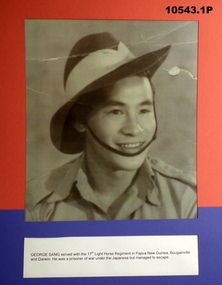
... As an Army Signaller he transferred in Egypt to the Division Signalling Company in France in France with his brother Hedley. During World War 2 he served in the Air Training Corps. 3. ...As an Army Signaller he transferred in Egypt to the Division Signalling Company in France in France with his brother Hedley. During World War 2 he served in the Air Training Corps. 3. ...Australian Chinese Servicemen from WW1 & WW2 photographs. Exhibition held at the Bendigo & District RSL, post 2010.1.2.3. Photographs on photographic paper, enlarged black and white portrait. Mount - red and blue colour cardboard, double mount with top area containing the photograph, lower area printed information. 1. Serviceman in uniform, portrait. 2. Serviceman in uniform, portrait. 3. Two Servicemen in uniform, full length informal portrait, WW1.Printed information - black ink print. 1. “GEORGE SANG” - served with the 17th Light Horse Regiment in Papua New Guinea, Bougainville and Darwin. He was a prisoner of war under the Japanese but managed to escape. 2. “SAM TONGWAY”enlisted on the 6th June 1917. He tried to enlist in 1916, but was rejected in medical grounds (regulations against those of a Chinese background). He embarked with Reinforcements to A.M.C. on the 6th May 1918. As an Army Signaller he transferred in Egypt to the Division Signalling Company in France in France with his brother Hedley. During World War 2 he served in the Air Training Corps. 3. “COLLIN YOUNG” shown here with his brother ELLIS, joined up in 1842 when he was seventeen and a half. He served in an artillery unit as an anti-tank gunner. With another artillery unit, he toured Queensland and New South Wales, then was posted to an anti-aircraft gun station in Darwin. photographs, australian/chinese, ww1, ww2 -
 Bendigo Military Museum
Book - DIARIES, c.WWI
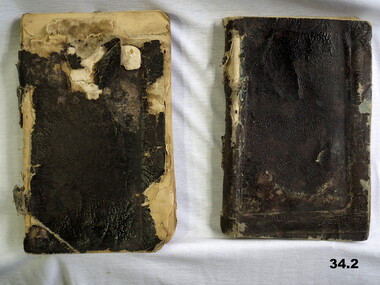
... Signal Coy 9.3.16. Embarked for France 2.6.1916. KIA Zonnebeke Belgium 23.9.1917. Horace Gibson was born in Bendigo. documents diaries personal notes records military history Inside cover of Volume 1: Horace Stanley Gibson, Clerk, Camberwell Victorian Railways Australia. Private address, c/o Mrs S E Gibson Barrell Street Eaglehawk, Victoria Australia. Diaries Volume 1 and Volume 2 are written in pen & ink, also contains sketches, names & addresses. Detailed account by day of the weather & what was eaten for each meal, as well as training ...The diaries belonged to Horace S. GIBSON, clerk with the Victorian Railways, Camberwell, No. 1817, 4th Div. Signal Coy. (Born Bendigo, enlisted Melbourne) on 6.7.1915 in the 12th reinforcements 1st Div Signal Coy. Embarked for Egypt 9.11.1915. Transferred to 4th Div Signal Coy 9.3.16. Embarked for France 2.6.1916. KIA Zonnebeke Belgium 23.9.1917. Horace Gibson was born in Bendigo. Diaries Volume 1 and Volume 2 are written in pen & ink, also contains sketches, names & addresses. Detailed account by day of the weather & what was eaten for each meal, as well as training, the war up to the morning he is killed in action.Inside cover of Volume 1: Horace Stanley Gibson, Clerk, Camberwell Victorian Railways Australia. Private address, c/o Mrs S E Gibson Barrell Street Eaglehawk, Victoria Australia. documents, diaries, personal notes, records, military history -
 Bendigo Military Museum
Photograph - Johnson Ground Elevation Meter (JGEM) Survey Vehicle - Army Survey Regiment, Fortuna, Bendigo, c1960s
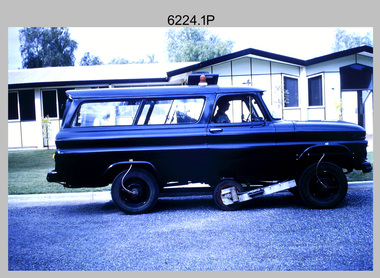
... training was undertaken at the Army's School of Military Survey located at Balcombe, Victoria. A small fifth wheel was mounted on a cantilever arm suspension midway between the front and rear wheels on the right side of the vehicle. It was lowered to and raised from its operating position by use of a constant pressure air cylinder. A telescopic bar, suspended between the front and rear axles, provided the reference datum for the angle measurement. The wheel provided the velocity or distance signal...training was undertaken at the Army's School of Military Survey located at Balcombe, Victoria. A small fifth wheel was mounted on a cantilever arm suspension midway between the front and rear wheels on the right side of the vehicle. It was lowered to and raised from its operating position by use of a constant pressure air cylinder. A telescopic bar, suspended between the front and rear axles, provided the reference datum for the angle measurement. The wheel provided the velocity or distance signal ...This is a set of 16 photograph of the Royal Australian Survey Corps’ Johnson Ground Elevation Meter (JGEM) Survey Vehicle taken at the Army Survey Regiment, Fortuna, Bendigo. The JGEM vehicle was extensively used by RA Svy within Australia from the late 1960s. A limited number of Ground Elevation Meter (GEM) station wagon type vehicles were manufactured by General Motors Corporation (GMC) in the USA for the United States Geological Survey, Canada’s mapping agencies, RA Svy and National Mapping (Natmap). The GEM was a four-wheel drive, four-wheel steer vehicle. Four-wheel steering was necessary to avoid systematic errors caused by non-tracking of front and rear wheels on conventionally steered vehicles. The manufacturer substituted the rear axle with a front axle and connected them to form the four-wheel steering mechanism. The two Australian GEM vehicles, referred to as Johnson GEMs (JGEMs) were converted into right-hand drive. After delivery in 1964, acceptance Natmap and RA Svy testing and operator training was undertaken at the Army's School of Military Survey located at Balcombe, Victoria. A small fifth wheel was mounted on a cantilever arm suspension midway between the front and rear wheels on the right side of the vehicle. It was lowered to and raised from its operating position by use of a constant pressure air cylinder. A telescopic bar, suspended between the front and rear axles, provided the reference datum for the angle measurement. The wheel provided the velocity or distance signal through a pulse generator system. A sensitive pendulum mounted on this bar provided the angle measurement for each minute distance traversed. The JGEM contained electromechanical instruments used to determine relative elevations, by trigonometric principles, along a traversed path. These relative elevations were obtained through apparatus which measures the instantaneous angle of inclination of the road and the instantaneous velocity of the meter along such a path. Road routes over which the JGEM operated were planned so that each started and ended as near as practicable to an existing point of known elevation (formally referred to as a level traverse bench mark). The difference in height from the bench mark and the road surface alongside the JGEM’s fifth wheel was measured with a level and staff. Along each route, mapping control photo reference points where new elevation values were required were identified on aerial photographs. Under favourable conditions it was possible to survey as much as 160km in an ordinary working day. The first of RA Svy’s JGEM operations was undertaken in 1:250,000 scale map areas of Queensland. CPL John Hook was the JGEM’s main operator in the early 1970s undertaking operations covering 1:250,000 scale map blocks over northern Victoria and central NSW, each requiring 36 points (9 runs of photography and 4 points across. SPR Lyn Thompson and SPR Bob McDonagh teamed with CPL Hook on some of these JGEM operations. When RA Svy was integrated into the Royal Australian Engineers in 1996, the JGEM vehicle with the Survey Corps collection was donated to its museum. It is believed to be the last of the original manufactured fleet in existence. The JGEM has undergone extensive refurbishment to achieve roadworthiness and is currently housed at The Australian Army Museum of Military Engineering, Hoslworthy Barracks, NSW. It can be viewed by making an appointment with the museum’s curator.This is a set of 16 photograph of the Royal Australian Survey Corps’ Johnson Ground Elevation Meter (JGEM) Survey Vehicle taken at the Army Survey Regiment, Fortuna, Bendigo. The photographs were on 35mm slide film and were scanned at 96 dpi. They are part of the Army Survey Regiment’s Collection. .1) - Photo, colour, c1960s, Johnson Ground Elevation Meter (JGEM) Survey Vehicle .2) - Photo, colour, c1960s, JGEM instrumentation, on-board computer. .3) - Photo, colour, c1960s, JGEM instrumentation. .4) - Photo, colour, c1960s, JGEM instrumentation, on-board computer. .5) - Photo, colour, c1960s, JGEM tyre pressure controller .6) - Photo, colour, c1960s, JGEM rear doors, SGT Geoff Briggs. .7) - Photo, colour, c1960s, JGEM 5th wheel distance/angle measurement device in lowered position, SGT Geoff Briggs. .8) - Photo, colour, c1960s, JGEM 5th wheel distance/angle measurement device in lowered position. .9) & .10) - Photo, colour, c1960s, JGEM tyre pressure system, SGT Geoff Briggs. .11) - Photo, colour, c1960s, JGEM tyre pressure system. SGT Geoff Briggs. .12) - Photo, colour, c1960s, JGEM levelling scope, levelling staff, unidentified technicians. .13) & .14) - Photo, colour, c1960s, JGEM levelling scope, unidentified technician. .15) & .16) - Photo, colour, c1960s, probably survey operation adjusted height plotted on block base sheet. .1P to .16P - Some of the equipment is annotated on the frame of the 35mm slides.royal australian survey corps, rasvy, army survey regiment, army svy regt, fortuna, asr, surveying -
 Bendigo Military Museum
Book - BOOKS, BOXED SET, Graham R McKenzie - Smith, The Unit Guide, 2018
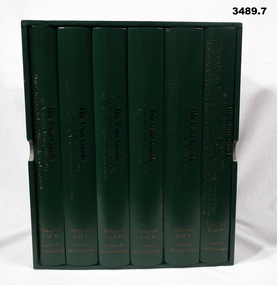
... Signal Units. Box of 6 books. The Unit Guide / The Australian Army / 1939 - 1945. 654 pages .6) Volume 5 of 6. Aust Army Service Corps, Aust Army Ordnance Corps and Aust Electrical & Mechanical Engineer Units. 706 pages. .7) Volume 6 of 6. Womens Services / Volunteer Defence Corps / War Graves, Survey, Labour, Salvage / Military Policing / Recruiting & Training...Signal Units. Box of 6 books. The Unit Guide / The Australian Army / 1939 - 1945. 654 pages .6) Volume 5 of 6. Aust Army Service Corps, Aust Army Ordnance Corps and Aust Electrical & Mechanical Engineer Units. 706 pages. .7) Volume 6 of 6. Womens Services / Volunteer Defence Corps / War Graves, Survey, Labour, Salvage / Military Policing / Recruiting & Training ....1) Box open, cardboard, dark green buckram, white paper lining, gold print on sides. .2) - .7) Hard cover book, cardboard, dark green buckram with gold print on front cover & spine. Pages are plain, cut, white, black print, black & white illustrations. .2) Volume 1 of 6. Unit & Location Indexes / Bibliography, Orders of Battle. 483 pages. .3) Volume 2 of 6. Headquarters, Infantry, Cavalry / Armoured & Intelligence Units. 605 pages. .4) Volume 3 of 6. Artillery, Air Defence and Engineer Units. 626 pages. .5) Volume 4 of 6. Medical and Signal Units. Box of 6 books. The Unit Guide / The Australian Army / 1939 - 1945. 654 pages .6) Volume 5 of 6. Aust Army Service Corps, Aust Army Ordnance Corps and Aust Electrical & Mechanical Engineer Units. 706 pages. .7) Volume 6 of 6. Womens Services / Volunteer Defence Corps / War Graves, Survey, Labour, Salvage / Military Policing / Recruiting & Training / Dental, Bath & Laundry / Veterinary & Animal / Movements & Transit / Pay, Records & Printing, Postal / Amenities & Canteens Units. 568 pages. books- military history, unit guide
