
Showing 19 items matching "singapore refugee"
-
 Tatura Irrigation & Wartime Camps Museum
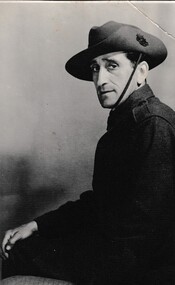
Photograph, Paul Bridgeman, late 1940's
... singapore refugee...Paul was an Singapore refugee and in Camp 3. Joined the 8th Employment Co. ...Paul was an Singapore refugee and in Camp 3. Joined the 8th Employment Co. singapore refugee paul bridgeman 8th employment co. ...Paul was an Singapore refugee and in Camp 3. Joined the 8th Employment Co. Black and white photos of Paul Bridgeman in slouch hat and uniform of the 8th Employment Co. singapore refugee, paul bridgeman, 8th employment co. -
 Tatura Irrigation & Wartime Camps Museum
Photograph, 1940's
... singapore refugee...Refugees from Singapore....Refugees from Singapore. singapore refugee Austrian Jewish refugees Black and white photos of a few adults, babes in arms and about 15 school age children in front of a tin hut. ...Refugees from Singapore.Black and white photos of a few adults, babes in arms and about 15 school age children in front of a tin hut. Austrian Jewish refugees on the Queen Mary.singapore refugee, austrian jewish refugees -
Tatura Irrigation & Wartime Camps Museum
Photograph, 1940's
... singapore refugee...Refugees from Singapore in Compound D, Camp 3 Tatura....Refugees from Singapore in Compound D, Camp 3 Tatura. singapore refugee Camp 3 Compound D Tatura Children on a log, with two adults standing. ...Refugees from Singapore in Compound D, Camp 3 Tatura.Children on a log, with two adults standing. Large gum trees in the background.singapore refugee, camp 3, compound d, tatura -
Tatura Irrigation & Wartime Camps Museum
Photograph
... singapore refugee...Singapore group - Jewish refugees from Vienna, Austria, fled the Nazi occupation in 1938. ...Singapore group - Jewish refugees from Vienna, Austria, fled the Nazi occupation in 1938. ...Singapore group - Jewish refugees from Vienna, Austria, fled the Nazi occupation in 1938. Settled in Straits Settlements Singapore and Malaya (then British Territory) but arrested in 1939 when WW2 broke out between Germany and Britain. C:\Camp3\Singaporegroup02.JPG. 1940 sent on "Queen Mary" ocean liner converted to troopship to Sydney then by train to Albury, Seymour, Rushworth to nearby constructed Camp 3D compound. a. this photo was taken in the gardens of Raffles Hotel, in Singapore prior to WW2, when the refugee families enjoyed life in safety. b. Ludwig and Olga Meilich, two of the above, photos donated by their nephew Walter Smiley in 1990.Top half. Approximately 6 rows of people of all ages, about 80 in all. A shed on left side of photo, about 4 trees behind and 2 palm fronds top right hand corner. Bottom half is a lady on left, man (dark shirt, white buttons and jacket) on right.singapore refugee, ludwig meilich, olga meilich, queen mary ocean liner -
Tatura Irrigation & Wartime Camps Museum
Photograph, Karl Duldig, 1941
... singapore refugee..., Indonesian 2nd front row: Ruth Gottlieb, Lisa Bader, Gracie Kouner, George Fink Front row: Lilliana Dellanoll, George Huppert, Eva Duldig and Gerald Seefeld Bottom right: bronze sculpture of Captain Edward Renata Broughton (NZ) O.C. 8th Employment Co. Refugees from Singapore. Slawa and Karl Duldig, Bauhaus artists from Vienna, Austria, fled to Singapore 1938, arrested in 1939 by British officials. ...Daughter Eva (photo) donated the photos. singapore refugee captain edward kenate broughton karl duldig eva duldig Harry Bader Dolly Seefeld Dora Seefelt Eva Jacoby Mariesa ? ...Top left - Karl Duldig, 8th Employment, with daughter Eva in front of him; Top right: The Duldig family in front of their hut in Camp 3. Slawa, Eva and Karl Bottom left: Army nurse and children: back row (left to right): Italian, Italian, Harry Bader 2nd back row: Italian, Dolly Seefeld, Dora Seefeld, Indonesian 3rd back row: ? Eva Jacoby, Mariesa ?, Indonesian 2nd front row: Ruth Gottlieb, Lisa Bader, Gracie Kouner, George Fink Front row: Lilliana Dellanoll, George Huppert, Eva Duldig and Gerald Seefeld Bottom right: bronze sculpture of Captain Edward Renata Broughton (NZ) O.C. 8th Employment Co. Refugees from Singapore. Slawa and Karl Duldig, Bauhaus artists from Vienna, Austria, fled to Singapore 1938, arrested in 1939 by British officials. Sent to Australia on Queen Mary to Tatura Group Internment Camp 3 compound D. Released with other families in 1942. Karl served in the 8th Employment Company. He and his wife taught in Melbourne schools (Mentone Grammar and St Catherine's Girls School). Daughter Eva (photo) donated the photos.4 black and white photographs of the Duldig family. One is father and daughter; one is mum, dad and daughter in front of hut; third is a group photograph of a nurse and a group of children and the third is of a bust of Captain Edward Renata Broughton. Photographs are mounted and in a fawn coloured frame. singapore refugee, captain edward kenate broughton, karl duldig, eva duldig, harry bader, dolly seefeld, dora seefelt, eva jacoby, mariesa ?, ruth gottlieb, lisa bader, gracie kouner, george fink, lilliana dellanol, george huppert, george seefeld -
 Tatura Irrigation & Wartime Camps Museum
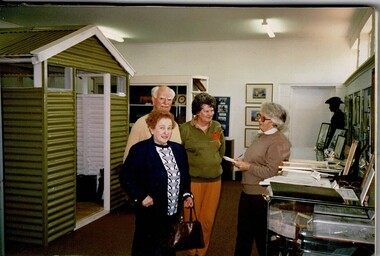
Photograph, Helmut and Edith Seefeld, 1991
... singapore refugee...Photograph taken 24 September 1991. singapore refugee helmut seefeld edith seefeld Colour photograph of Helmut and Edith Seefeld with Lurline Knee and Lyn Harrison at Tatura Museum. ...Helmut and Edith Seefeld were from the Singapore group in Camp 3D during WW2. Photograph taken 24 September 1991.Colour photograph of Helmut and Edith Seefeld with Lurline Knee and Lyn Harrison at Tatura Museum. Photograph on foam backing.singapore refugee, helmut seefeld, edith seefeld -
 Tatura Irrigation & Wartime Camps Museum
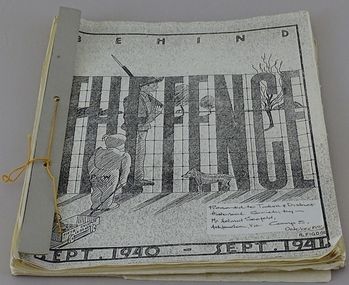
Book, Behind the Fence, 1941
... Made by internees, Singapore Group Refugees at Camp 3 Tatura for entertainment purposes...Made by internees, Singapore Group Refugees at Camp 3 Tatura for entertainment purposes tatura singapore group camp 3 books history local Soft cover loose leaf book "Behind the Fence" Sept 1940 - Sept1941. 12month periodical. ...Made by internees, Singapore Group Refugees at Camp 3 Tatura for entertainment purposesSoft cover loose leaf book "Behind the Fence" Sept 1940 - Sept1941. 12month periodical. Has camp sketch on front cover. Written (typed) in English and German. Black & White illustrations and sketches. Card cover bound with coloured thread.tatura, singapore group camp 3, books, history, local -
 Tatura Irrigation & Wartime Camps Museum
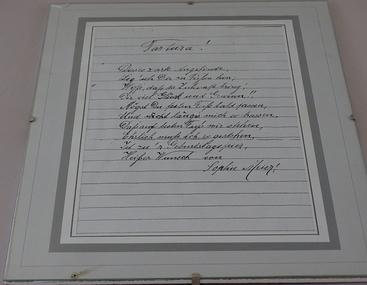
Document, Tatura, 1940's
... Helmut Seefeld, Singapore Group, refugees, internees at Camp 3 Tatura...Helmut Seefeld, Singapore Group, refugees, internees at Camp 3 Tatura tatura documents pamphlets internment camp poetry Helmut Seefeld Sophie Meier Framed and mounted single sided sheet of paper, photocopy of handwritten (in German) poem titled "Tartura" Tatura Document Document ...Poem written in Camp 3 by Mrs. Sophie Meier, mother of Mrs. Helmut Seefeld, Singapore Group, refugees, internees at Camp 3 TaturaFramed and mounted single sided sheet of paper, photocopy of handwritten (in German) poem titled "Tartura"tatura, documents, pamphlets, internment camp poetry, helmut seefeld, sophie meier -
Tatura Irrigation & Wartime Camps Museum
Document, Seefeld Letters & Documents, 1940's
... Includes collection of correspondence and files between Garry (Gerhard) Seefeld and the Australian Authorities, regarding the Jewish Refugees, Singapore Group and his family's continued internment in Tatura. ...Includes collection of correspondence and files between Garry (Gerhard) Seefeld and the Australian Authorities, regarding the Jewish Refugees, Singapore Group and his family's continued internment in Tatura. ...Includes collection of correspondence and files between Garry (Gerhard) Seefeld and the Australian Authorities, regarding the Jewish Refugees, Singapore Group and his family's continued internment in Tatura. Included are secret reports as to why Garry and family continued to be interned after all other family members had been released. All the above information was made available from the National Archives, Canberra and forwarded to Loretta Forsey (daughter of Gerhard Seefeld) by Keith Forsey in 2001. Files date from 25 February, 1942 to 3 December 1942.Blue plastic 3 ringed binderww2 camp 3, documents, letters, reports, seefeld -
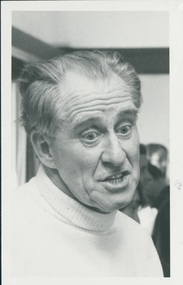 Uniting Church Archives - Synod of Victoria
Bw photo, Undated
... Refugee World Service. From 1968 to 1971, Perkins worked with the East Asian Christian Conference and then took a position with the World Council of Churches in Geneva with its Commission on Churches Participation in Development. He returned to Australia in 1973 to a position with the Methodist Board of Missions and then returned to the Christian Conference of Asia in 1976 and relocated to Singapore for several years. ...Refugee World Service. From 1968 to 1971, Perkins worked with the East Asian Christian Conference and then took a position with the World Council of Churches in Geneva with its Commission on Churches Participation in Development. He returned to Australia in 1973 to a position with the Methodist Board of Missions and then returned to the Christian Conference of Asia in 1976 and relocated to Singapore for several years. ...Harvey Perkins was a Methodist minister and a peacemaker throughout his life of service and social activism. He knew the certainty that without justice there can be no peace, within, or between, communities and nations. He was greatly influenced by ''liberation theology'' and framed his life of thought, analysis and action on the teachings of the Bible. He was also a visionary in working closely with Asian churches on ecumenical and social justice issues in a way that anticipated by decades the closer relationships Australia now enjoys with Asia. He understood that any form of intervention altered the power relationship within a community and often challenged the dominant social interests in the post-colonial Asian countries. He knew any form of aid had to empower its recipients and be based on a partnership of equality. In the early 1960s, Perkins was an opponent of the war in Indochina and conscription in Australia and played an important role in activating congregations to protest against the war. His keen intelligence, knowledge of history and analytical skills demolished the false foundation on which the US and its allies entered the war and he organised medical and social work teams in South Vietnam and Laos to help refugees and displaced persons. In the 1970s Perkins played an important role in ''decolonising'' and devolving power in the Methodist Church missions in Aboriginal Australia and the Pacific Islands by analysing power structures and relationships through what he had learnt in Asia. Harvey Perkins and his twin sister, Jean, were born in Tasmania on January 29, 1919, children of Leslie Perkins and his wife, Doris (nee Cook). Leslie was a Methodist minister and Harvey and Jean's childhood was spent in parishes in urban and rural areas of Tasmania and Victoria. The family saw the grinding poverty and desperate human need wrought by the Depression as a ceaseless tide of people came knocking at the door of the local parsonage for help. In 1941, Perkins enlisted as an officer in the Australian Navy and served in the Pacific theatre until 1946. To his children, he explained his justification as being the real threat of invasion but it was a war that altered the direction of his life. On discharge he abandoned his completed studies at Melbourne University in law and commerce and studied for a degree in divinity. He was active in the World Student Christian Federation and in 1949, was ordained into the Methodist Church. A few years later, Perkins travelled to a World Student Christian Federation conference in Canada, on his way to study in Cambridge, and met an expatriate, Jill McCrory. They married in 1953. After Cambridge, Perkins returned to Australia and served as a minister in the Mitcham area of the growing Melbourne outer suburbs until 1956, when he was appointed General Secretary of the Australian Council of Churches and director of the Inter-Church Aid and Refugee World Service. From 1968 to 1971, Perkins worked with the East Asian Christian Conference and then took a position with the World Council of Churches in Geneva with its Commission on Churches Participation in Development. He returned to Australia in 1973 to a position with the Methodist Board of Missions and then returned to the Christian Conference of Asia in 1976 and relocated to Singapore for several years. Before retiring in 1984 he worked with the Uniting Church Board of Social Responsibility. In retirement Perkins continued to work in the Dee Why parish, enjoying preaching, leading study groups and working as a pastor in a local community. Along with his work, Perkins had a lifelong passion for AFL and his beloved team North Melbourne. Wherever he was in the world he could be found fiddling with a short-wave radio to listen to a game. In later years, Perkins developed Alzheimer's and his home became his haven until two weeks before his death. Harvey Perkins is survived by Jill, children Mary, Ro, David, Marguerite, Anna, Harvey and Kate and their partners, 13 grandchildren and two great-grandchildren. Jean died in 1981. (Obituary in the SMH by David Perkins) Head and shoulders portrait of Rev. Harvey PerkinsRev. Harvey Perkinsrev. harvey perkins; methodist minister; christian conference of asia; australian council of churches -
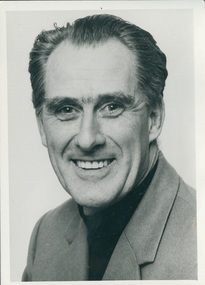 Uniting Church Archives - Synod of Victoria
BW photo, Undated
... Refugee World Service. From 1968 to 1971, Perkins worked with the East Asian Christian Conference and then took a position with the World Council of Churches in Geneva with its Commission on Churches Participation in Development. He returned to Australia in 1973 to a position with the Methodist Board of Missions and then returned to the Christian Conference of Asia in 1976 and relocated to Singapore for several years. ...Refugee World Service. From 1968 to 1971, Perkins worked with the East Asian Christian Conference and then took a position with the World Council of Churches in Geneva with its Commission on Churches Participation in Development. He returned to Australia in 1973 to a position with the Methodist Board of Missions and then returned to the Christian Conference of Asia in 1976 and relocated to Singapore for several years. ...Harvey Perkins was a Methodist minister and a peacemaker throughout his life of service and social activism. He knew the certainty that without justice there can be no peace, within, or between, communities and nations. He was greatly influenced by ''liberation theology'' and framed his life of thought, analysis and action on the teachings of the Bible. He was also a visionary in working closely with Asian churches on ecumenical and social justice issues in a way that anticipated by decades the closer relationships Australia now enjoys with Asia. He understood that any form of intervention altered the power relationship within a community and often challenged the dominant social interests in the post-colonial Asian countries. He knew any form of aid had to empower its recipients and be based on a partnership of equality. In the early 1960s, Perkins was an opponent of the war in Indochina and conscription in Australia and played an important role in activating congregations to protest against the war. His keen intelligence, knowledge of history and analytical skills demolished the false foundation on which the US and its allies entered the war and he organised medical and social work teams in South Vietnam and Laos to help refugees and displaced persons. In the 1970s Perkins played an important role in ''decolonising'' and devolving power in the Methodist Church missions in Aboriginal Australia and the Pacific Islands by analysing power structures and relationships through what he had learnt in Asia. Harvey Perkins and his twin sister, Jean, were born in Tasmania on January 29, 1919, children of Leslie Perkins and his wife, Doris (nee Cook). Leslie was a Methodist minister and Harvey and Jean's childhood was spent in parishes in urban and rural areas of Tasmania and Victoria. The family saw the grinding poverty and desperate human need wrought by the Depression as a ceaseless tide of people came knocking at the door of the local parsonage for help. In 1941, Perkins enlisted as an officer in the Australian Navy and served in the Pacific theatre until 1946. To his children, he explained his justification as being the real threat of invasion but it was a war that altered the direction of his life. On discharge he abandoned his completed studies at Melbourne University in law and commerce and studied for a degree in divinity. He was active in the World Student Christian Federation and in 1949, was ordained into the Methodist Church. A few years later, Perkins travelled to a World Student Christian Federation conference in Canada, on his way to study in Cambridge, and met an expatriate, Jill McCrory. They married in 1953. After Cambridge, Perkins returned to Australia and served as a minister in the Mitcham area of the growing Melbourne outer suburbs until 1956, when he was appointed General Secretary of the Australian Council of Churches and director of the Inter-Church Aid and Refugee World Service. From 1968 to 1971, Perkins worked with the East Asian Christian Conference and then took a position with the World Council of Churches in Geneva with its Commission on Churches Participation in Development. He returned to Australia in 1973 to a position with the Methodist Board of Missions and then returned to the Christian Conference of Asia in 1976 and relocated to Singapore for several years. Before retiring in 1984 he worked with the Uniting Church Board of Social Responsibility. In retirement Perkins continued to work in the Dee Why parish, enjoying preaching, leading study groups and working as a pastor in a local community. Along with his work, Perkins had a lifelong passion for AFL and his beloved team North Melbourne. Wherever he was in the world he could be found fiddling with a short-wave radio to listen to a game. In later years, Perkins developed Alzheimer's and his home became his haven until two weeks before his death. Harvey Perkins is survived by Jill, children Mary, Ro, David, Marguerite, Anna, Harvey and Kate and their partners, 13 grandchildren and two great-grandchildren. Jean died in 1981. (Obituary in the SMH by David Perkins) Head and shoulders portrait of the Rev. Harvey Perkins. Photo taken some years before the photo of him in F524 -9Rev. Harvey Perkinsrev. harvey perkins; methodist minister; christian conference of asia; australian council of churches -
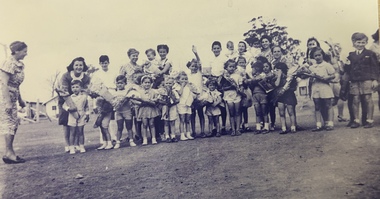 Tatura Irrigation & Wartime Camps Museum
Photograph, Refugee Families
... Straits Settlement Refugee families in compound D Camp 3 Tatura. Austrian and German Jewish families who sought refuge in Malaya and Singapore in 1938, interned in Singapore in 1940 and transported to Australia in September 1940...Straits Settlement Refugee families in compound D Camp 3 Tatura. Austrian and German Jewish families who sought refuge in Malaya and Singapore in 1938, interned in Singapore in 1940 and transported to Australia in September 1940 Singapore Camp 3 children families Refugees Straits Settlement Black and White photograph of a group of children and parents in Camp 3, compound D. ...Straits Settlement Refugee families in compound D Camp 3 Tatura. Austrian and German Jewish families who sought refuge in Malaya and Singapore in 1938, interned in Singapore in 1940 and transported to Australia in September 1940Black and White photograph of a group of children and parents in Camp 3, compound D. singapore, camp 3, children, families, refugees, straits settlement -
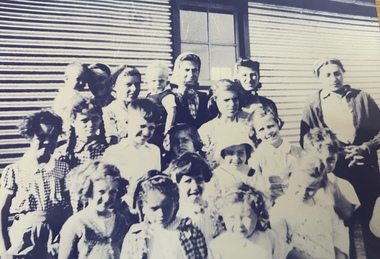 Tatura Irrigation & Wartime Camps Museum
Photograph, Camp 3 Families
... Straits Settlement Refugee familes in Compound D, Camp 3 Tatura. German and Austrian Jewish families sought refuge in Malaya and Singapore in 1938. ...Singapore Straits Settlement Jewish refugees camp 3 Tatura Black and white photograph of a group of German and Austrian children and parents. ...Straits Settlement Refugee familes in Compound D, Camp 3 Tatura. German and Austrian Jewish families sought refuge in Malaya and Singapore in 1938. Interned in Singapore in 1940 and Transported to Australia in September 1940.Black and white photograph of a group of German and Austrian children and parents. Standing in front of a Camp hunt in Camp 3, compound Dsingapore, straits settlement, jewish refugees, camp 3, tatura -
Tatura Irrigation & Wartime Camps Museum
Document, Information sheets of POW and Internment Camps WW2, Tatura, 1990 typed
... Jewish refugees interned from Singapore in 1990. Information sheets of POW and Internment Camps WW2, Tatura....Jewish refugees interned from Singapore in 1990. Information sheets of POW and Internment Camps WW2, Tatura. jewish internees internment camps pow tatura victoria camp 3 Clear plastic blue back folder. ...POW Internment camps. WW2. Jewish refugees interned from Singapore in 1990. Information sheets of POW and Internment Camps WW2, Tatura.Clear plastic blue back folder.jewish internees, internment camps, pow, tatura victoria, camp 3 -
Tatura Irrigation & Wartime Camps Museum
Document - Austrian Jewish refugees - Singapore, 06/08/1941 with additions later
... A clear plastic folder with a black margin with a white paper insert, on which is written "Memorabilia from Austrian Jewish refugees interned in Singapore and camp 3 1940'. The heading of the text is "Press release- reluctant passengers on the Queen Mary" and concludes Authorised by Eva de Jong - Duldig ...An outstanding collection of memorabilia of Karl Duldig, Ludwig Mielich, Helmut Seefeld and all those who arrived in Australia on the Queen Mary 26th September 1940 As above A clear plastic folder with a black margin with a white paper insert, on which is written "Memorabilia from Austrian Jewish refugees interned in Singapore and camp 3 1940'. The heading of the text is "Press release- reluctant passengers on the Queen Mary" and concludes Authorised by Eva de Jong - Duldig Document - Austrian Jewish refugees - Singapore Eva de jong-Duldig Karl Duldig Mr H. ...An outstanding collection of memorabilia of Karl Duldig, Ludwig Mielich, Helmut Seefeld and all those who arrived in Australia on the Queen Mary 26th September 1940A clear plastic folder with a black margin with a white paper insert, on which is written "Memorabilia from Austrian Jewish refugees interned in Singapore and camp 3 1940'. The heading of the text is "Press release- reluctant passengers on the Queen Mary" and concludes Authorised by Eva de Jong - Duldig As above -
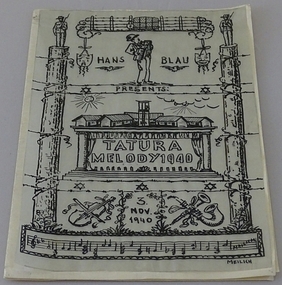 Tatura Irrigation & Wartime Camps Museum
Programme, Tatura Melody 1940, 1940
... Refugees at the Tatura Camp (of the Singapore Group)...Refugees at the Tatura Camp (of the Singapore Group) tatura documents programmes Meilich Hand produced programme of concert "Tatura Melody 1940". ...Programme of musical show presented by Hans Blay & Company. Refugees at the Tatura Camp (of the Singapore Group)Hand produced programme of concert "Tatura Melody 1940". Cover of waxed paper, printed and illustrated in ink (black). Insert of programme typed dated 3 nov 1940. Wording on cover Hans Blay presents: Tatura Melody 1940Meilichtatura, documents, programmes -
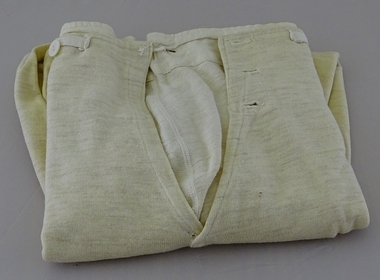 Tatura Irrigation & Wartime Camps Museum
Clothing - Men's Underpants, 1940's
... Worn by Helmut SEEFELD, a Jewish Austrian refugee at Tatura. Part of the Singapore group of internees....Worn by Helmut SEEFELD, a Jewish Austrian refugee at Tatura. Part of the Singapore group of internees. men's underwear Helmut Seefeld Singapore group Long woollen cream underpants with 3 button holes, 1 button. ...Worn by Helmut SEEFELD, a Jewish Austrian refugee at Tatura. Part of the Singapore group of internees.Long woollen cream underpants with 3 button holes, 1 button. A tape is laced through 2 holes at the centre back.men's underwear, helmut seefeld, singapore group -
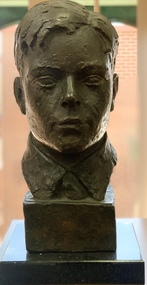 Mentone Grammar School
Sculpture (collection), 'Boy', 1967
... In 1945, after feeling Nazi Germany in 1939, Karl Duldig and his wife, Slawa, were finally granted ‘landing permits’ in Australia, after six years living in refugee camps, both here and Singapore. Duldig was appointed art master at Mentone Grammar in 1945, while also establishing a small ceramics business with his artist-inventor wife, Slawa. ...In 1945, after feeling Nazi Germany in 1939, Karl Duldig and his wife, Slawa, were finally granted ‘landing permits’ in Australia, after six years living in refugee camps, both here and Singapore. Duldig was appointed art master at Mentone Grammar in 1945, while also establishing a small ceramics business with his artist-inventor wife, Slawa. ...Karl Duldig -
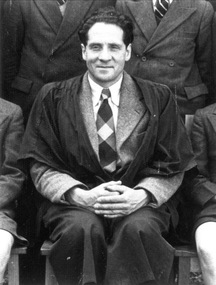 Mentone Grammar School
Karl Duldig, Art Master (1945-1967)
... In 1945, after feeling Nazi Germany in 1939, Karl Duldig and his wife, Slawa, were finally granted ‘landing permits’ in Australia, after six years living in refugee camps, both here and Singapore. Duldig was appointed art master at Mentone Grammar in 1945, while also establishing a small ceramics business with his artist-inventor wife, Slawa. ...In 1945, after feeling Nazi Germany in 1939, Karl Duldig and his wife, Slawa, were finally granted ‘landing permits’ in Australia, after six years living in refugee camps, both here and Singapore. Duldig was appointed art master at Mentone Grammar in 1945, while also establishing a small ceramics business with his artist-inventor wife, Slawa. ...In 1945, after feeling Nazi Germany in 1939, Karl Duldig and his wife, Slawa, were finally granted ‘landing permits’ in Australia, after six years living in refugee camps, both here and Singapore. Duldig was appointed art master at Mentone Grammar in 1945, while also establishing a small ceramics business with his artist-inventor wife, Slawa. His work was prolific across several mediums. Our School Archives holds a large collection of sketches, as well as several bronze busts which he made, depicting life, students, and staff at Mentone Grammar during his time at the School from 1945 to 1967.
