
Showing 8 items matching "sisters of nazareth"
-
 Ballarat Heritage Services
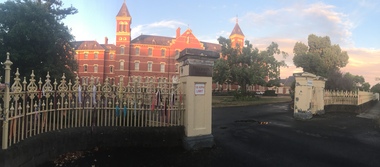
Image, Nazareth House, Ballarat, 11/01/2016
... ...sisters of nazareth...Colour photograph of a three storey building known as Nazareth House run by the Sisters of Nazareth. ...The ribbons were highlighting the concept of 'No more silence'. nazareth house ballarat orphanage catholic sisters of nazareth residential care ribbons architecture Colour photograph of a three storey building known as Nazareth House run by the Sisters of Nazareth. ...Nazareth House was founded in 1888. This photograph was taken at the time of the Royal Commission into Institution Child Sex Abuse and the residency of Bishop Mulkearns. The ribbons were highlighting the concept of 'No more silence'.Colour photograph of a three storey building known as Nazareth House run by the Sisters of Nazareth. nazareth house, ballarat, orphanage, catholic, sisters of nazareth, residential care, ribbons, architecture -
 Ballarat Heritage Services
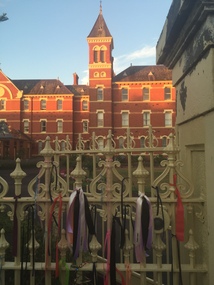
Image, Nazareth House, Ballarat, 11/01/2016
... ...sisters of nazareth...Colour photograph of a three storey building known as Nazareth House run by the Sisters of Nazareth. ...The ribbons were highlighting the concept of 'No more silence'. nazareth house ballarat orphanage catholic sisters of nazareth residential care ribbons architecture Colour photograph of a three storey building known as Nazareth House run by the Sisters of Nazareth. ...Nazareth House was founded in 1888. This photograph was taken at the time of the Royal Commission into Institution Child Sex Abuse and the residency of Bishop Mulkearns. The ribbons were highlighting the concept of 'No more silence'.Colour photograph of a three storey building known as Nazareth House run by the Sisters of Nazareth. nazareth house, ballarat, orphanage, catholic, sisters of nazareth, residential care, ribbons, architecture -
 Ballarat Heritage Services
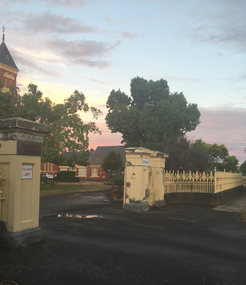
Image, Clare Gervasoni, Nazareth House, Ballarat, 11/01/2016
... ...sisters of nazareth...Colour photograph of a three storey building known as Nazareth House run by the Sisters of Nazareth. ...The ribbons were highlighting the concept of 'No more silence'. nazareth house ballarat orphanage catholic sisters of nazareth residential care ribbons Colour photograph of a three storey building known as Nazareth House run by the Sisters of Nazareth. ...Nazareth House was founded in 1888. This photograph was taken at the time of the Royal Commission into Institution Child Sex Abuse and the residency of Bishop Mulkearns. The ribbons were highlighting the concept of 'No more silence'.Colour photograph of a three storey building known as Nazareth House run by the Sisters of Nazareth. nazareth house, ballarat, orphanage, catholic, sisters of nazareth, residential care, ribbons -
 Ballarat Heritage Services
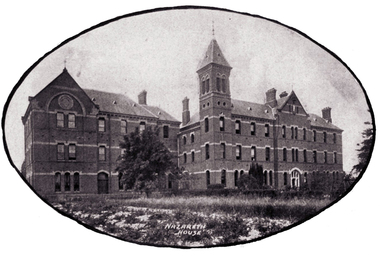
Image, Nazareth House, Ballarat
... ...sisters of nazareth...Black and whote image of a three storey building known as Nazareth House run by the Sisters of Nazareth....nazareth House was founded in 1888. nazareth house ballarat orphanage catholic sisters of nazareth residential care architecture Black and whote image of a three storey building known as Nazareth House run by the Sisters of Nazareth. ...nazareth House was founded in 1888.Black and whote image of a three storey building known as Nazareth House run by the Sisters of Nazareth.nazareth house, ballarat, orphanage, catholic, sisters of nazareth, residential care, architecture -
 Warrnambool and District Historical Society Inc.
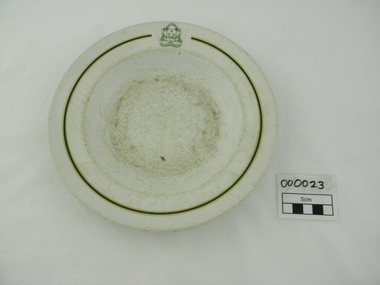
Domestic object - China bowl, Gibsons and Paterson Limited, St Ann's College, Mid 20th Century
... Sisters of Mercy to come to Victoria. The Warrnambool nuns worked hard to establish a school and orphanage for the socially disadvantaged children of the district. They purchased Wyton from Captain Ardlie that year and also Amhurst later on. The Nazareth...Sisters of Mercy to come to Victoria. The Warrnambool nuns worked hard to establish a school and orphanage for the socially disadvantaged children of the district. They purchased Wyton from Captain Ardlie that year and also Amhurst later on. The Nazareth ...St. Anns College had its beginnings in the arrival in May 1872 of a group of nuns from Ireland. They were the third group of Sisters of Mercy to come to Victoria. The Warrnambool nuns worked hard to establish a school and orphanage for the socially disadvantaged children of the district. They purchased Wyton from Captain Ardlie that year and also Amhurst later on. The Nazareth sisters of Ballarat took over the orphanage in the late 1880's and moved the children to Ballarat but the school continued to develop an expanding curriculum. A chapel was built in 1887 and a school wing in 1906. They survived on tuition fees and the generosity of benefactors though the early and middle part of the 20th century including a large bequest by Mrs Vera Kenna in the 1960's. Boarders were a regular part of convent life until the 1970's which is probably the source of this plate. St Ann's College was combined with St Joseph's CBC college as Emmanuel College and operates today as the largest Catholic college in the district.This has significance as it is associated with one of the longest running schools in the district and hence would have a connection to many Warrnambool people as well as district people who boarded at the college.White bowl, with green and yellow stripe around edge and emblem. Surface is quite scratched on front and bottom of bowl.Inscription on emblem. " St. Anns Warrnambool around edge of logo with Omnia Vincit Labor on banner through the middle with four stars in the background. Printed in green. Inscription on base Grindley Hotel Ware England . Vitrified . Gibson and Paterson Limited New Zealand. CIR stamped into china on base.secondary school, catholic, warrnambool, st ann's college, sisters of mercy, education, emmanuel college -
 Warrnambool and District Historical Society Inc.
Document - Documents (St. Ann’s ), letter, Mid 20th century
... Sisters of Mercy by their grandfather, William Ardlie. Dorothy and Agnes Ardlie had been pupils at St. Ann’s School. Some of the documents relate to the orphanage established at St. Ann’s in 1881 when an extension was added to the convent for that purpose. The orphanage was closed when a similar institution, Nazareth...Sisters of Mercy by their grandfather, William Ardlie. Dorothy and Agnes Ardlie had been pupils at St. Ann’s School. Some of the documents relate to the orphanage established at St. Ann’s in 1881 when an extension was added to the convent for that purpose. The orphanage was closed when a similar institution, Nazareth ...These items come from the estates of Dorothy and Agnes Ardlie of Warrnambool. Dorothy Ardlie (1910-1993) and her sister Agnes (1915-1993) were the daughters of law clerk Arthur Ardlie and his wife Ethel, the granddaughters of the prominent Warrnambool lawyer, William Ardlie and his wife Mary and the great granddaughters of John and Mary Ardlie, pioneer settlers in Warrnambool. All of the documents relate to St. Ann’s Convent/School in Warrnambool. The Sisters of Mercy established St Mary’s Wyton school in 1872 and the name was changed to St.Ann’s in 1888. Dorothy and Agnes Ardlie would have been particularly interested in the convent building established around the original building of Wyton as this building had been the home of John Ardlie and had been sold to the Sisters of Mercy by their grandfather, William Ardlie. Dorothy and Agnes Ardlie had been pupils at St. Ann’s School. Some of the documents relate to the orphanage established at St. Ann’s in 1881 when an extension was added to the convent for that purpose. The orphanage was closed when a similar institution, Nazareth House, was opened in Ballarat. Thes items are of minor interest as material compiled by the Ardlie sisters, Dorothy and Agnes, residents of Warrnambool in the 20th century. .1 A sheet of paper containing a letter handwritten in black ink and an envelope with the address handwritten in black ink .2 A sheet of paper containing a letter handwritten in blue ink .3 A black and white photograph of St. Ann’s Convent .4 Two sheets of blue paper with rough plans of St. Ann’s building interior .5 A sheet of paper with a black and white sketch of St. Ann’s Convent .6 A sheet of white paper with photocopies of two newspaper cuttingsardlie family, warrnambool, st. ann’s convent -
 Returned Nurses RSL Sub-branch
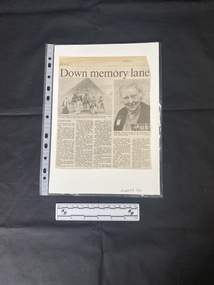
Newspaper - Newspaper clipping, Manuela Cifra, Down memory lane, [1995]
... April 1940 saw Jean amoung the first Victorian nursing sisters to go overseas. Jean nursed in tent hospitals in Gaza, Mersa Matruh, Nazareth and Colombo before heading home to Australia to nurse sick and wounded from New Guinea. ...April 1940 saw Jean amoung the first Victorian nursing sisters to go overseas. Jean nursed in tent hospitals in Gaza, Mersa Matruh, Nazareth and Colombo before heading home to Australia to nurse sick and wounded from New Guinea. ...Jean Hanna was one of a group of old collegians who presented a book containing the names of eighty former students who served World War II to Presbyterian Ladies College, Burwood. Jean, 93, had seen war firsthand, working twelve hour shifts in tent hospitals, nursing sick, wounded, amputees and POW's. By 1937 Jean was the sister-in-charge of the Alfred Hospital's operating theatre and after a European tour where she witnessed Germany arming, displaying swastikas everywhere and restricting movement in and out of Germany, Jean registered with the Australian Nursing Service and were called up. April 1940 saw Jean amoung the first Victorian nursing sisters to go overseas. Jean nursed in tent hospitals in Gaza, Mersa Matruh, Nazareth and Colombo before heading home to Australia to nurse sick and wounded from New Guinea. In April 1945 Jean went to another tent hospital in Borneo, where she cared for civilians and POW's, including a survivor of the Sandakan death march. Discharged in 1946, Jean joined the Alfred Hospital again until her retirement in 1962. A newspaper clipping of a story of five columns of text beneath two black and white photos. The photo on the left is of four women in uniform, two on camels and two on donkeys, with three men on foot, in front of a pyramid. The photo on the right os on an older woman wearing service medals.'NEWS'[graphite pencil, left top] 'AANS'[graphite pencil, right top]world war 2, wwii, ww2, world war ii, middle east, 2/1st casualty clearing station, nan schofield, egypt, battle of bardia, greece, syrian campaign, syria, japanese, american barrack hospital, ipswitch, labuan island, children's health bureau, melbourne -
 Returned Nurses RSL Sub-branch
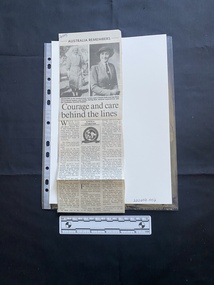
Newspaper - Newspaper clipping, Natalia Cuthbertson, Courage and care behind the lines, [24/8/95]
... Sister Gay Mole was in the Nurses Army Reserve in 1939 in the 2/9th unit, with her war service starting her in Puckapunyal then on to the Middle East. After a several months on Ceylon she was back in Australia before sailing to the Pacific, where she was among the first medical staff into Changi Prison. Prisoners of War Army Nurses WW2 WWII World War Two Stonnington Moratai TobrukRats Palestine German Jerusalem Syrian Queensland New Guinea Borneo Labuan Island Japan Singapore Alexandria Nazareth ...When talking about World War II, Sisters Gay Mole and Jean Crameri both recall tent hospitals, epidemics, bombs and nursing without hot water and electricity. They also recall hard work, comradeship and bravery. The two women were among the3000 nurses who formed the Australian General Hospital (AGH) during the war. Sister Jean Crameri was working at the Royal Women's Hospital when she volunteered and joined the 2/9th unit of the AGH. She served in the Middle East, nursed survivors of the Kokoda Trail and saw the Commander-in-Chief if the Australian Army, Field Marshall Blamey declare peace in the South West Pacific. Sister Gay Mole was in the Nurses Army Reserve in 1939 in the 2/9th unit, with her war service starting her in Puckapunyal then on to the Middle East. After a several months on Ceylon she was back in Australia before sailing to the Pacific, where she was among the first medical staff into Changi Prison. A newspaper clipping with three columns of text and a title underneath two black and white photos, both of young women in nurse's uniforms.'24/8/95.' [black ink, top left corner]prisoners of war, army nurses, ww2, wwii, world war two, stonnington, moratai, tobrukrats, palestine, german, jerusalem, syrian, queensland, new guinea, borneo, labuan island, japan, singapore, alexandria, nazareth, india, 3uz baby health centre
