
Showing 6 items matching "situational awareness"
-
 Moorabbin Air Museum
Manual - Sikorsky S76 helicopters, Introduction & Overview Jayrow Helicopters Pty Ltd
... ...Situational awareness...Sikorsky S76 helicopters Decision theory overview Factors affecting human performance Information processing Situational awareness Improvement strategies Presentation for course on decision making while flying Sikorsky S76 helicopter. ...Presentation for course on decision making while flying Sikorsky S76 helicopter.Plastic covered, spiral bound book type manualnon-fictionPresentation for course on decision making while flying Sikorsky S76 helicopter.decision theory overview, factors affecting human performance, information processing, situational awareness, improvement strategies -
 Kiewa Valley Historical Society
Box Cuticle Soap, mid to late 1900's
... situations helped boost the advertising "pitch" and subliminal undertones to effective levels required for a highly competitive health related market place. 'selling This subliminally,"medically" endorsed product was one of many during the great "spin" revolution of product marketing and selling. This item is significant in that it demonstrates that greater infusion of product awareness ...The mid 1900's provided the start of "the body beautiful" revolution. The cosmetic industry, with the help of quasi scientific selling advertising slant targeted those "customers" that needed the "extra care" factor that only their product could offer. At this period in time their advertising power was based on in store, radio and newspaper media channels with saturation levels relatively low. In the later years of the 1900's saturation levels and a wider range of products and increased competition further increased the product saturation levels available to the buying residents. With the introduction of television the advertisements become more elaborate and "catchy" words, phrases and comedy type situations helped boost the advertising "pitch" and subliminal undertones to effective levels required for a highly competitive health related market place. 'sellingThis subliminally,"medically" endorsed product was one of many during the great "spin" revolution of product marketing and selling. This item is significant in that it demonstrates that greater infusion of product awareness throughout rural areas was highly successful through a greater variety of advertising media. It also demonstrates that in a highly competitive marketplace there are no physical boundaries that impinge upon the distribution of products and services. The rural sector is a highly lucrative region for any product that helps protect the body from all the "nasty's" that become more noticeable in a rural environment. This rectangular box which had contained cuticle soap is constructed from cardboard and reinforced by a black nylon impregnated sheeting. This impregnation was required to keep the box from soaking up any water from the user's hands. The top section of the box(lid) has and in large print "KELSEY'S" top line followed by "CUTICLE" off to the right and underneath and to the right "SOAP". Below this and in smaller print is "MEDICINALLY..." below this and in smaller print "EMOLLIENT AND REFRESHING, REDOLENT, CLEANSES, CURES, PRESERVES, PURIFIES." and last line underneath "SPECIALLY ADAPTED FOR TENDER SKIN" On each of the sides of the top lid are, side 1 "INVALUABLE FOR THE NURSERY." underneath in smaller print "JOHN M. KELSEY CO." to the left of this and on a green backed highlighter "No. 1744 - Guaranteed under Pure Food Act, 1908, N.S.W. by John M. Kelsey Co. - No. 1744. Melbourne, Victoria." On the right side and in large print "KELSEY'S CUTICLE SOAP" on the next side and also a similar sign on the opposite side "SPECIALLY ADAPTED FOR TENDER SKIN." below this "JOHN M. KELSEY CO." "Registered" and on the other long side in large print "SPECIALLY ADAPTED FOR TENDER SKIN" underneath in smaller print JOHN M. KELSEY CO. Registered"specialised soap, toilet requisites, nursery health., bathroom, domestic -
Bendigo Historical Society Inc.
Administrative record - Commercial Egg Producers' Association of Victoria (CEPA) Central Council Correspondence, 1984
... Starick, President of A.C.E.P., communicates the association has not seen the B.A.E. report.Their dealings with the Minister of Agriculture are limited and indirect.There is no cause for alarm at this stage.The sender feels it is important to be aware of the situation. 8504.40s This document is a formal invitation from K. ...Starick, President of A.C.E.P., communicates the association has not seen the B.A.E. report.Their dealings with the Minister of Agriculture are limited and indirect.There is no cause for alarm at this stage.The sender feels it is important to be aware of the situation. 8504.40s This document is a formal invitation from K. ...The Commercial Egg Producers' Association of Victoria was active by the 1930s, engaging in industry management and lobbying.The Commercial Egg Producer's Association (CEPA) had branches in Bendigo, South Bendigo, Eaglehawk, Wedderburn, Murrabit and Euroa.CEPA Commercial Egg Producer's Association (Bendigo Region) correspondence, for the year 1984. This item includes the following documents: 8504.40a This letter provides advice to Miss Karen Smith regarding employment opportunities in the poultry industry 8504.40b The Committee is requesting a deputation to the full Board of the Egg farmersof Victoria as soon as possible, ideally before August, rather than waiting until the November meeting. 8504.40c This document is a formal letter addressed to the Minister of Agriculture, Mr. Eric Kent, dated June 27, 1984. Nomination of Representatives:Mr. Dennis J. Oakes is nominated as the representative for the Victorian Poultry Advisory Committee. Mr. Ron Robins is nominated as the deputy delegate, to ensure the Association is represented if the main delegate is unavailable. 8504.40d To the Egg farmer of Victoria. The Association discusses a proposed points system for egg quality testing. Concerns are raised about extra costs for agents and grading floors, as well as the need for inspectors to take samples from P.A.'s and farm packers. Clarification is sought on who will cover these additional costs.Production Cost Survey. The Association supports a survey by Price Waterhouse Associates Pty. Ltd. to assess feed and other farm costs. Emphasis is placed on the need to consider varying prices and types of grains when setting egg prices. Interest is expressed in learning more about the proposal and meeting with relevant stakeholders.E gg Powder Tailings for Calf FeedThe letter references previous correspondence about marketing egg powder tailings as an ingredient in calf feed.The Association requests updates on any progress or preparations regarding this product.Invitation to Board MeetingThe Association invites the full Board to hold their meeting in Bendigo on November 13, 1984. 8504.40e CEPA Annual Conference Business Paper June 1984 8504.40f To the Minister of Agriculture Victoria, This letter from the Commercial Egg Producers' Association of Victoria outlines the following: The Association expresses strong support for the New South Wales Government and the Egg Corporation's efforts to combat illegal and unlawful egg producers. There is significant alarm that 'rebel traders' have been allowed to operate for an extended period, undermining legitimate farmers who follow established guidelines. The Association requests to be kept informed about any further actions the government plans to take regarding the control of illegal egg producers. 8504.40g The Commercial Egg Producers Association is inviting Mr. J. M. Brumby M.H.R. to a special meeting. 8504.40h This document is an official invitation from the Commercial Egg Producers Association to Mr. David Kennedy, M.L.A., requesting him to officially open a special meeting on June 18, 1984, at the Diagnostic Centre in Epsom. The meeting will focus on the effects of exotic diseases in livestock and poultry, 8504.40i This document is a formal letter from K. Fitzgibbon to Hon. Eric Kent, M.P., Minister of Agriculture, nominating candidates for a producer vacancy on the Victorian Egg Marketing Board. 8504.40j Annual Meeting Announcement - The Central Council of C.E.P.A. will hold its annual meeting at the Diagnostic Centre, Epsom, on Monday, 18th June 1984 at 2:00 p.m. 8504.40k This document is a formal letter from the Commercial Egg Producers Association to the Egg Farmers of Victoria, outlining Industry Funding. Members discussed the need for national support and funding for ACEP (Australian Council of Egg Producers) and its membership in the National Farmers Federation. 8504.40l This document is a formal letter from Kevin Fitzgibbon to Ross Davies, EO of Victorian Farmers and Graziers Association, regarding industry levy collection. 8504.40m The Commercial Egg Producers' Association of Victoria expresses gratitude to Mr. David Kennedy, M.L.A., for his support in passing new Egg Industry Stabilization Legislation. 8504.40n This document is a formal thank-you letter from the Secretary of the Commercial Egg Producers' Association of Victoria to Hon. J. Radford. The Association thanks Hon. J. Radford for his efforts in passing the new Egg Industry Stabilization Legislation through Parliament. 8504.40o This document is a formal letter from the secretary of an association, K. Fitzgibbon, addressed to a researcher, Mr. F. Lezannais. 8504.40p The document is a formal protest letter addressed to the Minister for Transport regarding a ban on transporting live chickens by bus to rural areas 8504.40q This letter requests political support for proposed Hen Levy Legislation affecting family farming. CEPA, instructed by their committee, asks Mr. Bernie Dunn (a Member of Parliament) to support the legislation during party meetings if it would help their cause. 8504.40r This telegram from K. Fitzgibbon, Secretary of C.E.P.A. of Victoria, to W. J. Starick, President of A.C.E.P., communicates the association has not seen the B.A.E. report.Their dealings with the Minister of Agriculture are limited and indirect.There is no cause for alarm at this stage.The sender feels it is important to be aware of the situation. 8504.40s This document is a formal invitation from K. Fitzgibbon, Secretary of CEPA, to Mr. C. L. Jefferson, Secretary of the Victorian Egg Marketing Board. Invitation to Meeting:The new Board and all its members are invited to hold a meeting in Bendigo at a suitable venue. 8504.40t This document is a formal letter from K. Fitzgibbon, Secretary, addressed to Mr. Alan T. Harrison, General Manager of the Victorian Egg Marketing Board. Notification: The letter informs Mr. Harrison that a copy of a submission regarding the Egg Industry Stabilization discussion paper has been sent to the Minister of Agriculture. 8504.40u This document is a formal letter from K. Fitzgibbon (Secretary) to Mr. Alan T. Harrison, General Manager of the Victorian Egg Marketing Board. Notification of Submission:The letter informs Mr. Harrison that a copy of a submission regarding the Egg Industry Stabilization discussion paper has been sent to the Minister of Agriculture. 8504.40v This document is a formal letter from K. Fitzgibbon, Secretary of CEPA, addressed to Mr. David Kennedy, M.L.A. The association has sent Mr. Kennedy a copy of their submission to the Victorian Egg Marketing Board regarding the Dockage Discussion Paper. 8504.40w The document is a letter from the secretary of CEPA to the manager of Crystal Egg Co., highlighting several operational concerns regarding egg reception. Concerns About Delivery Schedules, Since the introduction of the 38-hour work week, some producers face difficulties delivering eggs after 3 PM on Fridays. 8504.40x Letter to the General Manager, Victorian Egg Marketing Board advocating for the continuation of the existing dockage system for egg marketing in Victoria:Adherence to Dockage System: The Commercial Egg Producers' Association of Victoria strongly supports maintaining the current dockage system, emphasizing its fairness and alignment with the Marketing of Primary Products Act. 8504.40y Letter to David Kennedy MLA re Retention and Confirmation of Hen Quotas - All existing hen quotas will be retained and confirmed as of the commencement of the new Act. 8504.40z Annual Conference Business Paper June 1983 8504.40aa The document is a formal letter from the CEPA addressed to the Department of Agriculture. The key points are: Support for Increasing Hen Quota and Advocacy for Poultry Refresher Courses 8504.40ab The document is a letter from the association's secretary to the Egg Farmers of Victoria, expressing concerns about the yolk color testing system for egg producers. 8504.40ac Notice of The Half Yearly Conference of the Central Council will take place at City Hall, Bendigo, on Friday, 23rd November 1984 at 7:00 p.m. 8504.40ad The Secretary (K. Fitzgibbon) formally invites the full Board of the Egg Farmers of Victoria to attend a meeting in Bendigo on Tuesday, November 13, 1984 8504.40ae The Secretary of the Commercial Egg Producers' Association of Victoria acknowledges receipt of a discussion paper on Egg Industry Stabilization sent by the Minister of Agriculture. 8504.40af CEPA Half Yearly Conference Business Paper Nov 1984 8504.40ag CEPA Minutes of annual Conference June 1984 8504.40ah This document is a letter from the Secretary of the South Bendigo Branch of the Commercial Egg Producers' Association, dated March 30, 1984. The letter is addressed to J. Quinlin, who is compiling a book on agriculture in Bendigo over the past 150 years. The Commercial Egg Producers' Association expresses their interest in the project and offers assistance. They specifically state their willingness to provide any information that may be helpful for the book. 8504.40ai This document is a formal letter from the South Bendigo Branch of the Commercial Egg Producers Association addressed to the Minister of Agriculture. The letter requests that members of the Poultry Advisory Board should be genuine representatives of poultry industry organizations and be nominated by those organizations. 8504.40aj Egg Farmers of Victoria Newletter - four pages April 1984 8504.40ak From CEPA to members: The Annual Meeting of the Central Council will be held at the Diagnostic Centre, Epsom, on Monday, 18th June, 1984, at 2:00 p.m. 8504.40al This document is a formal letter from the Department of Agriculture, Victoria, addressed to the Commercial Egg Producers Association. The letter acknowledges that two errors were present in a previous letter, (part of this document) sent to the Association and apologizes for these mistakes.It provides the corrected text for page 2, paragraph 3 of the earlier correspondence. Invitation for Industry Input: The Department emphasizes the importance of industry leaders contributing their views and comments.The Association is invited to make a written submission on any matters covered by the Terms of Reference. Submissions should be sent to Dr. Jim McLaughlin at the Department's address by June 1, 1984. 8504.40am This document is a formal acknowledgment letter from the Secretary of the Australian Senate's Select Committee on Animal Welfare. The document serves as an official confirmation that the concerns raised about caged birds will be considered by the relevant parliamentary committee. 8504.40an CEPA Notice of Annual Meeting June 1984 8504.40ao This document is a formal letter from the Minister of Agriculture, Eric Kent, addressed to Mr. D. Kennedy, M.P. The letter responds to an inquiry from Mr. Kennedy regarding the panel of names submitted by the Commercial Egg Producers Association for vacancies on the Victorian Egg Marketing Board. 8504.40ap Minutes of Annual Conference June 1984 8504.40aq This document is a formal letter from the Minister of Agriculture addressing concerns about licence fee increases for small egg producers. 8504.40ar Six Pages. This document reports on the operations and activities of the Poultry Farmer Licensing Committee during the ninth licensing season, covering the period from March 1, 1983, to June 30, 1984. It was presented to both Houses of Parliament in Victoria as required by the Egg Industry Stabilization Act 1983. The report provides an official account of the committee's work in regulating and overseeing poultry farmer licensing within this timeframe. 8504.40as Six Pages - The Shield newsletter. This document is a publication from the R.S.P.C.A. (A.C.T.) Inc. dated July 1984. It appears to be an official communication or newsletter, registered by Australia Post, and likely contains information relevant to animal welfare or organizational updates for the R.S.P.C.A 8504.40at Notice of CEPA Half Yearly Conference Nov 1984 8504.40au This document is a formal letter from Bruce Reid, a Member of the Victorian Legislative Council, addressed to the Secretary of the South Bendigo Branch of the Commercial Egg Producers Association. The letter acknowledges receipt of the Association's objection to the proposed single fund plan for workers' compensation in Victoria. Bruce Reid states he will bring the Association's concerns to the attention of the Hon. Jeff Kennett, Leader of the Opposition.egg producer's information, correspondence, cepa, commercial egg producers' association -
 National Wool Museum
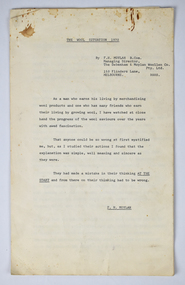
Archive - Report, Fred Moylan, The Wool Situation, 1970
... awared the Member of the Order of Australia in 1997 for his contribution to the Australian and international wool industry. Source: Publication Moylan Woollens produced by the RMIT University Textile Resource Centre. Frederick Moylan The Debenham & Moylan Woollen Co. Pty. Ltd Report Wool Industry THE WOOL SITUATION ...Fred Moylan OAM born in Melbourne 1923, founded Moylan Woolen in 1950, at the beginning of an extended period of prosperity for the Australian wool industry. Moylan Woollens initial main focus was in the wholesale wool trade. In 1958-1959 the business diversified into angora farming and distribution. In 1967 the company merged with Debenhams Australia to form Debenham and Moylan Woollen Co Pty Ltd, later in 1980 the company was sold to Richard Allen. Moylan was a key business figure in the formation of the Australian Wool Bureau and Woolmark. He was awared the Member of the Order of Australia in 1997 for his contribution to the Australian and international wool industry. Source: Publication Moylan Woollens produced by the RMIT University Textile Resource Centre. Seven page single sided printed report with black typed text on cream paper.THE WOOL SITUATION 1970 / By F. H. MOYLAN B. Com. / Managing Director, / The Debenham & Moylan Woollen Co. / Pty. Ltd. / 153 Flinders Lane, / MELBOURNE. / 3000.frederick moylan, the debenham & moylan woollen co. pty. ltd, report, wool, industry -
 Camberwell RSL Sub-Branch
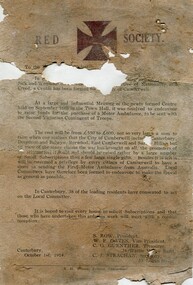
Red Cross Poster 1914, Red Cross Poster to raise fund for a Motor Ambulance, dated 1st October 1914, 1914
... Once General Kitchener was made aware of this situation he immediately overruled the ban and 100 motor ambulances and 1000 Nurses were sent to France. ...Once General Kitchener was made aware of this situation he immediately overruled the ban and 100 motor ambulances and 1000 Nurses were sent to France. ...Significant, one of the earliest details of the Red Cross Society in WW1 Very significant, very rare.Paper poster, headed Red Cross Society. Asking for interested citizen in the Camberwell/Canterbury area to form committees to raise 600 pounds to buy a fitted out Motor Ambulance to send over to France as part of the war effort. In October 1914 not one motor Ambulance was on the French front as the War office had banned any Red Cross involvement with wounded soldiers. Once General Kitchener was made aware of this situation he immediately overruled the ban and 100 motor ambulances and 1000 Nurses were sent to France. This fund raising by Camberwell Residents for a Motor Ambulance to be sent to France would have been among the first in WW1.See photo for complete details -
 Melbourne Legacy
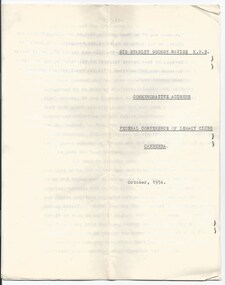
Document - Speech, Commemorative Address - Sir Stanley Savige K.B.E. Federal Conference of Legacy Clubs, Canberra, 10/1954
... situation in the forward areas. He dealt personally with his subordinate commanders whenever it was possible to do so. No one says his G.S.O. 1. understood better than he did the importance of front line troops seeing their G.O.C. frequently, and knowing that he was aware of and prepared to share their hardships and dangers. ...situation in the forward areas. He dealt personally with his subordinate commanders whenever it was possible to do so. No one says his G.S.O. 1. understood better than he did the importance of front line troops seeing their G.O.C. frequently, and knowing that he was aware of and prepared to share their hardships and dangers. ...After the death of Stan Savige this address was given at the Canberra Conference in October 1954. It is tribute to his life. Sir Stanley Savige KBE : Commemorative Address Federal Conference of Legacy Clubs, Canberra : October 1954. On the 15th of May this year Legacy learned to its enduring sorrow of the death of its Founder, Lieut. General Stanley George Savige KBE, CB, CBE, DSO, MC, ED, for more than 30 years affectionately known to us all as Legatee Stan Savige. He was the embodiment of all those things for which Legacy stands, and each one of us who knew him and worked with him feels a great and abiding sense of personal loss. It is proper, therefore, that those of us at this Conference, the first after his passing, representative of Legacy throughout the Commonwealth, and comprising so many who were his friends, so many who knew the depth of his love for Legacy, should acknowledge our debt to our Founder and ensure, so far as we may, that the inspiration of his life and work in this Cause shall not be lost to those who follow after. It was not ordained that Stanley George Savige - should enjoy a long life, but it was to prove a life of outstanding service. Born at Morwell in Victoria some 63 years ago, he received with his brothers and sisters such education as was then available to a lad in a mining district. He had no particular opportunities of advancement, but from his early days he cherished a strong ambition to make a success of his life, and with this in view he lost no opportunity of adding to his knowledge. Always a lover of the open country, a good bushman and a fine shot, he became as a young man, a Scoutmaster with a keen following of boys. Even in those early days he attracted youth and showed undoubted promise of the quality of leadership which later was to make him famous. Opportunity came with the first World War, and he took his place as a private soldier in the original 24th Battalion AIF. Followed Gallipoli and Anzac where his marksmanship and bush craft stood him in good stead. Conscious that his early training was not sufficient to secure the promotion he desired, he set himself to enlarge it. Only a man of fine fibre and rare determination could apply himself to study on that war torn Peninsula, where our men, hitherto untested, suffered every known hardship and no man knew, from hour to hour, whether he would survive. But Savige achieved it. Himself then a Corporal he found another Corporal who was a former Schoolmaster and learned from him all that he had to teach. Savige was on his way. He was commissioned on the Field and allotted the heroic task of leading the last party off that desperate coast during the famous evacuation. In France he became the Adjutant of his Battalion and one of the best known officers in the 6th Brigade. He won the Military Cross and was mentioned in despatches. Early in 1918 he received a signal distinction, He was included in a small but distinguished band of Officers and Non-Commissioned Officers from the British and Dominion Forces most carefully selected for individual courage and proved qualities of leadership, and was sent to Persia, under the command of Major-General Dunsterville, Kipling’s famous Stalky, to assist and mobilise the friendly tribes with a view to protecting the road to India, left wide open by the withdrawal of Russia. The story of the Dunsterforce, its suffering and achievements in the face of incredible hardships and difficulties, was later to be told by Savige in his book “Stalky’s Forlorn Hope”. He emerged, finally, unscathed, despite his active participation in several of the bloodiest battles of all time, with the rank of Captain and a DSO and MC to his credit, to say nothing of three mentions in despatches. In later years, further decorations were to be conferred upon him, but I believe he valued none of these so highly as his awards for outstanding personal bravery won in the Field when he was an Officer of comparatively junior rank. Such was the man who in August 1923, at the instance of his former Commander, Major-General Sir John Gellibrand, gathered around him a handful of men who had fought and laughed with him over four well remembered years. This small band adopted the name of “Legacy”, but its purpose then was, in the main, to assist in safeguarding the interests of ex-servicemen in this country. Worthy although the case undoubtedly was, the conception and ideal which was to distinguish Legacy from all kindred post-war movements did not emerge until two years later. The torch had not been lit. Legacy had not yet found its soul. What has been achieved since then is known to you all. The Legacy ideal, unique in its conception, with no known counterpart elsewhere, is now accepted, welcomed and honoured throughout the Commonwealth and abroad. But in those early days the achievements of our Founder in the face of all manner of difficulties and frustrations are worthy of our lasting memory and thankfulness. As the source of every river lies in the hills, so must the inspiration from which stems a great conceptions of service to one’s fellow men be lofty and above reproach. Savige was the embodiment of this new expression of comradeship, as he was the central figure and driving force of the little group that sponsored it. But for his zeal, his faith and determination, it is likely that the flame, newly kindled, might have flickered and died. The idea of men returned from active service pledging for the sake of their former comradeship, their personal assistance to the widows, and above all, to the children of those who had fought beside them and paid the full price of War, was so completely new and unexpected that it was by no means readily accepted. There were no funds, no precedents to guide the new adventurers, only the clear bright flame of an ideal just envisaged, and the conviction that the Cause was unassailable. Nor were there lacking many who said that the community held no place for Legacy, that it was born of sentiment only, and would quickly pass. The scoffers are gone and one since forgotten, but the torch remains and burns brighter than ever. Down the years of Legacy there are many names deserving of honour, men from all States and all stations of life, but no name stands out in such clear and bold relief as does the name of our Founder. By his works you shall know him. He was, in truth, the Soul of Legacy. He sought no office and preferred to work as one of the team. Six years went by before he accepted the Presidency of Melbourne Club, and then only because his fellows would book no further delay. “The Spirit of Legacy is Service” - so runs the Charter, and that was Savige’s Creed. By virtue of his attainments he was called upon to take a leading part in the administration of Legacy, first within his own club and later, as Chairman of the Co-ordinating Council of Legacy in Australia. But always it was the essentially human character of the work which enthralled and upheld him, and the tasks which gave him most joy were those which brought him into close personal contact with the youngsters and their home life. Like their elders they recognised his goodwill and his leadership and responded to it. It was Savige who made possible the first camps held for the boys and girls by Melbourne Club. These were erected on his own seaside property, and were originally conducted under his personal direction and largely with the aid of funds he had collected. There was hardly an important post in his own Club that Savige did not at some time occupy and adorn. He was happiest in the company of those men with whom he had served in the field, and cherished always the comradeship born of active service which is of the essence of Legacy. He was a man of strong convictions but attentive always to another’s point of view. As a Legatee he played a leading part in bringing hope and encouragement to many a mother on whom the whole responsibility of a young family had been suddenly and tragically laid; in the attainment of the ambitions of many an orphan child, which not so long since had seemed to him or her to be mere dreams, impossible of realisation. Comfort for the bereaved, new hope for the children’s physical and educational welfare, assistance with the home, aid for the sick, money for the needy and a new courage to face a future that hitherto had held no promise, all these facets of Legacy endeavour combine to present a living and enduring memorial to the man we honour as our Founder today. Between the two World Wars in addition to establishing himself successfully in civilian life and answering the constant calls of Legacy on his energy and time, Savige maintained an active association with the Army. He was convinced that a Second AIF would one day be urgently called upon, and as a Battalion Commander he spared no effort to train the Officers under his charge during the uneasy years of peace for the trial that he felt must come. These men have all subsequently had distinguished military careers, their names are well known and many of the serve in Legacy today. When the second crisis came, Savige himself was one of the first to offer, and although his youth was spent, he proudly carried the number VX13 throughout the terrible years that followed. This time he was to command, first the 17th Australian Infantry Brigade in the first action of the Second AIF against the enemy at Barida, and subsequently at Tobruk and Derna - all famous names now. It was his patrols which gave the warning - unheeded at the time - that Rommel’s reinforcements were reaching North Africa far earlier than was expected. Then followed the grim days of Greece and Crete when the fine qualities of his leadership were put to the utmost test. I have been told by those who were closest to him it was typical of Savige that when his convoys were on the move back and were being blasted from the air by the unopposed Luftwaffe, he should sit by the side of the open road, wearing his red banded cap, to steady the morale of men who had then no chance of hitting back at the enemy. Unorthodox no doubt, but here was a man indeed. Throughout the whole campaign and later when he commended the 3rd division in New Guinea and later still when with the rank of Lieutenant-General he became a Corps Commander in New Guinea and Bouganville, it was at all times characteristic of him that he should see for himself the situation in the forward areas. He dealt personally with his subordinate commanders whenever it was possible to do so. No one says his G.S.O. 1. understood better than he did the importance of front line troops seeing their G.O.C. frequently, and knowing that he was aware of and prepared to share their hardships and dangers. He took many risks that he should not have taken, exhausted himself physically and mentally times without number, and considered himself not at all in order to secure the success of his operations. Finally, in Bouganville, he brought his campaign to a victorious conclusion and accepted the personal surrender of the Japanese Commander. Savige is known as one of Australia’s most human military leaders, but let no one believe that he did not ask and receive the utmost of his men. He trained them in a hard school but he was ever conscious of their needs and observant and thoughtful of their welfare. Fearless and untiring under conditions which brought younger men down, he asked nothing that he was not himself prepared to give and do. The close of the Second World War left him with the same brave heart; but a vitality greatly impaired. He was called up again and again to perform important national tasks, notably that of Co-ordinator of Demobilisation and Dispersal. But his interest in Legacy never flagged it was in fact more personal than ever, for under his command many junior legatees, sons of former comrades had proved themselves worthy of their Fathers in war and in peace. In the bearing and achievements of the young men of the Second A.I.F. he took a particular and justifiable pride. He applied himself to the Extension of Legacy to areas where it had not previously been practicable to operate. His record of service and close personal contact with the men of both wars made him a most welcome pioneer and many new Clubs and Groups resulted from his efforts. He founded, and I doubt whether any one else could have done so, the Club in the great Capital of our Empire. His reputation and obvious sincerity surmounted obstacles that might well have daunted lesser man. Legacy’s debt to him visibly increased. But he was ever a simple man, with a great love and understanding of his fellow men and a true Legatee at heart. Much that he did will never be known or recognised, save by those who benefitted. His service in Legacy ranged from the humble kitchen of cottage and farm to our representation in Westminster Abbey itself. A knighthood set the seal upon an outstanding career. None the less when upon the death of Field Marshall Sir Thomas Blamey, Lieut. General Sir Stanley Savige became the Patron of the Melbourne Club, he retained at his own express desire, the title of Legatee Savige, and when on that final day we bade him farewell, when the Flags he had served so well were lowered and the guns which had formed a grim final salute, it was apparent to all who had eyes to see that this great and simple man had won such a place in the hearts and affection of his fellow country men as is given to few men indeed. From the packed Cathedral, escorted by his fellow Generals, followed by men of his own Units, by Legatees and a great company of others who had cause to honour and esteem him, he made his last journey. But that is not the end. His voice and presence are lost to us but his memory and inspiration must ever remain. As he has bequeathed to the National War Memorial yonder his diaries, records and battle plans, so he has bequeathed to us his fellow Legatees his greatest achievement and his trust, Legacy itself. Never was the Torch passed by worthier hands. Now it is ours to hold it high. Whatever material memorial the future many hold for him, Legacy owes its Founder a livelier recompense. It is within our power to implement what I believe to be his greatest wish, that Legacy and its ideal of comradeship and service shall flourish and endure. Let each one of us then resolve that we shall, within our Clubs, in all tasks to which we are assigned, both great and small, keep in our minds the life and spirit of Stanley George Savige, so that we may be proud at all times to say of Legacy to those who follow after - “If you would see his memorial - Look around you”.The tribute to Stanley Savige shows how greatly he was regarded by the Legatees.Off white quarto paper with black type, address given about Stan Savige to the Canberra Conference, x 12 pages.savige, speech, obituary
