
Showing 144 items matching "social impact"
-
 Port Melbourne Historical & Preservation Society
Document, Ewan Ogilvy's Bayside Papers, Box Three - Inner Urban Ministerial Advisory Committee - Report on Social Impact Work for major Developments Jan 1988, 1987
... Ewan Ogilvy's Bayside Papers, Box Three - Inner Urban Ministerial Advisory Committee - Report on Social Impact Work for major Developments Jan 1988...From Ewan Ogilvy's chronologically organised 'Bayside Papers' relating to the proposed development of Port Melbourne industrial land in the late 1980s: Stapled photocopies of Inner Urban Ministerial Advisory Committee - Report on Social Impact Work for major Developments Jan 1988...His files were presented to the Society in May 2001 on his preparation for leaving Victoria. town planning town planning - proposals shelved - bayside public action campaigns environmental issues public housing missions to seamen ewan ogilvy centre for urban research and action sandridge city development co pty ltd scdc linton r lethlean barry pullen - mlc Signed 'Ewan Ogilvy' From Ewan Ogilvy's chronologically organised 'Bayside Papers' relating to the proposed development of Port Melbourne industrial land in the late 1980s: Stapled photocopies of Inner Urban Ministerial Advisory Committee - Report on Social Impact Work for major Developments Jan 1988 Ewan Ogilvy's Bayside Papers, Box Three - Inner Urban Ministerial Advisory Committee - Report on Social Impact Work for major Developments Jan 1988 Document ...Ewan Ogilvy, former Melbourne Councillor and also of Community Services Victoria, Inner Urban Ministerial Advisory Committee and Uniting Church's Centre for Urban Research and Action (CURA), was instrumental in social justice approaches to town planning. He and CURA's Social Justice and the City Project funded Port Melbourne community groups protesting against the SCDC development in 1987. His files were presented to the Society in May 2001 on his preparation for leaving Victoria.From Ewan Ogilvy's chronologically organised 'Bayside Papers' relating to the proposed development of Port Melbourne industrial land in the late 1980s: Stapled photocopies of Inner Urban Ministerial Advisory Committee - Report on Social Impact Work for major Developments Jan 1988Signed 'Ewan Ogilvy'town planning, town planning - proposals shelved - bayside, public action campaigns, environmental issues, public housing, missions to seamen, ewan ogilvy, centre for urban research and action, sandridge city development co pty ltd, scdc, linton r lethlean, barry pullen - mlc -
 Bendigo Historical Society Inc.
Document - Kangaroo Flat Gold Mine Collection: Williams United Gold Mine, Unknown
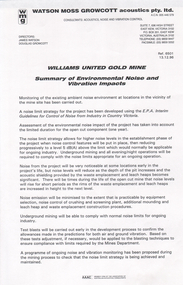
... ...social impact...Proposed Williams United Gold Mining Project, one page. Summary of social impact assessment 5. Summary, one page, of land use planning impact study, Williams United Gold Mining Project 6. ...Bendigo mining gold mining proposal Williams United mine social impact vibration impacts noise Six pages of information on the Williams United Gold Mining project proposed development by Bendigo Mining N.L. 1. ...Six pages of information on the Williams United Gold Mining project proposed development by Bendigo Mining N.L. 1. Williams United Gold Mine, one page, summary of environmental noise and vibration impacts. Watson Moss Growcott Acoustics Pty Ltd on top of page, dated 13.12.96. 2. Williams United Project, one page assessment of archaeological and heritage values, summary of conclusions and recommendations. Undated. 3. Proposed Williams United Project, one page double sided. Study of plant life on site. On back page: ' Proposed Birds/Carshalton Project, study of plants on site. 4. Proposed Williams United Gold Mining Project, one page. Summary of social impact assessment 5. Summary, one page, of land use planning impact study, Williams United Gold Mining Project 6. Williams United/Forty Foot Spurs. One page document. bendigo mining n.l., bendigo, mining, gold, mining proposal, williams united mine, social impact, vibration impacts, noise -
Broadmeadows Historical Society & Museum
Book (series) - Report, E. Hamilton-Smith, A.U.A., (Youth Services Planning Division) et al, Broadmeadows – A Growing City, 1972
... Public housing — social impact....) — social conditions Local government — planning and policy Youth services — Victoria Welfare services — urban communities Public housing — social impact Community development Broadmeadows – A Growing City Book Report E. ...Broadmeadows City Council; created through the Youth Services Planning Division with contributions from academic researchers and advisory committees.Produced as a commissioned study by the City of Broadmeadows to examine general welfare conditions and youth work needs within the municipality and to guide future planning, service provision, and community development.Two-volume set comprising: • Volume 1: Detailed survey data and working papers (207 pages) • Volume 2: Integrated summary, analysis, and recommendations (81 pages)A two-volume report documenting a comprehensive social survey of Broadmeadows, covering population growth, welfare services, youth needs, housing conditions, education, health, and employment. Volume 1 contains detailed data and statistical material, while Volume 2 synthesises findings and presents policy recommendations for municipal planning and community development.broadmeadows (vic.) — social conditions, local government — planning and policy, youth services — victoria, welfare services — urban communities, public housing — social impact, community developmentbroadmeadows (vic.) — social conditions, local government — planning and policy, youth services — victoria, welfare services — urban communities, public housing — social impact, community development -
Whitehorse Historical Society Inc.
Article, Railyards, 27/04/1988 12:00:00 AM
... If the railyard had been built there would have been a loss of $77,000 in lost rates alone. The social and economic impact would have been significant. ...If the railyard had been built there would have been a loss of $77,000 in lost rates alone. The social and economic impact would have been significant. ...If the railyard had been built there would have been a loss of $77,000 in lost rates alone. The social and economic impact would have been significant. ...Nunawading Council spent $62,000 in the campaign against Metrail's now abandoned plan for railyards in the municipality.Nunawading Council spent $62,000 in the campaign against Metrail's now abandoned plan for railyards in the municipality. Ron O'Neill, the strategic planner revealed details of costs in a report to council committee. Payments went to consultants, solicitors. If the railyard had been built there would have been a loss of $77,000 in lost rates alone. The social and economic impact would have been significant. Council had been instrumental in ensuring that an environmental effects statement was prepared.Nunawading Council spent $62,000 in the campaign against Metrail's now abandoned plan for railyards in the municipality. railways, o'neill, ron, city of nunawading, nunawading railway depot -
 Bendigo Historical Society Inc.
Document - Kangaroo Flat Gold Mine Collection: Land Use Impact Study, Unknown
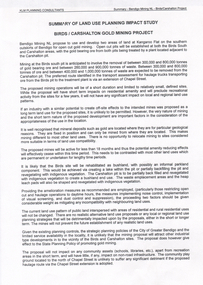
... Proposed Birds South/Carshalton Gold Mining Project, Summary of Social Impact Assessment. 4. Birds/Carshalton project - economic benefits, tourism benefits, public sector externalities, effect on property values and recommendation. ...Proposed Birds South/Carshalton Gold Mining Project, Summary of Social Impact Assessment. 4. Birds/Carshalton project - economic benefits, tourism benefits, public sector externalities, effect on property values and recommendation. ...Four pages of information on the Birds/Carshalton Gold Mining poposed development by Bendigo Mining N.L.. 1. Summary of land use planning impact study, Birds/Carshalton Gold Mining Project. On top of page: ' KLM Planning Consultants, Summary Bendigo Mining NL - Birds/Carshalton Project. 2. South Birds/Carshalton Gold Mines, summary of environmental noise and vibration impacts. On top of page: Watson Moss Growcott Acoustics Pty Ltd. 3. Proposed Birds South/Carshalton Gold Mining Project, Summary of Social Impact Assessment. 4. Birds/Carshalton project - economic benefits, tourism benefits, public sector externalities, effect on property values and recommendation. bendigo mining n.l., bendigo, mining, gold, mining proposal, dust supression, carshalton mine, williams united mine, birds reef -
Lakes Entrance Historical Society
Book, Calder Stuart and Winty, East Cunninghame and Lake Tyers Beach. A case study Report, 1976
... A case history of resort development in the Lake Tyers Beach Victoria coast area, considering the history of land use and future planning with regard to environmental impact and social requirements....Natural History Land Settlement A case history of resort development in the Lake Tyers Beach Victoria coast area, considering the history of land use and future planning with regard to environmental impact and social requirements. East Cunninghame and Lake Tyers Beach. ...A case history of resort development in the Lake Tyers Beach Victoria coast area, considering the history of land use and future planning with regard to environmental impact and social requirements.natural history, land settlement -
 National Wool Museum
Film - 16o8, Abha Gupta, Streamline Media and Communications Group Pty Ltd, 2025
... Beyond creating aesthetically compelling garments, ‘16o8’ project served as a catalyst for social impact. By prioritising fair wages and opportunities for marginalised communities, she uplifted artisans and craftspeople, embedding sustainability across all levels and stages of her endeavour. ...Beyond creating aesthetically compelling garments, ‘16o8’ project served as a catalyst for social impact. By prioritising fair wages and opportunities for marginalised communities, she uplifted artisans and craftspeople, embedding sustainability across all levels and stages of her endeavour. ...One of three We The Makers videos commissioned by the Programs and Education department at the National Wool Museum to assist in learning and engagement alongside the We The Makers Sustainable Fashion Prize 2025 exhibition at the National Wool Museum. The films feature artist interviews from three finalists from We the Makers, providing insights into their personal influences, the motivations behind their material choices and the impact of culture on artistic practice. This film features designer Abha Gupta and her work '1608'. Artist Statement: ‘16o8' collection by designer Abha Gupta pays tribute to the historic moment when the British first arrived in India, a pivotal event that reshaped the country's fashion landscape for over two centuries. She launched this collection under her brand name, ‘Antiek East’. Designed under the mentorship of RMIT professor Blake Barns, the collection draws inspiration from the era of British colonisation, reflecting its profound influence on Indian fashion history. Drape suit jacket in the collection is meticulously handwoven and handmade by local artisans using natural fibres, embodying a commitment to traditional craftsmanship. Beyond creating aesthetically compelling garments, ‘16o8’ project served as a catalyst for social impact. By prioritising fair wages and opportunities for marginalised communities, she uplifted artisans and craftspeople, embedding sustainability across all levels and stages of her endeavour. This commitment not only resonated through the ethical sourcing of materials but also through the conscientious production practices that minimise environmental impact. Circular design principles guided the approach of this project, emphasising materials that are biodegradable and minimise environmental impact. Natural dyeing processes not only uphold traditional craftsmanship but also reduce harmful chemical runoff into ecosystems. By choosing sustainable fabrics and methods, the project aimed to create garments that are not only beautiful but also ethically and environmentally sound.Three minute eighteen second digital video with audio. abha gupta, fashion, designer, film, we the makers, sustainability, textiles -
 Flagstaff Hill Maritime Museum and Village
Book - Illustrated Reference Book/Social History, Louis Auguste Gustave Doré et al, London a Pilgrimage, 1872
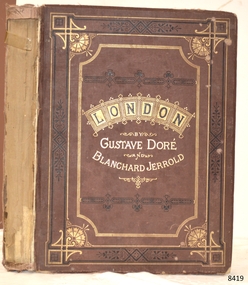
... This work is immensely significant, though its legacy is primarily driven by its artistic and social impact rather than Jerrold's prose alone. ...This work is immensely significant, though its legacy is primarily driven by its artistic and social impact rather than Jerrold's prose alone. ...London A Pilgrimage (1872) is one of the most celebrated, visually striking, and socially important illustrated books of the 19th century; as such, the work is a highly desirable piece of publishing history. The book offers a comprehensive, episodic portrait of Victorian London at the height of the British Empire. The prominent French artist Gustave Doré and English journalist William Blanchard Jerrold shared a fascination with urban life, combining their talents to create one of the 19th century's greatest collaborative works. They spent days exploring the metropolis together to capture the stark dualities of the city. Rather than focusing solely on the grand landmarks of the wealthy, the book famously juxtaposes the "sunlight and shadows" of London life. When Jerrold suggested a massive, joint exploration of London in 1869, it brought together two perfect skill sets: Jerrold provided the investigative journalistic grit and intimate knowledge of London’s social strata, while Doré provided the haunting, cinematic visual poetry through his illustrations.Hard cover book, London a Pilgrimage Author: William Blanchard Jerrold Publisher: Grant & Co, 74-78 Turnmill St. London. EC. Date: 1872 Morocco Olive hardcover with a damaged spine, lettering in gold with a title in a surrounded with a decorative panel. non-fictionLondon A Pilgrimage (1872) is one of the most celebrated, visually striking, and socially important illustrated books of the 19th century; as such, the work is a highly desirable piece of publishing history. The book offers a comprehensive, episodic portrait of Victorian London at the height of the British Empire. The prominent French artist Gustave Doré and English journalist William Blanchard Jerrold shared a fascination with urban life, combining their talents to create one of the 19th century's greatest collaborative works. They spent days exploring the metropolis together to capture the stark dualities of the city. Rather than focusing solely on the grand landmarks of the wealthy, the book famously juxtaposes the "sunlight and shadows" of London life. When Jerrold suggested a massive, joint exploration of London in 1869, it brought together two perfect skill sets: Jerrold provided the investigative journalistic grit and intimate knowledge of London’s social strata, while Doré provided the haunting, cinematic visual poetry through his illustrations.flagstaff hil, warrnambool, flagstaff hill maritime museum, maritime museum, shipwreck coast, flagstaff hill maritime village, great ocean road, book, pattison collection, warrnambool library, warrnambool mechanics’ institute, ralph eric pattison, corangamite regional library service, warrnambool city librarian, mechanics’ institute library, victorian library board, warrnambool books and records, warrnambool children’s library -
The Beechworth Burke Museum
Audio - Oral History, Jennifer Williams, Mr Ken Blake and Mrs Doreen Blake, 30th March 2000
... They demonstrate the highs and lows of living and running a business in Beechworth through economic lows and the impact of both social and physical isolation. Newspaper Blakes Ken and doreen Ovens and Murray advertiser Beechworth development o&m 1960s 1980s 1970s This is a digital copy of a recording that was originally captured on a cassette tape. ...Ken and Doreen came to Beechworth on boxing day in 1959, when they were offered a business at a good price. This business was the Ovens and Murray advertiser, one of the oldest running newspapers in Australia. When they arrived Ken already had a background as a professional linotype operator, however both him and Doreen had no experience running a town newspaper. Ken and Doreen owned the paper till the 1980s, when they formed the Blake press. Throughout the years the Blakes kept up to date with Beechworth news, politics and events happening throughout the community, Ken was even permitted to sit in on the town committee meetings. They saw the town develop from a small mining town in rural Victoria, to a bustling, tourist hotspot.This oral history is significant because it shows how the town of Beechworth developed from a small outpost mining town to a popular tourist destination. It also showcases a different perspective of the towns development, that of the new owners (at the time) of the Ovens and Murrary Advertiser. The advertiser is an integral part of Beechworth's history and has been running since it was proclaimed a town (proclaimed a town in 1856, the advertiser first ran its paper in 1855). Without the advertiser the history of Beechworth would be buried, but with newspapers dating back all the way to 1855, Beechworth is provided with a rich and vibrant retelling of the history of their town and what life was like from 1855 to present day. Ken and Doreen's oral history provides an insight into what it was like revitalising a worn out part of history, of restoring it back to its former glory. They demonstrate the highs and lows of living and running a business in Beechworth through economic lows and the impact of both social and physical isolation.This is a digital copy of a recording that was originally captured on a cassette tape. The cassette tape is black with a horizontal white strip and is currently stored in a clear flat plastic rectangular container. It holds up 40 minutes of recordings on each side.newspaper, blakes, ken and doreen, ovens and murray advertiser, beechworth, development, o&m, 1960s, 1980s, 1970s -
The Beechworth Burke Museum
Audio - Oral History, Jennifer Williams, Mr Tom Carey, 3/08/2000
... socially significant to the cultural heritage of the region. He details important historical events and hardships in the region's history that had a lasting local, regional and national impact, including Australia during war time, economic struggles, and women's and men’s societal roles in a rural area. ...Mr Tom Carey was born in 1940 in Beechworth to family from Beechworth and Woolshed. His family had strong associations with Australia's Gold Rush, with grandparents having followed the rush from town to town, and parents in Beechworth. Tom has strong associations with Beechworth and its surrounds, with his family having some connection to the Kelly Gang. Tom worked in many industries in Beechworth, from the Bridge Road, Price’s Store, tannery, post office, the Kiewa Murray Water Authority, and the Beechworth Council. This oral history recording was part of a project conducted by Jennifer Williams in the year 2000 to capture the everyday life and struggles in Beechworth during the twentieth century. This project involved recording seventy oral histories on cassette tapes of local Beechworth residents which were then published in a book titled: Listen to what they say: voices of twentieth century Beechworth. These cassette tapes were digitised in July 2021 with funds made available by the Friends of the Burke. Mr Tom Carey account of his life in Beechworth and the local area during the 20th century is historically and socially significant to the cultural heritage of the region. He details important historical events and hardships in the region's history that had a lasting local, regional and national impact, including Australia during war time, economic struggles, and women's and men’s societal roles in a rural area. This oral history account is socially and historically significant as it is a part of a broader collection of interviews conducted by Jennifer Williams which were published in the book 'Listen to what they say: voices of twentieth-century Beechworth.' While the township of Beechworth is known for its history as a gold rush town, these accounts provide a unique insight into the day-to-day life of the town's residents during the 20th century, many of which will have now been lost if they had not been preserved. This is a digital copy of a recording that was originally captured on a cassette tape. The cassette tape is black with a horizontal white strip and is currently stored in a clear flat plastic rectangular container. It holds up 40 minutes of recordings on each sideMr Tom Carey/ beechworth, oral history, burke museum, tannery, beechworth council, kelly gang, bridge road, price’s store, post office, the kiewa murray water authority, woolshed, gold rush, carey, tom carey, listen to what they say -
 The Beechworth Burke Museum
Audio - Oral History, Jennifer Williams, Mrs Margaret Galbriath, 24th May 2000
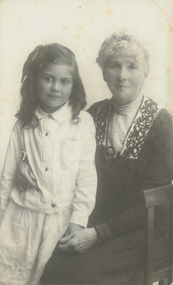
... socially significant to the cultural heritage of the region. She details important historical events and hardships in the region's history that had a lasting local, regional and national impact, including Australia during war time, the Great Depression, immmigration, economic struggles, and women's societal roles in a rural area. ...Mrs Margaret Galbraith was born in Beechworth in 1913 on the 5th February. Her parents immigrated to Australia in 1910 from England. Her father was killed after being thrown from a cart in 1912, and her mother eventually purchased the general store in which she worked from the Ladson family. Margaret has some insights into the local area during the Depression from the perspective of a store owner, as well as the presence of 'tramps' in the town, and Chinese immigrants in the community. She speaks a lot about her mother who was a very strong woman. She retired at 80. Margaret married a Ladson in Melbourne and had children. She lived at 47 Finch Street, Beechworth. This oral history recording was part of a project by Jennifer Williams in 2000 to capture the everyday life and struggles in Beechworth during the 20th century. This project involved recording 70 oral history stories on cassette tapes of local Beechworth residents, which were then published in a book called Listen to What they Say: Voices of 20th Century Beechworth. The cassettes were digitised in 2021 with funds made available by the Friends of Bourke.Mrs Margaret Galbraith's account of her life in Beechworth and the local area during the 20th century is historically and socially significant to the cultural heritage of the region. She details important historical events and hardships in the region's history that had a lasting local, regional and national impact, including Australia during war time, the Great Depression, immmigration, economic struggles, and women's societal roles in a rural area. This oral history account is socially and historically significant as it is a part of a broader collection of interviews conducted by Jennifer Williams which were published in the book 'Listen to what they say: voices of twentieth-century Beechworth.' While the township of Beechworth is known for its history as a gold rush town, these accounts provide a unique insight into the day-to-day life of the town's residents during the 20th century, many of which will have now been lost if they had not been preserved.This is a digital copy of a recording that was originally captured on a cassette tape. The cassette tape is black with a horizontal white strip and is stored in a clear, flat, plastic, rectangular container. It holds up to 40 minutes of recordings each sideMrs Margaret Galbraithlisten to what they say, ladson, oral history, bourke museum, beechworth, galbraith, margaret galbraith, general store -
The Beechworth Burke Museum
Audio - Oral History, Jennifer Williams, Mr Allan Parkinson, 22nd June 2000
... socially significant to the cultural heritage of the region. He details important historical events and hardships that had lasting local, regional and national impacts, including Australia during wartime, post-war migration and economic struggles. ...Allan Parkinson was born in Beechworth in 1924. The eldest of eight children, his mother provided laundry services to the people of Beechworth whilst his father worked for the local tannery, trapping rabbits. Allan fondly remembers times spent during his childhood catching rabbits with his father. As his younger years were set amidst the experiences of World War Two and the Great Depression, Allan recalls a feeling of solidarity amongst the residents of Beechworth that was present during this time(for instance, sharing food with neighbours in wartime), as well as the disassociation he felt as a returning soldier after the war. Allan talks of the great number of 'New Australians' who arrived in Beechworth in the post-war years, many of them coming from war-torn countries in Europe. Before being integrated into Australian society, these 'New Australians' would often first spend time at the Migrant Reception and Training Centre in Bonegilla, Northern Victoria. They were taught English and learnt about Australian life before being billeted out across the country to fill labor shortages. Following time spent up in Queensland, Allan worked in the forestry industry, clearing thousands of acres across Victoria which were needed to plant pines. The interview ends with discussions of the famous Wheelbarrow Push from Beechworth to Mt Buffalo in 1935, of which Allan's Uncle Tom was a central participant; this is an event which has since become an annual fundraising tradition in Beechworth. This oral history recording was part of a project conducted by Jennifer Williams in the year 2000 to capture the everyday life and struggles in Beechworth during the twentieth century. This project involved recording seventy oral histories on cassette tapes of local Beechworth residents which were then published in a book titled: Listen to what they say: Voices of twentieth century Beechworth. These cassette tapes were digitised in July 2021 with funds made available by the Friends of the Burke. Mr Allan Parkinson's account of his life in Beechworth and the local area during the twentieth century is historically and socially significant to the cultural heritage of the region. He details important historical events and hardships that had lasting local, regional and national impacts, including Australia during wartime, post-war migration and economic struggles. This oral history account is historically and socially significant as it is part of a broader collection of interviews conducted by Jennifer Williams which were published in the book 'Listen to what they say: voices of twentieth century Beechworth'. While the township of Beechworth is known for its history as a gold rush town, these accounts provide a unique insight into the day-to-day life of the town's residents during the twentieth century, many of which would have been lost if they had not been preserved. This is a digital copy of a recording that was originally captured on a cassette tape. The cassette tape is black with a horizontal white stripe and is currently stored in a clear flat plastic rectangular container. It holds up to forty minutes of recordings on each side. Mr Allan Parkinson / allan parkinson, oral history, beechworth forestry, forestry industry, beechworth tannery, jennifer williams, rabbit trapping, new australians, australian depression, rabbiting, bonegilla, bonegilla migrant camp, 20th century beechworth, wheelbarrow push beechworth to mt buffalo, barrowthon, wheelbarrow push 1935, listen to what they say, listen to what they say: voices of twentieth century beechworth, world war two, wartime, wartime solidarity, burke museum -
 The Beechworth Burke Museum
Audio - Oral History, Jennifer Williams, Mavis Jensen, 11 May 2000
... socially significant to the cultural heritage of the region. She details important historical events and hardships in the region's history that had a lasting local, regional and national impact, including Australia during war time, economic struggles, and women's societal roles in a rural area. ...Mavis Jensen (nee Knight) was born in Broadford in 1920 and came to Beechworth with her family a year later, so her father could assist his father at Knight's Blacksmith at 1A Camp Street, where the Hotel Nicholas is now located. Mavis Jensen left school at the age of 13 and worked as a kitchen maid at Ovens Benevolent Asylum. She was employed as a ward assistant at Mayday Hills Hospital from 1939 to 1980, except for 1958-59 when she gave birth to her son, Noel. This oral history recording was part of a project conducted by Jennifer Williams in the year 2000 to capture the everyday life and struggles in Beechworth during the twentieth century. This project involved recording seventy oral histories on cassette tapes of local Beechworth residents which were then published in a book titled: Listen to what they say: voices of twentieth century Beechworth. These cassette tapes were digitised in July 2021 with funds made available by the Friends of the Burke.Mavis Jensen's account of her life in Beechworth and the local area during the 20th century is historically and socially significant to the cultural heritage of the region. She details important historical events and hardships in the region's history that had a lasting local, regional and national impact, including Australia during war time, economic struggles, and women's societal roles in a rural area. Her oral history is particularly significant for its insights into developments in psychiatric patient treatment and care in regional Victoria, as well as women's work conditions in the mid-twentieth century. This oral history account is socially and historically significant as it is a part of a broader collection of interviews conducted by Jennifer Williams which were published in the book 'Listen to what they say: voices of twentieth-century Beechworth.' While the township of Beechworth is known for its history as a gold rush town, these accounts provide a unique insight into the day-to-day life of the town's residents during the 20th century, many of which will have now been lost if they had not been preserved.This is a digital copy of a recording that was originally captured on a cassette tape. The cassette tape is black with a horizontal white strip and is currently stored in a clear flat plastic rectangular container. It holds up 40 minutes of recordings on each side.Mavis Jensen /listen to what they say, beechworth, oral history, burke museum, jensen, mavis jensen, psychiatric hospitals, mid-twentieth century psychiatry, regional hospitals, regional mental health care, mid-twentieth century women's working conditions, mayday hills hospital., ovens benevolent asylum, beechworth hospital history -
 The Beechworth Burke Museum
Audio - Oral History, Jennifer Williams, Miss Amy Elizabeth Porritt, 10th February 2000
... socially significant to the cultural heritage of the region. She details important historical events and hardships in the region's history that had a lasting local, regional and national impact, including Australia during war time, economic struggles, and women's societal roles in a rural area. ...Amy Elizabeth Porritt was born on the 21st of March 1915 on Atkinson Road, Beechworth to Thomas Frederick Rodan and Maud Isabel Dowling. Her family had strong associations with Australia's oldest continuously operating newspaper, the Ovens and Murray. Both her grandfather and father worked on this newspaper and played a significant role in continuing its operation. Amy was well-known in the Beechworth community and is remembered fondly for her generosity and her love of cats ‘they are all I live for’ she would often say. She was an avid gardener and had a beautiful garden at 47 Finch Street. This oral history recording was part of a project conducted by Jennifer Williams in the year 2000 to capture the everyday life and struggles in Beechworth during the twentieth century. This project involved recording seventy oral histories on cassette tapes of local Beechworth residents which were then published in a book titled: Listen to what they say: voices of twentieth century Beechworth. These cassette tapes were digitised in July 2021 with funds made available by the Friends of the Burke. Miss Amy Elizabeth Porrit's account of her life in Beechworth and the local area during the 20th century is historically and socially significant to the cultural heritage of the region. She details important historical events and hardships in the region's history that had a lasting local, regional and national impact, including Australia during war time, economic struggles, and women's societal roles in a rural area. This oral history account is socially and historically significant as it is a part of a broader collection of interviews conducted by Jennifer Williams which were published in the book 'Listen to what they say: voices of twentieth-century Beechworth.' While the township of Beechworth is known for its history as a gold rush town, these accounts provide a unique insight into the day-to-day life of the town's residents during the 20th century, many of which will have now been lost if they had not been preserved.This is a digital copy of a recording that was originally captured on a cassette tape. The cassette tape is black with a horizontal white strip and is currently stored in a clear flat plastic rectangular container. It holds up 40 minutes of recordings on each side.Miss Amy Elizabeth Porrit / listen to what they say, beechworth, oral history, burke museum, porritt, amy elizabeth porritt, gardener, ovens and murray newspaper, o&m -
The Beechworth Burke Museum
Audio - Oral History, Jennifer Williams, Robert Mason, 3 August 2000
... socially significant to the cultural heritage of the region. He recalls some of the changes that Beechworth underwent such as the introduction of electricity in the 1950s and an increase in tourism. His account is important to the region's history in terms of important historical events such as WWII and other events impacting the region. ...Mason Robert was born in (unintelligible) in 19(unintelligible). Mason's grandparents were from Stanley, where Mason completed his schooling. Mason started working for the Forestry Commission in 1939 looking after Crown land but eventually went into the army in 1942. At the Forestry Commission, he was responsible for maintaining and looking after the land. Mason later went to work for the Lands Department after working at the Commission for seven years. This oral history recording was part of a project conducted by Jennifer Williams in the year 2000 to capture the everyday life and struggles in Beechworth during the twentieth century. This project involved recording seventy oral histories on cassette tapes of local Beechworth residents which were then published in a book titled: Listen to what they say: voices of twentieth century Beechworth. These cassette tapes were digitised in July 2021 with funds made available by the Friends of the Burke.Mason Robert's account of his life in Beechworth and the local area during the 20th century is historically and socially significant to the cultural heritage of the region. He recalls some of the changes that Beechworth underwent such as the introduction of electricity in the 1950s and an increase in tourism. His account is important to the region's history in terms of important historical events such as WWII and other events impacting the region. This oral history account is socially and historically significant as it is a part of a broader collection of interviews conducted by Jennifer Williams which were published in the book 'Listen to what they say: voices of twentieth-century Beechworth.' While the township of Beechworth is known for its history as a gold rush town, these accounts provide a unique insight into the day-to-day life of the town's residents during the 20th century, many of which will have now been lost if they had not been preserved.This is a digital copy of a recording that was originally captured on a cassette tape. The cassette tape is black with a horizontal white strip and is currently stored in a clear flat plastic rectangular container. It holds up 40 minutes of recordings on each side.Mr. Robert Mason/beechworth, mason robert, forestry commission, lands department, crown land, wwii, listen to what they say, burke museum, jennifer williams, oral history -
 The Beechworth Burke Museum
Audio - Oral History, Jennifer Williams, Mr Charles Ladson, 7 December 2000
... social, and religious heritage of the region. Charles details important historical events, local life, and hardships in the region's history that had a lasting local, regional and national impact. ...Charles Ladson in 1926 in Beechworth. The recording details Charles' life growing up in Beechworth, his working life as a carpenter and as woodworking teacher, and later his marriage. Charles grandfather arrived in Beechworth following the gold rush and set up shop as a trader. This oral history recording was part of a project conducted by Jennifer Williams in the year 2000 to capture the everyday life and struggles in Beechworth during the twentieth century. This project involved recording seventy oral histories on cassette tapes of local Beechworth residents which were then published in a book titled: Listen to what they say: voices of twentieth century Beechworth. These cassette tapes were digitised in July 2021 with funds made available by the Friends of the Burke.The recording of Charles Ladson's life in Beechworth and the local area during the 20th century is historically and socially significant to the cultural, historical, social, and religious heritage of the region. Charles details important historical events, local life, and hardships in the region's history that had a lasting local, regional and national impact. This oral history account is socially and historically significant as it is a part of a broader collection of interviews conducted by Jennifer Williams which were published in the book 'Listen to what they say: voices of twentieth-century Beechworth.' While the township of Beechworth is known for its history as a gold rush town, these accounts provide a unique insight into the day-to-day life of the town's residents during the 20th century, many of which will have now been lost if they had not been preserved.This is a digital copy of a recording that was originally captured on a cassette tape. The cassette tape is black with a horizontal white strip and is currently stored in a clear flat plastic rectangular container. It holds up 40 minutes of recordings on each side.Mr Charles Ladsonteacher, burke museum, beechworth, charles ladson, ladson, religion, listen to what they say, gold rush -
 The Beechworth Burke Museum
Audio - Oral History, Jennifer Williams, Joan Jessup, 18th May 2000
... social, and religious heritage of the region. She details important historical events, local life, religious matters, and schooling in the region's history that had a lasting local, regional and national impact, including Australia during war time, economic struggles, and women's societal and working roles in a rural area. ...Joan Jessup was born on the 17th November, 1926 at at Nurse Longmore's in High Street, Beechworth. In this recording, Joan recounts her childhood in Beechworth, her personal and working life as a young unmarried woman, and then later her marriage to Albert Jessup and her family life at Murmungee and Beechworth. This oral history recording was part of a project conducted by Jennifer Williams in the year 2000 to capture the everyday life and struggles in Beechworth during the twentieth century. This project involved recording seventy oral histories on cassette tapes of local Beechworth residents which were then published in a book titled: Listen to what they say: voices of twentieth century Beechworth. These cassette tapes were digitised in July 2021 with funds made available by the Friends of the BurkeThis recording of Joan Jessup's life in Beechworth and the local area during the 20th century is historically and socially significant to the cultural, historical, social, and religious heritage of the region. She details important historical events, local life, religious matters, and schooling in the region's history that had a lasting local, regional and national impact, including Australia during war time, economic struggles, and women's societal and working roles in a rural area. This oral history account is socially and historically significant as it is a part of a broader collection of interviews conducted by Jennifer Williams which were published in the book 'Listen to what they say: voices of twentieth-century Beechworth.' While the township of Beechworth is known for its history as a gold rush town, these accounts provide a unique insight into the day-to-day life of the town's residents during the 20th century, many of which will have now been lost if they had not been preservedThis is a digital copy of a recording that was originally captured on a cassette tape. The cassette tape is black with a horizontal white strip and is currently stored in a clear flat plastic rectangular container. It holds up 40 minutes of recordings on each side.Joan Jessuplisten to what they say, joan jessup, beechworth, burke museum, jessup -
The Beechworth Burke Museum
Audio - Oral History, Jennifer Williams, Mr Graeme Gallus, 16 November 2000
... socially significant to the cultural heritage of the region. She details important historical events and hardships in the region's history that had a lasting local, regional and national impact, including Australia during war time, economic struggles, and women's societal roles in a rural area. ...Graeme Gallus was born on the Mornington Peninsular in a town called Sommerville, in 1938. His family was born in Germany and came to Australia in 1851. He arrived in Beechworth in 1981 after purchasing a taxi service. He talks about local businesses, government employment, community celebrations and clubs. Miss Amy Elizabeth Porrit's account of her life in Beechworth and the local area during the 20th century is historically and socially significant to the cultural heritage of the region. She details important historical events and hardships in the region's history that had a lasting local, regional and national impact, including Australia during war time, economic struggles, and women's societal roles in a rural area. This oral history account is socially and historically significant as it is a part of a broader collection of interviews conducted by Jennifer Williams which were published in the book 'Listen to what they say: voices of twentieth-century Beechworth.' While the township of Beechworth is known for its history as a gold rush town, these accounts provide a unique insight into the day-to-day life of the town's residents during the 20th century, many of which will have now been lost if they had not been preserved.This is a digital copy of a recording that was originally captured on a cassette tape. The cassette tape is black with a horizontal white strip and is currently stored in a clear flat plastic rectangular container. It holds up 40 minutes of recordings on each side.Mr Graeme Gallussommerville, gallus, graeme gallus, taxi, beechworth, real estate, christmas, lions club -
 The Beechworth Burke Museum
Audio - Oral History, Jennifer Williams, Mr Harry Mason, 13th April 2000
... socially significant to the cultural heritage of the region. He details important historical events and hardships in the region's history that had a lasting local, regional and national impact, including Australia during war time, economic struggles, and women's societal roles in a rural area. ...Mr Harry Mason was born in Stanley, Victoria, on the 23rd of July 1925, attending the primary school in Stanley and high school in Beechworth on the mail truck. His family initially moved to the area during the initial Gold Rush period. He moved to Beechworth in 1960. For seven years after school, he worked in the local orchard full time before becoming the local gravedigger, responsible for digging the graves of Beechworth residents and Asylum for 23 years. This oral history recording was part of a project conducted by Jennifer Williams in the year 2000 to capture the everyday life and struggles in Beechworth during the twentieth century. This project involved recording seventy oral histories on cassette tapes of local Beechworth residents which were then published in a book titled: Listen to what they say: voices of twentieth-century Beechworth. These cassette tapes were digitised in July 2021 with funds made available by the Friends of the Burke.Mr Harry Mason's account of his life in Beechworth and the local area during the 20th century is historically and socially significant to the cultural heritage of the region. He details important historical events and hardships in the region's history that had a lasting local, regional and national impact, including Australia during war time, economic struggles, and women's societal roles in a rural area. Mr Mason also discusses agricultural and gravedigging practices of the time as well as what it was like growing up in rural Australia. This first-hand account is imperative to our understanding of life during the last century. This oral history account is socially and historically significant as it is a part of a broader collection of interviews conducted by Jennifer Williams which were published in the book 'Listen to what they say: voices of twentieth-century Beechworth.' While the township of Beechworth is known for its history as a gold rush town, these accounts provide a unique insight into the day-to-day life of the town's residents during the 20th century, many of which will have now been lost if they had not been preserved.This is a digital copy of a recording that was originally captured on a cassette tape. The cassette tape is black with a horizontal white strip and is currently stored in a clear flat plastic rectangular container. It holds up 40 minutes of recordings on each side.Mr Harry Madon /listen to what they say, beechworth, oral history, burke museum, harry mason, stanley, orchard, jennifer williams, asylum -
The Beechworth Burke Museum
Audio - Oral History, Jennifer Williams, Fred and Bette Wyatt, 27 April 2000
... socially significant to the cultural heritage of the region. They both mention important historical events and hardships in the region's history that had a lasting local, regional and national impact, including Australia during wartime, economic struggles, and the development of Beechworth town. ...Fred was born on the 1st of March 1928 and Bette in 1934, in Beechworth. Both of their families immigrated from England on convict ships in the 1800s. Fred and Bette both had large families of 9 and 5 siblings respectively, with 2 of Fred's siblings suffering from muscular dystrophy both dying at 20 years old which affected the family. Bette originally worked in multiple cafes and kitchens in Beechworth before working in "Ennals Store" which was a grocery store, for over 30 years. Fred worked as a milkman during the war before becoming an engineer at the tannery and the brewery in Beechworth. He rebuilt the factory at the brewery during the 1970s and worked there until he retired. This oral history recording was part of a project conducted by Jennifer Williams in the year 2000 to capture the everyday life and struggles in Beechworth during the twentieth century. This project involved recording seventy oral histories on cassette tapes of local Beechworth residents which were then published in a book titled: Listen to what they say: voices of twentieth century Beechworth. These cassette tapes were digitised in July 2021 with funds made available by the Friends of the Burke.Fred and Bette Wyatt's account of their lives in Beechworth and the local area during the 20th century is historically and socially significant to the cultural heritage of the region. They both mention important historical events and hardships in the region's history that had a lasting local, regional and national impact, including Australia during wartime, economic struggles, and the development of Beechworth town. This oral history account is socially and historically significant as it is a part of a broader collection of interviews conducted by Jennifer Williams which were published in the book 'Listen to what they say: voices of twentieth-century Beechworth.' While the township of Beechworth is known for its history as a gold rush town, these accounts provide a unique insight into the day-to-day life of the town's residents during the 20th century, many of which will have now been lost if they had not been preserved.This is a digital copy of a recording that was originally captured on a cassette tape. The cassette tape is black with a horizontal white strip and is currently stored in a clear flat plastic rectangular container. It holds up 40 minutes of recordings on each side.Fred and Bette Wyattbeechworth, beechworth tannery, beechworth brewery, fred and bette wyatt, wyatt, wyatt beechworth, ennals store, ennals beechworth, listen to what they say, burke museum -
 The Beechworth Burke Museum
Audio - Oral History, Jennifer Williams, Mr Desmond Zwar, 19 October 2000
... socially significant to the cultural heritage of the region. He details important historical events and hardships in the region's history that had a lasting local, regional and national impact, including Australia during war time, economic struggles, and the relationships of different social groups in the town. ...Desmond was born in 1931 in Beechworth but left at age 11 (in 1944) to be educated in Melbourne at Scotch College but returned to the town for holidays and when he was finished with school. Desmond is the son of Raymond Zwar who was 1 of the 3 brothers who owned the Tannery in Beechworth. He worked there when he was 19 for a year in 1950, when the first Baltic migrants came to town. In 1951, Desmond left Beechworth to work in Albury for a newspaper called the "Border Mail" before moving to Melbourne to write for the "Melbourne Herald". He was later known for becoming a writer, having produced 17 books under his name at the time of the interview. This oral history recording was part of a project conducted by Jennifer Williams in the year 2000 to capture the everyday life and struggles in Beechworth during the twentieth century. This project involved recording seventy oral histories on cassette tapes of local Beechworth residents which were then published in a book titled: Listen to what they say: voices of twentieth century Beechworth. These cassette tapes were digitised in July 2021 with funds made available by the Friends of the Burke.Mr Desmond Zwar's account of his life in Beechworth during the 20th century is historically and socially significant to the cultural heritage of the region. He details important historical events and hardships in the region's history that had a lasting local, regional and national impact, including Australia during war time, economic struggles, and the relationships of different social groups in the town. This oral history account is socially and historically significant as it is a part of a broader collection of interviews conducted by Jennifer Williams which were published in the book 'Listen to what they say: voices of twentieth-century Beechworth.' While the township of Beechworth is known for its history as a gold rush town, these accounts provide a unique insight into the day-to-day life of the town's residents during the 20th century, many of which will have now been lost if they had not been preserved.This is a digital copy of a recording that was originally captured on a cassette tape. The cassette tape is black with a horizontal white strip and is currently stored in a clear flat plastic rectangular container. It holds up 40 minutes of recordings on each side.Mr Desmond Zwardesmond zwar, zwar, beechworth, burke museum, raymond zwar, zwar tannery, the tannery, zwar brothers tannery, beechworth tannery, listen to what they say, jennifer williams -
 The Beechworth Burke Museum
Audio - Oral History, Jennifer Williams, Wilma Wells, 10th February 2000
... Wilma Wells account of her life during the 20th century is historically and socially significant to the cultural heritage of Beechworth and the surrounding regions. She details important historical places and hardships within the region that have a lasting impact which includes but is not limited to issues with race, women's societal expectations and economic struggles. ...Born on the 24th of December 1912 at the Three Mile was Wilma Wells. Her mother born into English heritage bore four children, one who died shortly after birth, while her father had Irish heritage and worked at May Day Hills as a warden and a nurse. Wilma married Ted Wells when she was 23 and subsequently had two daughters. This oral history recording was part of a project conducted by Jennifer Williams in the year 2000 to capture the everyday life and struggles in Beechworth during the twentieth century. This project involved recording seventy oral histories on cassette tapes of local Beechworth residents which were then published in a book titled: Listen to what they say: voices of twentieth century Beechworth. These cassette tapes were digitised in July 2021 with funds made available by the Friends of the Burke. Wilma Wells account of her life during the 20th century is historically and socially significant to the cultural heritage of Beechworth and the surrounding regions. She details important historical places and hardships within the region that have a lasting impact which includes but is not limited to issues with race, women's societal expectations and economic struggles. This oral history account is socially and historically significant as it is a part of a broader collection of interviews conducted by Jennifer Williams which were published in the book 'Listen to what they say: voices of twentieth-century Beechworth.' While the township of Beechworth is known for its history as a gold rush town, these accounts provide a unique insight into the day-to-day life of the town's residents during the 20th century, many of which will have now been lost if they had not been preserved.This is a digital copy of a recording that was originally captured on a cassette tape. The cassette tape is black with a horizontal white strip and is currently stored in a clear flat plastic rectangular container. It holds up 40 minutes of recordings on each side.Mrs Wilma Wells /beechworth, may day hills, oral history, burke museum, wilma wells, hospital, listen, weddings, three mile, picnic -
 The Beechworth Burke Museum
Photograph
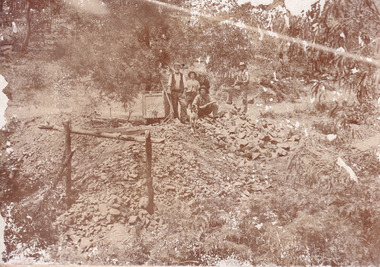
... This image has historical, social and research significance for patterns of emigration during of the Victorian Gold Rush, and the historical, social and environmental impacts of mining at Beechworth at the turn of the nineteenth and twentieth centuries. ...This image is a reproduction of an 1899 original depicting the 'Williams Good Luck Mine' on the Mopoke Reef (also called 'Morepork Gully') in the Dingle Ranges, approximately three miles from Beechworth. A large opening to a mine can be seen behind the men in the photograph, with a wheeled cart on a track leading to the men's position, where the soil and rocks have been hauled away. This photograph interestingly contains dogs alongside the miners. While dogs have been recorded as deterrents to thieves in the Victorian goldfields, these dogs appear as companions to these men. Following the discovery of gold at Beechworth in 1852, rushes quickly followed at surrounding creeks and gullies in the district. In the late nineteenth and early twentieth centuries, small syndicates of miners continued to work old or abandoned quartz reefs, often persisting without the assistance of heavy machinery to remove the large amounts of rock, in order to obtain yields at ever greater depths. The group of miners in this photograph are Mr. Roger Williams and Sons, who revived operations at the ‘Old Good Luck’ mine on the Mopoke Reef in the Dingle Range near Beechworth around 1892, working the site for more than two decades. An emigrant from Cornwall with experience in the tin mining industry, 19 year old Roger Williams senior sailed to New Zealand in 1840, then to Australia where he spent time in the Bendigo Gold Fields before settling in Beechworth in the early 1860s. Mr Williams senior worked on various mining activities in the district, including the Rocky Mountain Tunnel project. Conversant with the character of gold-bearing reefs in the area, the syndicate dug an eight hundred foot tunnel, digging down as far down as two hundred feet with little capital save their labour, to connect and provide better working access to the mass of reefs and veins in the vicinity. Progress was hampered by poor air quality charged with fumes from dynamite and large quantities of rock had to be crushed to obtain payable yields. The Victorian Goldfields are filled with ruins and remnants of the area's rich mining history, ranging from small alluvial diggings to the remains of huge mining companies. Site names often changed several times throughout the nineteenth and twentieth centuries. Some sites were abandoned and forgotten, others were worked continuously over many decades. The names of mines were often repeated at different locations throughout the Victorian Goldfields. For example, there is a Mopoke Gully heritage mine near Fryers Creek, Victoria. 'Mopoke' is a common onomatopoeic name for Morepork and Australian Boobook owls.This image has historical, social and research significance for patterns of emigration during of the Victorian Gold Rush, and the historical, social and environmental impacts of mining at Beechworth at the turn of the nineteenth and twentieth centuries. As gold became scarce and government support and large company investment waned, poor hard-working miners laboured intensively to make a living through periods of high unemployment. This image can be compared and studied alongside other historical mining photographs and objects in the Burke Museum Collection. It has potential to improve our understanding of miners working conditions and the shifting character of mining in the Beechworth district.Sepia coloured rectangular photograph printed on gloss photographic paper mounted on card. Obverse: Williams/ Good/ Luck Reverse: A02498/ 1997. 2498/ Good Luck/ Mine/ 1899/ Mopoke. burke museum, beechworth museum, beechworth, gold fields, gold rush, victorian gold rush, gold ming history, colonial australia, australian gold rushes, mining technology, beechworth historic district, indigo gold trail, migration, indigo shire, good luck gold mine, victorian goldfields, mining syndicates, gold fever, quartz-mining, small-scale mining, old good luck mine, mopoke gully, quartz reefs beechworth -
 Flagstaff Hill Maritime Museum and Village
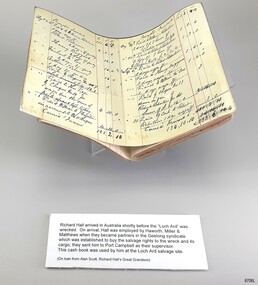
Book - Cash Book, Richard Hall, Manager of Loch Ard salvage site, 1878
... impact of the tragic Loch Ard event. Additionally, the artefacts hold archaeological importance, offering insights into Victoria’s shipping history and early social and historical themes. ...Richard Hall arrived in Australia shortly before the "Loch Ard" was wrecked at Port Campbell in June 1878. On arrival, Hall was employed by the partners Haworth, Miller & Matthews, a Geelong syndicate established to buy the salvage rights to the wreck and its cargo. The firm sent Hall to Port Campbell as their supervisor. Hall used this cash book at the Loch Ard salvage site, keeping a record of the date, the workers’ names, hours worked and amount paid. The wreck was difficult to access from the shore, so the firm sent its recently purchased steamer, the SS Napier, to allow access from the sea. Sadly, the steamer hit rocks in the process, and it sank nearby with a cargo of general stores for settlers along the coast. Rochard Hall’s cash book has been passed down through his family’s generations. Currently, it belongs to his great-grandson, who has generously loaned it for display with other significant Loch Ard relics. Richard Hall’s cash book is significant as a record of essential details regarding the salvage process in the 1870s, including the date of work, the names of workers involved, the hours they worked, and the payments made. The use of this cash book ensured meticulous documentation of the workforce and financial transactions during the salvage period. Richard Hall’s cash book has been carefully preserved within his family for generations. Today, it is in the possession of his great-grandson, who has generously loaned it for public exhibition alongside other important relics from the Loch Ard shipwreck. The cash book serves as a tangible link to the events surrounding the salvage and the individuals involved in this historic episode. The Loch Ard shipwreck itself is a landmark event in Victoria’s maritime history and is registered on the Victorian Heritage Register (Ref S 417). The Flagstaff Hill Maritime Village houses a diverse and substantial collection of artefacts recovered from the Loch Ard, representing one of the largest assemblies of items from this significant shipwreck. The collection serves as a vital snapshot of history, enabling interpretation of the circumstances and impact of the tragic Loch Ard event. Additionally, the artefacts hold archaeological importance, offering insights into Victoria’s shipping history and early social and historical themes. The collection’s historical significance is further emphasised by its association with what is regarded as the worst and best-known shipwreck in Victoria’s history. Cash book: a small cash book with printed blue lines and red columns. Entries are handwritten in blue ink. They show the date, the name of the person paid, the amount paid, and the cheque number, or cash. The book is kindly on loan from Alan Scott, Richard Hall's great-grandson.Handwritten entries in pen and ink.flagstaff hill maritime museum and village, great ocean road, shipwreck coast, richard hall, loch ard, cash book, financial record, salvage, haworth miller and matthews, geelong salvage syndicate, 1878 wreck, port campbell, ss napier, salvage supervisor, salvage manager, salvage workers, richard hall's cash book, loch ard cash book -
 Flagstaff Hill Maritime Museum and Village
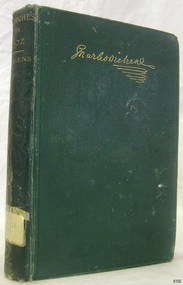
Book - A Fictional Story, Charles Dickens et al, Sketches by Boz. (Illustrative of Ever day Life and Every day People), 1892
... impact on the development of visual storytelling and graphic narrative. The title page in this edition of sketches by Dickens exemplifies the era's illustrative style, featuring a balloon and crowd scene by Cruikshank. As Dickens' debut book, it introduced his style, chronicling Victorian London's street life and social ...Charles Dickens (1812–1870) was one of the great English novelists of the Victorian era, famous for vivid characters, social criticism, and stories that were first published in serial form. He began as a journalist, rose to enormous popularity during his lifetime, and wrote major works such as Oliver Twist, David Copperfield, and Great Expectations. Sketches by Boz is Charles Dickens' first published book, a collection of fifty six short sketches originally appearing in periodicals from 1833 to 1836 under his pseudonym "Boz." It captures everyday London life through vivid observations of ordinary people and scenes. The book is divided into four sections, "Our Parish," "Scenes," "Characters," and "Tales." The first three offer non narrative portraits of urban life, while "Tales" includes fictional stories. Illustrated by George Cruikshank with forty plates, it blends humor, social commentary, and realism. Published by Chapman & Hall, London, the specified full title matches the "New Edition, Complete" or first one-volume combined edition from 1839, compiling two earlier 1836 series. Earlier parts issues ran 1837-1839; Chapman & Hall took over rights in 1837. "Ltd" likely indicates a later reprint by Chapman & Hall Ltd., but core content remains unchanged.Sketches by Boz. (Illustrative of Ever day Life and Every day People) .Author: Charles Dickens. Publisher: Chapman & Hall Ltd, London. Date: 1892. (See note section this document for more information on Edition). Blue leather hardcover with title on spine in gold lettering. The spine has a Library label.fictionCharles Dickens (1812–1870) was one of the great English novelists of the Victorian era, famous for vivid characters, social criticism, and stories that were first published in serial form. He began as a journalist, rose to enormous popularity during his lifetime, and wrote major works such as Oliver Twist, David Copperfield, and Great Expectations. Sketches by Boz is Charles Dickens' first published book, a collection of fifty six short sketches originally appearing in periodicals from 1833 to 1836 under his pseudonym "Boz." It captures everyday London life through vivid observations of ordinary people and scenes. The book is divided into four sections, "Our Parish," "Scenes," "Characters," and "Tales." The first three offer non narrative portraits of urban life, while "Tales" includes fictional stories. Illustrated by George Cruikshank with forty plates, it blends humor, social commentary, and realism. Published by Chapman & Hall, London, the specified full title matches the "New Edition, Complete" or first one-volume combined edition from 1839, compiling two earlier 1836 series. Earlier parts issues ran 1837-1839; Chapman & Hall took over rights in 1837. "Ltd" likely indicates a later reprint by Chapman & Hall Ltd., but core content remains unchanged.book, the old curiosity shop, charles dickens, shipwrecked-coast, flagstaff-hill, flagstaff-hill-maritime-museum, warrnambool, maritime-museum, flagstaff-hill-maritime-village, pattison collection, warrnambool library, warrnambool mechanics’ institute, ralph eric pattison, corangamite regional library service, warrnambool city librarian, mechanics’ institute library, victorian library board, warrnambool books and records, warrnambool children’s library, great ocean road -
 Greensborough Historical Society
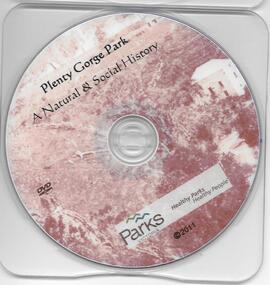
DVD, Plenty Gorge Park: a natural and social history / Parks Victoria, 2011_
... This DVD gives some detail of the Plenty Gorge Park, its natural environment and impact of man. plenty gorge park parks victoria plenty river 1 DVD. Plenty Gorge Park: a natural and social history / Parks Victoria. ...This DVD gives some detail of the Plenty Gorge Park, its natural environment and impact of man.1 DVD. plenty gorge park, parks victoria, plenty river -
Connecting Home
book, Deadly Design, Bewteen Two Worlds, 2008
... Social Significance, The information recorded from stolen generation participants explains to non-aboriginal health & human service professionals about the social impact of the politically incorrect times that state & national laws and policies had been introduced to forcibly remove aboriginal & toerres strait islander children form family, land and culture. ...As a result of the recommendations arising from the Stolen Generations Taskforce Report 2003. The taskforce identified the need for an independant, community controlled organisation in Victoria to be established to meet the needs of the stolen generation in this state. Connecting Home seeks to undertalke activities that will assist members of the stolen generation and engage in publc awareness and education. Historic Significance, this is one of Victoria's first books published that helps to explain the thought & feelings of Stolen Generation people, that has been developed to address recommendations from the Bringing Them Home Report. Social Significance, The information recorded from stolen generation participants explains to non-aboriginal health & human service professionals about the social impact of the politically incorrect times that state & national laws and policies had been introduced to forcibly remove aboriginal & toerres strait islander children form family, land and culture. Research Significance, Soft cover book, with 43 pages. Picture of aboriginal girl, crying, holding teddy bear on front cover. Content is a guide aimed at understanding the Stolen Generations for Health & Human Service Professionals. book, stolen, generations, victoria, victorian, human, resources, syd, jackson, roseann, hepbruns haines, aiatsis, missions, rererves, aboriginal, legal, service, child, care, agency, health, education, consultative, group, housing, cooperative, bringing, them, home, counsellor, program, link, up, koori, heritage, trust -
 Orbost & District Historical Society
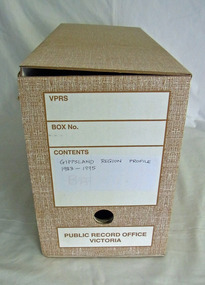
box of documents, 1984 - 1995
... impact of infrastructure investment in different parts of regional and rural Victoria. This set of documents is a useful research tool. Gippsland-region industry-Gippsland agriculture-Gippsland population-Gippsland resources-Gippsland A cardboard box of documents related to Gippsland Regional Profile. It contains reports on social ...This report is an analysis of regional strengths and challenges. It is research to assess the need for and impact of infrastructure investment in different parts of regional and rural Victoria. This set of documents is a useful research tool.A cardboard box of documents related to Gippsland Regional Profile. It contains reports on social indicators, industries, poulation, areas, assets and resources, agriculture, coal,manufacturing and forestry.gippsland-region industry-gippsland agriculture-gippsland population-gippsland resources-gippsland -
 Greensborough Historical Society
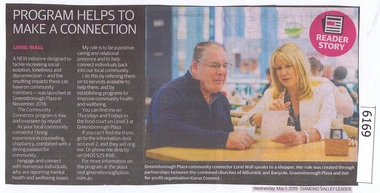
Newspaper Clipping, Diamond valley Leader, Program Helps to make a Connection, 01/05/2019
... A new initiative designed to tackle increasing social isolation, loneliness and disconnection - and the resulting impacts these can have on community members - was launched at Greensborough Plaza in November 2018 as the Community Connector Program....A new initiative designed to tackle increasing social isolation, loneliness and disconnection - and the resulting impacts these can have on community members - was launched at Greensborough Plaza in November 2018 as the Community Connector Program. social isolation greensborough plaza community connector program News article 1 page, black text. ...A new initiative designed to tackle increasing social isolation, loneliness and disconnection - and the resulting impacts these can have on community members - was launched at Greensborough Plaza in November 2018 as the Community Connector Program.News article 1 page, black text.social isolation, greensborough plaza, community connector program -
 Greensborough Historical Society
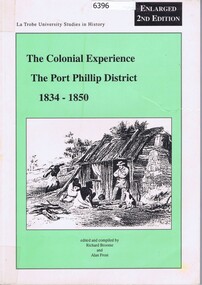
Book, Richard Broome, The Colonial experience: the Port Phillip District 1834-1850 2nd ed, 1999_
... Contains documents relating to patterns of migration, impact of European colonisation, social and political institutions and historical interpretation of the Port Phillip District...Contains documents relating to patterns of migration, impact of European colonisation, social and political institutions and historical interpretation of the Port Phillip District victoria history melbourne 128 p., black and white print and illustrations The Colonial experience: the Port Phillip District 1834-1850 2nd ed. ...Contains documents relating to patterns of migration, impact of European colonisation, social and political institutions and historical interpretation of the Port Phillip District128 p., black and white print and illustrationsvictoria history, melbourne
