
Showing 58 items matching "social norms"
-
 Wyndham Art Gallery (Wyndham City Council)
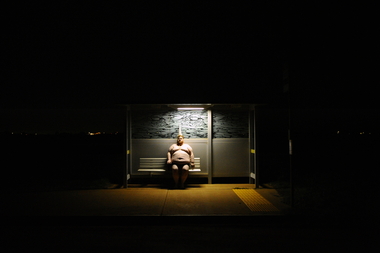
Photograph - Assigned Liminal At Birth, FOOT (Connor Ovenden-Shaw), 2025
... ...Social norms...Gender identity Queer identity Self-representation Liminality Body politics Social norms Photography Assigned Liminal At Birth Photograph Assigned Liminal At Birth FOOT (Connor Ovenden-Shaw) ...It is a strange queer magic to, however briefly, exist within another plane on an ordinary winter night. Much like a moth, I as a queer person am drawn to strange florescent lit transitional spaces, where gender, form and aesthetic is recognisably consistent, beautiful in its embrace of unconventional beauty.The artist known as FOOT is an award winning queer multidisciplinary artist working on unceded Wadawurrung land in Naarm’s outer west passionate about body liberation, sustainability and stupidity, their work is a rich tapestry of historical and cultural referencing that poses alternative questions to the ‘norms’ of this world through the use of colour, nostalgia and space. Winner of the 2026 Wyndham Art Prize LEAP Award.gender identity, queer identity, self-representation, liminality, body politics, social norms, photography -
 Kiewa Valley Historical Society
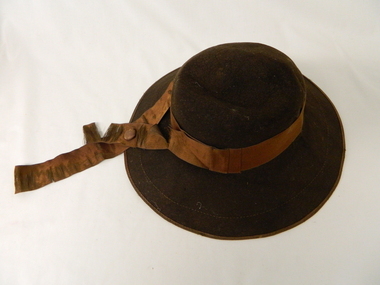
Hat Child's Felt, Circa mid 1900's
... The closeness of smaller rural communities is the main factor regarding social norms. The visible standing within the community was uppermost. ...The closeness of smaller rural communities is the main factor regarding social norms. The visible standing within the community was uppermost. ...This brown wool felt hat with a broad brim was, by its style, used by a adolescent child for church services. This was worn in a period where church services on Sunday was an important weekly ritual by the whole family. Special (church only) dresses and hats were worn not only to show respect to the church but also part of expected community mores relating to religious beliefs. This behavioural pattern was more entrench in the rural communities than within larger cities. The closeness of smaller rural communities is the main factor regarding social norms. The visible standing within the community was uppermost. The period pre 2000 was a more coheasive family environment ( due to greater intra family activities) which provided better communication and family activities.This "church styled" hat is very significant to the rural lifestyle and its mores. It clearly demonstrates the coheasive force that religion has on the Valley population. The closeness that the semi isolation (at this time) brought about by the Valley's physical land formation and the poor roads within the valley brought families closer together. Not turning up for important social functionsw was duely noted by all (and frowned upon). Mrs E. Fisher lived at Mongan's Bridge in the Kiewa Valley.Brown child's all felt hat size 6 1/4. A broad brim with a lighter brown velvet ribbon head band. Head band has a crossover to the left front with 100 mm extension flowing over the brim. The top of the inside of the head pocket is lined with a soft silk fabric.6 and one quarter (size tag). Unreadable crest / monogramchildren's head wear, social head dress, church hats -
 The Beechworth Burke Museum
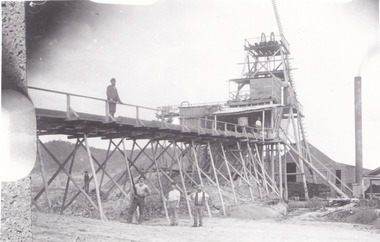
Photograph, 1857
... Industry boomed, new practices were adopted and social norms were upended. ...Industry boomed, new practices were adopted and social norms were upended. This image is of historical significance as it informs on the history of Australian gold mining. ...This photograph is of old mine workings on the site of the Spring Creek diggings. Spring Creek is a contact zone for granite pluton and siltstones, shales and standstones; which has, over time, encouraged natural springs to form. Enriched with gold washed out of the surrounding granite, these alluvial deposits achieved fame from 1852 onwards as the Spring Creek Diggings sprang to life (not realised as geographically important until 1871). In Spring Creek that runs behind the main street of Beechworth, near the foot of Newtown Hill a pint pot of gold was discovered on one of these expeditions in 1852 by prospectors Baker and Strickland and the gold rush town of Spring Creek was formed. Australian gold rushes have always created a sense of independence and freedom; as do-it-yourself, off-grid, low-tech adventures. People of all backgrounds were drawn to the gold fields by the prospect of riches and adventure, but they also learned self-sufficiency and found freedom of expression. Industry boomed, new practices were adopted and social norms were upended. This image is of historical significance as it informs on the history of Australian gold mining. It represents the innovation that accompanied the mining industry and the importance of gold mining in town building and regional histories. Black and white rectangular photograph on unmounted board.gold mining, spring creek, mining, geography, geology -
 Eltham District Historical Society Inc
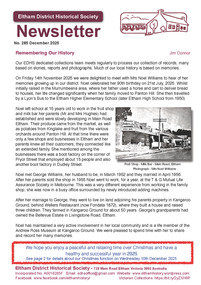
Journal - Newsletter, Newsletter, No. 285 December 2025
... Contents: • Remembering Our History by Jim Connor • Rabbits by Jim Connor • Our First “Forgotten War” – Eltham Shire Boys of the Boer War by Terry Beaton • …..from our collection: Postcard – Camille Treherne • Celebrating Nillumbik’s Natural Environment: Felix Borsari by Liz Pidgeon • La Ronde by Jim Connor • Eltham Social Cricketers by Norm Williams • An amateur tramp: rambles with pen and camera – 1928 by William Freame • Angus and the Cross by Julia Drew ...Contents: • Remembering Our History by Jim Connor • Rabbits by Jim Connor • Our First “Forgotten War” – Eltham Shire Boys of the Boer War by Terry Beaton • …..from our collection: Postcard – Camille Treherne • Celebrating Nillumbik’s Natural Environment: Felix Borsari by Liz Pidgeon • La Ronde by Jim Connor • Eltham Social Cricketers by Norm Williams • An amateur tramp: rambles with pen and camera – 1928 by William Freame • Angus and the Cross by Julia Drew The Shire of Eltham Historical Society was formed in October 1967. ...Contents: • Remembering Our History by Jim Connor • Rabbits by Jim Connor • Our First “Forgotten War” – Eltham Shire Boys of the Boer War by Terry Beaton • …..from our collection: Postcard – Camille Treherne • Celebrating Nillumbik’s Natural Environment: Felix Borsari by Liz Pidgeon • La Ronde by Jim Connor • Eltham Social Cricketers by Norm Williams • An amateur tramp: rambles with pen and camera – 1928 by William Freame • Angus and the Cross by Julia Drew The Shire of Eltham Historical Society was formed in October 1967. The first newsletter of the Society was issued May 1978 and has been published continuously ever since on a bi-monthly basis. With the cessation of the Shire of Eltham in late 1994, the Society's name was revised to Eltham District Historical Society and this name first appeared with issue No. 103, July 1995. The collection of the Society's newsletters provides a valuable resource on the history of the Society's activities, office bearers and committee members, guest speakers and subjects of historical interest pertinent to the former Shire of Eltham and the Eltham District.A4 newsletter distributed to members (Digital and A4 photocopy)newsletter, eltham district historical society -
 Flagstaff Hill Maritime Museum and Village
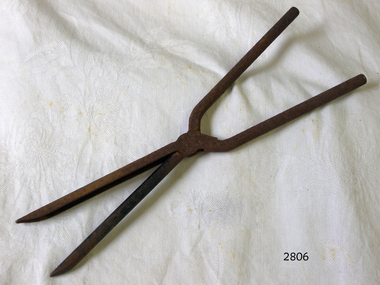
Domestic object - Hair Tongs, Marcel Grateau, 1900 +
... A significant item that gives us a snapshot not only into women's hairstyles of the 1920s and 1930s but a look into the social norms of that era. Therefore the item is of social interest in regards to the story it tells and the development of women's fashion in hair styling. flagstaff hill warrnambool shipwrecked coast flagstaff hill maritime museum maritime museum shipwreck coast flagstaff hill maritime village great ocean road tongs curling tongs hairdressing None Marcel Tongs, metal, used to impart a hair wave by heating and crimping the hair Domestic object Hair Tongs Marcel Grateau ...Marcelling is a hair styling technique in which hot curling tongs are used to induce a curl into the hair. Its appearance was similar to that of a finger wave but it is created using a different method. Marcelled hair was a popular style for women's hair in the 1920s and 30s often in conjunction with a bob cut. For those women who had long hair, it was common to tie the hair at the nape of the neck and pin it above the ear with a stylish hairpin or flower. Accounts vary about the invention of the style, but Marcel Grateau (1852–1936) is widely credited with inventing the hair styling technique in the 1870s. He started with a small salon in Montmartre, Paris where his clients were the poorer classes. As he developed the waving method that would later become the Marcel wave, using heated curling irons, The inventor and stylist emigrated to the United States and changed his name to François Marcel Woelfflé, sometimes reported as François Marcel. He was granted U.S. patents for implements for performing the technique; the first, U.S. patent 806386, entitled "Curling-Iron", was published in 1905, and the second, entitled "Hair-Waving Iron", for an electric version, under the name François Marcel, was published in 1918. His obituary appeared under the name Francois Marcel Grateau in 1936. Originally the irons had to be heated in the fire, but hair easily got burnt until 1924 when electric irons were invented and the temperature could be regulated. A significant item that gives us a snapshot not only into women's hairstyles of the 1920s and 1930s but a look into the social norms of that era. Therefore the item is of social interest in regards to the story it tells and the development of women's fashion in hair styling.Marcel Tongs, metal, used to impart a hair wave by heating and crimping the hairNoneflagstaff hill, warrnambool, shipwrecked coast, flagstaff hill maritime museum, maritime museum, shipwreck coast, flagstaff hill maritime village, great ocean road, tongs, curling tongs, hairdressing -
 Flagstaff Hill Maritime Museum and Village
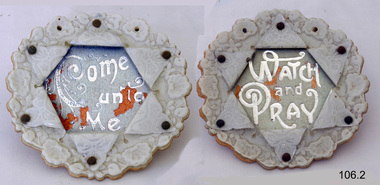
Decorative object - Wall Decoration, Late 19th to early 20th centuries
... These items of decoration were very popular at this time and the subject item is significant as it gives a snapshot into the social norms of past generations. flagstaff hill warrnambool shipwrecked coast flagstaff hill maritime museum shipwreck coast great ocean road paper wall decoration Watch and Pray and Come Unto Me Wall decoration white china with relief circular hanging pieces, paper folds pinned back to reveal words Paper is pinned by metal studs. ...During the Victorian era, the period (1837-1901) in which Queen Victoria ruled England. The queen’s influence was felt throughout the world, including in the United States and Australia where Victorian values shaped society and style, especially in home décor. This period’s distinct style presents an eclectic mix of highly ornamented furniture, wallpaper, and knick-knacks. Particularly in terms of furniture, and the characteristic floral patterns and rich, contrasting colours, wall hanging that enjoyed the height of its popularity during the Victorian era were of the spiritual type with an either embroidered or punched paper religious motto or bible quote. Mottoes were commonly hung high up on the wall or in an area of prominence, to remind the viewer of their important message, such as “He Leadeth Me” and “Honesty, Industry, and Sobriety.” Short and pithy, they embodied the ideals of Victorian society. Technological advances contributed to the boom of religious mottoes whereas before the Industrial Revolution home décor of this sort was handmade and therefore minimal, now consumers could purchase and fill their homes with all sorts of mass-produced ephemera goods similar to the subject item. Many of these mass-produced period pieces still exist today, often in their original frames, ceramic, or paper formats. Flagstaff maritime museum has many examples of mottoes on display that serve to reflect the period in which values of home, faith, and Christianity were very prominent in everyday Victorian society.An item that reflects the social values and attitudes of the late Victorian era that was used to promote good Christian and moral values in many households. These items of decoration were very popular at this time and the subject item is significant as it gives a snapshot into the social norms of past generations. Wall decoration white china with relief circular hanging pieces, paper folds pinned back to reveal words Paper is pinned by metal studs. Paper folds create star shape. (set of 2)Watch and Pray and Come Unto Meflagstaff hill, warrnambool, shipwrecked coast, flagstaff hill maritime museum, shipwreck coast, great ocean road, paper wall decoration -
 Flagstaff Hill Maritime Museum and Village
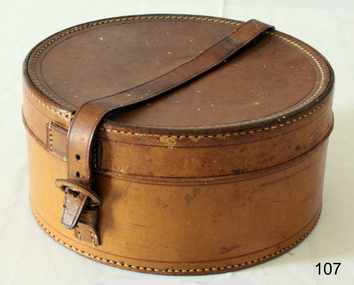
Container - Collar Box, Rexbilt Leather Company, 1924-1930
... The subject item comes from a time that gives a snapshot into the past at the social norms of the time. flagstaff hill warrnambool shipwrecked coast flagstaff hill maritime museum shipwreck coast flagstaff hill maritime village great ocean road collar box men's collar box men's collar leather collar box Collar inside box marked "CF652 Rexbilt Size 16 1/2 x 1 3/4" Collar box, leather, cylindrical, includes strap, buckle, stitching and cardboard lining and man's white collar Container Collar Box Rexbilt Leather Company ...The evolution of the stiff shirt collar occurred in the 1830s when the detachable collar was "invented." At this time, the detachable collars were simply normal shirt collars like you’d see today, but sold separately from the shirt itself and needed to be kept in a container to keep them clean and accessible. The detachable collars were a way to avoid the weekly laundry. Because collars and cuffs were both the most visible parts of shirts and the parts most likely to get dirty, separating them allowed people to do the shirt equivalent of only washing your armpits after you go to the gym. That meant that the main body of the shirt could remain soft while the collar and cuffs that were visible could be starched and shaped. The popularity of detachable collars and starched collars, in general, began to fade in the 1920s and 30s. As shirt styles began to change. The advent of central heating, lighter weight fabrics, and a more relaxed social attitude to fashion all contributed to making men’s clothes more comfortable and less formal.An item that was used to store detachable men’s shirt collars from the early 20th century at a time when men's fashion was more formal and how a person dressed especially for formal occasions dictated a person's social standing. The subject item comes from a time that gives a snapshot into the past at the social norms of the time.Collar box, leather, cylindrical, includes strap, buckle, stitching and cardboard lining and man's white collarCollar inside box marked "CF652 Rexbilt Size 16 1/2 x 1 3/4" flagstaff hill, warrnambool, shipwrecked coast, flagstaff hill maritime museum, shipwreck coast, flagstaff hill maritime village, great ocean road, collar box, men's collar box, men's collar, leather collar box -
 Greensborough Historical Society
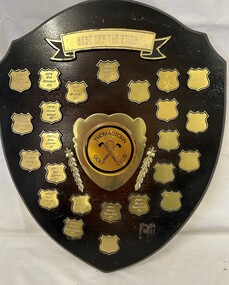
Award - Trophy, Thomastown Golf Club, Thomastown Golf Club. Best off the Stick, 1976-1988, 1976-1988
... Winners named on small engraved shields: 1976 Peter Wreglesworth; 1977 Ern Holland; 1978 Bob Mitchell; 1979 Peter Wreglesworth and Norm Wrest; 1980 Richard Langton; 1981 Ron Gibson; 1982 Michael Long; 1983 Ron Gibson; 1984 Garry Schreiders and Ron Gibson; 1985 Garry Schreiders; 1986 Kevin Bousfield; 1987 Alan Almond; 1988 Kevin Dousfield. Thomastown Golf Club was a social ...Perpetual golf trophy awarded by the Thomastown Golf Club for Best off the Stick, 1976-1988. Winners named on small engraved shields: 1976 Peter Wreglesworth; 1977 Ern Holland; 1978 Bob Mitchell; 1979 Peter Wreglesworth and Norm Wrest; 1980 Richard Langton; 1981 Ron Gibson; 1982 Michael Long; 1983 Ron Gibson; 1984 Garry Schreiders and Ron Gibson; 1985 Garry Schreiders; 1986 Kevin Bousfield; 1987 Alan Almond; 1988 Kevin Dousfield. Thomastown Golf Club was a social club formed in 1976. This is part of the Robert (Bob) Jones collection of Club memorabilia.Golf trophy, timber shield with "Thomastown Golf Club" and "Best off the Stick" engraved on plaques attached to shield with 15 small engraved plaques attached naming winners ."Best off the Stick" engraved on plaque attached to top of shield.thomastown golf club, golf trophies, bob jones, robert jones -
 Federation University Historical Collection
Photograph, Ballarat College of Advanced Education 1oth Annivesary Ball, 1986
... Two men in white shirts and bow ties and a woman are seated at a social function. The men are Ken Clements (Academic Registrar) and Norm Barling (Lecturer in Education) ...The photograph was taken at the 10th anniversary Ball, a celebration of 10 years since Ballarat Institute of Advanced Education and Ballarat Teachers' COllege mergerd in 1976. ken clements norman barling anniversary merger ballarat institute of advanced education ballarat college of advanced education ballarat teachers' college state college of victoria at ballarat Two men in white shirts and bow ties and a woman are seated at a social function. The men are Ken Clements (Academic Registrar) and Norm Barling (Lecturer in Education) Ballarat College of Advanced Education 1oth Annivesary Ball Photograph ...The photograph was taken at the 10th anniversary Ball, a celebration of 10 years since Ballarat Institute of Advanced Education and Ballarat Teachers' COllege mergerd in 1976.Two men in white shirts and bow ties and a woman are seated at a social function. The men are Ken Clements (Academic Registrar) and Norm Barling (Lecturer in Education) ken clements, norman barling, anniversary, merger, ballarat institute of advanced education, ballarat college of advanced education, ballarat teachers' college, state college of victoria at ballarat -
 Flagstaff Hill Maritime Museum and Village
Container - Tin, McKenzies Foods, circa 1930s
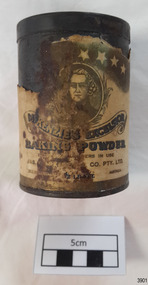
... It gives a snapshot into domestic life and social norms of the pre and post war period in Melbourne The tin is significant for its association with a local family in the 1930s for the preparation of family meals. flagstaff hill asset baking powder tin container flagstaff hill museum kitchen item cookery baking grocery mckenzie rising agent food container flagstaff hill warrnambool shipwrecked coast flagstaff hill maritime museum maritime museum shipwreck coast flagstaff hill maritime village great ocean road tin cooking ingredient baking powder mckenqie Text includes “JAS. ...This tin once contained McKenzie’s baking powder, a cooking ingredient. It was donated with other similar tins that were used by the donor’s mother who was married in 1932. It those times in Australia all manner of household items, including food and drink, were sold by hawkers (salesmen) who travelled from door to door in both suburban and rural areas. The donor remembered the bicarb soda tin on her mother’s pantry shelf. The McKenzie’s Baking Powder label adds the information that the ingredients were “Prepared with Aerophos, Regd. Trade Mark, the finest raising ingredient. A product of Albright & Wilson, Australia Pty. Ltd.” It also says that it “Excels all others in use”. The Australian family business, McKenzie’s Foods, began in Melbourne in 1852 and continues today, now run be the fifth generation of descendants from the original owners. Its baking and cookery products are well recognised by Australians. This tin originates in the early 1900s from an Australian company that is now managed by fifth generation descendants of the original family after its inception in 1852. The tin increases in significance for its use as a recognised object found in many Australian kitchens since early days. It gives a snapshot into domestic life and social norms of the pre and post war period in Melbourne The tin is significant for its association with a local family in the 1930s for the preparation of family meals. Tin container, cylindrical, with cream paper label with gold highlights, motif and text. Used for selling McKenzie’s Excelsior baking powder. Container has push-on lid. Quantity of 1/2 LB. NETT. Made in Australia by Jas. F. McKenzie & Co. Pty Ltd. Text includes “JAS. F. McKENZIE & CO. PTY. LTD. / AUSTRALIA“ “McKENZIE’S EXCELSIOR / BAKING POWDER”. Motif: man’s portrait within oval frame with wheat sheaf border, placed below figures of sun, moon and stars. Information and instructions. flagstaff hill asset, baking powder tin, container, flagstaff hill museum, kitchen item, cookery, baking, grocery, mckenzie, rising agent, food container, flagstaff hill, warrnambool, shipwrecked coast, flagstaff hill maritime museum, maritime museum, shipwreck coast, flagstaff hill maritime village, great ocean road, tin, cooking ingredient, baking powder, mckenqie -
 Flagstaff Hill Maritime Museum and Village
Container - Tin, W T Rawleigh, Circa 1930s
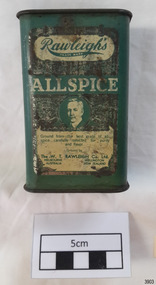
... It gives a snapshot into domestic life and social norms of the pre and post war period in Melbourne The tin is significant for its association with a local family in the 1930s for the preparation of family meals. flagstaff hill museum container spice container rawleigh company tin container kitchen item tin cooking ingredient food container grocery allspice rawleigh co. ...This tin once contained Rawleigh's Allspice, a cooking ingredient. It was donated with other similar tins that were used by the donor’s mother who was married in 1932. It those times in Australia all manner of household items, including food and drink, were sold by hawkers (salesmen) who travelled from door to door in both suburban and rural areas. The donor remembered the tin on her mother’s pantry shelf. The Rawleigh Nutmegs label stated “Selected whole nutmegs not ground but granulated to preserve full strength and flavour.” The company had operated in Melbourne, Australia, and Wellington, New Zealand. W.T. Rawleigh & Co. was established by William Rawleigh in America in 1889 and later expanded into Australia. The company made a variety of household products in a factory in Collins Place, Melbourne, between 1930 and 1935. It specialised in medicines and remedies, food additives, cleaning products and toiletries. The company in Melbourne expanded into their factory in Dawson Street, Brunswick, in the mid-1930s. Independent salesmen, often referred to as ‘The Rawleigh’s man’, sold Rawleigh products door-to-door between the wars and after the Second World War in the Melbourne suburbs. Rayleigh’s products are still produced today. The tin is significant for its association with W.T Rawleigh, one of Melbourne’s strong growing manufacturers in period particularly between the World Wars. Rawleigh’s was, and still is, well known for its household and cleaning products, medicines, food additives and toiletries. The tin increases in significance for its use as a recognised object found in many Australian kitchens since early days. It gives a snapshot into domestic life and social norms of the pre and post war period in Melbourne The tin is significant for its association with a local family in the 1930s for the preparation of family meals. Rawleigh's rectangular Allspice spice tin, green, with directions for use on back and sides of container.Text “Rawleigh’s ALLSPICE” “The W.T. RAWLEIGH Co. Ltd.” “MELGOURNE / AUSTRALIA” “WELLINGTON / NEW ZEALAND” Motif: Man’s portrait in a circle. Other text includes information about spices.flagstaff hill museum, container, spice container, rawleigh company, tin container, kitchen item, tin, cooking ingredient, food container, grocery, allspice, rawleigh co. -
 Flagstaff Hill Maritime Museum and Village
Domestic object - Cooking pot and lid, T & C Clarke and Co Ltd, 1880 to1910
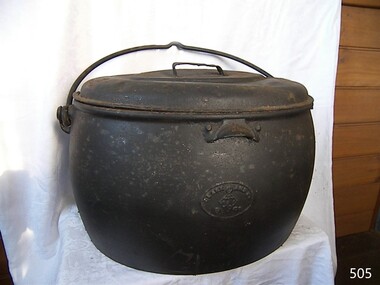
... The cooking pot is significant because it demonstrates one of the social norms founded by early settlers to this region. ...T & C Clark & Company Limited, based at Shakespeare Foundry, was founded in 1795 by Thomas and Charles Clark and grew to be one of the largest iron foundries in Wolverhampton. The firm was the pioneers of Enamelled Cast ironware and the founder Charles Clerk went on to became mayor of Wolverhampton in 1860 after also serving as a Councilor, Alderman, and later Chief Magistrate. The company exhibited many products at the International Exhibition of 1862 at South Kensington, alongside the gardens of the Royal Horticultural Society. The company was also awarded the silver medal for its products at the International Paris Exhibition in 1878. The company's product range included thousands of items, both domestic and industrial. T & C Clark pioneered the use of enamelled cast ironware, after taking out a patent in 1839 guaranteed to be free of lead or arsenic. In the late 1940s and 1950s the company produced acid-resisting enamelled cast iron boiling pans; steam-jacketed pans; stills; square and rectangular tanks; open and closed mixing vessels; flanged pipes; bends and tees; laboratory equipment; small scale plant; evaporating bowls; beakers; sulphonates; and glass-lined mild steel tanks for beer, mineral water, and food. The company is listed as enamelled chemical plant manufacturers in Kelly's 1962 Wolverhampton Directory, but within a few years, the company had ceased trading. The cooking pot is significant because it demonstrates one of the social norms founded by early settlers to this region. That close ties to "Mother England" and the "establishment" was still very strong. The social and family values from the British way of life was ingrained in colonial society until well past Australian Federation in July of 1900. It was not until the friendly "American soldier" invasion during World War II that the Empire mindset was slowly being eroded away. This change was the slowest in semi remote rural areas such as the Warrnambool district. Cast iron open fire cooking pot with lidCLARK & Co. PATENT", Below this a six star triangle with the letter "C" in the middleflagstaff hill museum, cooking appliance, camp fire pot, cast iron, t & c clark & co, drovers cooking pot -
 Flagstaff Hill Maritime Museum and Village
Decorative object - Wall Decoration, 1850 to 1901
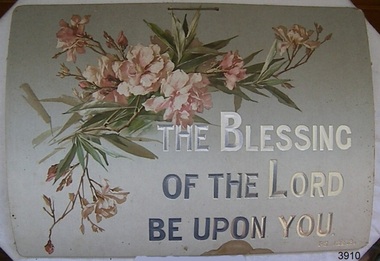
... These items of decoration were very popular at this time and the subject item is significant as it gives a snapshot into the social norms of past generations. flagstaff hill warrnambool shipwrecked coast flagstaff hill maritime museum shipwreck coast great ocean road paper wall decoration religious home decoration societal values victorian moral values wall hanging wall decoration spiritual decoration Bible verse Giles Collection Embossed"THE BLESSING / OF THE LORD/ BE UPON YOU." ...This item is part of the Giles Collection, dating back to the late Victorian era, from the 1880s to the early 1900s, in which Queen Victoria ruled England. The queen’s influence was felt throughout the world, including in the United States and Australia where Victorian values shaped society and style, especially in home décor. This period’s distinct style presents an eclectic mix of highly ornamented furniture, wallpaper, and knick-knacks. Particularly in terms of furniture, and the characteristic floral patterns and rich, contrasting colours, wall hangings that enjoyed the height of their popularity during the Victorian era were of the spiritual type with either embroidered or punched paper religious motto or bible quote. Mottoes were commonly hung high up on the wall or in an area of prominence, to remind the viewer of their important message, such as “He Leadeth Me” and “Honesty, Industry, and Sobriety.” Short and pithy, they embodied the ideals of Victorian society. Technological advances contributed to the boom of religious mottoes whereas before the Industrial Revolution home décor of this sort was handmade and therefore minimal, now consumers could purchase and fill their homes with all sorts of mass-produced ephemera goods similar to the subject item. Many of these mass-produced period pieces still exist today, often in their original frames, ceramic, enamelled or paper formats. Flagstaff maritime museum has many examples of mottoes on display that serve to reflect the period in which values of home, faith, and Christianity were very prominent in everyday Victorian society. The Giles Family There are many 19th century items of furniture, linen and crockery donated to Flagstaff Hill Maritime Village by Vera and Aurelin Giles. The items are associated with the Giles Family and are known as the “Giles Collection”. These items mostly came from the simple home of Vera’s parents-in-law, Henry Giles and his wife Mary Jane (nee Freckleton), whose photos are in the parlour. They married in 1880. Henry Giles was born at Tower Hill in 1858. He was a labourer on the construction of the Breakwater before leaving in 1895 to build bridges in N.S.W. for about seven years. Mary Jane was born in 1860 at Cooramook. She attended Mailor’s Flat State School where she was also a student teacher before, as a family legend has it, she became a governess at “Injemiara” where her grandfather, Francis Freckleton, once owned land. Henry and Mary’s family of six, some of whom were born at Mailor’s Flat and later children at Wangoom, lived with their parents at Wangoom and Purnim west, where Henry died in 1933 and Mary Jane in 1940.The Giles family collection has social significance at a local level, because it illustrates the level of material support the Warrnambool community gave to Flagstaff Hill when the Museum was established. This wall decoration reflects the social values and attitudes of the late Victorian era that was used to promote good Christian and moral values in many households. These items of decoration were very popular at this time and the subject item is significant as it gives a snapshot into the social norms of past generations. Printed card wall hanging with floral design. Religious text on the sign is embossed onto the card and highlighted in silver print. There is a handwritten ink inscription, and a pencil inscription, on the back. A string is attached to two holes on top of the card. Embossed"THE BLESSING / OF THE LORD/ BE UPON YOU." "PS 129.8." In pencil "H/S" In ink "To dear Granny with lots of love / from Dorothy. X X."flagstaff hill, warrnambool, shipwrecked coast, flagstaff hill maritime museum, shipwreck coast, great ocean road, paper wall decoration, religious, home decoration, societal values, victorian moral values, wall hanging, wall decoration, spiritual decoration, bible verse, giles collection -
 Flagstaff Hill Maritime Museum and Village
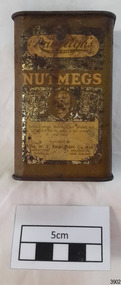
Container - Tin, W T Rawleigh, Circa 1930s
... It gives a snapshot into domestic life and social norms of the pre and post war period in Melbourne The tin is significant for its association with a local family in the 1930s for the preparation of family meals. tin container flagstaff hill warrnambool shipwrecked coast flagstaff hill maritime museum maritime museum shipwreck coast flagstaff hill maritime village great ocean road food container tin kitchen item container cooking ingredient grocery spice container nutmeg rawleigh co. ...This tin once contained Rayleigh's Nutmegs, a cooking ingredient. It was donated with other similar tins that were used by the donor’s mother who was married in 1932. It those times in Australia all manner of household items, including food and drink, were sold by hawkers (salesmen) who travelled from door to door in both suburban and rural areas. The donor remembered the tin on her mother’s pantry shelf. The Rawleigh Nutmegs label stated “Selected whole nutmegs not ground but granulated to preserve full strength and flavour.” The company had operated in Melbourne, Australia, and Wellington, New Zealand. W.T. Rawleigh & Co. was established by William Rawleigh in America in 1889 and later expanded into Australia. The company made a variety of household products in a factory in Collins Place, Melbourne, between 1930 and 1935. It specialised in medicines and remedies, food additives, cleaning products and toiletries. The company in Melbourne expanded into their factory in Dawson Street, Brunswick, in the mid-1930s. Independent salesmen, often referred to as ‘The Rawleigh’s man’, sold Rawleigh products door-to-door between the wars and after the Second World War in the Melbourne suburbs. Rayleigh’s products are still produced today. The tin is significant for its association with W.T Rawleigh, one of Melbourne’s strong growing manufacturers in period particularly between the World Wars. Rawleigh’s was, and still is, well known for its household and cleaning products, medicines, food additives and toiletries. The tin increases in significance for its use as a recognised object found in many Australian kitchens since early days. It gives a snapshot into domestic life and social norms of the pre and post war period in Melbourne The tin is significant for its association with a local family in the 1930s for the preparation of family meals. Rawleigh spice tin, rectangular, tall, used for storing Rawleigh's nutmeg. Tin has a flip-top lid, is coloured gold and comes with directions for use on front, back and sides of container.Text includes “W.T. RAWLEIGH Co. Ltd.”, “MELBOURNE / AUSTRALIA”, WELLINGTON / NEW ZEALAND” “Rawleigh’s / NUTMEGS” Motif: man’s portrait in a circle. Other text includes information about spices.tin container, flagstaff hill, warrnambool, shipwrecked coast, flagstaff hill maritime museum, maritime museum, shipwreck coast, flagstaff hill maritime village, great ocean road, food container, tin, kitchen item, container, cooking ingredient, grocery, spice container, nutmeg, rawleigh co. -
 Flagstaff Hill Maritime Museum and Village
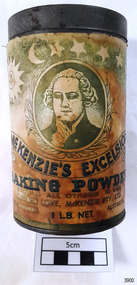
Container - Tin, McKenzies Foods, circa 1930s
... It gives a snapshot into domestic life and social norms of the pre and post war period in Melbourne The tin is significant for its association with a local family in the 1930s for the preparation of family meals. flagstaff hill asset baking powder tin container flagstaff hill museum kitchen item cooking ingredients flagstaff hill warrnambool shipwrecked coast flagstaff hill maritime museum maritime museum shipwreck coast flagstaff hill maritime village great ocean road tin cooking ingredient food container grocery cookery rising agent baking powder mckenzie mckenzie foods Text includes “CLIFFORD LOVE, McKENZIE PTY. ...This tin once contained McKenzie’s baking powder, a cooking ingredient. It was donated with other similar tins that were used by the donor’s mother who was married in 1932. It those times in Australia all manner of household items, including food and drink, were sold by hawkers (salesmen) who travelled from door to door in both suburban and rural areas. The donor remembered the bicarb soda tin on her mother’s pantry shelf. The McKenzie’s Baking Powder label adds the information that the ingredients were “Prepared with Aerophos, Regd. Trade Mark, the finest raising ingredient. A product of Albright & Wilson, Australia Pty. Ltd.” It also says that it “Excels all others in use”. The company began in Melbourne in 1852 and continues today, now run be the fifth generation of descendants from the original owners. This tin originates in the early 1900s from an Australian company that is now managed by fifth generation descendants of the original family after its inception in 1852. The tin increases in significance for its use as a recognised object found in many Australian kitchens since early days. It gives a snapshot into domestic life and social norms of the pre and post war period in Melbourne The tin is significant for its association with a local family in the 1930s for the preparation of family meals. Tin container, cylindrical, with cream and green paper label with gold highlights, motif and text. Used for selling McKenzie’s Excelsior baking powder. Container has push-on lid. Quantity of 1LB. NET. Made in Australia by McKenzie Ltd.Text includes “CLIFFORD LOVE, McKENZIE PTY. LTD.” “McKENZIE’S EXCELSIOR / BAKING POWDER”. Motif: man’s portrait within oval frame with wheat sheaf border, placed below figures of sun, moon and stars. Information and instructions. flagstaff hill asset, baking powder tin, container, flagstaff hill museum, kitchen item, cooking ingredients, flagstaff hill, warrnambool, shipwrecked coast, flagstaff hill maritime museum, maritime museum, shipwreck coast, flagstaff hill maritime village, great ocean road, tin, cooking ingredient, food container, grocery, cookery, rising agent, baking powder, mckenzie, mckenzie foods -
 Flagstaff Hill Maritime Museum and Village
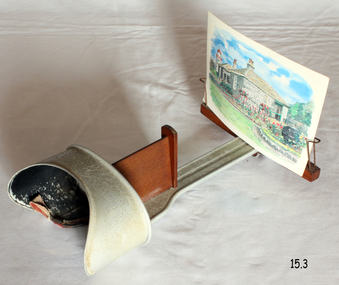
Leisure object - Stereoscope, H C White, Late 19th century
... Used for entertainment and also educational purposes and significant as it gives us a snapshot into the Victorian era and its social and domestic societal norms. warrnambool shipwrecked-coast flagstaff-hill flagstaff-hill-maritime-museum maritime-museum flagstaff-hill-maritime-village stereoscope stereographs stereoscope viewers home entertainment Printed on metal plate "THE FINE-ART PHOTOGRAPHERS' PUBLISHING CO. 48 Rydevale Rd, LONDON, S.W." ...The development of stereoscopic photography views or stereographs was immensely popular in the United States and Europe from about the mid-1850s through the early years of the 20th century. First described in 1832 by English physicist Sir Charles Wheatstone, stereoscopy was improved by Sir David Brewster in 1849. The production of the stereograph entailed making two images of the same subject, usually with a camera with two lenses placed 6 cm apart to simulate the position of the human eyes, and then mounting the positive prints side by side laterally on a stiff backing. Brewster devised a stereoscope through which the finished stereograph could be viewed; the stereoscope had two eyepieces through which the laterally mounted images, placed in a holder in front of the lenses, were viewed. The two images were brought together by the effort of the human brain to create an illusion of three-dimensionality. Stereographs were made of a wide range of subjects, the most popular being views of landscapes and monuments and composing narrative scenes of a humorous or slightly suggestive nature. Stereoscopes were manufactured for various price ranges and tastes, from the simple hand-held device introduced by Oliver Wendell Holmes who promoted stereography through articles to elaborate floor models containing large numbers of images that could be flipped into place. The stereograph became especially popular after Queen Victoria expressed interest in it when it was exhibited at the 1851 Crystal Palace Exposition. Like television today, stereography during the second half of the 19th century was both an educational and a recreational device with a considerable impact on public knowledge and taste. The Fine-art Photographers' Publishing Co. published many stereoscopic pictures from many different photographers from around the world under license. They also not only sold these images of various scenes and of famous people of the time but also were retail sellers of the viewers with the subject item having been made in the USA probably by H C White who held the patent for the subject items design from 1895 to 1902.An item that was very popular from the mid 19th century through to the beginning of the Edwardian period. Used for entertainment and also educational purposes and significant as it gives us a snapshot into the Victorian era and its social and domestic societal norms. Stereoscope viewer with adjustable view-finder that has a padded nose rest. The slide holder can move along the channel to suit the viewer. Made in London by the Fine-art Photographers' Publishing Co. Printed on metal plate "THE FINE-ART PHOTOGRAPHERS' PUBLISHING CO. 48 Rydevale Rd, LONDON, S.W." Embossed on viewing cup "U.S.A. PATENT OCT.15.1895" "CANADA / FRANCE / GERMANY / D'R''G'M' NO. 53803" "JUNE 3.1902 / FEBY 1.1896 / B.S.G.D.B. / GREAT BRITAIN / AUSTRIA / BELGIUM"warrnambool, shipwrecked-coast, flagstaff-hill, flagstaff-hill-maritime-museum, maritime-museum, flagstaff-hill-maritime-village, stereoscope, stereographs, stereoscope viewers, home entertainment -
 Flagstaff Hill Maritime Museum and Village
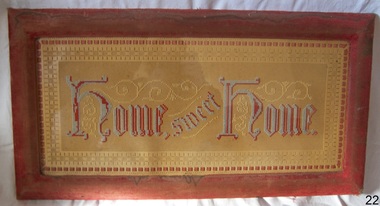
Artwork, other - Wall decoration, Vera Giles, late 19th to early 20th century
... These items of decoration were very popular at this time and the subject item is significant as it gives a snapshot into the social norms of past generations. The Giles family collection is of additional social significance at a local level, because it not only illustrates the level of material support the Warrnambool community gave to Flagstaff Hill during it’s establishment. ...During the Victorian era, the period (1837-1901) in which Queen Victoria ruled England. The queen’s influence was felt throughout the world, including in the United States and Australia where Victorian values shaped society and style, especially in home décor. This period’s distinct style presents an eclectic mix of highly ornamented furniture, wallpaper, and knick-knacks. Particularly in terms of furniture, and the characteristic floral patterns and rich, contrasting colours, wall hanging that enjoyed the height of its popularity during the Victorian era were of the spiritual type with an either embroidered or punched paper religious motto or bible quote. Mottoes were commonly hung high up on the wall or in an area of prominence, to remind the viewer of their important message, such as "Home sweet Home “He Leadeth Me” and “Honesty, Industry, and Sobriety.” Short and pithy, they embodied the ideals of Victorian society. Technological advances contributed to the boom of religious mottoes whereas before the Industrial Revolution home décor of this sort was handmade and therefore minimal, now consumers could purchase and fill their homes with all sorts of mass-produced ephemera goods similar to the subject item. Many of these mass-produced period pieces still exist today, often in their original frames, ceramic, or paper formats. Flagstaff maritime museum has many examples of mottoes on display that serve to reflect the period in which values of home, faith, and Christianity were very prominent in everyday Victorian society. For more information on the Giles collection see Acquisition section this document: An item that reflects the social values and attitudes of the late Victorian era that was used to promote good Christian and moral values in many households. These items of decoration were very popular at this time and the subject item is significant as it gives a snapshot into the social norms of past generations. The Giles family collection is of additional social significance at a local level, because it not only illustrates the level of material support the Warrnambool community gave to Flagstaff Hill during it’s establishment. But the Giles collection also gives us an additional view into what domestic life was like in early colonial times prior to Federation.Wall decoration, framed handmade embroidered tapestry with the woven inscription, Frame has velvet cover. This item is part of the Giles CollectionHome Sweet Home, in gothic scriptflagstaff hill, warrnambool, shipwrecked coast, flagstaff hill maritime museum, flagstaff hill maritime village, great ocean road, soft furnishing, wall decoration, home sweet home, wall hanging, handmade wall hanging, giles collection, henry giles, tower hill, cooramook, warrnambool breakwater, mailor’s flat, wangoom, 19th century handcraft, mrs vera giles -
 Flagstaff Hill Maritime Museum and Village
Container - Glass Bottle, W T Rawleigh, 1920s
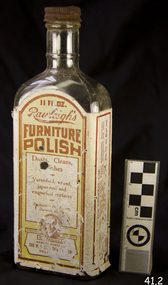
... A significant item as it gives a snapshot into domestic life and social norms of the pre and post war period in Melbourne and throughout Australia and New Zealand. ...W.T. Rawleigh's & Co. manufactured various household products in a factory in Collins Place, Melbourne, between 1930 and 1935. The W.T. Rawleigh Company was an American company started by William Rawleigh in 1889. The company expanded to both Canada and Australia with the Rawleigh company specialising in medicines, remedies, food additives, cleaning products and toiletries. Due to increased demand, Rawleigh’s required a larger factory and thus built the factory in Dawson Street Brunswick Victoria and by 1950 the factory had been extended to include 98,000 square feet of floor space. The Brunswick factory ceased production in the late 1970s and manufacturing was moved to New South Wales. During the peak of production, more than 200 people were employed in the Brunswick factory and several independent sale representatives sold their products door-to-door throughout the country. The ‘Rawleigh’s man’ was a regular door-to-door salesman of inter war and post-war suburban Melbourne. Rawleigh’s products are still in production today.A significant item as it gives a snapshot into domestic life and social norms of the pre and post war period in Melbourne and throughout Australia and New Zealand. The item demonstrates how selling house hold products door to door was pioneered in Australia by the Rawleigh’s company in the early 1900s and is still in existence today.Bottle, glass, narrow neck rectangular base with metal screw top.label of Rawleigh's Furniture Polishflagstaff hill, warrnambool, flagstaff hill maritime museum, shipwreck coast, flagstaff hill maritime village, great ocean road, bottle, rawleigh's furniture polish, furniture polish, rawleigh's, cleaning -
 Kiewa Valley Historical Society
Iron Hand, circa 1867 to circa 1871
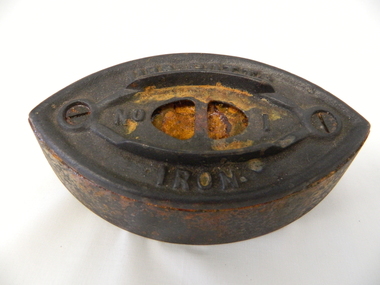
... These irons were used in an era where stiff collars and creases in particular types of clothing was essentially a social requirement Historically these irons fulfilled a particular function that was the norm in isolated or semi isolated country locations. ...This is size one of three sizes (Mrs Potts) irons available in the late 1800s and early 1900s which were used for (press) ironing clothes etc. using wood or coal based heaters. The majority of these irons would have been placed on top of wood or coal fuelled stoves. They survived longer in isolated outback regions where electricity had not been connected. The weight of these irons was intentionally heavy so as to press the clothes etc. neatly. These irons were used in an era where stiff collars and creases in particular types of clothing was essentially a social requirementHistorically these irons fulfilled a particular function that was the norm in isolated or semi isolated country locations. Cities and larger towns had professional laundry and pressing shops. In smaller towns and homesteads, wives and relatives would use these heavy irons and required strong arms. In middle and higher levels of society these irons would be used by maids or nannies. Their use was a necessity to conform to the social requirements of acceptable appearances that all clothing worn had been "pressed" clean. In the Kiewa Valley the majority of these irons would have been used by mothers or relatives. Men would hardly have used these irons as society labelled this type of activity as "women's work"This double pointed, heavy and solid cast iron, is a Mrs Potts No. 1 type. It does not have a handle. It was used to iron clothes. Open cavity on top for handle (not included) see KVHS 0369 for No. 3 ironMrs Potts No. 1house hold, ironing, domestic, pressing, clothes appliance -
 Kiewa Valley Historical Society
Iron Hand, 1867 to 1871
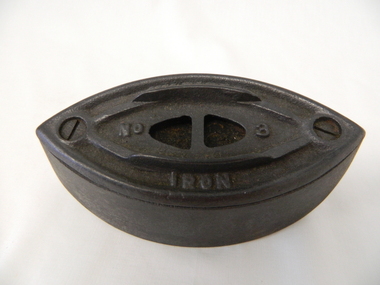
... These irons were used in an era where stiff collars and creases in particular types of clothing was essentially a social requirement Historically these irons fulfilled a particular function that was the norm in isolated or semi isolated country locations i.e., ironed clothes and linen.The iron was heated by using locally acquired wood in a cast iron stove or "pot Belly". ...This is size one of three sizes (Mrs Potts) irons available in the late 1800s and early 1900s which were used for (press) ironing clothes etc. using wood or coal based heaters. The majority of these irons would have been placed on top of wood or coal fuelled stoves. They survived longer in isolated outback regions where electricity had not been connected. The weight of these irons was intentionally heavy so as to press the clothes etc. neatly. These irons were used in an era where stiff collars and creases in particular types of clothing was essentially a social requirementHistorically these irons fulfilled a particular function that was the norm in isolated or semi isolated country locations i.e., ironed clothes and linen.The iron was heated by using locally acquired wood in a cast iron stove or "pot Belly". It would be placed on top of the stove but not directly in the flames. Cities and larger towns had professional laundry and pressing shops. In smaller towns and homesteads, wives and relatives would use these heavy irons which required strong arms. In middle and higher levels of society these irons would be used by maids or nannies. Their use was a necessity, to conform to the social requirements of acceptable appearances in that all clothing worn had been "pressed" clean. In the Kiewa Valley the majority of these irons would have been used by mothers or relatives. Men would hardly have used these irons as society labelled this type of activity as "women's work"This double pointed, heavy and solid cast iron, is a Mrs Potts No.3 type. It does not have a handle. It was used to iron clothes. Open cavity on top for handle (not included) Note: one end is pointed up to allow the natural weight of the iron to increase the pressure at any of the "hard to press" spots or emphasizing required creases. see KVHS 0368 for No. 1 ironMrs Potts No. 3house hold, ironing, domestic, pressing, clothes appliance -
 Kiewa Valley Historical Society
Photograph of Kiewa Valley Pioneer Family, Three Generations of Kiewa Valley Pioneer Family (Coopers), late 1900s'
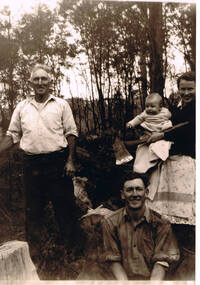
... The rural sector was in this point of time one which women were highly respected and the unwritten law of providing "assistance" and "reverence" by men in such actions as, socially opening doors, tipping the cap, offering a sturdy arm for support and refraining from doing or saying anything "uncouth" in a woman's presence. It was in a time when women's liberation was just starting to grow strength. Rural areas, on the hole, took longer to interfuse "city" hatched norms...The rural sector was in this point of time one which women were highly respected and the unwritten law of providing "assistance" and "reverence" by men in such actions as, socially opening doors, tipping the cap, offering a sturdy arm for support and refraining from doing or saying anything "uncouth" in a woman's presence. It was in a time when women's liberation was just starting to grow strength. Rural areas, on the hole, took longer to interfuse "city" hatched norms ...This historical family photograph spans three generations of the Cooper Family, a pioneer family, still residing in the Kiewa Valley. The large axe held by Pat was a handy tool for pioneer families to chop down trees for land clearing, building sheds and fences, outhouses and fire wood. This photograph was taken during a time where both male and females did some heavy lifting and processing. The rural sector at this point in time was physically a hard location for both sexes. The segregation of the sexes into specific job categories was some times non existent although household "chores" was in the main a woman's domain. The rural sector was in this point of time one which women were highly respected and the unwritten law of providing "assistance" and "reverence" by men in such actions as, socially opening doors, tipping the cap, offering a sturdy arm for support and refraining from doing or saying anything "uncouth" in a woman's presence. It was in a time when women's liberation was just starting to grow strength. Rural areas, on the hole, took longer to interfuse "city" hatched norms of behaviour. This photograph of a pioneer family still residing in the Kiewa Valley demonstrates not only the close protective environment that the valley has on all its inhabitants but also the close bonding that neighbors have towards each other. The term "God's gifted country" fits warmly with all the settlements in the valley. The relatively isolated (physically, visually and communications wise) has since post World War II been whittled away by faster and vastly improved communications with "the outside" world. The strength of commitment to the rural life can be seen in the faces of the family members in this photograph. The proud heritage is displayed without any external pressure. This large black and white family photograph is a reproduction on Fujicolor Crystal Archive Paper manufactured by Fujifilm. It is 200gsm matt finished paper with no borders. On the reverse side, written in pencil "Ted Cooper sitting aged 24-25, Pat Amery (Ted's youngest sister) holding Ted's eldest son Doug and Ted's father John Franklin Cooper(22-8-1892)"john cooper, ted cooper, pat amery, doug cooper, pioneer family kiewa valley -
 Kiewa Valley Historical Society
Box Starch, Pre decimal currency date(14th February 1966)
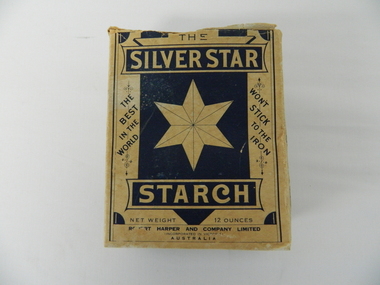
... Rural areas were deeply entrenched into colonial and the pioneer family structure viz- a-vie social and dress fashion standards. British values and norms lingered on well beyond the changes happening in city fashion. ...This brand of starch was first manufactured before 1966 and covered the period when Australian made was the preferred clothing due to limited imports from England. This was a period when the demand for "home grown" produce was at its peak. This was in a time when by necessity and ease of supply and not by the "Buy Australian" campaign (of later years), was the major factor for the demand of these type of laundry goods. It was in a time when starch was used in formal clothing to put a "crisp" or fresh new appearance for clothes. This product was in the era and importantly the social more of "clothes make the person" in which starched shirts and dresses was the fashion vogue. Formality of dress was a strictly British "class" up-man-ship which from the 1950's onwards became less and less visible. The Australian "Ocker" or fair "dink'm" bloke became more entrenched after World War II. The national identity was slowly developing.This box of starch is very relevant to the Kiewa Valley because this box highlights the differences ,in this period, between city and rural social standards. Rural areas were deeply entrenched into colonial and the pioneer family structure viz- a-vie social and dress fashion standards. British values and norms lingered on well beyond the changes happening in city fashion. Tradition and English "ties" were the backbone of early colonies and it was only after World War II that these "ties" were becoming irrelevant. Early traditions lingered well past the independence sought by Federation, colony to statehood and trade with other nations eg. USA and Asia. The idea that a change in "status" would automatically change the social mores of Australians, especially in rural ares, was not fully grasped by the "law makers" and those wanting change.This box (capacity 12 ozs) has white(aged into cream) and blue printing and a "white star" on five sides, the sixth side has a laundry scene with two ladies, in early 1900's fashion. The package is made from 200 gsm thick cardboard. As manufacture was made before and during the two World Wars 1914 to 1945 the promotion was heavily focused on Australian made and Australian grown maize. One side of the box has instructions of use and all the other sides are promotional, detailing "the best in the world and won't stick to the iron""SILVER STAR", "THE BEST IN THE WORLD", "WON'T STICK TO THE IRON", "REQUIRES NO BOILING", INSTRUCTIONS FOR USE", "ROBERT HARPER AND COMPANY LIMITED", "INCORPORATED IN VICTORIA, AUSTRALIA", "NET WEIGHT 12 OUNCES", "LARGE BOX 12 OZS"domestic laundry essentials, cotton clothing preparations, household starch "crisp and neat appearances. -
 Warrnambool and District Historical Society Inc.
Book, Woman's World, 1961
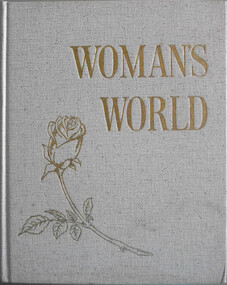
... The book is published prior to the granting of equal pay, affirmation of women's rights, acceptance of working mother and career woman as the norm . The book reinforces the socially accepted concept of the married homemaker and mother as perceived at the time, now the idealised concept is questioned. ...The book is published prior to the granting of equal pay, affirmation of women's rights, acceptance of working mother and career woman as the norm . The book reinforces the socially accepted concept of the married homemaker and mother as perceived at the time, now the idealised concept is questioned. ...Vintage Australian book for the homemaker c1958. The book is published prior to the granting of equal pay, affirmation of women's rights, acceptance of working mother and career woman as the norm . The book reinforces the socially accepted concept of the married homemaker and mother as perceived at the time, now the idealised concept is questioned. At the time of publication and reprints this book was envisaged to empower women. Whether' a teenager, career woman, a young married or mother' as a 'guide, philosopher, and friend' The editor Alleyne Jukes was born in Warrnambool to Charles and Mary Jukes of the Floral Farm, Warrnambool. She attended Braemar Grammar School and Warrnambool High School. She lived and worked in Melbourne as a journalist and secretary living in St Kilda and Elsternwick 1949, Bentleigh 1954, Oakleigh 1963. In 1961 she gathered together a number of writers and consultants to produce Woman's World, a book designed as the woman's Bible to enable her to have access to expert advice and information about home and outside work fields. The book was hailed at the time as the only work of its type produced entirely for Australian conditions and was an immediate success appealing to a wide range of readers. A similar subject book of smaller size and format has been sighted 'The People's Home Library', 1910 reprinted in 1923 by RC Barnum published by The Oceanic Publishing Company. A Library of three practical books, Medical 478 pp, Home Recipe 238 pp and Home Stock 315pp.This book is a guide for everything from how to answer a telephone correctly to sorting out marital problems. A reference guide for how to be a complete and successful young woman. Courses on Beauty, Fashion, Poise and Personality, Cooking,Every Wise Woman, Love and Marriage, The Home, The Family and Interests and Hobbies. This book has significance for Warrnambool as Alleyne Jukes was born in Warrnambool and has strong family connections to the district.A hardback reference book 'Woman's World' with a cream vinyl binding of flecked fabric outside cover and spine. Gold gilt lettering for the title and a gold gilt rose motif on the front; gold gilt lettering and publisher's name on the spine; plain back cover. The endpapers are repeated of black and white pen ink drawings showing the roles of women on varying splashes of a vairety of mono-coloured backgrounds. A general index on page 602 plus cooking index page 606 and dressmaking and sewing index page 607. The 607 pages are printed on thick, gloss white paper for 64 pages and coarser, white matt paper for the remainder. The table of contents lists a pictorial Introduction and nine chapters (courses) 'that is a 'bible' to the woman 'cares' and is vital to her as her femininity'. The editor has a heading "WOMAN" The Unacknowledged Specialist" and signed with her printed signature...Alleyne Jukes.' No dedication included although a text from Proverbs 31:10-31 (The Capable Wife)alleyne m jukes, woman, self improvement, 'bible', warrnambool -
 Buninyong & District Historical Society
Photograph - Copy of B&W photo, Buninyong Scouts and Cubs, standing on Holy Trinity Church tennis courts, 1930's, Buninyong Scouts and Cubs, standing on Holy Trinity Church tennis courts, 1930's
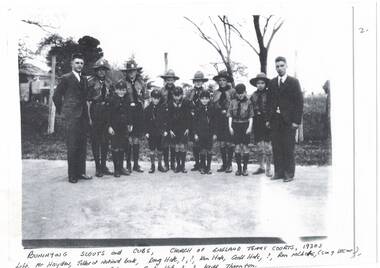
... historic, social, people Buninyong Holy Trinity Anglican Church tennis court Boy Scouts Cubs Hale Hayden Nichols Thornton "Buninyong Scouts & Cubs, Church of England tennis courts, 1930's Left, Mr Hayden, Teller at National Bank, Doug Hale, ?, ?, Ken HAle, ?, Ron Nichols (son of Vicar), Norm ...historic, social, peopleBuninyong Scouts and Cubs, standing on Holy Trinity Church tennis courts, 1930's"Buninyong Scouts & Cubs, Church of England tennis courts, 1930's Left, Mr Hayden, Teller at National Bank, Doug Hale, ?, ?, Ken HAle, ?, Ron Nichols (son of Vicar), Norm Thornton, Cubs - Gordon Hale, ?, ?, Keith Thornton."buninyong, holy trinity anglican church, tennis court, boy scouts, cubs, hale, hayden, nichols, thornton -
 Bendigo Historical Society Inc.
Newspaper - Bendigo Advertiser Article - Rowing for 150 years, Sat 04 June 2022
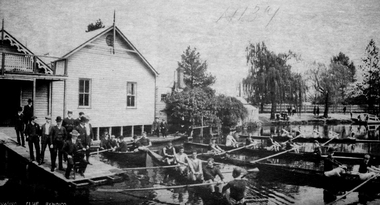
... norms in sport. Key athletes such as Hannah Every-Hall and Neville Howell have played significant roles in the club's development and reputation. The club emphasizes inclusivity, welcoming juniors, women, men, and masters, and fostering a family-friendly, socially responsible culture.The ethos of volunteerism and community connection is central to the club's identity and future aspirations. ...norms in sport. Key athletes such as Hannah Every-Hall and Neville Howell have played significant roles in the club's development and reputation. The club emphasizes inclusivity, welcoming juniors, women, men, and masters, and fostering a family-friendly, socially responsible culture.The ethos of volunteerism and community connection is central to the club's identity and future aspirations. ...Rowing was introduced to Bendigo in 1872 by John Godfrey, who built the first wooden skiff and promoted the sport locally. The Sandhurst and Bendigo Rowing Clubs were formed in 1873, with Lake Weeroona's creation in 1879 providing a permanent home for the club. BRC members have competed nationally and internationally, including at the Commonwealth and Olympic Games. Notable achievements include women from Bendigo winning the Henley on the Maribyrnong three years in a row during the 1930s, challenging gender norms in sport. Key athletes such as Hannah Every-Hall and Neville Howell have played significant roles in the club's development and reputation. The club emphasizes inclusivity, welcoming juniors, women, men, and masters, and fostering a family-friendly, socially responsible culture.The ethos of volunteerism and community connection is central to the club's identity and future aspirations. The club has survived challenges such as droughts, wars, and the COVID-19 pandemic, consistently adapting and continuing its activities. Physical mementos and historical relics are preserved and celebrated, especially during milestone events like the 150th anniversary. 1872 the First skiff built and rowing demonstrated in Bendigo.1879: Lake Weeroona created.1927: Club officially named Bendigo Rowing Club.1969: Revitalization led by Olympic gold medallist Neville Howell.1992: Jason Day represents Australia at the Barcelona Olympics.2012: Hannah Every-Hall competes at the London Olympics.2022: 150th anniversary celebration.Bendigo Advertiser Article - Rowing for 150 years, Sat 04 June 2022, by Anthony Pinder This item contains the following documents: 3486.61a Colour photo of current Bendigo Rowing Club President Lynda Davis and Jesse Sherwood in the club rooms 3486.61b Colour photo of four members in a kayak 3486.61c Colour photo of Livia Rosaia exercising 3486.61d Black and white photo of the Bendigo Rowers in 1905 at the old sheds which were situated at the Nolan St end of Lake Weeroona 3486.61e Bendigo Advertiser Article - Rowing for 150 years bendigo, bendigo rowing club, john godfrey, lake weeroona -
 Bendigo Historical Society Inc.
Document - R.S.L. BENDIGO COLLECTION: ANNUAL VICTORY BALL 1948, 17th August, 1948
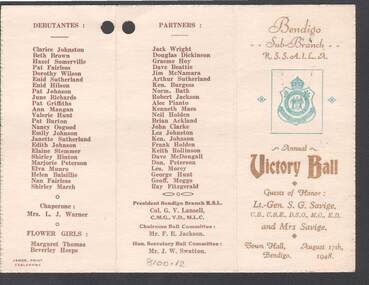
... Social...Victory Ball...R.S.L. Bendigo Collection - Annual Victory Ball 1948... Lt-Gen S G Savige... Mrs Savige... Clarice Johnston... Beth Brown... Hazel Somerville... Pat Fairless... Dorothy Wilson... Enid Sutherland... Enid Hilson... Pat Johnson... June Richards... Pat Griffiths... Ann Mangan... valerie Hunt... Pat Burton... Nancy Osgood... Emily Johnson... Janette Sutherland... Edith Johnson... Elaine Stemmer... Shirley Hinton... Marjorie Peterson... Elva Munro... Helen Balsillie... Nan Fairless... Shirley March... Mrs L J Warner... Margaret Thomas... Beverley Heeps... James... jack Wright... Douglas Dickinson... Graeme Hoy... Dave Beattie... Jim McNamara... Arthur Sutherland... Ken Burgess... Norm...Social Victory Ball R.S.L. Bendigo Collection - Annual Victory Ball 1948 Lt-Gen S G Savige Mrs Savige Clarice Johnston Beth Brown Hazel Somerville Pat Fairless Dorothy Wilson Enid Sutherland Enid Hilson Pat Johnson June Richards Pat Griffiths Ann Mangan valerie Hunt Pat Burton Nancy Osgood Emily Johnson Janette Sutherland Edith Johnson Elaine Stemmer Shirley Hinton Marjorie Peterson Elva Munro Helen Balsillie Nan Fairless Shirley March Mrs L J Warner Margaret Thomas Beverley Heeps James jack Wright Douglas Dickinson Graeme Hoy Dave Beattie Jim McNamara Arthur Sutherland Ken Burgess Norm Fath Robert Jackson Alec Pianto Kenneth Maes Neil Holden Brian Ackland John Clarke Les Johnstone Ken Johnson Frank Holden Keith Rollinson Dave McDougall Don Peterson Les Morey George Hunt Geoff Meggs Ray Fitzgerald Col G V Lansell Mr F E Jackson Mr J W Swatton James, Print Eaglehawk Three copies of Bendigo Sub-branch R.S.S.A.I.L.A. ...Three copies of Bendigo Sub-branch R.S.S.A.I.L.A. Annual Victory Ball held at the Town Hall, Bendigo on August 17th, 1948. Guests of Honour were Lt.-Gen. S. G. Savige, C.B., C.B.E., D.S.O., M.C., E.D. AND Mrs Savige. Card is cream with gold print on the front and a blue RLS badge. Other printing is brown. The inside of the tri-fold has a Dance Program of 28 dances and a space for Autographs. The other side has the Debutantes: Clarice Johnston, Beth Brown, Hazel Somerville, Pat Fairless, Dorothy Wilson, Enid Sutherland, Enid Hilson, Pat Johnson, June Richards, Pat Griffiths, Ann Mangan, Valerie Hunt, Pat Burton, Nancy Osgood, Emily Johnson, Janette Sutherland, Edith Johnson, Elaine Stemmer, Shirley Hinton, Marjorie Peterson, Elva Munro, Helen Balsillie, Nan Fairless and Shirley March. Chaperone:Mrs L J Warner. Flower Girls: Margaret Thomas and Beverley Heeps. Partners: Jack Wright, Douglas Dickinson, Graeme Hoy, Dave Beattie, Jim McNamara, Arthur Sutherland, Ken Burgess, Norm Fath, Robert Jackson, Alec Pianto, Kenneth Maes, Neil Holden, Brian Ackland, John Clarke, Les Johnstone, Ken Johnson, Frank Holden, Keith Rollinson, Dave McDougall, Don Peterson, Les Morey, George Hunt, Geoff Meggs and Ray Fitzgerald. President Bendigo Branch R.S.L. Col G V Lansell. Chairman Ball Committee: Mr F E Jackson. Hon. Secretary Ball Committee: Mr J W Swatton. Printed by James, Print, Eaglehawk.James, Print Eaglehawkevent, social, victory ball, r.s.l. bendigo collection - annual victory ball 1948, lt-gen s g savige, mrs savige, clarice johnston, beth brown, hazel somerville, pat fairless, dorothy wilson, enid sutherland, enid hilson, pat johnson, june richards, pat griffiths, ann mangan, valerie hunt, pat burton, nancy osgood, emily johnson, janette sutherland, edith johnson, elaine stemmer, shirley hinton, marjorie peterson, elva munro, helen balsillie, nan fairless, shirley march, mrs l j warner, margaret thomas, beverley heeps, james, jack wright, douglas dickinson, graeme hoy, dave beattie, jim mcnamara, arthur sutherland, ken burgess, norm fath, robert jackson, alec pianto, kenneth maes, neil holden, brian ackland, john clarke, les johnstone, ken johnson, frank holden, keith rollinson, dave mcdougall, don peterson, les morey, george hunt, geoff meggs, ray fitzgerald, col g v lansell, mr f e jackson, mr j w swatton -
 Bendigo Historical Society Inc.
Photograph - NORM GILLIES COLLECTION: PHOTOGRAPH BUCHRABANYULE HALL 1909
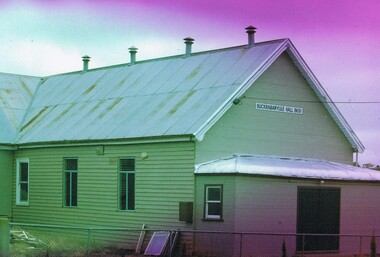
... Buchrabanyule Hall Norm gillies Photograph Buchrabanyule Hall 1909 Rear hand written note: the Gillies family attended social functions at this hall damaged print with purple hue Photograph NORM GILLIES COLLECTION: PHOTOGRAPH BUCHRABANYULE HALL 1909 ...Photograph Buchrabanyule Hall 1909 Rear hand written note: the Gillies family attended social functions at this hall damaged print with purple huebuchrabanyule hall, norm gillies -
 Bendigo Historical Society Inc.
Photograph - NORM GILLIES COLLECTION: COLOURED PHOTOGRAPH GLENLOTH HOTEL
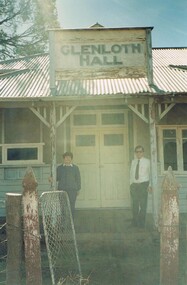
... Glenloth Hotel Norm Gillies Collection Coloured photograph man & woman at old Glenloth Hotel, closed rear of photo notes the hotel was the site of Gillies social gatherings Photograph NORM GILLIES COLLECTION: COLOURED PHOTOGRAPH GLENLOTH HOTEL ...Coloured photograph man & woman at old Glenloth Hotel, closed rear of photo notes the hotel was the site of Gillies social gatheringsglenloth hotel, norm gillies collection -
 Narre Warren and District Family History Group
Book, Rosalind David et al, Two remarkable women : Frances Fitzgerald Fawkner & Sara 'Sally' Rainforth, 2013
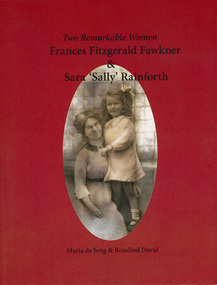
... This intriguing double biography shows how women's lives are shaped by society's expectations and how social norms have changed. The book follows the lives of two strong women - Frances Fitzgerald Fawkner and Sara 'Sally' Rainforth"--Back cover. 177 p. ..."Melbourne in the 1890s - women can't vote and unmarried mothers are social outcasts. Frances, a young journalist, believes in equal rights for women and their right to have children outside of wedlock. In 1905, pregnant and alone, she boards a steamship for London. Closely intertwined with the lives of Frances and her daughter Sally are the lives of Frances' best friend Ethel and her husband, author Charles Chomley ... As an adult in rural Wales, Frances' daughter Sally must learn to reconcile the past, her origins, and the loss of loves ones. Gardening becomes her passion. This intriguing double biography shows how women's lives are shaped by society's expectations and how social norms have changed. The book follows the lives of two strong women - Frances Fitzgerald Fawkner and Sara 'Sally' Rainforth"--Back cover.177 p.non-fiction"Melbourne in the 1890s - women can't vote and unmarried mothers are social outcasts. Frances, a young journalist, believes in equal rights for women and their right to have children outside of wedlock. In 1905, pregnant and alone, she boards a steamship for London. Closely intertwined with the lives of Frances and her daughter Sally are the lives of Frances' best friend Ethel and her husband, author Charles Chomley ... As an adult in rural Wales, Frances' daughter Sally must learn to reconcile the past, her origins, and the loss of loves ones. Gardening becomes her passion. This intriguing double biography shows how women's lives are shaped by society's expectations and how social norms have changed. The book follows the lives of two strong women - Frances Fitzgerald Fawkner and Sara 'Sally' Rainforth"--Back cover.berwick (vic.), frances elmes, frances fitzgerald fawkner, sara 'sally' rainforth, charles chomley, ethel a'beckett, dr thomas elmes -
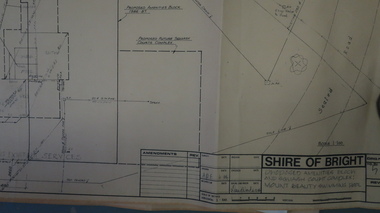 Kiewa Valley Historical Society
Plans - Mt Beauty Swimming Pool & Amenities Building, Mt Beauty Swimming Pool & Amenities Building by Shire of Bright
... History of swimming for the Kiewa Valley community and its affect on the following - social, education, and tourism mt beauty swimming pool squash court shire of bright On back of the 6th plan in red pen "Roger Sorry Delay / Getting Plans Back / Norm Boden" 6 large pages of black print on yellowed paper. ...Mt Beauty's Swimming Pool was built by Alpine Shire and included a Squash Court. October 1986. Previously the community swam in the West and East Kiewa Rivers. The pool enabled all of the community to swim in a safe area and the opportunity to swim long distances.History of swimming for the Kiewa Valley community and its affect on the following - social, education, and tourism6 large pages of black print on yellowed paper. Dated October 1986 and includes plans for the Mt Beauty Swimming Pool and a Squash Court.On back of the 6th plan in red pen "Roger Sorry Delay / Getting Plans Back / Norm Boden"mt beauty, swimming pool, squash court, shire of bright
