
Showing 6 items matching "soda bottle australia"
-
 Flagstaff Hill Maritime Museum and Village
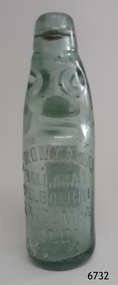
Domestic object - Codd neck bottle, E. Rowlands, 1921
... ...soda bottle australia...Australia that allowed their workers and the towns they were situated in to prosper and develop into what they are today. A good example of hand blown glass. flagstaff hill warrnambool shipwrecked-coast flagstaff-hill flagstaff-hill-maritime-museum maritime-museum shipwreck-coast flagstaff-hill-maritime-village bottle codd bottle hiram codd glass marble bottle e. rowlands bottle manufacturer soda bottle australia early recyclable bottle codd's patent bottle marble bottle refreshments soda water marble top 1920s codd patent 702 handmade blown "E. ...The design of the bottle is called a Codd, sometimes referred to as a marble bottle or "Codd's patent bottle". During the mid-to-late 1800s, there were many inventions to keep the fizz in carbonated drinks such as ginger ale, soda water, and fruit drinks. Hiram Codd, an English engineer invented a successful process that he patented as "Codd's patented globe stopper bottle" in 1872. The Codd-neck bottle (commonly called Codd or marble bottle) is manufactured in two parts. The body of the bottle is cast in two sections. At the time of joining the sections, glass marble and rubber seal are inserted into the neck section. The lip is then applied to the top of the bottle. The Codd bottle is filled upside down as the pressure of the gas from the carbonated liquid holds the marble up and out of the way. When the bottle stands upright the gas pushes the marble up against the washer, creating a firm seal to keep the fizz inside. The bottle is opened by pushing the marble down firmly to allow some of the gas to escape. The marble drops down and is caught in a depression formed in the neck. When the bottle is tilted to pour or drink the liquid the marble rests in a dimple. Two Ballarat miners, Evan Rowland and Robert Lewis started manufacturing mineral and aerated waters, bitters, cordials, and liqueurs in 1854, in a tent on the shores of Lake Wendouree Ballarat. Another 13 firms at that time employed manual operations, whereas they introduced Taylor's No. 1 machine that speeded up the process and laid the foundation for their fortune. Evan Rowland was a pioneer in the aerated water trade in Australia. He was born on August 2, 1826, in North Wales. In 1852, during the gold rush, he emigrated to Melbourne, and in 1854 he went to Ballarat and formed a partnership with Robert Lewis, the firm being called ‘‘Rowlands & Lewis’’. Their next step was to secure a supply of pure water. Using mineral Waters that they found via a natural spring at Warrenheip, Victoria. From the outset, the beverages made from this water gained repute and were in great demand. Their business prospered so well that in 1858 they were able to build a factory at the corner of Sturt and Dawson Streets, Ballarat, and to fit with the most up-to-date machinery then in use. By 1870 their business had increased so much and demand had grown to such an extent that Mr. Rowlands erected another factory, covering over an acre of ground at the corner of Dana and Doveton Streets, costing £13,000. The factory was fitted with the most modern equipment of the time to manufacture cordials and aerated water. In 1873 Rowlands established an agency at 116 Collins St, Melbourne, because the demand for the products of the Melbourne factory became so large. The company expanded to Sydney opening a factory at the corner of Burns & Hay Streets Darling Harbour obtaining spring water to supply this plant from Katoomba in the Blue Mountains. The water was brought to Sydney by rail. In the meantime, the Melbourne concern had progressed so rapidly that in 1888 a magnificent factory embodying all the latest ideas and equipment was built in King Street Melbourne. Robert Lewis was a fellow Welshman born in 1816, and he arrived in Port Phillip in 1853 and became a partner in the early day with Evan Rowland but with lesser and shorter involvement in the firm, from which he retired in 1876. Robert Lewis was perhaps better known as Ballarat's first mayor and a Member of the Legislative Assembly. He was a strong supporter of local charities, president/treasurer of the Eisteddfod Committee, a major force in the development of the Ballarat Hospital, and he was the mayor of Ballarat five times, the first in 1863, (having been a counsellor as early as 1859) and for the last time in 1881. Lewis died in 1884 of a stroke in Ballarat. Rowlands continued in the firm and invented and patented an improved soda water bottle. The water used in Rowlands products was filtered four times but his attempts to use local corks failed on quality grounds. He was a stickler for quality, which was so good that many outside Victoria were prepared to pay the 'premium' imposed by inter-colonial customs duty payable at that time. By the 1890s, Rowlands had factories in Ballarat, Melbourne, Sydney, and Newcastle. He died in 1894 but his company continued until well after the Second World War when it was sold to Schweppes. Bottles such as this popular brand, containing soda water, were often used on paddle steamers for refreshments.An early manufacturing process producing the first mineral waters in Australia was invented and developed by an early Welsh migrant to Australia. The Evan Rowlands story gives an insight into the early development of manufacturing industries in Australia that allowed their workers and the towns they were situated in to prosper and develop into what they are today. A good example of hand blown glass.Bottle; clear glass Codd neck bottle with small marble in top. Once contained soda water or soft drink. Manufactured in 1921 by E. Rowlands of Ballarat, Melbourne, Katoomba and Sydney. The bottle is 'recyclable' - the message on the base says that it remains the property of E. Rowlands Pty Ltd. Inscriptions on three adhesive labels at time of donation"E. ROWLANDS BALLARAT MELBOURNE KATOOMBA AND SYDNEY". Imprinted into bas "1921" "THIS BOTTLE REMAINS THE PROPERTY OF E. ROWLANDS PTY LTD" On adhesive labels (3) " 1921 ON BASE (LASTED 1924) CODD PATENT 702" "SMALL SIZE. MARBLE TOP SODA WATER PAPER LABEL. USED" "ON PADDLE STEAMERS. POPULAR BRAND"flagstaff hill, warrnambool, shipwrecked-coast, flagstaff-hill, flagstaff-hill-maritime-museum, maritime-museum, shipwreck-coast, flagstaff-hill-maritime-village, bottle, codd bottle, hiram codd, glass marble bottle, e. rowlands bottle manufacturer, soda bottle australia, early recyclable bottle, codd's patent bottle, marble bottle, refreshments, soda water, marble top, 1920s, codd patent 702, handmade, blown -
 Bendigo Historical Society Inc.
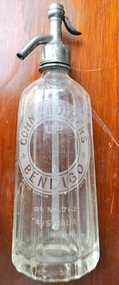
Functional object - COHN BROTHERS COLLECTION: COHN BROTHERS SODA SYPHON
... soda syphon made from clear colourless glass with a silver metal levered syphon top. The glass is etched with a circular label. The Label has the words 'COHN BROTHERS BENDIGO' arranged in a circular manner. In the Centre of the Circular label the Letters 'LT.D.' are also etched. Underneath the Main label are The Words 'British Syphon London' arranged in a circular form. The Sign 'Rg. No. 762, Australia' is also etched into the glass under the main label. The bottle...Bottles soda syphon Cohns Cohns Soda Syphon. This is a soda syphon made from clear colourless glass with a silver metal levered syphon top. The glass is etched with a circular label. The Label has the words 'COHN BROTHERS BENDIGO' arranged in a circular manner. In the Centre of the Circular label the Letters 'LT.D.' are also etched. Underneath the Main label are The Words 'British Syphon London' arranged in a circular form. The Sign 'Rg. No. 762, Australia ...Cohns Soda Syphon. This is a soda syphon made from clear colourless glass with a silver metal levered syphon top. The glass is etched with a circular label. The Label has the words 'COHN BROTHERS BENDIGO' arranged in a circular manner. In the Centre of the Circular label the Letters 'LT.D.' are also etched. Underneath the Main label are The Words 'British Syphon London' arranged in a circular form. The Sign 'Rg. No. 762, Australia' is also etched into the glass under the main label. The bottle has a 'fluted' shape and tapers towards the top. It is approximately 1 litre capacity diameter of the base is approx 80mm and height 350m. On the base of the syphon is a Trade Mark that appears to be a Hot air balloon or maybe a light bulb? Housed in wooden Cohns Soft-Drink crate Item # 7322Cohnsfood technology, bottles, soda syphon -
 Warrnambool and District Historical Society Inc.
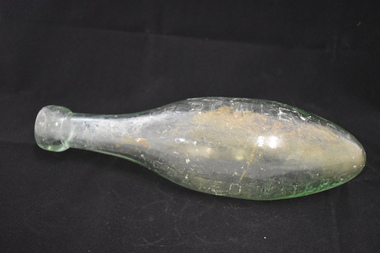
Bottle, S Rowley, Late 19th century
... As the bottle had to lie on its side the soda was kept in contact with the cork and stopped the cork from shrinking and causing loss of pressure. This bottle comes from the Warrnambool aerated waters factory of John Searle Rowley (1837-1893). John Rowley, born in England, came to Australia...As the bottle had to lie on its side the soda was kept in contact with the cork and stopped the cork from shrinking and causing loss of pressure. This bottle comes from the Warrnambool aerated waters factory of John Searle Rowley (1837-1893). John Rowley, born in England, came to Australia ...This bottle was known as a torpedo bottle. As the bottle had to lie on its side the soda was kept in contact with the cork and stopped the cork from shrinking and causing loss of pressure. This bottle comes from the Warrnambool aerated waters factory of John Searle Rowley (1837-1893). John Rowley, born in England, came to Australia in 1856 and in 1865 he opened a branch of the Geelong Corio Brewery at the corner of Timor and Banyan Streets in Warrnambool, bottling the beer, not brewing it. In 1870 this business was closed and Rowley developed his soft drinks business which he had established in 1868. In 1872 the business was called the Warrnambool Steam Aerated Works when a steam engine was purchased from Melbourne. In 1872 the factory was turning out 600 dozen bottles a day. By the 1880s the factory was occupying half an acre of land, was employing 13 people and manufacturing 20 varieties of drinks. Rowley died in 1893. He had been active in community affairs, serving four years on the Warrnambool Council and on the committees of the Warrnambool Hospital and the Mechanics Institute. This bottle is of great interest as it comes from the factory of the prominent 19th century Warrnambool aerated waters manufacturer, John Rowley. Few of his bottles have survived today. Cordial and soft drinks manufacturing was an important industry in Warrnambool for over 100 years and John Rowley was a key figure in this industry.This is a glass bottle, tinted green. The body of the bottle has an oval shape tapering to a point at the end and is known as a torpedo bottle. It can only be stored lying on its side. The neck of the bottle ends with a moulded glass top. There is no stopper. The bottle is slightly discoloured inside. The information on the maker is embossed into the body of the bottle.‘J.S. Rowley’s Aerated Waters Timor Street Warrnambool’john searle rowley, cordial manufacturers in warrnambool, history of warrnambool -
 Sunshine and District Historical Society Incorporated
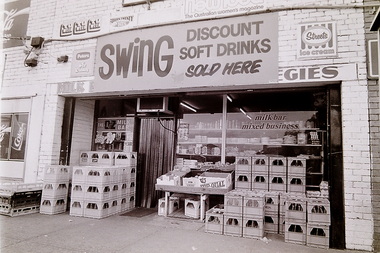
Photograph - Main Rd East Cnr McArthur St Shops St. Albans, The Advocate, 1991
... SWING was a local Australian soft‑drink company, likely family‑run, producing Lemonade, Cola, Orange, Portello, Creamy soda and other classic flavours of the era. SWING operated during the peak era of small bottlers...SWING was a local Australian soft‑drink company, likely family‑run, producing Lemonade, Cola, Orange, Portello, Creamy soda and other classic flavours of the era. SWING operated during the peak era of small bottlers ...This local milk bar & mixed business was the local SWING Soft Drinks distributor. SWING was a local Australian soft‑drink company, likely family‑run, producing Lemonade, Cola, Orange, Portello, Creamy soda and other classic flavours of the era. SWING operated during the peak era of small bottlers (1950s–1970s), when nearly every town had its own soft‑drink works. These small manufacturers disappeared during the industry collapse of the 1980's and 1990's, when Coca‑Cola, Pepsi, and Schweppes bought out or out‑competed most independents.This photographs captures the demand for the local SWING soft drinks in the early 1990's.5663 - Main Rd East Cnr McArthur St Shops 1991 (Sun Adv 485) Photo 01.JPGmain road east, mcarthur street, st. albans, swing -
 Wodonga & District Historical Society Inc
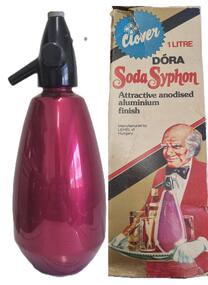
Domestic object - Clover "Dora" Soda Syphon
... soda water. It was also called a Seltzer bottle. The modern syphon was created in 1829 by two Frenchmen. They became very popular in the 1920s and 1930s and although they became less common after World War II there was a later resurgence with the desire for people to produce their own beverages at home. The Dóra soda syphon was manufactured by Lehel of Hungary located in the city of Jászberény. Lehel was the largest Hungarian appliance company, focusing on refrigerators and other kitchen appliances. This model was first produced in 1971. In 1972 Australia...soda water. It was also called a Seltzer bottle. The modern syphon was created in 1829 by two Frenchmen. They became very popular in the 1920s and 1930s and although they became less common after World War II there was a later resurgence with the desire for people to produce their own beverages at home. The Dóra soda syphon was manufactured by Lehel of Hungary located in the city of Jászberény. Lehel was the largest Hungarian appliance company, focusing on refrigerators and other kitchen appliances. This model was first produced in 1971. In 1972 Australia ...A soda syphon is a device designed to dispense carbonated or soda water. It was also called a Seltzer bottle. The modern syphon was created in 1829 by two Frenchmen. They became very popular in the 1920s and 1930s and although they became less common after World War II there was a later resurgence with the desire for people to produce their own beverages at home. The Dóra soda syphon was manufactured by Lehel of Hungary located in the city of Jászberény. Lehel was the largest Hungarian appliance company, focusing on refrigerators and other kitchen appliances. This model was first produced in 1971. In 1972 Australia became Lehel’s newest market. In Australia they were marketed as Clover soda syphons and distributed by the Lark Trading Co Pty Ltd. In 1991 Lehel was acquired by Electrolux.This item is significant because soda syphons were commonly used through Australia and the Wodonga district from1930s onwards. A carboard box containing an anodised aluminium soda syphon. The box features and image of a soda syphon on one side and another image of a butler serving drinks with a soda syphon on tray on the reverse. It includes a box of 10 replacement soda bulbs and a folded pamphlet of information and instructions.Box Front Clover 1 LITRE DÓRA Soda Syphon Attractive anodised aluminium finish Manufactured by LEHEL of Hungary Box Back Clover DÓRA Soda Syphon High quality Complete 12 month warranty Spare parts and accessories includedsoda syphons, domestic items -
 Whitehorse Historical Society Inc.
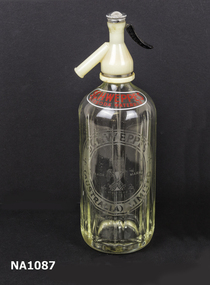
Domestic object - Bottle
... Soda Water'. Etched on bottle 'Schweppes Australia Limited' 'Trade Mark'...GLASS TECHNOLOGY Bottles 'Schweppes - 30 fl. Oz. Soda Water'. Etched on bottle 'Schweppes Australia Limited' 'Trade Mark' Glass soda bottle with lid acting as dispenser Domestic object Bottle ...Glass soda bottle with lid acting as dispenser'Schweppes - 30 fl. Oz. Soda Water'. Etched on bottle 'Schweppes Australia Limited' 'Trade Mark'glass technology, bottles
