
Showing 6 items matching "soldier's own diary"
-
 Magnet Galleries Melbourne Inc
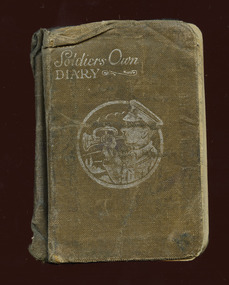
Soldier's own diary, robertson thomas185.tif
... Soldier's own diary......soldier's own diary...ww1 world war 1 aif A.I.F soldier's own diary diary Front of soldier's diary robertson thomas185.tif Soldier's own diary ...Front of soldier's diaryww1, world war 1, aif, a.i.f, soldier's own diary, diary -
 Mont De Lancey
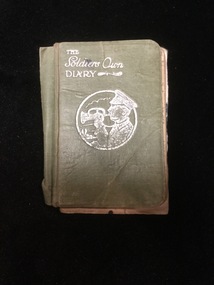
Diary, The Soldier’s own diary, c1918
... The Soldier’s own diary. ...The Soldier's Own diary. Small diary with green cover with soldier blowing trumpet on the front cover....The Soldier’s own diary. Diary ...Belonged to Ebenezer GrayThe Soldier's Own diary. Small diary with green cover with soldier blowing trumpet on the front cover."Solider's own diary" embossed in silver.diaries -
 Flagstaff Hill Maritime Museum and Village
Book - Mariner's Pocket Book, Captain John Budge Murray, circa 1881 - 1887
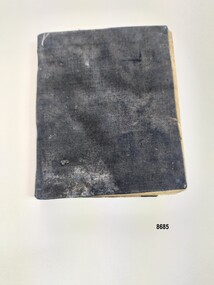
... owned by Master Mariner John Budge Murray. It is 119 pages long and contains a mix of detailed navigational calculations and lessons, diary entries, drill commands for soldiers "On Parade" and personal jottings. ...owned by Master Mariner John Budge Murray. It is 119 pages long and contains a mix of detailed navigational calculations and lessons, diary entries, drill commands for soldiers "On Parade" and personal jottings. ...This is a small pocketbook owned by Master Mariner John Budge Murray. It is 119 pages long and contains a mix of detailed navigational calculations and lessons, diary entries, drill commands for soldiers "On Parade" and personal jottings. The dates in the notebook span the years from 1881 to 1887 and mention trips from Hong Kong to Singapore, Galle, Colombo, the Suez Canal, Aden, Port Said, Malta, Gibraltar and London. Two of the ships mentioned include the S. S. Bangalore and the S. S. Assam - both belonged to the "Peninsula and Oriental Steam Navigation Company" (later known as the P&O Line). John Budge Murray was born in 1847 at Olrig, Caithness in Scotland. During the course of his career, he was a merchant marine employed by the Peninsula and Oriental Steam Navigation Company (better known as P&O) and also became a master mariner and Captain serving in the Chinese Naval Service. When he married in 1888, his marriage certificate listed his occupation as "Captain in the Chinese Naval Service". Family records show his sister describing him as "commanding three frigates in the South China Sea - allegedly chasing pirates!" His obituary in the "John O'Groat Journal" in 1910 said he was "one of the original contingent of Britons who served as officers in the Chinese Fleet ...it was they who cleared the Chinese seas of the pirates who infected them." It went on to say "Captain Murray was brave even to the most reckless exposure of his life and ... the Chinese crews had explicit faith in him." John Murray and his wife Jessie had four children and by 1901 were living on a farm at Aucorn in Caithness. One of his sons (also called John Budge Murray) immigrated to Australia and joined the 8th Battalion, AIF (Australia Imperial Force) in 1915 and was killed in France in August 1918. Captain Murray died at Olrig in 1910. In 1840 the Peninsula Steam Navigation Company won a contract for the mail service between the U.K. and Egypt. They expanded their operations to include mail contracts to Alexandria, from Suez to Ceylon, Madras and Calcutta and in 1845 further expanded their operations to Shanghai. Steam communication with Australia was inaugurated in 1852 and in 1854 the Bombay Mail Service passed from the East India Company to P&O. By 1884 P&O's fleet contained fifty ships including the S.S. Assam and S.S. Bangalore - both are mentioned in Captain Murray's pocketbook. In 1882 the S.S. Bangalore was operating in the Bombay / Far East mail service and had made several trips in 1876 between Bombay and Melbourne. In 1875, the Qing Dynasty began to establish a modern Imperial Navy. They ordered a series of warships from Britain and Germany. Two of these ships (the Chaoyong and the Yangwoi) were built at the Tyne shipyards and sailed to China in 1881. They also needed to improve the skills of their naval personnel, and some skilled officers were recruited from Britain. This pocketbook is a significant example of a Master Mariner's everyday working pocketbook. It is also an important object as it belonged to a Scottish Master Mariner who held the unusual position as an officer in the Chinese Naval Fleet.A Master Mariner's small pocket-sized notebook. It has a black cover, 119 pages and contains a mix of navigational records, personal addresses, diary type entries and personal jottings in ink and pencil.First page - "John Budge Murray/Aucorn /Bower/ J. B. Murray/John B/ John B Murray/ Aucorn"flagstaff hill maritime museum and village, great ocean road, captain john budge murray, captain murray, master mariner, navigational calculations, ships log, pocketbook, peninsula and oriental steam navigation company, p&o, s.s. bangalore, s.s. assam, drill commands, chinese naval service, qing dynasty, south china sea -
 Bendigo Military Museum
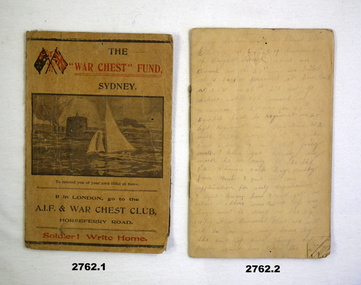
Mixed media - BOOKLET & DIARY WW1, The War Chest Fund, Sydney, 1919
... documents - diaries military history - army Passchendaele barracks trust "The War Chest Fund, Sydney To remind you of your own folks at home If in London, go to the AIR & War chest Club, Horseferry Club Soldier Write Home" .1) Booklet, cardboard cover with black & white print, on cover illustrated yacht on water with black / red print. ....1) Booklet, cardboard cover with black & white print, on cover illustrated yacht on water with black / red print. Australian flag & Union Jack calendar on back cover 1918 - 1919. .2) Handwritten in pencil, diary, 10 pages."The War Chest Fund, Sydney To remind you of your own folks at home If in London, go to the AIR & War chest Club, Horseferry Club Soldier Write Home"documents - diaries, military history - army, passchendaele barracks trust -
 Narre Warren and District Family History Group
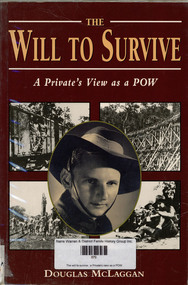
Book, Douglas McLaggan, The will to survive : a Private's view as a POW, 1995
... It shows the young private soldier's viewpoint of the POW experience; of the mateship, humour and above all the courage and determination and willpower to live under circumstances ranking among the the most appalling of the 20th century. Even during the most trying periods, McLaggan risked his own security by keeping a meticulous diary ...This book is about the life and times of Doug McLaggan starting with the vanished era of the 1920s and 1930s, which led up to the Second World War in which so many youngsters eagerly enlisted. McLaggan among them, saw action only briefly before becoming a POW after the fall of Singapore. It shows the young private soldier's viewpoint of the POW experience; of the mateship, humour and above all the courage and determination and willpower to live under circumstances ranking among the the most appalling of the 20th century. Even during the most trying periods, McLaggan risked his own security by keeping a meticulous diary. From these diaries emerges an extraordinary account of one man's will to survive when men unfit to work on the railway were so cruelly treated by the Japanese engineers in charge of its construction. The story of the POWs under the Japanese has been told before, but McLaggan's account, simply and honestly told, combined with his often forthright views makes this a fascinating and moving story of an ordinary man faced with an extraordinary test of body and mind. (Back cover)non-fictionThis book is about the life and times of Doug McLaggan starting with the vanished era of the 1920s and 1930s, which led up to the Second World War in which so many youngsters eagerly enlisted. McLaggan among them, saw action only briefly before becoming a POW after the fall of Singapore. It shows the young private soldier's viewpoint of the POW experience; of the mateship, humour and above all the courage and determination and willpower to live under circumstances ranking among the the most appalling of the 20th century. Even during the most trying periods, McLaggan risked his own security by keeping a meticulous diary. From these diaries emerges an extraordinary account of one man's will to survive when men unfit to work on the railway were so cruelly treated by the Japanese engineers in charge of its construction. The story of the POWs under the Japanese has been told before, but McLaggan's account, simply and honestly told, combined with his often forthright views makes this a fascinating and moving story of an ordinary man faced with an extraordinary test of body and mind. (Back cover)doug mclaggan, world war 1939-1945, prisoners of war -
 Returned Nurses RSL Sub-branch
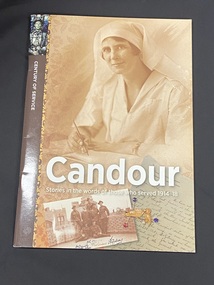
Book - Illustrated paperback book, Department of Veterans' Affairs, Canberra, Candour: stories in the words of those who served 1914-18, 2018
... Australian Army - military life World War 1914-1918 Military Nursing Military Service soldiers The Australian soldier and sailor frequently recorded in his diary or in his home-letters indications of the thoughts, hopes, and fears which were uppermost in his mind, and descriptions of his own and others' work and actions. ...The Australian soldier and sailor frequently recorded in his diary or in his home-letters indications of the thoughts, hopes, and fears which were uppermost in his mind, and descriptions of his own and others' work and actions. These papers are often the most valuable human documents....from cover.Staple-bound paperback book with a brown strip along the left side with an image of a soldier in stained glass at the top and 'century of service' printed sideways beneath it. The cover is a sepia toned portrait of an Army nurse with images of a letter, brooch and postcard at the bottom of the page. The title is printed in large white text just above the bottom images.non-fictionThe Australian soldier and sailor frequently recorded in his diary or in his home-letters indications of the thoughts, hopes, and fears which were uppermost in his mind, and descriptions of his own and others' work and actions. These papers are often the most valuable human documents....from cover. australian army - military life, world war 1914-1918, military nursing, military service, soldiers
