
Showing 5 items matching "soldiers-family relationships"
-
 Returned Nurses RSL Sub-branch
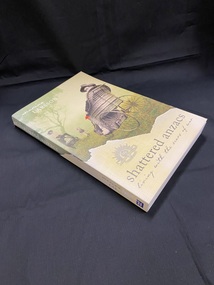
Book - Paperback book, University of New South Wales Press, Shattered ANZACs: living with the scars of war, 2009
... ...soldiers-family relationships...Australian and New Zealand Army Corps War veterans disabled veterans Australia soldiers-family relationships post-traumatic stress disorder social aspects of war psycholgical aspects of war WW1 WWI First World War World War 1914-1918 Living with the Scars of War tells the untold story of thousands of Australian families who welcomed home disabled soldiers after the First World War. ...Living with the Scars of War tells the untold story of thousands of Australian families who welcomed home disabled soldiers after the First World War. It offers a poignant account of the impact of physical injury and shell shock upon returned soldiers, and explores the profound and lasting consequences of disablement for their kin in the 1920s and 1930s. Drawing the reader into the emotional interior of family life, it evocatively brings to light the daily struggles of Australia's 90,000 'changed men', and reveals the significant burdens carried by their family members--Provided by publisher.Cover design wraps around the spine and both covers. Lower section is a pale yellow/white colour with silver text. The higher section is a torn green image of a grassed field and tree with black and white images of a lady and pram, a young boy, and a man in a wheelchair with one red poppy. The back cover image is a welcome home sign with a gathering of people beneath it.non-fictionLiving with the Scars of War tells the untold story of thousands of Australian families who welcomed home disabled soldiers after the First World War. It offers a poignant account of the impact of physical injury and shell shock upon returned soldiers, and explores the profound and lasting consequences of disablement for their kin in the 1920s and 1930s. Drawing the reader into the emotional interior of family life, it evocatively brings to light the daily struggles of Australia's 90,000 'changed men', and reveals the significant burdens carried by their family members--Provided by publisher.australian and new zealand army corps, war veterans, disabled veterans australia, soldiers-family relationships, post-traumatic stress disorder, social aspects of war, psycholgical aspects of war, ww1, wwi, first world war, world war 1914-1918 -
 Federation University Historical Collection
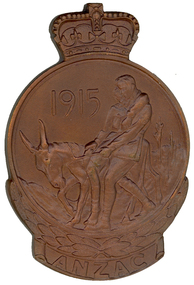
Medal - Numismatics, ANZAC Commemorative Medal for R.M. Serjeant, 1967
... relationship to Robert M. Serjeant who died on 28 April 2015 at Gallipoli of wounds received in Action. serjeant r.m. serjeant robert m. sergeant anzac medal numismatics Engraved: "1238 R.M. Serjeant" Bronze commemorative medal in black presentation case showing Simpson and his donkey carrying a wounded soldier to safety. A crown is situated on top of the medal, and the word ANZAC beneath the medal. The opposite side depicts Australia, New Zealand and the Southern Cross Constellation. The lower half is bordered with New Zealand Fern leaves. The commemorative medal was presented to the family ...Robert M. Serjeant was the only son of Theo and Alice Serjeant, and grandson of famed mine manager Robert Malachy Serjeant (1829-1902). Robert Serjeant was a past student of the Ballarat School of Mines (SMB), and at the time of his World War One enlistment he had just finished an electrical course, and was working as a junior member of the SMB Department of Electricity. Robert Serjeant enlisted in December 1914. Corporal Serjeant (2138) of the 8th Battalion, died of wounds received in action at Gallipoli on 28 April 1915, aged 20. He was buried at sea and his name is listed at the Lone Pine Memorial. A brown paper parcel of Robert Serjeant's belongings was returned to his parents. It contained his discs, wrist-watch (damaged), notebook, hymn book and letters. [1] The Ballarat Courier reported: 'He was of quiet disposition, and a great student, devoting himself closely to his work.' Further information on R.M. Serjeant can be found at https://bih.federation.edu.au/index.php/Robert_M._Serjeant_Jnr The following statement on the ANZAC Commemorative Medallion and Badge was made by by Prime Minister Holt in 16 March 1967 when the Minister for Defence announced that it had been decided by the Australian Government, in consultation with the New Zealand Government, to issue a medallion and lapel badge to the veterans of the Gallipoli Campaign. "Last March, the Minister for Defence announced that it had been decided by the Australian Government, in consultation with the New Zealand Government, to issue a medallion and lapel badge to the veterans of the Gallipoli Campaign. I am glad to be able to announce that arrangements have now been completed for the production of the medallion and the badge. The Minister for the Army will be arranging distribution to those wishing to receive them as soon as possible. The Government hopes that production of the medallion and lapel badge will be sufficiently advanced to permit at least some of them to be distributed by ANZAC Day. The medallion (with the name of the recipient inscribed) will be issued to the surviving members of the Australian Defence Force who served on the Gallipoli Peninsula, or in direct support of the operations from close off-shore, at any time during the period from the first ANZAC Day in April, 1915 to the date of final evacuation in January, 1916. Next of kin or other entitled persons will be entitled to receive the medallion on behalf of their relatives, if the relative died on active service or has since died. For surviving members, a lapel badge will also be available for wearing. This will be a replica of the obverse (or front) of the medallion and will be about 1 inch high and 2/3 inch wide - the same size as the RSL badge. The medallion is the work of Mr. Raymond Ewers, the well-known Australian artist, based on a suggestion by Mr. Eric Garrett, a staff artist with the Department of the Army. It has been endorsed by both the Government of New Zealand and ourselves. It will be approximately 3 inches high and 2 inches wide. The obverse of the medallion depicts Simpson and his donkey carrying a wounded soldier to safety. It will be bordered on the lower half by a laurel wreath above the word ANZAC. The reverse (the back) shows a relief map of Australian and New Zealand superimposed by the Southern Cross. The lower half will be bordered by New Zealand fern leaves. The medallion will be cast in bronze and the lapel badge will be metal of a bronze colour. For the information of the honourable members I present also a brief statement setting out the conditions of eligibility which will apply to the medallion and badge and the manner in which those desiring to receive them should apply."(https://www.awm.gov.au/encyclopedia/anzac/medallion/doc.asp, accessed 26/02/2014) Conditions of eligibility. All members of the Australian Defence Force who served during the Gallipoli Campaign are entitled to receive the ANZAC Commemorative medallion. The campaign lasted from April 25, 1915 to January 8, 1916. The award will be made for service on the Gallipoli Peninsula and service in support of the operations in an area off-shore eastward of a line drawn from Yukyeri Point (lat 39 50' 40'' N long 26 9' 45'' E) through a point in lat 39 53' N long 26 0' E thence to Cape Gremea (lat 40 35' N long 26 6' E). The award will also be available to members of philanthropic organisations and the Press who were accredited to the AIF, and to Australian members of the crews of merchant ships or hospital ships which operated in direct support within the defined area. Note: The boundary line would run just off-shore from the land masses north and south of the Dardanelles, and is estimated to be within about 5 miles from the beach at ANZAC Cove. (https://www.awm.gov.au/encyclopedia/anzac/medallion/doc.asp, accessed 26/02/2014) This Item is significance because is was only issued to members of the Australian and New Zealand Defence Force who served at Gallipoli. This Medallion is significant because of its relationship to Robert M. Serjeant who died on 28 April 2015 at Gallipoli of wounds received in Action. Bronze commemorative medal in black presentation case showing Simpson and his donkey carrying a wounded soldier to safety. A crown is situated on top of the medal, and the word ANZAC beneath the medal. The opposite side depicts Australia, New Zealand and the Southern Cross Constellation. The lower half is bordered with New Zealand Fern leaves. The commemorative medal was presented to the family of Robert M. Serjeant. Gift of David Stevens, 2014.Engraved: "1238 R.M. Serjeant"serjeant, r.m. serjeant, robert m. sergeant, anzac, medal, numismatics -
 Bendigo Historical Society Inc.
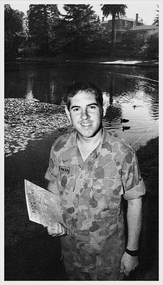
Newspaper - Fortuna Article - "Fortuna Opens its Doors", Mar 30 1996
... family, particularly George Lansell, a prominent gold mine owner known as the "Quartz King." The Army initiated tours 20 years ago to connect with the local community and showcase the building and the regiment's work.The tours provide an opportunity for the public to interact with soldiers and learn about their activities. After the death of George Lansell's wife, a symbolic procession with an empty coffin protested poor mine ventilation and miners' health conditions, highlighting social issues of the time.The document shares anecdotes from tours, such as Lansell's purchase of goats from local children, illustrating his character and the community's relationship with him. ...family, particularly George Lansell, a prominent gold mine owner known as the "Quartz King." The Army initiated tours 20 years ago to connect with the local community and showcase the building and the regiment's work.The tours provide an opportunity for the public to interact with soldiers and learn about their activities. After the death of George Lansell's wife, a symbolic procession with an empty coffin protested poor mine ventilation and miners' health conditions, highlighting social issues of the time.The document shares anecdotes from tours, such as Lansell's purchase of goats from local children, illustrating his character and the community's relationship with him. ...Despite a report suggesting otherwise, tours of the historic Fortuna house in Bendigo will not cease when the Army Topographic Support Establishment (ATSE) takes over from the Army Survey Regiment. Both Army representatives and ATSE management confirm that public access and tours will remain unchanged. A mistaken news story led to a surge in tour attendance, with numbers tripling as people rushed to visit before the supposed closure. Recent tours have seen up to 70 visitors, including interstate travelers and descendants of the Lansell family. Fortuna is a 140-year-old house with deep ties to Bendigo's history.Originally owned by Christopher and Theodore Ballerstedt (1855–1871), it is most famously associated with the Lansell family, particularly George Lansell, a prominent gold mine owner known as the "Quartz King." The Army initiated tours 20 years ago to connect with the local community and showcase the building and the regiment's work.The tours provide an opportunity for the public to interact with soldiers and learn about their activities. After the death of George Lansell's wife, a symbolic procession with an empty coffin protested poor mine ventilation and miners' health conditions, highlighting social issues of the time.The document shares anecdotes from tours, such as Lansell's purchase of goats from local children, illustrating his character and the community's relationship with him. The homestead includes notable features like a grand entrance hall, glassroom, main staircase, Pompeii fountain, and a Roman bath.The house is known for its eclectic Victorian architecture, with many styles incorporated based on Lansell's preferences. Guided tours cover the complete history of Fortuna Villa and the Lansell family, lasting about three and a half hours on Sundays.Bookings are available by phone.Recent Military UpdatesThe Army will remain at the Fortuna site, though the military side will move out and soldiers will be reassigned or enter the workforce.Fortuna Restoration Article - "Fortuna Opens its Doors" - Bendigo Advertiser Sat Mar 30 1996 - Author Nicole Ferrie This item contains the following: 11217.2a Black and White Photo of one of the tour guides - Lance Cpl Richard Arman in the Fortuna Gardens 11217.2b Black and White Photo of one of the tour guides - Lance Cpl Richard Arman on the balcony 11217.2c Part of page 2 - Fortuna Open its Doors 11217.2d Part of page 2 - Fortuna Open its Doorsnon-fictionbendigo, fortuna, army tropographic support establishment -
 Alfred Hospital Nurses League - Nursing History Collection
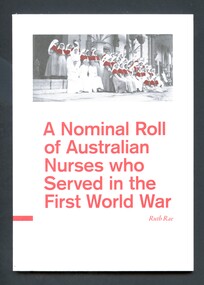
Book, Ruth Rae 1957, A nominal roll of Australian nurses who served in the First World War, 2015
... family relationships with other nurses Of significance to the AHNL as there are Alfred nurses listed. World War 1914-1918-nominal roll-nurses Nurses Australian Army Nurses Unlike the Australian War Memorial nominal roll, the Australian College of nursing nominal roll includes the names of those nurses who served in India, with other allied services and those who died on home service while caring for returned soldiers during the 1918-1919 influenza pandemic. ...Unlike the Australian War Memorial nominal roll, the Australian College of nursing nominal roll includes the names of those nurses who served in India, with other allied services and those who died on home service while caring for returned soldiers during the 1918-1919 influenza pandemic.Illustrated book with white front and back covers and red spine. The front cover has a red, black and white photograph of a group of nurses: Nursing staff of the 2nd AGH, Ghizerah, Egypt. Title and author's name are printed in red below this photo. Abbreviated title and author's name printed in white on the spine. Back cover has abbreviated title printed in red and a summary of the book printed in blacknon-fictionUnlike the Australian War Memorial nominal roll, the Australian College of nursing nominal roll includes the names of those nurses who served in India, with other allied services and those who died on home service while caring for returned soldiers during the 1918-1919 influenza pandemic.world war 1914-1918-nominal roll-nurses, nurses, australian army nurses -
 Sunshine and District Historical Society Incorporated
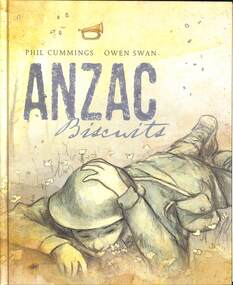
Book - Anzac Biscuits, Scholstic Australia et al, 2013
... The Anzac biscuit originated during World War I as a durable, long-lasting treat sent by women in Australia and New Zealand to soldiers, evolving into a cultural symbol of remembrance. Signed copy by the Author World War 1914 - 1918 Cooking family relationships and emotional bonds The ANZAC spirit and Australian wartime history A childrens illustrated book which tells a story of a young girl who connects with her soldier father by baking ANZAC biscuits. ...A childrens illustrated book which tells a story of a young girl who connects with her soldier father by baking ANZAC biscuits.Hard covered book with an illustration of a soldier on the frontfictionA childrens illustrated book which tells a story of a young girl who connects with her soldier father by baking ANZAC biscuits. world war 1914 - 1918, cooking, family relationships and emotional bonds, the anzac spirit and australian wartime history
