
Showing 43 items matching "solving the mystery"
-
 Tatura Irrigation & Wartime Camps Museum
Booklet, Solving the Mystery, 1978
... Solving the Mystery...solving the mystery...Survey map on back, Certificate of Title details on front. Solving the Mystery Booklet ...Story of Catholic Church in Tatura. Education and early history of Tatura 1870's. First Catholic Church was built at Baldwinville/Byrneside 1878. Present Church built in 1912.Gold cover, green writing. Survey map on back, Certificate of Title details on front.solving the mystery, burton-clay fr r, catholicism in tatura, tatura, sacred heart church, books, history, local, religion -
Tatura Irrigation & Wartime Camps Museum
Booklet, Solving The Mystery, 1978
... Solving The Mystery...solving the mystery...Written to explain the first Catholic Church was built at Baldwinsville-Byrneside in 1878. Solving The Mystery Booklet ...Story of Tatura Catholic Church and Education. Early history of Tatura 1870's. Present church built in 1912Gold cover, green writing. Survey map on back. Written to explain the first Catholic Church was built at Baldwinsville-Byrneside in 1878.solving the mystery, catholicism in tatura, burton-clay father r, tatura, sacred heart church, books, history, local, religion -
Tatura Irrigation & Wartime Camps Museum
Booklet, Solving The Mystery, 1978
... Solving The Mystery...solving the mystery...Present church built in 1912 solving the mystery burtonclay r catholicism in tatura glover i tatura sacred heart church books history local Written to explain the first church was built at Baldwinsville - Byrneside, 1878 Solving The Mystery Booklet ...Story of Tatura Catholic Church and Education. Early history of Tatura 1870's. Present church built in 1912Written to explain the first church was built at Baldwinsville - Byrneside, 1878solving the mystery, burtonclay r, catholicism in tatura, glover i, tatura, sacred heart church, books, history, local -
Tatura Irrigation & Wartime Camps Museum
Book, Father R Burton-Clay, Solving the mystery, 1978
... Solving the mystery...Pages stapled together Solving the mystery Book Father R Burton-Clay Rushworth Printing Company ...The birth of Catholicism in TaturaCardboard cover, yellow, with green printing. 48 pages. Pages stapled togetherInside cover - "Presented to Tatura and District Historical Society by Mrs J Forster, 22/08/84" -
Tatura Irrigation & Wartime Camps Museum
Booklet, Solving the Mystery, 1978
... Solving the Mystery...Survey map on back, Certificate of Title details on front. Solving the Mystery Booklet ...Story of Catholic Church in Tatura. Education and early history of Tatura 1870's. Present Church built in 1912. First Catholic Church was built at Baldwinville-Byrneside. 1878Gold cover.Green writing. Survey map on back, Certificate of Title details on front.sacred heart church, tatura, books, history, local, religion -
Tatura Irrigation & Wartime Camps Museum
Book, Solving the Mystery, 1978
... Solving the Mystery...Allotments map on back cover. Solving the Mystery Book ...Written to record history of the Catholic Church's early days in Byrneside and Tatura and start of Catholic EducationYellow cover, green writing. Allotments map on back cover.books, history, local -
 Mont De Lancey
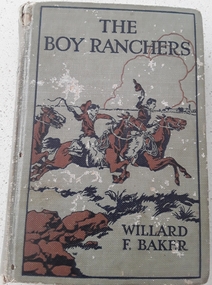
Book, Willard F baker, The Boy Ranchers OR Solving the mystery at Diamond X, 1921
... The Boy Ranchers OR Solving the mystery at Diamond X...The Boy Ranchers OR Solving the mystery at Diamond X Book Willard F baker Cupples & Leon Company ...Merve from Auntie Zillie and Uncle Henry. with love Xmas 1927Grey hardcover children's book The Boy Ranchers by Willard F Baker with brown and white illustration on front with two boys riding horses in the rocky country. Cover has title and author, spine has title, author, publisher and illustration of a cow.Merve from Auntie Zillie and Uncle Henry. with love Xmas 1927children's fiction, adventure stories, books -
 Robin Boyd Foundation
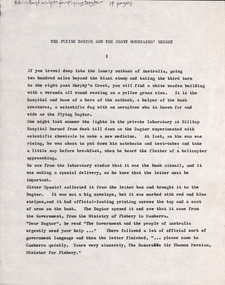
Document - Script, Robin Boyd, The Flying Dogtor and The Snowy Mountain's Secret. Adventure No. 6, The Lake Monsters, Episodes 44-52, 1963
... The Dogtor is called to the Snowy Mountains Scheme to solve the mystery of a sea-serpent in Lake Eucumbene. ...The Dogtor is called to the Snowy Mountains Scheme to solve the mystery of a sea-serpent in Lake Eucumbene. ...This transcript outlines the storyline of the final adventure (no. 6) of The Flying Dogtor (The Lake Monster) in 4 chapters, episodes 44-52. The Dogtor is called to the Snowy Mountains Scheme to solve the mystery of a sea-serpent in Lake Eucumbene. After investigations around and under the water, he solves the mystery and is finally awarded suitably in Canberra.The Flying Dogtor" series was broadcast on Australian Television Network (later becoming the Seven Network) between February and April 1964 (see item D254 for schedule).Typewritten, quarto, carbon copy, 14 pagesOn top left 'Robin Boyd script for Flying Dogtor 14 pages' in Penleigh Boyd's handwriting.the flying dogtor, snowy mountains, robin boyd, crawford productions, manuscript -
 Bendigo Historical Society Inc.
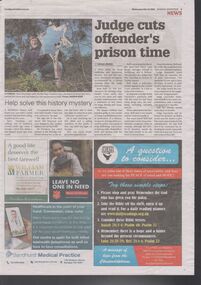
Newspaper - Article about a mystery sign found in Bendigo bushland, Wed May 27 2020
... Bendigo Advertiser: Story entitled 'Help Solve this History Mystery', about a star-shaped metal sign. ...Terry Davidson found the star in plain sight in the Diamond Hill historical area near Kangaroo Flat, Golden Square and Spring Gully. bendigo mystery star terry davidson Bendigo Advertiser: Story entitled 'Help Solve this History Mystery', about a star-shaped metal sign. ...Terry Davidson found the star in plain sight in the Diamond Hill historical area near Kangaroo Flat, Golden Square and Spring Gully.Bendigo Advertiser: Story entitled 'Help Solve this History Mystery', about a star-shaped metal sign. bendigo mystery star, terry davidson -
 Robin Boyd Foundation
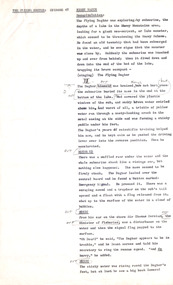
Document - Script, Robin Boyd, The Flying Dogtor. Episode 47 Night Watch, 1963
... The Flying Dogtor, called by the Government to Canberra to help solve the mystery of a monster or sea-serpent, that seemed to be threatening the Snowy Mountain Scheme, spent a night in a tunnel. ...The Flying Dogtor, called by the Government to Canberra to help solve the mystery of a monster or sea-serpent, that seemed to be threatening the Snowy Mountain Scheme, spent a night in a tunnel. ...The Flying Dogtor, called by the Government to Canberra to help solve the mystery of a monster or sea-serpent, that seemed to be threatening the Snowy Mountain Scheme, spent a night in a tunnel. He was waiting for the monster to appear, so that he could try to find out where it came from and what it wanted. Suddenly, he heard heavy breathing close behind him in the darkness.The Flying Dogtor" series was broadcast on Australian Television Network (later becoming the Seven Network) between February and April 1964 (see item D254 for schedule).Typewritten, carbon copy, foolscap, 2 pagesHandwritten pencil edits and additions.the flying dogtor, robin boyd, crawford productions, manuscript -
 Robin Boyd Foundation
Document - Script, Robin Boyd, The Flying Dogtor. Episode 49 The Serpent Net, 1963
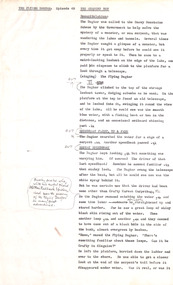
... The Flying Dogtor, helping solve the mystery of a monster or sea serpent that was wandering the lakes and tunnels of the Snowy Mountains Scheme, noticed strange things happening: a speedboat driven by a snakey-looking person and a lookout tower operated by spiders, it seemed... ...The Flying Dogtor, helping solve the mystery of a monster or sea serpent that was wandering the lakes and tunnels of the Snowy Mountains Scheme, noticed strange things happening: a speedboat driven by a snakey-looking person and a lookout tower operated by spiders, it seemed... ...The Flying Dogtor, helping solve the mystery of a monster or sea serpent that was wandering the lakes and tunnels of the Snowy Mountains Scheme, noticed strange things happening: a speedboat driven by a snakey-looking person and a lookout tower operated by spiders, it seemed... Later, a plan to trap the serpent in an underground tunnel was arranged by The Flying Dogtor. He asked for several things: a team of fisherman; a large fishing net; two fast fishing boats; and an enormous canvas bag.The Flying Dogtor" series was broadcast on Australian Television Network (later becoming the Seven Network) between February and April 1964 (see item D254 for schedule).Typewritten, carbon copy, foolscap, 2 pagesHandwritten pencil edits and additions.the flying dogtor, robin boyd, crawford productions, manuscript -
 Robin Boyd Foundation
Document - Script, Robin Boyd, The Flying Dogtor. Episode 48 The Tower, 1963
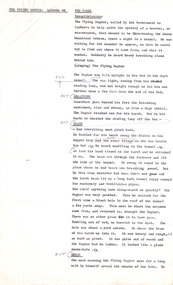
... The Flying Dogtor was called to the Snowy Mountains Scheme by the Government to help solve the mystery of a monster or sea serpent, that was wandering the lakes and tunnels. ...The Flying Dogtor was called to the Snowy Mountains Scheme by the Government to help solve the mystery of a monster or sea serpent, that was wandering the lakes and tunnels. ...The Flying Dogtor was called to the Snowy Mountains Scheme by the Government to help solve the mystery of a monster or sea serpent, that was wandering the lakes and tunnels. Several times, the Dogtor caught a glimpse of a monster but every time, it got away before he could see it properly or speak to it. Then he came to a weird-looking lookout on the edge of the lake, and paid his sixpence to climb to the platform for a look through a telescope. He heard faintly, a nasty sound of eerie, spidery laughter.The Flying Dogtor" series was broadcast on Australian Television Network (later becoming the Seven Network) between February and April 1964 (see item D254 for schedule).Typewritten, carbon copy, foolscap, 2 pagesHandwritten pencil edits and additions.the flying dogtor, robin boyd, crawford productions, manuscript -
 Mission to Seafarers Victoria
Journal (item) - Periodicals-Annual, Shiplovers' Society of Victoria, The Annual Dog Watch
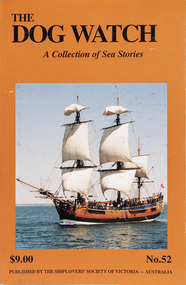
... Smith - 85 Can you solve the mystery? K.S. - 87 A Norwegian apprentice in the 1930s - Capt. ...Smith - 85 Can you solve the mystery? K.S. - 87 A Norwegian apprentice in the 1930s - Capt. ...This journal provides the reader with glimpses of the adventures and hardships of a seaman's life. Many of the stories are of sailing ships.Contributes to our knowledge of the importance of shipping and places on record those stories of the sea which would otherwise be lost.Contents Editorial - - 5 Adelaide to Sydney on the Endeavour - P. Kelly - 7 A tribute to Capt. G.A. Molyneux - T.E. Goldfinch - 27 The Bos’n’s Chair - R.N. Thiele - 29 A Gallant Steward - B. Springthrope - 33 The Australians return to the Phillipines - W.S. McUtchen - 35 Sunbathing is good for the eyes - Capt. R. Hart - 49 William Thomas, The Liverpool Shipowner & the Holyhead — wrecked on Point Lonsdale - G.I. Hawkes - 50 “Seahorses” - G.M. Naug - 56 Henry Greathead 1757-1813 Inventor of the Lifeboat - B.M. Morris - 57 The Milag Book - K. Shewan - 63 Life & Death of a Shipyard - E. Pennell - 65 A Donkey’s Breakfast & Parish Rig - W.P. Shemmeld - 69 The Indian Rope Trick — witnessed - R.A. Bloom - 74 MV Otaio, Training for the Sea at Sea - J. Giles - 77 “Sailorman” - N. Smith - 85 Can you solve the mystery? K.S. - 87 A Norwegian apprentice in the 1930s - Capt. G. Skomedal - 88 Snippets from the papers of Alexander McLennan — Sailmaker - J. McLennan - 103 A Mother’s Letter - B.M. Morris - 106 The Carrick ex City of Adelaide - R.C. Shepherd - 108 Book Reviews - - 111sailing ships, steamships, shipping, seafaring life, shiplovers' society of victoria, dog watch -
 Federation University Historical Collection
Newspaper - Newsclippings, Tantanoola Tiger Newsclippings
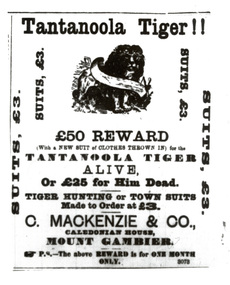
... At that time Herbert Allchurch, an Adelaide detective, was sent to solve the mystery. A few days after his arrival Allchruch went to the front bar of the Tiger Hotel and arrested local rabbit shooter and trapper, Charlie Edmunson, with sheep stealing. ...At that time Herbert Allchurch, an Adelaide detective, was sent to solve the mystery. A few days after his arrival Allchruch went to the front bar of the Tiger Hotel and arrested local rabbit shooter and trapper, Charlie Edmunson, with sheep stealing. ...In the early 1880s a small circus travelled between Millicent and Mt Gambier, South Australia. After camping overnight they discovered their Bengal Tiger at escaped and disappeared into dense scrub. After searching for hours they continued to Mt Gambier and reported the loss of the tiger to police. Police and local volunteers continued the search for the escaped tiger, but no sighting were made. In the early 1890s sheep in the Tantanoola area started to disappear with the still unsighted tiger being blamed. In 1893 reports of an unusual animal in the Tantanoola area started, with many describing the animal as the missing tiger, or a large dog. One eye witness claimed to have seen the animal carrying a full grown sheep in its mouth. The reports grew in number and exaggeration with sightings from Robe to Bendigo. In the Tantanoola district children were escorted with shotgun guards to and from school, with many homes keeping guns at the ready in case the tiger suddenly appeared. In August 1895 Tom Donovan shot the "Tantanoola Tiger" on Mt Salt Station, around 20 kms south of Tantanoola. The corpse was taken to Marks, a Mount Gambier taxidermist, at which time the animal was identified as an Assyrian or Northern Russian Wolf. Donovan displayed the animal far and wide. Despite the animal's death sheep continued to disappear from properties in the district over many years. It was of particular concern between 1909 and 1910. At that time Herbert Allchurch, an Adelaide detective, was sent to solve the mystery. A few days after his arrival Allchruch went to the front bar of the Tiger Hotel and arrested local rabbit shooter and trapper, Charlie Edmunson, with sheep stealing. After his 1911 trial Edmunson admitted to stealing over 4,000 sheep during the previous 20 years. He was gaoled for six years with hard-labour in January 1911. Edmunson had been selling the skins of the stolen sheep, leaving the carcusses to rot. He earned around five pounds per week during the 1990s and early 1900s, a time when the economy was depressed. It is not known had the animal known as the Tantanoola Tiger came to Australia, but it is believed it survived one of three ships wrecked of the coast between 1890 and 1893, making it to shore along with some of the shipwrecked passengers. (From a card produced by the Tantanoola Tiger Hotel, where the 'tiger' is on display.)A collection of Newsclippings from 1892 - 1895 photocopied onto A4 white paper. The clippings relate to the Tantanoola Tiger. Clippings include: * Border Watch 1892 - Tantanoola Tiger Reward * Sydney Morning Herald, 04/07/1857 - Animals in Zoological Gardens, including a number of large cats. * Claims the Tantanoola Tiger was an escaped circus animal (ie The Advertiser [Adelaide], 31 October 1893) * Search parties for the Tantanoola Tiger (ie Barrier Miner 19/05/1893; Barrier Miner 03/1081893) * Thylacine claim (ie Morning Bulletin [Rockhampton] 11/03/1895 * Afghan and Indian Hunters (ie Barrier Miner 07/02/1895) * Sighting by John Bird of Scarsdale - Wanganui Herald 15/12/1900. " ... Mr Bird was travelling on foot along a lonely track through very dense scrub, when he was stricken with amazement to see a full-grown tiger standing in a small dam about 30ft away, and holding in its jaws the carcass of a newly-killed lamb. He remained long enough to thoroughly take in the animals appearance, and then beat a hasty retreat unmolested. His description of the animal is as follows: A tawny-coloured creature, with a dirty mottled skin; in general appearance like an immense cat; body 4ft long, and of a uniform thickness from shoulder to hindquarters; in bulk equal to a very large pig. The legs were hidden in the water. A similar animal is reported to gave been seen near Canico, some miles away. ..." * Victorian country sightings # Bullarto - Argus 06/05/1905 # Dean - Launceston Examiner 28/01/1895 # Bendigo - Hobart Mercury 15/03/1895 # Ballan - Launceston Examiner 03/08/1895 * South Australian register 17/06/1885 " There is a tiger or panther wandering at large in Victoria, according to a rumour. It has taken the place of the Bunyip, whom hundreds have seen but none captured. This tiger is supposed to have broken loose from a travelling menagerie in the North-eastern district. At the beginning we should like it roved that such an escape ever took place. Perhaps the showmen were afraid to report the fact to the police; at any rate they did not do so. The first story about the tiger being seen came from the neighborhood of Wangaratta, 60 miles from the place where it is said to have commenced business on its own account. He was followed, but vanished among trees. Next we hear of a strange animal, bigger than a St Bernard's dog, but shorter legged, having appeared at least 150 miles from Wangaratta. Between Lilydale and Wangaratta there is a dividing range 2,000 feet high in the lowest past, besides several large rivers. An finally, the tiger - changed from a panther - is reported as having been seen within the suburban circle, about 8 miles from the general Post Office. They show you footprints, and point to the carcasses of mangled cows and calves. Casts have been taken of the footprints for examination by scientific men, who pronounce them doglike, and yet not doglike, but panther-like, which gives a nervous turn, for the panther may take up killing children and grown-up people. One tiger will not account for so many apparitions. There must have been a general strike among the menageries, and a breaking-up companies. ... * Research article by Philip A. Clarke "Indigenous Spirit and Ghost Folklore of 'Settled' Australia. australian animal folklore collection, tantanoola tiger, tom donovan, herbert allchurch, charles edmunson, sheep, charlie edmunson, mythical, myth, folklore -
Federation University Historical Collection
Document, Articles on the Bunyip, 1983 - 1989
... A number of articles on the Bunyip * The Nessie Mystery Solver by Roy Fraser (October 1983) * Developers meet match (Wagyl) (The Age, 06 Jan 1989) * Narrandera's bunyips burst into tourism's limelight by Melanie Sincock (wagga Advertiser, 18 November 1986) * Hunting the bunyip by M.A. ...(http://en.wikipedia.org/wiki/Bunyip) This material was collected and used for resarch purposes by David Waldron australian animal folklore collections bunyip bunyipswagyl shane picket narrandera swan river david Waldron A number of articles on the Bunyip * The Nessie Mystery Solver by Roy Fraser (October 1983) * Developers meet match (Wagyl) (The Age, 06 Jan 1989) * Narrandera's bunyips burst into tourism's limelight by Melanie Sincock (wagga Advertiser, 18 November 1986) * Hunting the bunyip by M.A. ...The bunyip is a large mythical creature from Aboriginal mythology, said to lurk in swamps, billabongs, creeks, riverbeds, and waterholes. The origin of the word bunyip has been traced to the Wemba-Wemba or Wergaia language of Aboriginal people of South-Eastern Australia. However, the bunyip appears to have formed part of traditional Aboriginal beliefs and stories throughout Australia, although its name varied according to tribal nomenclature. Various written accounts of bunyips were made by Europeans in the early and mid-19th century, as settlement spread across the country. (http://en.wikipedia.org/wiki/Bunyip) This material was collected and used for resarch purposes by David Waldron A number of articles on the Bunyip * The Nessie Mystery Solver by Roy Fraser (October 1983) * Developers meet match (Wagyl) (The Age, 06 Jan 1989) * Narrandera's bunyips burst into tourism's limelight by Melanie Sincock (wagga Advertiser, 18 November 1986) * Hunting the bunyip by M.A. Troyahn (Australiasian Post, 06 October 1883) * Beware the bunyip, you Moomba skiers by Edel Wignell (The Age, 05 March 1982) * The yarn that grew the bunyip legend (Australasian Post, 30 December 1971) australian animal folklore collections, bunyip, bunyipswagyl, shane picket, narrandera, swan river, david waldron -
 Bendigo Historical Society Inc.
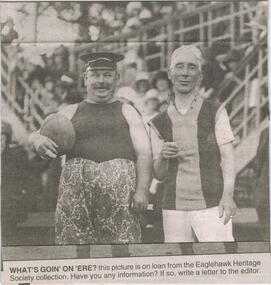
Newspaper - JENNY FOLEY COLLECTION: WHAT'S GOIN'ON'ERE
... Have you any information? Photo mystery solved: The way we were photo which appeared in Tuesday's Bendigo Advertiser, was taken in 1928 at a football match as part of the back to Eaglehawk celebrations. ...Have you any information? Photo mystery solved: The way we were photo which appeared in Tuesday's Bendigo Advertiser, was taken in 1928 at a football match as part of the back to Eaglehawk celebrations. ...Bendigo Advertiser ''the way we were'' from 2003. What's goin'on 'ere? this picture is on loan from the Eaglehawk Heritage Society collection. Have you any information? Photo mystery solved: The way we were photo which appeared in Tuesday's Bendigo Advertiser, was taken in 1928 at a football match as part of the back to Eaglehawk celebrations. It is of Eaglehawk mayor of the day, Cr. Don Oswald (left) and Dr. Alexander Ryan. Eaglehawk celebrations: the man in last Thursday's paper the way we were should have read Danny Oswald, Peg Leg road Eaglehawk, and Dr. Alex Lyons, ''Nirvana'', Church Street, Eaglehawk. Written by J.L. Truscott, Christian Street Eaglehawk. The clip is in a folder.newspaper, bendigo advertiser, the way we were -
 Melbourne Tram Museum
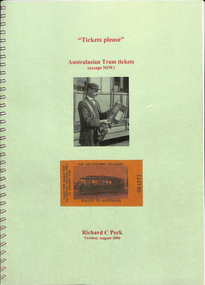
Book, Richard C Peck, "Tickets Please - Australasian tram tickets except NSW", Aug. 2006
... Has a table of contents, introduction, an overview of the operators, list of Urban Transport Milestones During the Tramway Era for NZ and a story "Mystery Solved by Tram Ticket by Robert Pine as told by Jack McLean about a murder in London that was solved by a tram ticket found in the person's clothes. ...Has a table of contents, introduction, an overview of the operators, list of Urban Transport Milestones During the Tramway Era for NZ and a story "Mystery Solved by Tram Ticket by Robert Pine as told by Jack McLean about a murder in London that was solved by a tram ticket found in the person's clothes. ...Book - spiral wire bound , clear plastic cover, green title sheet and card back, approx. 110 pages, black and white presentation giving examples of tram tickets along with notes on each system for Melbourne, Country Victoria, Queensland, South Australia, Western Australia, Tasmania, New Zealand (11 systems) and Tourist tramways. Has a table of contents, introduction, an overview of the operators, list of Urban Transport Milestones During the Tramway Era for NZ and a story "Mystery Solved by Tram Ticket by Robert Pine as told by Jack McLean about a murder in London that was solved by a tram ticket found in the person's clothes. Rear page has purchase details of the book and CD, along with a contact address in Sydney. See Reg Item 5579 for the CD. Bob Merchant of the Sydney Tramway Museum advised 4/3/2021 that: Richard Peck, as Curator of Philately, Printing and Postal Technology, was responsible for the Museum of Applied Arts and Sciences acquiring major artefacts from the NSW Government Printing Office when it was forcibly closed by the government in 1989. In retirement Richard has researched the history of private bus routes before 1932 and government bus routes 1932-2021. He maintains a large database of all types of NSW transport tickets.trams, tramways, tickets, reports, melbourne, mmtb, stories -
 Flagstaff Hill Maritime Museum and Village
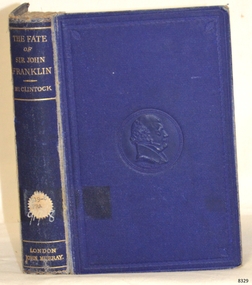
Book - Reference Travel Diary/History, Sir Francis Leopold M'Clintock, The Voyage of The 'Fox'. Fate of Sir John Franklin, 1881
... M'Clintock gathered heartbreaking artifacts from the abandoned camps, including silver spoons, clothing, and skeletal remains, thereby solving the greatest Victorian maritime mystery. Sir John Franklin (1786–1847) was a legendary British Royal Navy officer and seasoned Arctic explorer. ...M'Clintock gathered heartbreaking artifacts from the abandoned camps, including silver spoons, clothing, and skeletal remains, thereby solving the greatest Victorian maritime mystery. Sir John Franklin (1786–1847) was a legendary British Royal Navy officer and seasoned Arctic explorer. ...This classic 1859 maritime narrative with the subject copy being the 1881 fifth edition details one of the most significant moments in Arctic exploration. It follows the definitive discovery of what happened to Sir John Franklin’s lost expedition. The Voyage of the 'Fox' is a first-hand travel diary and official report written by Captain Francis Leopold McClintock.The Voyage of The 'Fox'. The Fate of Sir John Franklin Author: Sir F Leopold M'Clintock Publisher: John Murray, Albemarle Street, London. Publisher to the Admiralty Date: 1881 Blue embossed hardcover with a blue spine and lettering in gold. The spine has a Library label with an inscription.non-fictionThis classic 1859 maritime narrative with the subject copy being the 1881 fifth edition details one of the most significant moments in Arctic exploration. It follows the definitive discovery of what happened to Sir John Franklin’s lost expedition. The Voyage of the 'Fox' is a first-hand travel diary and official report written by Captain Francis Leopold McClintock.flagstaff hill, warrnambool, shipwrecked coast, flagstaff hill maritime museum, maritime museum, shipwreck coast, flagstaff hill maritime village, great ocean road, book, pattison collection, warrnambool library, warrnambool mechanics’ institute, ralph eric pattison, corangamite regional library service, warrnambool city librarian, mechanics’ institute library, victorian library board, warrnambool books and records, warrnambool children’s library, the voyage of the 'fox'. the fate of sir john franklin, sir f leopold m'clintock, arctic exploration -
 Narre Warren and District Family History Group
Book, Narre Warren & District Family History Group Inc, Casey Cardinia Collection - Selected articles from the West Gippsland Trader - Volume 2, 2021
... The Mystery Map 30 May 2013 Finding a Road to the Jordan 4 Apr 2013 Rick Solves Mystery of American Captain 2 May ? The Haunted Hills - Tall Story or Truth? ...The Mystery Map 30 May 2013 Finding a Road to the Jordan 4 Apr 2013 Rick Solves Mystery of American Captain 2 May ? The Haunted Hills - Tall Story or Truth? ...Folder containing a table of contents and a selection of articles on Gippsland History by John Wells in the West Gippsland Trader Volume 2. The date the articles were published, and title of articles are listed below. 19 Jul 2012 Gembrook - an Attractive Little Town 7 Jun 2012 Getting Rid of the Wood 21 Mar 2013 Getting Into Orbost 13 Dec ? Metung - A BEnd in the River 20 Sep 2012 The Royal Victorian Navy 6 Dec 2012 Tree Ferns to Blackberries 22 Nov 2012 Nowa Nowa Arm and Boggy Creek 18 Oct 2012 Home of the Baw Baw Frog 1 Nov 2012 Clearing the Hills 11 Oct 2012 The Loss of the Monumental City 4 Oct 2012 The Waterloo Township 13 Sep 2012 Birth of the Shire of Morwell 27 Sep 2012 George Black and Tarwin Meadows 9 Aug 2012 The Forgotten Corner of Gippsland 27 Mar 2008 Thomas William Harrison’s Family 3 Jul ? Railway was Enormous Value to Swamp Country 19 Jun 2008 The Narre Warren Reserve Gates 12 Jun 2008 Heavy Harry is a Pretty Crook Giant 2 May ? Small Settlements on a Long Gippsland Track 5 Jun 2008 Land of Bullumwaal ot “Two Spears” 29 May 2008 Bigger Stops on a Long Road 15 May 2008 Crossing the Beautiful Snowy River 17 Apr 2008 I Remember Uncle Jack aqs an Old Man with Something Wrong 25 Jun 2009 The Murder of Cornelius Green 2 Jul 2009 Captain James Cook was too Late 5 Sep 2013 Oil and the Gippsland Lakes 18 Jun 2009 The Suburbs Around Sale 13 May 2010 The Boag Generations go on and on in Gippsland 27 May 2010 Underwater Coal at Yallourn Open Cut 4 Nov 2010 Narracan - the Aboriginal Name for Crow 23 Apr 2009 Driving Along the Omeo Track 2 Dec 2010 Remembering Those Old Wives’ Tales that we all Grew up with 16 Apr 2009 Myrtlebank, the Lost Suburb 16 Dec 2010 The Tragedy of the Loch Ard 9 Dec 2010 The Latrobe River Wharf on the East Bank 2 Jun 2011 Stony Creek Township’s Quiet Past 17 Mar 2011 William Barak Saw the Whites Take Over 5 May 2011 The Squatters’ Names Still Here 12 May 2011 The Diary of C.A.Ramsden (part one) 26 May 2011 South Coast Towns, 1891 19 May 2011 The Second Part of C.A.Ramsden’s Diary 28 Apr 2011 Squatter Names Still Remain on our Maps 13 Oct 2011 The Resting Place of 1131 Australians 29 Sep 2011 The Mitchell Valley Hopfields Oct 6 Lest We Forget - Lijssenthoek 10 Nov 2011 The Kurnai Men UNKNOWN The Returning of Captain Joe McLaughlin 6 Jun 2013 The Marlo Plains 16 May 2013 Bain’s Border Hotel 23 May ? The Mystery Map 30 May 2013 Finding a Road to the Jordan 4 Apr 2013 Rick Solves Mystery of American Captain 2 May ? The Haunted Hills - Tall Story or Truth? 18 Apr ? Interesting Times 15 Aug 2013 Remembering the Good Times 11 Dec 2014 The Old Sale Road - an Important Link 26 Mar 2015 Difficult to Know the Real Story 27 Nov 2014 The State’s Real Birthday 12 Sep 2013 The Herald 1925 2 Oct 2014 Beacons of Hope 9 Oct 2014 The Joys of Parenthood 6 Nov 2014 Aboriginal Life in Gippsland 30 Oct 2014 Growing up in Gippsland - Harriett Quigley 26 Sep 2013 The McHaffie Diary 19 Sep 2013 Outtrim - Once a Boom Town 10 Oct 2013 Happy Hundredth Birthday 4 Sep 2014 Many Towns Simply Disappeared 17 Jul 2014 Long Distance Farmer 25 Sep 2014 Sam Anderson - Gippsland’s First Farmer 28 Aug 2014 Local Oil 90 Years Ago 6 Mar 2014 A Fiery Summer - 1898 20 Feb 2014 The Corduroy Roads 8 May 2014 The Darkness Within 13 Mar ? Draining the Moe Swamp 1 May 2014 Any Ideas on Old Cannon? 3 Jul 2014 The Magnificent Snowy 14 Aug 2014 Two Gems in the Hills 19 Jun 2014 The Towns Down the Line 27 Feb 2014 State School 2502, Longwarry 18 Sep 2014 Lakes a Natural Fishing Ground 15 May 2014 Police Down the Ages 22May 2014 Iron Horse Came at a Walk 29 May 2014 Prom’s Early Attraction 12 Jun 2014 A Brief History of Meeniyan 5 Jun 2014 Ride on the Old Great Southern 26 Jun 2014 When Victoria Police Went on Strike 23 Apr 2015 Grandma’s Family Lost Heavily 11 Jun 2015 A Rail Journey Almost to Orbost 28 May 2015 Second Battle of Hastings 4 Jun 2015 Dandenong to Trafalgar by Train 18 Jun 2015 The Travelling Picture Man 19 Feb 2015 Water was a Problem 5 Feb 2015 Sandy Point Return Invokes Memories 24 Oct 2013 Lyrebirds Nesting in Trees? 12 Mar 2015 Supplying Melbourne’s Water 9 Aug 2015 They Shall Not Grow Old as we That Are Left 9 Jul 2015 National Parks a Valuable Resource 11 Sep 2014 Living Through the Best and the Worst 12 Feb 2015 Fishing is Part of Port’s History 26 Feb 2015 Chance Lost to Eliminate Rabbits 5 Mar 2015 Bloomfield - End of the Line, in a Way 11 Jul ? Emerald Primary School 22 Aug 2013 The Heartbreak Hills 17 Oct 2013 Port Albert, Land of Elephants 14 Nov 2013 Bullumwaal Land of Two Spears 28 Nov 2013 Coalville - the Forgotten Mine 5 Dec 2013 Early Travel with the Bishop 12 Dec 2013 Bishop Perry in Gippsland 19 Dec 2013 The Great Sale Goldfields Hoax 20 Mar 2014 A Chance to Dazzle the Kids 27 Mar 2014 More of Those Creeks and Rivers 3 Apr 2014 The Arctocephalus is With us Still 10 Apr 2014 Upper Yarra Dam had an Early Start UNKNOWN Harkaway’s Colorful History Contains Some Doubtful Tales UNKNOWN Berwick and the Peninsula in 1886non-fictiongippsland lakes, emerald primary school, meeniyan, upper yarra dam -
 Narre Warren and District Family History Group
Book, Narre Warren & District Family History Group Inc, Casey Cardinia Collection - Selected articles from the West Gippsland Trader - Volume 1, 2010
... The Mystery Map 30 May 2013 Finding a Road to the Jordan 4 Apr 2013 Rick Solves Mystery of American Captain 2 May ? The Haunted Hills - Tall Story or Truth? ...The Mystery Map 30 May 2013 Finding a Road to the Jordan 4 Apr 2013 Rick Solves Mystery of American Captain 2 May ? The Haunted Hills - Tall Story or Truth? ...Folder containing a table of contents and a selection of articles on Gippsland History by John Wells in the West Gippsland Trader Volume 1. The date the articles were published, and title of articles are listed below. 30 Oct 1997 Noojee Railway Line is an Engineering Classic 06 Nov 1997 Railways were a kiss of life for small settlements 13 Nov 1997 Erica was a timber and railway town 20 Nov 1997 People fought for railway line through to Stratford 27 Nov 1997 Tiny towns on the Wonthaggi line Vol 16 No 50 Cobungra station has some wild and beautiful country Vol 16 No 51 The explorers we have forgotten Vol 17 No 30 Hallam store became a place for men to gather 14 Feb 2002 Charlie Styles and his dull grey bedford bus Vol 26 No 10 Southern Community names 03 Aug 2006 A bit more Cloverlea 28 Sep 2006 Many airlines were keen to link wide brown land 26 Oct 2006 The ‘run’ at Top Plain 02 Nov 2006 Briagolong and the Garden of Eden 09 Nov 2006 I found a treasure in a milk bar 16 Nov 2006 Got five bob in your pocket, or should I say fifty cents? 23 Nov 2006 Trains were important in developing Gippsland 30 Nov 2006 The main line into Gippsland 07 Dec 2006 Alfred Howitt was a great man who deserves recognition Dec 2006? Christmas again? Already? 15 Feb 2007 The Great Southern Railway 08 Mar 2007 Expectations about water quality have changed since the old days 29 Mar 2007 Navigating by tree tops 12 Apr 2007 The Gippsland railway branch lines were very important in many ways 26 Apr 2007 Some community names from our northern hills 10 May 2007 Community names at the eastern end 24 May 2007 A shorter railway with big tonnages 31 May 2007 Cerberus was the guard dog 07 Jun 2007 Suburban stations in Gippsland 14 Jun 2007 How many Longwarry schools were there? 21 Jun 2007 Traralgon run was Hobson’s choice 28 Jun 2007 Maiden and Mormon and Happy Go Lucky 05 Jul 2007 Consider the humble rabbit trap 12 Jul 2007 Five acre blocks are everywhere 26 Jul 2007 Fencing, but not the Olympic variety 02 Aug 2007 Hanging the barbed wire fences 09 Aug 2007 Collecting and keeping the tucker we gathered 23 Aug 2007 The Longwarry Primary School itself 30 Aug 2007 Surveyors did it hard down Poowong way 06 Sep 2007 Back to the Poowong story 13 Sep 2007 A “think piece” or an indulgence? 20 Sep 2007 Longwarry “extra late final” 04 Oct 2007 Platina’s gone but not forgotten 11 Oct 2007 Robert Nield – Murray is back at it 18 Oct 2007 Spetts’ cottage at Walhalla 25 Oct 2007 Across the Alps to Omeo 08 Nov 2007 Where the gold lies deep in settlements that died 15 Nov 2007 Mines aplenty in the Walhalla area 22 Nov 2007 The other Violet Town – Jolly’s 29 Nov 2007 Mallacoota archaeology 06 Dec 2007 The Cassilis township or call it a settlement 13 Dec 2007 George Bass missed French Island 08 Feb 2008 David Mickle relates many stories of railway accidents 11Sep 2008 Lord Howe has a long history 18 Sep 2008 Quarry Hills important link for Berwick 25 Sep 2008 Tall ships, short ships, schooners and sloops 26 Jun 2008 We find Yanakie Jack again 03 Jul 2008 The well known Baw Baw Track 10 Jul 2008 Land of the moon? 07 Aug 2008 I loved eeling in the Tarago River 14 Aug 2008 Don’t let the red steer loose 28 Aug 2008 Yes, there is a place called Jumbuk 04 Sep 2008 The land of the big trees 23 Oct 2008 Still looking for Gippsland’s first town 13 Nov 2008 Journey to the bowels of the earth 30 Oct 2008 For King and Country – J.M. Laidlaw 06 Nov 2008 Jesse Huggett lived an adventurous life 22 Nov 2008 Churchill Island, yet again 04 Dec 2008 Bowman’s Track – if we can find it 11 Dec 2008 Draining of the great Koo Wee Rup Swamp 18 Dec 2008 The swampies had a go 02 Apr 2009 Looking for natural gas not offshore oil 21 Aug 2008 The Dreaded Summer Wildfire 17 Jul 2008 The Tangel (or Tanjil) hills District 7 Feb 2012 The Tanjil Area Goldrush 29 Aug 2013 Saddled and Spurred 9 Feb 2012 Many Racecourses Have Disappeared 16 Feb 2012 Fraser’s Hotel in Glenmaggie 23 Feb 2012 “Nothing Today, Jack!” on the Berwick Hill 1 Mar 2012 The Schnapper Point Line 8 Mar 2012 The Imaginary Town of Tambo 22 Mar 2012 The Tanjil Story Part One 15 Mar 2012 Inverloch Served Mosquito Fleet of Mis-Matched Boats 21 Jun 2012 The Last Bits of the Line 29 Mar 2012 “Gold Rush” to the Tanjil Area led to Reef Mining Companies 16 Aug 2012 New Life for Old Port Welshpool? 30 Aug 2012 The Capital of South Gippsland 28 Jun 2012 The Last Bits of the Line 5 Jul 2012 Ferdinand Von Mueller - a Man of Knowledge 12 Jul 2012 Stones in the Creek 19 Jul 2012 Gembrook - an Attractive Little Town 7 Jun 2012 Getting Rid of the Wood 21 Mar 2013 Getting Into Orbost 13 Dec ? Metung - A BEnd in the River 20 Sep 2012 The Royal Victorian Navy 6 Dec 2012 Tree Ferns to Blackberries 22 Nov 2012 Nowa Nowa Arm and Boggy Creek 18 Oct 2012 Home of the Baw Baw Frog 1 Nov 2012 Clearing the Hills 11 Oct 2012 The Loss of the Monumental City 4 Oct 2012 The Waterloo Township 13 Sep 2012 Birth of the Shire of Morwell 27 Sep 2012 George Black and Tarwin Meadows 9 Aug 2012 The Forgotten Corner of Gippsland 27 Mar 2008 Thomas William Harrison’s Family 3 Jul ? Railway was Enormous Value to Swamp Country 19 Jun 2008 The Narre Warren Reserve Gates 12 Jun 2008 Heavy Harry is a Pretty Crook Giant 2 May ? Small Settlements on a Long Gippsland Track 5 Jun 2008 Land of Bullumwaal ot “Two Spears” 29 May 2008 Bigger Stops on a Long Road 15 May 2008 Crossing the Beautiful Snowy River 17 Apr 2008 I Remember Uncle Jack aqs an Old Man with Something Wrong 25 Jun 2009 The Murder of Cornelius Green 2 Jul 2009 Captain James Cook was too Late 5 Sep 2013 Oil and the Gippsland Lakes 18 Jun 2009 The Suburbs Around Sale 13 May 2010 The Boag Generations go on and on in Gippsland 27 May 2010 Underwater Coal at Yallourn Open Cut 4 Nov 2010 Narracan - the Aboriginal Name for Crow 23 Apr 2009 Driving Along the Omeo Track 2 Dec 2010 Remembering Those Old Wives’ Tales that we all Grew up with 16 Apr 2009 Myrtlebank, the Lost Suburb 16 Dec 2010 The Tragedy of the Loch Ard 9 Dec 2010 The Latrobe River Wharf on the East Bank 2 Jun 2011 Stony Creek Township’s Quiet Past 17 Mar 2011 William Barak Saw the Whites Take Over 5 May 2011 The Squatters’ Names Still Here 12 May 2011 The Diary of C.A.Ramsden (part one) 26 May 2011 South Coast Towns, 1891 19 May 2011 The Second Part of C.A.Ramsden’s Diary 28 Apr 2011 Squatter Names Still Remain on our Maps 13 Oct 2011 The Resting Place of 1131 Australians 29 Sep 2011 The Mitchell Valley Hopfields Oct 6 Lest We Forget - Lijssenthoek 10 Nov 2011 The Kurnai Men UNKNOWN The Returning of Captain Joe McLaughlin 6 Jun 2013 The Marlo Plains 16 May 2013 Bain’s Border Hotel 23 May ? The Mystery Map 30 May 2013 Finding a Road to the Jordan 4 Apr 2013 Rick Solves Mystery of American Captain 2 May ? The Haunted Hills - Tall Story or Truth? 18 Apr ? Interesting Times 15 Aug 2013 Remembering the Good Times 11 Dec 2014 The Old Sale Road - an Important Link 26 Mar 2015 Difficult to Know the Real Story 27 Nov 2014 The State’s Real Birthday 12 Sep 2013 The Herald 1925 2 Oct 2014 Beacons of Hope 9 Oct 2014 The Joys of Parenthood 6 Nov 2014 Aboriginal Life in Gippsland 30 Oct 2014 Growing up in Gippsland - Harriett Quigley 26 Sep 2013 The McHaffie Diary 19 Sep 2013 Outtrim - Once a Boom Town 10 Oct 2013 Happy Hundredth Birthday 4 Sep 2014 Many Towns Simply Disappeared 17 Jul 2014 Long Distance Farmer 25 Sep 2014 Sam Anderson - Gippsland’s First Farmer 28 Aug 2014 Local Oil 90 Years Ago 6 Mar 2014 A Fiery Summer - 1898 20 Feb 2014 The Corduroy Roads 8 May 2014 The Darkness Within 13 Mar ? Draining the Moe Swamp 1 May 2014 Any Ideas on Old Cannon? 3 Jul 2014 The Magnificent Snowy 14 Aug 2014 Two Gems in the Hills 19 Jun 2014 The Towns Down the Line 27 Feb 2014 State School 2502, Longwarry 18 Sep 2014 Lakes a Natural Fishing Ground 15 May 2014 Police Down the Ages 22May 2014 Iron Horse Came at a Walk 29 May 2014 Prom’s Early Attraction 12 Jun 2014 A Brief History of Meeniyan 5 Jun 2014 Ride on the Old Great Southern 26 Jun 2014 When Victoria Police Went on Strike 23 Apr 2015 Grandma’s Family Lost Heavily 11 Jun 2015 A Rail Journey Almost to Orbost 28 May 2015 Second Battle of Hastings 4 Jun 2015 Dandenong to Trafalgar by Train 18 Jun 2015 The Travelling Picture Man 19 Feb 2015 Water was a Problem 5 Feb 2015 Sandy Point Return Invokes Memories 24 Oct 2013 Lyrebirds Nesting in Trees? 12 Mar 2015 Supplying Melbourne’s Water 9 Aug 2015 They Shall Not Grow Old as we That Are Left 9 Jul 2015 National Parks a Valuable Resource 11 Sep 2014 Living Through the Best and the Worst 12 Feb 2015 Fishing is Part of Port’s History 26 Feb 2015 Chance Lost to Eliminate Rabbits 5 Mar 2015 Bloomfield - End of the Line, in a Way 11 Jul ? Emerald Primary School 22 Aug 2013 The Heartbreak Hills 17 Oct 2013 Port Albert, Land of Elephants 14 Nov 2013 Bullumwaal Land of Two Spears 28 Nov 2013 Coalville - the Forgotten Mine 5 Dec 2013 Early Travel with the Bishop 12 Dec 2013 Bishop Perry in Gippsland 19 Dec 2013 The Great Sale Goldfields Hoax 20 Mar 2014 A Chance to Dazzle the Kids 27 Mar 2014 More of Those Creeks and Rivers 3 Apr 2014 The Arctocephalus is With us Still 10 Apr 2014 Upper Yarra Dam had an Early Start UNKNOWN Harkaway’s Colorful History Contains Some Doubtful Tales UNKNOWN Berwick and the Peninsula in 1886non-fictionwonthaggi railway line towns, great southern railway, baw baw track -
 Flagstaff Hill Maritime Museum and Village
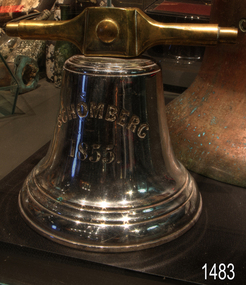
Functional object - Bell, Schomberg 1855, Before 1855
... The ’Mystery’ of the small bell solved: Despite numerous attempts by the staff at Flagstaff Hill to restore the bell’s lustre, the bell remained dull and tarnished. ...The ’Mystery’ of the small bell solved: Despite numerous attempts by the staff at Flagstaff Hill to restore the bell’s lustre, the bell remained dull and tarnished. ...The Rescue and Journey of the Schomberg Bells: This bell was the smaller of two rescued by the crew of the Schomberg following the ship’s wreck in 1855. While the specific purpose of the smaller bell is unknown, it may have served to assemble the crew or signal mealtimes on board. After surviving the shipwreck, the crew carried both bells as they made their way along the coastline. Their journey eventually led them to the home of settler John Manning, located at Hopkins Point near Warrnambool. Manning took possession of the bells and subsequently presented them to two churches in Warrnambool. The smaller bell went to St Joseph’s Catholic Church, while the larger bell went to St John’s Presbyterian Church. After around a year, the small bell at St Joseph’s developed a crack and became unusable. Thomas Manifold imported a replacement bell for the church, and the damaged bell was stored at his farm. Years later, when the property was sold to John Logan, the discarded bell was donated to the old Warrnambool Museum upon its opening in 1886. The Curator, Joseph Archibald, placed the bell on display in the entry. In 1975, it was transferred from the Warrnambool Art Gallery to Flagstaff Hill. The ’Mystery’ of the small bell solved: Despite numerous attempts by the staff at Flagstaff Hill to restore the bell’s lustre, the bell remained dull and tarnished. In October 1986, Director Peter Ronald decided to send the bell for professional advice. The bell was entrusted to Briggs Marine Products, a renowned brass founder established in 1912. Upon examination, the specialists at Briggs discovered the reason behind the bell’s persistent lack of shine: it had originally been silver-plated, but most of the plating had worn away over time. The experts at Briggs then undertook the task of restoring the bell, successfully returning it to a gleaming silver surface. The Sailing Ship Schomberg: Launched in 1855, the Schomberg was regarded as the “Noblest” ship afloat at the time. Owned by the Black Ball Line, it was built for their passenger fleet by Alexander Hall of Aberdeen at a cost of £43,103. The construction featured three skins: one planked fore and aft and two diagonally planked, all fastened with screw-threaded trunnels (wooden rails). The ship’s First Class accommodation was luxurious, boasting velvet pile carpets, large mirrors, rosewood, birds-eye maple and mahogany timbers, satin damask soft furnishings, and an oak-lined library with a piano. Schomberg had a capacity for 1,000 passengers. The ship’s master, Captain James Nicol Forbes—also known as ‘Bully’ Forbes—was only 34 years old at the launch. He had a reputation for setting and breaking speed records on the Black Ball Line’s Marco Polo and Lightning. In 1852, Forbes completed the London to Melbourne journey on the Marco Polo in 68 days, a record at the time, though 53 passengers died during the voyage. In 1854, he sailed the Lightning to Melbourne in 76 days and returned in only 63 days—a record that stood among sailing ships. Forbes was known for driving his ship and crew to their limits, often prioritising speed over passenger comfort. Determined to set new records, he promised to reach Melbourne in sixty days, declaring he would do so “with or without the help of God.” The Maiden Voyage and the Wreck: Schomberg departed Liverpool on 6th October 1855, flying a banner that read “Sixty Days to Melbourne”. The vessel carried 430 passengers and 3,000 tons of cargo, including materials to build the Melbourne to Geelong Railway and a bridge over the Yarra River. Among the cargo were a cow for fresh milk, pens for fowls and pigs, and 90,000 gallons of water for drinking and washing. Additionally, it transported 17,000 letters and 31,800 newspapers. The ship and cargo were insured for $300,000, a considerable sum for the era. Poor winds while crossing the equator delayed Schomberg’s progress. Land was first sighted on Christmas Day at Cape Bridgewater near Portland. Captain Forbes followed the coastline towards Melbourne, but was reportedly playing cards when the third mate, Henry Keen, reported land only three miles away. The ship ran aground on a sand spit near Curdie’s Inlet (approximately 56 km west of Cape Otway) on 26th December 1855, after 78 days at sea. The sand spit and nearby currents were not marked on Forbes’s map. During the night, the crew launched a lifeboat to search for a safe landing spot for the passengers. The scouting party advised Forbes to wait until morning, as rough seas posed a danger to the lifeboats. At dawn, the ship’s Chief Officer spotted the SS Queen and signalled for help. The master of the Queen brought his vessel alongside, and all passengers and crew disembarked safely. The Black Ball Line’s Melbourne agent sent another steamer to collect the passengers’ baggage, and other steamers assisted with cargo salvage until worsening weather forced operations to cease. Notably, a plunderer later recovered a case of Wellington boots, but all were for the left foot. The wreck and its cargo were sold to local merchants Manifold & Bostock, who did not attempt further salvage. They later sold their interest to a Melbourne businessman and two seafarers. In 1864, after two men drowned in their attempt to reach the Schomberg, salvage efforts were abandoned. By 1870, parts of the ship had washed ashore on New Zealand’s South Island. Today, the wreck is about nine metres below the surface. Although most woodwork has disintegrated, the vessel’s shape remains discernible due to the railway irons, girders, and framework. Various goods and materials from the ship are scattered nearby. The bell is particularly significant in that along with other items from the wreck helped in part to having the legislation changed to protect shipwrecks, with far tighter controls being employed to oversee the salvaging of wreck sites. This bell forms part of the Schomberg collection at Flagstaff Hill maritime museum. The collection as a whole is of historical and archaeological significance at a State level. Flagstaff Hill’s collection of artefacts from the Schomberg is also significant for its association with the Victorian Heritage Registered Schomberg shipwreck (VHR S 612). The collection is of additional significance because of the relationship between the objects salvaged, as together they help us to interpret the story of the Schomberg. The collection as a whole is historically significant for representing aspects of Victoria's maritime history and its potential to interpret social and historical themes from society at the time of the wreck. A small ship’s bell. The silver-plated metal bell bears the ship’s name and year of construction on one side and the name and address of the ship’s builders on the other. These details are deeply engraved into the metal and formed in bold, upper-case lettering. The bell has two bell stands: the left and the right. Both stands have an Iron pipe bent into an inverted ‘Y’ shape, with a hole along its length and feet attached to a rectangular metal plate at the other two ends. Feet are bolted to a timber base that has a hole drilled through the centre for mounting. Bell's front; “SCHOMBERG” with “1855” below. Bell's back “HALL & SONS (crack splits letter “N”) / BUILDERS (in italics) / ABERDEEN” (crack splits letter “B”).flagstaff hill, flagstaff hill maritime museum and village, warrnambool, maritime museum, maritime village, great ocean road, shipwreck coast, schomberg, silver plated bell, mess bell, bell stands, captain ‘bully’ forbes, alexander hall and son, james baines and company, liverpool’s black ball line, bell, schomberg bell, ship's bell, small bell, st joseph's church, briggs marine, john manning, john logan, warrnambool museum, briggs foundry, silver bell -
Federation University Historical Collection
Book - Book - Scrapbook, Ballarat School of MInes: Scrapbook of Newspaper Cuttings, Book 79. June 1997 to August 1997
... The papers concerned are The Courier, Ballarat, The Australian, The Age and other region papers over the period of 7 June 1997 to 5 August 1997. teaching positions advertised pre-employment courses courses available enrolment for smb courses nathan holliday nrma top apprentice scott brady ballarat's gallows mystery solved federal tafe plan worries smb head memorial plaque to hanged men freighter's engineering traineeship tafe merger creates super-college smb agrees to merger wimmera tafe rejects merger new evidence points to remains' location peter bailey to compete in youth skills olympics switzerland merger official course on providing a home away from home roy schrieke retires descendant against memorial peter bailey gold medallist skill olympics in st gallen excellent results for ballarat region aquaculture course historic sites listed henry sutton reverse tafe decision stawell times-news more host families needed david belford award winner city yearning for cultural heart corporate learning gold medal for peter bailey competition on apprentice funding'play revisits our history town and gown debate viticulture traineeship program one tafe division career in food row looms over staff offers jeff kennet cuts new attitude to education victorian primary industries board apprenticeships rural studies department Book with yellow cover, front, spiral bound. ...Collection of newspaper articles related to Ballarat School Of Mines.They cover activities and advertisements for staff. The papers concerned are The Courier, Ballarat, The Australian, The Age and other region papers over the period of 7 June 1997 to 5 August 1997. Book with yellow cover, front, spiral bound. teaching positions advertised, pre-employment courses, courses available, enrolment for smb courses, nathan holliday, nrma top apprentice, scott brady, ballarat's gallows mystery solved, federal tafe plan worries smb head, memorial plaque to hanged men, freighter's engineering traineeship, tafe merger creates super-college, smb agrees to merger, wimmera tafe rejects merger, new evidence points to remains' location, peter bailey to compete in youth skills olympics, switzerland, merger official, course on providing a home away from home, roy schrieke retires, descendant against memorial, peter bailey gold medallist, skill olympics in st gallen, excellent results for ballarat region, aquaculture course, historic sites listed, henry sutton, reverse tafe decision, stawell times-news, more host families needed, david belford award winner, city yearning for cultural heart, corporate learning, gold medal for peter bailey, competition on apprentice funding'play revisits our history, town and gown debate, viticulture traineeship program, one tafe division, career in food, row looms over staff offers, jeff kennet cuts, new attitude to education, victorian primary industries board apprenticeships, rural studies department -
 Flagstaff Hill Maritime Museum and Village
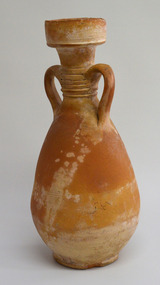
Ceramic - Amphora, mid-to-late 19th century
... The amphora's presence in the hummocks remains an intriguing and tantalising mystery, yet to be solved!...The amphora's presence in the hummocks remains an intriguing and tantalising mystery, yet to be solved! The amphora is significant for the mystery it holds. ...This amphora or jug has a silhouette shaped like a woman with her hands on her hips, wearing a long, flared-out skirt. The design was used in ancient Greece for pottery storage jars, the neck being narrower than the body. According to reports, this amphora was discovered in 1934 by Joe O'Keeffe, in a sand blowout, or sand hummocks, west of Levy's Point, west of Warrnambool, while he was planting marram grass for Mr Duncan. An article in the Warrnambool Standard newspaper of December 21, 1985, states that the amphora may be linked to the wooden sailing ship called the Mahogany Ship (also called the Ancient Wreck). Thermoluminescence testing indicates the relic was made in the mid-to-late 19th century, and experts suggest it was of North African origin. The presence of the amphora in the dunes, and the amphora itself, is still a mystery. The amphora was donated to Flagstaff Hill on a long-term loan by the Duncan family and displayed to the public for the first time on December 21, 1985. The exhibition continued until February 2023, when the objects on display in the Assistant Lighthouse Keepers Cottage (Shipwreck Museum) were returned to storage to rest, and the redevelopment of the Cottage began. A search for members of the Duncan Family was undertaken by Flagstaff Hill and stakeholders to resolve the loan term, but the family at that time was unknown. As such, to properly care for the amphora, it has been registered until ownership can be determined. The amphora is currently on display in the Great Circle Gallery, where members of the Duncan family recognised it and have since made contact with the museum. The amphora's presence in the hummocks remains an intriguing and tantalising mystery, yet to be solved!The amphora is significant for the mystery it holds. Its origin and connection with the local area have led to local speculation since it was discovered in 1934. Amphora or jug; earthenware, orange clay with areas of cream. The vessel has a wide mouth, a deep lip, two opposing handles between the neck and shoulder, and a bulbous body. The curved handles have a design of six bands between them. There are three rings of small dots encircling the body. The underside has concentric circles in the clay, an uneven edge and pinhole markings. The amphora is kindly on loan from the Duncan family.Pinhole patterns: [3 holes above 3 holes] opposite [3 holes above 3 holes], 1 hole] [ 1 hole above 2 holes] flagstaff hill maritime museum and village, warrnambool, great ocean road, shipwreck coast, amphora, jug, mahogany ship, ancient wreck, joe o'keefe, duncan, thermoluminescence, north africa, levy point, pottery, storage jar, flagstaff hill, maritime museum, maritime village, shipwreck artefact, relic, shipwreck museum, pottery jar, ancient jar, egyptian water pot, greek jar, ceramic jar, mystery, exotic jar, mystery antique, historic jug, 1934, joe o’keefe, marshall duncan, port fairy, 1935, 1985, marshall mckenzie duncan, mac duncan, duncan family, 1981, dan madden, scientific investigation, scientific analysis, scientific dating, north african origin, mid-late 19th century, marram grass, levy’s point -
 Bendigo Military Museum
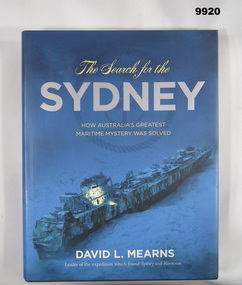
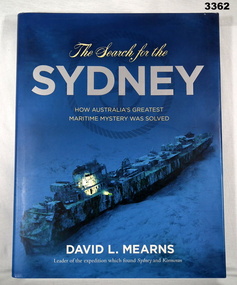
Book - MARITIME, WW2, David L Mearns, THE SEARCH FOR THE SYDNEY, 2009
... From the front dust cover; "The Search for the / SYDNEY/ HOW AUSTRALIA'S GREATEST MARITIME MYSTERY WAS SOLVED". See original owner details Cat. ...From the front dust cover; "The Search for the / SYDNEY/ HOW AUSTRALIA'S GREATEST MARITIME MYSTERY WAS SOLVED". See original owner details Cat. ...From the front dust cover; "The Search for the / SYDNEY/ HOW AUSTRALIA'S GREATEST MARITIME MYSTERY WAS SOLVED". See original owner details Cat. No. 9917.Hardcover book with dust cover. Hardcover, cardboard, aquamarine colour buckram, with silver colour print on front and spine. Dust cover - aquamarine colour paper with silver, gold and white colour print on front, spine and back. Illustrated front and back, naval shipwreck and naval ship. The dust cover unfolds to show detailed diagrams of H.M.A.S. SYDNEY for the Wallstead Shipyard in beige and brown colours. 264 pages - cut, plain, white colour paper. illustrated black and white and colour photographs. publication, book, hmas sydney, ww2 -
 Bendigo Military Museum
Book - BOOK NAVAL, David L Mears, The Search for the Sydney, 2009
... The Search for the Sydney, How Australia's Greatest Maritime Mystery was Solved. David L Mears, leader of the expedition which found Sydney and Kormoran. ...The Search for the Sydney, How Australia's Greatest Maritime Mystery was Solved. David L Mears, leader of the expedition which found Sydney and Kormoran. ...The Search for the Sydney, How Australia's Greatest Maritime Mystery was Solved. David L Mears, leader of the expedition which found Sydney and Kormoran. From back cover: The Full and Official Story of the Six Year Hunt for HMAS Sydney.Hard cardboard cover, buckram, silver colour print on front & spine, aquamarine colour background. Dust cover is silver, yellow, white & pale blue print. Photos on front are model of naval shipwreck, on back is a naval ship. The dust cover unfolds to show detailed diagrams of HMAS Sydney for the Wallsend Shipyard. Beige & brown colours. 264 pages, cut, glossy white. Illustrated black & white & colour photos & maps. Name plate on front flyleaf.Handwritten in black ink on front flyleaf name plate: "Noel R"hmas sydney, the search, maritime -
 Monbulk RSL Sub Branch
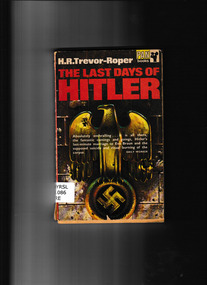
Book, Pan Books, The last days of Hitler, 1952
... Hugh Trevor-Roper, an intelligence officer, was given the task of solving the mystery. His brilliant piece of detective work not only proved finally that Hitler had killed himself in Berlin, but also produced one of the most fascinating history books ever written. ...The classic account of Hitler's fall from power, first pubilshed in 1947, reissued with a striking new cover. In September 1945 the fate of Adolf Hitler was a complete mystery. He had simply disappeared, and had been missing for four months. Hugh Trevor-Roper, an intelligence officer, was given the task of solving the mystery. His brilliant piece of detective work not only proved finally that Hitler had killed himself in Berlin, but also produced one of the most fascinating history books ever written. The Last Days of Hitler tells the extraordinary story of those last days of the Thousand Year Reich in the Berlin Bunker. Besieged in the shattered capital, but still dominating the remains of his court, Hitler reiterated the original alternative of Nazism: either total victory or annihilation. This book is the record of that carefully prepared, ceremonious finale to a terrible chapter of history. World War II. Military History. Nazi Germany.Index, notes, map, p.267.non-fictionThe classic account of Hitler's fall from power, first pubilshed in 1947, reissued with a striking new cover. In September 1945 the fate of Adolf Hitler was a complete mystery. He had simply disappeared, and had been missing for four months. Hugh Trevor-Roper, an intelligence officer, was given the task of solving the mystery. His brilliant piece of detective work not only proved finally that Hitler had killed himself in Berlin, but also produced one of the most fascinating history books ever written. The Last Days of Hitler tells the extraordinary story of those last days of the Thousand Year Reich in the Berlin Bunker. Besieged in the shattered capital, but still dominating the remains of his court, Hitler reiterated the original alternative of Nazism: either total victory or annihilation. This book is the record of that carefully prepared, ceremonious finale to a terrible chapter of history. World War II. Military History. Nazi Germany. germany - politics and government - 1933-1945, adolf hitler - death and burial -
 Monbulk RSL Sub Branch
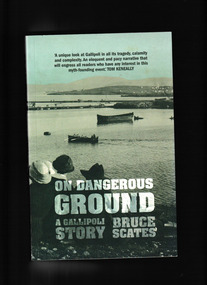
Book, UWA Pub, On dangerous ground : a Gallipoli story, 2012
... Bean returns to Anzac Cove with artist George Lambert and soldier Harry Vickers to solve the greatest mystery of the campaign, to discover Gallipoli's secret. ...It is 1915, during World War I at Gallipoli, and Lt. Roy Irwin is missing. The young woman who loves him, and the men who fought beside him, begin their search for Lt. Irwin. Later, in 1919, historian C.E.W. Bean returns to Anzac Cove with artist George Lambert and soldier Harry Vickers to solve the greatest mystery of the campaign, to discover Gallipoli's secret. Forward to 2015, and Dr. Mark Troy's quest to preserve the peninsula from roadworks is sidetracked by political intervention and diplomatic intrigue. But a flirtation with a dynamic young woman from Army Intelligence uncovers long-forgotten documents protecting Gallipoli's graves. In this eagerly awaited book, one of Australia's leading historians uses a playful hybrid of history and fiction - moving between the historical realm and the world of the imagination - to recreate the most dramatic moments of the Gallipoli campaign in World War I.Bibliography, ill, p.223.fictionIt is 1915, during World War I at Gallipoli, and Lt. Roy Irwin is missing. The young woman who loves him, and the men who fought beside him, begin their search for Lt. Irwin. Later, in 1919, historian C.E.W. Bean returns to Anzac Cove with artist George Lambert and soldier Harry Vickers to solve the greatest mystery of the campaign, to discover Gallipoli's secret. Forward to 2015, and Dr. Mark Troy's quest to preserve the peninsula from roadworks is sidetracked by political intervention and diplomatic intrigue. But a flirtation with a dynamic young woman from Army Intelligence uncovers long-forgotten documents protecting Gallipoli's graves. In this eagerly awaited book, one of Australia's leading historians uses a playful hybrid of history and fiction - moving between the historical realm and the world of the imagination - to recreate the most dramatic moments of the Gallipoli campaign in World War I.gallipoli campaign - fiction, war stories -
 Robin Boyd Foundation
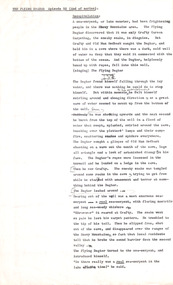
Document - Script, Robin Boyd, The Flying Dogtor. Episode 52 End of Series, 1963
... Sir Thomas Persian, the Minister of Fishery, was so delighted when he learned that the mystery of the lake was solved, that he held a big parade through the streets of Canberra in honour of The Flying Dogtor....Sir Thomas Persian, the Minister of Fishery, was so delighted when he learned that the mystery of the lake was solved, that he held a big parade through the streets of Canberra in honour of The Flying Dogtor. ...This is the last episode of 'The Flying Dogtor'. The Dogtor found himself falling through the icy water, and there was nothing he could do to stop himself. But suddenly, he was shooting upwards and burst through the top of the well. A real sea serpent came to the Dogtor's rescue. Sir Thomas Persian, the Minister of Fishery, was so delighted when he learned that the mystery of the lake was solved, that he held a big parade through the streets of Canberra in honour of The Flying Dogtor.The Flying Dogtor" series was broadcast on Australian Television Network (later becoming the Seven Network) between February and April 1964 (see item D254 for schedule).Typewritten, carbon copy, foolscap, 2 pagesHandwritten pencil edits and additions.the flying dogtor, robin boyd, crawford productions, manuscript, ohm2022, ohm2022_4 -
 Robin Boyd Foundation
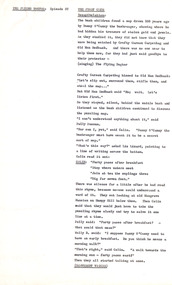
Document - Script, Robin Boyd, The Flying Dogtor. Episode 37 The First Clue, 1963
... The bush children found a bushranger's secret map containing mystery clues in the form of a rhyme. They solved the first clue, but while they were working on the next, Crafty Carson Carpetbag and Old Man Redback were lying in wait to pounce on them. ...The bush children found a bushranger's secret map containing mystery clues in the form of a rhyme. They solved the first clue, but while they were working on the next, Crafty Carson Carpetbag and Old Man Redback were lying in wait to pounce on them. ...The bush children found a bushranger's secret map containing mystery clues in the form of a rhyme. They solved the first clue, but while they were working on the next, Crafty Carson Carpetbag and Old Man Redback were lying in wait to pounce on them. They did not realise the danger they were in. And they were a long way from the protection of their faithful friend, The Flying Dogtor.The Flying Dogtor" series was broadcast on Australian Television Network (later becoming the Seven Network) between February and April 1964 (see item D254 for schedule).Typewritten, carbon copy, foolscap, 2 pagesPage 2: minor handwritten edit, bottom of pagethe flying dogtor, robin boyd, crawford productions, manuscript -
 Robin Boyd Foundation
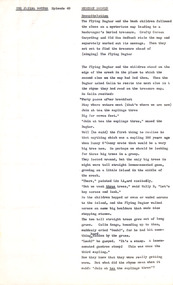
Document - Script, Robin Boyd, The Flying Dogtor. Episode 40 Mystery Solved, 1963
... The Flying Dogtor Robin Boyd Crawford Productions manuscript Page 1 & 2: minor handwritten edits Typewritten, carbon copy, foolscap, 2 pages The Flying Dogtor. Episode 40 Mystery Solved Document Script Robin Boyd ...The Flying Dogtor and the bush children followed clues on an old map they found which led them to the place where a bushranger had buried treasure 100 years ago. Crafty Carson Carpetbag and Old Man Redback stole the map, and followed the same clues to the same spot. Crafty started digging immediately but Wilbur Wombat, who was doing the digging for the Dogtor's party, wanted to wait until night. He was the sort of animal who worked better at night, explained The Flying Dogtor.The Flying Dogtor" series was broadcast on Australian Television Network (later becoming the Seven Network) between February and April 1964 (see item D254 for schedule).Typewritten, carbon copy, foolscap, 2 pagesPage 1 & 2: minor handwritten editsthe flying dogtor, robin boyd, crawford productions, manuscript
