
Showing 72 items matching "south africa - history"
-
 Monbulk RSL Sub Branch
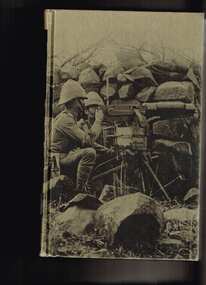
Book, The folio society, The Boer war, 1979
... ...South Africa - History...Boer war 1899-1901 - History South Africa - History Rudyard Kipling said of the Boer War that it gave the British, 'no end of a lesson'. ...Rudyard Kipling said of the Boer War that it gave the British, 'no end of a lesson'. Thomas Pakenham's account of the terrible conflict shows how the war had unforseen consequences for the Europeans and South Africa.Index, bibliography, ill, maps, p.774.non-fictionRudyard Kipling said of the Boer War that it gave the British, 'no end of a lesson'. Thomas Pakenham's account of the terrible conflict shows how the war had unforseen consequences for the Europeans and South Africa.boer war 1899-1901 - history, south africa - history -
 Returned Nurses RSL Sub-branch
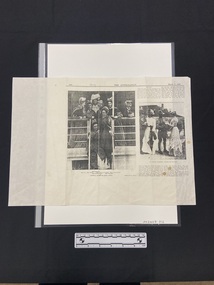
Newspaper - Photocopy of a newspaper clipping, The Australasian, The pin, March 17, 1900
... South Africa...Pins - history...The large photo is of seven Victorian nurses bound for South Africa (Sister Ivy, Sister Langlands, Sister Walker, Sister Rawson, Sister Bernhard Smith, Sister Dorothy Smith, Sister Thompson). The article discusses the history...Australian Army Nurses Victorian Nurses - South Africa Pins - history 'NC17' [Handwritten in blue ink on the top of the page] Photocopy of a newspaper article. ...The large photo is of seven Victorian nurses bound for South Africa (Sister Ivy, Sister Langlands, Sister Walker, Sister Rawson, Sister Bernhard Smith, Sister Dorothy Smith, Sister Thompson). The article discusses the history of the pin, introduced in Britain in the fifteenth century as personal fasteners used in the dressing process. It explains the materials used for 'pins' and the connection to the phrase 'pin-money'. The second photo was taken at Victoria Barracks, it shows a well-dressed lady pinning on favours to a soldier in uniform, beside them stands another lady arm-in-arm with another soldier.Photocopy of a newspaper article. The article is in the top right corner and there is some white space on the left hand side and below. The article consists of a large photo of a group of women and a Captain boarding a ship. To the right of the image is a smaller photo of two men and two women at Victoria Barracks, above and below this picture are two small columns of text.'NC17' [Handwritten in blue ink on the top of the page]australian army nurses, victorian nurses - south africa, pins - history -
 8th/13th Victorian Mounted Rifles Regimental Collection
Document - History VMR South Africa
... History VMR South Africa...South Africa...Boer War...history...After Federation the VMR was gathered up into the Australian Light Horse. light horse VMR South Africa Boer War history Photocopy of a single page typed document relating to the Victorian Mounted Rifles in South Africa 1899-1902. ...The Victorian Mounted Rifles was raised as the mounted arm of the Victorian Colonial defence force in 1885. It was under the command of Colonel Thomas Caradoc Rose (Tom) Price (1842-1911). Price was born in Tasmania, educated in Hobart Town and at Scotch College, Melbourne, before entering the East India Military College, Addiscombe, England. He was commissioned on 7 July 1861 in the Madras Infantry and began twenty years’ service in India with several regiments, retiring in April 1883. On his return to Victoria he was tasked with raising of a force of one thousand, to be known as the Victorian Mounted Rifles, and appointed a lieutenant-colonel in the Permanent Military Forces. Companies of the Victorian Mounted Rifles were raised in rural districts throughout Victoria. The soldiers were paid a small annual allowance and were required to provide their own horse. Many members served in contingents to the Boer War. After Federation the VMR was gathered up into the Australian Light Horse. Photocopy of a single page typed document relating to the Victorian Mounted Rifles in South Africa 1899-1902.light horse, vmr, south africa, boer war, history -
Dandenong & District Historical Society
Document - Chunky Charlie's South African Cuisine, Articles Concerning Chunky Charlie's South African Cuisine
... Chunky Charlie's South African Cuisine, Newspaper Article, History...Chunky Charlie's South African Cuisine, Newspaper Article, History Articles concerning Chunky Charlie's South African Cuisine Articles Concerning Chunky Charlie's South African Cuisine Document Chunky Charlie's South African Cuisine ...Chunky Charlie's South African Cuisine, Newspaper Article, History -
 Federation University Historical Collection
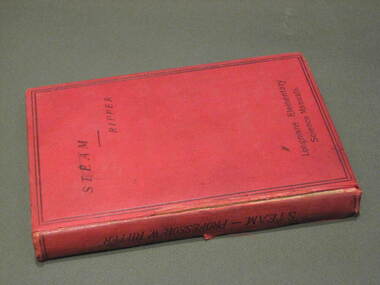
Book, William Ripper, Steam, 1897
... South Africa. The following is from the Federation Uni Honour Roll at http://federation.edu.au/about-us/our-university/history/geoffrey-blainey-research-centre/honour-roll/j/alfred-gresham-johnston-1872-1901 The October 1901 Ballarat School of Mines (SMB) Students Magazine reported 'Alf. ...South Africa. The following is from the Federation Uni Honour Roll at http://federation.edu.au/about-us/our-university/history/geoffrey-blainey-research-centre/honour-roll/j/alfred-gresham-johnston-1872-1901 The October 1901 Ballarat School of Mines (SMB) Students Magazine reported 'Alf. ...This book was owned by Alf Gresham Johnston who was a former SMB mining student from the Ballarat School of Mines. He died at the age of 29 during military service in South Africa. The following is from the Federation Uni Honour Roll at http://federation.edu.au/about-us/our-university/history/geoffrey-blainey-research-centre/honour-roll/j/alfred-gresham-johnston-1872-1901 The October 1901 Ballarat School of Mines (SMB) Students Magazine reported 'Alf. Johnston's gone. The news came as a shock to all of us at the school. He who was with us a few short months ago, in all strength of sturdy manhood, has met a soldier's death in South Africa, and we sincerely mourn his loss…. His heart was in the school, and he did his best to further its interests … His last act on leaving Australian shores was to send a telegram from Albany to Prof. Mica Smith, to whom he was warmly attached, wishing the School and all connected with it "Good-bye". In his short, all to short, life of 29 years, he had more adventure than falls the lot of most men, and possibly the spirit of adventure, and also, of duty, prompted him to throw in his lot with the "colors," and leave for the front. The news of his death comes to us with added weight of sadness when we remember that he was one of the organisers of the School entertainment last year to help swell the fund for the erection of a statue to fallen Victorian soldiers.'A small red book with a double black line bordering the front cover, with the text Longmans Elementary Science Manuals on the bottom of the cover. On the back cover is an L&Co logoOn the title page is the inscription of the original owner of the book Alf G Johnston School of Mines Ballarat 1899. Inside the front cover and on page 19 is the stamp of the School of Mines Ballaratalfred johnston, steam engine, compound engines, condensers, heat, horse-power, transfer of heat, combustion of fuel, saturated steam, cranks and crank shafts, watt governor, boilers, alf johnston, william ripper, boer war -
 Federation University Historical Collection
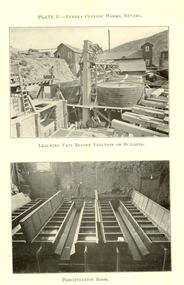
Book, The New Scientific Publishing Company, Practical Notes on the Cyanide Process, 1901
... Contents include history of Chemistry, laoratory tests, design of works, construction details, arrangements of pipes. leaching process, zinc, Nevada, South Africa, Australia. ...Contents include history of Chemistry, laoratory tests, design of works, construction details, arrangements of pipes. leaching process, zinc, Nevada, South Africa, Australia. ...The author, Francis Bosqui, was the Superintendent of the Standard Consolidated Mining Company's Cyanide Works, Brodie, California. Brown hard covered book of 201 pages. Includes many illustrations including a number of pullout photographs. Contents include history of Chemistry, laoratory tests, design of works, construction details, arrangements of pipes. leaching process, zinc, Nevada, South Africa, Australia. Chapter 14 is the exemplifications of practice: Australia, new Zealand and India. it includes references to Kalgoorlie, Hannan Brownhill mill, South German mine at Maldon, W.B. Gray, Day Dawn Mine in Western Australiacyanide, bosqui, nevada, america, mining -
 Flagstaff Hill Maritime Museum and Village
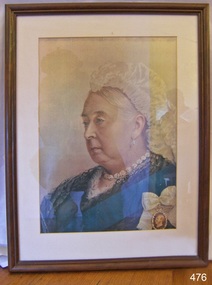
Print - Portrait of Queen Victoria, Hoy Art Picture Framing, Original probably painted in 1887 or 1897 to commemorate 50 or 60 years on the throne
... South Africa overshadowed the end of her reign. As in the Crimean War nearly half a century earlier, Victoria reviewed her troops and visited hospitals; she remained undaunted by British reverses during the campaign: 'We are not interested in the possibilities of defeat; they do not exist.' Victoria died at Osborne House on the Isle of Wight, on 22 January 1901 after a reign which lasted almost 64 years, then the longest in British history...South Africa overshadowed the end of her reign. As in the Crimean War nearly half a century earlier, Victoria reviewed her troops and visited hospitals; she remained undaunted by British reverses during the campaign: 'We are not interested in the possibilities of defeat; they do not exist.' Victoria died at Osborne House on the Isle of Wight, on 22 January 1901 after a reign which lasted almost 64 years, then the longest in British history ...Queen Victoria was born at Kensington Palace, London, on 24 May 1819. She was the only daughter of Edward, Duke of Kent, the fourth son of George III. Her father died shortly after her birth and she became heir to the throne because the three uncles who were ahead of her in the succession - George IV, Frederick Duke of York, and William IV - had no legitimate children who survived. Warmhearted and lively, Victoria had a gift for drawing and painting; educated by a governess at home, she was a natural diarist and kept a regular journal throughout her life. On William IV's death in 1837, she became Queen at the age of 18. Queen Victoria is associated with Britain's great age of industrial expansion, economic progress and, especially, empire. At her death, it was said, Britain had a worldwide empire on which the sun never set. In the early part of her reign, she was influenced by two men: her first Prime Minister, Lord Melbourne, and then her husband, Prince Albert, whom she married in 1840. Both men taught her much about how to be a ruler in a 'constitutional monarchy, in which the monarch had very few powers but could use much influence. Albert took an active interest in the arts, science, trade and industry; the project for which he is best remembered was the Great Exhibition of 1851, the profits from which helped to establish the South Kensington museums complex in London. Her marriage to Prince Albert produced nine children between 1840 and 1857. Most of her children married into other Royal families in Europe. Edward VII (born 1841), married Alexandra, daughter of Christian IX of Denmark. Alfred, Duke of Edinburgh and of Saxe-Coburg and Gotha (born 1844) married Marie of Russia. Arthur, Duke of Connaught (born 1850) married Louise Margaret of Prussia. Leopold, Duke of Albany (born 1853) married Helen of Waldeck-Pyrmont. Victoria, Princess Royal (born 1840) married Friedrich III, German Emperor. Alice (born 1843) married Ludwig IV, Grand Duke of Hesse and by Rhine. Helena (born 1846) married Christian of Schleswig-Holstein. Louise (born 1848) married John Campbell, 9th Duke of Argyll. Beatrice (born 1857) married Henry of Battenberg. Victoria bought Osborne House (later presented to the nation by Edward VII) on the Isle of Wight as a family home in 1845, and Albert bought Balmoral in 1852. Victoria was deeply attached to her husband and she sank into depression after he died, aged 42, in 1861. She had lost a devoted husband and her principal trusted adviser in affairs of state. For the rest of her reign she wore black. Until the late 1860s she rarely appeared in public; although she never neglected her official Correspondence, and continued to give audiences to her ministers and official visitors, she was reluctant to resume a full public life. She was persuaded to open Parliament in person in 1866 and 1867, but she was widely criticised for living in seclusion and quite a strong republican movement developed. Seven attempts were made on Victoria's life, between 1840 and 1882 - her courageous attitude towards these attacks greatly strengthened her popularity. With time, the private urgings of her family and the flattering attention of Benjamin Disraeli, Prime Minister in 1868 and from 1874 to 1880, the Queen gradually resumed her public duties. In foreign policy, the Queen's influence during the middle years of her reign was generally used to support peace and reconciliation. In 1864, Victoria pressed her ministers not to intervene in the Prussia-Denmark war, and her letter to the German Emperor (whose son had married her daughter) in 1875 helped to avert a second Franco-German war. On the Eastern Question in the 1870s - the issue of Britain's policy towards the declining Turkish Empire in Europe - Victoria (unlike Gladstone) believed that Britain, while pressing for necessary reforms, ought to uphold Turkish hegemony as a bulwark of stability against Russia, and maintain bi-partisanship at a time when Britain could be involved in war. Victoria's popularity grew with the increasing imperial sentiment from the 1870s onwards. After the Indian Mutiny of 1857, the government of India was transferred from the East India Company to the Crown, with the position of Governor-General upgraded to Viceroy, and in 1877 Victoria became Empress of India under the Royal Titles Act passed by Disraeli's government. During Victoria's long reign, direct political power moved away from the sovereign. A series of Acts broadened the social and economic base of the electorate. These acts included the Second Reform Act of 1867; the introduction of the secret ballot in 1872, which made it impossible to pressurise voters by bribery or intimidation; and the Representation of the Peoples Act of 1884 - all householders and lodgers in accommodation worth at least £10 a year, and occupiers of land worth £10 a year, were entitled to vote. Despite this decline in the Sovereign's power, Victoria showed that a monarch who had a high level of prestige and who was prepared to master the details of political life could exert an important influence. This was demonstrated by her mediation between the Commons and the Lords, during the acrimonious passing of the Irish Church Disestablishment Act of 1869 and the 1884 Reform Act. It was during Victoria's reign that the modern idea of the constitutional monarch, whose role was to remain above political parties, began to evolve. But Victoria herself was not always non-partisan and she took the opportunity to give her opinions, sometimes very forcefully, in private. After the Second Reform Act of 1867, and the growth of the two-party (Liberal and Conservative) system, the Queen's room for manoeuvre decreased. Her freedom to choose which individual should occupy the premiership was increasingly restricted. In 1880, she tried, unsuccessfully, to stop William Gladstone - whom she disliked as much as she admired Disraeli and whose policies she distrusted - from becoming Prime Minister. She much preferred the Marquess of Hartington, another statesman from the Liberal party which had just won the general election. She did not get her way. She was a very strong supporter of the Empire, which brought her closer both to Disraeli and to the Marquess of Salisbury, her last Prime Minister. Although conservative in some respects - like many at the time she opposed giving women the vote - on social issues, she tended to favour measures to improve the lot of the poor, such as the Royal Commission on housing. She also supported many charities involved in education, hospitals and other areas. Victoria and her family travelled and were seen on an unprecedented scale, thanks to transport improvements and other technical changes such as the spread of newspapers and the invention of photography. Victoria was the first reigning monarch to use trains - she made her first train journey in 1842. In her later years, she became the symbol of the British Empire. Both the Golden (1887) and the Diamond (1897) Jubilees, held to celebrate the 50th and 60th anniversaries of the Queen's accession, were marked with great displays and public ceremonies. On both occasions, Colonial Conferences attended by the Prime Ministers of the self-governing colonies were held. Despite her advanced age, Victoria continued her duties to the end - including an official visit to Dublin in 1900. The Boer War in South Africa overshadowed the end of her reign. As in the Crimean War nearly half a century earlier, Victoria reviewed her troops and visited hospitals; she remained undaunted by British reverses during the campaign: 'We are not interested in the possibilities of defeat; they do not exist.' Victoria died at Osborne House on the Isle of Wight, on 22 January 1901 after a reign which lasted almost 64 years, then the longest in British history. Her son, Edward VII succeeded her. She was buried at Windsor beside Prince Albert, in the Frogmore Royal Mausoleum, which she had built for their final resting place. Above the Mausoleum door are inscribed Victoria's words: "Farewell best beloved, here, at last, I shall rest with thee, with thee in Christ I shall rise again." Source: https://www.royal.uk/queen-victoria This picture captures Queen Victoria in her later years. It may well have been painted to commemorate her Golden Anniversary in 1887, or her Diamond Anniversary in 1897.Picture, print, reproduction of a drawing or photograph of Queen Victoria. She is wearing a dark-coloured dress, white headdress and a diamond necklace and earrings. On her left shoulder is the Royal Order of Victoria and Albert, awarded to female members of the British Royal Family and female courtiers. There are four grades or classes of this Royal Order as well as the Sovereign's Badge, which is exclusive to her. Also across her left shoulder, is a blue riband representing the Order of the Garter. The picture is in a medium-coloured timber frame with a white string across the width at the rear. The label says it was framed by Hoy Art, Warrnambool. The signature of the Queen is on the picture but is not obvious since the picture has been re-framed."HOY ART / PICTURE FRAMING / 48 Kepler St, Warrnambool 3280 / Phone (055) 62 8022" Signature (hidden by new framing) "Victoria H.R.S."flagstaff hill, warrnambool, shipwrecked-coast, flagstaff-hill, flagstaff-hill-maritime-museum, maritime-museum, shipwreck-coast, flagstaff-hill-maritime-village, picture of queen victoria, queen victoria, the royal order of victoria and albert, the order of the garter, hoy art -
 Lara RSL Sub Branch
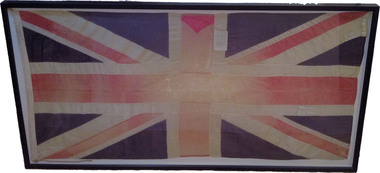
Flag, Australian Flag (Union Jack) 1900
... South Africa between 1901 and 1902. The flag was taken into the Wilmansrust engagement in which 19 soldiers died and 41 were wounded. On return to Australia, the flag was used in marches by the South Africa, China Old Veterans Association - Geelong. This flag represents a unique part of Australian history ...There is a Union Jack brought back from South Africa by 1229 Trooper Fredrick James Smith. Between 1899 and 1902, around 16,500 Australians served in South Africa during the Boer War. This was the largest international deployment of troops from the Australian Colonies before Australian Federation. Of the 16,500 men who served in South Africa, 606 were killed in action or died of diseases. The Australian War Memorial records that the fighting conditions in South Africa extremely hard on men and horses. Australians fighting in South Africa were doing so as part of Colony based Regiments such as the Victorian Mounted Rifles, New South Wales Lancers, Queensland Mounted Infantry as well as units from the other states. Australians were awarded six Victoria Crosses during the campaign along with many other decorations. In May of 1902 the treaty of Vereeniging was signed officially ending the Boer War. The Boer War is commemorated in many Towns and Cities around Australia. The Lara RSL Sub Branch holds some memorabilia from the Boer War. There is a Union Jack brought back from South Africa by 1229 Trooper Fredrick James Smith. He was a resident of Lara and was a member of the 5th Victorian Mounted Rifles. It was reported that he carried this flag into battle. The Lara RSL also holds the flag staff of the China, South African and Old Veterans Association. Both these items are of national significance. Both the flag and flag staff were used in marches in Geelong each year until 1916 when Anzac Day commenced. The flag and flag staff were donated to the Lara RSL sub Branch when he joined in 1928. Fredrick James Smith was born at Lara in 1879, the son of Mr/Mrs Smith from Lara. He was a farm hand from Horton Vale, Anakie when he joined F Company of the 5th Victorian Mounted Rifles at the beginning of February 1901. Two weeks later, he left for South Africa on the 15th February. Before leaving, he purchased the flag from W. Libby & Son Geelong. Frederick Left for South Africa on the 15 February 1901 on the Orient. He saw service between March 1901 - March 1902 in east Transvaal and Natal frontier under the British Major General S. Beatson then Pulteney, including the defeat at Wilmansrust where 18 soldiers were killed and 42 wounded (12th June 1901 - heaviest casualties of any Australian contingent,); and the successful intervention at Onverwacht on the 4th January 1902. The 5th Victorian Mounted Rifles suffered: 36 killed or died of wounds, 13 died of disease of a contingent of 46 Officers, 971 Other Ranks and 1099 horses. They returned to Australia on the 26th April 1902 on the Custodian after sailing from Point Natal in South Africa on the 5th April. On his return, Tropper Smith (Saddler Private) joined the South African Soldiers Association of Victoria – Geelong Branch, and after 1928, he joined the Lara RSL. He was buried in Western Cemetery on the 19th June 1968 at the age of 89. Enrolled February 1901 Departed for South Africa on 15 February 1901 Establishment: 46 Officers, 971 Other Ranks with 1099 horses Mobilised at Pretoria: 24 March -- 4 April 1901 Typical company: 1 Captain, 4 Lieutenants, 1 company sergeant-major, 1 company quartermaster-sergeant, 1 sergeant-farrier, 1 sergeant-saddler, 5 sergeants, 6 corporals, 3 shoeing-smiths, 3 saddlers, 1 bugler, 99 privates. Total in company: 126 with 131 horses. Engagements: Rhenoster Kop, Klippan, Kornfontein, Drivelfontein, Wilmansrust, Kambuladraai, H'Lobane, Luchiel's Nek, Loch's Kraal, Vryheid, Onverwacht, Johnston Hoek Killed in action (or died): six Officers, 48 Other Ranks VC Winner: Lieut. L. C. Maygar News article Leader (Melbourne) Saturday 31st May 1902, page 42 - Dear Cinderella. — This is the second time I have written to you. I was very sorry at not seeing my first letter in "The Leader". But I hope to say, that this one will be in. The last time I wrote to you I told you that my brother (Fredrick Smith) went to the Boer War in South Africa, and that he was supposed to be killed in the Wilmansrust disaster. But this time I am going to tell you about his return, and the grand welcome he got from the residents of Lara. Mother, Father, and my Brother, went down to Melbourne, to meet the boat. You can just imagine how rejoiced we all were to see him back again. The railway station was decorated some thing beautiful with flags of all description all the colours you could think of. He has bought a lot of Boer curios home and some Kaffir bracelets. They are such funny looking things. The residents of Lara, also gave my brother a grand social and ball there were over four hundred people present, They presented him with a hand some gold chain, and locket suitably inscribed, and a pair of gold sleeve links, they were magnificent. The ball was very nice. . I had a few dances. I enjoyed myself grand. I think this is all I can tell you this time. I must conclude with love. I remain yours sincerely - BESSIE SMITH. Age 14-years. This flag is of national significance as it was used in the Boer War by Private Fredrick James Smith (SN:1229) of the 5th Victorian Mounted Rifles, F Company in their deployment to South Africa between 1901 and 1902. The flag was taken into the Wilmansrust engagement in which 19 soldiers died and 41 were wounded. On return to Australia, the flag was used in marches by the South Africa, China Old Veterans Association - Geelong. This flag represents a unique part of Australian history from which the movie, Breaker Morant was taken. It is of spiritual significance as the Boer War was where the first Australian received the Imperial Victoria Cross, and the spirit of Anzac was conceived, giving birth in World War 1. The Flag represents the spirit of Australians who fought and died in South Africa.Cotton Union Jack flag approx 221cm wide by 109cm tall with small repair patches and center section cotton deteriorated.Has the word "Lara" inscribed in black on bottom part of the flag heading. Has the flag makers name "W.Libby & Son" on the top part of the flag heading.boer war, union jack flag, south africa, wilmansrust, 5th victorian mounted rifles, f coy, private fredrick james smith, service number 1229, february 1901, april 1902, south africa china old veterans association -
 Flagstaff Hill Maritime Museum and Village
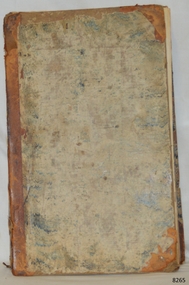
Book - Reference Travel/History/Cartography, Mr Salmon (Thomas Salmon) et al, Modern History or, the Present State of All Nations. Vol III, 1746
... The subject, Volume III, specifically covers the Americas with its European colonisation, indigenous cultures, and trade, along with regional natural histories across both North and South America (including accounts of Hernán Cortés in Mexico, and Francisco Pizarro in Peru, Chile, and the West Indies). Africa...The subject, Volume III, specifically covers the Americas with its European colonisation, indigenous cultures, and trade, along with regional natural histories across both North and South America (including accounts of Hernán Cortés in Mexico, and Francisco Pizarro in Peru, Chile, and the West Indies). Africa ...This 1746 3rd Edition of Thomas Salmon’s Modern History is a fantastic slice of Enlightenment era geography and publishing history. It sits at a fascinating intersection of early modern travel literature, top tier cartography, and the rise of one of London's most famous publishing houses. Thomas Salmon’s Modern History: or, the Present State of All Nations was an ambitious encyclopedic project. Rather than focusing strictly on dynastic timelines, Salmon took a modern geographical and ethnographic approach. For each region covered, he detailed its geography and climate, along with its natural resources, plants, animals, and minerals. Culture and society were covered by focusing on local habits, dress, religious rites, laws, customs, and architecture. Economy and trade were also detailed, including the arts, sciences, husbandry, and commercial manufactures.Hard cover book,Modern History: or, the Present State of All Nations Vol III Author: Mr Salmon (Thomas Salmon) Illustrator: Herman Moll Publisher: T Longman and T Shewell, London. Date: 1746 (MDCCXLVI), 3rd Edition Further Information: Set of Three Volumes. Hard covered book has reinforcing on the spine and corners. The cover is very well worn and has remnants of a coloured design. The fly page is printed in red and black ink and has a long description of the contents. Inside the cover is printed a Coat of Arms, there is a stocker on the inside cover. non-fictionThis 1746 3rd Edition of Thomas Salmon’s Modern History is a fantastic slice of Enlightenment era geography and publishing history. It sits at a fascinating intersection of early modern travel literature, top tier cartography, and the rise of one of London's most famous publishing houses. Thomas Salmon’s Modern History: or, the Present State of All Nations was an ambitious encyclopedic project. Rather than focusing strictly on dynastic timelines, Salmon took a modern geographical and ethnographic approach. For each region covered, he detailed its geography and climate, along with its natural resources, plants, animals, and minerals. Culture and society were covered by focusing on local habits, dress, religious rites, laws, customs, and architecture. Economy and trade were also detailed, including the arts, sciences, husbandry, and commercial manufactures.flagstaff hill, flagstaff hill maritime museum and village, warrnambool, maritime museum, maritime village, great ocean road, shipwreck coast, pattison collection, ralph eric pattison, warrnambool mechanics’ institute, mechanics’ institute library, warrnambool library, free library, corangamite regional library service, mr salmon, thomas salmon, 18th century, 1746, history, geography, social studies, culture, maps, modern history, present state of all nations vol iii, herman moll, t longman and t shewell, social history, cartography -
 Flagstaff Hill Maritime Museum and Village
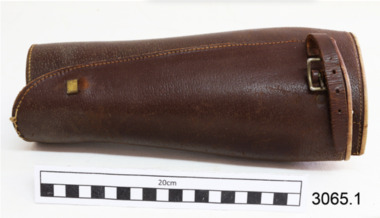
Clothing - Leather Leggings, 1899 to 1920
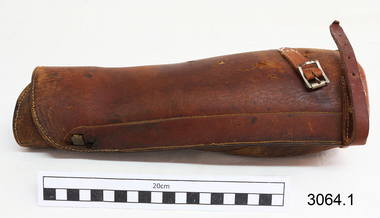
... history. It was a time when many young men gave their lives during the South African and First World Wars in the defence of the then British Empire as part of the Imperial Forces that were gathered from many British-controlled Colonial countries. flagstaff hill warrnambool flagstaff hill maritime museum shipwreck coast flagstaff hill maritime village great ocean road leggings leather leggings protective leggings protective clothing Australian Mounted Light Horse Units Military Equipment None A pair of two Leather Leggings used by Mounted Australian soldiers during the first world war. ...The subject leather leggings are associated with mounted troops known as the Australian Light Horse that served in the South African War from 1899 to 1902. After the war, Britain wanted to use fewer mounted troops and restructured its force around a style of combat that needed more infantry. But the defence of Australia still relied upon mounted military units as these were more mobile than infantry and could travel faster over long distances. Light Horse brigades in the Australian Imperial Force (AIF) mostly contained recruits who served in the Light Horse regiments of the Citizen Forces. Many young men from rural areas of Australia volunteered for the Light Horse regiments. They had to pass a riding test to join, this test was easier for men from the bush because horses were still the main method of transport on farms and in country towns. The army did not officially accept First Australians into the AIF until May 1917 when enlistment standards were relaxed to include 'half-castes' with a parent of European origin. Indigenous soldiers served as valuable members of the Light Horse and many possessed excellent horse handling skills and specialist tracking knowledge.The subject items are part of the uniform for the Light Horse Units that served in the Australian army from 1899 until 1918. These leggings were worn by soldiers on horseback and are significant as they represent a noteworthy time in Australia's early military history. It was a time when many young men gave their lives during the South African and First World Wars in the defence of the then British Empire as part of the Imperial Forces that were gathered from many British-controlled Colonial countries.A pair of two Leather Leggings used by Mounted Australian soldiers during the first world war. The leggings are dark tan in colour with stitching to attach buckles and fastener straps. The strap buckles are made of brass and the leather legging straps are of same leather as leggings. Noneflagstaff hill, warrnambool, flagstaff hill maritime museum, shipwreck coast, flagstaff hill maritime village, great ocean road, leggings, leather leggings, protective leggings, protective clothing, australian mounted light horse units, military equipment -
 Flagstaff Hill Maritime Museum and Village
Clothing - Leather Leggings, 1899 to 1918
... history. It was a time when many young men gave their lives during the South African and First World Wars in the defence of the then British Empire as part of the Imperial Forces that were gathered from many British-controlled Colonial countries. flagstaff hill warrnambool flagstaff hill maritime museum shipwreck coast flagstaff hill maritime village great ocean road leggings leather leggings protective leggings protective clothing Australian Mounted Light Horse Units Military Equipment None A pair of two Leather Leggings used by Mounted Australian soldiers during the first world war. ...The subject leather leggings are associated with mounted troops known as the Australian Light Horse that served in the South African War from 1899 to 1902. After the war, Britain wanted to use fewer mounted troops and restructured its force around a style of combat that needed more infantry. But the defence of Australia still relied upon mounted military units as these were more mobile than infantry and could travel faster over long distances. Light Horse brigades in the Australian Imperial Force (AIF) mostly contained recruits who served in the Light Horse regiments of the Citizen Forces. Many young men from rural areas of Australia volunteered for the Light Horse regiments. They had to pass a riding test to join, this test was easier for men from the bush because horses were still the main method of transport on farms and in country towns. The army did not officially accept First Australians into the AIF until May 1917 when enlistment standards were relaxed to include 'half-castes' with a parent of European origin. Indigenous soldiers served as valuable members of the Light Horse and many possessed excellent horse handling skills and specialist tracking knowledge.The subject items are part of the uniform for the Light Horse Units that served in the Australian army from 1899 until 1918. These leggings were worn by soldiers on horseback and are significant as they represent a noteworthy time in Australia's early military history. It was a time when many young men gave their lives during the South African and First World Wars in the defence of the then British Empire as part of the Imperial Forces that were gathered from many British-controlled Colonial countries.A pair of two Leather Leggings used by Mounted Australian soldiers during the first world war. The leggings are dark tan in colour with stitching to attach buckles and fastener straps. The strap buckles are made of brass and the leather legging straps are of same leather as leggings. Noneflagstaff hill, warrnambool, flagstaff hill maritime museum, shipwreck coast, flagstaff hill maritime village, great ocean road, leggings, leather leggings, protective leggings, protective clothing, australian mounted light horse units, military equipment -
 Australian National Surfing Museum
Book, Flying Pineapple Media, To The Four Corners Of The World, 1/1/2011 (estimated)
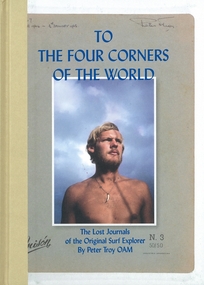
... history of the surf travels by Peter Troy. Troy's travels are the stuff of legends. An original and influential figure in the early days of surfing at Bells Beach, Troy left Australia in 1963 and roamed the planet with surfboard under arm from Europe to Hawaii, South America to South Africa, introducing surfing to Brazil and discovering untold perfect waves like Nias off the coast of Sumatra. ...history of the surf travels by Peter Troy. Troy's travels are the stuff of legends. An original and influential figure in the early days of surfing at Bells Beach, Troy left Australia in 1963 and roamed the planet with surfboard under arm from Europe to Hawaii, South America to South Africa, introducing surfing to Brazil and discovering untold perfect waves like Nias off the coast of Sumatra. ...This book is the definitive history of the surf travels by Peter Troy. Troy's travels are the stuff of legends. An original and influential figure in the early days of surfing at Bells Beach, Troy left Australia in 1963 and roamed the planet with surfboard under arm from Europe to Hawaii, South America to South Africa, introducing surfing to Brazil and discovering untold perfect waves like Nias off the coast of Sumatra. He documented every step of this remarkable journey in letters home which were rediscovered after his untimely death in 2008.This book represents the major surf travel history of one of the great legends in world surfing Peter Troy from Torquay. In 1962 Troy was one of the founders of the Bells Beach Surf Contest, the longest running surf contest in the world. He was an intrepid surf traveller who during the period 1963-1966 introduced surfing to the country of Brazil and explored the four corners of the globe for waves. This book is a unique record of world travel by surfer(s)during this period.Full colour, hard bound travel surf book by Peter Troy OAM, edited by Brendan McAloon. Colour cover image of a young Peter Troy by Rennie Ellis.ISBN - 978-0-9808480-0-7torquay, rod brooks, surf, bells beach, peter troy, rennie ellis, hawaii, nias, vic tantau, terry wall, bells beach surf contest, brazil, world surfing championships, biarritz, european surfing championships, flying pineapple media, sean doherty -
 Bendigo Military Museum
Booklet - BOOKLETS SOUTH AFRICA WW1, c.1915
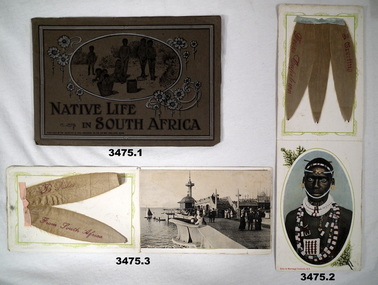
... Part of the HEWSTON collection re WW1 & WW2. documents - booklets military history - souvenirs Africa .1) Printed: “Native life in South Africa” .2) Printed: “Zulu in marriage costume SA” .3) Printed: “From South Africa” 3 x Souvenir booklets from South Africa. .1) Dark grey/brown cover with illustration of native children within an oval shape. ...Items collected by Bert HEWSTON on the way to England WW1, refer Cat No 2759.2 for his service history. Part of the HEWSTON collection re WW1 & WW2.3 x Souvenir booklets from South Africa. .1) Dark grey/brown cover with illustration of native children within an oval shape. Contains colour prints of native people & places. 15 pages. .2) A coloured reproduction of a Zulu in marriage costume. Cream card cover with pale brown printing. Contains 3 x dried silver leaves fromTable Mountain fused to the inside back cover. .3) Photo post card of Promenade Pier, Cape Town which has 2 x dried silver leaves from Table Mountain fused to the inside the back cover..1) Printed: “Native life in South Africa” .2) Printed: “Zulu in marriage costume SA” .3) Printed: “From South Africa”documents - booklets, military history - souvenirs, africa -
 Bendigo Military Museum
Book - BOOK, BOER WAR, The Sting ........ in Reids Raid, 2018
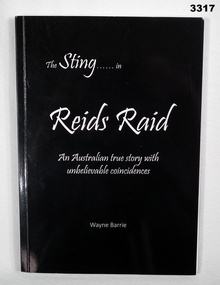
... It occurred in the 1899 - 1902 Boer War in South Africa. books-military-history boer war Soft cardboard cover, white print on glossy black background on front, spine & back. 107 pages cut, plain, white, illustrated with black & white & sepia photos, maps & illustrated. ...From the book cover: Reids Raid is a true story with all the qualities of a good Aussie yarn. It occurred in the 1899 - 1902 Boer War in South Africa.Soft cardboard cover, white print on glossy black background on front, spine & back. 107 pages cut, plain, white, illustrated with black & white & sepia photos, maps & illustrated.books-military-history, boer war -
 Waverley RSL Sub Branch
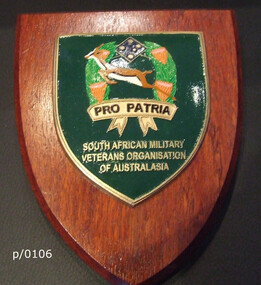
Plaque South African Military Veterans Organisation of Australia
... L. sub branch by South African Military Veterans Organisation of Australia http://www.samvoa.org/abouthistory.html http://www.samvoa.org/abouthistory.html The founder of SAMVOA, Veteran Tony Macquet MMM, documents the early history of the organisation: Two statements characterise the formation of the South African Military Veterans Organisation of Australasia that has taken on the acronym SAMVOA: SAMVOA was long in the making, yet I am reminded of what Garth Pienaar once said, "If you had not started it, I would have". ...Presented to Waverley R. S. L. sub branch by South African Military Veterans Organisation of Australia http://www.samvoa.org/abouthistory.htmlhttp://www.samvoa.org/abouthistory.html The founder of SAMVOA, Veteran Tony Macquet MMM, documents the early history of the organisation: Two statements characterise the formation of the South African Military Veterans Organisation of Australasia that has taken on the acronym SAMVOA: SAMVOA was long in the making, yet I am reminded of what Garth Pienaar once said, "If you had not started it, I would have". And no doubt he or someone else would have because it needed "starting" and it just did not seem right that almost every other nation was represented on ANZAC Day and there were no South Africans marching, particularly when South Africans fought alongside Australians in two World Wars and in Korea. It is important to note that SAMVOA has had predecessors who were South Africans who had marched in Melbourne and probably elsewhere prior to 1996, but they were an older group of WW1 and WW2 veterans who by 1996 were too old to even travel by vehicle and they had fallen away. Around 1998, I contacted and spoke to their leader Major (retd.) Norval who confirmed that their group had become too old to march and he was delighted that a younger group was interested, although at that stage it was only me. http://www.samvoa.org/membership.html SAMVOA Membership This Veteran Organisation dedicates itself, in grateful recognition and memory of our countrymen, the Immortal Dead of South Africa, who, at the call of Duty, made the great Sacrifice on the battlefields of Africa, Asia and Europe and on the Sea. Their ideal is our legacy, Their sacrifice our inspiration. Metal Plaque mounted on wooden shield shaped backing plateSouth African Military Veterans Organisation of Australia Pro Patriasamvoa, south africa, military veterans organization australia, pro patria, -
 Kiewa Valley Historical Society
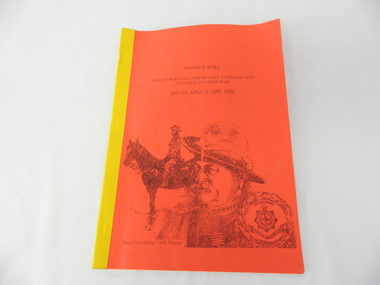
Book - Non Fiction History, Honour Roll - South Africa 1899 - 1902 Albury-Wodonga and District Residents Who Served In The Boer War, reprinted 03/2008
... The degree of adaptability, by these servicemen, to suit the environment in which they fought provided the first real insight into the Australian psyche "of those living and surviving on the harsh Australian outback" history boer war ex-servicemen and women albury and wodonga Author's complimentary inscription "To Mount Beauty Museum with compliments" signed Ian R Docking This book has a bright red soft cover and is bound with bright yellow tape. There is a drawing of two Australian soldiers on the front, one on horseback Honour Roll - South Africa ...Historical information of soldiers from the Albury-Wodonga district who fought in the Boer War in South Africa 1899 - 1902. In 1996 the then curator for the 8/13 VMR Museum, the Hon Colonel John Neale, commissioned the author to research a group of returned servicemen and women from the Boer War and had lived within 100 km radius of the Albury/Wodonga townships.The Boer War was the second war in South Africa and was the result of heavy taxes and non voting rights of the local white Boer population. Colonial forces including the Australian Light Horse contingent where called upon by England to overthrow the rebellion. This War was the first engagement of Australian troops fighting on foreign soil.This Honour Roll details the pay rates, the battle highlights, weapons used and maps covering the first Australian contingent of soldiers who fought in the Transvaal (Boer War).. Listed are the names of those soldiers who lived within 100klms of Albury and Wodonga.The soldiers are listed by Location, Rank, Initial,Name and Unit. The significance of both the War and those who served in it is two fold. Firstly it demonstrates that the tie between the Colonial outreaches of England's Empire to "the Motherland" were extremely strong at this point in time. This union remained strong up until the middle of World War II when England could not help Australia to defend itself against possible invasion by Japan. The alliance between Australia and the United States of America replaced the British/Australian pact. Secondly the attitude of, and the high degree of horsemanship of those from the Albury and Wodonga area. The degree of adaptability, by these servicemen, to suit the environment in which they fought provided the first real insight into the Australian psyche "of those living and surviving on the harsh Australian outback"This book has a bright red soft cover and is bound with bright yellow tape. There is a drawing of two Australian soldiers on the front, one on horsebackAuthor's complimentary inscription "To Mount Beauty Museum with compliments" signed Ian R Docking history, boer war, ex-servicemen and women, albury and wodonga -
 Warrnambool and District Historical Society Inc.
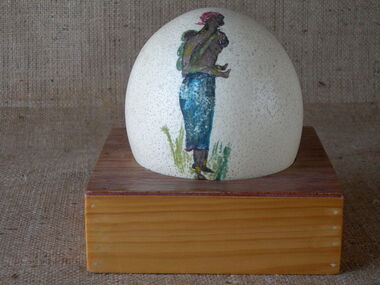
Egg, Painted Ostrich Egg, Early 20th century
... South Africa after the Boer War or purchased by travellers to foreign lands at other times. This ostrich egg has no known provenance. This ostrich egg has been in the collection of the Warrnambool and District Historical Society for 45 years and the only known connection it has to Warrnambool is seen in the fact that the donor was Mrs Uebergang and the Uebergang name is well-known in our district as the Uebergangs were pioneering settlers in the Allansford/ Warrnambool area. history of warrnambool ostrich eggs painted ostrich egg This is a cream-coloured ostrich egg resting in a circular cavity in the centre of a rectangular wooden frame. ...Ostrich eggs were a novelty item found in many homes in the 19th and early 20th centuries, though in Australian homes they were more likely to be emu eggs. Some ostrich eggs may have been brought to Australia from South Africa after the Boer War or purchased by travellers to foreign lands at other times. This ostrich egg has no known provenance.This ostrich egg has been in the collection of the Warrnambool and District Historical Society for 45 years and the only known connection it has to Warrnambool is seen in the fact that the donor was Mrs Uebergang and the Uebergang name is well-known in our district as the Uebergangs were pioneering settlers in the Allansford/ Warrnambool area. This is a cream-coloured ostrich egg resting in a circular cavity in the centre of a rectangular wooden frame. The egg has a small hole on the top and has paintings of an African woman and child on one side of the egg and huts with palm trees on the other side. history of warrnambool, ostrich eggs, painted ostrich egg -
 Bendigo Military Museum
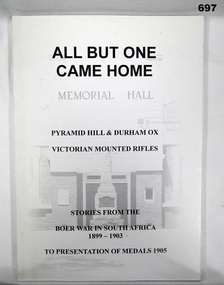
Book, Pyramid Hill District Historical Society, All but one came home, February 2008
... books military history Pyramid hill a Durham Ox. Victorians mounted Rifles stones from the Boer War in South Africa 1899 -1903 to presentation of medals 1905" compiled by margret Williamson Cindy Parker and Lisa Pickersgill while soft cover photo of memorial hall and centotaph on cover. 128 PP All but one came home. ...Pyramid hill a Durham Ox. Victorians mounted Rifles stones from the Boer War in South Africa 1899 -1903 to presentation of medals 1905" compiled by margret Williamson Cindy Parker and Lisa Pickersgill while soft cover photo of memorial hall and centotaph on cover. 128 PPbooks, military history -
 Bendigo Military Museum
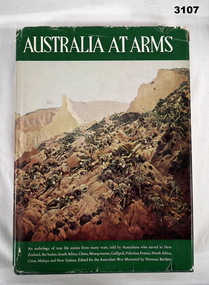
Book - BOOK, MILITARY HISTORY, Norman Bartlett, Australia at Arms, 1962
... An anthology of true life stories as told by Australians who served in New Zealand, South Africa, World War I & II. books-biography military history photography illustrations Hard, green, buckram cover embossed with gold shield surrounded by laurel wreath. ...An anthology of true life stories as told by Australians who served in New Zealand, South Africa, World War I & II.Hard, green, buckram cover embossed with gold shield surrounded by laurel wreath. Dust jacket with colour illustration on front. Title in white print on green background. Title in gold print on spine. End papers illustrated in green with maps & figure of soldiers. 265 pages with cut edges & black & white photos & drawings.books-biography, military history, photography, illustrations -
 Bendigo Military Museum
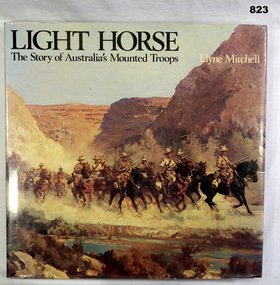
Book, Elyne Mitchell, Light Horse: The Story of Australia's Mounted Troops, 1978
... Book documents the role of Australian mounted regiments from the South African (Boer) War to the fall of Damascus in 1918. books light horse military history Author's signature on title page: Elyne Mitchell Book, black buckram hard cover with title in grey letters on spine. ...The author, Elyne Mitchell is the daughter of General Sir Harry Chauvel, Commander of the Desert Mounted Corps in World War I. Book documents the role of Australian mounted regiments from the South African (Boer) War to the fall of Damascus in 1918.Book, black buckram hard cover with title in grey letters on spine. Black dust cover with illustration on front. Title in black letters. Illustrated end papers, 112 pages with cut edges. Colour & black & white illustrations. Author's signature on title page: Elyne Mitchellbooks, light horse, military, history -
 4th/19th Prince of Wales's Light Horse Regiment Unit History Room
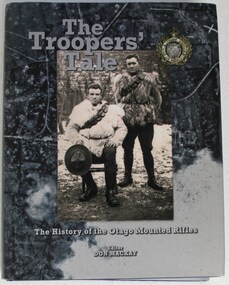
Book, Don Mackay, The Troopers' Tale - The History of the Otago Mounted Rifles, 2012
... "The Troopers' Tale" records the history of the regiment from the 1860's to the present day, and tells the personal stories of many previously unknown New Zealand soldiers. book otago mounted rifles history south african war world war 1 book otago mounted rifles history south african war world war 1 ISBN 978-0-47320462-4 Hard cover book. 382 pages The Troopers' Tale - The History of the Otago Mounted Rifles Book Book Don Mackay Turnbull Ross Publishing Southern Colour Print ...The Otago Mounted Rifles served in the Boer War. In World War 1 the Regiment fought at Gallipoli, then, later, on the Western Front they were part of 1 ANZAC Corps with elements of the 4th and 8th Australian Light Horse Regiments. Later the OMR was reorganised into II ANZAC Corps with B and D Squadrons of the 4th Australian light Horse. Featuring nearly 400 photographs, illustrations and maps. "The Troopers' Tale" records the history of the regiment from the 1860's to the present day, and tells the personal stories of many previously unknown New Zealand soldiers. Hard cover book. 382 pagesISBN 978-0-47320462-4book, otago mounted rifles, history, south african war, world war 1, book, otago mounted rifles, history, south african war, world war 1 -
 4th/19th Prince of Wales's Light Horse Regiment Unit History Room
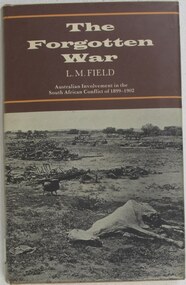
Book, Wilke & Co Ltd, The Forgotten War, Australian Involvement in the South African Conflict of 1899-1902, 1979
... book history boer war book history boer war Stamp of a previous owner, namely Brunswick Public Library Hard covered book of 236 pages, with photos and illustrations The Forgotten War, Australian Involvement in the South African Conflict of 1899-1902 Book Book Wilke & Co Ltd L M Field Melbourne University Press ...Hard covered book of 236 pages, with photos and illustrationsStamp of a previous owner, namely Brunswick Public Librarybook, history, boer war, book, history, boer war -
4th/19th Prince of Wales's Light Horse Regiment Unit History Room
Newsletter, Brunswick Community History Group, Fusion - Newsletter of the Brunswick Community History Group, Nov 2009, 2009
... South African war. There is also an invitation to a service at the memorial for 'Australian Heritage Week' 2011 Fusion - Newsletter of the Brunswick Community History Group, Nov 2009 Newsletter Brunswick Community History Group ...A photocopy of the newsletter, which carries an article on the unveiling of a memorial to those Brunswick soldiers who served in the South African war. There is also an invitation to a service at the memorial for 'Australian Heritage Week' 2011boer war, memorial -
4th/19th Prince of Wales's Light Horse Regiment Unit History Room
Book, Laurie Field, The Forgotten War - Australia and the Boer War, 1995
... australian military history Boer War Paperback book of 234 pages Green covered paperback book with coloured illustration of mounted riflemen. This book charts the course of the Australian troops in the Boer War in South Africa. ...Green covered paperback book with coloured illustration of mounted riflemen. This book charts the course of the Australian troops in the Boer War in South Africa.Paperback book of 234 pagesaustralian military history, boer war -
 Bendigo Military Museum
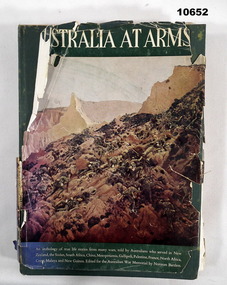
Book - ANTHOLOGY, MILITARY, Norman Bartlett for the Australian War Memorial, "AUSTRALIA AT ARMS", 1955
... From the Dust Cover "AUSTRALIA AT ARMS/ An Anthology of true life stories from many wars, told by Australians who served in New/ Zealand, the Sudan, South Africa, China, Mesopotamia, Gallipoli, Palestine, France, North Africa, Crete, Malaya and New Guinea." Publications Books Military History Anthology Hard cover book with dust cover. ...From the Dust Cover "AUSTRALIA AT ARMS/ An Anthology of true life stories from many wars, told by Australians who served in New/ Zealand, the Sudan, South Africa, China, Mesopotamia, Gallipoli, Palestine, France, North Africa, Crete, Malaya and New Guinea."Hard cover book with dust cover. Hardcover, cardboard with dark green colour with gold print on front and spine. Dustcover, paper with white and black print on front, spine and book. Illustrated in colour the painting "ANZAC the Landing" by George Lambert. Flaps with printed information. 265 pages, cut, plain, off white paper. Illustrated, black and white photographs and paintings from the "Australian War Memorial". End papers - illustrated green colour print two soldiers with a map in the background.publications, books, military history, anthology -
 Kiewa Valley Historical Society
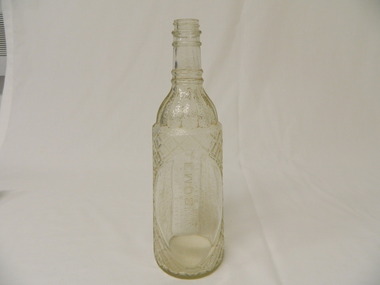
Bottle - Cordial, 1940's
... History of Brookes Lemos ltd. Historical: Change of Bottles - shape, glass, stopper, embossing. Bottle collectors. Aesthetic: Display showing embossing and shape cordial drink bottle brookes lemos ltd. Printed from top to bottom: 1 flat side: 'Regd Design No 9072 Australia No 8449 India / No 689933 Great Britain No / 1926 Union of South Africa / No 57737 U S America No 1921 New Zealand Regd 1925 Canada / Only Contents Sold'. ...Cordial came in bottles bought at the local grocery store or at a large city store on a shopping expedition. The shape of the bottles changed as did the stopper used to seal it. Bottles were re cycled remaining the property of the manufacturer. History of Brookes Lemos ltd.Historical: Change of Bottles - shape, glass, stopper, embossing. Bottle collectors. Aesthetic: Display showing embossing and shape Clear glass bottle curved on 1 side with criss cross pattern two thirds of the way up surrounding a clear oval shape with narrower ends top and bottom. The other side is made up of 3 flat 'pieces' each with print in capital letters, heavily embossed. On 1 of these flat sides below the writing is the 'outline picture' of a 'boy' holding a similar bottle. Above these sides the bottle becomes round and tapers with vertical embossing to a double lip, a neck and then another double lip with a screw for the top.Printed from top to bottom: 1 flat side: 'Regd Design No 9072 Australia No 8449 India / No 689933 Great Britain No / 1926 Union of South Africa / No 57737 U S America No 1921 New Zealand Regd 1925 Canada / Only Contents Sold'. Middle flat side: 'Brookes Lemos Limited / Manufacturers of / Lemos / Registered Trade Mark' Third flat side: 'This Bottle is the Property / Brookes Lemos Limited and / Cannot be Legally Used / By Others For Any Purpose.' Also outline picture of boy Base: 'F380'cordial, drink, bottle, brookes lemos ltd. -
 Monbulk RSL Sub Branch
Book, Norman Bartlett, Australia at arms, 1955
... An anthology commissioned by the Australian war memorial australia - military history australia - military - personal narratives An anthology of true life stories from many wars, told by Australians who served in New Zealand, the Sudan, South Arica, China, Mesopotamia, Gallipoli, Palestine, France, North Africa, Crete, Malaya and New Guinea. ill (plates) (b/w) Australia at arms Book Norman Bartlett Australian War Memorial ...An anthology of true life stories from many wars, told by Australians who served in New Zealand, the Sudan, South Arica, China, Mesopotamia, Gallipoli, Palestine, France, North Africa, Crete, Malaya and New Guinea.ill (plates) (b/w)non-fictionAn anthology of true life stories from many wars, told by Australians who served in New Zealand, the Sudan, South Arica, China, Mesopotamia, Gallipoli, Palestine, France, North Africa, Crete, Malaya and New Guinea.australia - military history, australia - military - personal narratives -
 Monbulk RSL Sub Branch
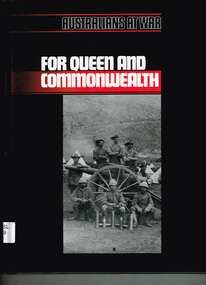
Book, Time Life books, For Queen and Commonwealth, 1987
... Australia - History - Military South African war 1899-1901 - Participation Boxer rebellion - Australian participation A study of Australian military involvement in the Sudan, China and South Africa. ...A study of Australian military involvement in the Sudan, China and South Africa. Includes illustrations.Index, Bibliography, ill, p.163non-fictionA study of Australian military involvement in the Sudan, China and South Africa. Includes illustrations.australia - history - military, south african war 1899-1901 - participation, boxer rebellion - australian participation -
 Monbulk RSL Sub Branch
Book, Australian War Memorial, Australia at arms, 1955
... Australian Military Forces - History Australia - Military history An anthology of true life stories from many wars, told by Australians who served in New Zealand, the Sudan, South Africa, China, Mesopotamia, Gallipoli, Palestine, France, North Africa, Crete, Malaya and New Guinea. ...An anthology of true life stories from many wars, told by Australians who served in New Zealand, the Sudan, South Africa, China, Mesopotamia, Gallipoli, Palestine, France, North Africa, Crete, Malaya and New Guinea.Ill, p.265.non-fictionAn anthology of true life stories from many wars, told by Australians who served in New Zealand, the Sudan, South Africa, China, Mesopotamia, Gallipoli, Palestine, France, North Africa, Crete, Malaya and New Guinea. australian military forces - history, australia - military history -
 Monbulk RSL Sub Branch
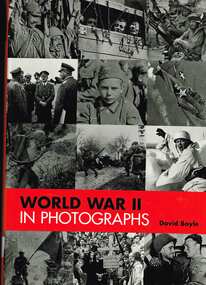
Book, Rebo Productions, World War II in photographs, 1988
... history. Military adn press photographers, propagandists, camera-wielding soldiers and civilians - all took the opportunity to record the tumultuous events of 1939-45. World War II in Photographs features 900 clearly captioned images selected from a wide variety of sources. Every major theatre of conflict is covered, from the icy seas of the Arctic Circle to the jungles of the South Pacific, from the deserts of North Africa ...World War II was the most intensively photographed conflict in history. Military adn press photographers, propagandists, camera-wielding soldiers and civilians - all took the opportunity to record the tumultuous events of 1939-45. World War II in Photographs features 900 clearly captioned images selected from a wide variety of sources. Every major theatre of conflict is covered, from the icy seas of the Arctic Circle to the jungles of the South Pacific, from the deserts of North Africa to the steppes of Russia.Index, ill, p.600.non-fictionWorld War II was the most intensively photographed conflict in history. Military adn press photographers, propagandists, camera-wielding soldiers and civilians - all took the opportunity to record the tumultuous events of 1939-45. World War II in Photographs features 900 clearly captioned images selected from a wide variety of sources. Every major theatre of conflict is covered, from the icy seas of the Arctic Circle to the jungles of the South Pacific, from the deserts of North Africa to the steppes of Russia.world war 1939-1945 - history, world war 1939-1945 - pictorial works
