
Showing 5 items matching "south channel fort"
-
 Melbourne Tram Museum
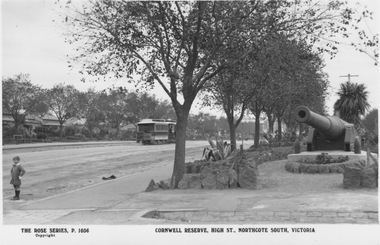
Postcard - Cornwell Reserve, High Street, Northcote South, 1913-1920s
... ...South Channel Fort...The cannons were originally built in England in 1884/8 5 and installed in Melbourne's South Channel Fort off Sorrento to defend against possible Russian invasion. ...The cannons were originally built in England in 1884/8 5 and installed in Melbourne's South Channel Fort off Sorrento to defend against possible Russian invasion. ...Photograph looks north along High Street from Walker Street with a Northcote line cable tram travelling northward and a large cannon located at right. Two cannons were placed at this point either side of High Street in June 1913 by the Northcote South Ratepayer’s Association. The cannons were originally built in England in 1884/8 5 and installed in Melbourne's South Channel Fort off Sorrento to defend against possible Russian invasion. Cornwell Reserve is now known as High Street Linear Reserve.Yields information about High Street Northcote South Postcard with label below photograph and postcard markings on rear. On front: 'The Rose Series P 1056 Cornwell Reserve, High Street, Northcote South'; on rear: 'Postcard - A real photograph Produced in Australia'high street, northcote, walker street, cable tram, large cannon, south channel fort, cornwell reserve, high street linear reserve. -
 Queenscliffe Maritime Museum
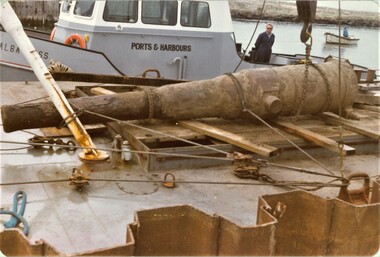
Photograph - Colour photo, 1980, of "disappearing gun" during transportation, Disappearing 12" Gun, 1980
... Disappearing gun relocated to Queenscliffe Fort from South Channel Fort 1980...Queenscliffe Maritime Museum 2 Wharf St Queenscliff geelong-and-the-bellarine-peninsula Disappearing gun relocated to Queenscliffe Fort from South Channel Fort 1980 Disappearing gun barrel being transported. historical references Reverse - " nil " Black & white 1908 photograph of Queenscliffe fishermen's catch on the pier Disappearing 12" Gun Photograph Colour photo, 1980, of "disappearing gun" during transportation. ...Disappearing gun relocated to Queenscliffe Fort from South Channel Fort 1980Disappearing gun barrel being transported.Black & white 1908 photograph of Queenscliffe fishermen's catch on the pierReverse - " nil "historical references -
 Queenscliffe Maritime Museum
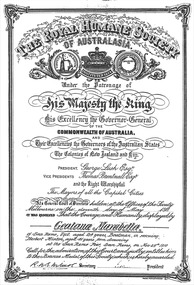
Certificate - Illuminated Address & Certification, Royal Humane Society certificate/citation for Geatana Marabella, dated 11 May 1911, 11 May 1911
... Disappearing gun relocated to Queenscliffe Fort from South Channel Fort 1980...Queenscliffe Maritime Museum 2 Wharf St Queenscliff geelong-and-the-bellarine-peninsula Disappearing gun relocated to Queenscliffe Fort from South Channel Fort 1980 Disappearing gun barrel being transported. historical references Reverse - " nil " Royal Humane Society Citation of 11 May 1911 for Geatana Marabella for 'courage & humanity' Royal Humane Society certificate/citation for Geatana Marabella, dated 11 May 1911. ...Disappearing gun relocated to Queenscliffe Fort from South Channel Fort 1980Disappearing gun barrel being transported.Royal Humane Society Citation of 11 May 1911 for Geatana Marabella for 'courage & humanity'Reverse - " nil "historical references -
 Queenscliffe Maritime Museum
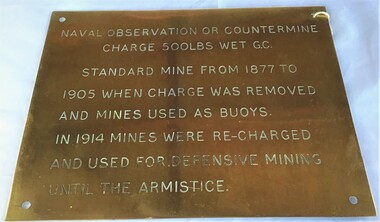
Plaque - Plaque, brass inscribed with Naval countermine information
... The scheme, involving massive expenditure, comprised a forward defence system of forts at Port Phillip heads dominated by Fort Queenscliff and South Channel Fort (artificial island), and a network of coastal batteries. ...The scheme, involving massive expenditure, comprised a forward defence system of forts at Port Phillip heads dominated by Fort Queenscliff and South Channel Fort (artificial island), and a network of coastal batteries. ...Found in garden shed of Mr Harry Barratt [WWI Gallipoli] and donated by his grandson. In 1877 Swan island was designed to defend shipping in Port Phillip and Hobson's Bays. The scheme, involving massive expenditure, comprised a forward defence system of forts at Port Phillip heads dominated by Fort Queenscliff and South Channel Fort (artificial island), and a network of coastal batteries. Some development of fortification had occurred in the 1850s, but it was the impetus of the Jervois-Scratchley reports which led to major work being undertaken in the 1880s. The overall defence plan involved a combination of guns, mines (known as electric torpedo) and ships to defend the entrance to Port Phillip Bay. Swan Island Fort would be used to protect the minefields in the harbour, Naval observation countermine charge 500lbs wet G.C Standard mine from 1877 to 1905 when charge was removed and mines used as buoys. In 1914 mines were recharged and used for defensive mining until Armistice.Brass plaque inscribed with information on naval countermineNaval observation or countermine charge 500lbs wet G.C. Standard mine from 1877 to 1905 when charge was removed and mines used as buoys. In 1914 mines were recharged and used for defensive mining until the Armistice.sea mine, plaque, pre wwi, naval countermine, swan island -
 Sunshine and District Historical Society Incorporated
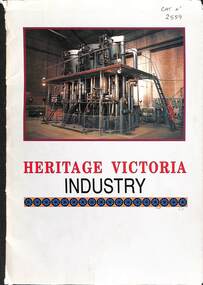
Book - Heritage Victoria Industry, National Trust of Australia, 1990
... Heritage Victoria Industry|McKay - Massey Ferguson Site|Avoca Powder Magazine|State Bank Williamstown|Pipemaker's Park|Beechworth Town|Rushworth Chronicle|Powelltown Saw Mill Sites|South Channel Fort|Victoria Brewery|Walkerville Lime Kilns|Williamstown Time Ball Tower and Tide Gauge|Wonthaggi Coal Mine|Mount Difficult Quarry Heatherlie|LaL Lal Blast Furnace|Geelong Telegraph Station|J. ...Heritage Victoria Industry|McKay - Massey Ferguson Site|Avoca Powder Magazine|State Bank Williamstown|Pipemaker's Park|Beechworth Town|Rushworth Chronicle|Powelltown Saw Mill Sites|South Channel Fort|Victoria Brewery|Walkerville Lime Kilns|Williamstown Time Ball Tower and Tide Gauge|Wonthaggi Coal Mine|Mount Difficult Quarry Heatherlie|LaL Lal Blast Furnace|Geelong Telegraph Station|J. ...Collection of information sheets on industries in Victoria
