Showing 74 items matching "south melbourne rowing club"
-
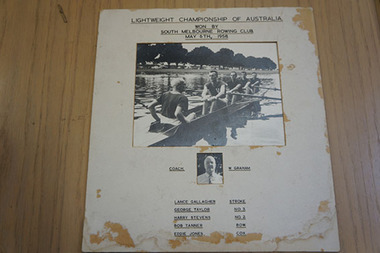
Albert Park-South Melbourne Rowing ClubPhotograph of South Melbourne Rowing Club Crew that Won the First Championship for Lightweight Fours (Penrith Cup), 1958, 1958
... Photograph of South Melbourne Rowing Club Crew that Won the First Championship for Lightweight Fours (Penrith Cup), 1958...Photograph of South Melbourne Rowing Club Crew that Won the First Championship for Lightweight Fours (Penrith Cup), 1958...rowing club...penrith cup...lightweight...four...championship...south melbourne...Lightweight Championship of Australia / Won by / South Melbourne Rowing Club / May 6th, 1958 Coach W. Graham / Lance Gallagher Stroke / George Taylor No. 3 / Harry Stevens No. 2 / Bob Tanner Bow / Eddie Jones Cox / South Melbourne state crew ??? ...Albert Park-South Melbourne Rowing Club Plant-Williamson Rowing Pavilion, 36 Aughtie Drive Albert Park Lake melbourne "As with most items in the AP-SMRC collection, the ‘chain of ownership’ is not formally recorded for this item. ..."As with most items in the AP-SMRC collection, the ‘chain of ownership’ is not formally recorded for this item. The image is not unique, but is one of a set that was produced for each of the men represented in the photographs, with perhaps additional copies for the SMRC. Lance Gallagher, speaking with Ms (Grace) Blake and the consultant (Mrs Margaret Birtley) on 8 June 2014, recalled the photograph well and confirmed on 17 July 2014 that he has a personal copy." 2014 Significance Assessment, p28."This item comprises two photographs mounted together with a caption that identifies the men depicted as being a South Melbourne Rowing Club (SMRC) crew and coach. Representing Victoria, this crew won the first Championship for Lightweight Fours at an Interstate Regatta. The race was contested on the Nepean River, NSW, on 3 May 1958. The photograph of the crew was taken on the Yarra River, Victoria, prior to the Regatta and was used for publicity in the Regatta program.16 The victory was significant to SMRC because the oarsmen and coaches (although not the coxswain) were members of that club. The item is a memento of the club’s success, through its crew, at an elite and national level. The Lightweight Four Championship event’s first hosting at Penrith on the Nepean River resulted in a perpetual trophy being donated by that local municipal council. The race for the Lightweight Championship Four continues to this day as a featured event at the annual Interstate Regatta. The Penrith Cup lends its name to this prestigious event. It is unusual for Interstate race crews to be drawn entirely from a single club; more typically, the state representative crews are selected as composites. The selection of an all-SMRC crew for this inaugural race between representative Lightweight Four crews testifies to the exceptional standards at SMRC during this period. The item is of historic significance because it provides pictorial evidence of the crew and the club’s success in a national competition and in a category of event that was being contested at the Interstate Regatta for the very first time. It also carries social significance through the captioning that credits the victory as being the club’s rather than the state’s, and thus reflects the pride of the SMRC in the achievements of its oarsmen and coaches." 2014 Statement of Significance, p30Unframed photograph of the crew which won the inaugural interstate men’s lightweight coxed four in Penrith, 1958. Lightweight Championship of Australia / Won by / South Melbourne Rowing Club / May 6th, 1958 Coach W. Graham / Lance Gallagher Stroke / George Taylor No. 3 / Harry Stevens No. 2 / Bob Tanner Bow / Eddie Jones Cox / South Melbourne state crew ??? This event became the Penrith Cup.rowing, albert park lake, apsm rowing club, penrith cup, lightweight, four, championship, south melbourne rowing club, gallagher, lance, taylor, george, stevens, harry, tanner, bob, jones, eddie, webster, jack, graham, wal -
Albert Park-South Melbourne Rowing ClubPhotograph, 1914 South Melbourne Rowing Club Photo, 1914
... 1914 South Melbourne Rowing Club Photo...This photograph was taken after the first members of the South Melbourne Rowing Club enlisted in World War One. ...Albert Park-South Melbourne Rowing Club Plant-Williamson Rowing Pavilion, 36 Aughtie Drive Albert Park Lake melbourne This photograph was taken after the first members of the South Melbourne Rowing Club enlisted in World War One. ...This photograph was taken after the first members of the South Melbourne Rowing Club enlisted in World War One. It was originally published in 'Punch' on 3 December, 1914 on page 19. The names of the men are as follows: Top Row.—Messrs. E. Staff, W. McCabe, C. Wolff, N. Jackson, W. Giles, V. Whelan, G. Tully (Hon. Treasurer), S. Thompson, H. Jones, T. Moves, J. Sherman. Second Row.—Messrs. G. A. Firman, C. Clarke, C. C. King, D. A. Bowman, A. Payne, W. Theil, V. Harcourt, B. Tribe, G. McKay, L. F. Bligh, W. Curtis, B. Haines. Third Row.—Messrs. F. Tobitt, J. J. Scanlan, P. Lohan, A. Jamieson, F. J. G. Maher, J. Bernet, H. Tribe, R. Cazaly, A. Henry, J. Meens, F. Mardell, T. Barrell, C. Bond, A. Casey. Sitting.—Messrs. C. De Fraga, A. Crook (Asst. Hon. Secretary), C. Borrman, R. C. Curwen, P. C. Shaw, W. McKay (Vice-President), A. H. Warland (President), G. T. Hastie (Vice-President), G. Anderson (Captain), H. C. Kennett, Fred L. Loud (Hon. Secretary), H. Dixon, G. Barrell (Vice-Captain). Front.—Coxswains D. Fereday, N. Tobitt, J. Maddock, N. Campbell, D. Donaldson.A black and white photograph depicting five rows of men, standing and seated in uniforms and suits. The photograph is under glass with a brown wooden frame.On reverse: N. Giles top row, 4th from left. -
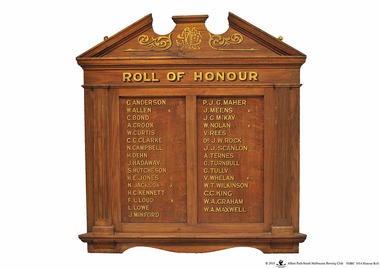
Albert Park-South Melbourne Rowing ClubHonour Board, SMRC / Roll of Honour, 1917
... South Melbourne Rowing Club...A wooden honour board depicting the names of the World War One enlistments from the South Melbourne Rowing Club. The names are written in gold lettering....Albert Park-South Melbourne Rowing Club Plant-Williamson Rowing Pavilion, 36 Aughtie Drive Albert Park Lake melbourne South Melbourne Rowing Club APSM Rowing Club Albert Park Lake Rowing Anderson, G. ...A wooden honour board depicting the names of the World War One enlistments from the South Melbourne Rowing Club. The names are written in gold lettering.G. Anderson, W. Allen (K), C. Bond, A. Crook, W. Curtis, C.C. Clarke, N. Campbell, H. Dehn, J. Hadaway, S. Hutcheson, H.E. Jones (K), N. Jackson (K), H.C. Kennett, F.L. Loud (K), L. Lowe, J. Minford, P.J.G. Maher, J. Meens (K), J.G. McKay, W. Nolan (K), V. Rees, Dr J.W. Rock, J.J. Scanlon, A. Ternes, G. Turnbull, G. Tully, V. Whelan (K), W.T. Wilkinson, C.C. King, W.A. Graham, W.A. Maxwellsouth melbourne rowing club, apsm rowing club, albert park lake, rowing, anderson, g., allan, william, bond, charles, crook, arthur, curtis, w., campbell, norman, dehn, james herbert, graham, w.a., hadaway, ernest john, hutcheson, sydney, jackson, norman, jones, herbert evan, kennett, henry clifford, clarke, c., king, clarence campbell, loud, frederick leslie, lowe, l., maher, percival john godfrey, maxwell, wilfred armstrong, mckay, j.g., meens, alexander john, minford, john, nolan, w., rees, v., rock, j. william, scanlan, john joseph, ternes, albert james, tully, gerald marcus, turnbull, g., whelan, victor, wilkinson, william thomas -
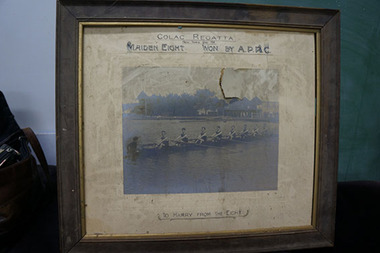
Albert Park-South Melbourne Rowing Club1911 Maiden Eight, Colac Regatta / New Year’s Day 1911 / Maiden Eight / To Harry from the Eight
... rowing club...albert park rowing club...south melbourne...Albert Park-South Melbourne Rowing Club Plant-Williamson Rowing Pavilion, 36 Aughtie Drive Albert Park Lake melbourne rowing apsm rowing club albert park rowing club south melbourne rowing club albert park lake monteath, charles duncan, henry robert chamber, w mcilroy, w leslie, cp harry, mb paxman, w moorhead, j brady, j On reverse: H.R. ...A black and white staged photograph of the Albert Park Maiden Eight who won at the Colac Regatta. The photograph is in a brown wooden frame with a gilt edge and is on beige cardboard mounting.On reverse: H.R. Duncan (cox), C. Monteath (s), W. Chambers (7), W. McIlroy (6), C.P. Leslie (5), M.B. Harry (4), W. Paxton (3), J. Moorhead (2), J. Faraday (b)rowing, apsm rowing club, albert park rowing club, south melbourne rowing club, albert park lake, monteath, charles, duncan, henry robert, chamber, w, mcilroy, w, leslie, cp, harry, mb, paxman, w, moorhead, j, brady, j -
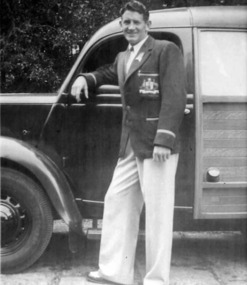
Albert Park-South Melbourne Rowing ClubPhoto of Jack Webster, S.M.R.C / AUSTRALIAN REPRESENTATIVE / Jack Webster, Unknown
... rowing club...webster, jack...south melbourne...Albert Park-South Melbourne Rowing Club Plant-Williamson Rowing Pavilion, 36 Aughtie Drive Albert Park Lake melbourne rowing apsm rowing club webster, jack south melbourne rowing club albert park lake auckland 1948 london olympic games 1950 auckland empire games commonwealth games Olympic Games, London 1948, 4- / Empire Games, Auckland 1950, 2- (Gold) A black and white photograph of Jack Webster in Australian national uniform standing in front of a car. ...A black and white photograph of Jack Webster in Australian national uniform standing in front of a car. The photograph is under glass with a white cardboard mounting.Olympic Games, London 1948, 4- / Empire Games, Auckland 1950, 2- (Gold)rowing, apsm rowing club, webster, jack, south melbourne rowing club, albert park lake, auckland, 1948 london olympic games, 1950 auckland empire games, commonwealth games -
Albert Park-South Melbourne Rowing ClubMap, Albert Park Lake, Post-1957
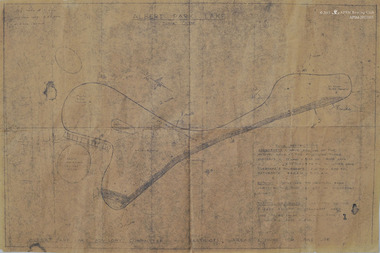
... rowing club...map...albert park rowing club...south melbourne...Albert Park-South Melbourne Rowing Club Plant-Williamson Rowing Pavilion, 36 Aughtie Drive Albert Park Lake melbourne albert park lake rowing apsm rowing club map albert park rowing club south melbourne rowing club ALBERT PARK LAKE / 1" = 320 / TIME RESTRICTIONS / SPEEDBOATS HAVE FULL USE OF THE HATCHED AREA AT THE FOLLOWING TIMES / SUNDAYS - 12 NOON - 5.30PM RACE DAYS. / 2.30PM - 3.30PM ALL OTHER DAYS / TUESDAYS & THURSDAYS - 2.00PM - 4.00PM / SATURDAYS - 8.00AM - 11.00AM / ROWING - CONFINED TO WESTERN BANK / UNRESTRICTED TIME EXCEPT IN SPEEDBOAT AREA / YACHTS, HIRE BOATS - UNRESTRICTED TIME & AREA EXCEPT IN SPEEDBOAT AREA. / (CARE TO BE TAKEN IN ROWING AREA / IF POSSIBLE KEEP CLEAR) / RESTRICTED TIMES & AREAS FOR LAKE USE A dyeline-type map of Albert Park Lake and buildings. ...A dyeline-type map of Albert Park Lake and buildings.ALBERT PARK LAKE / 1" = 320 / TIME RESTRICTIONS / SPEEDBOATS HAVE FULL USE OF THE HATCHED AREA AT THE FOLLOWING TIMES / SUNDAYS - 12 NOON - 5.30PM RACE DAYS. / 2.30PM - 3.30PM ALL OTHER DAYS / TUESDAYS & THURSDAYS - 2.00PM - 4.00PM / SATURDAYS - 8.00AM - 11.00AM / ROWING - CONFINED TO WESTERN BANK / UNRESTRICTED TIME EXCEPT IN SPEEDBOAT AREA / YACHTS, HIRE BOATS - UNRESTRICTED TIME & AREA EXCEPT IN SPEEDBOAT AREA. / (CARE TO BE TAKEN IN ROWING AREA / IF POSSIBLE KEEP CLEAR) / RESTRICTED TIMES & AREAS FOR LAKE USEalbert park lake, rowing, apsm rowing club, map, albert park rowing club, south melbourne rowing club -
Albert Park-South Melbourne Rowing ClubMoore Sculling Machine
... rowing club...significance assessment...malcolm moore industries ltd...kerns...1900...sculling machine...albert park rowing club...south melbourne..."The ‘Moore’ Rowing Machine at the Albert Park – South Melbourne Rowing Club (AP- SMRC) is a rare example in Australia of the Kerns patent design from 1900. ..."Grace Blake’s conversations with older members of the Club have elicited the following information during July 2014: • Don Christie recalls the machine being acquired by (or donated to) SMRC in the 1960s. SMRC later donated it to APRC. • Bob Duncan remembers it being at APRC. • Max Shaw joined the club in 1946 but doesn’t recall it at all. • Peter Watson recalls collecting the rowing machine from the old APRC club house before its demolition (c. 1995). The AP-SMRC machine carries a ‘maker’s plate’ with the name Moore... Moore Crane and Engineering Company Pty Ltd was a subsidiary of Malcolm Moore Industries Ltd whose manufacturing engineering works were located on Williamstown Road, Port Melbourne from 1927. The founder established the main business in 1921 and retired in 1953.21 The business was delisted from the Australian Stock Exchange in 1976. Grace Blake advises that some of the earlier SMRC members were plumbers and therefore worked in trades connected with engineering. She reports that Peter Watson recalls some of his contemporaries completing their engineering apprenticeships at Malcolm Moore Industries Ltd in the 1970s. There are still many unanswered questions concerning the history and provenance of the rowing machine at the time of writing this report, but the connection with a local engineering works is certainly fascinating. Questions to explore in the future include: Did Moore manufacture the machine, or import it (and perhaps assemble it) under licence? Was this machine a ‘one-off’ or did Moore make / distribute others within Australia? When, why and how did SMRC acquire the machine? Why did SMRC decide not to retain it, but to pass it over to APRC? And how did APRC use it?" 2014 Significance Assessment, pp38-40. "The ‘Moore’ Rowing Machine at the Albert Park – South Melbourne Rowing Club (AP- SMRC) is a rare example in Australia of the Kerns patent design from 1900. This machine may not, however, be that old in construction or use. The AP-SMRC machine is almost intact, appearing to lack only the leather straps for fastening the rower’s feet to the foot-rests. Spalding manufactured the design in the USA in the early decades of the 20th century, but the metal elements in its models are traditionally black. The bright red paint on the AP-SMRC machine suggests something different. The AP-SMRC machine carries a maker’s plate that associates it directly with a local engineering business, Malcolm Moore Industries Ltd of Williamstown Road, Port Melbourne. Club members recall the machine being at the South Melbourne Rowing Club in the 1960s, and being transferred at a later date to the Albert Park Rowing Club. The machine has not been used since the founding of the amalgamated AP-SMRC and requires careful conservation. The ‘Moore’ rowing machine is of national research significance as a rare survivor, in Australia, of the well-regarded Kerns patent design that was popularised by Spalding in the northern hemisphere. The English River and Rowing Museum website quotes a testimonial from an AG Spalding & Bros’ Mail Order Catalogue: ‘This machine was described by ‘an experienced oarsman’ ... “to be the most perfect rowing machine ever produced”. A feature was the adjustment of the resistance so “the weaker sex can use the machine”’. Its historic significance lies in its rarity (and perhaps uniqueness) as an aid to the training of rowers at two successful clubs on Albert Park Lake. Additional historic significance lies in the connection that the rowing machine represents between local rowing clubs and a major local manufacturing engineer. The ‘Moore’ rowing machine bridges the realms of innovation and application, of industry and recreation, of land-based and aquatic sports, and of two neighbouring rowing clubs on the Albert Park Lake." 2014 Significance Assessment, p43"A rowing machine that appears to be built to the Kerns patent design from 1900 but may not be that old in construction or use. The machine is heavy and includes parts made from cast iron. The cast iron components are painted in a distinctive bright red. The wooden seat moves on timber slides. Resistance is created by spring mechanisms at the ends of two frame elements that connect with two wooden ‘oars’, and by the central chain-driven system that co-ordinates with the rower’s movements. The machine carries a maker’s plate with the single word ‘Moore’ in an oval design, using white letters against a navy background, fastened to the base board and close to the foot-rests." 2014 Significance Assessment, p38Moorerowing, apsm rowing club, significance assessment, malcolm moore industries ltd, kerns, 1900, sculling machine, albert park rowing club, south melbourne rowing club, albert park lake, rowing machine, ergo -
Warrnambool and District Historical Society Inc.Medal, Warrnambool R.C Regatta
... south of Merri St) Warrnambool great-ocean-road This Warrnambool Rowing Club medal was awarded to the winners of the Society Fours in 1908. The Friendly Society group that won the race was the Manchester Unity Independent Order of Odd Fellows, a benefit society owned by members who assist other members in times of illness or unemployment. Originally founded in Manchester, England, the M.U.I.O.O.F. started in Melbourne ...This Warrnambool Rowing Club medal was awarded to the winners of the Society Fours in 1908. The Friendly Society group that won the race was the Manchester Unity Independent Order of Odd Fellows, a benefit society owned by members who assist other members in times of illness or unemployment. Originally founded in Manchester, England, the M.U.I.O.O.F. started in Melbourne in 1840. The Warrnambool branch was founded in 1860. The Warrnmbool Rowing Club was established in 1873, though there had been several boat clubs associated with the Hopkins River going back to the 1850s. No information has been found on R.Russell. This medal is of interest as a memento of a Warrnambool sporting club award in 1908 and of the winner of the award, a Warrnambool group and a member of that group.This circular brass medal has a shield shaped centrepiece with text on both obverse and reverse surrounded by a plain annulus edged with small scrolls. It has a ring at the top.Obverse- W.R.C. Regatta 1908 Reverse SOCIETY FOURS Won by M.U.I.O.O.F.R RUSSELL. A maker's hallmark.warrnambool rowing club, the friendly society, m.u.i.o.o.f. -
Ballarat Tramway MuseumEphemera - Calendar, Ballarat Historical Society, 2014
... Ballarat Tramway Museum South Gardens Reserve Wendouree Parade Ballarat Ballarat goldfields Photograph of the fundraising committee, and social function for The Most Popular Conductress Competition award, held on 30/9/1944 at the Ballarat City Rowing Club, after the formal announcement on 31/8/1944 at the Melbourne Town Hall ball. ...Photograph of the fundraising committee, and social function for The Most Popular Conductress Competition award, held on 30/9/1944 at the Ballarat City Rowing Club, after the formal announcement on 31/8/1944 at the Melbourne Town Hall ball.Demonstrates a photograph of the fundraising committee.Calendar - A4 landscape - wire bound produced for 2015.most popular conductress, sylvia mitchell, tramways, red cross, ballarat -
Ballarat Tramway MuseumMagazine - Cutting from SEC News, State Electricity Commission of Victoria (SECV), "Mrs Sylvia Mitchell Entertained", Oct. 1944
... Ballarat Tramway Museum South Gardens Reserve Wendouree Parade Ballarat Ballarat goldfields Item headed "Mrs Sylvia Mitchell Entertained" report on the success of the fundraising by Sylvia, the presentation on 30/9/1944 at the Rowing Club, the fund raising procession and Gala day, and the Gala Ball held in Melbourne Town Hall. ...Item headed "Mrs Sylvia Mitchell Entertained" report on the success of the fundraising by Sylvia, the presentation on 30/9/1944 at the Rowing Club, the fund raising procession and Gala day, and the Gala Ball held in Melbourne Town Hall. Also reports on the Bendigo candidate, Mrs Dorothy Rosewarne who raised 1725 pounds. Has photos of the Treasure Tram and the procession float.Yields information about the SEC fund raising by Sylvia Mitchell for the Red Cross Prisoners of War fund.Magazine cutting from the SEC News for October 1944 page 11 pasted onto a ruled sheet of scrap paper.most popular conductress, sylvia mitchell, conductor, conductress, tramways, sec, red cross, dorothy rosewarne, parades, processions -
City of Melbourne LibrariesPhotograph, Bull, Hugh Jones, 1897-1993, Princes Bridge Centenary pylons under construction
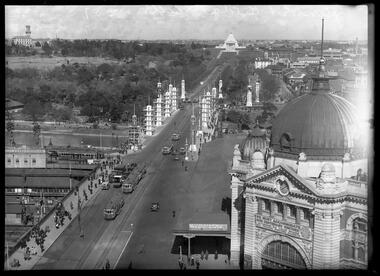
... Melbourne’s past. “Boathouse Row” comprises 7 amateur rowing clubs, the first established in 1859 (Melbourne University Boat Club). Other Clubs were Richmond, Melbourne, Banks, Melbourne Grammar School, Yarra Yarra and Mercantile. South...Melbourne’s past. “Boathouse Row” comprises 7 amateur rowing clubs, the first established in 1859 (Melbourne University Boat Club). Other Clubs were Richmond, Melbourne, Banks, Melbourne Grammar School, Yarra Yarra and Mercantile. South ...Princes Bridge Centenary pylons under construction Possibly taken from Young and Jacksons Hotel (formerly Princes Bridge Hotel) on the corner of Flinders and Swanston streets, Flinders Street Station’s clocks and main entrance dominate, along with its distinctive copper dome and decorative façade. The time on the main clock is 1.40pm, and the sign underneath, reflecting Melbourne’s upcoming Centenary reads, “We must accommodate our Centenary visitors! Citizens! Do your share by taking paying guests.” At left is the original Princes Bridge Station, today the site of Federation Square. The riverside tram terminus advertises a Café/Tobacconist/Refreshment Room selling cigars & cigarettes, fountain drinks & confectionery, and in smaller text: “Leave your boot repairs here”. Nearly everyone is dressed in dark suits, coats and hats. The footpaths are wide and there are no traffic lights. The roadway stretches towards the Shrine of Remembrance, not yet dedicated but very dominant on the skyline. Government House is clearly visible across the wide parkland that would come to be known as Kings Domain and that is an area of deep importance to the people of the Eastern Kulin. Originally, Birrarung was part of a network of swamps and lagoons linked to the course of the river. From 1896, Public Works Department engineer Carlo Catani, oversaw a new channel to straighten the river and the swamps and lagoons were filled with spoil from the channel works. From the same vantage point today, only the top of the tower of Government House would be visible. The photo captures the pylons along Princes Bridge, mid-construction and being installed to mark Melbourne’s Centenary. The pylons were not without controversy. Both The Argus and The Age bemoaned them for being “made almost entirely of imported softwood timber”, denying work to native hardwood timber workers and sawmillers, and leading visitors to think Australia did not have its own exceptional native hardwoods. The pylons were also variously described in their incomplete state, as unimaginative and resembling an oilfield. Published: The Age 5 September 1934 Featured in "Newsworthy: Melbourne in photographs 1933-1936" exhibition at East Melbourne Library, October to December 2023. Exhibition caption by project volunteer, Louise McKenzie Photographer notations on slide: "Pylons + St Kilda Rd C57" Published: Age (Melbourne, Vic. : 1854 - 1954), Wednesday 5 September 1934, page 11 Published title: DECORATIONS -- THEN AND NOW. Published caption: "Although not completed yet, some impression of the effect of the decorations on Princes-bridge may be obtained from the first picture which shows the majestic sweep of St Kilda road with the Shrine of Remembrance and Government House dominating the horizon. The area to the left of St. Kilda-road and in front of Government House is portion of the area which it is proposed to call the King's Domain, which extends to Domain-road and Anderson-street..." Description: East-facing, elevated view of Flinders Street Station and Princes Bridge, featuring partially completed pylons erected for Melbourne's Centenary celebrations. The Shrine of Remembrance and Government House can be seen in the distance. In the foreground are trams, cars and trucks, pedestrians, Batman Avenue tram terminus and refreshment rooms. Signage on Flinders Street Station encourages citizens to accommodate Centenary visitors. The Melbourne Centenary was held 1934-35 in celebration John Batman's proclamation that Melbourne "the place for a village". Centenary events included a visit by Prince Henry, Duke of Gloucester. A Centenary Cake measuring 50 feet in height and ten tons in weight was cut into 250,000 pieces and sold at 1 shilling per piece for charity. Spectacular floodlighting of city landmarks, the creation of the Pioneer Women's Memorial Garden, and the MacRobertson Air Race from London, were other notable activities. Research by project volunteer, Louise McKenzie: The photo in The Age collage of 5 September 1934 has a slightly cropped foreground. The original photo has been taken from an elevated vantage point, most probably the roof of the Nicholas Building on the corner of Flinders and Swanston streets. The right foreground is dominated by the main “clocks” entrance to Flinders Street Station, showing its distinctive copper dome and decorative façade. The time on the main clock is 1.40 pm. The main sign on the front of the Station reads, "We Must Accommodate our Centenary Visitors! Citizens! Do your share by taking paying guests. Write to The Official Centenary Accommodation Bureau, 436 Collins St. City. Tel M 4671”. Another sign at eye level at the main entrance says: “Cheap Trips on Sundays”. The sign on the end of the roof along the eastern side of the station reads, “The Babies Need Your Help! Support Broadmeadows Foundling Hospital Appeal. July and August”. Run by the Sisters of St Joseph of the Sacred Heart, St Joseph’s Foundling Hospital was a purpose built infants’ home for up to 300 babies, plus accommodation for expectant mothers, mainly single women. In the early 1930s, the department (Victorian Children’s Welfare Department) contracted St Joseph’s Foundling Hospital to care for an additional 60 infant state wards, and up to 175 non wards at any given time. In 1931 it also operated a mothercraft training school. The centre foreground shows the commencement of Princes Bridge. Beneath the left side of the bridge was the site of the original Princes Bridge Station, by this time incorporated into Flinders Street Station, and today the area is the site of Federation Square. It was linked to Flinders Street station by the railway tracks that ran underneath the northern approach to the bridge. This photo shows a tram terminus which has a Café/Tobacconist/Refreshment Room, selling cigars & cigarettes, fountain drinks & confectionary, and a sign: Leave your boot repairs here. In the foreground is a wide roadway running south/north, comprising two vehicle lanes each heading north/south, and a central section containing two sets of tram tracks. There are cars, buses and delivery vans on the roadway. The trams visible are Glen Iris (Route No. 6; tram no. 448), Toorak (Route No. 8, tram no. 333), ? (No. 7), ? (No. 1), and ? (No. 2A). The footpaths are extremely wide. There is a square newspaper/magazine stand on the eastern side footpath. And also a “Ferry” sign. There are no traffic lights, but a policeman is visible on the roadway. There are pedestrians – men, women, children, a porter with trolley, women with prams. Clothing comprises dark suits, coats and hats for nearly everyone. There are double headed “Collins Street” lights along the side of the roadway, and along the northern riverbank. The roadway in the foreground is an extension of Swanston Street, which becomes Princes Bridge, then St Kilda Road, stretching towards the Shrine of Remembrance, and diverting past it. The Shrine had not yet been officially dedicated, and looks very white and dominant on the skyline. On the LHS of St Kilda Road, Government House is clearly visible across the wide parkland to be known as Kings Domain. The Kings Domain area is important to the people of the Eastern Kulin nation, and also has historical importance for its association with the early settlement of Melbourne and the foundation of British colonial administration in Victoria. On the southern side of the Yarra River (Birrarung) an historic rowing boathouse is visible, located adjacent to the Alexandra Gardens. Originally Birrarung was part of a network of swamps and lagoons linked to the course of the river. From 1896, under the guidance of engineer Carlo Catani* a new channel to straighten the river was created and the swamps and lagoons were filled with spoil from the channel works. The gardens were then created and completed in time for a Royal visit by the Duke of York in May 1901. The gardens are named after Alexandra of Denmark, the wife of King Edward VII. Both these areas, plus the Royal Botanic Gardens Victoria, Shrine of Remembrance Reserve, Sidney Myer Music Bowl, Government House, and the Queen Victoria Gardens together form the Domain Parklands. The extent of the subsequent plantings is evident today, where from the same vantage point only the top of the tower of Government House would be visible. *Catani was born in Florence in 1852, but after arriving in Melbourne worked as a civil engineer for the Victorian Government. His last major project was the reclamation of the foreshore of St Kilda, envisaged in the style of a European resort, complete with a split level esplanade, bathing pavilions, dance halls, amusements and a French-Italian style of landscape complete with palms. The gardens at the end of Fitzroy Street, St Kilda, now bear his name. The historic boathouse visible across the Yarra is another glimpse into Melbourne’s past. “Boathouse Row” comprises 7 amateur rowing clubs, the first established in 1859 (Melbourne University Boat Club). Other Clubs were Richmond, Melbourne, Banks, Melbourne Grammar School, Yarra Yarra and Mercantile. South of the river and west of the bridge is an area today developed into the Melbourne arts precinct of Hamer Hall and the Arts Centre. But at this time it was the home of Wirths Olympia Circus, which comprised Wirths Pleasure Park (an amusement park), a 5,000 seat auditorium – Hippodrome, a roller skating rink, a glaciarium, a cinema, and the Green Mill Dance Hall. Dog shows were also held at Olympia. The Green Mill Dance Hall closed in 1950, and the remainder of the Wirth buildings on site were destroyed by fire in December 1953. The feature of the photo is the pylons erected along Princes Bridge to mark Melbourne’s Centenary in 1934. The sixteen plastered pylons were designed by Roy Prentice, the second person to qualify as an architect at The University of Melbourne’s Bachelor of Architecture degree, in 1933, aged 27. Simon Reeves in his article marking the 100th birthday of Roy Prentice on 20 June 2006 reports that the State Electricity Commission sponsored this work, and the Argus reported that “… the pylons were “illuminated from within to give the effect of soft radiance”. Australia Home Beautiful 1 Oct 1934 reports in a very detailed and comprehensive article: The 10 taller pylons, including flagpole, were 48 ft, with a base of 8 ft. Timber-framed and faced with fibrous plaster and galvanised sheet iron, each structure was securely bolted to a concrete foundation three feet in depth. Panels of glass let into the shaft of each pylon were indirectly lit by 40, 100 watt lamps, and the upper bank of internal lamps were dyed so as to flood the panels with a deep red light. The decorative painted shields and flagpoles/pennants were illuminated by three 200 watt projectors concealed in the roof of each pylon, and were part of an electric night light decoration scheme involving 28 miles of wire to supply more than 20,000 lights. An article in the Argus on 18 October 1934 provided minute detail of the lighting erected in Melbourne for the Centenary, converting it “… into a coloured fairyland by night.” The estimated cost of 10 pounds per hour the lights were on. The display included 800 standard light poles 30 feet high which were tiered with electric bulbs concealed in inverted cones, 138 specially designed “Venetian poles” draped in flags trophies and streamers. The streets included in the electric night light decoration scheme were Bourke Street from Spring to William, the entire length of Collins Street, Flinders Street from Elizabeth to Spring, Lonsdale Street from Elizabeth to Swanston, Swanston and Elizabeth Streets from Flinders to Lonsdale, and parts of Springs and Spencer Streets. Together with the Princes Bridge pylons, approximately 28 miles of wire was required to supply power to the more than 20,000 lights. And that is just in the city of Melbourne. It was estimated the same amount of lighting was duplicated among other local councils. The pylons were not without controversy. The Argus on 28 August 1934 in an article headed “Imported Timber in Pylons” reported that the Princes Bridge pylons are “made almost entirely of imported softwood timber”, and have therefore denied work to native hardwood timber workers and sawmillers. The same day the Melbourne Age ran a similar story, bemoaning the fact that foreign oregon had been used which may lead tourists to think Australia did not have its own exceptional native hardwoods. A Camberwell City Councillor described the pylons as unimaginative, and the Herald reported that skeletons of pylons for the Centenary decorations in their present form led the area to resemble an oilfield! The Yarra River and Princes Bridge have long been a focal point of Melbourne life. In the early days of European settlement in Melbourne a rope-hauled punt carried people across the Yarra River. A surge in population and increased shipping traffic created a need for a bridge. There was difficulty in agreeing on a suitable site for the bridge (options were crossing at Elizabeth, Swanston, Queen or Market Streets), but the NSW Government favoured Swanston Street and the Melbourne Town Council decided on a temporary bridge across the Yarra spanning from the foot of Swanston Street. This first bridge was a single span timber toll bridge designed by Scottish born bridge designer David Lennox, and completed in 1845. It was 120 feet long, had a roadway of 17 feet wide, and a footpath on one side of 4 feet. It was leased to the Melbourne Bridge Company in the name of Robert A Balbirnie. The tollhouse was on the north side of the river and the toll keeper, Patrick Doherty, was credited with saving nine lives during the four years he was in charge of the toll station. The second bridge was stone (completed 1850), and named Prince’s Bridge after the HRH Prince of Wales, later Edward VII. It was designed with an elliptical single arc and an exceedingly small rise in proportion to the span. However, this design created an obstacle for flood waters, and together with Melbourne’s increasing population it was quickly apparent that a new bridge was required. At its opening on 15 November 1850 coincided with the imminent declaration of Victoria as a separate colony, it provided a moment of great celebration for Melbournians and “The opening ceremony was described as the grandest processional display witnessed in the colony.” (ToMelbourne.com.au) Princes Bridge in its present form, as depicted in this photograph, was designed by Jenkins, D’Ebro and Grainger, and constructed in 1886-88 by David Munro. John Grainger (father of Australian composer Percy Grainger) did the majority of the design work for the bridge. The structure was to have three arches each 96 feet wide measured across the river, and the banks on both sides were raised to allow more space for floodwater to flow. St Kilda Road was originally many feet below the current level. The bridge is of architectural significance for its substantial size, giant half columns, extensive use of wrought and cast iron, decorative elements (cast-iron lamps) and the skilled stonemasonry in the construction of the abutments and piers. Its main design features are similar to those of Blackfriars Bridge in London (1870). The bluestones were quarried from Footscray, the Malmsbury stones were from quarries at Kyneton, and the granite from Harcourt. The cost was met by the State of Victoria, City of Melbourne, and six out of seven of its municipalities, and their coats of arms feature on the bridge. The building of the bridge reflected the boom period of Melbourne, including the Victorian gold rush 1851- late 1860s, and its contractor, David Munro, was also responsible for the construction of Queens Bridge and Sandridge Railway Bridge. The Centenary pylons are no longer in place, but today this intersection still plays a major part in Melbourne’s daily life: people still meet “under the clocks” at Flinders Street station, and the route in and out of the city along St Kilda Road is often a feature of parades such as Moomba, the Grand Final Parade, and of course the Anzac Day Parade which commences at the Princes Bridge intersection and finishes at the Shrine of Remembrance. There are many tram routes, which cross the Bridge, and it directs pedestrians towards the Arts Precinct, the various components of Domain Park, plus the Southbank restaurant and rowing precincts. Even though this is a street scene, it feels very intimate; the viewer is instantly immersed in the activity of a Melbourne afternoon, looking down St Kilda Road from a viewpoint near today’s Federation Square. References: DECORATIONS -- THEN AND NOW. (1934, September 5). The Age (Melbourne, Vic. : 1854 - 1954), p. 11. Retrieved September 21, 2023, from http://nla.gov.au/nla.news-article205880269 'Flinders Street railway station', Wikipedia, https://en.wikipedia.org/wiki/Flinders_Street_railway_station 'St Joseph’s Foundling Hospital (1901-75)', Finding Records, Department of Health and Human Services, State of Victoria, https://www.findingrecords.dhhs.vic.gov.au/collectionresultspage/St-JosephsFoundling-Hospital-Babies-Home#departmental-administration 'Alexandra Gardens', City of Melbourne, https://www.melbourne.vic.gov.au/community/parks-open-spaces/major-parks-gardens/Pages/alexandra-gardens.aspx 'Wirths Circus', Wikipedia, https://en.wikipedia.org/wiki/Wirth's_Circus 'Roy Prentice: Centenary Architect', Built Heritage Pty Ltd, Simon Reeves, https://www.builtheritage.com.au/downloads/prentice.pdf 'Princes Bridge', Heritage Council Victoria, https://vhd.heritagecouncil.vic.gov.au/places/817 PORT PHILLIP. (1846, April 1). The Sydney Morning Herald (NSW : 1842 - 1954), p. 3. Retrieved September 21, 2023, from http://nla.gov.au/nla.news-article12886251 'Edward VII', Wikipedia, https://en.wikipedia.org/wiki/Edward_VII 'Princes Bridge', ToMelbourne.com, https://tomelbourne.com.au/princes-bridge/ 'Princes Bridge', eMelbourne, https://www.emelbourne.net.au/biogs/EM01189b.htm 'Princes Bridge', Australia for everyone, http://australiaforeveryone.com.au/files/melbourne/princes-bridge.html 'Victorian gold rush', Wikipedia, https://en.wikipedia.org/wiki/Victorian_gold_rush IMPORTED TIMBER IN PYLONS (1934, August 28). The Argus (Melbourne, Vic. : 1848 - 1957), p. 9. Retrieved September 21, 2023, from http://nla.gov.au/nla.news-article10952507 Princes-Bridge Pylons. (1934, August 28). The Age (Melbourne, Vic. : 1854 - 1954), p. 7. Retrieved September 21, 2023, from http://nla.gov.au/nla.news-article205532235 Pylons Appear Near Princes Bridge (1934, August 18). The Herald (Melbourne, Vic. : 1861 - 1954), p. 1. Retrieved September 21, 2023, from http://nla.gov.au/nla.news-article243104375 PRINCES-BRIDGE PYLONS. (1934, September 20). The Age (Melbourne, Vic. : 1854 - 1954), p. 10. Retrieved September 21, 2023, from http://nla.gov.au/nla.news-article205873535 28 Miles of Wire (1934, October 18). The Argus (Melbourne, Vic. : 1848 - 1957), p. 1 (The Junior Argus). Retrieved September 21, 2023, from http://nla.gov.au/nla.news-article10977836 'Historical references for Boathouse Row, Melbourne', http://boathouserowmelbourne.com.au/history/ 'ITALIAN DELEGATION TO HONOUR CARLO CATANI, DESIGNER OF THE ST KILDA FORESHORE, St Kilda Historical Society, 2001, https://web.archive.org/web/20070928061938/http://www.skhs.org.au/~SKHSarticles/articles/Carlo_Catani.html# HISTORY IN LIGHTS (1934, July 12). The Herald (Melbourne, Vic. : 1861 - 1954), p. 16. Retrieved September 21, 2023, from http://nla.gov.au/nla.news-article243172436 'Dressing Melbourne for the Duke', The Australian home beautiful: a journal for the home builder. Vol 12 No. 10 (1 October 1934), page 21, 58. Retrieved September 14, 2023, from http://nla.gov.au/nla.obj-2950922209Photographer notations on slide: "Pylons + St Kilda Rd C57".centenaries, bridges, lighting, flinders street railway station -

Power House Rowing ClubBlack and white photograph, PHRC Maiden VIII Henley Regatta, 1933, 1933
... Power House Rowing Club 164 Alexandra Avenue South Yarra melbourne rowing rowers sweep rowing men river riverbank sportsmen sports J Barton Jr (cox) H Rutter (Str) P Hiddlestone (7) R Luff (6) R Manser (5) J Ramsbottom (4) W Wakeham (3) W Tutt (2) V Muller (Bow) J Barton Senr (Coach) Digital scan of black and white photograph. ...Digital scan of black and white photograph. J Barton Jr (cox) H Rutter (Str) P Hiddlestone (7) R Luff (6) R Manser (5) J Ramsbottom (4) W Wakeham (3) W Tutt (2) V Muller (Bow) J Barton Senr (Coach)rowing, rowers, sweep rowing, men, river, riverbank, sportsmen, sports -
Power House Rowing ClubBlack and white photograph, Maiden VIII, 1935, 1935
... Power House Rowing Club 164 Alexandra Avenue South Yarra melbourne J Barton (Coach) H Rutter (Str) R Luff (7) L Orr (6) F Hiddlestone (5) J Glover (4) Not recorded (3) J Fuller (2) V Muller (Bow) Digital scan of black and white photograph. ...Digital scan of black and white photograph.J Barton (Coach) H Rutter (Str) R Luff (7) L Orr (6) F Hiddlestone (5) J Glover (4) Not recorded (3) J Fuller (2) V Muller (Bow) -
Power House Rowing ClubBlack and white photograph, PHRC Maiden VIII Henley win, 1935, 1935
... Power House Rowing Club 164 Alexandra Avenue South Yarra melbourne rowing rowers river riverbank spectators boats Digital scan of black and white photograph. ...Digital scan of black and white photograph. Names not recorded.rowing, rowers, river, riverbank, spectators, boats -
Power House Rowing ClubBlack and white photograph, PHRC Maiden VIII Henley, 1935, 1935
... Power House Rowing Club 164 Alexandra Avenue South Yarra melbourne rowers rowing sportsmen men river riverbank sports row J Barton Jnr (cox) H Rutter (Str) F Huddlestone (7) R Luff (6) R Manser (5) W Ramsbottom (4) W Wakeham (3) W Tatt (2) V Muller (Bow) J Barton Snr (Coach) Digital scan of black and white photograph. ...Digital scan of black and white photograph. J Barton Jnr (cox) H Rutter (Str) F Huddlestone (7) R Luff (6) R Manser (5) W Ramsbottom (4) W Wakeham (3) W Tatt (2) V Muller (Bow) J Barton Snr (Coach)rowers, rowing, sportsmen, men, river, riverbank, sports, row -
Power House Rowing ClubBlack and white photograph, The Sears Studio St Kilda, PHRC Novice VIII, 1936
... Power House Rowing Club 164 Alexandra Avenue South Yarra melbourne J Barton Jnr (cox) I Scales (Str) N West (&) J Chadwick (6) J Fuller (5) D Stewart (4) L Orr (3) D Garside (2) E Campbell (Bow) J Barton Snr (Coach) Digital scan of framed black and white photograph. ...Digital scan of framed black and white photograph.J Barton Jnr (cox) I Scales (Str) N West (&) J Chadwick (6) J Fuller (5) D Stewart (4) L Orr (3) D Garside (2) E Campbell (Bow) J Barton Snr (Coach) -
Power House Rowing ClubBlack and white photograph, PHRC crew practice 4, 1937, 1937
... Power House Rowing Club 164 Alexandra Avenue South Yarra melbourne rowers rowing row sports sportsmen river riverbank Digital scan of black and white photograph. ...Digital scan of black and white photograph. Names not recorded.rowers, rowing, row, sports, sportsmen, river, riverbank -
Power House Rowing ClubBlack and white photograph, Head of the Lake, 1938, 1938
... Power House Rowing Club 164 Alexandra Avenue South Yarra melbourne rowing rowers lake sports sportsmen Digital scan of black and white photograph. ...Digital scan of black and white photograph. Names not recorded.rowing, rowers, lake, sports, sportsmen -
Power House Rowing ClubBlack and white photograph, PHRC crew racing 4, 1938, 1938
... Power House Rowing Club 164 Alexandra Avenue South Yarra melbourne Digital scan of black and white photograph. ...Digital scan of black and white photograph. Names not recorded. -
Power House Rowing ClubMaiden IV Winner MRA regatta, 1938, 1938
... Power House Rowing Club 164 Alexandra Avenue South Yarra melbourne POWER HOUSE MAIDEN IV - WINNERS MURRAY ROWING ASSOCIATION REGATTA 1938 C BARNES (BOW) J COWLEY (2) A GEYTON (3) E ISRAEL (STR) J GATES (COX) R KEON-COHEN (COACH) Digital scan of black and white photograph. ...Digital scan of black and white photograph.POWER HOUSE MAIDEN IV - WINNERS MURRAY ROWING ASSOCIATION REGATTA 1938 C BARNES (BOW) J COWLEY (2) A GEYTON (3) E ISRAEL (STR) J GATES (COX) R KEON-COHEN (COACH) -
Power House Rowing ClubBlack and white photograph, PHRC Winners Army Service Regatta, 1939, 1939
... Power House Rowing Club 164 Alexandra Avenue South Yarra melbourne Digital scan of black and white photograph. ...Digital scan of black and white photograph. Names not recorded. -
Power House Rowing ClubBlack and white photograph, PHRC Maiden IV Winner VRA regatta, 1939, 1939
... Power House Rowing Club 164 Alexandra Avenue South Yarra melbourne WINNERS MAIDEN FOUR. ...Digital scan of black and white photograph.WINNERS MAIDEN FOUR. V.R.A. REGATTA. 30TH JAN.,1939. V. Muller, W. Pollock, J. Fuller, D. Fisher, A. Beattie (Cox) Coach Russel – Keon-Cohen -
Power House Rowing ClubBlack and white photograph, 02 PHRC Novice IV UY Regatta, 1957, 1957
... Power House Rowing Club 164 Alexandra Avenue South Yarra melbourne Digital scan of black and white photograph. 02 PHRC Novice IV UY Regatta, 1957 Black and white photograph ...Digital scan of black and white photograph. -
Power House Rowing ClubBlack and white photograph, 02 Maiden VIII, 1958, 1958
... Power House Rowing Club 164 Alexandra Avenue South Yarra melbourne Digital scan of black and white photograph. ...Digital scan of black and white photograph. Names not recorded. -
Power House Rowing ClubColour photograph, 03 Albert Park Novice IV, 1959, 1959
... Power House Rowing Club 164 Alexandra Avenue South Yarra melbourne Digital scan of colour photograph. ...Digital scan of colour photograph. Names not recorded. -
Power House Rowing ClubColour photograph, 08 Albert Park Maiden II, 1960, 1960
... Power House Rowing Club 164 Alexandra Avenue South Yarra melbourne Digital scan of colour photograph. ...Digital scan of colour photograph. Names not recorded. -
Power House Rowing ClubColour photograph, 20 Moomba Procession, 1960, 1960
... Power House Rowing Club 164 Alexandra Avenue South Yarra melbourne Digital scan of colour photograph. ...Digital scan of colour photograph. Names not recorded. -
Power House Rowing ClubBlack and white photograph, 01 Maiden VIII won 4 races, 1967, 1967
... Power House Rowing Club 164 Alexandra Avenue South Yarra melbourne Digital scan of black and white photograph. ...Digital scan of black and white photograph. Names not recorded. -
Power House Rowing ClubBlack and white photograph, 01 Junior IV winners Henley and 2 others, 1968, 1967
... Power House Rowing Club 164 Alexandra Avenue South Yarra melbourne Digital scan of black and white photograph. ...Digital scan of black and white photograph. Names not recorded. -
Power House Rowing ClubNewspaper clipping - LADY SOMERS IN NEW ROLE Boat Christened, LADY SOMERS IN NEW ROLE Boat Christened
... Power House Rowing Club 164 Alexandra Avenue South Yarra melbourne LADY SOMERS IN NEW ROLE Boat Christened Newspaper clipping - LADY SOMERS IN NEW ROLE Boat Christened ...