
Showing 90 items matching "souvenir german"
-
 Embroiderers Guild, Victoria
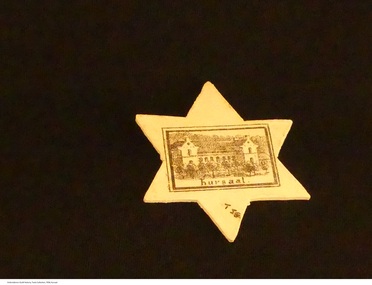
Tool - Thread Winder, ?1900's
... ...Souvenir German...Souvenir thread winder showing two views of German spa town buildings. (?...set of five) Souvenir thread winder from Germany Thread-winder Souvenir German Waldenschlösschen Kösen (side angle of building with flag flying) Kursaal (Front view long building) Wooden six pointed star, lacquered thread winder, pink colour, decorated with one black scene on either side Tool Thread Winder ...Thread-winders had been essential sewing tools when cotton and threads were bought in skeins and needed to be sound onto something to keep them from tangling. Souvenir thread winder showing two views of German spa town buildings. (?set of five)Souvenir thread winder from GermanyWooden six pointed star, lacquered thread winder, pink colour, decorated with one black scene on either sideWaldenschlösschen Kösen (side angle of building with flag flying) Kursaal (Front view long building)thread-winder, souvenir german -
 Ringwood RSL Sub-Branch
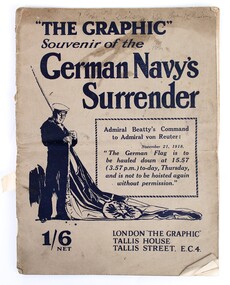
Book - Document, WW1 Magazine, Graphic Publications, The German Navy Surrenders, 1918
... The Graphic Souvenir of the German Navy Surrender November 1918....The Graphic Souvenir of the German Navy Surrender November 1918. ...The Graphic Souvenir of the German Navy Surrender November 1918. -
 Embroiderers Guild, Victoria
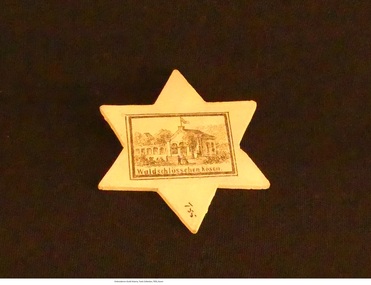
Tool - Thread Winder, ?1900's
... Thread-winders had been essential sewing tools when cotton and threads were bought in skeins and needed to be sound onto something to keep them from tangling. Souvenir thread winder of ??German spa town...Thread-winders had been essential sewing tools when cotton and threads were bought in skeins and needed to be sound onto something to keep them from tangling. Souvenir thread winder of ??German spa town Souvenir thread winder. ...Thread-winders had been essential sewing tools when cotton and threads were bought in skeins and needed to be sound onto something to keep them from tangling. Souvenir thread winder of ??German spa townSouvenir thread winder.Wooden six pointed star, lacquered thread winder, pink colour, decorated with one black scene on either side, Waldschlosschen Kosen (one side: scene with trees and houses), Wellenbaden (other side: ? typical spa house)thread-winder, spa souvenir -
 Nhill and District Historical Society Inc.
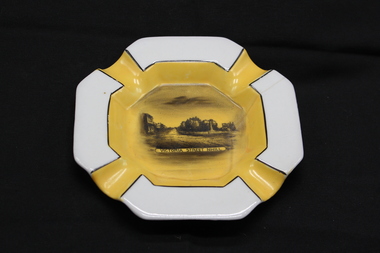
Ceramic - c 1920-1935 Souvenir Ashtray, Victoria Street, Nhill, c 1920 - 1935
... Souvenir Ashtray...Victoria street--Nhill...Manufactured in Germany...The dish is an example of the early 20th-century international souvenir trade, in which German porcelain manufacturers produced inexpensive objects depicting Australian towns and tourist destinations. ...The form, with raised sections around the perimeter suitable for resting cigarettes, indicates that it was manufactured as a souvenir ashtray, although it could also have been used as a small decorative dish. On the base - Red circular manufacturer's mark, incorporating the words “Bavaria” and “Germany.” ...The dish is an example of the early 20th-century international souvenir trade, in which German porcelain manufacturers produced inexpensive objects depicting Australian towns and tourist destinations. ...The dish is an example of the early 20th-century international souvenir trade, in which German porcelain manufacturers produced inexpensive objects depicting Australian towns and tourist destinations. Such objects were intended to be purchased as tangible reminders of travel or locality. Its use as an ashtray also reflects the domestic and social culture of the period, when smoking accessories were commonplace household objects. The dish depicts Victoria Street, Nhill, a significant regional street in the Wimmera township of Nhill, Victoria. The survival of the street name and pictorial representation makes this more than a generic souvenir: it is a small piece of Nhill local-history material culture.Small octagonal/scalloped porcelain dish with a white ground, broad mustard-yellow decorative band and fine black outlining. The recessed central panel contains a sepia transfer-printed view of a country street, with buildings, trees, fencing and roadway. The image is identified beneath by the printed inscription “VICTORIA STREET NHILL.” The form, with raised sections around the perimeter suitable for resting cigarettes, indicates that it was manufactured as a souvenir ashtray, although it could also have been used as a small decorative dish. On the base - Red circular manufacturer's mark, incorporating the words “Bavaria” and “Germany.” image is identified beneath by the printed inscription “VICTORIA STREET NHILL.” on base - Red circular manufacturer's mark to reverse, apparently incorporating the words “Bavaria” and “Germany.” c 1920-1935 souvenir ashtray, victoria street--nhill, manufactured in germany, ceramics -
 Frankston RSL Sub Branch
Pocketbook, Souvenir, Taschenbuch Groß-Deutschland, Geschichtstafel, Deutschlands Wehrmacht, Weltatlas, 31 August, 1941
... Small, soft cover, pocketbook presumably souvenired from a German soldier during the latter stages of World War 2. ...provenance unknown The front cover is printed in black ink with the following "Taschenbuch Groß-Deutschland, Geschichtstafel, Deutschlands Wehrmacht, Weltatlas" Small, soft cover, pocketbook presumably souvenired from a German soldier during the latter stages of World War 2. ...provenance unknownSmall, soft cover, pocketbook presumably souvenired from a German soldier during the latter stages of World War 2. The pocketbook is of the type originally issued by the German military and was printed in August 1941, edited by Georg Westermann, Braunschweig. The book has a red coloured cover with black printing and contains 48 pages. Pages are printed in black, the maps are printed in colour. The pocketbook is in good condition, some pages have tears and the cover is scuffed. The pocket book title translates as "Paperback Greater Germany, History Chart, Germany's Wehrmacht, World Atlas" and is a collection of information about the German Reich, German military units and insignia and world maps, 1942 calendar, etc. The original owner has made markings on some maps and has made notes.The front cover is printed in black ink with the following "Taschenbuch Groß-Deutschland, Geschichtstafel, Deutschlands Wehrmacht, Weltatlas" -
 Mission to Seafarers Victoria
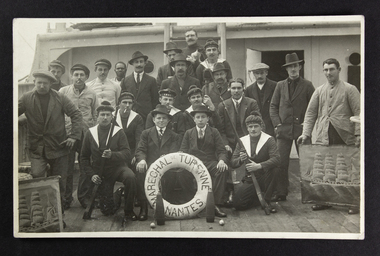
Postcard - Photograph, Black and white, Green Bros, 1918
... At sea, the threat were the German submarines: the U-boats. crew barque french 1918 marechal de turenne nantes wwi world war one first world war great war buoy ship mascot cat a.m.b.c bayonet african black man apprentices armement militaire des bâtiments de commerce bachi sailor beret radio transmitters telegraph morse telecommunication german submarines u-boats cigarettes smoking williamstown mission to seafarers seamen's mission nelson place crews and ships Printed at the back: On the left: Green Bros/Photo/251 Nelson Place, Williamstown Centered: Post Card/Correspondence/Address only Top right corner for the stamp: Kodak Australia Written at the back: octobre 1918 Souvenir du navire Maréchal de Turenne Berthot Jacquet Renaut R. ...The Maréchal de Turenne, a three mast barque, was built in the "Chantiers de la Loire" shipyard in Nantes, port in the West of France, in 1899 by the company René Guillon et René Fleury. Capacity of 3000 barrels. The barque is called a "cap-hornier" in French. In a book written in 1973 by Georges Aubin, "La mer douce et cruelle", ed. France-Empire, a chapter "Une traversée du trois-mâts nantais Maréchal de Turenne" (page 285 to 319) tells how the ship was navigating from London to New-York to load barrels of petrol bound for Melbourne.The photograph demonstrates how prepared the merchant navy was during the First World War. The French Merchant Navy had additional men from the Navy: the six sailors in uniform and sailor "bachi" bonnet with the AMBC inscription were on the ship to support the crew in case of enemy attack. Two of those soldiers carry a bayonet. One of the sailors is wearing headphones: World War One saw telecommunication progress. At sea, the threat were the German submarines: the U-boats.The photograph depicting the 22 members of the crew was taken in October 1918 onboard the Marechal de Turenne. The two on the right and left side are holding a picture of the barque. One man at the back is holding a cat. 11 names are written at the back. The photograph was turned into a postcard.Printed at the back: On the left: Green Bros/Photo/251 Nelson Place, Williamstown Centered: Post Card/Correspondence/Address only Top right corner for the stamp: Kodak Australia Written at the back: octobre 1918 Souvenir du navire Maréchal de Turenne Berthot Jacquet Renaut R. Renaut H. Lecoq Mercier Berger Dubas Lorie Coat Tilloncrew, barque, french, 1918, marechal de turenne, nantes, wwi, world war one, first world war, great war, buoy, ship mascot, cat, a.m.b.c, bayonet, african, black man, apprentices, armement militaire des bâtiments de commerce, bachi, sailor beret, radio transmitters, telegraph, morse, telecommunication, german submarines, u-boats, cigarettes, smoking, williamstown, mission to seafarers, seamen's mission, nelson place, crews and ships -
 Marysville & District Historical Society
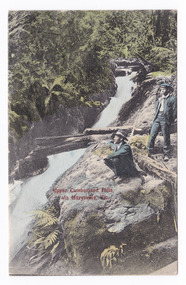
Postcard (item) - Colour tinted postcard, Victorian Stamp Market, Upper Cumberland Falls, via Marysville, Vic, 1908
... Cambarville was impacted by the 2009 Black Saturday bushfires and any remaining structures were destroyed. cumberland falls cambarville marysville victoria waterfalls postcard souvenir mountain ash mining timber mills big culvert yarra track a cameron fj barton black saturday bushfires 1939 bushfires eucalyptus regnans victorian stamp market victorian stamp market series POST CARD This space may be used for Correspondence. FOR ADDRESS ONLY Printed in Germany ...An early colour tinted photograph of the Upper Cumberland Falls near Cambarville in Victoria. This postcard was published by Victorian Stamp Market as a souvenir of Marysville. An early colour tinted photograph of the Upper Cumberland Falls near Cambarville in Victoria. These falls are located on the Marysville-Wood's Point Road. Cambarville is notable for its giant mountain ash (Eucalyptus regnans) trees within the Cumberland Memorial Scenic Reserve, and relics from former sawmills and gold mining. The Big Culvert is located nearby on the Marysville - Woods Point Road, which was historically part of the Yarra Track. Cambarville was established as a timber mill town in the 1940s. Timber mill owners A Cameron and FJ Barton named Cambarville. They established the mill to salvage timber from trees destroyed in the 1939 bushfires. Cambarville was impacted by the 2009 Black Saturday bushfires and any remaining structures were destroyed.POST CARD This space may be used for Correspondence. FOR ADDRESS ONLY Printed in Germany V.S.M. Seriescumberland falls, cambarville, marysville, victoria, waterfalls, postcard, souvenir, mountain ash, mining, timber mills, big culvert, yarra track, a cameron, fj barton, black saturday bushfires, 1939 bushfires, eucalyptus regnans, victorian stamp market, victorian stamp market series -
 Marysville & District Historical Society
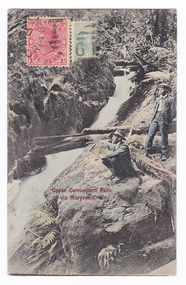
Postcard (item) - Colour tinted postcard, Victorian Stamp Market, Upper Cumberland Falls via Marysville, Vic, 1908
... Cambarville was impacted by the 2009 Black Saturday bushfires and any remaining structures were destroyed. cumberland falls cambarville marysville victoria waterfalls postcard souvenir mountain ash mining timber mills big culvert yarra track a cameron fj barton black saturday bushfires 1939 bushfires eucalyptus regnans victorian stamp market victorian stamp market series POST CARD This space may be used for Correspondence. FOR ADDRESS ONLY Printed in Germany ...An early colour tinted photograph of the Upper Cumberland Falls near Cambarville in Victoria. This postcard was published by Victorian Stamp Market as a souvenir of Marysville. An early colour tinted photograph of the Upper Cumberland Falls near Cambarville in Victoria. These falls are located on the Marysville-Wood's Point Road. Cambarville is notable for its giant mountain ash (Eucalyptus regnans) trees within the Cumberland Memorial Scenic Reserve, and relics from former sawmills and gold mining. The Big Culvert is located nearby on the Marysville - Woods Point Road, which was historically part of the Yarra Track. Cambarville was established as a timber mill town in the 1940s. Timber mill owners A Cameron and FJ Barton named Cambarville. They established the mill to salvage timber from trees destroyed in the 1939 bushfires. Cambarville was impacted by the 2009 Black Saturday bushfires and any remaining structures were destroyed.POST CARD This space may be used for Correspondence. FOR ADDRESS ONLY Printed in Germany V.S.M. Series WOOD / VICT/ A/ 10 -4.S.10-3/ DISTRIBUZIONS JWO Gricardi/ Via Galletti/ V 16/ Loruis/ Italy Mary A????/ Australiacumberland falls, cambarville, marysville, victoria, waterfalls, postcard, souvenir, mountain ash, mining, timber mills, big culvert, yarra track, a cameron, fj barton, black saturday bushfires, 1939 bushfires, eucalyptus regnans, victorian stamp market, victorian stamp market series -
 Marysville & District Historical Society
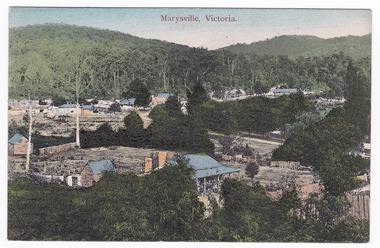
Postcard (item) - Colour tinted postcard, Victorian Stamp Market, Marysville, Victoria, Unknown
... Early postcard of Marysville township c.1900 marysville victoria victorian stamp market postcard souvenir POST CARD Printed in Germany This Space may be used for Correspondence. ...A colour-tinted photograph of the early Marysville township in Victoria. This postcard was published by Victorian Stamp Market as a souvenir of Marysville.Early postcard of Marysville township c.1900POST CARD Printed in Germany This Space may be used for Correspondence. FOR ADDRESS ONLY V.S.M. Series.marysville, victoria, victorian stamp market, postcard, souvenir -
 Marysville & District Historical Society
Postcard (item) - Colour postcard, Stanley Mullen Pty Ltd, Greetings from Victoria, Early 1900's
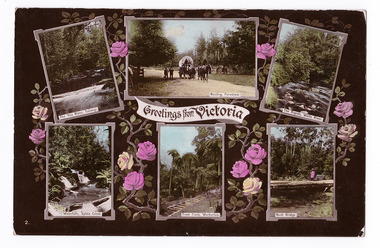
... A colour postcard with four colour photographs of attractions in an around Marysville in Victoria. marysville victoria yea river tallangi fernshaw watts river waterfall sylvia creek warburton bridge stanley mullen postcard souvenir tram track Greetings from Victoria The Yea River, Tallangi/ Resting, Fernshaw/ The Rapids, Watts River/ Waterfalls, Sylvia Creek/ Tram Track, Warburton/ Bush Bridge POST CARD Stanley Mullen Pty Ltd., Melbourne Printed in Germany Date Stamp-CARLTON NORTH-VICTORIA/ -2FE10 French stamp Ma soer voudrait favie/ les memes exchanges/ que moi. ...A colour postcard with six colour photographs of attractions in an around Marysville in Victoria. This postcard was produced by Stanley Mullen Pty Ltd. of Melbourne as a souvenir of Marysville.A colour postcard with four colour photographs of attractions in an around Marysville in Victoria.Greetings from Victoria The Yea River, Tallangi/ Resting, Fernshaw/ The Rapids, Watts River/ Waterfalls, Sylvia Creek/ Tram Track, Warburton/ Bush Bridge POST CARD Stanley Mullen Pty Ltd., Melbourne Printed in Germany Date Stamp-CARLTON NORTH-VICTORIA/ -2FE10 French stamp Ma soer voudrait favie/ les memes exchanges/ que moi. Son/ addresse est./ Miss. B. Coleman/ 95 Richardson St/ N. Carlton/ Avee mes meilleurs/ souhaits/ Votre tres devouee/ R. Coleman STAMP/ ON/ BACK Monsieur A. Rochet/ 22 Rue Longue,/ Lyon/ Rhone/ Francemarysville, victoria, yea river, tallangi, fernshaw, watts river, waterfall, sylvia creek, warburton, bridge, stanley mullen, postcard, souvenir, tram track -
 Flagstaff Hill Maritime Museum and Village
Postcard - Historical, Warrnambool, Christ Church, Warrnambool, Early 20th century
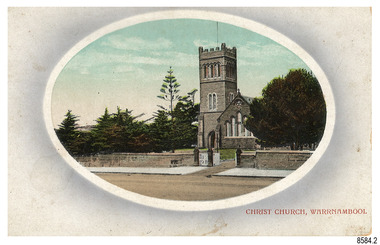
... The church is part of Warrnambool's life events and the historical significance of the building, Flagstaff Hill Maritime Museum Flagstaff Hill Maritime Village Flagstaff Hill Maritime Museum and Village Maritime Museum Warrnambool Great Ocean Road Warrnambool and District Warrnambool Scenes local scenes Views of Warrnambool Joseph Jordan Jordan Series Jordan Photography postcard souvenir correspondence cameo postcard landscape Christ Church bell tower German bells Warrnambool Church religious building stone building Anglican Church Parish of Warrnambool Front, in red: “CHRIST CHURCH, WARRNAMBOOL” Back in black: “Jordan Series” “POST CARD” “PRINTED IN GREAT BRITAIN” “For correspondence” “The Address only to be written here” Postcard, one of nine, landscape orientation, coloured print within an oval border and mauve-toned shading. ...The nine postcards in this set were donated together and date to the early 1900s. All but one postcard in this set shows images of Warrnambool, in the Western District of Victoria; the other has a London image. The postcards were all printed in Great Britain according to that country’s postal regulations. The fronts of all cards have titles printed in red. Most of the images on the cards are attributed to photographer Joseph Jordan and belong to the Jordan Series. The back of these cards has an outline for a postage stamp, a vertical dividing line and a heading on each side of the line to separate the Correspondence from the Address. Postcards or ‘correspondence cards’ appeared in Britain in 1894. They were plain cards with a space for the message on one side and an address on the other; regulations didn’t allow anything but the address to be written on the ‘address’ side. In 1902 the British regulations then allowed a picture to be printed on the front and the address on the back, so messages had to be written on the picture side. Soon, the regulations changed and the back was divided for a message and the address. Christ Church Warrnambool – The image on this card shows Christ Church, a stone building built in 1856. The Anglican church is in Henna Street, Warrnambool. The church, outer buildings and grounds are heritage-listed. Its bell tower harbours German bells. Joseph Jordan - Joseph Jordan was born in 1841 in Leicester England. When he was 16 he joined the 7th Queen's Own Hussars and was sent to India at the outbreak of the mutiny. He took part in the relief of Lucknow and remained in India for eleven years. It was during this time, he became interested in photography. He was posted to New Zealand and later came to Victoria, becoming a sergeant major of the Mounted Rifles. In the mid-1880s he came to the Western district where he was responsible for establishing units of the Mounted Rifles in various country towns such as Dunkeld, Mortlake, Panmure, Bushfield, Koroit etc. He resigned from the army in 1889 and set up a professional photography studio in Liebig Street, Warrnambool. He became very well known in the Western District for family photographs, official photographs of local councillors and groups as well as views of local scenery. In 1891 he photographed the wrecked barque ‘Fiji’ at ‘Wrecks Beach’ near Princetown. His business was taken over by his son Arthur around 1917. Joseph was a keen rifle shot and in 1924 he donated the "Jordan Shield" as a prize to the Victorian Rifle Association. He was made a "Life Honorary Member" of the Warrnambool Returned Soldiers League and in 1933 he was recognised as being the oldest living soldier in Victoria. Joseph died in 1935 aged 95.This card is the only one of the nine cards with the location of Warrnambool added to the name 'Joseph Series'. It is also the only one that has text within the outline for the postage stamp. The font used for the test of the headings is slightly different to the other cards. Joseph Jordan is a significant figure in Warrnambool history as he helped to establish early units of the Mounted Rifles (G Company) in local towns during the late 1880's and later, photographed local scenes, groups and citizens of early Warrnambool. This postcard of Christ Church Warrnambool is significant for its connection to the church. The early building of the church in 1856, within the first decade of Warrnambool being proclaimed a town, shows the strong religious desire of the community. The church is part of Warrnambool's life events and the historical significance of the building,Postcard, one of nine, landscape orientation, coloured print within an oval border and mauve-toned shading. The cameo image is a stone castle-top bell tower beside a church building flanked by trees. A stone fence is across the front, with pedestrian and vehicle white picket gates. The title is in red print on the front of the card. There is no correspondence written on the card. The reverse has inscriptions and outlines for a postage stamp. Jordan Series, printed in Great Britain.Front, in red: “CHRIST CHURCH, WARRNAMBOOL” Back in black: “Jordan Series” “POST CARD” “PRINTED IN GREAT BRITAIN” “For correspondence” “The Address only to be written here”flagstaff hill maritime museum, flagstaff hill maritime village, flagstaff hill maritime museum and village, maritime museum, warrnambool, great ocean road, warrnambool and district, warrnambool scenes, local scenes, views of warrnambool, joseph jordan, jordan series, jordan photography, postcard, souvenir, correspondence, cameo postcard, landscape, christ church, bell tower, german bells, warrnambool church, religious building, stone building, anglican church, parish of warrnambool -
 Flagstaff Hill Maritime Museum and Village
Postcard - Historical, Flagstaff Hill, Christ Church, Warrnambool, Early 20th century
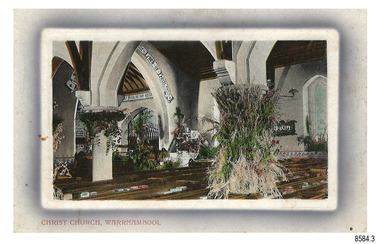
... The church is part of Warrnambool's life events and the historical significance of the building, Flagstaff Hill Maritime Museum Flagstaff Hill Maritime Village Flagstaff Hill Maritime Museum and Village Maritime Museum Warrnambool Great Ocean Road Warrnambool and District Warrnambool Scenes local scenes Views of Warrnambool Joseph Jordan Jordan Series Jordan Photography postcard souvenir correspondence cameo postcard landscape Christ Church bell tower German bells Warrnambool Church religious building stone building Anglican Church Parish of Warrnambool arch pillars Front, in red: “CHRIST CHURCH, WARRNAMBOOL” Back in black: “Jordan Series” “POST CARD” “PRINTED IN GREAT BRITAIN” “For correspondence” “The Address only to be written here” Text on the arch: "THE LORD OF HOSTS" Postcard, one of nine, landscape orientation, coloured print within an oval border and mauve-toned shading. ...The nine postcards in this set were donated together and date to the early 1900s. All but one postcard in this set shows images of Warrnambool, in the Western District of Victoria; the other has a London image. The postcards were all printed in Great Britain according to that country’s postal regulations. The fronts of all cards have titles printed in red. Most of the images on the cards are attributed to photographer Joseph Jordan and belong to the Jordan Series. The back of these cards has an outline for a postage stamp, a vertical dividing line and a heading on each side of the line to separate the Correspondence from the Address. Postcards or ‘correspondence cards’ appeared in Britain in 1894. They were plain cards with a space for the message on one side and an address on the other; regulations didn’t allow anything but the address to be written on the ‘address’ side. In 1902 the British regulations then allowed a picture to be printed on the front and the address on the back, so messages had to be written on the picture side. Soon, the regulations changed and the back was divided for a message and the address. Christ Church Warrnambool – The image on this card shows Christ Church, a stone building built in 1856. The Anglican church is in Henna Street, Warrnambool. The church, outer buildings and grounds are heritage-listed. Its bell tower harbours German bells. Joseph Jordan - Joseph Jordan was born in 1841 in Leicester England. When he was 16 he joined the 7th Queen's Own Hussars and was sent to India at the outbreak of the mutiny. He took part in the relief of Lucknow and remained in India for eleven years. It was during this time, he became interested in photography. He was posted to New Zealand and later came to Victoria, becoming a sergeant major of the Mounted Rifles. In the mid-1880s he came to the Western district where he was responsible for establishing units of the Mounted Rifles in various country towns such as Dunkeld, Mortlake, Panmure, Bushfield, Koroit etc. He resigned from the army in 1889 and set up a professional photography studio in Liebig Street, Warrnambool. He became very well known in the Western District for family photographs, official photographs of local councillors and groups as well as views of local scenery. In 1891 he photographed the wrecked barque ‘Fiji’ at ‘Wrecks Beach’ near Princetown. His business was taken over by his son Arthur around 1917. Joseph was a keen rifle shot and in 1924 he donated the "Jordan Shield" as a prize to the Victorian Rifle Association. He was made a "Life Honorary Member" of the Warrnambool Returned Soldiers League and in 1933 he was recognised as being the oldest living soldier in Victoria. Joseph died in 1935 aged 95.This card is the only one of the nine cards with the location of Warrnambool added to the name 'Joseph Series'. It is also the only one that has text within the outline for the postage stamp. The font used for the test of the headings is slightly different to the other cards. Joseph Jordan is a significant figure in Warrnambool history as he helped to establish early units of the Mounted Rifles (G Company) in local towns during the late 1880's and later, photographed local scenes, groups and citizens of early Warrnambool. This postcard of Christ Church Warrnambool is significant for its connection to the church. The early building of the church in 1856, within the first decade of Warrnambool being proclaimed a town, shows the strong religious desire of the community. The church is part of Warrnambool's life events and the historical significance of the building,Postcard, one of nine, landscape orientation, coloured print within an oval border and mauve-toned shading. The cameo image is of the Interior of the church chapel, with exposed timber beams, white arches decorated with flowers, pews with books on shelves, and organ pipes. There is text on the image. The title is in red print on the front of the card. The back has inscriptions and outlines for a postage stamp. There is no correspondence written on the card. Jordan Series, printed in Great Britain.Front, in red: “CHRIST CHURCH, WARRNAMBOOL” Back in black: “Jordan Series” “POST CARD” “PRINTED IN GREAT BRITAIN” “For correspondence” “The Address only to be written here” Text on the arch: "THE LORD OF HOSTS"flagstaff hill maritime museum, flagstaff hill maritime village, flagstaff hill maritime museum and village, maritime museum, warrnambool, great ocean road, warrnambool and district, warrnambool scenes, local scenes, views of warrnambool, joseph jordan, jordan series, jordan photography, postcard, souvenir, correspondence, cameo postcard, landscape, christ church, bell tower, german bells, warrnambool church, religious building, stone building, anglican church, parish of warrnambool, arch pillars -
Glenelg Shire Council Cultural Collection
Souvenir - Souvenir Letter Opener - Portland Harbour, n.d
... souvenir of Portland Portland Harbour letter opener Front: On handle: above image, 'THE HARBOUR PORTLAND' Back: On blade, just above handle 'MADE IN GERMANY' Souvenir letter opener / fruit knife, dagger shaped, white plastic handle, with coloured image of the harbour, Portland. ...Souvenir letter opener / fruit knife, dagger shaped, white plastic handle, with coloured image of the harbour, Portland.Front: On handle: above image, 'THE HARBOUR PORTLAND' Back: On blade, just above handle 'MADE IN GERMANY'souvenir of portland, portland harbour, letter opener -
Glenelg Shire Council Cultural Collection
Souvenir - Souvenir Dish - Portland, Victoria, n.d
... souvenir of Portland Portland Harbour public baths Back: Base: Stamp 'Made in Germany' White china dish with basket weave sides, gold line rim; view of harbour and baths. ...White china dish with basket weave sides, gold line rim; view of harbour and baths. 'Portland' in black print above images.Back: Base: Stamp 'Made in Germany'souvenir of portland, portland harbour, public baths -
 Orbost & District Historical Society
war souvenir
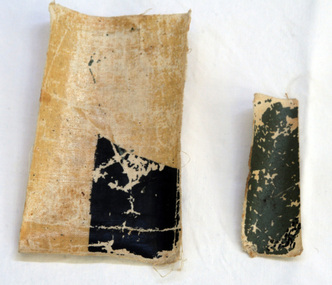
... German plane brought down by an allied fighter. The pilot was shot through the head. It was given to Mary Gilbert by Alex P. Cameron to be donated to the museum. This item is a reminder of the personal stories of WW1. souvenir ...These pieces of canvas are from a German plane brought down by an allied fighter. The pilot was shot through the head. It was given to Mary Gilbert by Alex P. Cameron to be donated to the museum.This item is a reminder of the personal stories of WW1.Two small pieces of canvas from a German plane brought down by another fighter. It is part of a black cross on the plane. There is hand-written information written on the back of both pieces.souvenir ww1 -
 Bendigo Military Museum
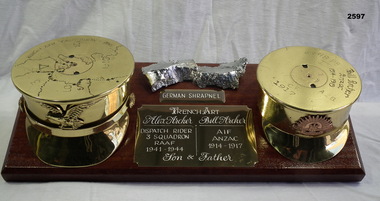
Memorabilia - TRENCH ART, WW1, WW2, Post 1945 (estimated); Made in WWI and WWII and assembled upon return
... In Australia he was re mustered as Office Orderly on 6.7.1944 and then discharged from the RAAF on 2.10.1944 Medically Unfit. handcrafts - trench art metal craft- brassware arms - ammunition military history - souvenirs Map - "North Africa, 1940", on left hand side, "18-Pounder, 1917, Bill Archer-Anzac, 1914-1919", on right hand side, "German shrapnel" Wooden base with brass shells either end resembling Officers caps,one being WWI, the other WWII, both inscribed. ...William John ARCHER (Bill) No 321 (born Castlemaine, enlisted Castlemaine) in B Coy 21st Batt AIF on 18.1.15. Embarked for Eygpt 8.5.15. Hospital 9.9.15 with Influenza. Hospital 24.11.15 with Gastric Enteritis. Hospital 2.1.16 with Otitis Media. Transfers to the 57th Batt and embarks for France. Hospital with Trench Fever 4.10.16. Promoted to Cpl 28.4.17. Hospital 19.3.18 with Scabies. WIA 18.4.18 GSW's to chest and leg severe. Discharged from the AIF medically unfit 9.1.19. Alexander William ARCHER No 40637 (born Castlemaine, enlisted Melbourne) in the RAAF on 16.5.41 age 18 years 8 months. He wanted to be a Mess Steward and was taken in as he had worked in similar work line. He then has 5 postings before embarking for Egypt on 2.4.1942 and was posted to No 3 SQD RAAF on 20.5.1942. Re mustered as a Motor Cyclist he became a Dispatch Rider on 8.9.1942 between the RAAF and the Army. Alex served in the Middle East and Italy with 3 SQD. He embarked from Egypt diagnosed with Kyphosis and Scoliosis on 5.2.1944. In Australia he was re mustered as Office Orderly on 6.7.1944 and then discharged from the RAAF on 2.10.1944 Medically Unfit. Wooden base with brass shells either end resembling Officers caps,one being WWI, the other WWII, both inscribed. Centre plaque inscribed Alex Archer and Bill Archer, father and son. Above the centre plaque is a piece of German shrapnel chrome plated Map - "North Africa, 1940", on left hand side, "18-Pounder, 1917, Bill Archer-Anzac, 1914-1919", on right hand side, "German shrapnel"handcrafts - trench art, metal craft- brassware, arms - ammunition, military history - souvenirs -
 Bendigo Military Museum
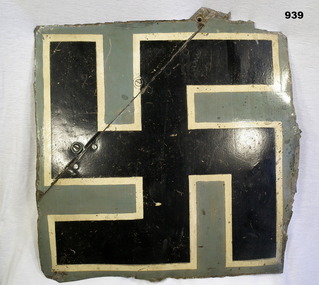
Souvenir - SWASTIKA SIGN WW2, pre 1945
... At one point he was shot down 3 times. military history, army souvenirs germany On back "Mantuba/Nov 1942/ N.A" Swastika symbol painted on aluminium aircraft skin. ...This section of aluminium sheet with Swastika is from a German ME 109 fighter that was shot down by RAAF pilot Brian Eaton over Libya in Nov 1942. This section of the plane was bought back to Australia by Alex ARCHER No 40637 who was a despatch rider with No 3 Sqd RAAF. Refer Cat No 2597 for Alex Archers service details. Brian Eaton. Brian Alexander EATON, CB, CBE, DSO. & Bar, DFC. CO of No 3 SQD RAAF April 1943 to Feb 1944, EATON joined the RAAF in 1936 and retired in 1973 with the rank of Air Vice Marshall. At one point he was shot down 3 times.Swastika symbol painted on aluminium aircraft skin. Symbol is black with cream edging on a grey-green background.On back "Mantuba/Nov 1942/ N.A"military history, army, souvenirs, germany -
 Bendigo Military Museum
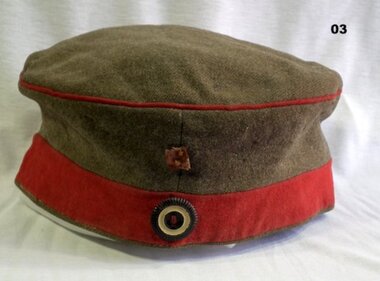
Headwear - CAP, GERMAN ARMY FIELD, WWI c. 1914 - 1918
... Souvenired by John GRYLLS. John enlisted No 418, 4th LH Regt AIF on 19.8.1914 and was given the rank of Sgt as he had 3 years prior LH experience. Embarked for Eygpt 20.10.1914. Embarked for Gallipoli 20.5.1915. Hospitalised 12.12.1915 with Mumps. Hospitalised 7.1.1916 with Rodent Ulcer. Transferred to 1st Anzac Cycle Batt 20.3.1916 with the rank of CSM. Embarked for France 25.3.1916. Promoted RSM 7.4.1917. Hospitalised 15.7.1917 with Scabies. Embarked for Australia 24.9.1918. Hospitalised in Colombo 29.10.1918 with Pnuemonia. Discharged from the AIF 30.3.1919. military uniform costume hats germany ...Souvenired by John GRYLLS. John enlisted No 418, 4th LH Regt AIF on 19.8.1914 and was given the rank of Sgt as he had 3 years prior LH experience. Embarked for Eygpt 20.10.1914. Embarked for Gallipoli 20.5.1915. Hospitalised 12.12.1915 with Mumps. Hospitalised 7.1.1916 with Rodent Ulcer. Transferred to 1st Anzac Cycle Batt 20.3.1916 with the rank of CSM. Embarked for France 25.3.1916. Promoted RSM 7.4.1917. Hospitalised 15.7.1917 with Scabies. Embarked for Australia 24.9.1918. Hospitalised in Colombo 29.10.1918 with Pnuemonia. Discharged from the AIF 30.3.1919.Medium, grey, brimless cap with red band around edge & red piping around crown. Button sewn on red band at front.Handwritten inside" Grylls Dingee Inside crown: Dingee, a small town near Bendigo Vicmilitary uniform, costume, hats, germany, male, ww1, the great war, world war one, german army - ww1 -
 Bendigo Military Museum
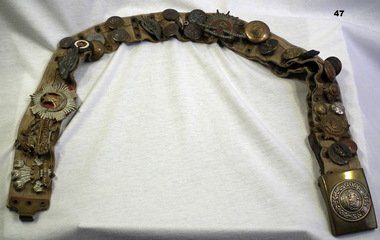
Memorabilia - BUTTONS AND BADGES, 1914 - 1918
... 29 various badges, buttons from assorted armies are attached to the German belt. The belt and assorted items were souvenired by John Stanley Howlett. ...German webbing belt bearing a souvenir collection of 29 various buttons and badges from assorted armies....Refer 41 medals, 48.4P photos. military history uniforms souvenirs buttons costume accessories - haberdashery On belt buckle: Gott Mit Uns (God with us) German webbing belt bearing a souvenir collection of 29 various buttons and badges from assorted armies. ...29 various badges, buttons from assorted armies are attached to the German belt. The belt and assorted items were souvenired by John Stanley Howlett. Refer 41 medals, 48.4P photos. German webbing belt bearing a souvenir collection of 29 various buttons and badges from assorted armies.On belt buckle: Gott Mit Uns (God with us)military history, uniforms, souvenirs, buttons, costume accessories - haberdashery -
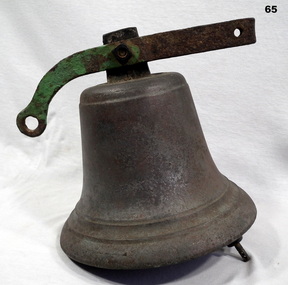 Bendigo Military Museum
Tool - SHIPS BELL, c.1900
... The Freighter had been torpedoed by a German Submarine in WW1. maritime technology ship relics military history - navy ships fittings souvenirs Ship's bell, rough cast bronze? ...This bell was apparently salvaged from a Freighter by Syd Storrie a Merchany Navy Sailor. The Freighter had been torpedoed by a German Submarine in WW1.Ship's bell, rough cast bronze? Clapper is rough cast steel. There is an old steel mounting bracket at the top, painted green. maritime technology, ship relics, military history - navy, ships fittings, souvenirs -
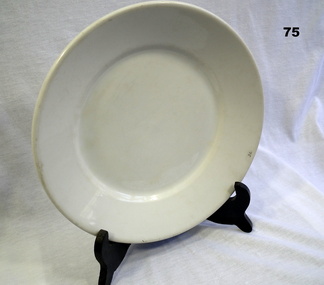 Bendigo Military Museum
Accessory - GERMAN PLATE, Bauscher Weiden, 1940
... WWII Germany, possibly used in German military installations military history german memorabilia souvenirs Stamped in black on underside: German Swastika surrounded by an eagle Makers mark in oval: Bauscher Weiden 1940 Circular white plate, stoneware with stamp on the base Accessory GERMAN PLATE Bauscher Weiden ...WWII Germany, possibly used in German military installationsCircular white plate, stoneware with stamp on the baseStamped in black on underside: German Swastika surrounded by an eagle Makers mark in oval: Bauscher Weiden 1940military history, german memorabilia, souvenirs -
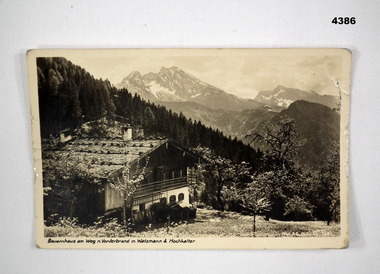 Bendigo Military Museum
Postcard - SOUVENIR POSTCARD, C. WW2
... Refer Cat No 3536P for his service records. Postcards Germany souvenirs On the rear in blue ink,” Wishing the recipient a happy Christmas and offering a description of the region where the photograph was taken, signed by Alan Fi” Post card, rectangular shape, white edge around with a B & W photo of a building in a forested mountain region, in white on the bottom RH corner acknowledgement of the photographer, on the back is a hand written letter in blue ink and space for a stamp. ...The photo is in the region of “Berchtesgadener in Germany”, item was sent around Christmas 1945. Part of the collection re Frederick Gardner Davey DFC RAAF. Refer Cat No 3536P for his service records.Post card, rectangular shape, white edge around with a B & W photo of a building in a forested mountain region, in white on the bottom RH corner acknowledgement of the photographer, on the back is a hand written letter in blue ink and space for a stamp.On the rear in blue ink,” Wishing the recipient a happy Christmas and offering a description of the region where the photograph was taken, signed by Alan Fi”postcards, germany, souvenirs -
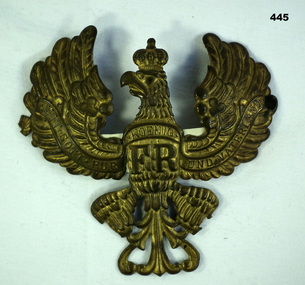 Bendigo Military Museum
Badge - BADGE GERMAN, C. 1914-18
... The badge souvenired by Herbert H Brownlee No 6312 AIF. Refer 444 for service history also 441.4, 443P, 483.2. numismatics-badges germany military history "Mitt-Gott. ...The badge souvenired by Herbert H Brownlee No 6312 AIF. Refer 444 for service history also 441.4, 443P, 483.2.Large pressed brass, shape is eagle with wings outstretched, crown on eagles head. Centre scroll through the middle. under scroll in large letters "FR""Mitt-Gott. Fur Koenig-und Vaterland"numismatics-badges, germany, military history -
 Bendigo Military Museum
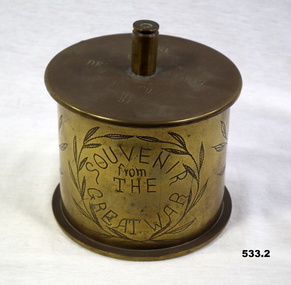
Memorabilia - TRENCH ART, BRASS CONTAINER, Post 1917
... Engraving is "Souvenir from the Great war " - "Made by G. KAMPER Duisberg Germany." .2) Lid, brass, round for .1) Lid is possibly a 3" shell with a small handle centre made from a round possible .303 size....Engraving is "Souvenir from the Great war " - "Made by G. KAMPER Duisberg Germany." .2) Lid, brass, round for .1) Lid is possibly a 3" shell with a small handle centre made from a round possible .303 size. ...Item belonged to William David Maher No 68, 8th LH Regt AIF. Refer 532 for main details. .1) Container, brass, round, made from possibly a 3" shell, engraved all around with depictions of small branches, leaves etc. Engraving is "Souvenir from the Great war " - "Made by G. KAMPER Duisberg Germany." .2) Lid, brass, round for .1) Lid is possibly a 3" shell with a small handle centre made from a round possible .303 size.,1) Marz, 1917. ST.G33,HL25 .2) DEZ 1917 ,ST, G,297 ,67,HL31arms - ammunition, brassware, engraving, trench art -
 Bendigo Military Museum
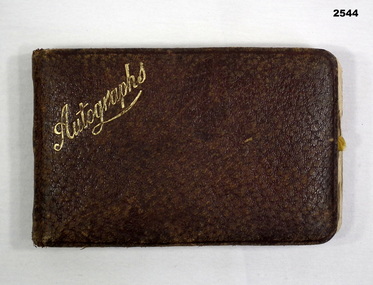
Book - BOOK, AUTOGRAPH, c.WWI
... Refer Cat No 2548.2P for his service history. books-autograph military history-souvenirs-army Handwritten in pencil inside front cover: “PTE W HOLMES” On inside of back cover sketch in biro: of the head of German soldier with cigarette Hock Lock written along with W HOLMES signature. ...Part of WILLIAM HOLMES Collection. Refer Cat No 2548.2P for his service history. Rectangular brown pigskin bound autograph book. Autographs embossed & highlighted in gold on top LH corner of cover. Pages contain handwritten messages & signatures from mainly 22nd AIF Batt members in 1918. Handwritten in pencil inside front cover: “PTE W HOLMES” On inside of back cover sketch in biro: of the head of German soldier with cigarette Hock Lock written along with W HOLMES signature.books-autograph, military history-souvenirs-army -
 Bendigo Military Museum
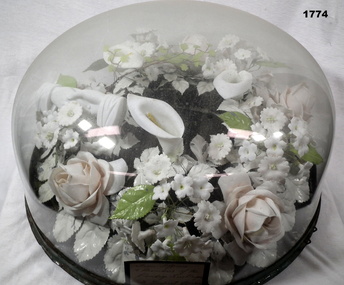
Souvenir - GLASS DOME, Post 1918
... Germany 6/5/17. See also item no 1776.3P. The item was from the Bendigo Fire Brigade of which Jack was a long member off. ornaments-glass military history-souvenirs WWI souvenir glass dome containing artificial flowers. ...Relates to John "Jack" Hindley, WIA and captured 11/4/17, died as POW in Germany 6/5/17. See also item no 1776.3P. The item was from the Bendigo Fire Brigade of which Jack was a long member off.WWI souvenir glass dome containing artificial flowers.ornaments-glass, military history-souvenirs -
 Waverley RSL Sub Branch
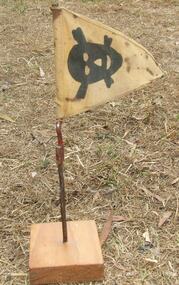
Minefield Warning Flag
... German Luftwaffe (Land Forces) minefield warning flag from WWII.originally intended to be gas markers, rather than mines, but as it turned out, the use changed .they were mounted on a red metal pole & there were 12 to a set in a leather pack. This Flag was presented to the Treasurer of Waverley RSL. It is a souvenir...German Luftwaffe (Land Forces) minefield warning flag from WWII.originally intended to be gas markers, rather than mines, but as it turned out, the use changed .they were mounted on a red metal pole & there were 12 to a set in a leather pack. This Flag was presented to the Treasurer of Waverley RSL. It is a souvenir ...German Luftwaffe (Land Forces) minefield warning flag from WWII.originally intended to be gas markers, rather than mines, but as it turned out, the use changed .they were mounted on a red metal pole & there were 12 to a set in a leather pack. This Flag was presented to the Treasurer of Waverley RSL. It is a souvenir from Bardia in Libya The Battle of Bardia was fought over three days between 3 and 5 January 1941, as part of Operation Compass, the first military operation of the Western Desert Campaign of the Second World War. It was the first battle of the war in which an Australian Army formation took part, the first to be commanded by an Australian general and the first to be planned by an Australian staff. Major General Iven Mackay's 6th Division assaulted the strongly held Italian fortress of Bardia, Libya, assisted by air support and naval gunfire, and under the cover of an artillery barrage. The 16th Infantry Brigade attacked at dawn from the west, where the defences were known to be weak. Sappers blew gaps in the barbed wire with Bangalore torpedoes and filled in and broke down the sides of the anti-tank ditch with picks and shovels. This allowed the infantry and 23 Matilda II tanks of the 7th Royal Tank Regiment to enter the fortress and capture all their objectives, along with 8,000 prisoners. In the second phase of the operation, the 17th Infantry Brigade exploited the breach made in the perimeter, and pressed south as far as a secondary line of defences known as the Switch Line. On the second day, the 16th Infantry Brigade captured the township of Bardia, cutting the fortress in two. Thousands of prisoners were taken, and the Italian garrison now held out only in the northern and southernmost parts of the fortress. On the third day, the 19th Infantry Brigade advanced south from Bardia, supported by artillery and the Matilda tanks, now reduced in number to just six. Its advance allowed the 17th Infantry Brigade to make progress as well, and the two brigades reduced the southern sector of the fortress. Meanwhile, the Italian garrisons in the north surrendered to the 16th Infantry Brigade and the Support Group of the British 7th Armoured Division outside the fortress. In all, some 36,000 Italian prisoners were taken. The victory at Bardia enabled the Allied forces to continue the advance into Libya and ultimately capture almost all of Cyrenaica. In turn this would lead to German intervention in the fighting in North Africa, changing the nature of the war in that theatre. Bardia boosted the competence and reputation of the Australian Army. Perhaps most important of all, it raised confidence in the possibility of an ultimate Allied victory around the world, which would lead to the Lend-Lease Act being passed in the United States http://en.wikipedia.org/wiki/Battle_of_BardiaCloth Flag bearing a skull and cross Bones on a metal spike mounted on a square varnished wooden basebardia, land mine, marker flag, minefield, mustard gas -
 Waverley RSL Sub Branch
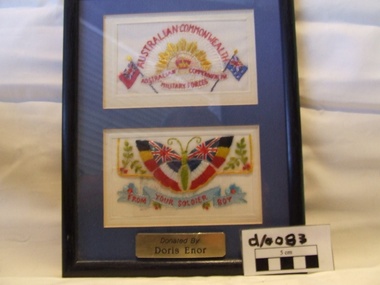
Embroidered souvenir
... trench art Australian Commonwealth Military Forces (Butterfly) From your soldier boy White cloth embroidered with rising sun badge flanked by Australian and British flags and butterfly created from National flag colours of Great Britain France and Germany Embroidered souvenir ...WWI ? trench artWhite cloth embroidered with rising sun badge flanked by Australian and British flags and butterfly created from National flag colours of Great Britain France and Germany Australian Commonwealth Military Forces (Butterfly) From your soldier boy -
 Warrnambool and District Historical Society Inc.
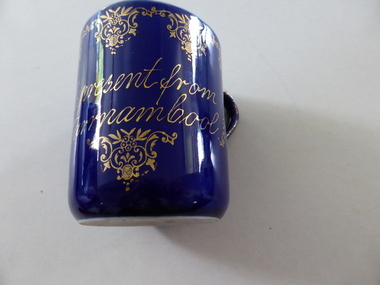
Souvenir Mug, A present from Warrnambool, Early 20th century
... souvenir of a visit to Warrnambool. Tourism in Warrnambool became important in the late 19th century with Warrnambool promoted as a spa resort. ( Coast line,sea baths etc). Today tourism is important in both summer and Winter (May Racing Carnival and whales). A object with which people, especially tourists, would identify. warrnambool A present from Warrnambool written on side of the mug. Made in Germany ...This cup is an impressive souvenir of a visit to Warrnambool. Tourism in Warrnambool became important in the late 19th century with Warrnambool promoted as a spa resort. ( Coast line,sea baths etc). Today tourism is important in both summer and Winter (May Racing Carnival and whales). A object with which people, especially tourists, would identify.Straight sided glazed royal blue cup with gold text and decoration.Glazed white interior.A present from Warrnambool written on side of the mug. Made in Germany stamped in red on bottom of mug. Numbered 13 warrnambool -
 Warrnambool and District Historical Society Inc.
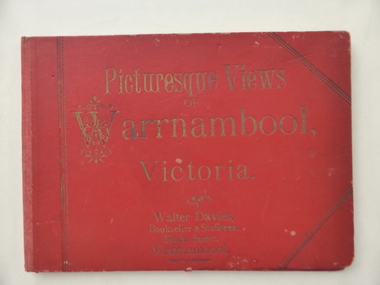
Book - Picturesque Views of Warrnambool, 1894
... Germany at the end of the 19th century for the Warrnambool tourist market. It was sold in the book shop of Walter Davies. The father of Walter Davies, also called Walter, was a law clerk and accountant who established the book and stationery shop in Timor Street in the late 1860s. The business was operated by Walter Davies Senior, then his son and later the grandson This album is of interest for several reasons:- 1. It is an interesting example of the type of tourist souvenir ...This album has been produced in Germany at the end of the 19th century for the Warrnambool tourist market. It was sold in the book shop of Walter Davies. The father of Walter Davies, also called Walter, was a law clerk and accountant who established the book and stationery shop in Timor Street in the late 1860s. The business was operated by Walter Davies Senior, then his son and later the grandsonThis album is of interest for several reasons:- 1. It is an interesting example of the type of tourist souvenir available to visitors to Warrnambool in the late 19th century. 2. It contains 13 photographs of Warrnambool in the late 19th century and these are of considerable historical value. 3. It is a good example of the type of articles sold by Walter Davies at his Timor Street shop in 1894. This is a hard cover folder containing 13 black and white photographs of Warrnambool and surrounds. The photographs are on several sheets of white paper joined together in concertina fashion to fit into the folder but they have become detached from the folder. Some of the photographs are torn at the edges. The cover of the folder has embossed gold lettering and the narrow spine is faded and the front cover is a little torn and stained. The inscription. ‘Xmas 1894’ is handwritten in black ink. ‘Picturesque Views of Warrnambool Victoria’ ‘Walter Davies, Bookseller & Stationer, Timor Street, Warrnambool’ ‘Printed in Germany’ ‘Xmas 1894’ picturesque warrnambool,, picturesque views of warrnambool, walter davies
