
Showing 20 items matching "space radio"
-
 Moorabbin Air Museum
Book - Space flight, Flight into Space
... ...Space radio...Space flight Tests & troubles Guided missiles Satellites Space environment Zero gravity Rocky space Telescopes in space Space radio Vacuum of space Other planets Technical & general overview of the future of spaceflight, circa 1953 Flight into Space Book Space flight ...Technical & general overview of the future of spaceflight, circa 1953non-fictionTechnical & general overview of the future of spaceflight, circa 1953tests & troubles, guided missiles, satellites, space environment, zero gravity, rocky space, telescopes in space, space radio, vacuum of space, other planets -
 Eltham District Historical Society Inc
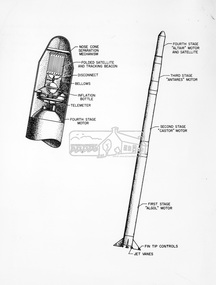
Photograph - Black and White Print, NASA, Four stage solid fuel Scout vehicle and cross section, 1960
... Space Industry 1960 NASA Rocket Scout Solid Fuel Rocket On reverse: Four stage solid fuel Scout vehicle and cross section of payload instrumentation. First solid fuel rocket used by N.A.S.A. to launch a satellite on orbital trajectory. Front cap comes off and satellite built of tghin mylar plastic film and aluminium foil emerges and inflates. Radio ...On reverse: Four stage solid fuel Scout vehicle and cross section of payload instrumentation. First solid fuel rocket used by N.A.S.A. to launch a satellite on orbital trajectory. Front cap comes off and satellite built of tghin mylar plastic film and aluminium foil emerges and inflates. Radio beacon built in for tracking.alan gardiner collection, space industry, 1960, nasa, rocket, scout solid fuel rocket -
 Eltham District Historical Society Inc
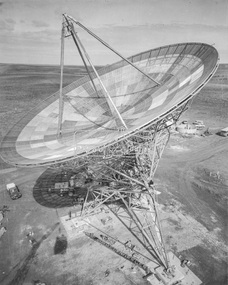
Photograph - Black and White Print, Weapons Research Establishment (WRE), 35' - 0" diameter dish at Island Lagoon, Woomera, 3 August, 1960
... Radio Telescope...Salisbury...Satellite Dish...South Australia...Space...Alan Gardiner Collection 1960 1960-08-03 Island Lagoon Radio Telescope Salisbury Satellite Dish South Australia Space Industry Weapons Research Establishment (WRE) Woomera On reverse: 35' - 0" diameter dish at Island Lagoon, Woomera Also stamped in blue ink: Phone: Ex. 253 STILL PHOTO SECTION W.R.E. ...On reverse: 35' - 0" diameter dish at Island Lagoon, Woomera Also stamped in blue ink: Phone: Ex. 253 STILL PHOTO SECTION W.R.E. SALISBURY, S.A. Neg. No. N60/2805 (in pencil) Date: Subject: Classification: UNCLASSIFIED (over stamped) 3 Aug 1960 (over stamped)alan gardiner collection, 1960, 1960-08-03, island lagoon, radio telescope, salisbury, satellite dish, south australia, space industry, weapons research establishment (wre), woomera -
 Eltham District Historical Society Inc
Document - Folder, Aerospace Industry, 1958-1961
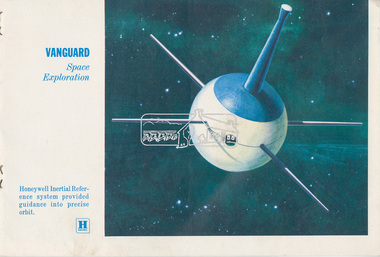
... space flight. Copy of missing cover - image sourced from Vanguard to Dyna Soar https://www.aerospaceprojectsreview.com/blog/?p=4892 2. Discussion paper: Work on Artificial Satellites; Weapons Research Establishment, Salisbury, South Australia (Paper presented by Chief Scientist, Department of Supply, Australia (Forwarded through Senior Representative, Department of Supply, London), 11 September 1958. CUKAC/P(58)-, Ref. SA5395/2/2; four pages, foolscap copy, browned and brittle 3. Article: Large Radio...space flight. Copy of missing cover - image sourced from Vanguard to Dyna Soar https://www.aerospaceprojectsreview.com/blog/?p=4892 2. Discussion paper: Work on Artificial Satellites; Weapons Research Establishment, Salisbury, South Australia (Paper presented by Chief Scientist, Department of Supply, Australia (Forwarded through Senior Representative, Department of Supply, London), 11 September 1958. CUKAC/P(58)-, Ref. SA5395/2/2; four pages, foolscap copy, browned and brittle 3. Article: Large Radio ...honeywell, scout rocket, echo satellite, mercury rocket, centaur rocket, advent rocket, mariner satellite, dyna soar, x-15, midas rocket, tiros satellite, discoverer rocket, vanguard satellite, aerospace industry, alan gardiner collection, space industry -
 National Vietnam Veterans Museum (NVVM)
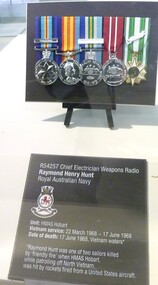
Medal, Raymond Henry Hunt
... spaces, the missile director equipment room and Tartar checkout room. Chief Electrician RH Hunt was killed in this attack and several sailors injured. HMAS Hobart Royal Australian Navy Raymond Henry Hunt Friendly Fire North Vietnam R54257 Chief Electrician Weapons Radio Tiger Island Five Replica Medals are placed horizontally on a single line of a blackboard that sits on a black stand. ...R54257 Chief Electrician Weapons Radio, Raymond Henry Hunt, Royal Australain Navy. Raymond Henry Hunt's unit: HMAS Hobart. His Vietnam Service was from 22nd March 1968 - 17th June 1968. In the early hours of 17 June 1968 Hobart was part of a naval task unit operating in the vicinity of Tiger Island north of the demilitarized zone off the east coast of North Vietnam. An unidentified aircraft was detected approaching the ship from the vicinity of Cap Lay and although evaluated as a ‘friendly’ it continued to close, firing a missile that struck Hobart amidships on her starboard side. The warhead passed through the main deck, seriously damaging several compartments, while the body of the missile passed through the outer skin of the aft funnel before ending up embedding itself in the forward funnel. In its passage shrapnel from the disintegrating missile killed Ordinary Seaman Butterworth who was closed up at the ships exposed anti aircraft control position above the bridge. Able Seaman JR Parker and Ordinary Seaman RF Davidson also suffered injuries. As Hobart's crew raced to action stations a second and third missile hit the ship. The second missile entered the transom without detonating, destroying the gunner's store before breaking up in the engineer's workshop and penetrating the after seaman's mess. The third missile hit the ship in the same area as the first, passing through one of the ship's fan spaces, the missile director equipment room and Tartar checkout room. Chief Electrician RH Hunt was killed in this attack and several sailors injured. Five Replica Medals are placed horizontally on a single line of a blackboard that sits on a black stand. The first four medals are silver with four different ribbons. The last medal is gold and white with green and white alternate ribbon.hmas hobart, royal australian navy, raymond henry hunt, friendly fire, north vietnam, r54257, chief electrician weapons radio, tiger island -
 Robin Boyd Foundation
Slide, Robin Boyd, 1967
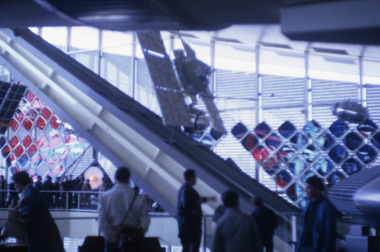
... The indoor exhibits covered aspects of Australian art and culture, architecture, industrial design and scientific innovation, such as the Snowy Mountains Hydro-Electric Power Scheme, the Parkes radio telescope, the design of Canberra, and the Australian way of life. Expo 67 Montreal robin boyd slide Made in Australia / 32 / MAY 67M6 Colour slide in a mount. Space ...Robin Boyd was appointed Exhibits Architect for the Australian Pavilion at Expo ‘67 in Montreal. The garden outside the pavilion featured a sculptural pool, a coral display, animal pool, a pit for kangaroos and Eucalypts and other native plants. The indoor exhibits covered aspects of Australian art and culture, architecture, industrial design and scientific innovation, such as the Snowy Mountains Hydro-Electric Power Scheme, the Parkes radio telescope, the design of Canberra, and the Australian way of life.Colour slide in a mount. Space exploration exhibits inside the US Pavilion, Expo 67, Monreal, CanadaMade in Australia / 32 / MAY 67M6expo 67, montreal, robin boyd, slide -
 Victorian Aboriginal Corporation for Languages
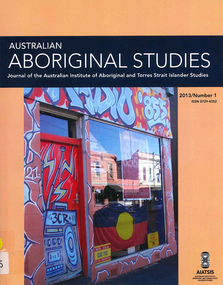
Periodical, Australian Institute of Aboriginal and Torres Strait Islander Studies, Australian Aboriginal studies : journal of the Australian Institute of Aboriginal and Torres Strait Islander Studies, 2013
... Symbols of place and space are never neutral, and this paper argues that they can either marginalise and oppress urban Aboriginal and Torres Strait Islander people, or demonstrate that they are included and engaged. Juggling with pronouns: Racist discourse in spoken interaction on the radio...Symbols of place and space are never neutral, and this paper argues that they can either marginalise and oppress urban Aboriginal and Torres Strait Islander people, or demonstrate that they are included and engaged. Juggling with pronouns: Racist discourse in spoken interaction on the radio ...We don?t leave our identities at the city limits: Aboriginal and Torres Strait Islander people living in urban localities Bronwyn Fredericks Aboriginal and Torres Strait Islander people who live in cities and towns are often thought of as ?less Indigenous? than those who live ?in the bush?, as though they are ?fake? Aboriginal people ? while ?real? Aboriginal people live ?on communities? and ?real? Torres Strait Islander people live ?on islands?. Yet more than 70 percent of Australia?s Indigenous peoples live in urban locations (ABS 2007), and urban living is just as much part of a reality for Aboriginal and Torres Strait Islander people as living in remote discrete communities. This paper examines the contradictions and struggles that Aboriginal and Torres Strait Islander people experience when living in urban environments. It looks at the symbols of place and space on display in the Australian cities of Melbourne and Brisbane to demonstrate how prevailing social, political and economic values are displayed. Symbols of place and space are never neutral, and this paper argues that they can either marginalise and oppress urban Aboriginal and Torres Strait Islander people, or demonstrate that they are included and engaged. Juggling with pronouns: Racist discourse in spoken interaction on the radio Di Roy While the discourse of deficit with regard to Australian Indigenous health and wellbeing has been well documented in print media and through images on film and on television, radio talk concerning this discourse remains underresearched. This paper interrogates the power of an interactive news interview, aired on the Radio National Breakfast program on ABC Radio in 2011, to maintain and reproduce the discourse of deficit, despite the best intentions of the interview participants. Using a conversation-analytical approach, and membership categorisation analysis in particular, this paper interrogates the spoken interaction between a well-known radio interviewer and a respected medical researcher into Indigenous eye health. It demonstrates the recreation of a discourse emanating from longstanding hegemonies between mainstream and Indigenous Australians. Analysis of firstperson pronoun use shows the ongoing negotiation of social category boundaries and construction of moral identities through ascriptions to category members, upon which the intelligibility of the interview for the listening audience depended. The findings from analysis support claims in a considerable body of whiteness studies literature, the main themes of which include the pervasiveness of a racist discourse in Australian media and society, the power of invisible assumptions, and the importance of naming and exposing them. Changes in Pitjantjatjara mourning and burial practices Bill Edwards, University of South Australia This paper is based on observations over a period of more than five decades of changes in Pitjantjatjara burial practices from traditional practices to the introduction of Christian services and cemeteries. Missions have been criticised for enforcing such changes. However, in this instance, the changes were implemented by the Aboriginal people themselves. Following brief outlines of Pitjantjatjara traditional life, including burial practices, and of the establishment of Ernabella Mission in 1937 and its policy of respect for Pitjantjatjara cultural practices and language, the history of these changes which commenced in 1973 are recorded. Previously, deceased bodies were interred according to traditional rites. However, as these practices were increasingly at odds with some of the features of contemporary social, economic and political life, two men who had lost close family members initiated church funeral services and established a cemetery. These practices soon spread to most Pitjantjatjara communities in a manner which illustrates the model of change outlined by Everett Rogers (1962) in Diffusion of Innovations. Reference is made to four more recent funerals to show how these events have been elaborated and have become major social occasions. The world from Malarrak: Depictions of South-east Asian and European subjects in rock art from the Wellington Range, Australia Sally K May, Paul SC Ta�on, Alistair Paterson, Meg Travers This paper investigates contact histories in northern Australia through an analysis of recent rock paintings. Around Australia Aboriginal artists have produced a unique record of their experiences of contact since the earliest encounters with South-east Asian and, later, European visitors and settlers. This rock art archive provides irreplaceable contemporary accounts of Aboriginal attitudes towards, and engagement with, foreigners on their shores. Since 2008 our team has been working to document contact period rock art in north-western and western Arnhem Land. This paper focuses on findings from a site complex known as Malarrak. It includes the most thorough analysis of contact rock art yet undertaken in this area and questions previous interpretations of subject matter and the relationship of particular paintings to historic events. Contact period rock art from Malarrak presents us with an illustrated history of international relationships in this isolated part of the world. It not only reflects the material changes brought about by outside cultural groups but also highlights the active role Aboriginal communities took in responding to these circumstances. Addressing the Arrernte: FJ Gillen?s 1896 Engwura speech Jason Gibson, Australian National University This paper analyses a speech delivered by Francis James Gillen during the opening stages of what is now regarded as one of the most significant ethnographic recording events in Australian history. Gillen?s ?speech? at the 1896 Engwura festival provides a unique insight into the complex personal relationships that early anthropologists had with Aboriginal people. This recently unearthed text, recorded by Walter Baldwin Spencer in his field notebook, demonstrates how Gillen and Spencer sought to establish the parameters of their anthropological enquiry in ways that involved both Arrernte agency and kinship while at the same time invoking the hierarchies of colonial anthropology in Australia. By examining the content of the speech, as it was written down by Spencer, we are also able to reassesses the importance of Gillen to the ethnographic ambitions of the Spencer/Gillen collaboration. The incorporation of fundamental Arrernte concepts and the use of Arrernte words to convey the purpose of their 1896 fieldwork suggest a degree of Arrernte involvement and consent not revealed before. The paper concludes with a discussion of the outcomes of the Engwura festival and the subsequent publication of The Native Tribes of Central Australia within the context of a broader set of relationships that helped to define the emergent field of Australian anthropology at the close of the nineteenth century. One size doesn?t fit all: Experiences of family members of Indigenous gamblers Louise Holdsworth, Helen Breen, Nerilee Hing and Ashley Gordon Centre for Gambling Education and Research, Southern Cross University This study explores help-seeking and help-provision by family members of Indigenous people experiencing gambling problems, a topic that previously has been ignored. Data are analysed from face-to-face interviews with 11 family members of Indigenous Australians who gamble regularly. The results confirm that substantial barriers are faced by Indigenous Australians in accessing formal help services and programs, whether for themselves or a loved one. Informal help from family and friends appears more common. In this study, this informal help includes emotional care, practical support and various forms of ?tough love?. However, these measures are mostly in vain. Participants emphasise that ?one size doesn?t fit all? when it comes to avenues of gambling help for Indigenous peoples. Efforts are needed to identify how Indigenous families and extended families can best provide social and practical support to assist their loved ones to acknowledge and address gambling problems. Western Australia?s Aboriginal heritage regime: Critiques of culture, ethnography, procedure and political economy Nicholas Herriman, La Trobe University Western Australia?s Aboriginal Heritage Act 1972 (WA) and the de facto arrangements that have arisen from it constitute a large part of the Aboriginal ?heritage regime? in that state. Although designed ostensibly to protect Aboriginal heritage, the heritage regime has been subjected to various scholarly critiques. Indeed, there is a widespread perception of a need to reform the Act. But on what basis could this proceed? Here I offer an analysis of these critiques, grouped according to their focus on political economy, procedure, ethnography and culture. I outline problems surrounding the first three criticisms and then discuss two versions of the cultural critique. I argue that an extreme version of this criticism is weak and inconsistent with the other three critiques. I conclude that there is room for optimism by pointing to ways in which the heritage regime could provide more beneficial outcomes for Aboriginal people. Read With Me Everyday: Community engagement and English literacy outcomes at Erambie Mission (research report) Lawrence Bamblett Since 2009 Lawrie Bamblett has been working with his community at Erambie Mission on a literacy project called Read With Me. The programs - three have been carried out over the past four years - encourage parents to actively engage with their children?s learning through reading workshops, social media, and the writing and publication of their own stories. Lawrie attributes much of the project?s extraordinary success to the intrinsic character of the Erambie community, not least of which is their communal approach to living and sense of shared responsibility. The forgotten Yuendumu Men?s Museum murals: Shedding new light on the progenitors of the Western Desert Art Movement (research report) Bethune Carmichael and Apolline Kohen In the history of the Western Desert Art Movement, the Papunya School murals are widely acclaimed as the movement?s progenitors. However, in another community, Yuendumu, some 150 kilometres from Papunya, a seminal museum project took place prior to the completion of the Papunya School murals and the production of the first Papunya boards. The Warlpiri men at Yuendumu undertook a ground-breaking project between 1969 and 1971 to build a men?s museum that would not only house ceremonial and traditional artefacts but would also be adorned with murals depicting the Dreamings of each of the Warlpiri groups that had recently settled at Yuendumu. While the murals at Papunya are lost, those at Yuendumu have, against all odds, survived. Having been all but forgotten, this unprecedented cultural and artistic endeavour is only now being fully appreciated. Through the story of the genesis and construction of the Yuendumu Men?s Museum and its extensive murals, this paper demonstrates that the Yuendumu murals significantly contributed to the early development of the Western Desert Art Movement. It is time to acknowledge the role of Warlpiri artists in the history of the movement.b&w photographs, colour photographsracism, media, radio, pitjantjatjara, malarrak, wellington range, rock art, arrernte, fj gillen, engwura, indigenous gambling, ethnography, literacy, erambie mission, yuendumu mens museum, western desert art movement -
 Ballarat Tramway Museum
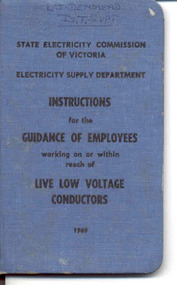
Book, State Electricity Commission of Victoria (SECV), "Instruction for the Guidance of Employees working on or within reach of Live Low Voltage Conductors", 1949
... space to record name and occupation of person issued to. In bottom left hand corner has form number "596-210 R2" Has been stamped "L. J. Denmead" by a hand stamped in blue ink and words "Departmental Tramway Supt." written in using blue ink. See image file 1854i2.jpg Book details procedure and rules for SEC employees working on or near low voltage conductors or Powerlines. Covers general matters, authorised employees, work on low voltage overhead lines, moving a conductor near live wires, public lighting, radio...space to record name and occupation of person issued to. In bottom left hand corner has form number "596-210 R2" Has been stamped "L. J. Denmead" by a hand stamped in blue ink and words "Departmental Tramway Supt." written in using blue ink. See image file 1854i2.jpg Book details procedure and rules for SEC employees working on or near low voltage conductors or Powerlines. Covers general matters, authorised employees, work on low voltage overhead lines, moving a conductor near live wires, public lighting, radio ...Booklet with blue Rexene cover and round corners on heavy card with sheet of paper glued on inside of covers and 32 printed pages stapled with in, titled "Instruction for the Guidance of Employees working on or within reach of Live Low Voltage Conductors". Also possibly known as the "L.V. Blue Book" - see top of definitions page. Dated 1949. Above title has name of the organisation - SECV - Electricity Supply Department. Inside front cover has space to record name and occupation of person issued to. In bottom left hand corner has form number "596-210 R2" Has been stamped "L. J. Denmead" by a hand stamped in blue ink and words "Departmental Tramway Supt." written in using blue ink. See image file 1854i2.jpg Book details procedure and rules for SEC employees working on or near low voltage conductors or Powerlines. Covers general matters, authorised employees, work on low voltage overhead lines, moving a conductor near live wires, public lighting, radio and carrier circuits, batteries, portable equipment, metering work on consumer premises, and definitions. Consists of 32 pages sheets of paper, printed and folded with one staple centrally and then stapled into the covers with paper inside pasted onto cover. Contents pages are not numbered. Covers blocked in blackSee issuing details above. On front cover in blue ink "L. J. Denmead / D. T. Supt"trams, tramways, sec, power lines, linesman, safety -
 Vision Australia
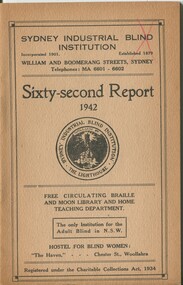
Administrative record - Text, Sydney Industrial Blind Institution: Sixty-Second Report 1942, 1943
... Articles in the annual report include: shortage of materials due to the war, employment has been found for over 60 people in munitions, aircraft, radio and other organisations, the retirement of two country collectors due to health reasons and the inability to currently recruit replacements, the limits of 'The Haven' have been reached and some requests for accommodation have had to be turned away due to a shortage of space, the quarterly concerts by musical artists have continued via the 'Glow Worm' sessions at 2.45pm each Saturday, the passing of transcribers Misses F. ...Articles in the annual report include: shortage of materials due to the war, employment has been found for over 60 people in munitions, aircraft, radio and other organisations, the retirement of two country collectors due to health reasons and the inability to currently recruit replacements, the limits of 'The Haven' have been reached and some requests for accommodation have had to be turned away due to a shortage of space, the quarterly concerts by musical artists have continued via the 'Glow Worm' sessions at 2.45pm each Saturday, the passing of transcribers Misses F. ...Articles in the annual report include: shortage of materials due to the war, employment has been found for over 60 people in munitions, aircraft, radio and other organisations, the retirement of two country collectors due to health reasons and the inability to currently recruit replacements, the limits of 'The Haven' have been reached and some requests for accommodation have had to be turned away due to a shortage of space, the quarterly concerts by musical artists have continued via the 'Glow Worm' sessions at 2.45pm each Saturday, the passing of transcribers Misses F. Moor and M. Rattray, and an explanation for not listing subscribers due to the shortage of paper.1 printed volume with black and white illustrationssydney industrial blind institution, annual report, o f vidler, roy kippax, employment, haven hostel, auxiliaries, f moor, m rattray -
Vision Australia
Audio (item) - Sound recording, Royal Victorian Institute for the Blind, Around the Institute: December 19, 2000
... December 19: Paralympic achievements – Russell Short and Christine Fisher, Space Camp – Chris Bailey. Royal Victorian Institute for the Blind Radio shows 1 digital sound file in WAV format Around the Institute: December 19, 2000 Audio Sound recording Royal Victorian Institute for the Blind ...Around the Institute was a weekly program designed to keep clients and staff informed of events, activities and thoughts relating to low vision and blindness. It consisted of interviews undertaken by Jo Matthews, with sound engineer Ed Gamble, designed to inform, educate and explore on a variety of topics. December 19: Paralympic achievements – Russell Short and Christine Fisher, Space Camp – Chris Bailey.royal victorian institute for the blind, radio shows -
 Federation University Art Collection
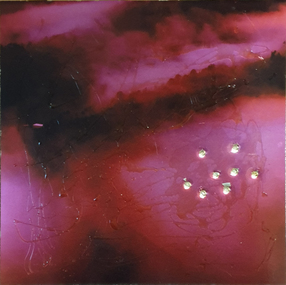
Artwork, other - Artwork, 'Ghosts in the Himalayas (Shot Up)' by Lisa Anderson, 2016
... space in its pre-Olympic development. Singing up Stones celebrated the people who created and use the Opera House and the Quay for performance and ideas. This included the first image projection onto the Sydney Opera House, a projection onto the Sydney Harbour Bridge and a ballet of cruise liners with the sound simulcast on the local radio station. ...space in its pre-Olympic development. Singing up Stones celebrated the people who created and use the Opera House and the Quay for performance and ideas. This included the first image projection onto the Sydney Opera House, a projection onto the Sydney Harbour Bridge and a ballet of cruise liners with the sound simulcast on the local radio station. lisa anderson available Two digital prints with acrylic on metal and bullet holes. ...Dr Lisa ANDERSON (1958- ) Dr Anderson’s research questions environmental issues that impact on the social structures of communities and their mapped or metaphysical borders. She develops projects around ways of understanding the effects of climate change. These include work with folklore, legends and religions that tell stories of coping with weather, forced migration of animals and people and coping with difference. She has undertaken international residency programs and exhibitions in the Arctic, Iceland, Paris, Norway, London and China, and she was the first Artist in Residence at the Australian Museum. These unique opportunities continue an extensive art practice of installation work, video, photography and sculpture. Anderson has an extensive record of exhibitions in Australia and overseas with work included in both private and corporate collections. Her exhibitions include Journeys: Due North, a large installation work that includes work created over a 10-year period of engagement in expedition and science work North of the Arctic Circle. Beneath the Beauty of Architecture, an exhibition at her London Gallery, Bicha, used images created in China, Nunuvut Territory in Canada and the Antarctic while working with the migration stories of survival. Dr Anderson has created many large scale artworks that challenge notions of occupation of the City, including Writing the City, a three-year program of installation works to shift the use of Sydney to being a city of public space in its pre-Olympic development. Singing up Stones celebrated the people who created and use the Opera House and the Quay for performance and ideas. This included the first image projection onto the Sydney Opera House, a projection onto the Sydney Harbour Bridge and a ballet of cruise liners with the sound simulcast on the local radio station. Two digital prints with acrylic on metal and bullet holes. This work is the result of research on the hidden voice of landscape undertaken by Dr Lisa Anderson while an Honorary Professor at Federation University Australia. lisa anderson, available -
 Whitehorse Historical Society Inc.
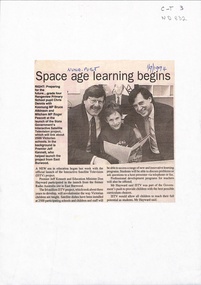
Newspaper - Article, Space age learning begins, 1/09/1994
... Radio Australia site at East Burwood. It will revolutionise the way Australian children are taught. Students will be able to discuss problems or ask questions to a host presenter via telephone or fax. Space ...Launch of the interactive satellite television project at the former Radio Australia site at East Burwood. It will revolutionise the way Australian children are taught. Students will be able to discuss problems or ask questions to a host presenter via telephone or fax.interactive satellite television, kennett, jeff, hayward, don, dennis, christopher, atkinson, bruce, education -
Vision Australia
Audio (item) - Sound recording, Royal Victorian Institute for the Blind, Around the Institute: January 1, 2002
... January 1: Great Victorian Bike Ride – Gerard Gardener, Space Camp - Peggy Soo. Royal Victorian Institute for the Blind Radio shows 1 digital sound file in WAV format Around the Institute: January 1, 2002 Audio Sound recording Royal Victorian Institute for the Blind ...Around the Institute was a weekly program designed to keep clients and staff informed of events, activities and thoughts relating to low vision and blindness. It consisted of interviews undertaken by Jo Matthews-Lamb, Susan Thompson, Janet Cronin and Corey Nassau, with sound engineer Ed Gamble, designed to inform, educate and explore on a variety of topics. January 1: Great Victorian Bike Ride – Gerard Gardener, Space Camp - Peggy Soo. royal victorian institute for the blind, radio shows -
Vision Australia
Audio (item) - Sound recording, Royal Victorian Institute for the Blind, Around the Institute: January 25, 2005
... January 25: Great Victorian Bike ride, Score Camp, Space Camp and Sydney trip with Guide Dogs Australia – Natasha Patterson. Royal Victorian Institute for the Blind Radio shows 1 digital sound file in WAV format Around the Institute: January 25, 2005 Audio Sound recording Royal Victorian Institute for the Blind Corey Nassau ...Around the Institute was a weekly program consisting of interviews around a specific topic, undertaken by host Corey Nassau. January 25: Great Victorian Bike ride, Score Camp, Space Camp and Sydney trip with Guide Dogs Australia – Natasha Patterson. royal victorian institute for the blind, radio shows -
 National Communication Museum
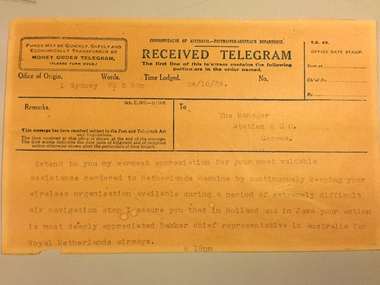
Document - Telegram, 24/10/1934
... When the Uiver crashed in the Syrian Desert in December 1934, Albury residents contributed to a memorial which honoured those who were killed. telegrams telegraphic messages communications radio uiver royal netherlands airways albury london to melbourne air race morse code "Extend to you my warmest appreciation for your most valuable / assistance rendered to Netherlands machine by continuously keeping your / wireless organisation available during a period of extremely difficult / air navigation stop I assure you that in Holland and in Java your action / is most deeply appreciated Bakker chief representative in Australia for / Royal Netherlands airways. / 6 18pm" Beige paper telegram printed with black ink and overwritten with typewriter. Telegram split into sections designating details of the telegram, details of the recipient and a space ...This telegram was sent from the Royal Netherlands Airways, Sydney, to the manager of ABC Radio Station 2CO, Corowa, New South Wales. This telegram relates to the 1934 London to Melbourne Air Race. The telegram records the Royal Netherlands Airways' thanks to ABC Radio 2CO radio staff for their efforts in broadcasting an emergency message to the residents of Albury after the Dutch airliner ‘Uiver’ became lost at night in bad weather. As requested local radio listeners drove their cars to the Albury racecourse and illuminated an emergency landing ground using their vehicle headlights. This allowed the lost airliner to land safely.This item relates to the London to Melbourne Air Race of 1934, a significant event that shaped Australia's history as it proved travelling to and from Australia could be done within a reasonable time by air, thereby making the country less isolated. Up to that time Australia was three weeks away from Europe by steam ship. The Air Race was dreamt up by the Lord Mayor of Melbourne, Harold Smith, to commemorate the centenary of Victoria's statehood and was sponsored by the Melbourne chocolate manufacturer Sir MacPherson Robertson. The Royal Netherlands Airways entered a Douglas DC2 plane 'Uiver' - the largest aircraft in the race, and the only one to carry passengers as well as crew, to show that a commercial passenger service to Australia was possible. But in the last leg of the race, the Uiver lost its way in an electrical storm over the Riverina town of Albury. Several communication methods were used to land the plane safely, including the signalling of the word "Albury" in Morse code using the town's street lights. Local ABC Radio station 2CO also made a call for locals to light up a makeshift landing strip for the plane at the town's racecourse. The plane landed safely and the next morning with the help of the townspeople who pulled it out of the mud, took off and finished the race in second place. The story of the Uiver points to the importance of communication in its various forms: two-way and broadcast radio, Morse, and light signals. The survival of the Uiver is a reflection of the ingenuity of Australian communications and the solutions that can be found through the sharing of ideas of information. The landing of the Uiver was an important moment in Albury's social history, as residents participated in the rescue of the plane and its passengers, helping the Uiver to continue on its journey and finish second in the Race. When the Uiver crashed in the Syrian Desert in December 1934, Albury residents contributed to a memorial which honoured those who were killed. Beige paper telegram printed with black ink and overwritten with typewriter. Telegram split into sections designating details of the telegram, details of the recipient and a space for the transmitted message. A small section of paper is missing from bottom left corner."Extend to you my warmest appreciation for your most valuable / assistance rendered to Netherlands machine by continuously keeping your / wireless organisation available during a period of extremely difficult / air navigation stop I assure you that in Holland and in Java your action / is most deeply appreciated Bakker chief representative in Australia for / Royal Netherlands airways. / 6 18pm"telegrams, telegraphic messages, communications, radio, uiver, royal netherlands airways, albury, london to melbourne air race, morse code -
 National Communication Museum
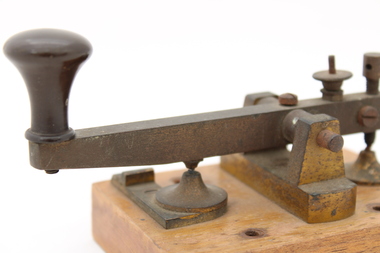
Equipment - Morse key, Postmaster-General's Department, circa 1920
... A telegraph or Morse key, sends a series of electrical signals down a telegraph line or via radio frequencies; the signals are interpreted as Morse code, a binary form of language constructed of 'dots and dashes', combinations of which correspond to letters of the alphabet. The motion of the key acts to complete an electrical circuit between the sender and receiver, producing a short pulse 'dot' or longer 'dash,' the space between the code indicates a broken current or wave....A telegraph or Morse key, sends a series of electrical signals down a telegraph line or via radio frequencies; the signals are interpreted as Morse code, a binary form of language constructed of 'dots and dashes', combinations of which correspond to letters of the alphabet. The motion of the key acts to complete an electrical circuit between the sender and receiver, producing a short pulse 'dot' or longer 'dash,' the space between the code indicates a broken current or wave. telegraph telegraphist morse code mechanisation Printed ink on base: "PMG" Device used to transmit telegraphic messages in Morse code through the manipulation of electric signals. ...A telegraph or Morse key, sends a series of electrical signals down a telegraph line or via radio frequencies; the signals are interpreted as Morse code, a binary form of language constructed of 'dots and dashes', combinations of which correspond to letters of the alphabet. The motion of the key acts to complete an electrical circuit between the sender and receiver, producing a short pulse 'dot' or longer 'dash,' the space between the code indicates a broken current or wave.Device used to transmit telegraphic messages in Morse code through the manipulation of electric signals. The metal 'key' sits in a central bracket on which it moves up and down aided by a spring, controlled by an operator pushing the black Bakelite knob on the protruding end of the device. The motion presses the key onto a circular metal disc, completing the circuit and sending an electrical pulse to the receiver. The apparatus is secured to a wooden base with wires attached to the terminals; a cut out section of the base suggests wires may have entered through this area, attaching to a battery.Printed ink on base: "PMG"telegraph, telegraphist, morse code, mechanisation -
 Melbourne Tram Museum
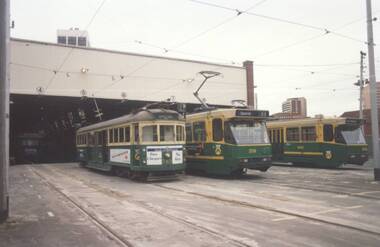
Photograph - Set of 11 Colour Print/s, Bill Davis, mid 1980's to 1990
... Features advertisements on trams for: Triple FM Radio, Bank of Melbourne, Space Deamons Printed on Kodak, Fujichrome or Konica paper....Features advertisements on trams for: Triple FM Radio, Bank of Melbourne, Space Deamons Printed on Kodak, Fujichrome or Konica paper. ...Set of 11 colour prints of Melbourne trams and locations during the mid 1980's to 1990, Photos not well focused. .1 - trams 782, 259 and 2002 out the front of South Melbourne Depot .2 - 979 and 888 at ditto .3 - 888 .4 - 975 and two other W's at Preston Depot .5 - 2001 - Burwood Road on a Special, near Hawthorn Bridge. .6 - ditto .7 - 968, Kingsway, South Melbourne near Sturt St .8 - 861 ditto .9 - 881 outbound St Kilda Road .10 - 900 and W2 442 (Restaurant tram 1) at Acland St terminus. .11 - 913, inbound Glenhuntly Road, on the east side of Glenhuntly Station. Features advertisements on trams for: Triple FM Radio, Bank of Melbourne, Space Deamons Printed on Kodak, Fujichrome or Konica paper.trams, tramways, ptc, south melbourne depot, preston depot, burwood rd, kingsway, st kilda rd, acland st, glenhuntly rd, tram 782, tram 259, tram 2002, tram 2001, tram 979, tram 888, tram 975, tram 968, tram 861, tram 881, tram 900, tram 442, tram 913 -
 Melbourne Tram Museum
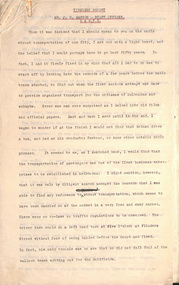
Document - Radio Transcript, Melbourne & Metropolitan Tramways Board (MMTB), "Wireless Report -- Mr. J. D. Barton Staff Officer MMTB", late 1920's
... Radio Transcript or script, 13 foolscap typed pages, double spaced titled "Wireless Report -- Mr. ...Trams tramways Public Transport Radio stations Horse Buses MTO Co Melbourne Cable Trams Radio Transcript or script, 13 foolscap typed pages, double spaced titled "Wireless Report -- Mr. ...Radio Transcript or script, 13 foolscap typed pages, double spaced titled "Wireless Report -- Mr. J. D. Barton Staff Officer MMTB". Looks at the history of public transport in Melbourne, in particular early transport problems, crossing the Yarra, the formation of the Melbourne Omnibus Co, the directors, early horse buses, the formation of the Melbourne Tramway and Omnibus Co and running issues with some stories. Item noted dated, presumed late 1920's.trams, tramways, public transport, radio stations, horse buses, mto co, melbourne, cable trams -
 Melbourne Tram Museum
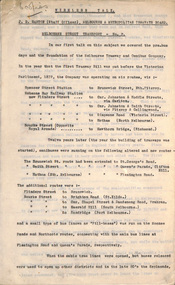
Document - Radio Transcript, Melbourne & Metropolitan Tramways Board (MMTB), "Wireless Talk -- Mr. J. D. Barton Staff Officer MMTB - Melbourne Street Transport No. 2", late 1920's
... Radio Transcript or script, 7 foolscap typed pages, double spaced titled "Wireless Talk -- Mr. ...Trams tramways Public Transport Radio stations Horse Buses MTO Co Melbourne Cable Trams MTT Has pencil notation in top left hand corner "6 copies" Radio Transcript or script, 7 foolscap typed pages, double spaced titled "Wireless Talk -- Mr. ...Radio Transcript or script, 7 foolscap typed pages, double spaced titled "Wireless Talk -- Mr. J. D. Barton Staff Officer MMTB - Melbourne Street Transport No. 2". Report looks at the history of horse bus routes in Melbourne, building of the cable trams, the Parliamentary Bills for the cable trams, constructing the lines, Mr. G. Duncan, Mr. Clapp, construction difficulties, the Melbourne Tramway Trust, MTOC, drainage issues, bridges, alterations to the Act, Patent issues with a London company, opening dates and comments about wire rope. Could be a few pages missing given the way it ends, no thank you or formal ending. Item noted dated, presumed late 1920's.Has pencil notation in top left hand corner "6 copies"trams, tramways, public transport, radio stations, horse buses, mto co, melbourne, cable trams, mtt -
 Melbourne Tram Museum
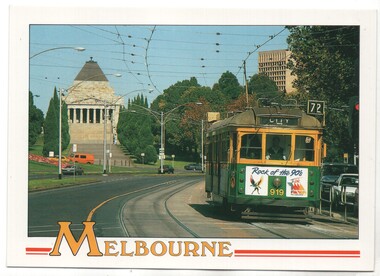
Postcard, Biscay Greeting Pty Ltd, W6 919 inbound on a route 72, St Kilda road, late 1980 or early 1990's
... Tram has advertising for the Triple M FM Radio station. Back has space for name and address, stamp and a message and details of the postcard. ...Tram has advertising for the Triple M FM Radio station. Back has space for name and address, stamp and a message and details of the postcard. ...Colour postcard divided back - Biscay Greetings, Impression series, number BG 349, featuring W6 919 inbound on a route 72, St Kilda road with the Shrine of Remembrance in the background. Tram has advertising for the Triple M FM Radio station. Back has space for name and address, stamp and a message and details of the postcard. Produced by Biscay Greetings, possibly late 1980 or early 1990's. 2nd copy added 30/8/2020trams, tramways, postcards, w6 class, st kilda rd, route 72, tram 919
