
Showing 5 items matching "spanish women's group"
-
 Kensington Neighbourhood House
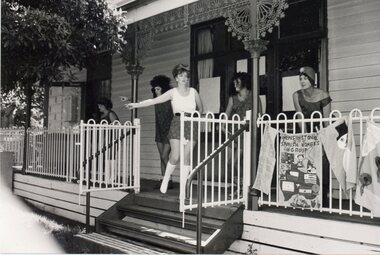
Photograph - KNH 5/7/002 Kensington Spanish Women's Group performing on back verandah of house
... KNH 5/7/002 Kensington Spanish Women's Group performing on back verandah of house...KNH 5/7/002 Kensington Spanish Women's Group performing on back verandah of house...Black and white photograph of Kensington Spanish Women's Group performing on back verandah of house...Black and white photograph of Kensington Spanish Women's Group performing on back verandah of house KNH 5/7/002 Kensington Spanish Women's Group performing on back verandah of house Photograph KNH 5/7/002 Kensington Spanish Women's Group performing on back verandah of house ...Black and white photograph of Kensington Spanish Women's Group performing on back verandah of house -
 Broadmeadows Historical Society & Museum
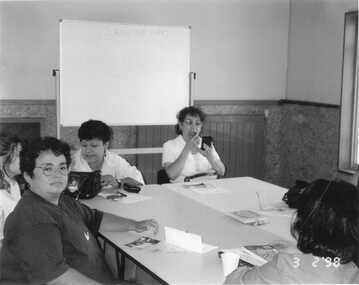
Photograph, Spanish Women's Group at Banksia Gardens 1998, 3 February 1998
... Spanish Women's Group at Banksia Gardens 1998......Spanish Women's Group...In 1998, the Spanish Women's Group at Banksia Gardens was actively engaged in various activities aimed at fostering social inclusion. ...Spanish Women's Group/At Banksia Gardens 1998...Banksia Gardens Broadmeadows Spanish Women's Group 1998 Social Activity Spanish Women's Group/At Banksia Gardens 1998 Black and white photograph on glossy photograph paper. ...In 1998, the Spanish Women's Group at Banksia Gardens was actively engaged in various activities aimed at fostering social inclusion. These initiatives were designed to help individuals integrate into society, providing a supportive environment for community building and personal development.The Spanish Women's Group at Banksia Gardens in 1998 played a crucial role in promoting social inclusion and community engagement. This group provided a supportive environment where individuals could connect, share experiences, and participate in activities designed to help them integrate into society. The initiatives undertaken by the group not only fostered a sense of belonging among its members but also contributed to the broader community's cultural diversity and social cohesion.Black and white photograph on glossy photograph paper.Spanish Women's Group/At Banksia Gardens 1998banksia gardens, broadmeadows, spanish women's group, 1998, social activity -
 Royal Australian and New Zealand College of Obstetricians & Gynaecologists (RANZCOG)
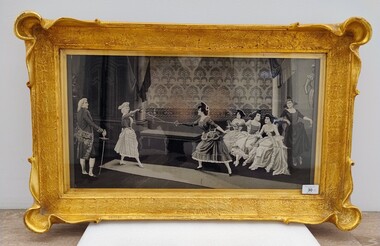
Craft - Stevengraph, Neyret Freres et Cie, Untitled (Fencing lesson), c. 1890s
... Spanish artist Mariano Alonzo Perez (1853-1930). This style of weaving is referred to as a Stevengraph, named for their original creator, Thomas Stevens (1828-1888), a 19th century weaver from Coventry, England. Neyret Freres began manufacturing textiles in 1823, and are still in operation today. Silk embroidery in a decorative gilt frame. The scene depicts a group of women ...This is a silk picture woven by the highly acclaimed French jacquard loom woven tapestry maker Neyret Freres. The scene is derived from a painting by Spanish artist Mariano Alonzo Perez (1853-1930). This style of weaving is referred to as a Stevengraph, named for their original creator, Thomas Stevens (1828-1888), a 19th century weaver from Coventry, England. Neyret Freres began manufacturing textiles in 1823, and are still in operation today. Silk embroidery in a decorative gilt frame. The scene depicts a group of women taking a fencing lesson, under the guidance of a male teacher. Two women are pictured pointing sabres at each other at the centre of the image, while four other women look on at the right of the image. The teacher is shown on the left hand side of the image, holding a sabre in his right hand which is pointing downwards so that the tip of his sabre is resting against the floor. All figures in the image are wearing Victorian era dress. There is a sticker for Gibson's Auctioneers attached to the bottom right hand corner of the front of the artwork. Two small stickers for Gibson's Auctioneers are attached to the back of the artwork, as well as a sticker referencing the framer of the work and a shipping sticker for International Art Services. Two d-rings and a wire fitting are attached to the back of the artwork for hanging. -
 Embroiderers Guild, Victoria
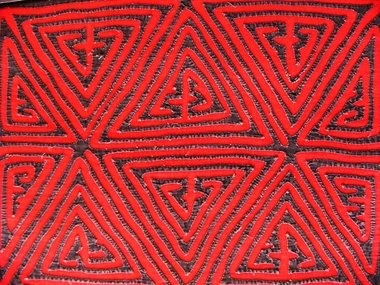
Textile - Panel, Mola Panel
... women's clothing of the indigenous Guna people from Panama. Their clothing includes a patterned wrapped skirt (saburet), a red and yellow headscarf (musue), arm and leg beads (wini), a gold nose ring (olasu) and earrings in addition to the mola blouse (dulemor). Two groups, Choco and Guna lived side by side without intermarriage and without adopting a similar culture.In Dulegaya, the Guna's native language, "mola" means "shirt" or "clothing". The mola originated with the tradition of Guna women painting their bodies with geometric designs, using available natural colors; at a certain point, after the arrival of the Spanish...women's clothing of the indigenous Guna people from Panama. Their clothing includes a patterned wrapped skirt (saburet), a red and yellow headscarf (musue), arm and leg beads (wini), a gold nose ring (olasu) and earrings in addition to the mola blouse (dulemor). Two groups, Choco and Guna lived side by side without intermarriage and without adopting a similar culture.In Dulegaya, the Guna's native language, "mola" means "shirt" or "clothing". The mola originated with the tradition of Guna women painting their bodies with geometric designs, using available natural colors; at a certain point, after the arrival of the Spanish ...The Mola or Molas is a hand-made textile that forms part of the traditional women's clothing of the indigenous Guna people from Panama. Their clothing includes a patterned wrapped skirt (saburet), a red and yellow headscarf (musue), arm and leg beads (wini), a gold nose ring (olasu) and earrings in addition to the mola blouse (dulemor). Two groups, Choco and Guna lived side by side without intermarriage and without adopting a similar culture.In Dulegaya, the Guna's native language, "mola" means "shirt" or "clothing". The mola originated with the tradition of Guna women painting their bodies with geometric designs, using available natural colors; at a certain point, after the arrival of the Spanish, these same designs were woven in cotton, and later still, sewn using cloth "acquired by trade from the ships that came to barter for coconuts during the 19th century". Red cotton background with black reverse applique mounted on grey cotton. Design includes the serpent symbol.applique, mola - reverse applique, south america, panels -
 Kew Historical Society Inc
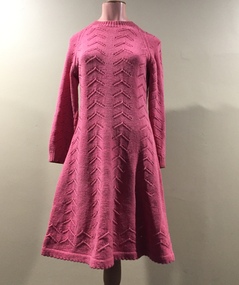
Clothing - Pink Knitted Dress with Arrow Pattern, Grace James, 1988
... group of these items of women's clothing is contained in the Grace James collection of outfits created for the dressmaker's daughter. The items have additional significance due to information about the purpose of the creation and the date when it was constructed. grace james women's clothing australian fashion 1969-1988 dressmakers - surrey hills (vic) fashion design fashion -- 1980s Knitted dress Long-sleeved pink, knitted wool dress with a high round neck created by the dressmaker Grace James for her daughter Ceri Spain in 1988. ...Grace James, the creator of the items in the Grace James collection, designed and created costumes over a 19 year period (1969-1988) for her daughter Ceri. The collection of clothing ranges from evening wear to knitted garments. All the items display exemplary dressmaking skills. The designs are of the period and reflect evolving fashions of the time. Some items are copies of published designs whereas others are original creations. The collection was donated in 2006.While most of the items in the Fashion & Design Collection of the Kew Historical Society are commercially designed items of clothing, there are also items made by home dressmakers. Many of these exhibit outstanding design knowledge and technical skills. A large and important group of these items of women's clothing is contained in the Grace James collection of outfits created for the dressmaker's daughter. The items have additional significance due to information about the purpose of the creation and the date when it was constructed.Knitted dress Long-sleeved pink, knitted wool dress with a high round neck created by the dressmaker Grace James for her daughter Ceri Spain in 1988. Acquired in 2006 Grace James Collectiongrace james, women's clothing, australian fashion 1969-1988, dressmakers - surrey hills (vic), fashion design, fashion -- 1980s
