
Showing 7 items matching "species selection"
-
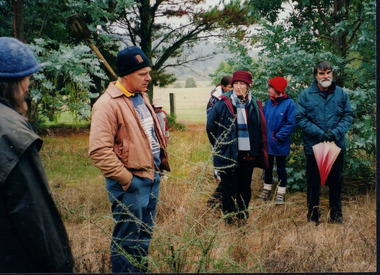 Wooragee Landcare Group
Photograph, 20th June 2004
... ...species selection...Revegetation can improve the condition of remnant vegetation in the area and provide habitat for local animals. Correct species selection, including all layers of vegetation, along with proper weather conditions and adequate site preparation, can maximise the successful outcome. ...Revegetation can improve the condition of remnant vegetation in the area and provide habitat for local animals. Correct species selection, including all layers of vegetation, along with proper weather conditions and adequate site preparation, can maximise the successful outcome. ...This photograph was taken on the 20th June 2004 as part of an event called "Successful Tree Planting!", organised by the Wooragee Landcare Group. It was addressed to all local residents and landholders in the area and involved practical demonstration of techniques suitable for successful planting of native trees and shrubs, as well as information about weed control. In the photograph are illustrated from left to right the following people: Chris Robinson; Tony Prowse; unknown child; Lesley Finedon; Ann Henderson, unknown. Revegetation can improve the condition of remnant vegetation in the area and provide habitat for local animals. Correct species selection, including all layers of vegetation, along with proper weather conditions and adequate site preparation, can maximise the successful outcome. Weed-free conditions and protection from rabbits and kangaroos are two more factors contributing to a quick plant growth. Wooragee Landcare, since its establishment in 1998, has organised a series of events and activities in order to promote weed and pest control, provide assistance and knowledge to landholders and ensure sustainability and protection of natural vegetation.The photograph is an example of the type of events and activities organised by Wooragee Landcare to educate and inform local residents and landholders on the most suitable techniques for successful planting of native trees and shrubs. Wooragee Landcare, abiding by its mission statement, promotes best land management strategies and ensures sustainability through collaboration with local community and council agencies.Landscape coloured photograph printed on gloss paper. Reverse: WAN NA 0ANA0N0 BN1+ 1 1636/ [PRINTED] (No.21)/935/successful tree planting, wooragee landcare group, 20th june 2004, successful planting, native trees and shrubs, weed control, revegetation, remnant vegetation, habitat, local animals, species selection, weather conditions, site preparation, weed-free, rabbits, kangaroos, plant growth, 1998, sustainability, natural vegetation -
 Marysville & District Historical Society
Document (Item) - Research Document, Rene de Koning, Darwin Street Named After Charles Robert Darwin (1809 - 1882), 13-08-2022
... species of life have descended from a common ancestor is now generally accepted and considered a fundamental concept in science. In a joint publication with Alfred Russel Wallace, he introduced his scientific theory that this branching pattern of evolution resulted from a process he called natural selection, in which the struggle for existence has a similar effect to the artificial selection involved in selective breeding. ...An account of the life of Charles Robert Darwin whom Darwin Street in Marysville in Victoria is named for.An account of the life of Charles Robert Darwin whom Darwin Street in Marysville in Victoria is named for. Charles Robert Darwin was an English naturalist, geologist, and biologist, widely known for his contributions to evolutionary biology. His theory that all species of life have descended from a common ancestor is now generally accepted and considered a fundamental concept in science. In a joint publication with Alfred Russel Wallace, he introduced his scientific theory that this branching pattern of evolution resulted from a process he called natural selection, in which the struggle for existence has a similar effect to the artificial selection involved in selective breeding. Charles Darwin has been described as one of the most influential figures in human history and is buried in Westminster Abbey. charles robert darwin, darwin street, marysville, victoria -
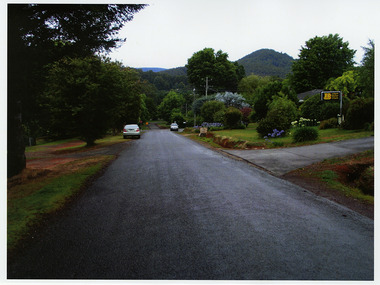 Marysville & District Historical Society
Photograph (Item) - Colour photograph, Unknown
... species of life have descended from a common ancestor is now generally accepted and considered a fundamental concept in science. In a joint publication with Alfred Russel Wallace, he introduced his scientific theory that this branching pattern of evolution resulted from a process he called natural selection, in which the struggle for existence has a similar effect to the artificial selection involved in selective breeding. ...A colour photograph of Darwin Street in Marysville in Victoria.A colour photograph of Darwin Street in Marysville in Victoria. Darwin Street was named after Charles Robert Darwin. Charles Robert Darwin was an English naturalist, geologist, and biologist, widely known for his contributions to evolutionary biology. His theory that all species of life have descended from a common ancestor is now generally accepted and considered a fundamental concept in science. In a joint publication with Alfred Russel Wallace, he introduced his scientific theory that this branching pattern of evolution resulted from a process he called natural selection, in which the struggle for existence has a similar effect to the artificial selection involved in selective breeding. Charles Darwin has been described as one of the most influential figures in human history and is buried in Westminster Abbey. charles robert darwin, darwin street, marysville, victoria, photograph -
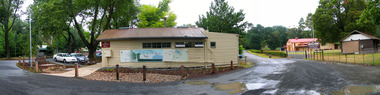 Marysville & District Historical Society
Photograph (Item) - Colour photograph, Unknown
... species of life have descended from a common ancestor is now generally accepted and considered a fundamental concept in science. In a joint publication with Alfred Russel Wallace, he introduced his scientific theory that this branching pattern of evolution resulted from a process he called natural selection, in which the struggle for existence has a similar effect to the artificial selection involved in selective breeding. ...A colour photograph of Darwin Street in Marysville in Victoria.A colour photograph of Darwin Street in Marysville in Victoria. Darwin Street was named after Charles Robert Darwin. Charles Robert Darwin was an English naturalist, geologist, and biologist, widely known for his contributions to evolutionary biology. His theory that all species of life have descended from a common ancestor is now generally accepted and considered a fundamental concept in science. In a joint publication with Alfred Russel Wallace, he introduced his scientific theory that this branching pattern of evolution resulted from a process he called natural selection, in which the struggle for existence has a similar effect to the artificial selection involved in selective breeding. Charles Darwin has been described as one of the most influential figures in human history and is buried in Westminster Abbey. charles robert darwin, darwin street, marysville, victoria, the country cupboard cafe, the marysville museum, photograph -
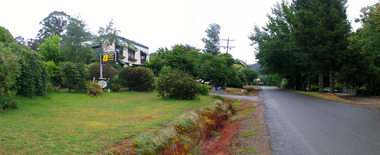 Marysville & District Historical Society
Photograph (Item) - Colour photograph, Unknown
... species of life have descended from a common ancestor is now generally accepted and considered a fundamental concept in science. In a joint publication with Alfred Russel Wallace, he introduced his scientific theory that this branching pattern of evolution resulted from a process he called natural selection, in which the struggle for existence has a similar effect to the artificial selection involved in selective breeding. ...A colour photograph of Darwin Street in Marysville in Victoria.A colour photograph of the Scenic Bed and Breakfast in Darwin Street in Marysville in Victoria. The Scenic Bed and Breakfast, along with all the guest houses in Marysville, was destroyed in the 2009 Black Saturday bushfires. Darwin Street was named after Charles Robert Darwin. Charles Robert Darwin was an English naturalist, geologist, and biologist, widely known for his contributions to evolutionary biology. His theory that all species of life have descended from a common ancestor is now generally accepted and considered a fundamental concept in science. In a joint publication with Alfred Russel Wallace, he introduced his scientific theory that this branching pattern of evolution resulted from a process he called natural selection, in which the struggle for existence has a similar effect to the artificial selection involved in selective breeding. Charles Darwin has been described as one of the most influential figures in human history and is buried in Westminster Abbey. charles robert darwin, darwin street, marysville, victoria, scenic b&b, 2009 black saturday bushfires, photograph -
 City of Moorabbin Historical Society (Operating the Box Cottage Museum)
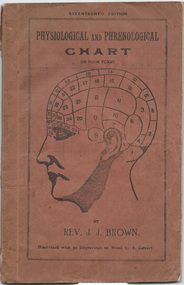
Booklet, Phrenological Chart, Rev,J.J.Brown c1928, Physiological and Phrenological Chart Rev,J.J.Brown c1928, c1928
... species. Rev. Brown acknowledges that this printed delineation for self assessment is only approximate and proper analysis would cost time and money for personal consultation. After Charles Darwin, 1809 - 1882, English naturalist whose scientific theory of evolution by natural selection became the foundation of modern evolutionary studies. ...George Reed was a draftsman who lived in Bentleigh , City of Moorabbin in mid 20th C Phrenology is a process that involves observing and/or feeling the skull to determine an individual's psychological attributes. Franz Joseph Gall believed that the brain was made up of 27 individual organs that determined personality, the first 19 of these 'organs' he believed to exist in other animal species. Rev. Brown acknowledges that this printed delineation for self assessment is only approximate and proper analysis would cost time and money for personal consultation.After Charles Darwin, 1809 - 1882, English naturalist whose scientific theory of evolution by natural selection became the foundation of modern evolutionary studies. His nonreligious biology appealed to the rising class of professional scientists and the general public. Phrenology became a popular interest.A paper booklet with diagrams, charts and photos explaining Phrenology in 54 pages by Rev. J.J. Brown Coloured front and back covers have a drawing of a model of the human skull divided into 36 sections Front Cover ; SEVENTEENTH EDITION/ PHYSIOLOGICAL AND PHRENOLOGICAL / CHART / ( IN BOOK FORM) /BY / REV. J.J. BROWN/ Illustrated with 70 Engravingson Wood by S. Calvertgall franz joseph, phrenology, darwin charles, naturalists, jewellers, ezard & clark company moorabbin, early settlers, moorabbin shire, mechanics institute cheltenham, ormond choral society, postworld war 11 settlers,housing estates moorabbin 1950, bentleigh, ormond, moorabbin, cheltenham, drama societies, musical society cheltenham, clark judy, reed gladys, reed george, draftsman, architect, -
 Flagstaff Hill Maritime Museum and Village
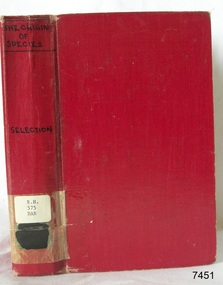
Book - Reference Book/Biology/Scientific, Charles Darwin, The Origin of Species or The Preservation of Favoured Races in the Struggle for Life, 1859
... The full title is “On the Origin of Species by Means of Natural Selection”, or the “Preservation of Favoured Races in the Struggle for Life”, the book was first published on 24th November 1859. ...The full title is “On the Origin of Species by Means of Natural Selection”, or the “Preservation of Favoured Races in the Struggle for Life”, the book was first published on 24th November 1859. ...The Origin of Species is Charles Darwin’s landmark 1859 book, and it introduced the idea that species change over time through natural selection. Darwin drew on observations from his voyage on the HMS Beagle, especially evidence from the Galapagos Islands, to argue that living things share common ancestry and adapt through inherited variation. Darwin’s central claim argues that individuals with traits better suited to their environment are more likely to survive and reproduce, so those traits become more common over generations. The book challenged the idea of special creation and became the foundation of modern evolutionary biology. The book is considered one of the most influential scientific works ever written because it provided a unifying explanation for the diversity of life. It also sparked major scientific and religious debate that continues to this day.The Origin of Species Author: Charles Darwin Publisher: John Murray Date: 1860non-fiction The Origin of Species is Charles Darwin’s landmark 1859 book, and it introduced the idea that species change over time through natural selection. Darwin drew on observations from his voyage on the HMS Beagle, especially evidence from the Galapagos Islands, to argue that living things share common ancestry and adapt through inherited variation. Darwin’s central claim argues that individuals with traits better suited to their environment are more likely to survive and reproduce, so those traits become more common over generations. The book challenged the idea of special creation and became the foundation of modern evolutionary biology. The book is considered one of the most influential scientific works ever written because it provided a unifying explanation for the diversity of life. It also sparked major scientific and religious debate that continues to this day. warrnambool, shipwrecked-coast, flagstaff-hill, flagstaff-hill-maritime-museum, maritime-museum, shipwreck-coast, shipwrecked-artefact, book, warrnambool mechanics’ institute, the origin of species, charles darwin, pattison collection
