Bendigo Historical Society Inc.
Article - Michele Matthews Collection: PHD Research - Taylor Family Transcript of Audio Interview, 1930s
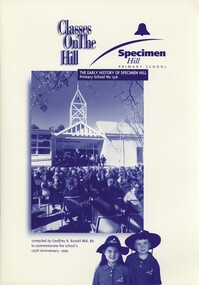
... Howard attended Specimen Hill State School, Golden Square State School, Quarry Hill State School, and later Bendigo High School. He remembered strict discipline, small class sizes in the primary years, and a strong interest in mathematics, particularly algebra and geometry. ...Howard attended Specimen Hill State School, Golden Square State School, Quarry Hill State School, and later Bendigo High School. He remembered strict discipline, small class sizes in the primary years, and a strong interest in mathematics, particularly algebra and geometry. ...
Dr Michele Matthews has been a local and social historian for nearly three decades since she first used correspondence held by the then Bendigo City Council for her Honours thesis. She is an ardent advocate for the use of local history records to tell Victorian and Australian history from a grassroots perspective. Michele’s MA thesis, ‘A forgotten “Father” of Federation: Sir John Quick 1852‑1911’ (2003), and her PhD thesis, ‘Survivors, schemes, Samaritans and shareholders: the impact of the Great Depression on Bendigo and District 1925‑1935’ (2007), both drew heavily on Bendigo and district records. Michele Matthews Collection: PHD Research - Taylor Family Transcript of Audio Tape Interview
This item includes the following document:
8672.91a Black and White photo of the Taylor house in Panton Street - Scanned from the transcript - Only a representation of the original photo.
8672.91b The document presents the early history of the Taylor family of Bendigo, tracing several generations from the arrival of John William Taylor in Victoria during the gold rush through to the childhood and early adulthood of Howard Johnson Taylor. Drawing heavily on oral history interviews, it describes how the family's experiences reflected the broader social and economic development of Bendigo, from the goldfields to the Depression era. Historical photographs of family members, homes and possessions accompany the narrative.
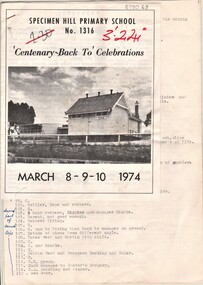
The story begins around 1860, when John William Taylor emigrated from England and walked from Melbourne to Bendigo carrying his belongings. Attracted by the gold rush, he acquired a miner's right and built a timber home on Specimen Hill near Chum Street. Although he initially pursued gold, he later secured work as a pattern maker in one of Bendigo's foundries before becoming a house builder as mining declined. He married Susanna Johnson, and together they raised nine children, establishing a family whose descendants remained closely connected with Bendigo for generations.
The narrative then focuses on Henry Johnson Taylor, the youngest son, and his wife Elva May Hartin, whose son Howard Johnson Taylor was born on 9 September 1912 in a weatherboard house on Specimen Hill. Howard's early childhood was marked by tragedy when his mother died in childbirth while expecting another child. The account reflects on the limitations of rural medical care at the time, suggesting that faster transport may have saved her life. Following her death, the family moved to Golden Square, and Henry later remarried May Whitcombe, who became Howard's stepmother.
Howard's childhood provides an insight into everyday life in early twentieth-century Bendigo. The family experienced the influenza epidemic that followed the First World War, although Henry survived despite lasting health effects. Howard recalled living in several homes built or renovated by his father, including properties in Panton Street and later Echuca Street, Quarry Hill. The document describes domestic life in detail, including wood-fired bath heaters, heating and cooking with timber, and the pride taken in maintaining weatherboard houses.
Education forms another important theme. Howard attended Specimen Hill State School, Golden Square State School, Quarry Hill State School, and later Bendigo High School. He remembered strict discipline, small class sizes in the primary years, and a strong interest in mathematics, particularly algebra and geometry. Despite enjoying school and performing well academically, the economic pressures of the Great Depression forced him to leave after obtaining his Merit Certificate so he could work alongside his father in the building trade. He later attended night classes to improve his building and bookkeeping skills.
The memoir also captures changing technology and transport during Howard's youth. The family initially travelled by horse and buggy before purchasing a Chevrolet touring car in 1925, a significant financial investment at the time. Howard developed a lifelong enthusiasm for motor vehicles, learning to drive as a teenager and eventually owning numerous cars. He also briefly owned a B.S.A. motorcycle before replacing it with a Ford V8 Roadster, illustrating the rapid shift from horse-drawn transport to motor vehicles during the interwar years.
Throughout the document, Howard's recollections provide valuable insight into family life, housing, education, employment, transport and community in Bendigo between the 1860s and the 1930s. Rather than simply recording genealogical facts, the narrative places the Taylor family's experiences within the broader history of Bendigo's growth from a gold mining settlement into a well-established regional city. The final pages consist of detailed footnotes referencing the original oral history recordings from which many of the quotations were drawn.bendigo, michele matthews collection, taylor transcript of audio tape interview